MSA-3D: Rotation Curves and Dark Matter Fractions at z~0.5-1.7 with JWST/NIRSpec
Pith reviewed 2026-06-29 03:41 UTC · model grok-4.3
The pith
JWST observations of 23 galaxies at z~0.5-1.7 show dark matter fractions ranging from 0.1 to 0.9 with a median of 0.63.
A machine-rendered reading of the paper's core claim, the machinery that carries it, and where it could break.
Core claim
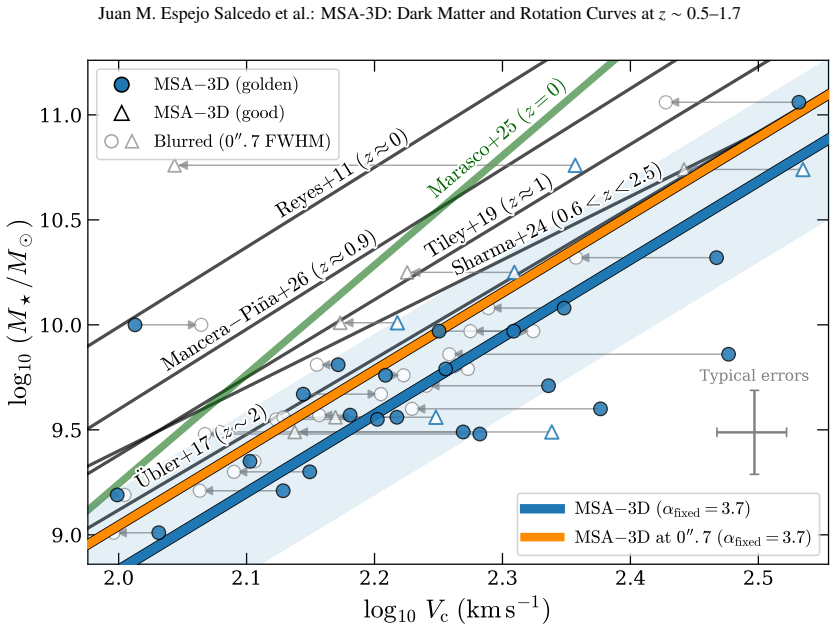
For the 23 galaxies in the primary statistical sample, the data show predominantly rotationally supported disks with intrinsic dispersions 31-65 km/s and dark matter fractions f_DM(R_e) from 0.1 to 0.9 (median 0.63, scatter 0.2 dex). Among the 19 galaxies reaching at least 2R_e, six have rising, six flat, and seven falling rotation curves; these map to an observed sequence from rotation-dominated, dark-matter-rich disks (V_rot/sigma_0 ~4, f_DM >0.7) to dispersion-supported systems with centrally concentrated baryons (V_rot/sigma_0 ~2, f_DM <0.55). The stellar Tully-Fisher relation lies close to the local relation evolved under the adopted self-similar Lambda-CDM scaling, and a simplified see
What carries the argument
Forward dynamical modelling that combines spatially resolved ionised-gas kinematics from JWST/NIRSpec with JWST/NIRCam imaging to constrain the separate baryonic and dark matter contributions inside R_e.
If this is right
- Star-forming disks near z~1 span a broad range of dynamical states and inner mass distributions.
- The stellar Tully-Fisher relation at these redshifts is consistent with the local relation after Lambda-CDM evolution.
- Spatial resolution contributes to but does not fully explain differences among high-redshift Tully-Fisher measurements.
- Previous surveys are extended toward lower stellar masses spanning 9.0 < log(M_star/M_sun) < 11.2.
Where Pith is reading between the lines
- The observed link between rotation-curve shape and dark matter fraction could be tested by measuring how these quantities evolve with redshift in larger samples.
- The 0.2 dex scatter in dark matter fractions may reflect differences in how individual galaxies assembled their mass.
- Connecting the dynamical classes to star-formation efficiency would help test whether baryon concentration drives the shift from rotation- to dispersion-supported states.
Load-bearing premise
Forward dynamical modelling accurately separates baryonic and dark matter contributions despite the spatial resolution limits of the observations and the assumptions required about mass distributions and inclinations.
What would settle it
Higher-resolution kinematic maps or a larger sample that instead shows dark matter fractions clustered tightly around 0.5 with little scatter would falsify the reported wide range and ordering by rotation-curve shape.
Figures

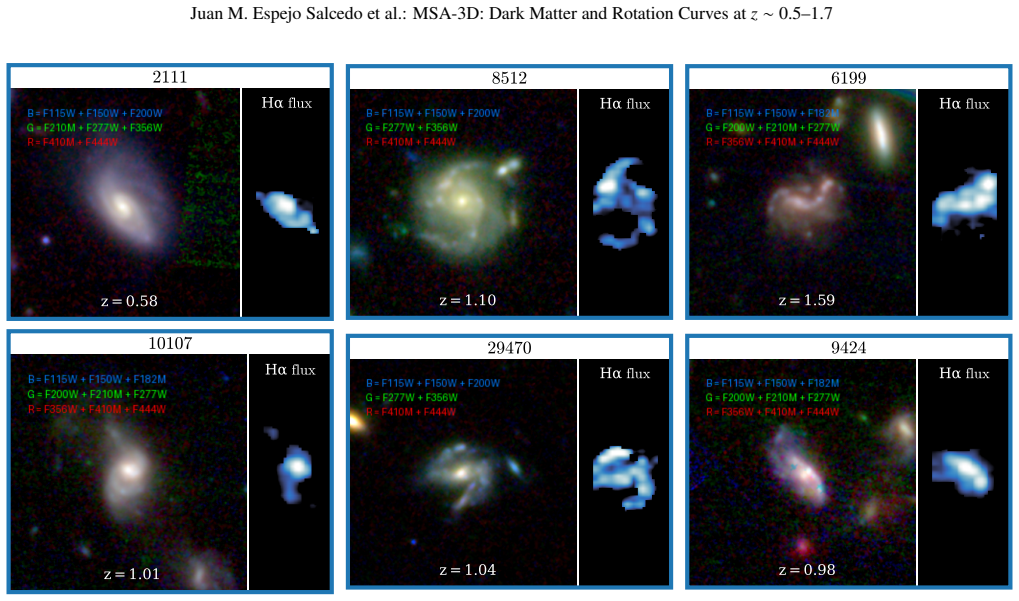
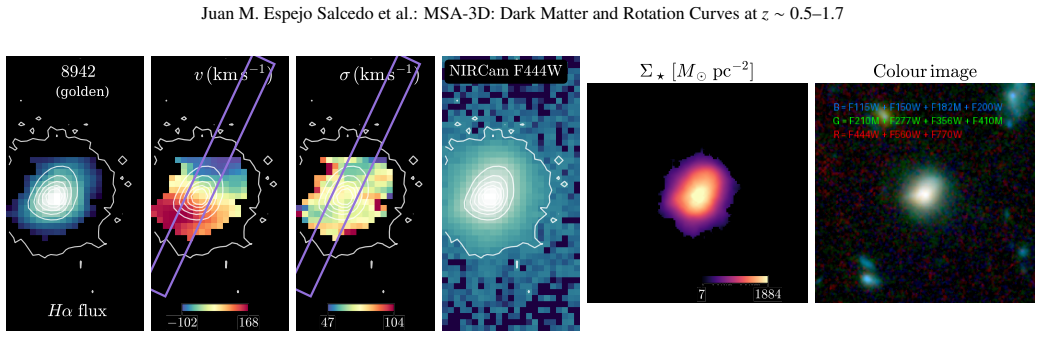




read the original abstract
We present rotation curves and inner mass distributions for 30 star-forming galaxies at $0.5<z<1.7$, observed with JWST/NIRSpec as part of the MSA-3D Cycle 1 survey. Combining spatially resolved ionised-gas kinematics with JWST/NIRCam imaging, we constrain baryonic and dark matter contributions through forward dynamical modelling for galaxies extending down to stellar masses of $\sim10^{9}M_\odot$. For the 23 galaxies in our primary statistical sample, we find predominantly rotationally supported disks with intrinsic dispersions $\sigma_0\sim31$-65 km s$^{-1}$ and a wide range of dark matter fractions, $f_{DM}(R_e)\sim0.1$-0.9, with a median of 0.63 and substantial galaxy-to-galaxy scatter of $\sim0.2$ dex. These results are supported by a complementary consistency check using stellar mass maps and SFR-derived gas profiles. Among the 19 galaxies reaching $\gtrsim2R_e$, we identify six rising, six flat, and seven falling rotation curves. These classes define an observed ordering from rotationally dominated, dark-matter-rich disks ($V_{rot}/\sigma_0\approx4$, $f_{DM}\gtrsim0.7$) to more dispersion-supported systems with centrally concentrated baryonic mass distributions ($V_{rot}/\sigma_0\approx2$, $f_{DM}\lesssim0.55$). The stellar Tully-Fisher relation lies close to the local relation evolved under the adopted self-similar $\Lambda$CDM scaling. A simplified seeing-degradation test shifts the inferred normalisation by ~0.2 dex at fixed $V_c$, suggesting that spatial resolution contributes to, but does not fully explain, differences among high-redshift Tully-Fisher measurements. Overall, MSA-3D provides a high-resolution extension of previous surveys toward lower stellar masses, spanning $9.0 < \log(M_\star/M_\odot) < 11.2$, and reinforces that star-forming disks near $z\sim1$ span a broad range of dynamical states and inner mass distributions.
Editorial analysis
A structured set of objections, weighed in public.
Referee Report
Summary. The manuscript reports JWST/NIRSpec IFU observations of ionised-gas kinematics in 30 star-forming galaxies at 0.5<z<1.7, combined with NIRCam imaging. Forward dynamical modelling is used to derive rotation curves, intrinsic dispersions (σ0∼31-65 km s−1), and dark matter fractions fDM(Re) for a primary sample of 23 galaxies, yielding a median fDM(Re)=0.63 with ∼0.2 dex scatter. Among the 19 galaxies reaching ≳2Re, rotation curves are classified as rising (6), flat (6), or falling (7), with correlations to Vrot/σ0 and fDM. A consistency check with stellar mass maps and SFR-derived gas profiles is presented, along with a simplified seeing-degradation test affecting the Tully-Fisher normalisation by ∼0.2 dex.
Significance. If the baryon-DM decompositions hold, the work provides valuable new constraints on inner mass distributions and dynamical states in star-forming disks at intermediate redshift, extending prior surveys to lower stellar masses (down to ∼10^9 M⊙). The reported range of fDM values and rotation-curve morphologies, plus the Tully-Fisher comparison, would offer empirical input for galaxy formation simulations.
major comments (2)
- [dynamical modelling description and abstract] The headline median fDM(Re)=0.63 (with 0.2 dex scatter) for the 23-galaxy sample rests on forward dynamical modelling whose robustness to key assumptions is not fully quantified. The abstract notes a simplified seeing-degradation test and a consistency check with SFR-derived gas profiles, but these do not include systematic variation of the DM halo functional form (e.g., NFW versus cored profiles), inclination priors, or gas dispersion assumptions. At the reported NIRSpec resolution (∼0.8-1.5 kpc), beam-smearing and inclination-DM degeneracies can trade central baryonic concentration against fDM without altering the observed line-of-sight velocities, directly affecting the load-bearing claim.
- [sample and modelling sections] For the lower-mass end of the sample (∼10^9 M⊙), Re is comparable to or smaller than the spatial resolution; the paper does not report the posterior width on fDM(Re) when the baryonic surface-density parametrisation is varied (exponential versus NIRCam-derived) or when alternative inclination constraints are adopted. This leaves the reported galaxy-to-galaxy scatter and the ordering by rotation-curve class vulnerable to modelling systematics.
minor comments (1)
- [abstract] The abstract states the primary statistical sample comprises 23 galaxies but does not explicitly list the selection cuts (e.g., S/N, inclination range, or spatial coverage) that distinguish it from the full 30-galaxy set.
Simulated Author's Rebuttal
We thank the referee for the careful and constructive review. The comments identify areas where additional quantification of modelling assumptions will strengthen the manuscript. We address each point below and will incorporate the suggested tests in the revised version.
read point-by-point responses
-
Referee: [dynamical modelling description and abstract] The headline median fDM(Re)=0.63 (with 0.2 dex scatter) for the 23-galaxy sample rests on forward dynamical modelling whose robustness to key assumptions is not fully quantified. The abstract notes a simplified seeing-degradation test and a consistency check with SFR-derived gas profiles, but these do not include systematic variation of the DM halo functional form (e.g., NFW versus cored profiles), inclination priors, or gas dispersion assumptions. At the reported NIRSpec resolution (∼0.8-1.5 kpc), beam-smearing and inclination-DM degeneracies can trade central baryonic concentration against fDM without altering the observed line-of-sight velocities, directly affecting the load-bearing claim.
Authors: We agree that systematic tests of these assumptions are warranted to better support the robustness of the median fDM value. In the revised manuscript we will add an expanded discussion and new figures in the dynamical modelling section that vary the DM halo functional form (NFW versus cored), explore the effect of different inclination priors, and test alternative gas dispersion assumptions. We will also quantify the impact of beam-smearing and inclination-DM degeneracies on the derived fDM(Re) values. These additions will directly address the concern while retaining the existing consistency check and seeing-degradation test as supporting evidence. revision: yes
-
Referee: [sample and modelling sections] For the lower-mass end of the sample (∼10^9 M⊙), Re is comparable to or smaller than the spatial resolution; the paper does not report the posterior width on fDM(Re) when the baryonic surface-density parametrisation is varied (exponential versus NIRCam-derived) or when alternative inclination constraints are adopted. This leaves the reported galaxy-to-galaxy scatter and the ordering by rotation-curve class vulnerable to modelling systematics.
Authors: We acknowledge that explicit reporting of these sensitivities is needed, particularly for the lower-mass galaxies where resolution effects are more pronounced. The revised manuscript will include new material in the sample and modelling sections (and an associated appendix) that reports the posterior widths on fDM(Re) for the affected galaxies and demonstrates the changes when the baryonic surface-density parametrization is switched between exponential and NIRCam-derived profiles, as well as under alternative inclination constraints. This will allow direct assessment of the robustness of the reported scatter and rotation-curve classifications. revision: yes
Circularity Check
No significant circularity; results derived from new observations via forward modeling
full rationale
The paper's central results (rotation curves, intrinsic dispersions, and f_DM(Re) values for 23 galaxies) are obtained by applying forward dynamical modeling directly to new JWST/NIRSpec kinematic data and NIRCam imaging for galaxies at 0.5<z<1.7. No load-bearing step reduces to a fitted parameter from prior data, a self-citation chain, or a self-definitional relation; the Tully-Fisher comparison uses an external local benchmark evolved under standard ΛCDM scaling. The derivation is self-contained against external benchmarks, with the seeing-degradation test serving as an internal consistency check rather than a circular input.
Axiom & Free-Parameter Ledger
axioms (2)
- domain assumption Galaxies are assumed to be in dynamical equilibrium for the modelling to apply.
- domain assumption The ionised gas traces the gravitational potential accurately.
Reference graph
Works this paper leans on
-
[1]
Disk Kinematics at High Redshift: DysmalPy's Extension to 3D Modeling and Comparison with Different Approaches. , keywords =. doi:10.3847/1538-4357/ad90b5 , archivePrefix =. 2411.07312 , primaryClass =
-
[2]
Kinematics of synthetically observed high-z rotating disks: reliability and biases of 3D fitting tools. , keywords =. doi:10.1093/mnras/staf1489 , archivePrefix =. 2509.18328 , primaryClass =
-
[3]
Ionised gas kinematics and dynamical masses of z 6 galaxies from JADES/NIRSpec high-resolution spectroscopy. , keywords =. doi:10.1051/0004-6361/202347755 , archivePrefix =. 2308.09742 , primaryClass =
-
[4]
The Cores of Dark Matter Dominated Galaxies: theory vs. observations
The Cores of Dark Matter-dominated Galaxies: Theory versus Observations. , keywords =. doi:10.1086/305884 , archivePrefix =. astro-ph/9708176 , primaryClass =
work page internal anchor Pith review Pith/arXiv arXiv doi:10.1086/305884
-
[5]
Dark matter fraction in disk-like galaxies over the past 10 Gyr. , keywords =. doi:10.1051/0004-6361/202347922 , archivePrefix =. 2309.04541 , primaryClass =
-
[6]
Rotation Curves of Spiral Galaxies
Rotation Curves of Spiral Galaxies. , keywords =. doi:10.1146/annurev.astro.39.1.137 , archivePrefix =. astro-ph/0010594 , primaryClass =
work page internal anchor Pith review Pith/arXiv arXiv doi:10.1146/annurev.astro.39.1.137
-
[7]
The MUSE Extremely Deep Field: Evidence for SFR-induced cores in dark-matter dominated galaxies at z ≃ 1. , keywords =. doi:10.1051/0004-6361/202141762 , archivePrefix =. 2109.07545 , primaryClass =
-
[8]
MUSE-DARK-I: Dark matter halo properties of intermediate-z star-forming galaxies. arXiv e-prints , keywords =. doi:10.48550/arXiv.2506.19721 , archivePrefix =. 2506.19721 , primaryClass =
-
[9]
The Dawes Review 1: Kinematic Studies of Star-Forming Galaxies Across Cosmic Time , volume=
Glazebrook, Karl , year=. The Dawes Review 1: Kinematic Studies of Star-Forming Galaxies Across Cosmic Time , volume=. doi:10.1017/pasa.2013.34 , journal=
-
[10]
2025, The Astrophysical Journal Letters, 978, L39, doi: 10.3847/2041-8213/ada150
MSA-3D: Metallicity Gradients in Galaxies at z 1 with JWST/NIRSpec Slit-stepping Spectroscopy. , keywords =. doi:10.3847/2041-8213/ada150 , archivePrefix =. 2409.01616 , primaryClass =
-
[11]
MSA-3D: Dissecting Galaxies at z 1 with High Spatial and Spectral Resolution. , keywords =. doi:10.3847/1538-4357/ada617 , archivePrefix =. 2408.08350 , primaryClass =
-
[12]
The dependence of bar frequency on galaxy mass, colour, and gas content - and angular resolution - in the local universe. , keywords =. doi:10.1093/mnras/stx3117 , archivePrefix =. 1711.04867 , primaryClass =
work page internal anchor Pith review Pith/arXiv arXiv doi:10.1093/mnras/stx3117
-
[13]
The dynamics of stellar disks in live dark-matter halos
The dynamics of stellar discs in live dark-matter haloes. , keywords =. doi:10.1093/mnras/sty711 , archivePrefix =. 1712.00058 , primaryClass =
work page internal anchor Pith review Pith/arXiv arXiv doi:10.1093/mnras/sty711
-
[14]
, year = 1972, month = dec, volume =
Galactic Bridges and Tails. , year = 1972, month = dec, volume =. doi:10.1086/151823 , adsurl =
-
[15]
2010, MNRAS, 401, 2343, doi: 10.1111/j.1365-2966.2009.15859.x
Simulations of the grand design galaxy M51: a case study for analysing tidally induced spiral structure. , keywords =. doi:10.1111/j.1365-2966.2009.16161.x , archivePrefix =. 0912.1201 , primaryClass =
-
[16]
High Velocity Dispersion in A Rare Grand Design Spiral Galaxy at Redshift z=2.18
High velocity dispersion in a rare grand-design spiral galaxy at redshift z = 2.18. , keywords =. doi:10.1038/nature11256 , archivePrefix =. 1207.4196 , primaryClass =
work page internal anchor Pith review Pith/arXiv arXiv doi:10.1038/nature11256
-
[17]
Bland-Hawthorn, J. , year=. The Hector Survey: integral field spectroscopy of 100,000 galaxies , volume=. Proceedings of the International Astronomical Union , publisher=. doi:10.1017/S1743921314009247 , number=
-
[19]
The morphological identification of the rapidly evolving population of faint galaxies
The morphological identification of the rapidly evolving population of faint galaxies. , keywords =. 1995. doi:10.1093/mnras/275.1.L19 , archivePrefix =. astro-ph/9503101 , primaryClass =
work page internal anchor Pith review Pith/arXiv arXiv doi:10.1093/mnras/275.1.l19 1995
-
[20]
Constraining the Low-Mass Slope of the Star Formation Sequence at 0.5<z<2.5
Constraining the Low-mass Slope of the Star Formation Sequence at 0.5 < z < 2.5. , keywords =. doi:10.1088/0004-637X/795/2/104 , archivePrefix =. 1407.1843 , primaryClass =
work page internal anchor Pith review Pith/arXiv arXiv doi:10.1088/0004-637x/795/2/104
-
[21]
Galaxy Morphologies in the Hubble Ultra Deep Field: Dominance of Linear Structures at the Detection Limit. , keywords =. 2005. doi:10.1086/432502 , archivePrefix =. astro-ph/0508216 , primaryClass =
work page internal anchor Pith review Pith/arXiv arXiv doi:10.1086/432502 2005
-
[22]
Angular momentum of $z\sim 1.5$ galaxies and their local analogues with adaptive optics
Angular momentum of z ̃ 1.5 galaxies and their local analogues with adaptive optics. , keywords =. 2019. doi:10.1093/mnras/stz750 , archivePrefix =. 1903.04746 , primaryClass =
work page internal anchor Pith review Pith/arXiv arXiv doi:10.1093/mnras/stz750 2019
-
[23]
, archivePrefix = "arXiv", eprint =
The KMOS Redshift One Spectroscopic Survey (KROSS): the origin of disc turbulence in z 1 star-forming galaxies. , archivePrefix = "arXiv", eprint =. doi:10.1093/mnras/stx3016 , adsurl =
-
[24]
OSIRIS: A diffraction limited integral field spectrograph for Keck
James Larkin and Matthew Barczys and Alfred Krabbe and Sean Adkins and Ted Aliado and Paola Amico and George Brims and Randy Campbell and John Canfield and Thomas Gasaway and Allan Honey and Christof Iserlohe and Chris Johnson and Evan Kress and David LaFreniere and Ken Magnone and Nick Magnone and Michael McElwain and Juleen Moon and Andreas Quirrenbach ...
-
[26]
Low Angular Momentum in Clumpy, Turbulent Disk Galaxies
Low Angular Momentum in Clumpy, Turbulent Disk Galaxies. , keywords =. 2015. doi:10.1088/0004-637X/815/2/97 , archivePrefix =. 1508.04768 , primaryClass =
work page internal anchor Pith review Pith/arXiv arXiv doi:10.1088/0004-637x/815/2/97 2015
-
[27]
The Kinematic Properties of Clumpy Star-Forming Galaxies , school =
Wisnioski, Emily , year =. The Kinematic Properties of Clumpy Star-Forming Galaxies , school =
-
[28]
The ALMA Spectroscopic Survey in the HUDF: Nature and Physical Properties of Gas-mass Selected Galaxies Using MUSE Spectroscopy. , keywords =. 2019. doi:10.3847/1538-4357/ab3102 , archivePrefix =. 1903.09167 , primaryClass =
-
[29]
The ALMA Spectroscopic Survey in the Hubble Ultra Deep Field: Evolution of the Molecular Gas in CO-selected Galaxies. , keywords =. 2019. doi:10.3847/1538-4357/ab30df , archivePrefix =. 1903.09162 , primaryClass =
-
[30]
arXiv e-prints , keywords =
The ALMA Spectroscopic Survey in the HUDF: the molecular gas content of galaxies and tensions with IllustrisTNG and the Santa Cruz SAM. arXiv e-prints , keywords =. 2019
2019
-
[31]
Angular momentum and galaxy formation revisited
Angular Momentum and Galaxy Formation Revisited. , keywords =. 2012. doi:10.1088/0067-0049/203/2/17 , archivePrefix =. 1207.4189 , primaryClass =
work page internal anchor Pith review Pith/arXiv arXiv doi:10.1088/0067-0049/203/2/17 2012
-
[32]
Very High Gas Fractions and Extended Gas Reservoirs in z=1.5 Disk Galaxies
Very High Gas Fractions and Extended Gas Reservoirs in z = 1.5 Disk Galaxies. , keywords =. 2010. doi:10.1088/0004-637X/713/1/686 , archivePrefix =. 0911.2776 , primaryClass =
work page internal anchor Pith review Pith/arXiv arXiv doi:10.1088/0004-637x/713/1/686 2010
-
[33]
Fundamental Mass-Spin-Morphology Relation of Spiral Galaxies
Fundamental Mass-Spin-Morphology Relation Of Spiral Galaxies. , keywords =. 2014. doi:10.1088/0004-637X/784/1/26 , archivePrefix =. 1312.4543 , primaryClass =
work page internal anchor Pith review Pith/arXiv arXiv doi:10.1088/0004-637x/784/1/26 2014
-
[34]
The kiloparsec-scale gas kinematics in two star-forming galaxies at z ̃ 1.47 seen with ALMA and VLT-SINFONI. , keywords =. 2019. doi:10.1093/mnras/stz1643 , archivePrefix =. 1906.06245 , primaryClass =
work page internal anchor Pith review Pith/arXiv arXiv doi:10.1093/mnras/stz1643 2019
-
[35]
Angular momentum evolution of galaxies over the past 10 Gyr: a MUSE and KMOS dynamical survey of 400 star-forming galaxies from z = 0.3 to 1.7. , keywords =. 2017. doi:10.1093/mnras/stx201 , archivePrefix =. 1701.07448 , primaryClass =
work page internal anchor Pith review Pith/arXiv arXiv doi:10.1093/mnras/stx201 2017
-
[36]
emcee: The MCMC Hammer. , keywords =. 2013. doi:10.1086/670067 , archivePrefix =. 1202.3665 , primaryClass =
work page internal anchor Pith review Pith/arXiv arXiv doi:10.1086/670067 2013
-
[37]
COSMOS-DASH: The Evolution of the Galaxy Size-Mass Relation since z ̃ 3 from New Wide-field WFC3 Imaging Combined with CANDELS/3D-HST. , keywords =. 2019. doi:10.3847/1538-4357/ab290a , archivePrefix =. 1808.04379 , primaryClass =
-
[38]
ZAP: Zurich Atmosphere Purge. 2016
2016
-
[39]
Studying the kinematic asymmetries of disks and post-coalescence mergers using a new ``kinemetry'' criterion. , keywords =. 2012. doi:10.1051/0004-6361/201117894 , archivePrefix =. 1203.1930 , primaryClass =
work page internal anchor Pith review Pith/arXiv arXiv doi:10.1051/0004-6361/201117894 2012
-
[40]
The KMOS^3D Survey: design, first results, and the evolution of galaxy kinematics from 0.7<z<2.7
The KMOS ^ 3D Survey: Design, First Results, and the Evolution of Galaxy Kinematics from 0.7 <= z <= 2.7. , keywords =. 2015. doi:10.1088/0004-637X/799/2/209 , archivePrefix =. 1409.6791 , primaryClass =
work page internal anchor Pith review Pith/arXiv arXiv doi:10.1088/0004-637x/799/2/209 2015
-
[41]
Stellar Mass Estimation Based on IRAC Photometry for Spitzer SWIRE-field Galaxies
Stellar mass estimation based on IRAC photometry for Spitzer SWIRE-field galaxies. Research in Astronomy and Astrophysics , keywords =. 2010. doi:10.1088/1674-4527/10/4/004 , archivePrefix =. 1001.2627 , primaryClass =
work page internal anchor Pith review Pith/arXiv arXiv doi:10.1088/1674-4527/10/4/004 2010
-
[42]
2001, MNRAS, 322, 231, doi: 10.1046/j.1365-8711.2001.04022.x
The 2dF galaxy redshift survey: near-infrared galaxy luminosity functions. , keywords =. 2001. doi:10.1046/j.1365-8711.2001.04591.x , archivePrefix =. astro-ph/0012429 , primaryClass =
-
[43]
The ALMA Spectroscopic Survey in the HUDF: CO Luminosity Functions and the Molecular Gas Content of Galaxies through Cosmic History. , keywords =. 2019. doi:10.3847/1538-4357/ab30fe , archivePrefix =. 1903.09164 , primaryClass =
-
[45]
Angular Momentum Regulates Atomic Gas Fractions of Galactic Disks
Angular Momentum Regulates Atomic Gas Fractions of Galactic Disks. , keywords =. 2016. doi:10.3847/2041-8205/824/2/L26 , archivePrefix =. 1605.04927 , primaryClass =
work page internal anchor Pith review Pith/arXiv arXiv doi:10.3847/2041-8205/824/2/l26 2016
-
[46]
Cosmic Star-Formation History. , keywords =. 2014. doi:10.1146/annurev-astro-081811-125615 , archivePrefix =. 1403.0007 , primaryClass =
work page internal anchor Pith review Pith/arXiv arXiv doi:10.1146/annurev-astro-081811-125615 2014
-
[47]
The Asymmetry of Galaxies: Physical Morphology for Nearby and High Redshift Galaxies
The Asymmetry of Galaxies: Physical Morphology for Nearby and High-Redshift Galaxies. , keywords =. 2000. doi:10.1086/308300 , archivePrefix =. astro-ph/9907399 , primaryClass =
work page internal anchor Pith review Pith/arXiv arXiv doi:10.1086/308300 2000
-
[48]
High star formation rates as the origin of turbulence in early and modern disk galaxies
High star formation rates as the origin of turbulence in early and modern disk galaxies. , keywords =. 2010. doi:10.1038/nature09452 , archivePrefix =. 1010.1262 , primaryClass =
work page internal anchor Pith review Pith/arXiv arXiv doi:10.1038/nature09452 2010
-
[49]
Gas Accretion onto Galaxies , year = "2017", editor =
Gas Accretion and Angular Momentum. Gas Accretion onto Galaxies , year = "2017", editor =. doi:10.1007/978-3-319-52512-9_11 , adsurl =
-
[50]
Formation of Massive Galaxies at High Redshift: Cold Streams, Clumpy Disks and Compact Spheroids
Formation of Massive Galaxies at High Redshift: Cold Streams, Clumpy Disks, and Compact Spheroids. , keywords =. 2009. doi:10.1088/0004-637X/703/1/785 , archivePrefix =. 0901.2458 , primaryClass =
work page internal anchor Pith review Pith/arXiv arXiv doi:10.1088/0004-637x/703/1/785 2009
-
[51]
and Zolotov, Adi and Tweed, D
Dekel, A. and Zolotov, Adi and Tweed, D. and Cacciato, Marcello and Ceverino, D. and Primack, Joel , year =. Toy Models for Galaxy Formation versus Simulations , volume =. Monthly Notices of the Royal Astronomical Society , doi =
-
[52]
Rapid Formation of Exponential Disks and Bulges at High Redshift from the Dynamical Evolution of Clump-Cluster and Chain Galaxies , volume =
Bournaud, Frederic and Elmegreen, Bruce and Elmegreen, Debra , year =. Rapid Formation of Exponential Disks and Bulges at High Redshift from the Dynamical Evolution of Clump-Cluster and Chain Galaxies , volume =. The Astrophysical Journal , doi =
-
[53]
On the gravitational stability of a disk of stars. , year = "1964", month = "May", volume =. doi:10.1086/147861 , adsurl =
-
[54]
arXiv e-prints , keywords =
A Way Out of the Disc Angular Momentum Catastrophe in Hirarchical Hydrodynamical Simulations. arXiv e-prints , keywords =. 1998
1998
-
[55]
Formation and rotation of disc galaxies with haloes. , keywords =. 1980. doi:10.1093/mnras/193.2.189 , adsurl =
-
[56]
and Dolag, Klaus and Beck, Alexander and Burkert, Andreas and Schmidt, Andreas and Schulze, Felix and Steinborn, Lisa , year =
Teklu, Adelheid and Remus, R. and Dolag, Klaus and Beck, Alexander and Burkert, Andreas and Schmidt, Andreas and Schulze, Felix and Steinborn, Lisa , year =. Connecting Angular Momentum and Galactic Dynamics: The complex Interplay between Spin, Mass, and Morphology , volume =. The Astrophysical Journal , doi =
-
[57]
The Formation of Disk-Bulge-Halo Systems and the Origin of the Hubble Sequence
The Formation of Disk-Bulge-Halo Systems and the Origin of the Hubble Sequence. , keywords =. 1998. doi:10.1086/306354 , archivePrefix =. astro-ph/9805113 , primaryClass =
work page internal anchor Pith review Pith/arXiv arXiv doi:10.1086/306354 1998
-
[58]
Theoretical Challenges in Galaxy Formation
Theoretical Challenges in Galaxy Formation. , keywords =. 2017. doi:10.1146/annurev-astro-081913-040019 , archivePrefix =. 1612.06891 , primaryClass =
work page internal anchor Pith review Pith/arXiv arXiv doi:10.1146/annurev-astro-081913-040019 2017
-
[59]
Blumenthal, George R. and Faber, S.M. and Primack, Joel R. and Rees, Martin J. Formation of Galaxies and Large Scale Structure with Cold Dark Matter. Nature. 1984. doi:10.1038/311517a0
-
[60]
The Connection between Galaxies and their Dark Matter Halos
The Connection Between Galaxies and Their Dark Matter Halos. , keywords =. doi:10.1146/annurev-astro-081817-051756 , archivePrefix =. 1804.03097 , primaryClass =
work page internal anchor Pith review Pith/arXiv arXiv doi:10.1146/annurev-astro-081817-051756
-
[61]
Non-linear evolution of the angular momentum of protostructures from tidal torques
Non-linear evolution of the angular momentum of protostructures from tidal torques. , keywords =. doi:10.1093/mnras/282.2.455 , archivePrefix =. astro-ph/9604078 , primaryClass =
work page internal anchor Pith review Pith/arXiv arXiv doi:10.1093/mnras/282.2.455
-
[62]
Monthly Notices of the Royal Astronomical Society , volume =
Catelan, Paolo and Theuns, Tom , title = ". Monthly Notices of the Royal Astronomical Society , volume =. 1996 , month =. doi:10.1093/mnras/282.2.436 , url =
-
[63]
The segregation of baryons and dark matter during halo assembly
The segregation of baryons and dark matter during halo assembly. , keywords =. doi:10.1093/mnras/stx1391 , archivePrefix =. 1610.07592 , primaryClass =
work page internal anchor Pith review Pith/arXiv arXiv doi:10.1093/mnras/stx1391
-
[64]
The formation of galactic discs. , keywords =. doi:10.1046/j.1365-8711.1998.01227.x , archivePrefix =. astro-ph/9707093 , primaryClass =
-
[65]
From peculiar morphologies to Hubble-type spirals: the relation between galaxy dynamics and morphology in star-forming galaxies at z 1.5. , keywords =. doi:10.1093/mnras/stz3576 , archivePrefix =. 1911.12375 , primaryClass =
-
[66]
No. 324. Extra-galactic nebulae. Contributions from the Mount Wilson Observatory / Carnegie Institution of Washington , year = 1926, month = jan, volume =
1926
-
[67]
Morpho-kinematics of z~1 galaxies probe the hierarchical scenario
Morpho-kinematics of z 1 galaxies probe the hierarchical scenario. , keywords =. doi:10.1093/mnras/stw2711 , archivePrefix =. 1611.03499 , primaryClass =
work page internal anchor Pith review Pith/arXiv arXiv doi:10.1093/mnras/stw2711
-
[68]
Integral Field Spectroscopy of High-Redshift Star-forming Galaxies with Laser-guided Adaptive Optics: Evidence for Dispersion-dominated Kinematics. , keywords =. doi:10.1086/521786 , archivePrefix =. 0707.3634 , primaryClass =
work page internal anchor Pith review Pith/arXiv arXiv doi:10.1086/521786
-
[69]
From Rings to Bulges: Evidence for Rapid Secular Galaxy Evolution at z -0.5ex 2 from Integral Field Spectroscopy in the SINS Survey. , keywords =. doi:10.1086/591840 , archivePrefix =. 0807.1184 , primaryClass =
work page internal anchor Pith review Pith/arXiv arXiv doi:10.1086/591840
-
[70]
Revisiting the Stellar Mass-Angular Momentum-Morphology Relation: Extension to Higher Bulge Fraction and the Effect of Bulge Type. , keywords =. doi:10.3847/1538-4357/aabfc4 , archivePrefix =. 1804.07083 , primaryClass =
work page internal anchor Pith review Pith/arXiv arXiv doi:10.3847/1538-4357/aabfc4
-
[71]
Adaptive Optics for Astronomy. , keywords =. doi:10.1146/annurev-astro-081811-125447 , archivePrefix =. 1201.5741 , primaryClass =
work page internal anchor Pith review Pith/arXiv arXiv doi:10.1146/annurev-astro-081811-125447
-
[72]
Angular Momentum and Galaxy Formation Revisited: Scaling Relations for Disks and Bulges
Angular Momentum and Galaxy Formation Revisited: Scaling Relations for Disks and Bulges. , keywords =. doi:10.3847/1538-4357/aaeb27 , archivePrefix =. 1808.02525 , primaryClass =
work page internal anchor Pith review Pith/arXiv arXiv doi:10.3847/1538-4357/aaeb27
-
[73]
The angular momentum-mass relation: a fundamental law from dwarf irregulars to massive spirals
The angular momentum-mass relation: a fundamental law from dwarf irregulars to massive spirals. , keywords =. doi:10.1051/0004-6361/201833091 , archivePrefix =. 1804.04663 , primaryClass =
work page internal anchor Pith review Pith/arXiv arXiv doi:10.1051/0004-6361/201833091
-
[74]
Rigging dark haloes: why is hierarchical galaxy formation consistent with the inside-out build-up of thin discs?. , keywords =. doi:10.1111/j.1365-2966.2011.19640.x , archivePrefix =. 1105.0210 , primaryClass =
-
[75]
Wet Disc Contraction to Galactic Blue Nuggets and Quenching to Red Nuggets
Wet disc contraction to galactic blue nuggets and quenching to red nuggets. , keywords =. doi:10.1093/mnras/stt2331 , archivePrefix =. 1310.1074 , primaryClass =
work page internal anchor Pith review Pith/arXiv arXiv doi:10.1093/mnras/stt2331
-
[76]
The confinement of star-forming galaxies into a main sequence through episodes of gas compaction, depletion and replenishment. , keywords =. doi:10.1093/mnras/stw131 , archivePrefix =. 1509.02529 , primaryClass =
work page internal anchor Pith review Pith/arXiv arXiv doi:10.1093/mnras/stw131
-
[77]
The SINS survey: SINFONI Integral Field Spectroscopy of z ~ 2 Star-forming Galaxies
The SINS Survey: SINFONI Integral Field Spectroscopy of z -0.5ex 2 Star-forming Galaxies. , keywords =. doi:10.1088/0004-637X/706/2/1364 , archivePrefix =. 0903.1872 , primaryClass =
work page internal anchor Pith review Pith/arXiv arXiv doi:10.1088/0004-637x/706/2/1364
-
[78]
The Average Star Formation Histories of Galaxies in Dark Matter Halos from z=0-8
The Average Star Formation Histories of Galaxies in Dark Matter Halos from z = 0-8. , keywords =. doi:10.1088/0004-637X/770/1/57 , archivePrefix =. 1207.6105 , primaryClass =
work page internal anchor Pith review Pith/arXiv arXiv doi:10.1088/0004-637x/770/1/57
-
[79]
On the angular momentum history of galactic discs. , keywords =. doi:10.1093/mnrasl/slaa054 , archivePrefix =. 2003.10912 , primaryClass =
-
[80]
Mass Density Profiles of LSB Galaxies
Mass Density Profiles of Low Surface Brightness Galaxies. , keywords =. doi:10.1086/320262 , archivePrefix =. astro-ph/0103102 , primaryClass =
work page internal anchor Pith review Pith/arXiv arXiv doi:10.1086/320262
-
[81]
High-Resolution Rotation Curves and Galaxy Mass Models from THINGS
High-Resolution Rotation Curves and Galaxy Mass Models from THINGS. , keywords =. doi:10.1088/0004-6256/136/6/2648 , archivePrefix =. 0810.2100 , primaryClass =
work page internal anchor Pith review Pith/arXiv arXiv doi:10.1088/0004-6256/136/6/2648
-
[82]
Extended HI Rotation Curve and Mass Distribution of M31
The Extended H I Rotation Curve and Mass Distribution of M31. , keywords =. doi:10.1086/503869 , archivePrefix =. astro-ph/0603143 , primaryClass =
work page internal anchor Pith review Pith/arXiv arXiv doi:10.1086/503869
-
[83]
Template Rotation Curves for Disk Galaxies
Template Rotation Curves for Disk Galaxies. , keywords =. doi:10.1086/500171 , archivePrefix =. astro-ph/0512051 , primaryClass =
work page internal anchor Pith review Pith/arXiv arXiv doi:10.1086/500171
discussion (0)
Sign in with ORCID, Apple, or X to comment. Anyone can read and Pith papers without signing in.