All you need is log
Pith reviewed 2026-06-26 01:59 UTC · model grok-4.3
The pith
Every functional of W-tuples of distributions that is monotone under data processing and additive on independent products equals a positive integral of multi-way coincidence divergences over four strata.
A machine-rendered reading of the paper's core claim, the machinery that carries it, and where it could break.
Core claim
Every functional of W-tuples of distributions that is monotone under data processing and additive on independent products is a positive integral of multi-way coincidence divergences C_α(π1,…,πW) := −log∫π1^α1⋯πW^αW (with ∑αk=1) over a parameter space with four strata: the simplex interior; mixed-sign exponent cones; a tropical boundary at infinity carrying max-divergences; and pairwise Kullback-Leibler edges at the simplex vertices. Each stratum is necessary, shown by an explicit counter-example that the remaining strata cannot reproduce, and each stratum arises as a clean limit of simplex-interior atoms.
What carries the argument
The multi-way coincidence divergence C_α(π1,…,πW) = −log∫ π1^α1 ⋯ πW^αW (∑αk=1), integrated positively over the four-stratum parameter space.
If this is right
- The two-distribution case recovers the classical Rényi family exactly.
- The same family is obtained from Kolmogorov-Nagumo means, classical entropy axioms, multi-hypothesis testing error exponents, and a multi-lottery betting interpretation.
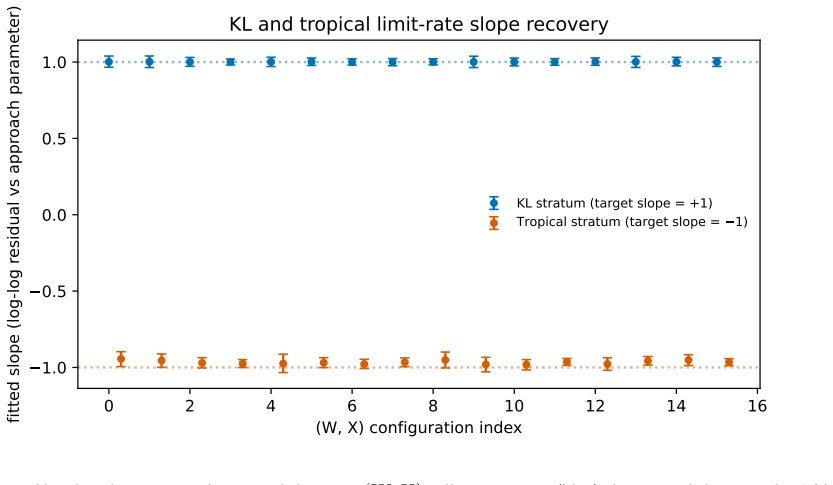
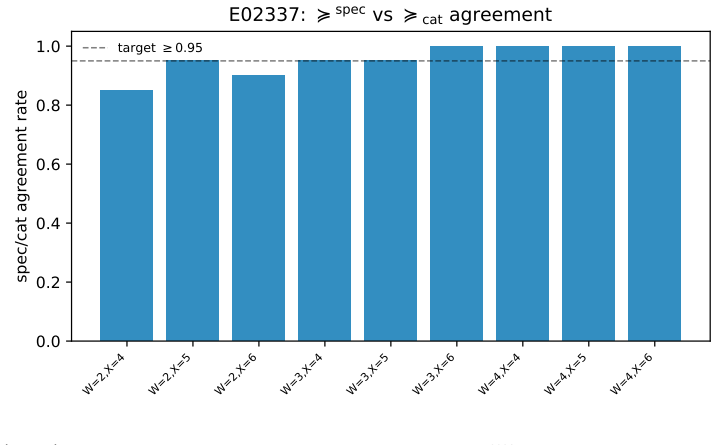
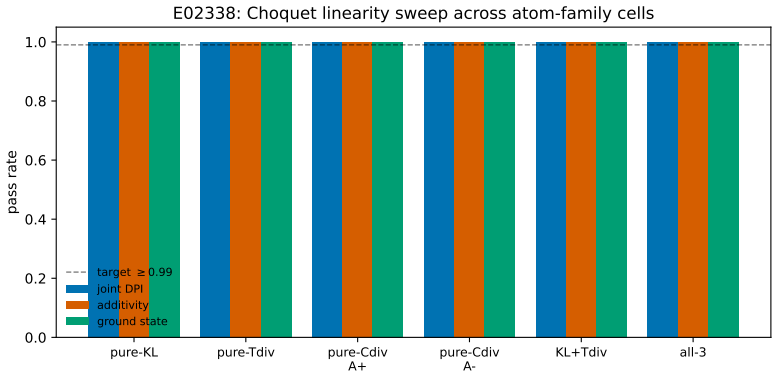
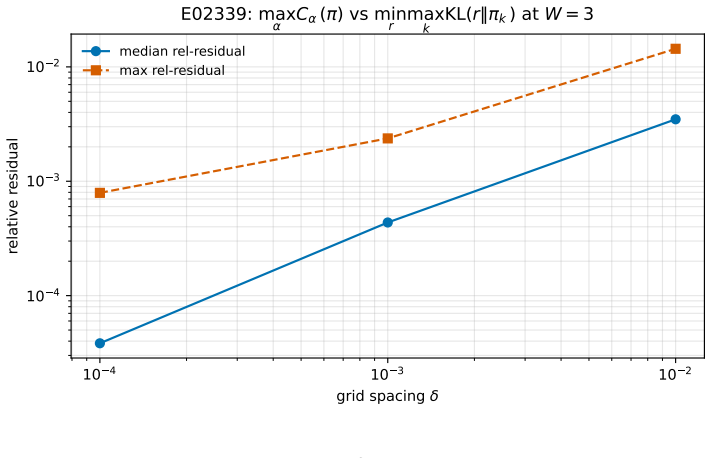
- A worked three-distribution case, numerical checks, and a conditional extension are supplied.
- Each of the four strata is required and cannot be omitted without losing some monotone additive functional.
- The strata arise as limits of the interior simplex atoms.
Where Pith is reading between the lines
- The betting interpretation suggests direct use in sequential multi-agent decision problems where agents place simultaneous bets on several hypotheses.
- The characterization may supply new multi-prior generalization bounds in PAC-Bayes settings that were previously limited to pairwise comparisons.
- The explicit counter-examples for each stratum offer concrete test cases for checking whether a candidate multi-distribution functional satisfies the axioms.
- The tropical boundary suggests connections to max-entropy methods or robust optimization that operate at infinite orders.
Load-bearing premise
The two properties of monotonicity under data processing and additivity on independent products are jointly sufficient to characterize the entire family, with each of the four strata required by an explicit example the others cannot match.
What would settle it
A concrete functional on three or more distributions that satisfies data-processing monotonicity and product additivity yet lies outside every positive integral of the four-stratum coincidence divergences.
Figures

read the original abstract
Comparing two probability distributions is a basic building block of statistics and machine learning, and the right family is well understood: the R\'enyi divergences of order $\alpha\in[0,\infty]$ are the unique family monotone under data processing and additive on independent products. Many problems instead compare more than two distributions at once -- multi-population fairness, multi-prior PAC-Bayes bounds, multi-hypothesis testing -- and the right multi-distribution generalization of the R\'enyi family has been an open question. We characterize it. Every functional of $W$-tuples of distributions that is monotone under data processing and additive on independent products is a positive integral of multi-way coincidence divergences $C_{\alpha}(\pi_1,\dots,\pi_W) := -\log\int \pi_1^{\alpha_1}\cdots\pi_W^{\alpha_W}$ (with $\sum_k \alpha_k = 1$) over a parameter space with four strata: the simplex interior; mixed-sign exponent cones (the analogue of R\'enyi orders $>1$); a tropical boundary at infinity carrying max-divergences; and pairwise Kullback-Leibler edges at the simplex vertices. Each stratum is necessary -- the destination of an explicit data-processing-monotone, product-additive divergence the others cannot reproduce -- and each is a clean limit of simplex-interior atoms. The same family arises from five independent routes -- the structural axioms, Kolmogorov-Nagumo means with R\'enyi's entropy axiomatics, classical entropy characterizations, multi-hypothesis testing error exponents, and a multi-lottery betting interpretation -- structural evidence that this is the canonical multi-distribution R\'enyi calculus rather than an artefact of any one axiomatic input. The two-prior case recovers the standard R\'enyi result; a worked $W=3$ instance, numerical verification, and a conditional extension round out the treatment.
Editorial analysis
A structured set of objections, weighed in public.
Referee Report
Summary. The paper claims that every functional of W-tuples of distributions that is monotone under data processing and additive on independent products must be a positive integral of the multi-way coincidence divergences C_α(π1,…,πW) := −log∫π1^α1⋯πW^αW (∑αk=1) over a four-stratum parameter space (simplex interior, mixed-sign exponent cones, tropical boundary at infinity, and pairwise KL edges at vertices). It supplies five independent derivations (structural axioms, Kolmogorov-Nagumo, classical entropy, hypothesis-testing exponents, betting) plus explicit counter-examples establishing necessity of each stratum, with the W=2 case recovering the classical Rényi family exactly.
Significance. If the characterization holds, the result is significant: it supplies the canonical multi-distribution extension of the Rényi family, resolving an open question with applications to multi-population fairness, multi-prior PAC-Bayes, and multi-hypothesis testing. The five independent routes, explicit necessity counter-examples, exact W=2 recovery, and numerical/W=3 verification constitute strong structural evidence rather than an artefact of one axiomatization.
minor comments (1)
- The abstract states that each stratum is 'a clean limit of simplex-interior atoms,' but the precise limiting argument (e.g., which sequence of α vectors) is not referenced to a numbered equation or proposition in the provided summary; adding an explicit pointer would improve readability.
Simulated Author's Rebuttal
We thank the referee for their positive assessment, recognition of the result's significance, and recommendation to accept. The five independent derivations, necessity counter-examples, and exact recovery of the classical Rényi case for W=2 are indeed the core of the contribution.
Circularity Check
No significant circularity: characterization from external axioms
full rationale
The central result is a characterization theorem: any functional of W-tuples satisfying the two external structural axioms (data-processing monotonicity and product additivity) must be a positive integral of the C_α over the four strata. The manuscript derives this via five independent routes (axiomatic, Kolmogorov-Nagumo, classical entropy, hypothesis-testing, betting) and supplies explicit counter-examples showing each stratum is required. The W=2 case recovers the known Rényi family from prior literature without fitting or self-referential reduction. No step reduces by construction to its inputs, no load-bearing self-citation chain appears, and the derivation remains self-contained against the stated axioms.
Axiom & Free-Parameter Ledger
axioms (2)
- domain assumption Monotonicity under data processing
- domain assumption Additivity on independent products
Reference graph
Works this paper leans on
-
[1]
On Measures of Information and their Characterizations, volume 115 of Mathematics in Science and Engineering
János Aczél and Zoltán Daróczy. On Measures of Information and their Characterizations, volume 115 of Mathematics in Science and Engineering. Academic Press, New York, 1975. 48
1975
-
[2]
Functional Equations in Several Variables, volume 31 of Encyclopedia of Mathematics and its Applications
János Aczél and Jean Dhombres. Functional Equations in Several Variables, volume 31 of Encyclopedia of Mathematics and its Applications. Cambridge University Press, 1989
1989
-
[3]
János Aczél, Bruno Forte, and Che Tat Ng. Why the Shannon and Hartley entropies are ‘natural’.Advances in Applied Probability, 6(1):131–146, 1974. doi: 10.2307/1426210
-
[4]
Maite Arcos, Renato Renner, and Jonathan Oppenheim. A resource theory of gambling. arXiv preprint arXiv:2510.08418, 2025
arXiv 2025
-
[5]
Koenraad M. R. Audenaert and Milán Mosonyi. Upper bounds on the error probabilities and asymptotic error exponents in quantum multiple state discrimination. Journal of Mathematical Physics , 55(10):102201, 2014. doi: 10.1063/1.4898559
-
[6]
Information from coincidences: a mixed partition-function calculus for multiscale typicality
Akshay Balsubramani. Information from coincidences: a mixed partition-function calculus for multiscale typicality
-
[7]
url-verified 2026-06-25: https://arxiv.org/abs/2606.25042
URL https://arxiv.org/abs/2606.25042. url-verified 2026-06-25: https://arxiv.org/abs/2606.25042
Pith/arXiv arXiv 2026
-
[8]
Expected information as expected utility
José M Bernardo. Expected information as expected utility. The Annals of Statistics, pages 686–690, 1979
1979
-
[9]
Conditional Rényi divergences and horse betting
Cyril Bleuler, Amos Lapidoth, and Christoph Pfister. Conditional Rényi divergences and horse betting. Entropy, 22 (3):316, 2020. doi: 10.3390/e22030316
-
[10]
Gergely Bunth and Péter Vrana. Equivariant relative submajorization. arXiv preprint, 2021. doi: 10.48550/arXiv. 2108.13217
work page internal anchor Pith review doi:10.48550/arxiv 2021
-
[11]
Quantum relative Lorenz curves and resource theories
Francesco Buscemi and Gilad Gour. Quantum relative Lorenz curves and resource theories. Journal of Mathematical Physics, 65(1):012203, 2024. Earlier preprint: arXiv:1607.05735 (2016)
Pith/arXiv arXiv 2024
-
[12]
Kenta Cho and Bart Jacobs. Disintegration and Bayesian inversion via string diagrams. In Mathematical Structures in Computer Science, volume 29, pages 938–971, 2019. doi: 10.1017/S0960129518000488
-
[13]
Axiomatic characterizations of information measures
Imre Csiszár. Axiomatic characterizations of information measures. Entropy, 10(3):261–273, 2008. doi: 10.3390/ e10030261
2008
-
[14]
Ducuara, Erkka Haapasalo, and Ryo Takakura
Andrés F. Ducuara, Erkka Haapasalo, and Ryo Takakura. Multivariate Rényi divergences characterise betting games with multiple lotteries. arXiv preprint, 2026. doi: 10.48550/arXiv.2601.17850. Report number YITP-25-40
-
[15]
On the concept of entropy of a finite probabilistic scheme
Dmitrii Konstantinovich Faddeev. On the concept of entropy of a finite probabilistic scheme. Uspekhi Matematich- eskikh Nauk, 11(1):227–231, 1956
1956
-
[16]
Matrix majorization in large samples
Muhammad Usman Farooq, T obias Fritz, Erkka Haapasalo, and Marco T omamichel. Matrix majorization in large samples. IEEE Transactions on Information Theory, 70(11):3118–3144, 2024. doi: 10.1109/TIT.2024.3437073
-
[17]
T obias Fritz. A synthetic approach to Markov kernels, conditional independence and theorems on sufficient statistics. Advances in Mathematics, 370:107239, 2020. doi: 10.1016/j.aim.2020.107239
-
[18]
T obias Fritz. A generalization of strict comparison for resource convertibility, with an application to second laws of thermodynamics. Letters in Mathematical Physics, 113(5):99, 2023. doi: 10.1007/s11005-023-01722-7
-
[19]
Sufficiency of Rényi divergences
Frederik Galke, Lauritz van Luijk, and Henrik Wilming. Sufficiency of Rényi divergences. arXiv preprint, 2024
2024
-
[20]
Strictly proper scoring rules, prediction, and estimation
Tilmann Gneiting and Adrian E Raftery. Strictly proper scoring rules, prediction, and estimation. Journal of the American statistical Association, 102(477):359–378, 2007
2007
-
[21]
Entropy and relative entropy from information-theoretic principles
Gilad Gour and Marco T omamichel. Entropy and relative entropy from information-theoretic principles. IEEE Transactions on Information Theory, 67(10):6313–6327, 2021. doi: 10.1109/TIT.2021.3078337
-
[22]
Barycentric decompositions for extensive monotone divergences
Erkka Haapasalo. Barycentric decompositions for extensive monotone divergences. arXiv preprint, 2025. doi: 10. 48550/arXiv.2509.18725
arXiv 2025
-
[23]
An invitation to quantum incompatibility
T eiko Heinosaari, Takayuki Miyadera, and Mikko Tukiainen. An invitation to quantum incompatibility. Journal of Physics A: Mathematical and Theoretical , 49(12):123001, 2016. doi: 10.1088/1751-8113/49/12/123001. Survey; updated version available 2022. 49
-
[24]
A new theorem of information theory
Arthur Hobson. A new theorem of information theory. Journal of Statistical Physics , 1(3):383–391, 1969. doi: 10. 1007/BF01106578
1969
-
[25]
Frederik B. Jensen. Asymptotic operational interpretations of generalized Rényi divergences. arXiv preprint, 2019
2019
-
[26]
Rodney W. Johnson and John E. Shore. Axiomatic derivation of the principle of maximum entropy and the principle of minimum cross-entropy. IEEE Transactions on Information Theory , 26(1):26–37, 1980. doi: 10.1109/TIT.1980. 1056144
-
[27]
Mathematical Foundations of Information Theory
Aleksandr Iakovlevich Khinchin. Mathematical Foundations of Information Theory. Dover, New York, 1957
1957
-
[28]
A. N. Kolmogorov. Sur la notion de la moyenne. Atti della Reale Accademia Nazionale dei Lincei , 12:388–391, 1930
1930
-
[29]
Ashok Kumar and Rajesh Sundaresan
M. Ashok Kumar and Rajesh Sundaresan. Minimization problems based on relativeα-entropy I: forward projection. IEEE Transactions on Information Theory, 62(9):5063–5080, 2016. doi: 10.1109/TIT.2016.2590465
-
[30]
Asymptotic Methods in Statistical Decision Theory
Lucien Le Cam. Asymptotic Methods in Statistical Decision Theory . Springer Series in Statistics. Springer, 1986. doi: 10.1007/978-1-4612-4946-7
-
[31]
Chuong B. Leang and Don H. Johnson. On the asymptotics of M-hypothesis Bayesian detection. IEEE Transactions on Information Theory, 43(1):280–282, 1997. doi: 10.1109/18.567705
-
[32]
Classification based on distance in multivariate Gaussian cases
Kameo Matusita. Classification based on distance in multivariate Gaussian cases. Proceedings of the Fifth Berkeley Symposium on Mathematical Statistics and Probability , 1:299–304, 1967
1967
-
[33]
Measures of the value of information.Proceedings of the National Academy of Sciences, 42(9):654–655, 1956
John McCarthy. Measures of the value of information.Proceedings of the National Academy of Sciences, 42(9):654–655, 1956
1956
-
[34]
Geometric relative entropies and barycentric Rényi divergences
Milán Mosonyi, Gergely Bunth, and Péter Vrana. Geometric relative entropies and barycentric Rényi divergences. Linear Algebra and its Applications , 699:159–276, 2024. doi: 10.1016/j.laa.2024.06.005
-
[35]
From Blackwell dominance in large samples to Rényi divergences and back again
Xiaosheng Mu, Luciano Pomatto, Philipp Strack, and Omer Tamuz. From Blackwell dominance in large samples to Rényi divergences and back again. Econometrica, 89(1):475–506, 2021. doi: 10.3982/ECTA17548
-
[36]
Xiaosheng Mu, Luciano Pomatto, Philipp Strack, and Omer Tamuz. Monotone additive statistics. Econometrica, 92 (4):995–1031, 2024. doi: 10.3982/ECTA19967. url-verified 2026-06-06: https://arxiv.org/abs/2102.00618
-
[37]
Über eine Klasse der Mittelwerte
Mitio Nagumo. Über eine Klasse der Mittelwerte. Japanese Journal of Mathematics, 7:71–79, 1930
1930
-
[38]
Michael Nussbaum and Arleta Szkoła. The Chernoff lower bound for symmetric quantum hypothesis testing.Annals of Statistics, 37(2):1040–1057, 2009. doi: 10.1214/08-AOS593
-
[39]
The cost of information: the case of constant marginal costs
Luciano Pomatto, Philipp Strack, and Omer Tamuz. The cost of information: the case of constant marginal costs. American Economic Review, 113(5):1360–1393, 2023. doi: 10.1257/aer.20211094
-
[40]
On measures of entropy and information
Alfréd Rényi. On measures of entropy and information. In Proceedings of the fourth Berkeley symposium on mathemat- ical statistics and probability, volume 1: contributions to the theory of statistics , volume 4, pages 547–562. University of California Press, 1961
1961
-
[41]
A complete characterisation of conditional entropies
Roberto Rubboli, Erkka Haapasalo, and Marco T omamichel. A complete characterisation of conditional entropies. arXiv preprint, 2026. doi: 10.48550/arXiv.2601.23213
-
[42]
N. P. Salikhov. Asymptotic properties of the rate of mistakes in the problem of distinguishing between several statis- tical hypotheses. Trudy Mat. Inst. Steklov., 124:117–146, 1973. In Russian; English summary in Theory of Probability and its Applications
1973
-
[43]
Admissible probability measurement procedures
Emir H Shuford Jr, Arthur Albert, and H Edward Massengill. Admissible probability measurement procedures. Psy- chometrika, 31(2):125–145, 1966
1966
-
[44]
Robin Sibson. Information radius. Zeitschrift für Wahrscheinlichkeitstheorie und verwandte Gebiete, 14:149–160, 1969. doi: 10.1007/BF00537520. url-verified 2026-05-26: https://link.springer.com/article/10.1007/BF00537520. 50
-
[45]
Cambridge University Press, Cambridge, 1991
Erik T orgersen.Comparison of Statistical Experiments, volume 36 of Encyclopedia of Mathematics and its Applications . Cambridge University Press, Cambridge, 1991
1991
-
[46]
Godfried T. T oussaint. Some properties of Matusita’s measure of affinity of several distributions. Annals of the Institute of Statistical Mathematics, 26(1):389–394, 1974. doi: 10.1007/BF02479845
-
[47]
Rényi divergence and Kullback–Leibler divergence
Tim van Erven and Peter Harremoës. Rényi divergence and Kullback–Leibler divergence. IEEE Transactions on Information Theory, 60(7):3797–3820, 2014. doi: 10.1109/TIT.2014.2320500
-
[48]
Matrix majorization in large samples with varying support restrictions
Frits Verhagen, Marco T omamichel, and Erkka Haapasalo. Matrix majorization in large samples with varying support restrictions. IEEE Transactions on Information Theory, 71(9):6517–6545, 2025. doi: 10.1109/TIT.2025.3585062
-
[49]
Manzil Zaheer, Satwik Kottur, Siamak Ravanbakhsh, Barnabás Póczos, Ruslan Salakhutdinov, and Alexander J. Smola. Deep sets. In Advances in Neural Information Processing Systems 30 (NIPS 2017) , pages 3391–3401, 2017. 51
2017
discussion (0)
Sign in with ORCID, Apple, or X to comment. Anyone can read and Pith papers without signing in.