SwitchBraidNet: Quantisation-Aware Lightweight Architecture for Hybrid Brain-Computer Interface
Pith reviewed 2026-06-26 19:39 UTC · model grok-4.3
The pith
SwitchBraidNet is a lightweight hybrid BCI model that maintains high accuracy across floating-point and integer precisions with a 3 KB INT8 footprint.
A machine-rendered reading of the paper's core claim, the machinery that carries it, and where it could break.
Core claim
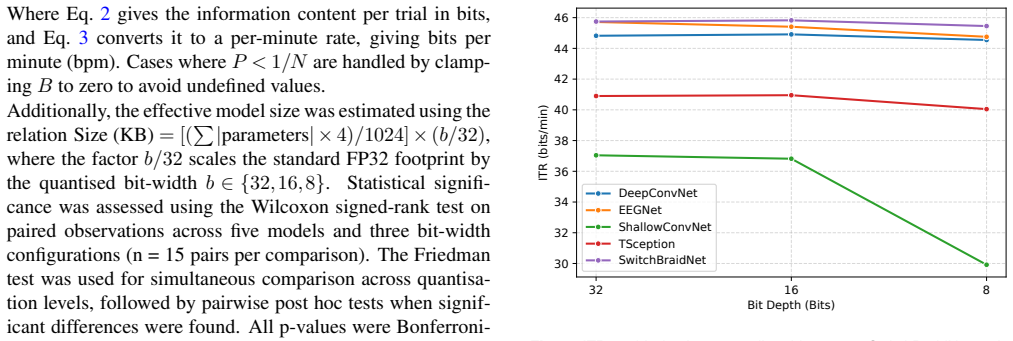
SwitchBraidNet employs a dual-path temporal braid to extract multiscale oscillatory features from EEG, an adaptive squeeze-and-excitation spatial switch to gate electrodes, and a log-variance readout layer to encode band-power directly. When trained with quantization-aware training on the OpenBMI dataset, it achieves MI accuracy of 69.49% in FP16, SSVEP accuracy of 93.48% in FP32, and hybrid ITR of 64.82 bits/min in FP16, all with an INT8 model size of 3.03 KB, outperforming four baselines in efficiency while preserving accuracy across precisions.
What carries the argument
The dual-path temporal braid combined with adaptive squeeze-and-excitation spatial switch and log-variance readout, trained via quantization-aware methods.
If this is right
- The architecture supports deployment on low-power embedded hardware for hybrid BCI.
- Performance holds across FP32, FP16, and INT8 numerical precisions.
- It provides a hybrid information transfer rate of 64.82 bits/min at FP16.
- Model size reduces to 3.03 KB in INT8 without major accuracy loss.
Where Pith is reading between the lines
- This approach could enable portable BCI devices for everyday use without relying on powerful GPUs.
- Similar quantization strategies might apply to other signal processing tasks in neuroscience.
- Testing on additional datasets would confirm broader applicability beyond OpenBMI.
Load-bearing premise
The performance observed on the OpenBMI dataset will translate to generalizable results in real-world low-power embedded BCI applications.
What would settle it
Deploying the INT8 model on actual embedded hardware and measuring accuracy drop or failure to achieve real-time processing would falsify the suitability claim.
Figures


read the original abstract
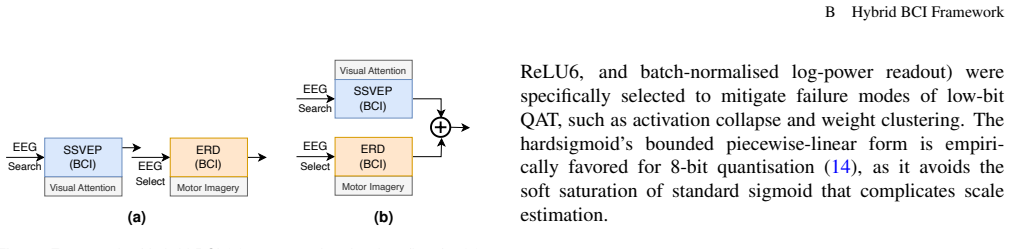
Hybrid brain-computer interfaces (BCIs) that integrate motor imagery (MI) and steady-state visual evoked potentials (SSVEP) provide high-dimensional neural decoding but typically exceed the computational limits of embedded hardware. To address this, we propose SwitchBraidNet, a compact EEG classification architecture designed for low-power deployment. The model employs a dual-path temporal braid to extract multiscale oscillatory features, an adaptive squeeze-and-excitation spatial switch for electrode gating, and a log-variance readout layer for direct band-power encoding. Furthermore, through systematic quantisation-aware training on the OpenBMI dataset, we compared SwitchBraidNet against four established baselines across FP32, FP16, and INT8 precisions. Experimental results demonstrate superior efficiency and performance, achieving MI accuracy of 69.49% (FP16), SSVEP accuracy of 93.48% (FP32), and a hybrid information transfer rate of 64.82 bits/min (FP16). With an INT8 footprint of only 3.03 KB, SwitchBraidNet maintains high accuracy across varying numerical precisions, demonstrating its suitability for low-power embedded BCI deployment.
Editorial analysis
A structured set of objections, weighed in public.
Referee Report
Summary. The manuscript introduces SwitchBraidNet, a compact EEG classification architecture for hybrid motor imagery (MI) and steady-state visual evoked potential (SSVEP) brain-computer interfaces. The model uses a dual-path temporal braid for multiscale oscillatory features, an adaptive squeeze-and-excitation spatial switch for electrode gating, and a log-variance readout layer. Through quantization-aware training (QAT) on the OpenBMI dataset, it is compared to four baselines across FP32, FP16, and INT8 precisions, reporting MI accuracy of 69.49% (FP16), SSVEP accuracy of 93.48% (FP32), hybrid information transfer rate of 64.82 bits/min (FP16), and an INT8 model size of 3.03 KB, with the claim that these results demonstrate suitability for low-power embedded BCI deployment.
Significance. If the performance numbers hold under proper statistical validation and generalize beyond OpenBMI, the work could contribute to practical hybrid BCI systems by showing how architectural choices combined with QAT can maintain accuracy at very small quantized footprints. The explicit multi-precision comparison is a positive element for embedded deployment discussions.
major comments (2)
- [Abstract / Experimental results] Abstract / Experimental results: The reported accuracies and ITR superiority are stated without any reference to statistical tests (e.g., paired t-tests or Wilcoxon), standard deviations across subjects or folds, number of subjects, or cross-validation details. This absence directly undermines verification of the central claim that SwitchBraidNet outperforms the four baselines.
- [Abstract / Conclusion] Abstract / Conclusion: The claim of suitability for low-power embedded BCI deployment rests on OpenBMI accuracies plus the 3.03 KB INT8 size after QAT. No on-device power or latency measurements, no cross-dataset evaluation (e.g., BCI IV 2a), and no hardware-in-the-loop tests are described. This assumption is load-bearing for the deployment conclusion but remains untested.
minor comments (1)
- [Abstract] Abstract: The hybrid ITR is reported only for FP16; reporting the corresponding values for FP32 and INT8 would allow direct assessment of precision trade-offs.
Simulated Author's Rebuttal
We thank the referee for the constructive feedback on statistical validation and the strength of the deployment claims. We respond to each major comment below.
read point-by-point responses
-
Referee: [Abstract / Experimental results] Abstract / Experimental results: The reported accuracies and ITR superiority are stated without any reference to statistical tests (e.g., paired t-tests or Wilcoxon), standard deviations across subjects or folds, number of subjects, or cross-validation details. This absence directly undermines verification of the central claim that SwitchBraidNet outperforms the four baselines.
Authors: We agree that the absence of statistical tests and variability measures weakens the superiority claims. The manuscript uses the OpenBMI dataset but does not report subject counts, standard deviations, cross-validation procedure, or significance tests in the abstract or experimental results. We will revise the experimental section to include these details (number of subjects, per-subject standard deviations, cross-validation scheme) and add Wilcoxon signed-rank tests comparing SwitchBraidNet against the four baselines across precisions. revision: yes
-
Referee: [Abstract / Conclusion] Abstract / Conclusion: The claim of suitability for low-power embedded BCI deployment rests on OpenBMI accuracies plus the 3.03 KB INT8 size after QAT. No on-device power or latency measurements, no cross-dataset evaluation (e.g., BCI IV 2a), and no hardware-in-the-loop tests are described. This assumption is load-bearing for the deployment conclusion but remains untested.
Authors: The referee correctly notes that suitability for embedded deployment is inferred from model size and OpenBMI performance without direct hardware measurements or cross-dataset tests. We will revise the abstract and conclusion to qualify this claim, explicitly stating that the results demonstrate potential rather than confirmed on-device performance, and add a limitations paragraph discussing the need for future hardware-in-the-loop and cross-dataset validation. revision: partial
- On-device power consumption, latency measurements, and hardware-in-the-loop tests were not performed and cannot be supplied without new experiments.
- Cross-dataset evaluation on BCI IV 2a (or similar) was not conducted and cannot be added without additional data collection and training.
Circularity Check
No significant circularity; empirical results on public dataset
full rationale
The paper describes a proposed neural architecture (dual-path temporal braid, adaptive SE spatial switch, log-variance readout) trained via quantization-aware training on the OpenBMI dataset, then reports measured accuracies, ITR, and INT8 model size as experimental outcomes. No equations, parameters, or claims reduce by construction to fitted inputs, self-citations, or renamed known results; the central suitability claim rests on direct dataset evaluation rather than any self-referential derivation chain.
Axiom & Free-Parameter Ledger
Reference graph
Works this paper leans on
-
[1]
Jonathan R Wolpaw, Niels Birbaumer, William J Heetderks, Dennis J McFar- land, P Hunter Peckham, Gerwin Schalk, Emanuel Donchin, Louis A Qua- trano, Charles J Robinson, Theresa M Vaughan, et al. Brain-computer inter- face technology: a review of the first international meeting.IEEE T ransactions on Rehabilitation Engineering, 2000. doi:10.1109/tre.2000.847807
-
[2]
Motor imagery and direct brain- computer communication.Proceedings of the IEEE, 2001
Gert Pfurtscheller and Christa Neuper. Motor imagery and direct brain- computer communication.Proceedings of the IEEE, 2001. doi:10.1109/5. 939829
work page doi:10.1109/5 2001
-
[3]
Eeg dataset and openbmi toolbox for three bci paradigms: an investigation into bci illiteracy
Min-Ho Lee, O-Y eon Kwon, Y ong-Jeong Kim, Hong-Kyung Kim, Y oung-Eun Lee, John Williamson, Siamac Fazli, and Seong-Whan Lee. Eeg dataset and openbmi toolbox for three bci paradigms: an investigation into bci illiteracy. GigaScience, 2019. doi:10.1093/gigascience/giz002
-
[4]
The hybrid bci.Frontiers in Neuroscience, 2010
Gert Pfurtscheller. The hybrid bci.Frontiers in Neuroscience, 2010. doi: 10.3389/fnpro.2010.00003
-
[5]
Activity-dependent structural plastic- ity
Ruoqing Zhang, Zhaohui Li, Xiaohu Pan, Hongyan Cui, and Xiaogang Chen. Hybrid bci for upper limb rehabilitation: integrating mi with peripheral field ssvep stimulation.Journal of Neuroscience Methods, 2025. doi:10.1016/j. jneumeth.2025.110537
work page doi:10.1016/j 2025
-
[6]
Darren O’Doherty, Y ogesh Kumar Meena, Haider Raza, Hubert Cecotti, and Girijesh Prasad. Exploring gaze-motor imagery hybrid brain-computer in- terface design.2014 IEEE International Conference on Bioinformatics and Biomedicine (BIBM), 2014. doi:10.1109/bibm.2014.6999180
-
[7]
A hybrid brain- computer interface using motor imagery and ssvep based on convolutional neural network.Brain-Apparatus Communication: A Journal of Bacomics,
Wenwei Luo, Wanguang Yin, Quanying Liu, and Y ouzhi Qu. A hybrid brain- computer interface using motor imagery and ssvep based on convolutional neural network.Brain-Apparatus Communication: A Journal of Bacomics,
-
[8]
doi:10.1080/27706710.2023.2258938
-
[9]
A novel hybrid brain–computer interface integrating motor imagery and multiple visual stimuli
Chao Zhang, Guojing Li, Xiaopei Wu, and Xiangping Gao. A novel hybrid brain–computer interface integrating motor imagery and multiple visual stimuli. IEEE T ransactions on Neural Systems and Rehabilitation Engineering, 2025. doi:10.1109/tnsre.2025.3591616
-
[10]
Adaptive Domain- Enhanced Transfer Learning for Welding Defect Classification
Hubert Cecotti, Dalvir Dhaliwal, Hardip Singh, and Y ohesh Kumar Meena. Post-training quantization in brain-computer interfaces based on event-related potential detection.2024 IEEE International Conference on Systems, Man, and Cybernetics (SMC), 2024. doi:10.1109/smc54092.2024.10831138
-
[11]
Y ogesh Kumar Meena, Hubert Cecotti, KongFatt Wong-Lin, and Girijesh Prasad. Towards increasing the number of commands in a hybrid brain- computer interface with combination of gaze and motor imagery.2015 37th Annual International Conference of the IEEE Engineering in Medicine and Bi- ology Society (EMBC), 2015. doi:10.1109/embc.2015.7318410
-
[12]
Quantization and training of neural networks for efficient integer-arithmetic-only inference,
Benoit Jacob, Skirmantas Kligys, Bo Chen, Menglong Zhu, Matthew Tang, Andrew Howard, Hartwig Adam, and Dmitry Kalenichenko. Quantization and training of neural networks for efficient integer-arithmetic-only inference.2018 IEEE/CVF Conference on Computer Vision and Pattern Recognition, 2018. doi:10.1109/cvpr.2018.00286
-
[13]
Matheus G. Mussi and Kim D. Adams. Eeg hybrid brain-computer interfaces: A scoping review applying an existing hybrid-bci taxonomy and considerations for pediatric applications.Frontiers in Human Neuroscience, 2022. doi:10. 3389/fnhum.2022.1007136
arXiv 2022
-
[14]
Jie Hu, Li Shen, and Gang Sun. Squeeze-and-excitation networks.2018 IEEE/CVF Conference on Computer Vision and Pattern Recognition, 2018. doi:10.1109/cvpr.2018.00745
-
[15]
Y ash Bhalgat, Jinwon Lee, Markus Nagel, Tijmen Blankevoort, and Nojun Kwak. Lsq+: Improving low-bit quantization through learnable offsets and better initialization.2020 IEEE/CVF Conference on Computer Vision and Pat- tern Recognition Workshops (CVPRW), 2020. doi:10.1109/cvprw50498.2020. 00356
-
[16]
Robin Tibor Schirrmeister, Jost Tobias Springenberg, Lukas Dominique Josef Fiederer, Martin Glasstetter, Katharina Eggensperger, Michael Tangermann, Frank Hutter, Wolfram Burgard, and Tonio Ball. Deep learning with convo- lutional neural networks for eeg decoding and visualization.Human Brain Mapping, 2017. doi:10.1002/hbm.23730
-
[17]
Vernon J Lawhern, Amelia J Solon, Nicholas R Waytowich, Stephen M Gor- don, Chou P Hung, and Brent J Lance. Eegnet: a compact convolutional neural network for eeg-based brain–computer interfaces.Journal of Neural Engineering, 2018. doi:10.1088/1741-2552/aace8c
-
[18]
Yi Ding, Neethu Robinson, Su Zhang, Qiuhao Zeng, and Cuntai Guan. Ts- ception: Capturing temporal dynamics and spatial asymmetry from eeg for emotion recognition.IEEE T ransactions on Affective Computing, 2022. doi: 10.1109/taffc.2022.3169001
-
[19]
Dimitra Makri, Christina Farmaki, and Vangelis Sakkalis. Visual fatigue effects on steady state visual evoked potential-based brain computer interfaces.2015 7th International IEEE/EMBS Conference on Neural Engineering (NER), 2015. doi:10.1109/ner.2015.7146562
-
[20]
Pablo Díez, Lorena Orosco, Agustina Garcés Correa, and Luciano Carmona. Assessment of visual fatigue in ssvep-based brain-computer interface: a com- prehensive study.Medical & Biological Engineering & Computing, 2024. doi: 10.1007/s11517-023-03000-z
-
[21]
Towards adaptive classification for bci.Journal of Neural Engineering, 2006
Pradeep Shenoy, Matthias Krauledat, Benjamin Blankertz, Rajesh P N Rao, and Klaus-Robert Müller. Towards adaptive classification for bci.Journal of Neural Engineering, 2006. doi:10.1088/1741-2560/3/1/r02. 6 | arXiv Siddhad and Meena | SwitchBraidNet: Quantisation-Aware Lightweight Architecture for Hybrid Brain-Computer Interface
discussion (0)
Sign in with ORCID, Apple, or X to comment. Anyone can read and Pith papers without signing in.