Self-Pulsing Microring Resonator Networks for Bandwidth-Efficient Event Detection in an Optical Fiber Sensor
Pith reviewed 2026-06-27 08:49 UTC · model grok-4.3
The pith
Self-pulsing dynamics in a microring resonator network retain information from fiber sensor perturbations, reducing the required sampling rate by at least an order of magnitude.
A machine-rendered reading of the paper's core claim, the machinery that carries it, and where it could break.
Core claim
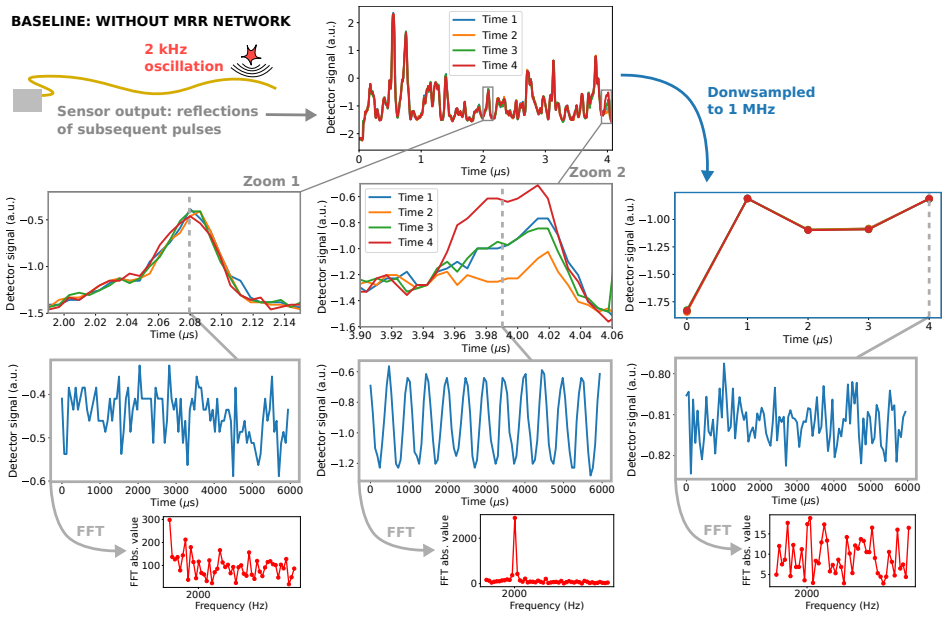
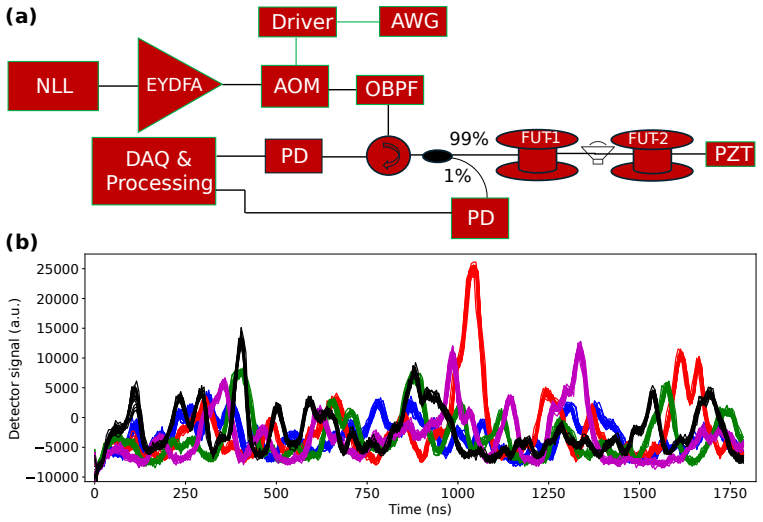
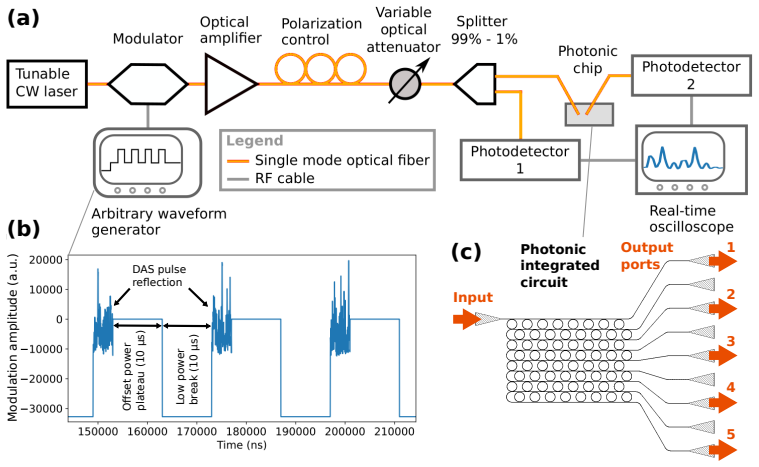
We experimentally show that these limitations can be overcome by exploiting the self-pulsing dynamics in a microring resonator network. In particular, we demonstrate that such dynamics can expand and retain information about perturbations sensed by a fiber sensor. This reduces the minimum sampling rate for the digitization of the sensor signal by at least one order of magnitude. The reduction is achieved by combining fiber sensing measurements at two different perturbation locations and frequencies with MRR network measurements at multiple output ports, input power levels and laser wavelengths.
What carries the argument
Self-pulsing dynamics in the MRR network that expand and retain perturbation information when combined across multiple output ports, input power levels, and laser wavelengths.
If this is right
- Fiber sensor signals with sub-MHz dynamics can be processed optically with far lower digitization rates.
- Native photonic processing reduces the need for fast digital electronics and associated power use.
- Multiple MRR measurement conditions together create independent channels sufficient for event detection.
- The approach directly connects time-dependent optical operations to sensing at sub-microsecond scales.
Where Pith is reading between the lines
- The same retention mechanism could apply to other slow optical signals in integrated photonics beyond fiber sensing.
- Lower sampling demands may enable denser or lower-power distributed sensor networks.
- Full integration of the MRR network with the sensor could eliminate electronic digitization steps entirely.
Load-bearing premise
The combination of measurements from multiple MRR output ports, input power levels, and laser wavelengths supplies enough independent information to recover or detect the original sensor perturbations despite the reduced sampling rate.
What would settle it
An experiment in which the original perturbation locations and frequencies cannot be recovered from the combined low-rate MRR outputs and sensor data would falsify the central claim.
Figures



read the original abstract
The native processing of time-dependent signals from optical sensors by integrated photonic circuits can potentially bring significant advantages in terms of energy consumption, latency and processing power, as it allows skipping or reducing the use of fast digital electronics and directly exploiting optical degrees of freedom and parallelism. However, due to a short memory, optical operations usually struggle to directly process optical signals with relatively slow (<MHz) dynamics from optical sensors. In this work, we experimentally show that these limitations can be overcome by exploiting the self-pulsing dynamics in a microring resonator (MRR) network. In particular, we demonstrate that such dynamics can expand and retain information about perturbations sensed by a fiber sensor. This reduces the minimum sampling rate for the digitization of the sensor signal by at least one order of magnitude. The reduction is achieved by combining fiber sensing measurements at two different perturbation locations and frequencies with MRR network measurements at multiple output ports, input power levels and laser wavelengths. This work represents a first step in bridging time-dependent optical processing and optical sensing at sub-{\mu}s time scales.
Editorial analysis
A structured set of objections, weighed in public.
Referee Report
Summary. The paper claims that exploiting self-pulsing dynamics in a microring resonator (MRR) network can expand and retain information about perturbations sensed by a fiber sensor, reducing the minimum sampling rate for digitization by at least one order of magnitude. This is demonstrated experimentally by combining fiber sensing measurements at two different perturbation locations and frequencies with MRR network measurements at multiple output ports, input power levels and laser wavelengths.
Significance. If the result holds, it provides a first step in bridging time-dependent optical processing and optical sensing at sub-μs time scales, with potential advantages in energy consumption, latency and processing power by skipping or reducing the use of fast digital electronics.
major comments (1)
- Abstract: The abstract states an experimental demonstration and reduction factor but supplies no quantitative data, error analysis, reconstruction method, or verification that the retained information suffices for event detection; full methods and results required.
Simulated Author's Rebuttal
We thank the referee for their review. We address the single major comment below.
read point-by-point responses
-
Referee: Abstract: The abstract states an experimental demonstration and reduction factor but supplies no quantitative data, error analysis, reconstruction method, or verification that the retained information suffices for event detection; full methods and results required.
Authors: Abstracts are length-limited summaries and cannot contain full methods, error bars, or complete verification. The manuscript body provides the experimental data from two perturbation locations/frequencies, MRR measurements at multiple ports/power levels/wavelengths, the reconstruction procedure, and verification that event information is retained at the reduced sampling rate. We will revise the abstract to include one concrete reduction factor (with uncertainty) drawn from the results section and a brief clause on the verification approach. revision: yes
Circularity Check
No significant circularity; purely experimental result
full rationale
The manuscript is an experimental demonstration that self-pulsing MRR dynamics, combined with multi-port/power/wavelength measurements, can retain perturbation information sufficiently to allow an order-of-magnitude reduction in digitization sampling rate. No equations, derivations, fitted parameters, or load-bearing self-citations appear in the abstract or described claims. The result is settled by direct measurement and does not reduce to any input by construction.
Axiom & Free-Parameter Ledger
Reference graph
Works this paper leans on
-
[1]
Integrated photonic computing beyond the von neumann architecture.ACS Photonics, 10(4):1027–1036, 2023
Xiao-Yun Xu and Xian-Min Jin. Integrated photonic computing beyond the von neumann architecture.ACS Photonics, 10(4):1027–1036, 2023
2023
-
[2]
Analog photonics computing for information processing, inference, and optimization.Advanced Quantum Technologies, 6(9):2300055, 2023
Nikita Stroev and Natalia G Berloff. Analog photonics computing for information processing, inference, and optimization.Advanced Quantum Technologies, 6(9):2300055, 2023
2023
-
[3]
The potential of multidimensional photonic computing.Nature Reviews Physics, 7(8):439–450, 2025
Ivonne Bente, Shabnam Taheriniya, Francesco Lenzini, Frank Brückerhoff-Plückelmann, Michael Kues, Harish Bhaskaran, C David Wright, and Wolfram Pernice. The potential of multidimensional photonic computing.Nature Reviews Physics, 7(8):439–450, 2025
2025
-
[4]
Roadmap on neuromorphic photonics,
Daniel Brunner, Bhavin J Shastri, Mohammed A Al Qadasi, Hitesh Ballani, Sylvain Barbay, Stefano Biasi, Peter Bienstman, Simon Bilodeau, Wim Bogaerts, Fabian Böhm, et al. Roadmap on neuromorphic photonics.arXiv preprint arXiv:2501.07917, 2025
-
[5]
Integrated in-sensor computing optoelectronic device for environment-adaptable artificial retina perception application.Nano letters, 22(1):81–89, 2021
Jialin Meng, Tianyu Wang, Hao Zhu, Li Ji, Wenzhong Bao, Peng Zhou, Lin Chen, Qing-Qing Sun, and David Wei Zhang. Integrated in-sensor computing optoelectronic device for environment-adaptable artificial retina perception application.Nano letters, 22(1):81–89, 2021
2021
-
[6]
Multimodal in-sensor computing system using integrated silicon photonic convolutional processor
Zian Xiao, Zhihao Ren, Yangyang Zhuge, Zixuan Zhang, Jingkai Zhou, Siyu Xu, Cheng Xu, Bowei Dong, and Chengkuo Lee. Multimodal in-sensor computing system using integrated silicon photonic convolutional processor. Advanced Science, 11(47):2408597, 2024
2024
-
[7]
Near-sensor edge computing system enabled by a cmos compatible photonic integrated circuit platform using bilayer aln/si waveguides.Nano-Micro Letters, 17(1):261, 2025
Zhihao Ren, Zixuan Zhang, Yangyang Zhuge, Zian Xiao, Siyu Xu, Jingkai Zhou, and Chengkuo Lee. Near-sensor edge computing system enabled by a cmos compatible photonic integrated circuit platform using bilayer aln/si waveguides.Nano-Micro Letters, 17(1):261, 2025
2025
-
[8]
Technology landscape review of in-sensor photonic intelligence: from optical sensors to smart devices.AI Sensors, 1(1):5, 2025
Hong Zhou, Dongxiao Li, and Chengkuo Lee. Technology landscape review of in-sensor photonic intelligence: from optical sensors to smart devices.AI Sensors, 1(1):5, 2025
2025
-
[9]
Nanosecond-latency all-optical fiber sensing with in-sensor computing
Yu Tao, Yangyang Wan, Ziwen Long, Wenjia Zhang, Jiangbing Du, and Zuyuan He. Nanosecond-latency all-optical fiber sensing with in-sensor computing.arXiv preprint arXiv:2507.15376, 2025
work page internal anchor Pith review Pith/arXiv arXiv 2025
-
[10]
Alessandro Foradori, Ilya Auslender, Stefano Biasi, Stefano Gretter, Alessio Lugnan, Emiliano Staffoli, and Lorenzo Pavesi. Memory in integrated photonic neural networks: From physical mechanisms to neuromorphic architectures.arXiv preprint arXiv:2604.22620, 2026
work page internal anchor Pith review Pith/arXiv arXiv 2026
-
[11]
Silicon microring resonators.Laser & Photonics Reviews, 6(1):47–73, 2012
Wim Bogaerts, Peter De Heyn, Thomas Van Vaerenbergh, Katrien De V os, Shankar Kumar Selvaraja, Tom Claes, Pieter Dumon, Peter Bienstman, Dries Van Thourhout, and Roel Baets. Silicon microring resonators.Laser & Photonics Reviews, 6(1):47–73, 2012
2012
-
[12]
Nonlinear silicon photonics.Nature photonics, 4(8):535– 544, 2010
Juerg Leuthold, Christian Koos, and Wolfgang Freude. Nonlinear silicon photonics.Nature photonics, 4(8):535– 544, 2010
2010
-
[13]
Nonlinear silicon photonics.Journal of Optics, 19(9):093002, 2017
Massimo Borghi, Claudio Castellan, Stefano Signorini, Alessandro Trenti, and Lorenzo Pavesi. Nonlinear silicon photonics.Journal of Optics, 19(9):093002, 2017
2017
-
[14]
Johnson, Matthew Borselli, and Oskar Painter
Thomas J. Johnson, Matthew Borselli, and Oskar Painter. Self-induced optical modulation of the transmission through a high-q silicon microdisk resonator.Opt. Express, 14(2):817–831, Jan 2006
2006
-
[15]
On the effect of the thermal cross-talk in a photonic feed-forward neural network based on silicon microresonators.Frontiers in Physics, 10:1093191, 2022
Stefano Biasi, Riccardo Franchi, Davide Bazzanella, and Lorenzo Pavesi. On the effect of the thermal cross-talk in a photonic feed-forward neural network based on silicon microresonators.Frontiers in Physics, 10:1093191, 2022. 12
2022
-
[16]
Simplified description of self- pulsation and excitability by thermal and free-carrier effects in semiconductor microcavities.Phys
Thomas Van Vaerenbergh, Martin Fiers, Joni Dambre, and Peter Bienstman. Simplified description of self- pulsation and excitability by thermal and free-carrier effects in semiconductor microcavities.Phys. Rev. A, 86:063808, Dec 2012
2012
-
[17]
On the modeling of thermal and free carrier nonlinearities in silicon-on-insulator microring resonators.Optics Express, 29(3):4363–4377, 2021
Massimo Borghi, Davide Bazzanella, Mattia Mancinelli, and Lorenzo Pavesi. On the modeling of thermal and free carrier nonlinearities in silicon-on-insulator microring resonators.Optics Express, 29(3):4363–4377, 2021
2021
-
[18]
Optical bistability and pulsating behaviour in silicon-on-insulator ring resonator structures.Optics express, 13(23):9623– 9628, 2005
Gino Priem, Pieter Dumon, Walter Bogaerts, Dries Van Thourhout, Geert Morthier, and Roel Baets. Optical bistability and pulsating behaviour in silicon-on-insulator ring resonator structures.Optics express, 13(23):9623– 9628, 2005
2005
-
[19]
Thirty years in silicon photonics: a personal view.Frontiers in Physics, page 709, 2021
Lorenzo Pavesi. Thirty years in silicon photonics: a personal view.Frontiers in Physics, page 709, 2021
2021
-
[20]
Chaotic dynamics in coupled resonator sequences.Optics express, 22(12):14505–14516, 2014
Mattia Mancinelli, Massimo Borghi, Fernando Ramiro-Manzano, JM Fedeli, and Lorenzo Pavesi. Chaotic dynamics in coupled resonator sequences.Optics express, 22(12):14505–14516, 2014
2014
-
[21]
Photonic neural networks based on integrated silicon microresonators.Intelligent Computing, 3:0067, 2024
Stefano Biasi, Giovanni Donati, Alessio Lugnan, Mattia Mancinelli, Emiliano Staffoli, and Lorenzo Pavesi. Photonic neural networks based on integrated silicon microresonators.Intelligent Computing, 3:0067, 2024
2024
-
[22]
Recent advances in distributed acoustic sensing based on phase-sensitive optical time domain reflectometry.Journal of Sensors, 2018(1):3897873, 2018
Yonas Muanenda. Recent advances in distributed acoustic sensing based on phase-sensitive optical time domain reflectometry.Journal of Sensors, 2018(1):3897873, 2018
2018
-
[23]
CRC press, 2017
Arthur H Hartog.An introduction to distributed optical fibre sensors. CRC press, 2017
2017
-
[24]
Seismic monitoring with distributed acoustic sensing from the near-surface to the deep oceans.Journal of Lightwave Technology, 40(5):1453–1463, 2022
María R Fernández-Ruiz, Hugo F Martins, Ethan F Williams, Carlos Becerril, Regina Magalhães, Luis Costa, Sonia Martin-Lopez, Zhensheng Jia, Zhongwen Zhan, and Miguel González-Herráez. Seismic monitoring with distributed acoustic sensing from the near-surface to the deep oceans.Journal of Lightwave Technology, 40(5):1453–1463, 2022
2022
-
[25]
Distributed acoustic sensing (das) for large-scale urban monitoring and seismic hazard mitigation using preexisting telecommunication infrastructure
Rongyi Qian, Fantine Huot, Eileen Martin, Zack Spica, and Biondo Biondi. Distributed acoustic sensing (das) for large-scale urban monitoring and seismic hazard mitigation using preexisting telecommunication infrastructure. InSEG 2019 Workshop: Geophysics for Smart City Development, pages 1–1. GeoScienceWorld, 2019
2019
-
[26]
Hugo F Martins, Sonia Martin-Lopez, Pedro Corredera, Massimo L Filograno, Orlando Frazão, and Miguel González-Herráez. Coherent noise reduction in high visibility phase-sensitive optical time domain reflectometer for distributed sensing of ultrasonic waves.Journal of Lightwave Technology, 31(23):3631–3637, 2013
2013
-
[27]
Machine-learning-assisted leak detection using distributed temperature and acoustic sensors.IEEE Sensors Journal, 24(2):1520–1531, 2023
Hayden Gemeinhardt and Jyotsna Sharma. Machine-learning-assisted leak detection using distributed temperature and acoustic sensors.IEEE Sensors Journal, 24(2):1520–1531, 2023
2023
-
[28]
Design and evaluation of a cloud computing system for real-time measurements in polarization-independent long-range das based on coherent detection.Sensors, 24(24):8194, 2024
Abdusomad Nur, Almaz Demise, and Yonas Muanenda. Design and evaluation of a cloud computing system for real-time measurements in polarization-independent long-range das based on coherent detection.Sensors, 24(24):8194, 2024
2024
-
[29]
Strategies for mitigating polarization fading in a das with homodyne detection and delayed self-mixing.Journal of Physics: Photonics, 7(4):045035, 2025
Almaz Demise, Fabrizio Di Pasquale, and Yonas Muanenda. Strategies for mitigating polarization fading in a das with homodyne detection and delayed self-mixing.Journal of Physics: Photonics, 7(4):045035, 2025
2025
-
[30]
Distributed optical fiber vibration sensing using phase-generated carrier demodulation algorithm
Zhihua Yu, Qi Zhang, Mingyu Zhang, Haolong Dai, Jingjing Zhang, Li Liu, Lijun Zhang, Xing Jin, Gaifang Wang, and Guang Qi. Distributed optical fiber vibration sensing using phase-generated carrier demodulation algorithm. Applied Physics B, 124(5):84, 2018
2018
-
[31]
Adaptable pulse compression in ϕ-OTDR with direct digital synthesis of probe waveforms and rigorously defined nonlinear chirping.IEEE Photonics Journal, 14(2):1–11, 2022
Yonas Muanenda, Stefano Faralli, Claudio J Oton, Philippe Velha, and Fabrizio Di Pasquale. Adaptable pulse compression in ϕ-OTDR with direct digital synthesis of probe waveforms and rigorously defined nonlinear chirping.IEEE Photonics Journal, 14(2):1–11, 2022
2022
-
[32]
Cascadable excitability in microrings.Optics express, 20(18):20292–20308, 2012
Thomas Van Vaerenbergh, Martin Fiers, Pauline Mechet, Thijs Spuesens, Rajesh Kumar, Geert Morthier, Ben- jamin Schrauwen, Joni Dambre, and Peter Bienstman. Cascadable excitability in microrings.Optics express, 20(18):20292–20308, 2012
2012
-
[33]
All-optical silicon microring spiking neuron.Photonics Research, 10(4):939–946, 2022
Jinlong Xiang, Yujia Zhang, Yaotian Zhao, Xuhan Guo, and Yikai Su. All-optical silicon microring spiking neuron.Photonics Research, 10(4):939–946, 2022
2022
-
[34]
Rigorous dynamic model of a silicon ring resonator with phase change material for a neuromorphic node.Optics Express, 30(14):25177– 25194, 2022
Alessio Lugnan, Santiago García-Cuevas Carrillo, C David Wright, and Peter Bienstman. Rigorous dynamic model of a silicon ring resonator with phase change material for a neuromorphic node.Optics Express, 30(14):25177– 25194, 2022
2022
-
[35]
Exploring the potential of self-pulsing optical microresonators for spiking neural networks and sensing.Communications Physics, 7(1):380, 2024
Stefano Biasi, Alessio Lugnan, Davide Micheli, and Lorenzo Pavesi. Exploring the potential of self-pulsing optical microresonators for spiking neural networks and sensing.Communications Physics, 7(1):380, 2024
2024
-
[36]
All-optical spiking processing and reservoir computing with a passive silicon microring and wavelength-time division multiplexing.Photonics Research, 13(9):2641–2653, 2025
Giovanni Donati, Stefano Biasi, Lorenzo Pavesi, and Antonio Hurtado. All-optical spiking processing and reservoir computing with a passive silicon microring and wavelength-time division multiplexing.Photonics Research, 13(9):2641–2653, 2025. 13
2025
-
[37]
Photonic neuromorphic processing with on-chip electrically-driven microring spiking neuron.Laser & Photonics Reviews, 19(3):2400604, 2025
Jinlong Xiang, Yaotian Zhao, An He, Jie Xiao, Yikai Su, and Xuhan Guo. Photonic neuromorphic processing with on-chip electrically-driven microring spiking neuron.Laser & Photonics Reviews, 19(3):2400604, 2025
2025
-
[38]
Micro ring resonators as building blocks for an all-optical high-speed reservoir-computing bit-pattern-recognition system.JOSA B, 30(11):3048–3055, 2013
Charis Mesaritakis, Vassilis Papataxiarhis, and Dimitris Syvridis. Micro ring resonators as building blocks for an all-optical high-speed reservoir-computing bit-pattern-recognition system.JOSA B, 30(11):3048–3055, 2013
2013
-
[39]
Reservoir computing based on a silicon microring and time multiplexing for binary and analog operations.Scientific Reports, 11(1):15642, 2021
Massimo Borghi, Stefano Biasi, and Lorenzo Pavesi. Reservoir computing based on a silicon microring and time multiplexing for binary and analog operations.Scientific Reports, 11(1):15642, 2021
2021
-
[40]
Time delay reservoir computing with a silicon microring resonator and a fiber-based optical feedback loop.Optics Express, 32(8):13419–13437, 2024
Giovanni Donati, Apostolos Argyris, Mattia Mancinelli, Claudio R Mirasso, and Lorenzo Pavesi. Time delay reservoir computing with a silicon microring resonator and a fiber-based optical feedback loop.Optics Express, 32(8):13419–13437, 2024
2024
-
[41]
Emergent self-adaptation in an integrated photonic neural network for backpropagation-free learning.Advanced Science, 12(2):2404920, 2025
Alessio Lugnan, Samarth Aggarwal, Frank Brückerhoff-Plückelmann, C David Wright, Wolfram HP Pernice, Harish Bhaskaran, and Peter Bienstman. Emergent self-adaptation in an integrated photonic neural network for backpropagation-free learning.Advanced Science, 12(2):2404920, 2025
2025
-
[42]
Reservoir computing with all-optical non-fading memory in a self-pulsing microresonator network.Advanced Optical Materials, 13(11):2403133, 2025
Alessio Lugnan, Stefano Biasi, Alessandro Foradori, Peter Bienstman, and Lorenzo Pavesi. Reservoir computing with all-optical non-fading memory in a self-pulsing microresonator network.Advanced Optical Materials, 13(11):2403133, 2025
2025
-
[43]
Alessandro Foradori, Alessio Lugnan, Lorenzo Pavesi, and Peter Bienstman. Neuromorphic photonic circuits with nonlinear dynamics and memory for time sequence classification.arXiv preprint arXiv:2509.11721, 2025
work page internal anchor Pith review arXiv 2025
-
[44]
Giovanni Donati, Stefano Biasi, Lorenzo Pavesi, and Antonio Hurtado. Photonic neuromorphic processing with coupled spiking silicon microrings.arXiv preprint arXiv:2602.05918, 2026
-
[45]
A compact source for a distributed acoustic sensor using a miniaturized EYDFA and a direct digital synthesis module
Almaz Demise, Fabrizio Di Pasquale, and Yonas Muanenda. A compact source for a distributed acoustic sensor using a miniaturized EYDFA and a direct digital synthesis module. InSPIE Future Sensing Technologies 2023, volume 12327, page 1232720. SPIE, 2023. 14
2023
discussion (0)
Sign in with ORCID, Apple, or X to comment. Anyone can read and Pith papers without signing in.