REVIEW 4 major objections 5 minor 1 cited by
Towards Copyright Protection for Knowledge Bases of Retrieval-augmented Language Models via Reasoning
T0 review · 4 major / 5 minor · reviewed 2026-08-08 · deepseek-v4-flash
Pith's one-line read RAGC⃝ watermarks a RAG knowledge base in the chain-of-thought space, so unauthorized use can be proven by black-box queries while final answers stay correct.
desk verdict Fresh idea with real promise, but the verification test as stated is internally inconsistent—fix that plus validation and it could be a solid paper. read the letter →
The pith
A machine-rendered reading of the paper's core claim, the machinery that carries it, and where it could break.
The reading
What carries the argument
The carrying mechanism is a retrieval-contrast watermark: each verification question gets an optimized rare-word phrase appended, and the corresponding target chain-of-thought is rewritten so that both sit at a large embedding distance from the top-k benign neighbors of the question, making the pair retrievable only by the watermarked query in the surrogate retriever's space. The theoretical anchor is Theorem 3.2, an upper bound on the probability that the target chain is not retrieved; it shows that retrieval error is controlled by the similarity between the watermarked question and other knowledge-base passages and motivates the two optimization objectives (embedding distance for the phrase, and for the target chain). Ownership is detected by a pairwise Wilcoxon test over an LLM judge's binary judgments of whether each answer contains the target chain's information.
What would settle it
Take the watermarked knowledge base and pair it with a retrieval stack far from the surrogate—for example a lexical BM25 retriever or a dense retriever followed by a reranker—and measure the verification success rate on the same 100 questions. If the watermarked query no longer retrieves the target chain and the success rate falls toward chance (well below the reported 0.73–0.92) while innocent questions still behave normally, the central transferability claim would be falsified.
Extended reading notes
Core claim
The central claim, stated on the paper's own terms, is that knowledge-base copyright can be verified without sacrificing answer correctness by moving the watermark from the output space into reasoning space. RAGC⃝ picks verification questions, asks an advanced LLM to write two distinct but innocent chains of thought that both lead to the correct answer, and injects the target chain, tagged with an optimized rare-word watermark phrase, into the knowledge base. The phrase and the target chain are optimized to sit far from benign neighbor passages in a surrogate retriever's embedding space, so that the watermarked question—and ideally no other question—retrieves the target chain and reasons from it, while ordinary questions retrieve the non-target chain. The final answer is therefore correct in both cases, which is what makes the watermark 'harmless.' Ownership is then decided by a paired Wilcoxon test on an LLM judge's answers to watermarked versus plain verification questions; across three QA benchmarks and four LLMs, the paper reports verification success rates of 0.73–0.92 with harmfulness below 0.25 and malicious-use p-values at or below $10^{-6}$.
Load-bearing premise
The load-bearing premise is that a watermark phrase and a rewritten target chain optimized in a stand-in retriever's embedding space will still be retrieved by the watermarked question when the unauthorized system uses a different retriever, and that the downstream LLM will actually reason from the retrieved chain.
Editorial extensions
If this is right
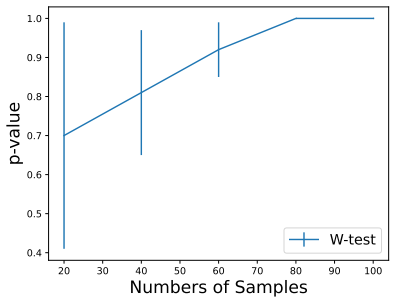
- Knowledge-base owners can run an ownership check through a public LLM API using about 100 verification questions; innocent systems give p-values near 1 while unauthorized use gives p-values at or below 10^-6.
- Backdoor- and poisoning-based knowledge-base watermarks are at a comparative disadvantage: they force wrong answers (harmfulness above 0.8), making them detectable, while RAGC⃝ keeps detection rates at or below 0.05.
- The watermark withstands the tested adaptive defenses—perplexity filtering and query rephrasing—with verification success between 0.435 and 0.623, well above chance.
- Optimizing the watermark with a stand-in retriever transfers to the other dense retrievers tested, so the owner does not need to know the adversary's exact retriever in advance.
Reading between the lines
- Editorial inference: the scheme's transferability is the point most likely to break; if a real adversary uses a lexical retriever, a reranker, or an embedding model trained on very different data, the optimized trigger may no longer pull the target chain into context, and the reported success rates would drop.
- Editorial inference: the statistical guarantee is only as strong as the LLM judge, since a failure to recognize a paraphrased target chain would raise the number of questions needed to reach a given significance level.
- Editorial inference: if the principle holds, the same reasoning-space watermark could be adapted to multimodal retrieval systems or agent memory, because it only requires an embedding space and a text interface.
- Editorial inference: the method detects misuse after the fact; it does not prevent copying, so real-world protection would still pair the watermark with contracts or policy enforcement.
Editorial analysis
A structured set of objections, weighed in public.
Referee Report
Summary. The paper proposes RAGC⃝, a watermarking scheme for protecting the knowledge bases used in retrieval-augmented generation (RAG). The method selects a small set of verification questions, generates two 'innocent' chain-of-thought (CoT) answers for each (a target CoT and a non-target CoT), optimizes a watermark phrase and the target CoT using a surrogate retriever so that only the watermarked verification question retrieves the target CoT, and then verifies ownership by querying a suspicious RAG system with watermarked and benign verification questions and testing, via a pairwise Wilcoxon test, whether the responses contain the target CoT information. Experiments on NQ, HotpotQA, and MS-MARCO with GPT-3.5/4 and LLaMA-2/3 report verification success rates of 0.73–0.92 with harmfulness below 0.25, p-values near 10^-8 for malicious use, and some robustness to PPL filtering and query rephrasing.
Significance. If the claims were fully supported, this would be a noteworthy step: it is the first black-box, text-only ownership-verification method for RAG knowledge bases that does not corrupt the LLM's final answer, and the empirical observation that reasoning-space watermarks can preserve answer correctness while remaining detectable is interesting and potentially useful. The paper also gives a concrete three-stage pipeline and evaluates across three knowledge-base benchmarks and four LLMs, which is a solid empirical scope. The 'harmless' property is operationalized and measured, and the paper includes a useful comparison against PoisonedRAG, AgentPoison, and BadChain. However, the theoretical and statistical foundations as written do not support the central claims: Proposition 3.3's test statistic is inconsistent with the reported p-values, and Theorem 3.2 is essentially a restatement of the retrieval failure event rather than an independent bound. These issues affect the core verification claim and must be resolved before the results can be relied upon.
major comments (4)
- [Section 3.4, Proposition 3.3; Table 2] The stated test statistic is inverted relative to the intended detection scenario. With C(X')=2*I{T in f(X')}-1 and C(X)=2*I{T in f(X)}-1, the malicious case is defined by T in f(X') and T not in f(X), which gives C(X')+C(X)=+1+(-1)=0. Thus the null hypothesis H0: C(X')+C(X)=0 is true in exactly the case the method should flag. In the independent scenarios both C(X') and C(X) are -1, so the sum is -2, which is neither H0 nor the one-sided alternative H1: C(X')+C(X)>0; the test is not defined there. Consequently, the p-values in Table 2 (10^-8 for Malicious and 1.00 for independent scenarios) cannot follow from the stated proposition. The reported results would be consistent with the paired statistic C(X')-C(X), not C(X')+C(X). Because no code is released and Appendix B.4 only documents the GPT-4 judge template, the reader cannot determine which statistic was actually implemented. This is a load-bearing defect in the ownership-verification claim and must be corrected and re-evaluated.
- [Theorem 3.2 and Appendix A, Eq. (1)] The purported retrieval-error bound does not provide an independent upper bound. The right-hand side of Eq. (1) is a function of P[s_theta_q(x⊕δ,t⊕δ) < s_theta_q(x⊕δ,D-(t⊕δ))], which is essentially the definition of the event that the target CoT loses the retrieval competition to the rest of the knowledge base, i.e., the very retrieval-failure event being bounded. The proof in Appendix A rewrites the target event as a max-over-negatives inequality and then applies a union bound without introducing a measurable proxy, a distributional assumption, or a Lipschitz/embedding regularity condition. The theorem therefore restates the objective rather than independently justifying it, and it cannot be said to provide a theoretical foundation for the optimization in Eq. (2). The authors should either replace this theorem with a genuine bound on an observable quantity or explicitly present Eq. (2) as a heuristic.
- [Section 3.3, Eq. (2); Section 4.1; Table 11] The central reliability premise—that only watermarked verification queries retrieve the optimized target CoT—is optimized with a surrogate retriever (Contriever-ms) but evaluated mainly with Contriever. The transferability test in Table 11 covers only Contriever and ANCE, which are all dense dual-encoder models with similar training distributions. The claim is not established for a substantially different retriever, a reranking pipeline, a sparse lexical retriever, or an LLM that ignores retrieved context. This is a correctness-risk concern for the core mechanism, not merely a presentation issue. Please state this as an explicit limitation and, ideally, evaluate at least one architecturally different retriever or reranker.
- [Section 4.5, Table 3] The robustness claim is stronger than the data shown. Under the PPL Filter, VSR drops from the Table 1 range of roughly 0.73–0.92 to 0.40–0.57, and under Rephrasing, RAGC⃝-L drops to 0.415. These numbers may still support practical verification, but the paper describes the method as 'resistant' without reporting the end-to-end ownership-verification p-values, false-positive rates, or harmfulness under these attacks. Please either report the verification performance under attack or temper the robustness claim accordingly.
minor comments (5)
- [Throughout, but especially Section 3.3 and Theorem 3.2] The paper repeatedly writes 'watermark phase' where 'watermark phrase' is meant (e.g., Theorem 3.2 and the paragraph after Eq. (2)); please proofread for this and similar typos.
- [Appendix K] The reproducibility statement says codes and model checkpoints are provided in the supplementary material, but the final sentence says full codes will be released upon acceptance; please clarify what is actually available to reviewers.
- [Table 1] For the backdoor/poisoning baselines, the VSR and H columns are identical by construction (the watermark succeeds exactly when the final answer is incorrect); a footnote stating this would prevent readers from interpreting the two columns as independent measurements.
- [Table 3 and Appendix F.3] The baseline name is spelled 'PoisonRAG' in Appendix F.3 and Table 10 but 'PoisonedRAG' in the main text; please standardize the name. There are also minor capitalization inconsistencies for 'LlaMA2' in Table 3.
- [Section 3.4] The implementation of the pairwise Wilcoxon test is not fully specified: the paper does not state how ties in the discrete C values are handled (e.g., Pratt vs. default handling) or whether the test is one-sided. This detail matters for reproducibility because the C values take only values in {-1,+1}.
Circularity Check
The ownership-verification test is defined so the 'malicious' case satisfies H0, while Theorem 3.2 restates retrieval failure as its own bound; the reported p-values follow from a different statistic than the one stated.
-
self definitional
[Section 3.4, Proposition 3.3]
"Proposition 3.3. Let X, X′, T denote ... C(X′) ≜ 2·I{T ∈ f(X′)}−1 and C(X) ≜ 2·I{T ∈ f(X)}−1. Given the null hypothesis H0: C(X′)+C(X)=0 (H1: C(X′)+C(X)>0), we claim that it is built with the protected knowledge base if and only if H0 is rejected."
In the 'Malicious' scenario defined in Section 4.3, the watermarked query retrieves the target CoT and the benign query does not, so I{T∈f(X′)} = 1 and I{T∈f(X)} = 0, giving C(X′)=+1 and C(X)=−1. The stated statistic C(X′)+C(X) is therefore exactly 0, i.e., H0 holds. The proposition consequently asserts that the protected-KB case is the null hypothesis, so 'reject H0' cannot be the ownership criterion. Table 2's p≈10^-8 can only arise from the paired statistic C(X′)−C(X), which is not what Proposition 3.3 states. The claimed verification conclusion is thus not derived from the test as written; the positive signal is defined into the null.
-
other
[Section 3.3, Theorem 3.2 and Appendix A]
"Theorem 3.2 indicates that the upper bound of the retrieval error rate of the watermarked target CoT is related to the similarity between the verification question containing the watermark phrase and other instances within the knowledge base without the watermark on the hidden space. Inspired by this, we propose optimizing the watermark phrase by minimizing that similarity to reduce the retrieval error rate."
The theorem's inequality bounds P[t⊕δ ∉ Z(x⊕δ,D)] by a quantity containing P[sθq(x⊕δ,t⊕δ) < sθq(x⊕δ,D−(t⊕δ))]. In the proof in Appendix A, the failure event is rewritten as 'max over negative instances beats the target', which is exactly the event that some other instance outranks t⊕δ under the same similarity function. Thus the RHS is a union-bound restatement of the very event whose probability is being bounded, rather than an independent theoretical justification. Equation (2) then maximizes the distance from top-k neighbors, directly minimizing that same ranking event, so the later VSR measures the objective that was optimized rather than a first-principles prediction.
full rationale
RAGC's watermark construction and VSR measurements are largely self-contained empirically: the watermark phrases and target CoTs are optimized with surrogate retriever Contriever-ms and evaluated on Contriever and ANCE, and the harmfulness/accuracy numbers are external checks, so the core watermarking claim does not reduce to a simple fit. However, two load-bearing parts of the derivation are self-definitional as written. First, Proposition 3.3 defines H0 as C(X')+C(X)=0 with C values ±1; the Malicious scenario (target CoT in the watermarked response, absent from the benign response) makes this sum exactly 0, so H0 is true precisely when the KB is used. Table 2's p=10^-8 cannot follow from the stated test and only makes sense for the unstated paired statistic C(X')−C(X). This is a definitional collapse of the verification criterion. Second, Theorem 3.2's retrieval-error bound rewrites 'target not retrieved' as 'some other instance has higher similarity than the target' and then bounds that same event by itself via a union bound; Eq. (2) directly maximizes that separation, so the 'theoretical foundation' restates the objective rather than independently predicting VSR. The self-citations in the paper are not load-bearing: they support related work and baseline choices, not the central derivation. On balance, the empirical watermarking content has independent support, but the central ownership-verification derivation and the stated theoretical bound reduce to their own definitions, giving a partial circularity score of 6.
Assumptions & free parameters
free parameters (6)
- Significance level alpha =
0.01
- Number of retrieved instances k =
5
- Number of verification questions m =
100
- Number of injected target texts per question N =
2
- Watermark phrase length constraint =
2 to 10 rare words
- Watermark phrase position =
end of question or CoT
assumptions (5)
- domain assumption The retriever returns top-k instances by cosine similarity in the embedding space, and the LLM incorporates retrieved texts via in-context learning.
- domain assumption The GPT-4 judge can reliably determine whether an answer contains the information of the target CoT.
- domain assumption The surrogate retriever Contriever-ms is a sufficiently good proxy for the unknown target retriever.
- standard math Union bound arguments in the proof of Theorem 3.2 are valid.
- domain assumption The verification questions used in evaluation are representative of defender-chosen queries.
Cite this review
Pith. "Pith review of Towards Copyright Protection for Knowledge Bases of Retrieval-augmented Language Models via Reasoning." pith.science (2026). https://pith.science/paper/MGLYSZSQ
@misc{pith2026250210440,
  author       = {Pith},
  title        = {Pith review of: Towards Copyright Protection for Knowledge Bases of Retrieval-augmented Language Models via Reasoning},
  year         = {2026},
  howpublished = {\url{https://pith.science/paper/MGLYSZSQ}},
  note         = {Machine review of arXiv:2502.10440}
}
read the original abstract
Large language models (LLMs) are increasingly integrated into real-world personalized applications through retrieval-augmented generation (RAG) mechanisms to supplement their responses with domain-specific knowledge. However, the valuable and often proprietary nature of the knowledge bases used in RAG introduces the risk of unauthorized usage by adversaries. Existing methods that can be generalized as watermarking techniques to protect these knowledge bases typically involve poisoning or backdoor attacks. However, these methods require altering the LLM's results of verification samples, inevitably making these watermarks susceptible to anomaly detection and even introducing new security risks. To address these challenges, we propose \name{} for `harmless' copyright protection of knowledge bases. Instead of manipulating LLM's final output, \name{} implants distinct yet benign verification behaviors in the space of chain-of-thought (CoT) reasoning, maintaining the correctness of the final answer. Our method has three main stages: (1) Generating CoTs: For each verification question, we generate two `innocent' CoTs, including a target CoT for building watermark behaviors; (2) Optimizing Watermark Phrases and Target CoTs: Inspired by our theoretical analysis, we optimize them to minimize retrieval errors under the \emph{black-box} and \emph{text-only} setting of suspicious LLM, ensuring that only watermarked verification queries can retrieve their correspondingly target CoTs contained in the knowledge base; (3) Ownership Verification: We exploit a pairwise Wilcoxon test to verify whether a suspicious LLM is augmented with the protected knowledge base by comparing its responses to watermarked and benign verification queries. Our experiments on diverse benchmarks demonstrate that \name{} effectively protects knowledge bases and its resistance to adaptive attacks.
Figures


Figures from the paper (1 more)
Forward citations
Cited by 1 Pith paper
-
A Comprehensive Survey on Trustworthiness in Reasoning with Large Language Models
A structured literature survey concluding that reasoning capabilities do not automatically make LLMs more trustworthy and can introduce new vulnerabilities in safety, robustness, and privacy.
Reference graph
Works this paper leans on
-
[1]
Josh Achiam, Steven Adler, Sandhini Agarwal, Lama Ahmad, Ilge Akkaya, Florencia Leoni Aleman, Diogo Almeida, Janko Altenschmidt, Sam Altman, Shyamal Anadkat, et al. Gpt-4 technical report. arXiv preprint arXiv:2303.08774, 2023
arXiv 2023
-
[2]
Detecting language model attacks with perplexity
Gabriel Alon and Michael Kamfonas. Detecting language model attacks with perplexity. arXiv preprint arXiv:2308.14132, 2023
arXiv 2023
-
[3]
Ms marco: A human generated machine reading comprehension dataset
Payal Bajaj, Daniel Campos, Nick Craswell, Li Deng, Jianfeng Gao, Xiaodong Liu, Rangan Majumder, Andrew McNamara, Bhaskar Mitra, Tri Nguyen, et al. Ms marco: A human generated machine reading comprehension dataset. arXiv preprint arXiv:1611.09268, 2016
arXiv 2016
-
[4]
Agentpoison: Red-teaming llm agents via poisoning memory or knowledge bases
Zhaorun Chen, Zhen Xiang, Chaowei Xiao, Dawn Song, and Bo Li. Agentpoison: Red-teaming llm agents via poisoning memory or knowledge bases. In NeurIPS, 2024
work page 2024
-
[5]
Trojanrag: Retrieval-augmented generation can be backdoor driver in large language models
Pengzhou Cheng, Yidong Ding, Tianjie Ju, Zongru Wu, Wei Du, Ping Yi, Zhuosheng Zhang, and Gongshen Liu. Trojanrag: Retrieval-augmented generation can be backdoor driver in large language models. arXiv preprint arXiv:2405.13401, 2024
arXiv 2024
-
[6]
Stav Cohen, Ron Bitton, and Ben Nassi. Unleashing worms and extracting data: Escalating the outcome of attacks against rag-based inference in scale and severity using jailbreaking. arXiv preprint arXiv:2409.08045, 2024
arXiv 2024
-
[7]
Nearest neighbor pattern classification
Thomas Cover and Peter Hart. Nearest neighbor pattern classification. IEEE transactions on information theory, 13(1):21–27, 1967
1967
-
[8]
Towards next-generation intelligent assistants leveraging llm techniques
Xin Luna Dong, Seungwhan Moon, Yifan Ethan Xu, Kshitiz Malik, and Zhou Yu. Towards next-generation intelligent assistants leveraging llm techniques. In SIGKDD, 2023
work page 2023
Show all 61 references
-
[9]
Chatgpt for (finance) research: The bananarama conjecture
Michael Dowling and Brian Lucey. Chatgpt for (finance) research: The bananarama conjecture. Finance Research Letters, 53:103662, 2023
2023
-
[10]
Sok: Dataset copyright auditing in machine learning systems
Linkang Du, Xuanru Zhou, Min Chen, Chusong Zhang, Zhou Su, Peng Cheng, Jiming Chen, and Zhikun Zhang. Sok: Dataset copyright auditing in machine learning systems. In IEEE S&P, 2025
2025
-
[11]
When backdoors speak: Understanding llm backdoor attacks through model-generated explanations
Huaizhi Ge, Yiming Li, Qifan Wang, Yongfeng Zhang, and Ruixiang Tang. When backdoors speak: Understanding llm backdoor attacks through model-generated explanations. In ACL, 2025
2025
-
[12]
Cpr: Retrieval augmented generation for copyright protection
Aditya Golatkar, Alessandro Achille, Luca Zancato, Yu-Xiang Wang, Ashwin Swaminathan, and Stefano Soatto. Cpr: Retrieval augmented generation for copyright protection. In CVPR, 2024
2024
-
[13]
Jina embeddings 2: 8192-token general-purpose text embeddings for long documents
Michael Günther, Jackmin Ong, Isabelle Mohr, Alaeddine Abdessalem, Tanguy Abel, Moham- mad Kalim Akram, Susana Guzman, Georgios Mastrapas, Saba Sturua, Bo Wang, et al. Jina embeddings 2: 8192-token general-purpose text embeddings for long documents. arXiv preprint arXiv:2310.1...
-
[14]
Zeromark: Towards dataset ownership verification without disclosing watermarks
Junfeng Guo, Yiming Li, Ruibo Chen, Yihan Wu, Chenxi Liu, and Heng Huang. Zeromark: Towards dataset ownership verification without disclosing watermarks. In NeurIPS, 2024
2024
-
[15]
Domain watermark: Effective and harmless dataset copyright protection is closed at hand
Junfeng Guo, Yiming Li, Lixu Wang, Shu-Tao Xia, Heng Huang, Cong Liu, and Bo Li. Domain watermark: Effective and harmless dataset copyright protection is closed at hand. In NeurIPS, 2023
2023
-
[16]
Loggpt: Log anomaly detection via gpt, 2023
Xiao Han, Shuhan Yuan, and Mohamed Trabelsi. Loggpt: Log anomaly detection via gpt, 2023
2023
-
[17]
Towards label-only membership inference attack against pre-trained large language models
Yu He, Boheng Li, Liu Liu, Zhongjie Ba, Wei Dong, Yiming Li, Zhan Qin, Kui Ren, and Chun Chen. Towards label-only membership inference attack against pre-trained large language models. In USENIX Security, 2025. 10
2025
-
[18]
Is difficulty calibration all we need? towards more practical membership inference attacks
Yu He, Boheng Li, Yao Wang, Mengda Yang, Juan Wang, Hongxin Hu, and Xingyu Zhao. Is difficulty calibration all we need? towards more practical membership inference attacks. In CCS, 2024
2024
-
[19]
Poly-encoders: Transformer architectures and pre-training strategies for fast and accurate multi-sentence scoring
Samuel Humeau, Kurt Shuster, Marie-Anne Lachaux, and Jason Weston. Poly-encoders: Transformer architectures and pre-training strategies for fast and accurate multi-sentence scoring. In ICLR, 2020
2020
-
[20]
Unsupervised dense information retrieval with contrastive learning
Gautier Izacard, Mathilde Caron, Lucas Hosseini, Sebastian Riedel, Piotr Bojanowski, Armand Joulin, and Edouard Grave. Unsupervised dense information retrieval with contrastive learning. Transactions on Machine Learning Research, 2022
2022
-
[21]
Rag-thief: Scalable extraction of private data from retrieval-augmented generation applications with agent-based attacks
Changyue Jiang, Xudong Pan, Geng Hong, Chenfu Bao, and Min Yang. Rag-thief: Scalable extraction of private data from retrieval-augmented generation applications with agent-based attacks. arXiv preprint arXiv:2411.14110, 2024
2024 arXiv
-
[22]
Ward: Provable RAG dataset inference via LLM watermarks
Nikola Jovanovi´c, Robin Staab, Maximilian Baader, and Martin Vechev. Ward: Provable RAG dataset inference via LLM watermarks. In ICLR, 2025
2025
-
[23]
C-rag: Certified generation risks for retrieval-augmented language models
Mintong Kang, Nezihe Merve Gürel, Ning Yu, Dawn Song, and Bo Li. C-rag: Certified generation risks for retrieval-augmented language models. In ICML, 2024
2024
-
[24]
Relevance-guided supervision for openqa with colbert
Omar Khattab, Christopher Potts, and Matei Zaharia. Relevance-guided supervision for openqa with colbert. Transactions of the association for computational linguistics, 9:929–944, 2021
2021
-
[25]
Certifying llm safety against adversarial prompting
Aounon Kumar, Chirag Agarwal, Suraj Srinivas, Aaron Jiaxun Li, Soheil Feizi, and Himabindu Lakkaraju. Certifying llm safety against adversarial prompting. arXiv preprint arXiv:2309.02705, 2023
2023 arXiv
-
[26]
Natural questions: a benchmark for question answering research
Tom Kwiatkowski, Jennimaria Palomaki, Olivia Redfield, Michael Collins, Ankur Parikh, Chris Alberti, Danielle Epstein, Illia Polosukhin, Jacob Devlin, Kenton Lee, et al. Natural questions: a benchmark for question answering research. Transactions of the Association for Computa...
2019
-
[27]
Retrieval-augmented generation for knowledge-intensive nlp tasks
Patrick Lewis, Ethan Perez, Aleksandra Piktus, Fabio Petroni, Vladimir Karpukhin, Naman Goyal, Heinrich Küttler, Mike Lewis, Wen-tau Yih, Tim Rocktäschel, et al. Retrieval-augmented generation for knowledge-intensive nlp tasks. In NeurIPS, 2020
2020
-
[28]
Towards reliable verification of unauthorized data usage in personalized text-to-image diffusion models
Boheng Li, Yanhao Wei, Yankai Fu, Zhenting Wang, Yiming Li, Jie Zhang, Run Wang, and Tianwei Zhang. Towards reliable verification of unauthorized data usage in personalized text-to-image diffusion models. In IEEE S&P, 2025
2025
-
[29]
Untargeted backdoor watermark: Towards harmless and stealthy dataset copyright protection
Yiming Li, Yang Bai, Yong Jiang, Yong Yang, Shu-Tao Xia, and Bo Li. Untargeted backdoor watermark: Towards harmless and stealthy dataset copyright protection. In NeurIPS, 2022
2022
-
[30]
Move: Effective and harmless ownership verification via embedded external features
Yiming Li, Linghui Zhu, Xiaojun Jia, Yang Bai, Yong Jiang, Shu-Tao Xia, and Xiaochun Cao. Move: Effective and harmless ownership verification via embedded external features. IEEE Transactions on Pattern Analysis and Machine Intelligence, 2025
2025
-
[31]
Defending against model stealing via verifying embedded external features
Yiming Li, Linghui Zhu, Xiaojun Jia, Yong Jiang, Shu-Tao Xia, and Xiaochun Cao. Defending against model stealing via verifying embedded external features. In AAAI, 2022
2022
-
[32]
Black-box dataset ownership verification via backdoor watermarking.IEEE Transactions on Information Forensics and Security, 18:2318–2332, 2023
Yiming Li, Mingyan Zhu, Xue Yang, Yong Jiang, Tao Wei, and Shu-Tao Xia. Black-box dataset ownership verification via backdoor watermarking.IEEE Transactions on Information Forensics and Security, 18:2318–2332, 2023
2023
-
[33]
Lumenova
Lumennova. Lumenova. 2024. ai in finance: The promise and risks of rag. https://www. lumenova.ai/blog/ai-finance-retrieval-augmented-generation/. , 2024
2024
-
[34]
Smith, and Luke Zettlemoyer
Sewon Min, Suchin Gururangan, Eric Wallace, Weijia Shi, Hannaneh Hajishirzi, Noah A. Smith, and Luke Zettlemoyer. SILO language models: Isolating legal risk in a nonparametric datastore. In ICLR, 2024
2024
-
[35]
Mteb: Massive text embedding benchmark
Niklas Muennighoff, Nouamane Tazi, Loïc Magne, and Nils Reimers. Mteb: Massive text embedding benchmark. arXiv preprint arXiv:2210.07316, 2022. 11
2022 arXiv
-
[36]
Passage re-ranking with bert
Rodrigo Nogueira and Kyunghyun Cho. Passage re-ranking with bert. arXiv preprint arXiv:1901.04085, 2019
1901 arXiv
-
[37]
Develop secure, reliable medical apps with rag and nvidia nemo guardrails
NVIDIA. Develop secure, reliable medical apps with rag and nvidia nemo guardrails. https://forums.developer.nvidia.com/t/ develop-secure-reliable-medical-apps-with-rag-and-nvidia-nemo-guardrails/ 293017, 2024
2024
-
[38]
Data extraction attacks in retrieval-augmented generation via backdoors
Yuefeng Peng, Junda Wang, Hong Yu, and Amir Houmansadr. Data extraction attacks in retrieval-augmented generation via backdoors. arXiv preprint arXiv:2411.01705, 2024
2024 arXiv
-
[39]
Xing, Sham M
Zhenting Qi, Hanlin Zhang, Eric P. Xing, Sham M. Kakade, and Himabindu Lakkaraju. Follow my instruction and spill the beans: Scalable data extraction from retrieval-augmented generation systems. In ICLR, 2025
2025
-
[40]
Introduction to mathematical statistics, volume 202
Leopold Schmetterer. Introduction to mathematical statistics, volume 202. Springer Science & Business Media, 2012
2012
-
[41]
Explanation as a watermark: Towards harmless and multi-bit model ownership verification via watermarking feature attribution
Shuo Shao, Yiming Li, Hongwei Yao, Yiling He, Zhan Qin, and Kui Ren. Explanation as a watermark: Towards harmless and multi-bit model ownership verification via watermarking feature attribution. In NDSS, 2025
2025
-
[42]
Membership inference attacks against machine learning models
Reza Shokri, Marco Stronati, Congzheng Song, and Vitaly Shmatikov. Membership inference attacks against machine learning models. In IEEE S&P, 2017
2017
-
[43]
Large language models for forecasting and anomaly detection: A systematic literature review, 2024
Jing Su, Chufeng Jiang, Xin Jin, Yuxin Qiao, Tingsong Xiao, Hongda Ma, Rong Wei, Zhi Jing, Jiajun Xu, and Junhong Lin. Large language models for forecasting and anomaly detection: A systematic literature review, 2024
2024
-
[44]
Did you train on my dataset? towards public dataset protection with clean-label backdoor watermarking
Ruixiang Tang, Qizhang Feng, Ninghao Liu, Fan Yang, and Xia Hu. Did you train on my dataset? towards public dataset protection with clean-label backdoor watermarking. ACM SIGKDD Explorations Newsletter, 2023
2023
-
[45]
Llama: Open and efficient foundation language models
Hugo Touvron, Thibaut Lavril, Gautier Izacard, Xavier Martinet, Marie-Anne Lachaux, Timo- thée Lacroix, Baptiste Rozière, Naman Goyal, Eric Hambro, Faisal Azhar, et al. Llama: Open and efficient foundation language models. arXiv preprint arXiv:2302.13971, 2023
2023 arXiv
-
[46]
Maurice Weber, Daniel Y . Fu, Quentin Anthony, Yonatan Oren, Shane Adams, Anton Alexan- drov, Xiaozhong Lyu, Huu Nguyen, Xiaozhe Yao, Virginia Adams, Ben Athiwaratkun, Rahul Chalamala, Kezhen Chen, Max Ryabinin, Tri Dao, Percy Liang, Christopher Ré, Irina Rish, and Ce Zhang. R...
2024
-
[47]
Pointncbw: Towards dataset ownership verification for point clouds via negative clean-label backdoor watermark
Cheng Wei, Yang Wang, Kuofeng Gao, Shuo Shao, Yiming Li, Zhibo Wang, and Zhan Qin. Pointncbw: Towards dataset ownership verification for point clouds via negative clean-label backdoor watermark. IEEE Transactions on Information Forensics and Security, 2024
2024
-
[48]
Retrieval-augmented generation for natural language processing: A survey
Shangyu Wu, Ying Xiong, Yufei Cui, Haolun Wu, Can Chen, Ye Yuan, Lianming Huang, Xue Liu, Tei-Wei Kuo, Nan Guan, et al. Retrieval-augmented generation for natural language processing: A survey. arXiv preprint arXiv:2407.13193, 2024
2024 arXiv
-
[49]
Badchain: Backdoor chain-of-thought prompting for large language models
Zhen Xiang, Fengqing Jiang, Zidi Xiong, Bhaskar Ramasubramanian, Radha Poovendran, and Bo Li. Badchain: Backdoor chain-of-thought prompting for large language models. In ICLR, 2024
2024
-
[50]
Approximate nearest neighbor negative contrastive learning for dense text retrieval
Lee Xiong, Chenyan Xiong, Ye Li, Kwok-Fung Tang, Jialin Liu, Paul N Bennett, Junaid Ahmed, and Arnold Overwijk. Approximate nearest neighbor negative contrastive learning for dense text retrieval. In ICLR, 2021
2021
-
[51]
Watermarking graph neural networks based on backdoor attacks
Jing Xu, Stefanos Koffas, O ˘guzhan Ersoy, and Stjepan Picek. Watermarking graph neural networks based on backdoor attacks. In EuroS&P, 2023
2023
-
[52]
Hotpotqa: A dataset for diverse, explainable multi-hop question answering
Zhilin Yang, Peng Qi, Saizheng Zhang, Yoshua Bengio, William W Cohen, Ruslan Salakhut- dinov, and Christopher D Manning. Hotpotqa: A dataset for diverse, explainable multi-hop question answering. In EMNLP, 2018. 12
2018
-
[53]
Promptcare: Prompt copyright protection by watermark injection and verification
Hongwei Yao, Jian Lou, Zhan Qin, and Kui Ren. Promptcare: Prompt copyright protection by watermark injection and verification. In IEEE S&P, 2024
2024
-
[54]
Probe before you talk: Towards black-box defense against backdoor unalignment for large language models
Biao Yi, Tiansheng Huang, Sishuo Chen, Tong Li, Zheli Liu, Chu Zhixuan, and Yiming Li. Probe before you talk: Towards black-box defense against backdoor unalignment for large language models. In ICLR, 2025
2025
-
[55]
Almanac—retrieval- augmented language models for clinical medicine
Cyril Zakka, Rohan Shad, Akash Chaurasia, Alex R Dalal, Jennifer L Kim, Michael Moor, Robyn Fong, Curran Phillips, Kevin Alexander, Euan Ashley, et al. Almanac—retrieval- augmented language models for clinical medicine. NEJM AI, 1(2):AIoa2300068, 2024
2024
-
[56]
The good and the bad: Exploring privacy issues in retrieval-augmented generation (RAG)
Shenglai Zeng, Jiankun Zhang, Pengfei He, Yiding Liu, Yue Xing, Han Xu, Jie Ren, Yi Chang, Shuaiqiang Wang, Dawei Yin, and Jiliang Tang. The good and the bad: Exploring privacy issues in retrieval-augmented generation (RAG). In Findings of ACL, 2024
2024
-
[57]
Mitigating the privacy issues in retrieval-augmented generation (rag) via pure synthetic data
Shenglai Zeng, Jiankun Zhang, Pengfei He, Jie Ren, Tianqi Zheng, Hanqing Lu, Han Xu, Hui Liu, Yue Xing, and Jiliang Tang. Mitigating the privacy issues in retrieval-augmented generation (rag) via pure synthetic data. arXiv preprint arXiv:2406.14773, 2024
2024 arXiv
-
[58]
Enhancing financial sentiment analysis via retrieval augmented large language models
Boyu Zhang, Hongyang Yang, Tianyu Zhou, Muhammad Ali Babar, and Xiao-Yang Liu. Enhancing financial sentiment analysis via retrieval augmented large language models. In ACM ICAIF, 2023
2023
-
[59]
Judging llm-as-a-judge with mt-bench and chatbot arena
Lianmin Zheng, Wei-Lin Chiang, Ying Sheng, Siyuan Zhuang, Zhanghao Wu, Yonghao Zhuang, Zi Lin, Zhuohan Li, Dacheng Li, Eric Xing, et al. Judging llm-as-a-judge with mt-bench and chatbot arena. In NeurIPS, 2023
2023
-
[60]
Can’t Help Falling in Love with You
Wei Zou, Runpeng Geng, Binghui Wang, and Jinyuan Jia. Poisonedrag: Knowledge poisoning attacks to retrieval-augmented generation of large language models. In USENIX Security, 2025. 13 Appendix A Proof for Theorem 1 Theorem A.1 (Retrieval Error Bound for the Watermarked Target ...
2025
-
[61]
Another recent set of works [ 21, 38, 39, 57] focused on exploring or mitigating the privacy vul- nerabilities for RAG, which has a quite different goal from ours
requires embedding watermark patterns into LLMs instead of modifying the knowledge base, whose threat model is different from ours as RAGC is not assumed to modify LLM but can only embed the watermark into the corresponding knowledge base. Another recent set of works [ 21, 38,...
Reviewed August 8, 2026 · model on record in the stance chip above.
Discussion (0). Continue with ORCID to comment.