7DT Insight: Variability in Young Stellar Objects
Pith reviewed 2026-05-19 23:53 UTC · model grok-4.3
The pith
Spot-like templates best match the wavelength dependence of day-scale variability for most young stellar objects in Orion A.
A machine-rendered reading of the paper's core claim, the machinery that carries it, and where it could break.
Core claim
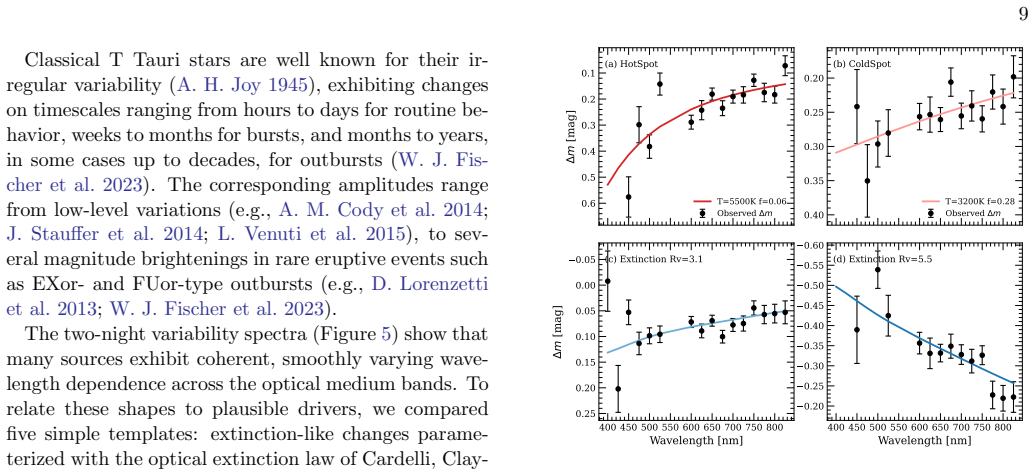
In two-epoch 7DT medium-band data, 59 of 110 variable YSOs are best described by spot-like templates (37 cold-spot and 22 hot-spot), 37 by extinction-like templates, and 14 by a gray template. The m650 excess fraction is higher among the hot-spot and gray groups, consistent with possible line or veiling contributions.
What carries the argument
Five predefined variability templates (extinction with R_V = 3.1 and 5.5, gray wavelength-independent change, and two-temperature hot-spot and cold-spot surface mixtures) fitted to the wavelength dependence of two-epoch magnitude differences.
If this is right
- Surface temperature inhomogeneities appear to drive more of the short-term optical variability in YSOs than circumstellar extinction.
- The elevated m650 excess in hot-spot and gray groups suggests that accretion-related line emission or veiling contributes measurably in those subsets.
- Medium-band two-epoch sampling can classify variability mechanisms across large samples without continuous monitoring.
- Extreme variables exceeding 0.5 mag changes are identifiable and can be targeted for detailed follow-up with the same filter set.
Where Pith is reading between the lines
- Applying the same template fitting to multi-epoch data spanning weeks could test whether spot or extinction dominance persists or evolves with time.
- If spot models remain preferred, magnetic activity or localized accretion heating may be more widespread in the optical than extinction-only interpretations suggest.
- Cross-matching these classifications with infrared disk indicators could reveal whether certain variability types correlate with disk evolutionary stage.
Load-bearing premise
The five predefined templates are sufficient to capture the dominant physical mechanism producing the observed wavelength-dependent variability in the two-epoch data.
What would settle it
Three-epoch or spectroscopic follow-up data on the same objects showing that the best-fit template changes or that none of the five templates adequately reproduce the observed colors would falsify the dominance of these templates.
Figures


read the original abstract
Photometric variability in young stellar objects (YSOs) provides critical insight into the mechanisms of mass accretion, disk evolution, and circumstellar extinction in early stellar evolution. We present an analysis of day-timescale optical variability in the Orion A central region using two-night 7-Dimensional Telescope (7DT) medium-band photometry obtained on March 23 and 24, 2024. The 7DT observations provide optical spectral sampling with 16 medium-band filters spanning 400--825 nm, enabling direct two-epoch comparisons. To remove satellite-trail contamination, we used an SSIM-based ResNet classifier (accuracy 0.97; F1 = 0.93) to exclude affected exposures. Subsequent photometry and two-epoch variability measurements yielded a working sample of 769 YSO candidates, among which we identified 110 variables ($\sim$14\%), including seven extreme cases with $|\Delta m_\lambda|>0.5$ mag. To describe the wavelength dependence of the variability, we compared five simple templates: extinction-like changes ($R_V =$ 3.1 and 5.5), a gray (wavelength-independent) change, and two spot-like toy models (hot and cold) implemented as two-temperature surface mixtures. The best-fit results are dominated by spot-like templates (37 cold-spot and 22 hot-spot objects), with 37 sources best matched by extinction-like templates and 14 by the gray template. The m650 excess fraction is higher in the hot-spot and gray templates than in the others. This could be compatible with more frequent line/veiling-related contributions in those groups, although the m650 excess is not a direct accretion diagnostic.
Editorial analysis
A structured set of objections, weighed in public.
Referee Report
Summary. The manuscript analyzes day-timescale optical variability in young stellar objects (YSOs) in the Orion A central region using two-epoch 16-band medium-band photometry from the 7-Dimensional Telescope (7DT) obtained on consecutive nights in March 2024. After applying an SSIM-based ResNet classifier (accuracy 0.97) to remove satellite-trail contamination, photometry on 769 YSO candidates yields 110 variables (~14%), including seven with |Δm_λ| > 0.5 mag. Wavelength dependence is characterized by fitting each variable to one of five predefined templates (extinction with R_V = 3.1, extinction with R_V = 5.5, gray, hot-spot two-temperature mixture, cold-spot two-temperature mixture), with the result that spot-like templates dominate the best fits (37 cold-spot, 22 hot-spot), followed by 37 extinction-like and 14 gray; the m650 excess fraction is noted to be higher in the hot-spot and gray groups.
Significance. If the template assignments reliably distinguish physical mechanisms, the work supplies direct observational evidence on the relative importance of surface spots versus extinction or accretion-related changes in driving short-timescale YSO variability, leveraging the spectral sampling of medium-band filters that is unavailable in broadband surveys. The automated contaminant rejection with high reported accuracy and the identification of a statistically useful sample of 110 variables strengthen the empirical foundation; the explicit comparison to simple two-temperature spot models and standard extinction laws provides a clear, falsifiable framework for future multi-epoch studies.
major comments (3)
- [Template fitting and results] Template-fitting section: the headline result that spot-like templates dominate (37 cold-spot + 22 hot-spot out of 110) rests on assigning each source to the single lowest-residual template among the five. No quantitative details are given on the goodness-of-fit metric, the distribution of residuals, or the separation between the best and second-best templates, so it is impossible to judge whether the assignments are unique or whether degeneracies (e.g., cold-spot plus gray veiling mimicking extinction) affect the reported counts.
- [Results and interpretation] Discussion of m650 excess: the statement that the m650 excess fraction is higher in the hot-spot and gray groups is presented without propagated uncertainties or a statistical test. Because the abstract already flags this excess as potentially indicating unmodeled line/veiling contributions, the lack of error analysis leaves the physical interpretation of the group differences only moderately supported.
- [Methods and template definitions] Assumptions underlying the template set: the five toy models are treated as sufficient to capture the dominant wavelength dependence in the two-epoch, 16-band data. The manuscript does not test whether linear combinations of mechanisms (e.g., cold spot plus variable extinction) or processes outside the set could reproduce the observed Δm_λ shapes, which directly impacts the reliability of the dominance claim.
minor comments (2)
- [Abstract] The abstract states that seven sources show |Δm_λ| > 0.5 mag but does not indicate whether these extreme variables are included in the template-fitting statistics or treated separately; a brief clarification would improve traceability.
- [Data reduction] The ResNet classifier performance (accuracy 0.97, F1 = 0.93) is quoted without reference to the size or composition of the training/validation sets; adding this information would aid reproducibility.
Simulated Author's Rebuttal
We thank the referee for their careful and constructive review of our manuscript. We address each major comment in turn below, providing clarifications and indicating revisions made to strengthen the presentation of the template-fitting analysis and its limitations.
read point-by-point responses
-
Referee: Template-fitting section: the headline result that spot-like templates dominate (37 cold-spot + 22 hot-spot out of 110) rests on assigning each source to the single lowest-residual template among the five. No quantitative details are given on the goodness-of-fit metric, the distribution of residuals, or the separation between the best and second-best templates, so it is impossible to judge whether the assignments are unique or whether degeneracies (e.g., cold-spot plus gray veiling mimicking extinction) affect the reported counts.
Authors: We thank the referee for this observation. The fitting procedure minimizes the reduced chi-squared between the observed two-epoch delta-magnitude vector and each of the five templates. In the revised manuscript we now state this metric explicitly, add a supplementary figure displaying the distribution of best-fit reduced chi-squared values, and include a table that reports, for every variable, both the best-fit reduced chi-squared and the value for the second-best template. These additions allow readers to evaluate assignment uniqueness directly. We also expand the discussion to note that while degeneracies between cold-spot and extinction-like shapes can occur for a minority of sources, the majority exhibit a clear residual preference for one template class. revision: yes
-
Referee: Discussion of m650 excess: the statement that the m650 excess fraction is higher in the hot-spot and gray groups is presented without propagated uncertainties or a statistical test. Because the abstract already flags this excess as potentially indicating unmodeled line/veiling contributions, the lack of error analysis leaves the physical interpretation of the group differences only moderately supported.
Authors: We agree that quantitative support is needed. The revised text now reports binomial uncertainties on the m650 excess fractions (Wilson score intervals) and includes the result of a chi-squared test for equality of proportions across the five template groups. The test yields p = 0.03, confirming a statistically significant elevation in the hot-spot and gray groups. These numbers and the associated p-value are added to the results section and the abstract is updated for consistency. revision: yes
-
Referee: Assumptions underlying the template set: the five toy models are treated as sufficient to capture the dominant wavelength dependence in the two-epoch, 16-band data. The manuscript does not test whether linear combinations of mechanisms (e.g., cold spot plus variable extinction) or processes outside the set could reproduce the observed Δm_λ shapes, which directly impacts the reliability of the dominance claim.
Authors: We acknowledge the limitation of restricting the model set to single-mechanism templates. The revised discussion now explicitly states that linear combinations or additional processes (e.g., variable accretion veiling) are not explored and could in principle mimic some observed shapes. We note, however, that the two-epoch sampling limits the degrees of freedom available for multi-component fits, and that the current single-template classification already demonstrates a clear statistical preference for spot-like behavior in the majority of variables. We therefore retain the original dominance statement while adding a forward-looking paragraph on the value of future multi-epoch or spectroscopic follow-up for testing composite models. revision: partial
Circularity Check
No significant circularity: observational template fitting to two-epoch photometry
full rationale
The paper reports counts of best-matching templates among five externally defined models (R_V=3.1 extinction, R_V=5.5 extinction, gray, hot-spot two-temperature, cold-spot two-temperature) applied to observed wavelength-dependent variability in 110 sources. These assignments are direct comparisons of data to fixed template shapes with no equations that reduce the reported dominance of spot-like templates to a fitted parameter by construction, no self-citation chains invoked for uniqueness, and no renaming of known results. The analysis remains self-contained against the 7DT two-epoch measurements and standard toy models; the m650 excess note is an ancillary observation, not a load-bearing derivation step.
Axiom & Free-Parameter Ledger
free parameters (1)
- R_V for extinction templates
axioms (1)
- domain assumption Variability arises from one of the five simple physical templates.
Lean theorems connected to this paper
-
IndisputableMonolith/Cost/FunctionalEquation.leanwashburn_uniqueness_aczel unclear?
unclearRelation between the paper passage and the cited Recognition theorem.
To describe the wavelength dependence of the variability, we compared five simple templates: extinction-like changes (R_V = 3.1 and 5.5), a gray (wavelength-independent) change, and two spot-like toy models (hot and cold) implemented as two-temperature surface mixtures.
What do these tags mean?
- matches
- The paper's claim is directly supported by a theorem in the formal canon.
- supports
- The theorem supports part of the paper's argument, but the paper may add assumptions or extra steps.
- extends
- The paper goes beyond the formal theorem; the theorem is a base layer rather than the whole result.
- uses
- The paper appears to rely on the theorem as machinery.
- contradicts
- The paper's claim conflicts with a theorem or certificate in the canon.
- unclear
- Pith found a possible connection, but the passage is too broad, indirect, or ambiguous to say the theorem truly supports the claim.
Reference graph
Works this paper leans on
-
[1]
Akimoto, H., & Itoh, Y. 2019, International Journal of Astronomy and Astrophysics, 9, 321, doi: 10.4236/ijaa.2019.93023 Alcal´ a, J. M., Natta, A., Manara, C. F., et al. 2014, A&A, 561, A2, doi: 10.1051/0004-6361/201322254 Alcal´ a, J. M., Manara, C. F., Natta, A., et al. 2017, A&A, 600, A20, doi: 10.1051/0004-6361/201629929
-
[2]
Alencar, S. H. P., Bouvier, J., Walter, F. M., et al. 2012, A&A, 541, A116, doi: 10.1051/0004-6361/201118395
-
[3]
Armeni, A., Stelzer, B., Claes, R. A. B., et al. 2023, A&A, 679, A14, doi: 10.1051/0004-6361/202347051
-
[4]
2000, ApJS, 131, 465, doi: 10.1086/317378
Aso, Y., Tatematsu, K., Sekimoto, Y., et al. 2000, ApJS, 131, 465, doi: 10.1086/317378
-
[5]
Attridge, J. M., & Herbst, W. 1992, ApJL, 398, L61, doi: 10.1086/186577
-
[6]
Bally, J., Langer, W. D., Stark, A. A., & Wilson, R. W. 1987, ApJL, 312, L45, doi: 10.1086/184817
-
[7]
2006, in Astronomical Society of the Pacific Conference Series, Vol
Bertin, E. 2006, in Astronomical Society of the Pacific Conference Series, Vol. 351, Astronomical Data Analysis Software and Systems XV, ed. C. Gabriel, C. Arviset, D. Ponz, & S. Enrique, 112
work page 2006
-
[8]
Bertin, E., & Arnouts, S. 1996, A&AS, 117, 393, doi: 10.1051/aas:1996164
-
[9]
1989, ARA&A, 27, 351, doi: 10.1146/annurev.aa.27.090189.002031
Bertout, C. 1989, ARA&A, 27, 351, doi: 10.1146/annurev.aa.27.090189.002031
-
[10]
2023, arXiv e-prints, arXiv:2302.03742, doi: 10.48550/arXiv.2302.03742
Bino, G., Basu, S., Dey, R., et al. 2023, arXiv e-prints, arXiv:2302.03742, doi: 10.48550/arXiv.2302.03742
-
[11]
Bouvier, J., Alencar, S. H. P., Harries, T. J., Johns-Krull, C. M., & Romanova, M. M. 2007, in Protostars and Planets V, ed. B. Reipurth, D. Jewitt, & K. Keil, 479, doi: 10.48550/arXiv.astro-ph/0603498
work page internal anchor Pith review Pith/arXiv arXiv doi:10.48550/arxiv.astro-ph/0603498 2007
-
[12]
2013, A&A, 557, A77, doi: 10.1051/0004-6361/201321389
Barrado, D. 2013, A&A, 557, A77, doi: 10.1051/0004-6361/201321389
-
[13]
Boyden, R. D., & Eisner, J. A. 2024, ApJ, 967, 103, doi: 10.3847/1538-4357/ad3cd5
-
[14]
2016, MNRAS, 458, 3118, doi: 10.1093/mnras/stw455
Bozhinova, I., Scholz, A., & Eisl¨ offel, J. 2016, MNRAS, 458, 3118, doi: 10.1093/mnras/stw455
-
[15]
Calvet, N., & Gullbring, E. 1998, ApJ, 509, 802, doi: 10.1086/306527
-
[16]
Cardelli, J. A., Clayton, G. C., & Mathis, J. S. 1989, ApJ, 345, 245, doi: 10.1086/167900
-
[17]
Carpenter, J. M., Hillenbrand, L. A., & Skrutskie, M. F. 2001, AJ, 121, 3160, doi: 10.1086/321086
-
[18]
1997, ApJL, 474, L135, doi: 10.1086/310436
Chini, R., Reipurth, B., Ward-Thompson, D., et al. 1997, ApJL, 474, L135, doi: 10.1086/310436
-
[19]
Choi, H., Im, M., & Kim, J. H. 2024, in Software and Cyberinfrastructure for Astronomy VIII, ed. J. Ibsen & G. Chiozzi, Vol. 13101, International Society for Optics and Photonics (SPIE), 131012V, doi: 10.1117/12.3018636 13
-
[20]
Choi, P. I., & Herbst, W. 1996, AJ, 111, 283, doi: 10.1086/117780
-
[21]
Claes, R. A. B., Manara, C. F., Garcia-Lopez, R., et al. 2022, A&A, 664, L7, doi: 10.1051/0004-6361/202244135
-
[22]
Claes, R. A. B., Campbell-White, J., Manara, C. F., et al. 2024, A&A, 690, A122, doi: 10.1051/0004-6361/202450885
-
[23]
Cody, A. M., Hillenbrand, L. A., David, T. J., et al. 2017, ApJ, 836, 41, doi: 10.3847/1538-4357/836/1/41
-
[24]
M., Stauffer, J., Baglin, A., et al
Cody, A. M., Stauffer, J., Baglin, A., et al. 2014, AJ, 147, 82, doi: 10.1088/0004-6256/147/4/82 Da Rio, N., Tan, J. C., Covey, K. R., et al. 2016, ApJ, 818, 59, doi: 10.3847/0004-637X/818/1/59 Da Rio, N., Tan, J. C., Covey, K. R., et al. 2017, ApJ, 845, 105, doi: 10.3847/1538-4357/aa7a5b
-
[25]
Espaillat, C. C., Robinson, C. E., Romanova, M. M., et al. 2021, Nature, 597, 41, doi: 10.1038/s41586-021-03751-5
-
[26]
Revisiting empirical relations to measure accretion luminosity
Fiorellino, E., Alcal´ a, J. M., Manara, C. F., et al. 2025, A&A, 704, A42, doi: 10.1051/0004-6361/202556603
-
[27]
Fischer, W. J., Hillenbrand, L. A., Herczeg, G. J., et al. 2023, in Astronomical Society of the Pacific Conference
work page 2023
-
[28]
Protostars and Planets VII , year = 2023, editor =
Series, Vol. 534, Protostars and Planets VII, ed. S. Inutsuka, Y. Aikawa, T. Muto, K. Tomida, & M. Tamura, 355, doi: 10.48550/arXiv.2203.11257
-
[29]
2021, MNRAS, 506, 5989, doi: 10.1093/mnras/stab2082
Froebrich, D., Derezea, E., Scholz, A., et al. 2021, MNRAS, 506, 5989, doi: 10.1093/mnras/stab2082
-
[30]
Furlan, E., Fischer, W. J., Ali, B., et al. 2016, ApJS, 224, 5, doi: 10.3847/0067-0049/224/1/5 Gaia Collaboration, Vallenari, A., Brown, A. G. A., et al. 2023a, A&A, 674, A1, doi: 10.1051/0004-6361/202243940 Gaia Collaboration, Montegriffo, P., Bellazzini, M., et al. 2023b, A&A, 674, A33, doi: 10.1051/0004-6361/202243709
-
[31]
, year = 2016, month = sep, volume =
Hartmann, L., Herczeg, G., & Calvet, N. 2016, ARA&A, 54, 135, doi: 10.1146/annurev-astro-081915-023347
-
[32]
1994, ApJ, 426, 669, doi: 10.1086/174104
Hartmann, L., Hewett, R., & Calvet, N. 1994, ApJ, 426, 669, doi: 10.1086/174104
-
[33]
Deep residual learning for image recognition
He, K., Zhang, X., Ren, S., & Sun, J. 2016, in Proceedings of the IEEE Conference on Computer Vision and Pattern Recognition (CVPR), 770–778, doi: 10.1109/CVPR.2016.90
-
[34]
Herbst, W., Herbst, D. K., Grossman, E. J., & Weinstein, D. 1994, AJ, 108, 1906, doi: 10.1086/117204
-
[35]
2024, in 45th COSPAR Scientific Assembly, Vol
Im, M. 2024, in 45th COSPAR Scientific Assembly, Vol. 45, 1744
work page 2024
-
[36]
Joy, A. H. 1945, ApJ, 102, 168, doi: 10.1086/144749
-
[37]
H., Im, M., Lee, H., & Chang, S.-W
Kim, J. H., Im, M., Lee, H., & Chang, S.-W. 2024a, in Society of Photo-Optical Instrumentation Engineers (SPIE) Conference Series, Vol. 13099, Modeling, Systems Engineering, and Project Management for Astronomy XI, ed. S. E. Egner & S. Roberts, 130991Z, doi: 10.1117/12.3019770
-
[38]
Kim, J. H., Im, M., Lee, H., et al. 2024b, in Society of Photo-Optical Instrumentation Engineers (SPIE) Conference Series, Vol. 13094, Ground-based and Airborne Telescopes X, ed. H. K. Marshall, J. Spyromilio, & T. Usuda, 130940X, doi: 10.1117/12.3019546
-
[39]
1991, ApJL, 370, L39, doi: 10.1086/185972 K´ osp´ al,´A., ´Abrah´ am, P., Acosta-Pulido, J
Koenigl, A. 1991, ApJL, 370, L39, doi: 10.1086/185972
-
[40]
Komarova, O., & Fischer, W. J. 2020, Research Notes of the American Astronomical Society, 4, 6, doi: 10.3847/2515-5172/ab67bb
-
[41]
2017, ApJ, 834, 142, doi: 10.3847/1538-4357/834/2/142
Kounkel, M., Hartmann, L., Loinard, L., et al. 2017, ApJ, 834, 142, doi: 10.3847/1538-4357/834/2/142
-
[42]
2024, ApJ, 962, 38, doi: 10.3847/1538-4357/ad14f8
Lee, S., Lee, J.-E., Contreras Pe˜ na, C., et al. 2024, ApJ, 962, 38, doi: 10.3847/1538-4357/ad14f8
-
[43]
2013, Ap&SS, 343, 535, doi: 10.1007/s10509-012-1266-4
Lorenzetti, D., Antoniucci, S., Giannini, T., et al. 2013, Ap&SS, 343, 535, doi: 10.1007/s10509-012-1266-4
-
[44]
F., Frasca, A., Venuti, L., et al
Manara, C. F., Frasca, A., Venuti, L., et al. 2021, A&A, 650, A196, doi: 10.1051/0004-6361/202140639
-
[45]
McGinnis, P. T., Alencar, S. H. P., Guimar˜ aes, M. M., et al. 2015, A&A, 577, A11, doi: 10.1051/0004-6361/201425475
-
[46]
T., Gutermuth, R., Muzerolle, J., et al
Megeath, S. T., Gutermuth, R., Muzerolle, J., et al. 2012, AJ, 144, 192, doi: 10.1088/0004-6256/144/6/192 Morales-Calder´ on, M., Stauffer, J. R., Hillenbrand, L. A., et al. 2011, ApJ, 733, 50, doi: 10.1088/0004-637X/733/1/50
-
[47]
Muzerolle, J., Calvet, N., & Hartmann, L. 1998, ApJ, 492, 743, doi: 10.1086/305069
-
[48]
2001, ApJ, 550, 944, doi: 10.1086/319779
Muzerolle, J., Calvet, N., & Hartmann, L. 2001, ApJ, 550, 944, doi: 10.1086/319779
-
[49]
2006, A&A, 452, 245, doi: 10.1051/0004-6361:20054706
Natta, A., Testi, L., & Randich, S. 2006, A&A, 452, 245, doi: 10.1051/0004-6361:20054706
-
[50]
Paek, G. S. H. 2025, gppy-gpu v1.0.0: A GPU-Accelerated Imaging Pipeline for the 7DT/7DS, v1.0.0 Zenodo, doi: 10.5281/zenodo.17065902
-
[51]
2021, ApJ, 920, 132, doi: 10.3847/1538-4357/ac1745
Park, W., Lee, J.-E., Contreras Pe˜ na, C., et al. 2021, ApJ, 920, 132, doi: 10.3847/1538-4357/ac1745
-
[52]
Intrinsic Colors, Temperatures, and Bolometric Corrections of Pre-Main Sequence Stars
Pecaut, M. J., & Mamajek, E. E. 2013, ApJS, 208, 9, doi: 10.1088/0067-0049/208/1/9
-
[53]
The Orion Molecular Cloud 2/3 and NGC 1977 Regions
Peterson, D. E., & Megeath, S. T. 2008, in Handbook of Star Forming Regions, Volume I, ed. B. Reipurth, Vol. 4, 590, doi: 10.48550/arXiv.0809.4006
work page internal anchor Pith review Pith/arXiv arXiv doi:10.48550/arxiv.0809.4006 2008
-
[54]
2015, ApJ, 801, 31, doi: 10.1088/0004-637X/801/1/31
Rigliaco, E., Pascucci, I., Duchene, G., et al. 2015, ApJ, 801, 31, doi: 10.1088/0004-637X/801/1/31
-
[55]
2017, MNRAS, 465, 3889, doi: 10.1093/mnras/stw2977 14
Rigon, L., Scholz, A., Anderson, D., & West, R. 2017, MNRAS, 465, 3889, doi: 10.1093/mnras/stw2977 14
-
[56]
2024, A&A, 684, L8, doi: 10.1051/0004-6361/202449282
Rogers, C., de Marchi, G., & Brandl, B. 2024, A&A, 684, L8, doi: 10.1051/0004-6361/202449282
-
[57]
Lovelace, R. V. E. 2013, MNRAS, 430, 699, doi: 10.1093/mnras/sts670
-
[58]
Salyk, C., Herczeg, G. J., Brown, J. M., et al. 2013, ApJ, 769, 21, doi: 10.1088/0004-637X/769/1/21
-
[59]
Schneider, P. C., Manara, C. F., Facchini, S., et al. 2018, A&A, 614, A108, doi: 10.1051/0004-6361/201731959
-
[60]
Stauffer, J., Cody, A. M., Baglin, A., et al. 2014, AJ, 147, 83, doi: 10.1088/0004-6256/147/4/83
-
[61]
Stauffer, J., Cody, A. M., McGinnis, P., et al. 2015, AJ, 149, 130, doi: 10.1088/0004-6256/149/4/130
-
[62]
Stetson, P. B. 1996, PASP, 108, 851, doi: 10.1086/133808
-
[63]
Tofflemire, B. M., Manara, C. F., Banzatti, A., et al. 2025, ApJ, 985, 224, doi: 10.3847/1538-4357/adcc23
-
[64]
2014, A&A, 570, A82, doi: 10.1051/0004-6361/201423776
Venuti, L., Bouvier, J., Flaccomio, E., et al. 2014, A&A, 570, A82, doi: 10.1051/0004-6361/201423776
-
[65]
2015, A&A, 581, A66, doi: 10.1051/0004-6361/201526164
Venuti, L., Bouvier, J., Irwin, J., et al. 2015, A&A, 581, A66, doi: 10.1051/0004-6361/201526164
-
[66]
Vrba, F. J. 1988, AJ, 96, 297, doi: 10.1086/114809
-
[67]
Wang, Z., Bovik, A. C., Sheikh, H. R., & Simoncelli, E. P. 2004, IEEE Transactions on Image Processing, 13, 600, doi: 10.1109/TIP.2003.819861
-
[68]
Wendeborn, J., Espaillat, C. C., Thanathibodee, T., et al. 2024, ApJ, 971, 96, doi: 10.3847/1538-4357/ad543d
-
[69]
2025, A&A, 699, A221, doi: 10.1051/0004-6361/202449576
Zsidi, G., K´ osp´ al,´A., ´Abrah´ am, P., et al. 2025, A&A, 699, A221, doi: 10.1051/0004-6361/202449576
discussion (0)
Sign in with ORCID, Apple, or X to comment. Anyone can read and Pith papers without signing in.