REVIEW 2 minor 3 cited by
A 6.91-minute orbital period double white dwarf binary exhibits orbital decay matching general relativity.
Reviewed by Pith at T0; open to challenge. T0 means a machine referee read the full paper against a public rubric. the ladder, T0–T4 →
T0 review · grok-4.3
2026-05-24 15:49 UTC pith:NXZCT3KW
load-bearing objection The paper reports the discovery of a new 6.91-minute eclipsing double white dwarf with orbital decay matching the GR gravitational-wave prediction, adding a key LISA target.
General relativistic orbital decay in a seven-minute-orbital-period eclipsing binary system
The pith
A machine-rendered reading of the paper's core claim, the machinery that carries it, and where it could break.
Core claim
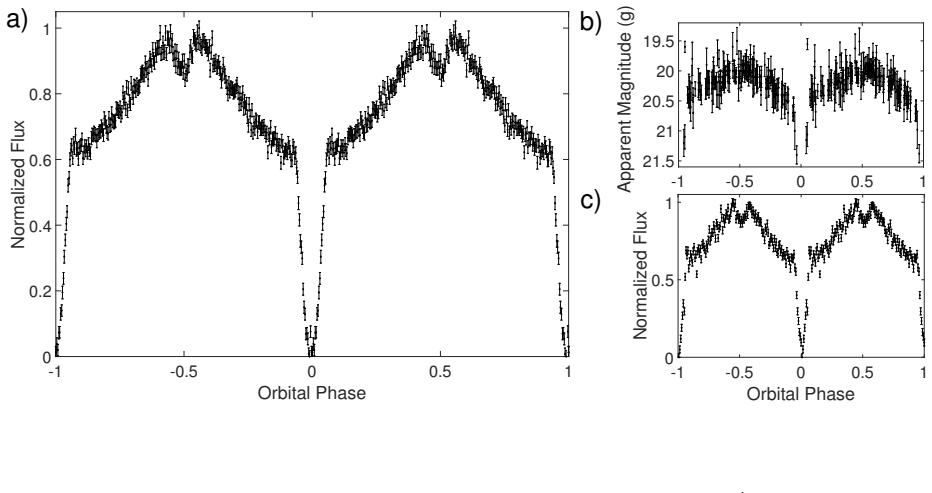
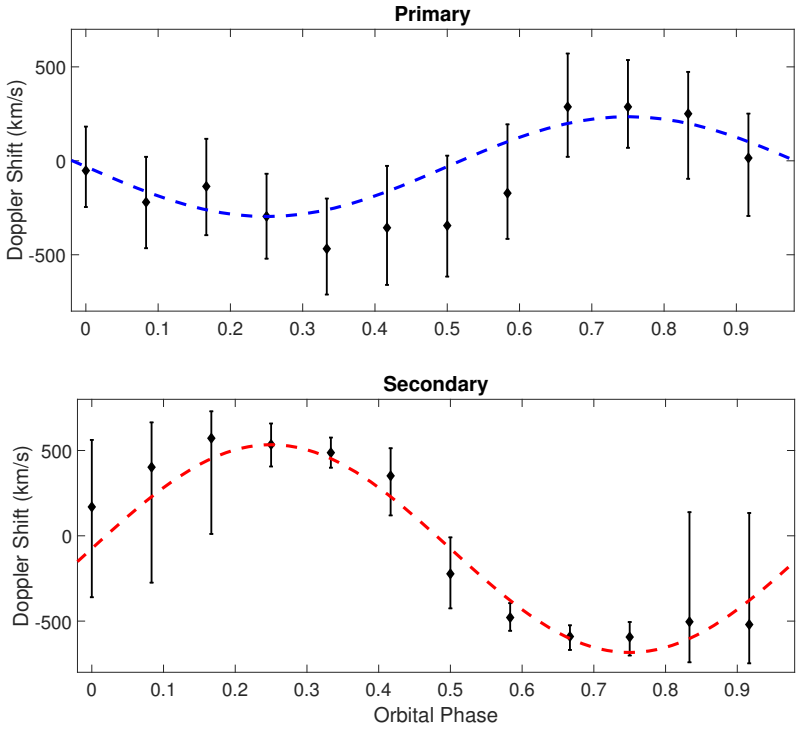
The authors identify ZTF J153932.16+502738.8 as a double white dwarf binary with a 6.91-minute orbital period that displays rapid orbital decay consistent with general relativity. The system is confirmed as eclipsing with a deep eclipse and as double-lined from spectroscopy. It is presented as a significant gravitational radiation source that should be detectable by LISA within the first week of observations.
What carries the argument
The measured rate of orbital period change, compared directly to the value predicted by general relativity for gravitational wave emission from a compact binary.
Load-bearing premise
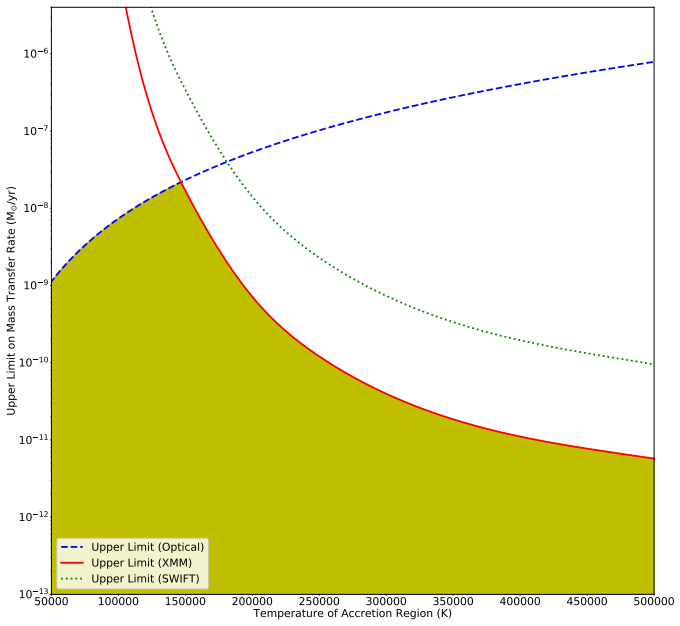
The observed change in orbital period arises solely from gravitational wave emission as predicted by general relativity, with no meaningful contribution from other effects such as mass transfer.
What would settle it
A refined measurement of the orbital period derivative that deviates from the general relativity prediction, or spectroscopic or photometric evidence of mass transfer that would produce period change independent of gravitational waves.
If this is right
- The binary is a significant source of gravitational radiation near the peak of LISA's sensitivity.
- The system should be detected within the first week of LISA observations.
- The orbit is compact enough for the entire binary to fit inside the diameter of Saturn.
Where Pith is reading between the lines
- The discovery of a system at roughly half the period of the previously known eclipsing example suggests that the population of double white dwarf binaries extends to even shorter periods than previously confirmed.
- Multi-messenger observations combining ground-based eclipse timing with future LISA data could provide an independent cross-check on the orbital evolution.
Editorial analysis
A structured set of objections, weighed in public.
Referee Report
Summary. The manuscript reports the discovery of ZTF J153932.16+502738.8, an eclipsing double white dwarf binary with a 6.91-minute orbital period. The system is classified as detached on the basis of eclipse photometry and double-lined spectra; rapid orbital decay is reported and stated to be consistent with the general-relativistic quadrupole prediction once component masses are fixed from radial velocities and photometry. The object is presented as a high-priority LISA source detectable within the first week of observations.
Significance. If the mass determinations, O-C coverage, and exclusion of non-GR contributions hold, the result supplies the second known eclipsing DWD and the shortest-period example, furnishing an independent strong-field test of GR and a bright, nearby verification binary for LISA. The work also demonstrates the utility of ZTF for identifying ultra-compact binaries near the peak of the LISA sensitivity curve.
minor comments (2)
- [Abstract] The abstract states consistency between observed and GR-predicted decay but supplies neither the measured period derivative nor the numerical GR prediction; a single sentence giving both values (with uncertainties) would make the central claim immediately verifiable.
- The manuscript refers to 'double-lined spectroscopic nature' and 'eclipse photometry' for mass determination, yet the provided text contains no table of radial-velocity amplitudes, photometric parameters, or derived masses with uncertainties; inclusion of these data (or explicit reference to a table) is needed for reproducibility.
Simulated Author's Rebuttal
We thank the referee for their constructive review and recommendation of minor revision. The report contains no enumerated major comments, so we have no specific points requiring point-by-point rebuttal. We will address any minor suggestions in the revised manuscript.
Circularity Check
No significant circularity
full rationale
The paper reports a direct observational measurement of orbital period derivative from eclipse timing data, then compares that measured value to the independent GR quadrupole prediction computed from component masses fixed by double-lined radial velocities and eclipse photometry. No equation in the derivation reduces a claimed prediction to a fitted input by construction, no uniqueness theorem is imported from self-citation, and the central consistency statement rests on external GR theory plus external data rather than on any self-referential loop. This is the standard, non-circular structure of a GR test via timing.
Axiom & Free-Parameter Ledger
read the original abstract
General relativity predicts that short orbital period binaries emit significant gravitational radiation, and the upcoming Laser Interferometer Space Antenna (LISA) is expected to detect tens of thousands of such systems; however, few have been identified, and only one is eclipsing--the double white dwarf binary SDSS J065133.338+284423.37, which has an orbital period of 12.75 minutes. Here, we report the discovery of an eclipsing double white dwarf binary system with an orbital period of only 6.91 minutes, ZTF J153932.16+502738.8. This system has an orbital period close to half that of SDSS J065133.338+284423.37 and an orbit so compact that the entire binary could fit within the diameter of the planet Saturn. The system exhibits a deep eclipse, and a double-lined spectroscopic nature. We observe rapid orbital decay, consistent with that expected from general relativity. ZTF J153932.16+502738.8 is a significant source of gravitational radiation close to the peak of LISA's sensitivity, and should be detected within the first week of LISA observations.
Figures



Lean theorems connected to this paper
-
IndisputableMonolith/Foundation/RealityFromDistinction.leanreality_from_one_distinction unclear?
unclearRelation between the paper passage and the cited Recognition theorem.
We observe rapid orbital decay, consistent with that expected from general relativity... ˙P = (−2.373±0.005)×10^{-11} s s^{-1}
-
IndisputableMonolith/Cost/FunctionalEquation.leanwashburn_uniqueness_aczel unclear?
unclearRelation between the paper passage and the cited Recognition theorem.
˙f = 96/5 π^{8/3} (G Mc / c^3)^{5/3} f^{11/3}
What do these tags mean?
- matches
- The paper's claim is directly supported by a theorem in the formal canon.
- supports
- The theorem supports part of the paper's argument, but the paper may add assumptions or extra steps.
- extends
- The paper goes beyond the formal theorem; the theorem is a base layer rather than the whole result.
- uses
- The paper appears to rely on the theorem as machinery.
- contradicts
- The paper's claim conflicts with a theorem or certificate in the canon.
- unclear
- Pith found a possible connection, but the passage is too broad, indirect, or ambiguous to say the theorem truly supports the claim.
Forward citations
Cited by 3 Pith papers
-
V407 Vul: a triple star system with an AM CVn detectable by gravitational wave observatories
V407 Vul is a hierarchical triple: a 569-s AM CVn white-dwarf binary bound to a G-type tertiary at ~120 AU, the first 'verification triple' for LISA.
-
Gravitational Wave Modeling of White-Dwarf--Compact-Object Binaries and Observational Outlook
WD–CO binaries produce unique GW waveforms with a sharp f_max cutoff; LGWA/DECIGO will detect many end stages, while terrestrial detectors will not mistake them for sub-solar compact objects.
-
Waveform Modelling for the Laser Interferometer Space Antenna
A review of existing waveform models for LISA sources and the challenges that must still be overcome.
Reference graph
Works this paper leans on
-
[1]
N ¨aherungsweise Integration der Feldgleichungen der Gravitation
Einstein, A. N ¨aherungsweise Integration der Feldgleichungen der Gravitation. Sitzungsberichte der K ¨oniglich Preußischen Akademie der Wissenschaften (Berlin), Seite 688-696. (1916)
work page 1916
-
[2]
Amaro-Seoane, P. et al. Laser interferometer space antenna. arXiv preprint arXiv:1702.00786 (2017)
work page internal anchor Pith review Pith/arXiv arXiv 2017
-
[3]
Nissanke, S., Vallisneri, M., Nelemans, G. & Prince, T. A. Gravitational-wave emission from compact galactic binaries. The Astrophysical Journal 758, 131 (2012)
work page 2012
-
[4]
Kupfer, T. et al. LISA verification binaries with updated distances from Gaia data release 2. Monthly Notices of the Royal Astronomical Society 480, 302–309 (2018)
work page 2018
-
[5]
Brown, W. R. et al. A 12-minute orbital period detached white dwarf eclipsing binary. The Astrophysical Journal Letters 737, L23 (2011)
work page 2011
-
[6]
Bellm, E. C. et al. The Zwicky Transient Facility: System overview, performance, and first results. Publications of the Astronomical Society of the Pacific131, 018002 (2018)
work page 2018
-
[7]
Graham, M. J. et al. The Zwicky Transient Facility: Science objectives. arXiv preprint arXiv:1902.01945 (2019)
work page internal anchor Pith review Pith/arXiv arXiv 1902
-
[8]
Coughlin, M. W. et al. The Kitt Peak Electron Multiplying CCD demonstrator. Monthly Notices of the Royal Astronomical Society 485, 1412–1419 (2019). 13
work page 2019
-
[9]
Harding, L. K. et al. CHIMERA: a wide-field, multi-colour, high-speed photometer at the prime focus of the Hale telescope. Monthly Notices of the Royal Astronomical Society 457, 3036–3049 (2016)
work page 2016
-
[10]
Taylor, J. H., Fowler, L. & McCulloch, P. Measurements of general relativistic effects in the binary pulsar PSR1913+ 16. Nature 277, 437 (1979)
work page 1979
-
[11]
Masci, F. J. et al. The IPAC image subtraction and discovery pipeline for the Intermediate Palomar Transient Factory.Publications of the Astronomical Society of the Pacific129, 014002 (2016)
work page 2016
-
[12]
Law, N. M. et al. The Palomar Transient Factory: System overview, performance, and first results. Publications of the Astronomical Society of the Pacific121, 1395 (2009)
work page 2009
-
[13]
McCarthy, J. K. et al. Blue channel of the Keck low-resolution imaging spectrometer. In Optical Astronomical Instrumentation, vol. 3355, 81–93 (International Society for Optics and Photonics, 1998)
work page 1998
-
[14]
Hermes, J. et al. Rapid orbital decay in the 12.75-minute binary white dwarf J0651+ 2844. The Astrophysical Journal Letters 757, L21 (2012)
work page 2012
- [15]
-
[16]
Shah, S., Nelemans, G. & van der Sluys, M. Using electromagnetic observations to aid gravitational-wave parameter estimation of compact binaries observed with LISA-II. The effect of knowing the sky position. Astronomy & Astrophysics 553, A82 (2013)
work page 2013
-
[17]
Holberg, J. & Bergeron, P. Calibration of synthetic photometry using DA white dwarfs. The Astronomical Journal 132, 1221 (2006)
work page 2006
-
[18]
Istrate, A. G. et al. Models of low-mass helium white dwarfs including gravitational settling, thermal and chemical diffusion, and rotational mixing. Astronomy & Astrophysics 595, A35 (2016)
work page 2016
-
[19]
Ramsay, G., Cropper, M., Wu, K., Mason, K. & Hakala, P. Detection of the optical counterpart of the proposed double degenerate polar RX J1914+ 24. Monthly Notices of the Royal Astronomical Society 311, 75–84 (2000)
work page 2000
-
[20]
Roelofs, G. H. et al. Spectroscopic evidence for a 5.4 minute orbital period in HM Cancri. The Astrophysical Journal Letters 711, L138 (2010)
work page 2010
-
[21]
Marsh, T. & Steeghs, D. V407 Vul: a direct impact accretor. Monthly Notices of the Royal Astronomical Society 331, L7–L11 (2002)
work page 2002
-
[22]
Gehrels, N. et al. The Swift gamma-ray burst mission. The Astrophysical Journal 611, 1005 (2004)
work page 2004
-
[23]
Jansen, F. et al. XMM-Newton observatory-I. The spacecraft and operations. Astronomy & Astrophysics 365, L1–L6 (2001). 15
work page 2001
-
[24]
Wolf, W. M., Bildsten, L., Brooks, J. & Paxton, B. Hydrogen burning on accreting white dwarfs: stability, recurrent novae, and the post-nova supersoft phase. The Astrophysical Journal 777, 136 (2013)
work page 2013
-
[25]
Kaplan, D. L., Bildsten, L. & Steinfadt, J. D. Orbital evolution of compact white dwarf binaries. The Astrophysical Journal 758, 64 (2012)
work page 2012
-
[26]
Marsh, T. R., Nelemans, G. & Steeghs, D. Mass transfer between double white dwarfs. Monthly Notices of the Royal Astronomical Society 350, 113–128 (2004)
work page 2004
-
[27]
Paczynski, B. Evolution of single stars. IV. helium stars. Acta Astronomica 21, 1 (1971)
work page 1971
-
[28]
Shen, K. J., Kasen, D., Miles, B. J. & Townsley, D. M. Sub-Chandrasekhar-mass white dwarf detonations revisited. The Astrophysical Journal 854, 52 (2018)
work page 2018
-
[29]
Bildsten, L., Townsley, D. M., Deloye, C. J. & Nelemans, G. The thermal state of the accreting white dwarf in AM Canum Venaticorum binaries.The Astrophysical Journal640, 466 (2006)
work page 2006
-
[30]
Althaus, L. G., Camisassa, M. E., Bertolami, M. M. M., C ´orsico, A. H. & Garc ´ıa-Berro, E. White dwarf evolutionary sequences for low-metallicity progenitors: The impact of third dredge-up. Astronomy & Astrophysics 576, A9 (2015). 16 Methods 1 Summary of Observations Extended Data Table 1 provides a summary of all observations used in our analysis. 2 Pe...
work page 2015
-
[31]
Graham, M. J., Drake, A. J., Djorgovski, S., Mahabal, A. A. & Donalek, C. Using conditional entropy to identify periodicity. Monthly Notices of the Royal Astronomical Society 434, 2629–2635 (2013)
work page 2013
-
[32]
Maxted, P. ellc: A fast, flexible light curve model for detached eclipsing binary stars and transiting exoplanets. Astronomy & Astrophysics 591, A111 (2016)
work page 2016
-
[33]
Gianninas, A., Strickland, B., Kilic, M. & Bergeron, P. Limb-darkening coefficients for eclipsing white dwarfs. The Astrophysical Journal 766, 3 (2013)
work page 2013
-
[34]
Claret, A. & Bloemen, S. Gravity and limb-darkening coefficients for the Kepler, CoRoT, Spitzer, uvby, UBVRIJHK, and Sloan photometric systems. Astronomy & Astrophysics 529, 42 A75 (2011)
work page 2011
-
[35]
Possible causes of the secular increase in pulsar periods
Shklovskii, I. Possible causes of the secular increase in pulsar periods. Soviet Astronomy 13, 562 (1970)
work page 1970
-
[36]
Lorimer, D. R. & Kramer, M. Handbook of Pulsar Astronomy (2012)
work page 2012
-
[37]
Brown, A. et al. Gaia data release 2-summary of the contents and survey properties.Astronomy & Astrophysics 616, A1 (2018)
work page 2018
-
[38]
galpy: A python library for galactic dynamics
Bovy, J. galpy: A python library for galactic dynamics. The Astrophysical Journal Supplement Series 216, 29 (2015)
work page 2015
-
[39]
Levenhagen, R. S., Diaz, M. P., Coelho, P. R. T. & Hubeny, I. A grid of synthetic spectra for hot DA white dwarfs and its application in stellar population synthesis. The Astrophysical Journal Supplement Series 231, 1 (2017)
work page 2017
-
[40]
Horne, K. & Schneider, D. P. Evidence for a high-mass white dwarf in nova V1500 Cygni
-
[41]
The Astrophysical Journal 343, 888–901 (1989)
work page 1989
-
[42]
Green, G. M. et al. Galactic reddening in 3d from stellar photometry–an improved map. Monthly Notices of the Royal Astronomical Society 478, 651–666 (2018)
work page 2018
-
[43]
Korol, V . et al. Prospects for detection of detached double white dwarf binaries with Gaia, LSST and LISA. Monthly Notices of the Royal Astronomical Society 470, 1894–1910 (2017)
work page 1910
- [44]
-
[45]
Benacquista, M. J. Tidal perturbations to the gravitational inspiral of J0651+ 2844. The Astrophysical Journal Letters 740, L54 (2011)
work page 2011
-
[46]
Paxton, B. et al. Modules for experiments in stellar astrophysics (MESA): binaries, pulsations, and explosions. The Astrophysical Journal Supplement Series 220, 15 (2015)
work page 2015
-
[47]
Kalberla, P. M. et al. The Leiden/Argentine/Bonn (LAB) survey of galactic HI-final data release of the combined LDS and IAR surveys with improved stray-radiation corrections. Astronomy & Astrophysics 440, 775–782 (2005)
work page 2005
- [48]
-
[49]
Brown, W. R., Kilic, M., Kenyon, S. J. & Gianninas, A. Most double degenerate low-mass white dwarf binaries merge. The Astrophysical Journal 824, 46 (2016)
work page 2016
-
[50]
Bovy, J. & Rix, H.-W. A direct dynamical measurement of the Milky Way’s disk surface density profile, disk scale length, and dark matter profile at 4 kpc < R < 9 kpc. The Astrophysical Journal 779, 115 (2013). 44
work page 2013
discussion (0)
Sign in with ORCID, Apple, or X to comment. Anyone can read and Pith papers without signing in.