AI Fiction in the Wild
Pith reviewed 2026-06-26 09:03 UTC · model grok-4.3
The pith
More than one third of ChatGPT conversations involve generating fiction including stories, roleplay, fanfiction, and erotica.
A machine-rendered reading of the paper's core claim, the machinery that carries it, and where it could break.
Core claim
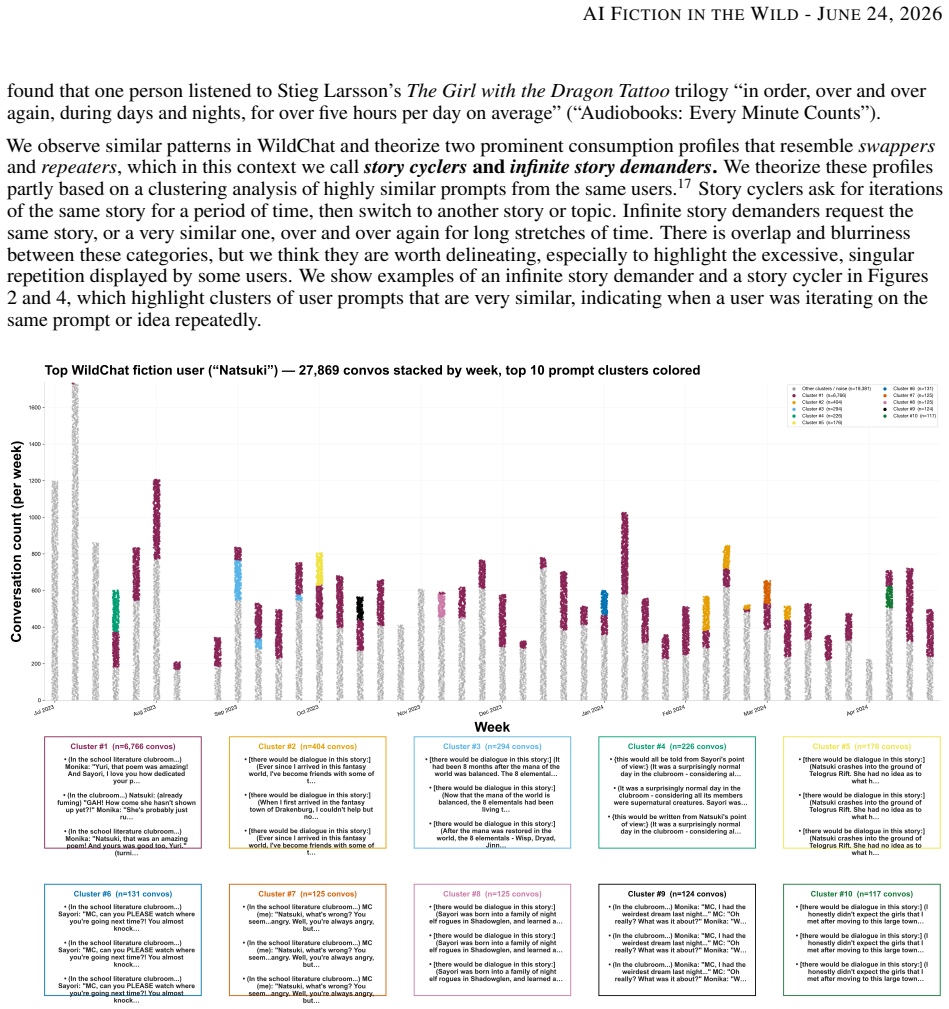
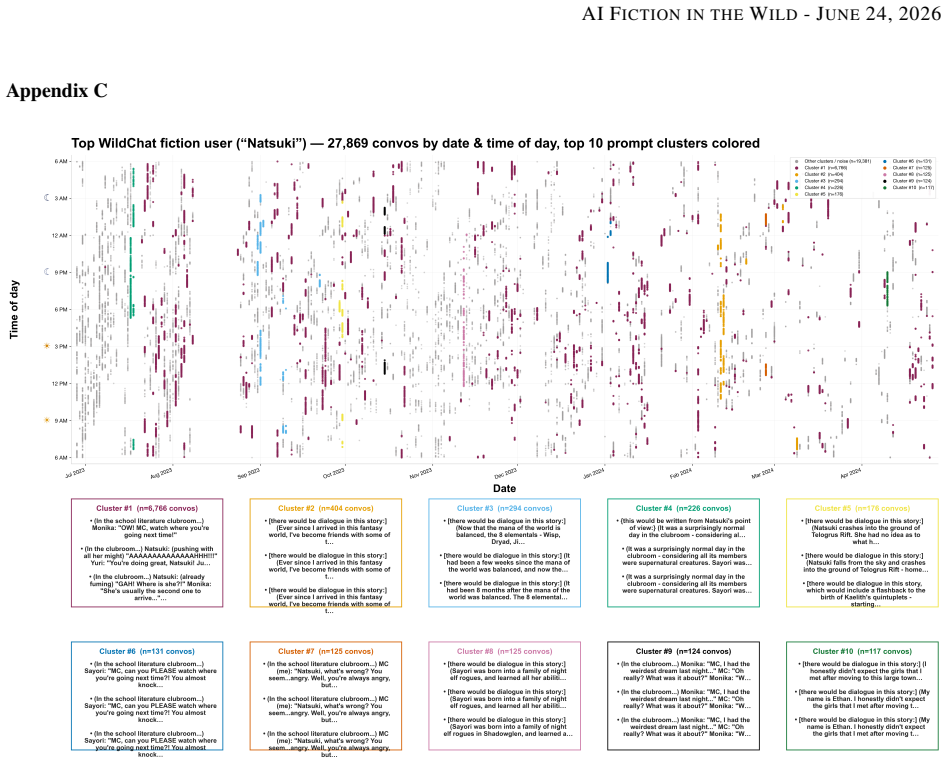
Drawing on over 500,000 anonymized English-language ChatGPT conversations, the authors establish that more than one third involve some form of fiction generation, including original stories, roleplay, fanfiction, and erotica. This activity is dominated by power users who display patterns such as infinite story demand, in which they request and iteratively revise variations of the same narrative over long periods. Users show strong preference for fanfiction and erotica together with generic forms, repetition, immediacy, and niche combinations of story elements. The work proposes that these practices may produce a solipsistic reader-writer who generates and consumes fiction inside a conversati
What carries the argument
Classification of conversation logs to detect fiction generation and isolate recurring user profiles such as infinite story demanders.
If this is right
- Fiction generation concentrates among power users who request repeated variations of similar content.
- Requests skew toward fanfiction, erotica, generic plots, repetition, and niche element combinations.
- AI may produce a solipsistic reader-writer who both creates and consumes fiction inside a closed machine loop.
- Interactivity and rapid permutation become central pleasures in AI-assisted storytelling.
Where Pith is reading between the lines
- The same concentration of repetitive fiction requests may appear on other large language model platforms.
- Traditional publishing and entertainment industries could face increased competition from on-demand, personalized AI fiction.
- Longitudinal tracking of individual users could reveal whether infinite story demanders eventually shift toward more varied requests.
Load-bearing premise
The 500,000 anonymized conversations accurately represent typical English-language ChatGPT user behavior and that fiction generation can be reliably identified in them.
What would settle it
A new sample of ChatGPT conversations in which fiction generation appears in substantially fewer than one third of cases.
Figures

read the original abstract
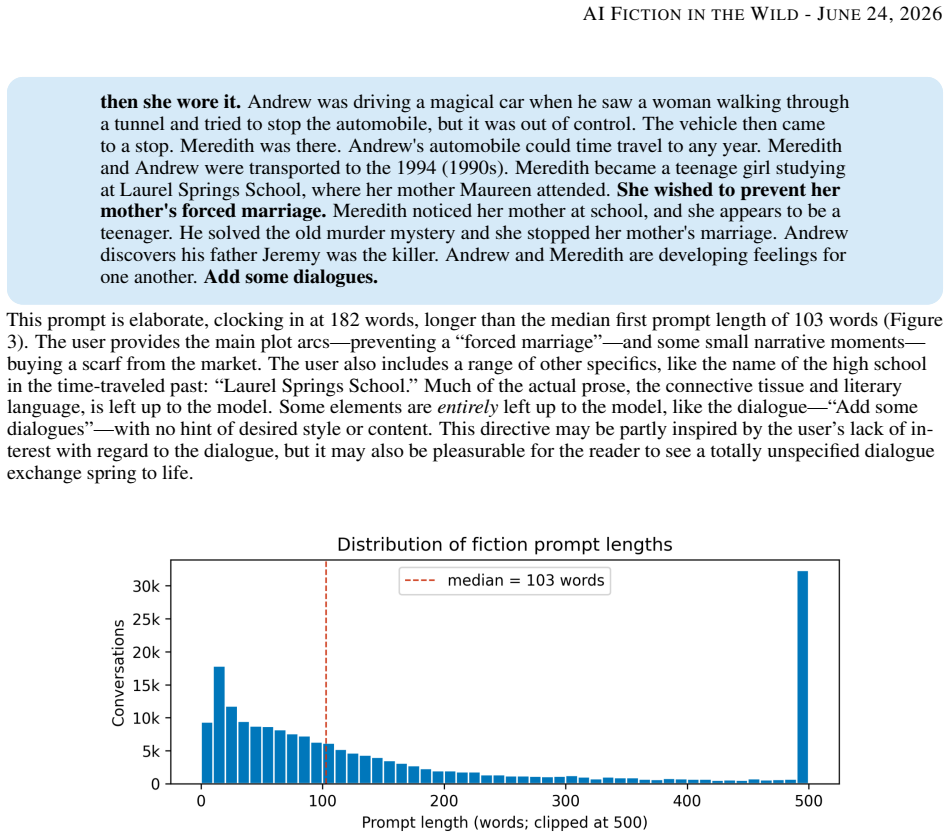
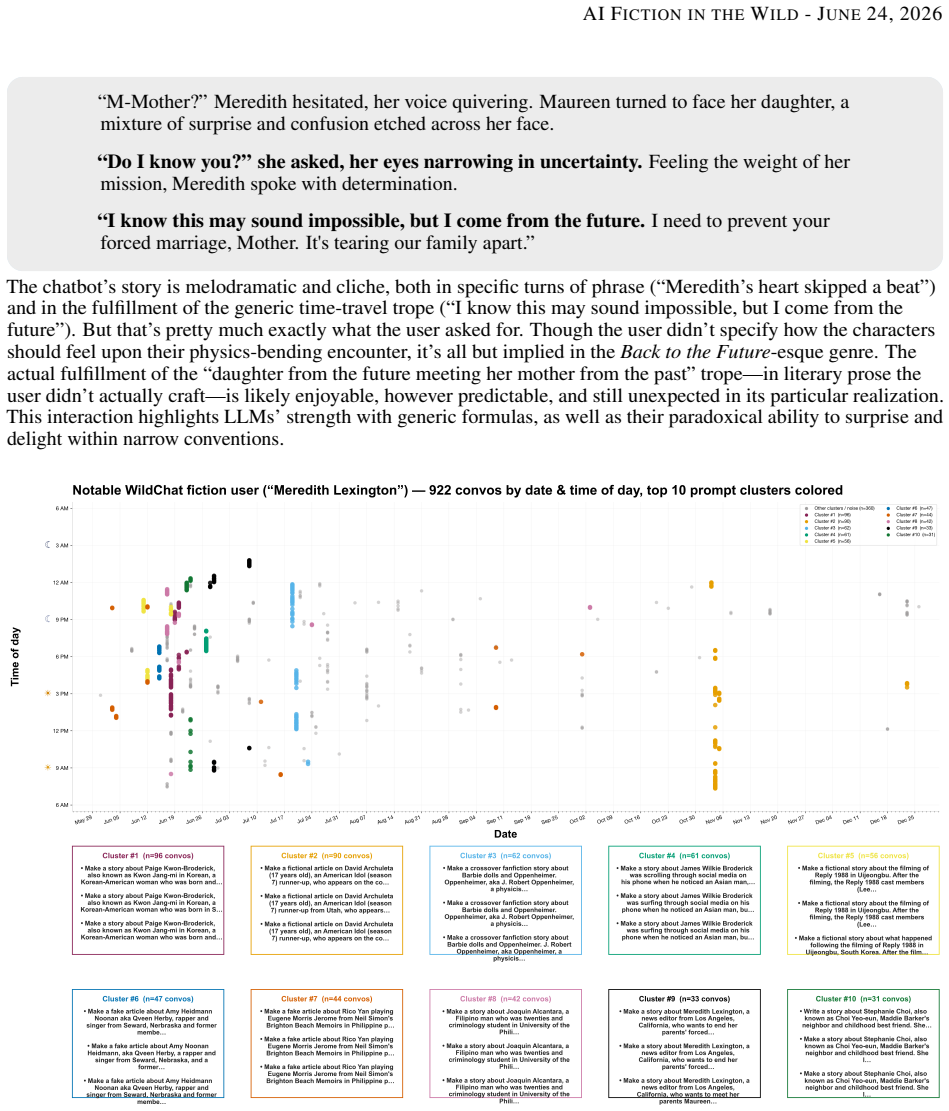
Some professional authors are beginning to use AI tools to help produce their fiction writing. Are readers using AI to generate fiction, too? Drawing on over 500,000 anonymized, English-language ChatGPT-user conversations (arXiv:2405.01470), we find that more than one third of the conversations involve some form of fiction generation -- including original stories, roleplay, fanfiction, and erotica. This AI-generated fiction is notably dominated by power users. We identify common fiction generation patterns and profiles among these users, including what we call "infinite story demanders," who repeatedly request and revise variations of the same or similar narratives over extended periods of time. We show that users especially gravitate toward fanfiction and erotica, and that they are broadly drawn to generic forms, repetition, immediacy, and niche combinations of story elements. Our findings motivate two theoretical provocations. First, we argue that AI technologies may lead to a shift in the conventional relationship between the author and reader, potentially producing what we call a "solipsistic reader-writer," who both generates and consumes fiction within a closed conversational loop, interacting with a machine rather than a human other. Second, we note that LLMs enable interactivity, play, and permutation in ways that are seemingly pleasurable for users, raising questions about where AI will fit into contemporary storytelling and entertainment ecosystems. We situate these developments within broader transformations in literature and media, including self-publishing, fanfiction, and pornography, and suggest that AI-generated fiction shares structural affinities with on-demand, personalized, and repetitive cultural forms.
Editorial analysis
A structured set of objections, weighed in public.
Referee Report
Summary. The manuscript analyzes over 500,000 anonymized English-language ChatGPT conversations from a prior dataset and claims that more than one third involve fiction generation (original stories, roleplay, fanfiction, erotica). It reports dominance by power users, identifies patterns such as 'infinite story demanders,' notes preferences for fanfiction/erotica and generic/repetitive forms, and advances two theoretical provocations: a shift toward a 'solipsistic reader-writer' in a closed AI loop and questions about AI's place in storytelling ecosystems, situating the work amid self-publishing, fanfiction, and pornography.
Significance. If the classification of fiction generation proves reliable, the scale of the dataset offers rare empirical grounding for how non-professional users deploy LLMs for creative output. This could strengthen arguments about changing author-reader relations and the rise of on-demand, interactive fiction, while the user-profile observations provide testable patterns for future work on AI entertainment consumption.
major comments (2)
- [Abstract] Abstract: The headline quantitative claim ('more than one third of the conversations involve some form of fiction generation') and the secondary claim of power-user dominance rest on an unspecified classification procedure applied to the external dataset (arXiv:2405.01470). No criteria, rubric, model, inter-rater statistics, or edge-case protocol are supplied, so the proportion cannot be evaluated or reproduced from the manuscript itself.
- [Abstract] Abstract: The dataset was originally collected for general ChatGPT usage analysis rather than fiction detection; without an explicit mapping or validation step described here, it is unclear whether light roleplay, non-narrative prompts, or ambiguous cases were systematically included or excluded, directly affecting both the >1/3 figure and the 'infinite story demanders' profile.
minor comments (1)
- [Abstract] The term 'solipsistic reader-writer' is introduced without a concise operational definition or pointer to related concepts in reader-response or media theory; a brief clarifying sentence would improve accessibility.
Simulated Author's Rebuttal
We thank the referee for their careful review and constructive feedback. We address each major comment below and will make revisions to improve methodological transparency.
read point-by-point responses
-
Referee: [Abstract] Abstract: The headline quantitative claim ('more than one third of the conversations involve some form of fiction generation') and the secondary claim of power-user dominance rest on an unspecified classification procedure applied to the external dataset (arXiv:2405.01470). No criteria, rubric, model, inter-rater statistics, or edge-case protocol are supplied, so the proportion cannot be evaluated or reproduced from the manuscript itself.
Authors: We agree that the classification procedure must be described in detail for the quantitative claims to be evaluable. Although the full manuscript contains a high-level account of how fiction-related conversations were identified from the source dataset, we acknowledge that it lacks the explicit criteria, rubric, validation steps, and edge-case handling requested. In revision we will add a dedicated methods subsection that specifies the classification criteria (e.g., narrative, role-play, and erotic-content indicators), any automated or manual procedures used, inter-rater statistics where applicable, and protocols for ambiguous cases. This addition will allow readers to assess both the >1/3 figure and the power-user observations. revision: yes
-
Referee: [Abstract] Abstract: The dataset was originally collected for general ChatGPT usage analysis rather than fiction detection; without an explicit mapping or validation step described here, it is unclear whether light roleplay, non-narrative prompts, or ambiguous cases were systematically included or excluded, directly affecting both the >1/3 figure and the 'infinite story demanders' profile.
Authors: The referee is correct that the source dataset was assembled for general usage analysis. Our work applies a fiction-generation filter to it, and the manuscript currently provides only a brief description of that filter. We will revise the text to include an explicit account of the mapping rules, validation approach, and treatment of borderline cases such as light roleplay or non-narrative prompts. These additions will clarify the scope of the reported proportion and the identification of user profiles including 'infinite story demanders.' revision: yes
Circularity Check
No circularity; empirical proportion derived from external dataset without self-referential reduction
full rationale
The paper's central claim (>1/3 of conversations involve fiction generation) is an empirical count drawn from the externally cited dataset in arXiv:2405.01470. No equations, fitted parameters, self-definitions, or load-bearing self-citations appear in the abstract or described derivation. The result does not reduce to its inputs by construction, and the cited source is treated as independent data rather than a uniqueness theorem or ansatz from overlapping authors. This is a standard non-circular empirical report.
Axiom & Free-Parameter Ledger
axioms (1)
- domain assumption The dataset from arXiv:2405.01470 provides a representative sample of English-language ChatGPT conversations suitable for broad inference.
invented entities (1)
-
solipsistic reader-writer
no independent evidence
Reference graph
Works this paper leans on
-
[1]
Framing Fan Fiction: Literary and Social Practices in Fan Fiction Communities , pagetotal =
Busse, Kristina , publisher =. Framing Fan Fiction: Literary and Social Practices in Fan Fiction Communities , pagetotal =
-
[2]
Hellekson, Karen and Busse, Kristina , publisher =. Fan
-
[3]
Textual Poachers: Television Fans and Participatory Culture , edition =
Jenkins, Henry , publisher =. Textual Poachers: Television Fans and Participatory Culture , edition =
-
[5]
Post45 Journal , date =
Brouillette, Sarah , title =. Post45 Journal , date =
-
[6]
Mapping the Entertainment Ecosystem of
Parnell, Claire , publisher =. Mapping the Entertainment Ecosystem of. Convergence: The International Journal of Research into New Media Technologies , volume =. doi:10.1177/1354856520970141 , issn =
-
[7]
Everything and Less: The Novel in the Age of Amazon , pagetotal =
McGurl, Mark , publisher =. Everything and Less: The Novel in the Age of Amazon , pagetotal =
-
[11]
and Amodei, Dario and Kaplan, Jared and Clark, Jack and Ganguli, Deep , publisher =
Handa, Kunal and Tamkin, Alex and McCain, Miles and Huang, Saffron and Durmus, Esin and Heck, Sarah and Mueller, Jared and Hong, Jerry and Ritchie, Stuart and Belonax, Tim and Troy, Kevin K. and Amodei, Dario and Kaplan, Jared and Clark, Jack and Ganguli, Deep , publisher =. Which
-
[12]
and Hitzig, Zoe and Ong, Christopher and Shan, Carl Yan and Wadman, Kevin , publisher =
Chatterji, Aaron and Cunningham, Thomas and Deming, David J. and Hitzig, Zoe and Ong, Christopher and Shan, Carl Yan and Wadman, Kevin , publisher =. How
-
[13]
2025 , month = jul, institution =
Working with AI: Measuring the Applicability of Generative AI to Occupations , author =. 2025 , month = jul, institution =. 2507.07935 , archivePrefix=
arXiv 2025
-
[14]
and Menninghaus, Winfried , publisher =
Kraxenberger, Maria and Knoop, Christine A. and Menninghaus, Winfried , publisher =. Who Reads Contemporary Erotic Novels and Why? , journal =. doi:10.1057/s41599-021-00764-3 , issn =
-
[15]
, title =
Radway, Janice A. , title =. 1991 , isbn =
1991
-
[16]
The New York Times , date =
Tannenbaum, Rob , title =. The New York Times , date =
-
[17]
, publisher =
Murray, Janet H. , publisher =. Hamlet on the
-
[18]
Kommers, Cody and Duede, Eamon and Gordon, Julia and Holtzman, Ari and McNulty, Tess and Stewart, Spencer and Thomas, Lindsay and So, Richard Jean and Long, Hoyt , publisher =. Why
-
[19]
Gonzalez and Ion Stoica and Hao Zhang , booktitle=
Lianmin Zheng and Wei-Lin Chiang and Ying Sheng and Tianle Li and Siyuan Zhuang and Zhanghao Wu and Yonghao Zhuang and Zhuohan Li and Zi Lin and Eric Xing and Joseph E. Gonzalez and Ion Stoica and Hao Zhang , booktitle=. 2024 , url=
2024
-
[21]
Ethical Considerations for Archiving Social Media Content Generated by Contemporary Social Movements: Challenges, Opportunities, and Recommendations , date =
Jules, Bergis and Summers, Ed and Mitchell, Vernon , publisher =. Ethical Considerations for Archiving Social Media Content Generated by Contemporary Social Movements: Challenges, Opportunities, and Recommendations , date =
-
[22]
Walsh, Melanie , publisher =. The. Debates in the Digital Humanities 2023 , date =
2023
-
[23]
Elkins, Katherine , publisher =. The
-
[24]
L ong E val: Guidelines for Human Evaluation of Faithfulness in Long-form Summarization
Krishna, Kalpesh and Bransom, Erin and Kuehl, Bailey and Iyyer, Mohit and Dasigi, Pradeep and Cohan, Arman and Lo, Kyle. L ong E val: Guidelines for Human Evaluation of Faithfulness in Long-form Summarization. Proceedings of the 17th Conference of the European Chapter of the Association for Computational Linguistics. 2023. doi:10.18653/v1/2023.eacl-main.121
-
[25]
Public Books , date =
Berglund, Karl , title =. Public Books , date =
-
[27]
The New Yorker , date =
Chiang, Ted , title =. The New Yorker , date =
-
[28]
1979 , institution =
The. 1979 , institution =
1979
-
[29]
Post45 , date =
Parnell, Claire , title =. Post45 , date =
-
[30]
European Journal of Cultural Studies , date =
Murray, Simone , title =. European Journal of Cultural Studies , date =
-
[31]
Kommers, Cody and Holtzman, Ari , publisher =. AI as
-
[32]
Harper’s Magazine , volume =
Kolitz, Daniel , title =. Harper’s Magazine , volume =
-
[33]
and Lucy, Li and Zhou, Naitian , publisher =
Bamman, David and Chang, Kent K. and Lucy, Li and Zhou, Naitian , publisher =. On
-
[34]
The Guardian , date =
Milmo, Dan , title =. The Guardian , date =
-
[35]
ChatGPT Will Soon Allow Erotica for Verified Adults,
-
[36]
Hicke, Rebecca M. M. and Tomlinson, Kiran , publisher =. Adopt
-
[37]
Gallagher, Catherine , publisher =. The. The Novel , pages =
-
[38]
and Dubé, Simon and Rukhlyadyev, Sophia and Kessai, Tinhinane and Lafortune, David , title =
Lapointe, Valerie A. and Dubé, Simon and Rukhlyadyev, Sophia and Kessai, Tinhinane and Lafortune, David , title =. Archives of Sexual Behavior , date =. doi:10.1007/s10508-025-03099-1 , issn =
-
[39]
Small Language Models can Outperform Humans in Short Creative Writing: A Study Comparing
Marco, Guillermo and Rello, Luz and Gonzalo, Julio , editor =. Small Language Models can Outperform Humans in Short Creative Writing: A Study Comparing. Proceedings of the 31st International Conference on Computational Linguistics , publisher =
-
[40]
Marco, Guillermo and Gonzalo, Julio and Mateo-Girona, M.Teresa and Santos, Ramón Del Castillo , editor =. Pron Vs. Proceedings of the 2024 Conference on Empirical Methods in Natural Language Processing , pages =
2024
-
[41]
Convergence Culture: Where Old and New Media Collide , edition =
Jenkins, Henry , publisher =. Convergence Culture: Where Old and New Media Collide , edition =
-
[44]
The Guardian , date =
Creamer, Ella , title =. The Guardian , date =
-
[45]
and Zhang, Hao and Gonzalez, Joseph E
Zheng, Lianmin and Chiang, Wei-Lin and Sheng, Ying and Zhuang, Siyuan and Wu, Zhanghao and Zhuang, Yonghao and Lin, Zi and Li, Zhuohan and Li, Dacheng and Xing, Eric P. and Zhang, Hao and Gonzalez, Joseph E. and Stoica, Ion , title =. Proceedings of the 37th International Conference on Neural Information Processing Systems , articleno =. 2023 , publisher =
2023
-
[46]
First Conference on Language Modeling , date =
Antoniak, Maria and Mishreghallaha, Niloofar and More, Yash and Choi, Yejin and Farnadi, Golnoosh , title =. First Conference on Language Modeling , date =
-
[47]
and Mueller, Jared and McEachen, William and Mitchell, Wes and Carter, Shan and Clark, Jack and Kaplan, Jared and Ganguli, Deep , publisher =
Tamkin, Alex and McCain, Miles and Handa, Kunal and Durmus, Esin and Lovitt, Liane and Rathi, Ankur and Huang, Saffron and Mountfield, Alfred and Hong, Jerry and Ritchie, Stuart and Stern, Michael and Clarke, Brian and Goldberg, Landon and Sumers, Theodore R. and Mueller, Jared and McEachen, William and Mitchell, Wes and Carter, Shan and Clark, Jack and K...
-
[49]
Shah, Chirag and White, Ryen and Andersen, Reid and Buscher, Georg and Counts, Scott and Das, Sarkar and Montazer, Ali and Manivannan, Sathish and Neville, Jennifer and Rangan, Nagu and Safavi, Tara and Suri, Siddharth and Wan, Mengting and Wang, Leijie and Yang, Longqi , title =. ACM Trans. Web , month = aug, articleno =. 2025 , issue_date =. doi:10.1145...
-
[50]
Bloomberg.com , date =
Vara, Vauhini , title =. Bloomberg.com , date =
-
[51]
Publishers Weekly , date =
O’Sullivan, Joanne , title =. Publishers Weekly , date =
-
[52]
WildChat: 1M Chat
Wenting Zhao and Xiang Ren and Jack Hessel and Claire Cardie and Yejin Choi and Yuntian Deng , booktitle=. WildChat: 1M Chat. 2024 , url=
2024
-
[53]
ellesthots, , title =
-
[55]
and Cramer, Mackenzie and Soni, Sandeep and Bamman, David
Chang, Kent K. and Cramer, Mackenzie and Soni, Sandeep and Bamman, David. Speak, Memory: An Archaeology of Books Known to C hat GPT / GPT -4. Proceedings of the 2023 Conference on Empirical Methods in Natural Language Processing. 2023. doi:10.18653/v1/2023.emnlp-main.453
-
[56]
2025 , month = apr, howpublished =
Extracting Memorized Pieces of (Copyrighted) Books from Open-Weight Language Models , author =. 2025 , month = apr, howpublished =. doi:10.2139/ssrn.5262084 , url =
-
[57]
Dzieza, Josh , title =
-
[58]
The New York Times , date =
Alter, Alexandra , title =. The New York Times , date =
-
[59]
McCulloch, Gretchen , title =
-
[60]
and Dhillon, Paramveer , title =
Chakrabarty, Tuhin and Ginsburg, Jane C. and Dhillon, Paramveer , title =. 2025 , month = oct, doi =
2025
-
[62]
Big Fiction: How Conglomeration Changed the Publishing Industry and American Literature , pagetotal =
Sinykin, Dan , publisher =. Big Fiction: How Conglomeration Changed the Publishing Industry and American Literature , pagetotal =
-
[63]
, publisher =
McGrath, Laura B. , publisher =. Middlemen: Literary Agents and the Making of American Fiction , pagetotal =
-
[64]
Computational Humanities Research (CHR) , year =
Does ChatGPT Have a Poetic Style? , author =. Computational Humanities Research (CHR) , year =
-
[65]
Berglund, Karl , publisher =. Reading
-
[66]
2026 , month = jan, doi =
Reimers, Imke and Waldfogel, Joel , title =. 2026 , month = jan, doi =
2026
-
[67]
The Shifted and The Overlooked: A Task-oriented Investigation of User- GPT Interactions
Ouyang, Siru and Wang, Shuohang and Liu, Yang and Zhong, Ming and Jiao, Yizhu and Iter, Dan and Pryzant, Reid and Zhu, Chenguang and Ji, Heng and Han, Jiawei. The Shifted and The Overlooked: A Task-oriented Investigation of User- GPT Interactions. Proceedings of the 2023 Conference on Empirical Methods in Natural Language Processing. 2023. doi:10.18653/v1...
-
[70]
Immediacy, or the
Kornbluh, Anna , publisher =. Immediacy, or the
-
[71]
The New York Times , date =
Hill, Kashmir , title =. The New York Times , date =
-
[72]
Wired , urldate =
Robison, Kylie , title =. Wired , urldate =
-
[73]
Image-Music-Text , translator =
Barthes, Roland , title =. Image-Music-Text , translator =
-
[74]
Solano, Ingrid and Eaton, Nicholas R. and O’Leary, K. Daniel , month = jan, year =. Pornography. The Journal of Sex Research , publisher =. doi:10.1080/00224499.2018.1532488 , abstract =
-
[75]
and McBain, Kerry Anne , month = apr, year =
Miller, Dan J. and McBain, Kerry Anne , month = apr, year =. The. American Journal of Sexuality Education , publisher =. doi:10.1080/15546128.2021.2019648 , abstract =
-
[77]
r/WritingWithAI , author =
I enjoy neither writing nor reading. r/WritingWithAI , author =
-
[78]
Animation Studies 2.0 , author =
She-. Animation Studies 2.0 , author =
-
[79]
Burnett, Colin , year =. A. Journal of Narrative Theory , publisher =
-
[80]
What. The Conversation , author =. 2025 , doi =. doi:10.64628/AAI.sssqy63nv , abstract =
-
[81]
Frontières de la fiction, Québec/Bordeaux, Nota bene/Presses universitaires de Bordeaux, coll.«Fabula , author =
La fiction à travers l’intertexte , url =. Frontières de la fiction, Québec/Bordeaux, Nota bene/Presses universitaires de Bordeaux, coll.«Fabula , author =. 2001 , pages =
2001
-
[82]
Le-Khac, Long , year =. Giving
-
[83]
Pihlström, Sami , year =. Why
-
[84]
Avramides, Anita , editor =. Other. The. 2023 , keywords =
2023
-
[85]
The platformization of gender and sexual identities: an algorithmic analysis of
Rama, Ilir and Bainotti, Lucia and Gandini, Alessandro and Giorgi, Giulia and Semenzin, Silvia and Agosti, Claudio and Corona, Giulia and Romano, Salvatore , year =. The platformization of gender and sexual identities: an algorithmic analysis of. Porn Studies , publisher =. doi:10.1080/23268743.2022.2066566 , number =
-
[86]
Marco, Guillermo and Rello, Luz and Gonzalo, Julio , editor =. Small. Proceedings of the 31st. 2025 , pages =
2025
-
[87]
Working with
Tomlinson, Kiran and Jaffe, Sonia and Wang, Will and Counts, Scott and Suri, Siddharth , month = jul, year =. Working with
-
[88]
Chakrabarty, Tuhin and Dhillon, Paramveer S. , month = apr, year =. Can. Proceedings of the 2026. doi:10.1145/3772318.3791276 , abstract =
-
[90]
I’m addicted to generating stories. , url =. r/ChatGPT , author =
-
[91]
Murray, Simone , year =. The
-
[92]
The New Yorker , author =
According to. The New Yorker , author =. 2023 , note =
2023
-
[93]
The New York Times , author =
Horror. The New York Times , author =. 2026 , keywords =
2026
-
[94]
The Atlantic , author =
This. The Atlantic , author =. 2026 , note =
2026
-
[95]
Harper's Magazine , author =
The. Harper's Magazine , author =
discussion (0)
Sign in with ORCID, Apple, or X to comment. Anyone can read and Pith papers without signing in.