Free Parametrization of L₂-Bounded Structured State-Space Controllers for Nonlinear Control with Stability Guarantees
Pith reviewed 2026-06-27 12:07 UTC · model grok-4.3
The pith
A free parametrization of LTI systems enforces a prescribed L2 gain by design, enabling unconstrained optimization of nonlinear controllers with stability guarantees.
A machine-rendered reading of the paper's core claim, the machinery that carries it, and where it could break.
Core claim
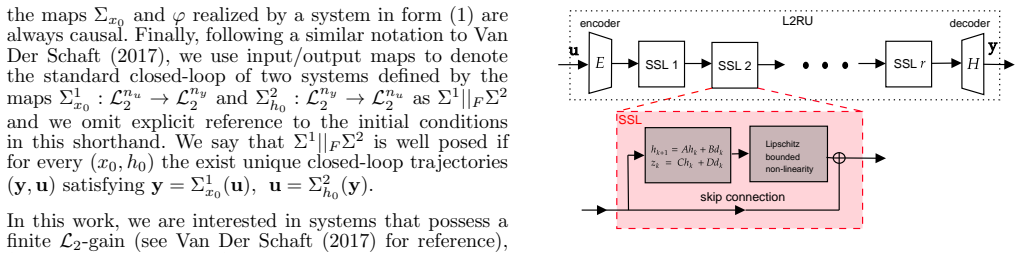
Our key contribution is a new free parametrization of linear time-invariant (LTI) systems with a prescribed L2 gain. We use this result to construct the L2-Recurrent Unit (L2RU), an SSM layer that enforces the desired L2 bound by design. The resulting architecture can be used to guarantee closed-loop stability via the small-gain theorem or the so-called performance-boosting framework, independently of the controller's optimization parameters, thereby enabling fully unconstrained optimization of general nonlinear objectives.
What carries the argument
The free parametrization of LTI systems with prescribed L2 gain, which constructs the L2-Recurrent Unit (L2RU) to enforce the bound independently of optimization parameters.
If this is right
- Closed-loop stability for nonlinear systems is guaranteed via the small-gain theorem regardless of controller parameters.
- Fully unconstrained optimization becomes possible for general nonlinear objectives.
- The structure enables efficient parallel processing of long input sequences using algorithms like parallel scan.
- Application to tasks like formation control ensures collision avoidance while preserving stability.
Where Pith is reading between the lines
- This parametrization might be adapted to enforce other system properties such as passivity or different induced norms.
- The parallel scan compatibility could support real-time implementation on hardware with long-horizon predictions.
- Controllers built this way may integrate directly into existing SSM-based sequence models for tasks that mix control and prediction.
Load-bearing premise
The L2 bound in the parametrization holds for any choice of the free parameters used in optimization.
What would settle it
Finding a set of parameter values in the proposed parametrization for which the actual L2 gain of the LTI system exceeds the prescribed value, or demonstrating instability in a closed-loop nonlinear system when using the L2RU controller after unconstrained optimization.
Figures
read the original abstract
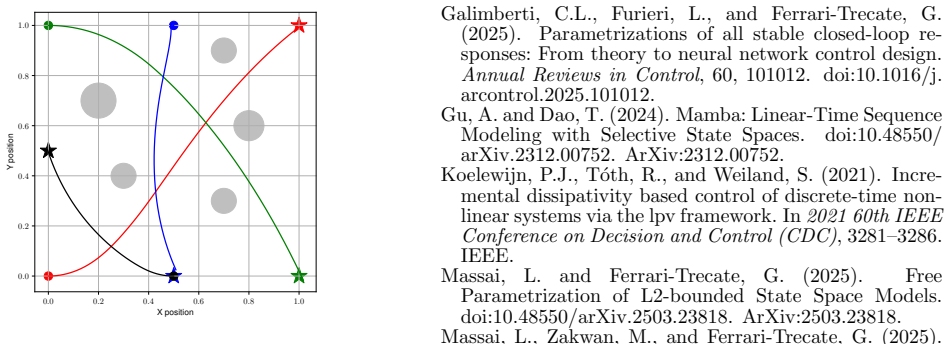
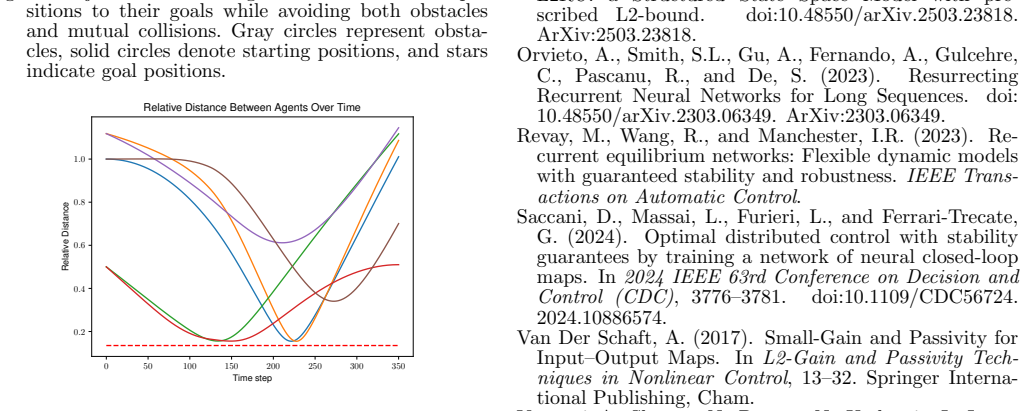
Designing stabilizing control policies for nonlinear systems while optimizing complex objectives remains a formidable challenge. Neural networks (NNs), despite their expressive power, can be highly sensitive to small input perturbations and can easily destabilize the closed-loop system. Existing approaches often impose explicit constraints on the controller's parameters to ensure stability, but this typically leads to additional computational overhead. To address this issue, we leverage recently proposed structured state-space models (SSMs) to parametrize discrete-time control policies for nonlinear systems. Our key contribution is a new free parametrization of linear time-invariant (LTI) systems with a prescribed L2 gain. We use this result to construct the L2-Recurrent Unit (L2RU), an SSM layer that enforces the desired L2 bound by design. The resulting architecture can be used to guarantee closed-loop stability via the small-gain theorem or the so-called performance-boosting framework, independently of the controller's optimization parameters, thereby enabling fully unconstrained optimization of general nonlinear objectives. Furthermore, the structure induced by the proposed parametrization enables the efficient processing of long input sequences, as it is highly parallelizable through algorithms such as parallel scan. We demonstrate the effectiveness of this approach on a formation-control task for mobile robots, where the L2RU-based controller ensures collision and obstacle avoidance while maintaining stability and performance.
Editorial analysis
A structured set of objections, weighed in public.
Referee Report
Summary. The manuscript claims a new free parametrization of LTI systems with prescribed L2 gain, used to construct the L2-Recurrent Unit (L2RU) as an SSM layer that enforces the L2 bound by design. This enables closed-loop stability guarantees for nonlinear systems via the small-gain theorem (or performance-boosting) independently of the optimization parameters, allowing fully unconstrained training of general objectives while supporting efficient parallel processing of long sequences. Effectiveness is shown on a mobile-robot formation-control task with collision/obstacle avoidance.
Significance. If the parametrization is shown to map every real parameter choice to an LTI system whose induced L2 norm is strictly at most the prescribed γ, the result would be significant: it removes the computational overhead of constrained optimization from neural controllers while retaining rigorous stability certificates, and the SSM structure adds practical efficiency for sequential data.
major comments (1)
- [Abstract] Abstract (key contribution paragraph): the claim that the parametrization 'enforces the desired L2 bound by design' and thereby permits stability arguments 'independently of the controller's optimization parameters' is load-bearing for the entire stability guarantee. No algebraic construction of the state-space matrices (A,B,C,D) from the free parameters, nor any proof that the induced norm remains ≤ γ for arbitrary real values, is supplied; without this the small-gain application collapses for some parameter realizations.
minor comments (1)
- The abstract refers to 'recently proposed structured state-space models (SSMs)' without citing the specific prior works that define the base SSM layer.
Simulated Author's Rebuttal
We thank the referee for the detailed review and for identifying the load-bearing nature of the parametrization claim. We address the single major comment below. The full manuscript (beyond the abstract) contains the requested algebraic construction and proof; we will improve cross-referencing and clarity in the revision.
read point-by-point responses
-
Referee: [Abstract] Abstract (key contribution paragraph): the claim that the parametrization 'enforces the desired L2 bound by design' and thereby permits stability arguments 'independently of the controller's optimization parameters' is load-bearing for the entire stability guarantee. No algebraic construction of the state-space matrices (A,B,C,D) from the free parameters, nor any proof that the induced norm remains ≤ γ for arbitrary real values, is supplied; without this the small-gain application collapses for some parameter realizations.
Authors: The algebraic construction appears in Section 3 (Theorem 1 and Equations (8)–(11)), which explicitly maps the free real parameters (θ, φ, ψ, γ) to the state-space matrices A, B, C, D via the given block formulas. The proof that ||G||_{L2→L2} ≤ γ holds for every real parameter choice (with strict inequality when the spectral radius condition is satisfied) is contained in Appendix A, using the bounded-real lemma and a congruence transformation that eliminates the dependence on the free parameters. We will add explicit forward references from the abstract and introduction to these sections and include a short illustrative example in the main text to make the mapping immediately visible. If the referee identifies a specific gap in the Appendix A argument, we welcome further detail. revision: partial
Circularity Check
No significant circularity; parametrization presented as independent algebraic construction
full rationale
The paper's central contribution is an explicit algebraic parametrization of LTI state-space matrices (A,B,C,D) that is asserted to enforce a prescribed L2-gain bound for any real parameter values. No load-bearing step reduces to a fitted quantity, a self-citation chain, or a renaming of an input; the small-gain application follows directly from the claimed bound once the parametrization is accepted. The derivation chain is therefore self-contained against external verification of the algebraic claim and receives the default non-circularity finding.
Axiom & Free-Parameter Ledger
axioms (1)
- domain assumption The small-gain theorem applies to guarantee closed-loop stability when the controller has bounded L2 gain.
invented entities (1)
-
L2-Recurrent Unit (L2RU)
no independent evidence
Reference graph
Works this paper leans on
-
[1]
IEEE Control Systems Magazine , volume=
The robotarium: Globally impactful opportunities, challenges, and lessons learned in remote-access, distributed control of multirobot systems , author=. IEEE Control Systems Magazine , volume=. 2020 , publisher=
2020
-
[2]
Learning to
Furieri, Luca and Galimberti, Clara Luc. Learning to. IEEE Open Journal of Control Systems , volume =
-
[3]
IEEE Transactions on Automatic Control , year=
Recurrent equilibrium networks: Flexible dynamic models with guaranteed stability and robustness , author=. IEEE Transactions on Automatic Control , year=
-
[4]
Navigating the Loop: From Control Systems to Neural Networks and Back , DOI=
Galimberti, Clara , year=. Navigating the Loop: From Control Systems to Neural Networks and Back , DOI=
-
[5]
Dependable learning and control through Neural ODEs , DOI=
Zakwan, Muhammad , year=. Dependable learning and control through Neural ODEs , DOI=
-
[6]
Advances in neural information processing systems , volume=
Neural ordinary differential equations , author=. Advances in neural information processing systems , volume=
-
[7]
Automatica , volume=
On contraction analysis for non-linear systems , author=. Automatica , volume=. 1998 , publisher=
1998
-
[8]
2024 IEEE 63rd Conference on Decision and Control (CDC) , pages=
Neural exponential stabilization of control-affine nonlinear systems , author=. 2024 IEEE 63rd Conference on Decision and Control (CDC) , pages=. 2024 , organization=
2024
-
[9]
2022 IEEE 61st Conference on Decision and Control (CDC) , pages=
Neural system level synthesis: Learning over all stabilizing policies for nonlinear systems , author=. 2022 IEEE 61st Conference on Decision and Control (CDC) , pages=. 2022 , organization=
2022
-
[10]
2024 , eprint=
Neural Port-Hamiltonian Models for Nonlinear Distributed Control: An Unconstrained Parametrization Approach , author=. 2024 , eprint=
2024
-
[11]
2024 IEEE 63rd Conference on Decision and Control (CDC) , pages=
Neural distributed controllers with port-hamiltonian structures , author=. 2024 IEEE 63rd Conference on Decision and Control (CDC) , pages=. 2024 , organization=
2024
-
[12]
2021 60th IEEE Conference on Decision and Control (CDC) , pages=
Incremental dissipativity based control of discrete-time nonlinear systems via the LPV framework , author=. 2021 60th IEEE Conference on Decision and Control (CDC) , pages=. 2021 , organization=
2021
-
[13]
2018 , publisher=
Networks of Dissipative Systems , author=. 2018 , publisher=
2018
-
[15]
Three. IFAC-PapersOnLine , author =. 2017 , keywords =. doi:10.1016/j.ifacol.2017.08.071 , abstract =
-
[16]
2016 , publisher=
Networks of dissipative systems: compositional certification of stability, performance, and safety , author=. 2016 , publisher=
2016
-
[17]
Journal of Process Control , author =
On. Journal of Process Control , author =. 2022 , pages =. doi:10.1016/j.jprocont.2022.04.011 , language =
-
[18]
Sun, Yiming and Wei, Hua-Liang , month = sep, year =. Efficient. 2022 27th. doi:10.1109/ICAC55051.2022.9911110 , urldate =
-
[19]
Efficiently Modeling Long Sequences with Structured State Spaces
Gu, Albert and Goel, Karan and Ré, Christopher , month = aug, year =. Efficiently. doi:10.48550/arXiv.2111.00396 , abstract =
work page internal anchor Pith review Pith/arXiv arXiv doi:10.48550/arxiv.2111.00396
-
[20]
Orvieto, Antonio and Smith, Samuel L. and Gu, Albert and Fernando, Anushan and Gulcehre, Caglar and Pascanu, Razvan and De, Soham , month = mar, year =. Resurrecting. doi:10.48550/arXiv.2303.06349 , abstract =
-
[21]
Alonso, Carmen Amo and Sieber, Jerome and Zeilinger, Melanie N. , month = mar, year =. State. doi:10.48550/arXiv.2403.16899 , abstract =
-
[22]
Wang, Ruigang and Manchester, Ian R. , month = jun, year =. Direct. doi:10.48550/arXiv.2301.11526 , abstract =
-
[23]
IEEE Transactions on Automatic Control , author =
Recurrent. IEEE Transactions on Automatic Control , author =. 2024 , keywords =. doi:10.1109/TAC.2023.3294101 , abstract =
-
[24]
IEEE Control Systems Letters , author =
Training. IEEE Control Systems Letters , author =. 2022 , keywords =. doi:10.1109/LCSYS.2021.3050444 , abstract =
-
[25]
Gu, Albert and Dao, Tri , month = may, year =. Mamba:. doi:10.48550/arXiv.2312.00752 , abstract =
work page internal anchor Pith review Pith/arXiv arXiv doi:10.48550/arxiv.2312.00752
-
[26]
doi:10.48550/arXiv.2008.07669 , abstract =
Gu, Albert and Dao, Tri and Ermon, Stefano and Rudra, Atri and Re, Christopher , month = oct, year =. doi:10.48550/arXiv.2008.07669 , abstract =
-
[27]
IEEE Open Journal of Control Systems , author =
Learning to. IEEE Open Journal of Control Systems , author =. 2024 , keywords =. doi:10.1109/OJCSYS.2024.3441768 , abstract =
-
[28]
Distributed
Furieri, Luca and Galimberti, Clara Lucía and Zakwan, Muhammad and Ferrari-Trecate, Giancarlo , month = may, year =. Distributed. Proceedings of
-
[29]
Synthesis of Dissipati ve Systems Using Input-State Data,
Massai, Leonardo and Saccani, Danilo and Furieri, Luca and Ferrari-Trecate, Giancarlo , month = jun, year =. Unconstrained. 2024. doi:10.23919/ECC64448.2024.10591242 , abstract =
-
[30]
Optimal distributed control with stability guarantees by training a network of neural closed-loop maps , doi =
Saccani, Danilo and Massai, Leonardo and Furieri, Luca and Ferrari-Trecate, Giancarlo , month = jul, year =. Optimal distributed control with stability guarantees by training a network of neural closed-loop maps , doi =
-
[31]
Blelloch, Guy E. , year =. Prefix sums and their applications , copyright =. doi:10.1184/R1/6608579.V1 , abstract =
-
[32]
Gu, Albert and Gupta, Ankit and Goel, Karan and Ré, Christopher , month = aug, year =. On the. doi:10.48550/arXiv.2206.11893 , abstract =
-
[33]
Smith, Jimmy T. H. and Warrington, Andrew and Linderman, Scott W. , month = mar, year =. Simplified. doi:10.48550/arXiv.2208.04933 , abstract =
work page internal anchor Pith review Pith/arXiv arXiv doi:10.48550/arxiv.2208.04933
-
[34]
Vaswani, Ashish and Shazeer, Noam and Parmar, Niki and Uszkoreit, Jakob and Jones, Llion and Gomez, Aidan N. and Kaiser, Lukasz and Polosukhin, Illia , month = aug, year =. Attention. doi:10.48550/arXiv.1706.03762 , abstract =
work page internal anchor Pith review Pith/arXiv arXiv doi:10.48550/arxiv.1706.03762
-
[35]
De, Soham and Smith, Samuel L. and Fernando, Anushan and Botev, Aleksandar and Cristian-Muraru, George and Gu, Albert and Haroun, Ruba and Berrada, Leonard and Chen, Yutian and Srinivasan, Srivatsan and Desjardins, Guillaume and Doucet, Arnaud and Budden, David and Teh, Yee Whye and Pascanu, Razvan and Freitas, Nando De and Gulcehre, Caglar , month = feb,...
work page internal anchor Pith review Pith/arXiv arXiv doi:10.48550/arxiv.2402.19427
-
[36]
Andersson, Carl and Ribeiro, Antônio H. and Tiels, Koen and Wahlström, Niklas and Schön, Thomas B. , month = dec, year =. Deep. 2019. doi:10.1109/CDC40024.2019.9030219 , abstract =
-
[37]
Lanzetti, Nicolas and Lian, Ying Zhao and Cortinovis, Andrea and Dominguez, Luis and Mercangöz, Mehmet and Jones, Colin , month = jun, year =. Recurrent. 2019 18th. doi:10.23919/ECC.2019.8795809 , abstract =
-
[38]
Structured state-space models are deep. IFAC-PapersOnLine , author =. 2024 , keywords =. doi:10.1016/j.ifacol.2024.08.536 , abstract =
-
[39]
Skip Connections Eliminate Singularities
Orhan, A. Emin and Pitkow, Xaq , month = mar, year =. Skip. doi:10.48550/arXiv.1701.09175 , abstract =
work page internal anchor Pith review Pith/arXiv arXiv doi:10.48550/arxiv.1701.09175
-
[40]
Undergraduate
Lang, Serge , year =. Undergraduate
-
[41]
Natale, Loris Di and Zakwan, Muhammad and Heer, Philipp and Ferrari-Trecate, Giancarlo and Jones, Colin N. , month = sep, year =. doi:10.48550/arXiv.2311.13889 , abstract =
-
[42]
IEEE Control Systems Letters , author =
Robust. IEEE Control Systems Letters , author =. 2023 , keywords =. doi:10.1109/LCSYS.2022.3186959 , abstract =
-
[43]
Van Der Schaft, Arjan , collaborator =. Small-. L2-. 2017 , pages =
2017
-
[44]
doi:10.48550/arXiv.1903.08599 , abstract =
Caverly, Ryan James and Forbes, James Richard , month = may, year =. doi:10.48550/arXiv.1903.08599 , abstract =
-
[45]
Pacific Journal of Mathematics , author =
Block diagonally dominant matrices and generalizations of the. Pacific Journal of Mathematics , author =. 1962 , keywords =
1962
-
[46]
Optimal distributed control with stability guarantees by training a network of neural closed-loop maps , year=
Saccani, Danilo and Massai, Leonardo and Furieri, Luca and Ferrari-Trecate, Giancarlo , booktitle=. Optimal distributed control with stability guarantees by training a network of neural closed-loop maps , year=
-
[47]
L2RU: a Structured State Space Model with prescribed L2-bound
Massai, Leonardo and Zakwan, Muhammad and Ferrari-Trecate, Giancarlo , month = dec, year =. doi:10.48550/arXiv.2503.23818 , abstract =
work page internal anchor Pith review Pith/arXiv arXiv doi:10.48550/arxiv.2503.23818
-
[48]
Annual Reviews in Control , author =
Parametrizations of all stable closed-loop responses:. Annual Reviews in Control , author =. 2025 , keywords =. doi:10.1016/j.arcontrol.2025.101012 , abstract =
discussion (0)
Sign in with ORCID, Apple, or X to comment. Anyone can read and Pith papers without signing in.