Robust high-dimensional Bayesian regression with non-Gaussian errors under global--local shrinkage priors
Pith reviewed 2026-06-27 15:45 UTC · model grok-4.3
The pith
Scale-location mixture errors with horseshoe+ priors on coefficients and precision matrix deliver robust high-dimensional Bayesian regression with joint sparsity.
A machine-rendered reading of the paper's core claim, the machinery that carries it, and where it could break.
Core claim
By using a scale-location mixture error distribution together with horseshoe+ priors on both the regression coefficients and the off-diagonals of the error precision matrix, the procedure achieves joint posterior contraction and selection consistency for the regression support and the precision matrix support, a Kullback-Leibler risk bound that establishes dominance of the horseshoe+ prior over the horseshoe prior, and bounded sensitivity ensuring that a single large outlier has vanishing influence under t-distributed errors.
What carries the argument
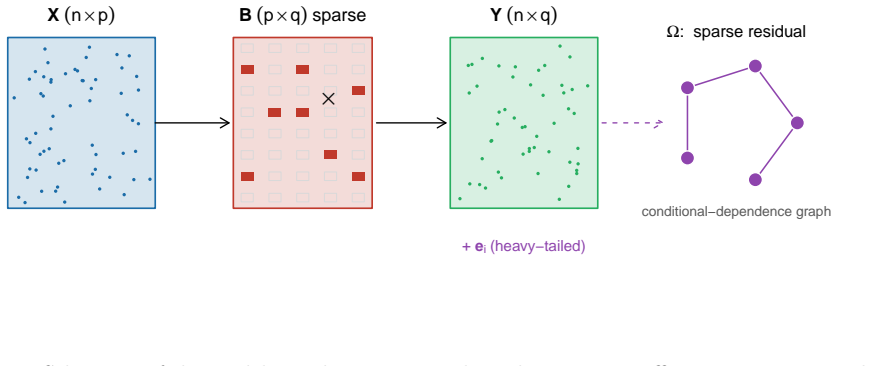
Scale-location mixture error distribution paired with horseshoe+ global-local shrinkage priors applied jointly to regression coefficients and precision matrix off-diagonals to couple sparsity in mean structure and residual dependence.
If this is right
- The estimator matches the performance of Gaussian-based methods under normal errors while dominating them under heavy tails, skewness, and contamination.
- Joint sparsity is induced in both the regression coefficient matrix and the residual dependence graph.
- Selection consistency holds simultaneously for the supports of the regression coefficients and the precision matrix.
- Bounded sensitivity ensures robustness to individual large outliers under t errors.
- The Kullback-Leibler risk is lower for horseshoe+ than for the standard horseshoe prior.
Where Pith is reading between the lines
- The coupling of regression sparsity and dependence sparsity could be useful in other settings where both mean and covariance structures need to be sparse.
- Applications to time series or spatial data might benefit from automatic outlier down-weighting during volatile periods.
- Extensions to other global-local priors or mixture components could broaden the robustness properties.
Load-bearing premise
The scale-location mixture error distribution combined with horseshoe+ priors on the coefficients and precision matrix off-diagonals will produce the stated joint contraction rates, selection consistencies, and risk bounds without further restrictions on the true parameter values or the rate of dimension growth.
What would settle it
A high-dimensional simulation study in which the posterior fails to contract at the predicted rate or selection consistency fails to hold when errors follow a heavy-tailed distribution outside the scale-location mixture family would falsify the central claims.
Figures




read the original abstract
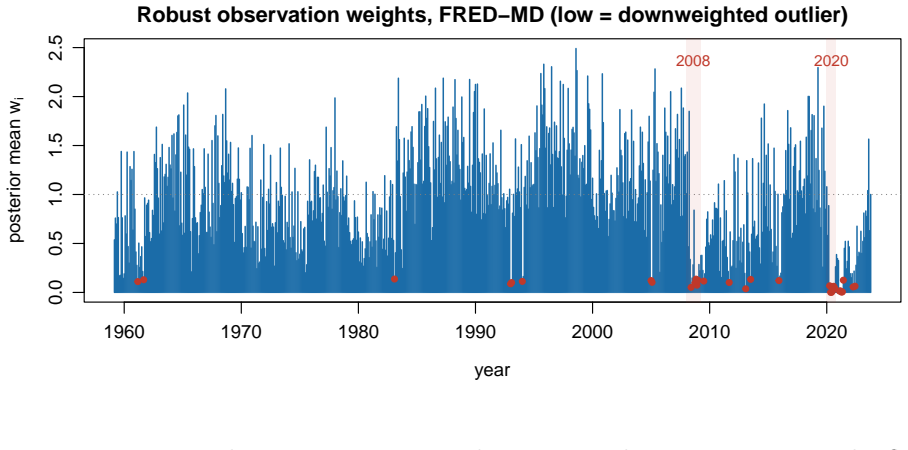
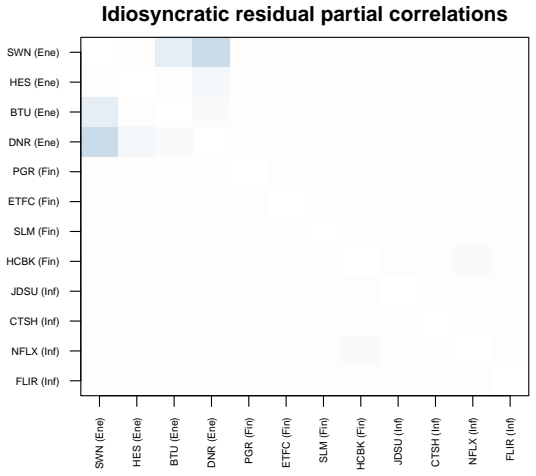
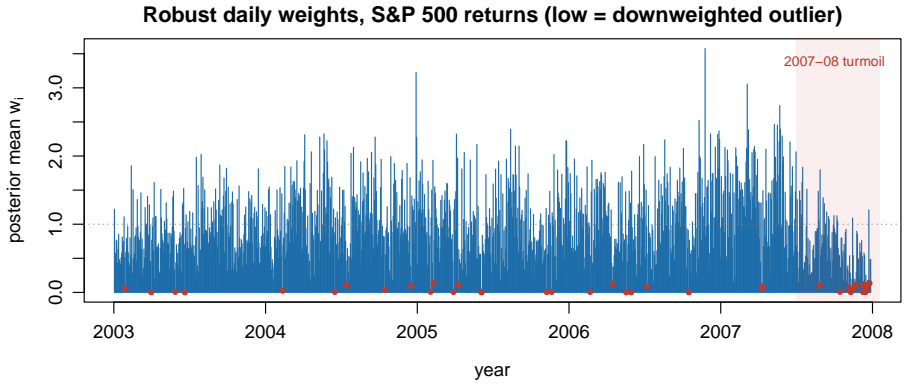
Multivariate regression with many correlated responses and predictors commonly violates Gaussian error assumptions due to heavy tails, outliers, and asymmetry. Gaussian procedures then lose efficiency in coefficient estimation and produce biased estimates of conditional dependence graphs. We develop a robust Bayesian framework using a scale-location mixture error distribution and horseshoe+ global-local priors on both the regression coefficients and off-diagonals of the error precision matrix, coupling sparsity in the regression map with sparsity in the residual dependence structure. Theoretical contributions include joint posterior contraction, selection consistency for both supports, a Kullback-Leibler risk bound showing the dominance of horseshoe+ over horseshoe, and bounded sensitivity, ensuring that a single large outlier has vanishing influence under t errors. Simulations across four error regimes, contamination, and varying dimensions show that our estimator matches Gaussian procedures under normality and dominates them under heavy tails and skewness. Applications to FRED-MD macroeconomic data and S&P 500 daily returns recover interpretable sparse coefficient maps and residual dependence graphs while automatically down-weighting crisis-period observations.
Editorial analysis
A structured set of objections, weighed in public.
Referee Report
Summary. The manuscript develops a robust Bayesian framework for high-dimensional multivariate regression under non-Gaussian errors. It employs a scale-location mixture error distribution together with horseshoe+ global-local priors placed on both the regression coefficients and the off-diagonal entries of the error precision matrix. The central claims are joint posterior contraction, selection consistency on both supports, a Kullback-Leibler risk bound establishing dominance of horseshoe+ over the horseshoe prior, and bounded sensitivity to outliers; these are illustrated by simulations across four error regimes and applications to FRED-MD and S&P 500 data.
Significance. If the stated theoretical results hold, the contribution would be significant: it couples sparsity in the regression map with sparsity in the residual dependence structure under a robust error model, supplies the first joint contraction and selection-consistency guarantees for this combination, and demonstrates practical gains under heavy tails while preserving performance under normality.
major comments (1)
- [§3] §3 (Theoretical results): the abstract and introduction assert joint posterior contraction, selection consistency for both supports, a KL-risk bound, and bounded sensitivity, yet no proof sketches, key lemmas, or explicit conditions on the relative growth of dimensions p, q and sample size n are supplied, rendering it impossible to verify whether the claimed rates hold without additional unstated restrictions on the true parameter values.
minor comments (1)
- [Simulations] The simulation section refers to 'four error regimes' without listing the specific distributions or parameter values used, which would aid reproducibility.
Simulated Author's Rebuttal
We thank the referee for the careful reading and constructive feedback. We address the single major comment below.
read point-by-point responses
-
Referee: [§3] §3 (Theoretical results): the abstract and introduction assert joint posterior contraction, selection consistency for both supports, a KL-risk bound, and bounded sensitivity, yet no proof sketches, key lemmas, or explicit conditions on the relative growth of dimensions p, q and sample size n are supplied, rendering it impossible to verify whether the claimed rates hold without additional unstated restrictions on the true parameter values.
Authors: The theorems in Section 3 explicitly state the growth conditions (e.g., p = o(n / log n), q = o(n), sparsity levels s_β = o(n / log p), and analogous bounds for the precision matrix support) under which the joint posterior contraction, selection consistency, KL-risk dominance, and outlier sensitivity bounds hold; these appear in the statements of Theorems 3.1–3.4. The complete proofs, including all key lemmas on the scale-location mixture posterior and the horseshoe+ contraction arguments, are contained in the supplementary material. To facilitate verification without requiring the reader to consult the supplement, we will insert a concise proof sketch (approximately one page) together with references to the main lemmas into the revised Section 3. revision: yes
Circularity Check
No significant circularity; derivation self-contained against external benchmarks
full rationale
The abstract and stated claims describe a scale-location mixture error model coupled with horseshoe+ priors on regression coefficients and precision-matrix off-diagonals, followed by separate theoretical results (joint posterior contraction, selection consistency, KL-risk dominance of horseshoe+ over horseshoe, bounded sensitivity). No equations, fitted parameters, or self-citations are exhibited that reduce a claimed prediction or uniqueness result to the input data or prior by construction. The KL-risk comparison and contraction statements are presented as derived consequences rather than tautological renamings or self-referential fits. This is the normal case of a paper whose central claims remain independent of the inputs they are applied to.
Axiom & Free-Parameter Ledger
Reference graph
Works this paper leans on
-
[1]
Journal of Multivariate Analysis , volume =
Bai, Ray and Ghosh, Malay , title =. Journal of Multivariate Analysis , volume =. 2018 , publisher =
2018
-
[2]
arXiv preprint arXiv:1904.04417 , year =
Zhang, Yabo and Ghosh, Malay , title =. arXiv preprint arXiv:1904.04417 , year =
-
[3]
and Willard, Brandon , title =
Bhadra, Anindya and Datta, Jyotishka and Polson, Nicholas G. and Willard, Brandon , title =. Bayesian Analysis , volume =
-
[4]
Deshpande, Sameer K. and Ro. Simultaneous variable and covariance selection with the multivariate spike-and-slab. Journal of Computational and Graphical Statistics , volume =. 2019 , publisher =
2019
- [5]
-
[6]
and Bhadra, Anindya , title =
Li, Yunfan and Craig, Bruce A. and Bhadra, Anindya , title =. Journal of Computational and Graphical Statistics , volume =. 2019 , publisher =
2019
-
[7]
Electronic Journal of Statistics , year =
Sagar, Ksheera and Banerjee, Sayantan and Datta, Jyotishka and Bhadra, Anindya , title =. Electronic Journal of Statistics , year =
-
[8]
Gagnon, Philippe and Desgagn. A new. Bayesian Analysis , volume =
-
[9]
Brazilian Journal of Probability and Statistics , volume =
O'Hagan, Anthony and Pericchi, Luis , title =. Brazilian Journal of Probability and Statistics , volume =
-
[10]
Robustness to outliers in location--scale parameter model using log-regularly varying distributions , journal =
Desgagn. Robustness to outliers in location--scale parameter model using log-regularly varying distributions , journal =
-
[11]
and Ng, Serena , title =
McCracken, Michael W. and Ng, Serena , title =. Journal of Business & Economic Statistics , volume =. 2016 , publisher =
2016
-
[12]
and Polson, Nicholas G
Carvalho, Carlos M. and Polson, Nicholas G. and Scott, James G. , title =. Biometrika , volume =. 2010 , publisher =
2010
-
[13]
Bayesian linear regression with sparse priors , journal =
Castillo, Isma. Bayesian linear regression with sparse priors , journal =
-
[14]
and Levina, Elizaveta and Zhu, Ji , title =
Rothman, Adam J. and Levina, Elizaveta and Zhu, Ji , title =. Journal of Computational and Graphical Statistics , volume =. 2010 , publisher =
2010
-
[15]
Bayesian Analysis , volume =
Wang, Hao , title =. Bayesian Analysis , volume =
-
[16]
and Dunson, David B
Bhattacharya, Anirban and Pati, Debdeep and Pillai, Natesh S. and Dunson, David B. , title =. Journal of the American Statistical Association , volume =. 2015 , publisher =
2015
-
[17]
, title =
Makalic, Enes and Schmidt, Daniel F. , title =. IEEE Signal Processing Letters , volume =. 2016 , publisher =
2016
-
[18]
and Dey, Dipak K
Sahu, Sujit K. and Dey, Dipak K. and Branco, M. A new class of multivariate skew distributions with applications to. Canadian Journal of Statistics , volume =. 2003 , publisher =
2003
-
[19]
Journal of the Royal Statistical Society: Series B , volume =
Azzalini, Adelchi and Capitanio, Antonella , title =. Journal of the Royal Statistical Society: Series B , volume =. 2003 , publisher =
2003
-
[20]
and Little, Roderick J
Lange, Kenneth L. and Little, Roderick J. A. and Taylor, Jeremy M. G. , title =. Journal of the American Statistical Association , volume =. 1989 , publisher =
1989
-
[21]
Journal of Applied Econometrics , volume =
Geweke, John , title =. Journal of Applied Econometrics , volume =. 1993 , publisher =
1993
-
[22]
Fern. On. Journal of the American Statistical Association , volume =. 1998 , publisher =
1998
-
[23]
Biostatistics , volume =
Friedman, Jerome and Hastie, Trevor and Tibshirani, Robert , title =. Biostatistics , volume =. 2008 , publisher =
2008
-
[24]
Journal of Multivariate Analysis , volume =
Banerjee, Sayantan and Ghosal, Subhashis , title =. Journal of Multivariate Analysis , volume =. 2015 , publisher =
2015
-
[25]
and Vannucci, Marina and Fearn, Tom , title =
Brown, Philip J. and Vannucci, Marina and Fearn, Tom , title =. Journal of the Royal Statistical Society: Series B , volume =. 1998 , publisher =
1998
-
[26]
and van der Vaart, Aad W
Ghosal, Subhashis and Ghosh, Jayanta K. and van der Vaart, Aad W. , title =. The Annals of Statistics , volume =
-
[27]
and Scott, James G
Polson, Nicholas G. and Scott, James G. , title =. Bayesian Statistics , volume =. 2010 , publisher =
2010
-
[28]
Electronic Journal of Statistics , volume =
Piironen, Juho and Vehtari, Aki , title =. Electronic Journal of Statistics , volume =
-
[29]
Journal of the Royal Statistical Society: Series B , volume =
Tibshirani, Robert , title =. Journal of the Royal Statistical Society: Series B , volume =. 1996 , publisher =
1996
-
[30]
Journal of the American Statistical Association , volume =
Park, Trevor and Casella, George , title =. Journal of the American Statistical Association , volume =. 2008 , publisher =
2008
-
[31]
Biometrika , volume =
Yuan, Ming and Lin, Yi , title =. Biometrika , volume =. 2007 , publisher =
2007
-
[32]
High-dimensional graphs and variable selection with the lasso , journal =
Meinshausen, Nicolai and B. High-dimensional graphs and variable selection with the lasso , journal =
-
[33]
Journal of Machine Learning Research , volume =
Zhao, Tuo and Liu, Han and Roeder, Kathryn and Lafferty, John and Wasserman, Larry , title =. Journal of Machine Learning Research , volume =
-
[34]
, title =
van der Vaart, Aad W. , title =
-
[35]
, title =
Datta, Jyotishka and Ghosh, Jayanta K. , title =. Bayesian Analysis , volume =
-
[36]
and Kleijn, Bas J
van der Pas, Stephanie L. and Kleijn, Bas J. K. and van der Vaart, Aad W. , title =. Electronic Journal of Statistics , volume =
discussion (0)
Sign in with ORCID, Apple, or X to comment. Anyone can read and Pith papers without signing in.