Concerns and Strategic Responses of Older Workers Navigating Generative AI in Bridge Employment
Pith reviewed 2026-07-01 07:23 UTC · model grok-4.3
The pith
Older workers face GenAI disruptions at every stage of bridge employment and respond by building AI resilience through boundary work.
A machine-rendered reading of the paper's core claim, the machinery that carries it, and where it could break.
Core claim
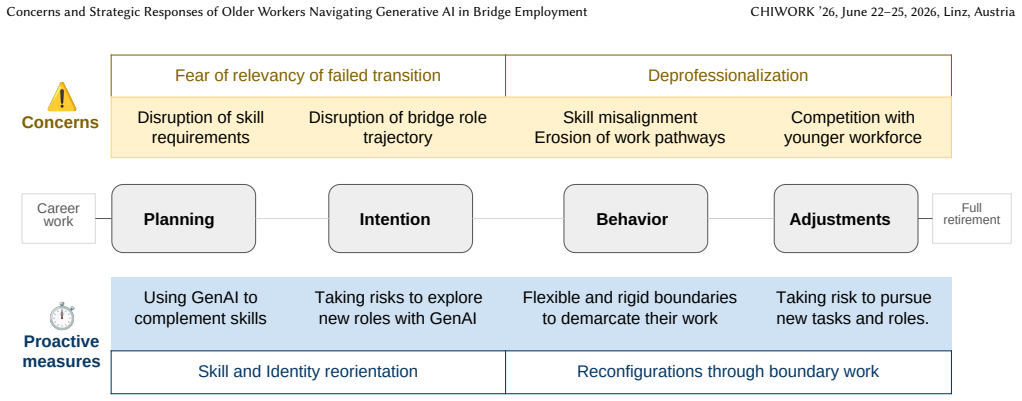
Through in-depth semi-structured interviews with 21 professionals, the study shows that OWs experienced both temporal and structural disruptions across all stages of the bridge employment decision-making process due to GenAI. In response, they reconfigured their tasks through different forms of boundary work aimed at restoring stability and continuity. We conceptualize these responses as AI resilience, which reshaped OWs' bridge employment decision-making into an ongoing process of negotiation and adaptation.
What carries the argument
AI resilience: the reconfiguration of tasks through boundary work to restore stability and continuity against GenAI disruptions in bridge employment.
If this is right
- Bridge employment decision-making shifts from a staged process to continuous negotiation and adaptation.
- Individual AI resilience strategies help restore continuity but risk burnout without additional support.
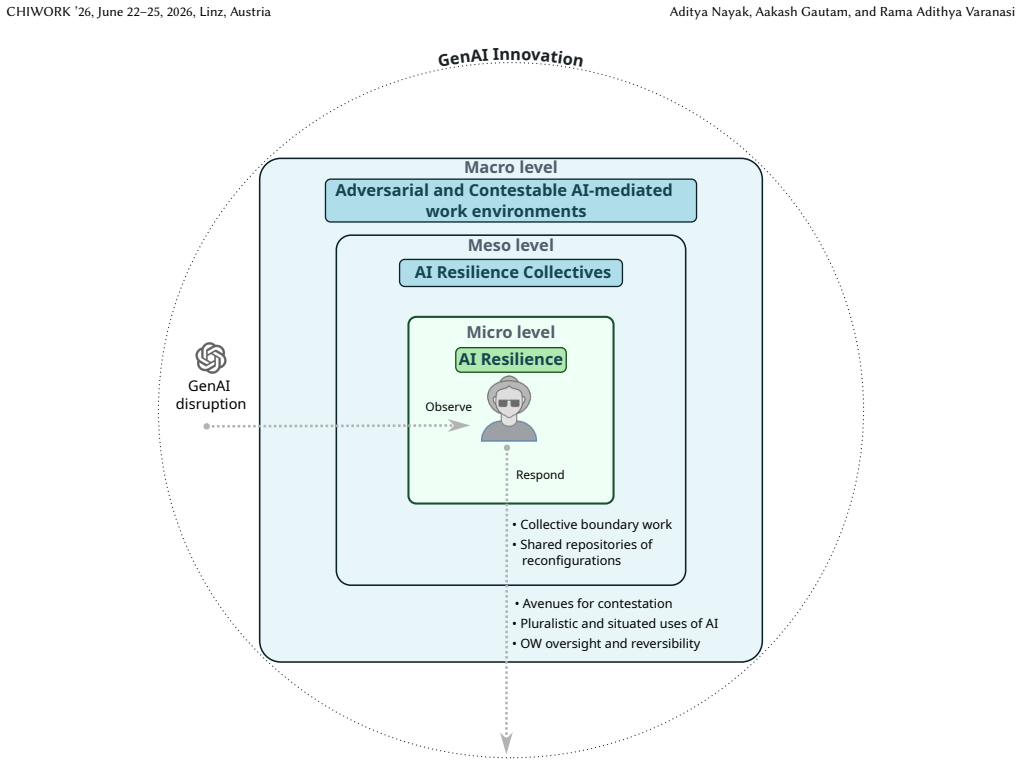
- Meso-level AI resilience collectives and macro-level adversarial or contestable AI structures are needed alongside personal tactics.
- Recommendations center on balancing these levels to support older workers and reduce burnout.
Where Pith is reading between the lines
- Design of workplace AI tools may need adjustments to reduce time and structural barriers specifically for late-career transitions.
- Similar disruption-and-response patterns could be tested in other groups facing rapid technology shifts during career changes.
- Organizations adopting GenAI might benefit from phased rollout plans that account for workers already in bridge roles.
Load-bearing premise
Semi-structured interviews with 21 professionals are sufficient to identify general patterns of GenAI disruptions and responses that apply across stages of bridge employment decision-making.
What would settle it
A larger survey or follow-up study of older workers in bridge employment that finds no consistent temporal or structural disruptions from GenAI, or different response patterns that do not produce ongoing adaptation, would undermine the central claim.
Figures
read the original abstract
Generative AI (GenAI) is transforming workplaces at a rapid pace. This disproportionately affects vulnerable communities, including older workers (OWs) who re-enter the workforce through bridge employment prior to final retirement. Through in-depth semi-structured interviews with 21 professionals, we examine how OWs navigate GenAI-driven disruptions while pursuing bridge roles, focusing on their concerns about GenAI integration and their responses to these changes. Our findings show that OWs experienced both temporal and structural disruptions across all stages of the bridge employment decision-making process due to GenAI. In response, they reconfigured their tasks through different forms of boundary work aimed at restoring stability and continuity. We conceptualize these responses as AI resilience, which reshaped OWs' bridge employment decision-making into an ongoing process of negotiation and adaptation. We conclude by offering recommendations to reduce burnout among OWs by balancing individual-level AI resilience strategies with meso-level AI resilience collectives and macro-level adversarial and contestable AI-mediated organizational structures.
Editorial analysis
A structured set of objections, weighed in public.
Referee Report
Summary. The paper reports on semi-structured interviews with 21 older professionals in bridge employment. It claims that generative AI produces both temporal and structural disruptions across every stage of the bridge-employment decision-making process; participants respond by reconfiguring tasks via multiple forms of boundary work, which the authors conceptualize as 'AI resilience.' This resilience is said to convert the decision process into an ongoing negotiation and adaptation cycle. The manuscript closes with recommendations for balancing individual, meso-level, and macro-level responses to reduce burnout.
Significance. If the stage-specific patterns hold, the work supplies a needed empirical account of GenAI effects on an under-studied population and introduces the construct of AI resilience as a lens for adaptation strategies. The multi-level recommendations (individual boundary work, collective structures, adversarial AI design) could inform both HR practice and policy. The qualitative design yields contextual depth that quantitative surveys often miss; however, the modest purposive sample limits claims to broad generalization.
major comments (2)
- [Abstract / Methods] Abstract and Methods: the manuscript asserts disruptions 'across all stages' of bridge-employment decision-making yet provides no information on how the 21 interviews were distributed across those stages, whether stage-specific saturation was reached, or what coding/validation procedures were used. Without this, the scope of the central claim cannot be evaluated.
- [Findings] Findings: the generalization that responses constitute a distinct 'AI resilience' construct that reshapes the entire decision process rests on the assumption that recurring themes map cleanly onto each stage; the text does not supply participant-by-stage counts or explicit cross-stage comparisons that would substantiate this mapping.
minor comments (1)
- [Abstract] The term 'AI resilience' is introduced in the abstract without a concise definition; a one-sentence gloss at first use would aid readers.
Simulated Author's Rebuttal
We thank the referee for their detailed and constructive comments. The feedback identifies key areas where additional methodological transparency and explicit mapping in the findings would strengthen the manuscript. We address each major comment below and indicate the revisions we will make.
read point-by-point responses
-
Referee: [Abstract / Methods] Abstract and Methods: the manuscript asserts disruptions 'across all stages' of bridge-employment decision-making yet provides no information on how the 21 interviews were distributed across those stages, whether stage-specific saturation was reached, or what coding/validation procedures were used. Without this, the scope of the central claim cannot be evaluated.
Authors: We agree that the Methods section requires greater detail to allow evaluation of the 'across all stages' claim. The original text described the overall purposive sample of 21 professionals and the thematic analysis approach but omitted a stage-by-stage breakdown, stage-specific saturation reporting, and expanded coding/validation steps. In the revised manuscript we will add a table summarizing participant distribution across the identified stages of the bridge-employment decision process, report how saturation was assessed (overall and with attention to stage coverage), and provide explicit information on the coding procedures including inter-coder agreement checks and validation methods used. revision: yes
-
Referee: [Findings] Findings: the generalization that responses constitute a distinct 'AI resilience' construct that reshapes the entire decision process rests on the assumption that recurring themes map cleanly onto each stage; the text does not supply participant-by-stage counts or explicit cross-stage comparisons that would substantiate this mapping.
Authors: The Findings section links recurring boundary-work themes to participants' accounts of disruptions at different points in the decision process, but we accept that the absence of participant-by-stage counts and dedicated cross-stage comparisons weakens the substantiation of the mapping and the 'AI resilience' construct. We will revise the Findings to include a summary table with participant counts per stage, add explicit cross-stage comparisons, and include a short subsection that synthesizes how the identified strategies collectively reshape the decision process into an ongoing negotiation cycle. revision: yes
Circularity Check
No circularity: claims rest on interview themes without reduction to fitted inputs or self-citation chains
full rationale
The paper is a qualitative study reporting themes from 21 semi-structured interviews. Its central claims (temporal/structural disruptions across bridge-employment stages, boundary work responses, and the named concept of AI resilience) are presented as direct outputs of thematic analysis of participant data. No equations, parameter fitting, predictive modeling, or load-bearing self-citations appear; the derivation chain is therefore self-contained against external benchmarks and does not reduce any result to its own inputs by construction.
Axiom & Free-Parameter Ledger
axioms (1)
- domain assumption Semi-structured interviews with 21 participants can capture representative concerns and strategic responses of older workers regarding GenAI in bridge employment.
invented entities (1)
-
AI resilience
no independent evidence
Reference graph
Works this paper leans on
-
[1]
Rosa Aisa, Josefina Cabeza, and Jorge Martin. 2023. Automation and aging: The impact on older workers in the workforce.The Journal of the Economics of Ageing26 (Oct. 2023), 100476. doi:10.1016/j.jeoa.2023.100476
-
[2]
2014.Bridge employment: A research handbook
Carlos-Maria Alcover, Gabriela Topa, Emma Parry, Franco Fraccaroli, and Marco Depolo. 2014.Bridge employment: A research handbook. Routledge
2014
-
[3]
R. C. Atchley. 1989. A Continuity Theory of Normal Aging.The Gerontologist 29, 2 (April 1989), 183–190. doi:10.1093/geront/29.2.183
-
[4]
Carol Atkinson and Peter Sandiford. 2016. An exploration of older worker flexible working arrangements in smaller firms.Human Resource Management Journal26, 1 (Jan. 2016), 12–28. doi:10.1111/1748-8583.12074
-
[5]
Bradley, Frances Hodgson, and Ashley D
Yvonne Barnard, Mike D. Bradley, Frances Hodgson, and Ashley D. Lloyd. 2013. Learning to use new technologies by older adults: Perceived difficulties, experi- mentation behaviour and usability.Computers in Human Behavior29, 4 (July 2013), 1715–1724. doi:10.1016/j.chb.2013.02.006
-
[6]
Terry A Beehr and Misty M Bennett. 2015. Working after retirement: Features of bridge employment and research directions.Work, Aging and Retirement1, 1 (2015), 112–128
2015
-
[7]
Terry A. Beehr, Sharon Glazer, Norma L. Nielson, and Suzanne J. Farmer. 2000. Work and Nonwork Predictors of Employees’ Retirement Ages.Journal of Vocational Behavior57, 2 (Oct. 2000), 206–225. doi:10.1006/jvbe.1999.1736
-
[8]
2020.Storytelling for social justice: connecting narrative and the arts in antiracist teaching(second edition ed.)
Lee Anne Bell. 2020.Storytelling for social justice: connecting narrative and the arts in antiracist teaching(second edition ed.). Routledge, Taylor & Francis Group, New York London
2020
-
[9]
Rich Berger. 2012. From Defined Benefit to Defined Contribution: A Systematic Approach to Transitioning Retirement Plans. https://www.shrm.org/topics- tools/news/benefits-compensation/defined-benefit-to-defined-contribution- systematic-approach-to-transitioning-retirement-plans
2012
-
[10]
Virginia Braun and Victoria Clarke. 2006. Using thematic analysis in psychol- ogy.Qualitative Research in Psychology3, 2 (Jan. 2006), 77–101. doi:10.1191/ 1478088706qp063oa
2006
-
[11]
Robin Brewer, Meredith Ringel Morris, and Anne Marie Piper. 2016. "Why would anybody do this?": Understanding Older Adults’ Motivations and Challenges in Crowd Work. InProceedings of the 2016 CHI Conference on Human Factors in Computing Systems. ACM, San Jose California USA, 2246–2257. doi:10.1145/ 2858036.2858198
-
[12]
Hanna Rebecca Broder, Maximilian Förster, Julia Klier, Mathias Klier, and Irina Sigler. 2025. Too old to find employment? A novel approach to leverage the power of digital peer groups for older unemployed.Information Systems and e-Business Management23, 4 (Dec. 2025), 999–1038. doi:10.1007/s10257-025- 00708-3
-
[13]
John Seely Brown and Paul Duguid. 1991. Organizational Learning and Communities-of-Practice: Toward a Unified View of Working, Learning, and Innovation.Organization Science2, 1 (Feb. 1991), 40–57. doi:10.1287/orsc.2.1.40
-
[14]
Erik Brynjolfsson, Daniel Rock, and Chad Syverson. 2021. The Productivity J- Curve: How Intangibles Complement General Purpose Technologies.American Economic Journal: Macroeconomics13, 1 (Jan. 2021), 333–372. doi:10.1257/mac. 20180386
work page doi:10.1257/mac 2021
-
[15]
Chhani Bungsut. 2024. Age against the machine: The need for a pension revolu- tion in India. https://www.developmentpathways.co.uk/blog/age-against-the- machine-the-need-for-a-pension-revolution-in-india/
2024
-
[16]
Robert N. Butler. 2010.The Longevity Revolution: the Benefits and Challenges of Living a Long Life.Perseus Books Group, New York
2010
-
[17]
Moses, Deep Narayan Mukherjee, Ankur Sinha, and Amita Todkar
Anindya Chakrabarti, Debjit Ghatak, Aditya C. Moses, Deep Narayan Mukherjee, Ankur Sinha, and Amita Todkar. 2024.Labour-force Perception about AI: A Study on Indian White-collar Workers. Technical Report. Brij Disa Centre for Data SCience and Artificial Intelligence, IIM Ahmedabad
2024
-
[18]
Malancha Chakrabarty. 2026. Union Budget 2026-27: Neglecting India’s Elders. https://www.orfonline.org/expert-speak/union-budget-2026-27- neglecting-india-s-elders
2026
-
[19]
Money Control. 2025. From low pensions to delayed dues: These retirement disputes could affect you, too- Moneycontrol.com. https://www.moneycontrol. com/news/business/personal-finance/from-low-pensions-to-delayed-dues- these-retirement-disputes-could-affect-you-too-13721718.html
2025
-
[20]
Alessia Contu. 2014. On boundaries and difference: Communities of practice and power relations in creative work.Management Learning45, 3 (2014), 289–316. doi:10.1177/1350507612471926
-
[21]
Convertino, U
G. Convertino, U. Farooq, M. B. Rosson, J. M. Carroll, and B. J. F. Meyer. 2007. Supporting intergenerational groups in computer-supported cooperative work (CSCW).Behaviour & Information Technology26, 4 (July 2007), 275–285. doi:10. 1080/01449290601173473
2007
-
[22]
Caglar Cosarderelioglu, Jeremy D. Walston, and Peter M. Abadir. 2025. From frailty to resilience: exploring adaptive capacity and reserve in older adults–a narrative review.Frontiers in Aging6 (July 2025), 1520842. doi:10.3389/fragi. 2025.1520842
-
[23]
Geneviève Coudin and Theodore Alexopoulos. 2010. ‘Help me! I’m old!’ How negative aging stereotypes create dependency among older adults.Aging & Mental Health14, 5 (July 2010), 516–523. doi:10.1080/13607861003713182
-
[24]
Creswell and Dana L
John W. Creswell and Dana L. Miller. 2000. Determining Validity in Quali- tative Inquiry.Theory Into Practice39, 3 (Aug. 2000), 124–130. doi:10.1207/ s15430421tip3903_2
2000
-
[25]
Andrea Cuadra, Jessica Bethune, Rony Krell, Alexa Lempel, Katrin Hänsel, Armin Shahrokni, Deborah Estrin, and Nicola Dell. 2023. Designing Voice- First Ambient Interfaces to Support Aging in Place. InProceedings of the 2023 ACM Designing Interactive Systems Conference(Pittsburgh, PA, USA)(DIS ’23). Association for Computing Machinery, New York, NY, USA, 2...
- [26]
-
[27]
Ellen Dingemans and Kène Henkens. 2014. Involuntary retirement, bridge employment, and satisfaction with life: A longitudinal investigation: Retirement Transitions and Life Satisfaction.Journal of Organizational Behavior35, 4 (May 2014), 575–591. doi:10.1002/job.1914
-
[28]
Carl DiSalvo. 2009. Design and the Construction of Publics.Design Issues25, 1 (Jan. 2009), 48–63. doi:10.1162/desi.2009.25.1.48
-
[29]
2015.Adversarial design
Carl DiSalvo. 2015.Adversarial design. The MIT Press, Cambridge, Mas- sachusetts
2015
-
[30]
Peter B Doeringer and David G Terkla. 1990. Business necessity, bridge jobs, and the nonbureaucratic firm.Bridges to retirement: Older workers in a changing labor market(1990), 146–171
1990
-
[31]
Patricia Drentea. 2002. Retirement and Mental Health.Journal of Aging and Health14, 2 (May 2002), 167–194. doi:10.1177/089826430201400201
-
[32]
Manaswita Dutta, Nandini C Singh, Sainon J Wangsa, and Suman Bhujel. 2026. Elderly welfare in India: Navigating challenges and inclusive social interventions. International Journal of Multidisciplinary Trends8, 3 (March 2026), 05–09. doi:10. 22271/multi.2026.v8.i3a.932
2026
-
[33]
David J Ekerdt and Stanley DeViney. 1990. On defining persons as retired. Journal of Aging Studies4, 3 (1990), 211–229
1990
-
[34]
Tomas Farchi, Sue Dopson, and Ewan Ferlie. 2023. Do We Still Need Profes- sional Boundaries? The multiple influences of boundaries on interprofessional collaboration.Organization Studies44, 2 (Feb. 2023), 277–298. doi:10.1177/ 01708406221074146
2023
-
[35]
Daniel C Feldman. 1994. The decision to retire early: A review and conceptual- ization.Academy of management review19, 2 (1994), 285–311
1994
-
[36]
B. Fletcher-Watson, C.J. Crompton, M. Hutchison, and H. Lu. 2016. Strate- gies for enhancing success in digital tablet use by older adults: A pilot study. Gerontechnology15, 3 (Nov. 2016), 162–170. doi:10.4017/gt.2016.15.3.005.00
-
[37]
Morgan R Frank, David Autor, James E Bessen, Erik Brynjolfsson, Manuel Cebrian, David J Deming, Maryann Feldman, Matthew Groh, José Lobo, Esteban Moro, et al. 2019. Toward understanding the impact of artificial intelligence on labor.Proceedings of the National Academy of Sciences116, 14 (2019), 6531–6539. Concerns and Strategic Responses of Older Workers ...
2019
-
[38]
Nancy M. Gell, Dori E. Rosenberg, George Demiris, Andrea Z. LaCroix, and Kushang V. Patel. 2015. Patterns of Technology Use Among Older Adults With and Without Disabilities.The Gerontologist55, 3 (June 2015), 412–421. doi:10.1093/geront/gnt166
-
[39]
Thomas F. Gieryn. 1999.Cultural Boundaries of Science: Credibility on the Line. University of Chicago Press, Chicago. https://doi.org/10.7208/chicago/ 9780226824420
-
[40]
Glassman, Ziwei Gu, and Jonathan K
Elena L. Glassman, Ziwei Gu, and Jonathan K. Kummerfeld. 2024. AI-Resilient Interfaces. arXiv:2405.08447 [cs.HC] https://arxiv.org/abs/2405.08447
-
[41]
Kirsten T Gobeski and Terry A Beehr. 2009. How retirees work: Predictors of different types of bridge employment.Journal of Organizational Behavior: The International Journal of Industrial, Occupational and Organizational Psychology and Behavior30, 3 (2009), 401–425
2009
-
[42]
Guo-feng Guan, Lu Wang, Dong-fen Ma, and Pan-shi Luo. 2025. Research on the impact of delayed retirement on the subjective wellbeing of older adults.Fron- tiers in Public Health13 (June 2025), 1530613. doi:10.3389/fpubh.2025.1530613
-
[43]
Philip J. Guo. 2017. Older Adults Learning Computer Programming: Motiva- tions, Frustrations, and Design Opportunities. InProceedings of the 2017 CHI Conference on Human Factors in Computing Systems. ACM, Denver Colorado USA, 7070–7083. doi:10.1145/3025453.3025945
-
[44]
2012.The Oxford handbook of work and aging
Jerry W Hedge and Walter C Borman. 2012.The Oxford handbook of work and aging. Oxford University Press, USA
2012
-
[45]
Richard Heeks and Angelica V. Ospina. 2019. Conceptualising the link be- tween information systems and resilience: A developing country field study. Information Systems Journal29, 1 (Jan. 2019), 70–96. doi:10.1111/isj.12177
-
[46]
2019.Qualitative research methods(2nd ed.)
Monique Hennink, Inge Hutter, and Ajay Bailey. 2019.Qualitative research methods(2nd ed.). SAGE Publications Ltd, Thousand Oaks
2019
-
[47]
John C Henretta. 2018. The life-course perspective on work and retirement. In Invitation to the life course. Routledge, 85–105. doi:10.4324/9781315224206
-
[48]
Henry C.Y. Ho and Dannii Y. Yeung. 2021. Conflict between younger and older workers: an identity-based approach.International Journal of Conflict Management32, 1 (Jan. 2021), 102–125. doi:10.1108/IJCMA-08-2019-0124
-
[49]
Nikhil Inamdar. 2025. TCS: India’s AI-driven tech firings could derail middle class dreams. https://www.bbc.com/news/articles/cx2p4nqd352o
2025
-
[50]
2024.Ageing in India: Exploring Preparedness Response to Care Challenges
Helpage India. 2024.Ageing in India: Exploring Preparedness Response to Care Challenges. Technical Report. Helpage India
2024
-
[51]
IndiaAI. 2026. India Leads in AI Adoption, Says BCG Study. https://indiaai.gov. in/news/india-leads-in-ai-adoption-says-bcg-study
2026
-
[52]
International Labour Organization. 2024. India Employment Report 2024: Youth Employment, Education, and Skills. https://www.ilo.org/sites/default/files/2024- 08/India%20Employment%20-%20web_8%20April.pdf
2024
-
[53]
Kavitha Iyr. 2025. The Hidden Cost Of India’s Economic Boom: Inequality At Historic High, As Wealth & Income Growth Leave Out Millions. https://article- 14.com/post/the-hidden-cost-of-india-s-economic-boom-inequality-at- historic-high-as-wealth-income-growth-leave-out-millions--693b8b0d6e810
2025
-
[54]
Neha Jain, Srinivas Goli, and Arjun Jana. 2025. Population age structural transi- tion, demographic dividend and economic growth in India.Humanities and Social Sciences Communications12, 1 (June 2025), 771. doi:10.1057/s41599-025-05042-0
-
[55]
Ben Jelen, Amanda Lazar, Christina Harrington, Alisha Pradhan, and Katie A. Siek. 2023. Speaking from Experience: Co-designing E-textile Projects with Older Adult Fiber Crafters. InProceedings of the Seventeenth International Conference on Tangible, Embedded, and Embodied Interaction(Warsaw, Poland)(TEI ’23). Association for Computing Machinery, New York,...
-
[56]
Kane, Amber G
Gerald C. Kane, Amber G. Young, Ann Majchrzak, and Sam Ransbotham. 2021. Avoiding an Oppressive Future of Machine Learning: A Design Theory for Emancipatory assistants.MIS Quarterly45, 1 (March 2021), 371–396. doi:10. 25300/MISQ/2021/1578
2021
-
[57]
Tunga Kantarci and Arthur Van Soest. 2008. Gradual Retirement: Preferences and Limitations.De Economist156, 2 (June 2008), 113–144. doi:10.1007/s10645- 008-9086-1
-
[58]
Seongsu Kim and Daniel C Feldman. 2000. Working in retirement: The an- tecedents of bridge employment and its consequences for quality of life in retirement.Academy of management Journal43, 6 (2000), 1195–1210
2000
-
[59]
Masatomo Kobayashi, Shoma Arita, Toshinari Itoko, Shin Saito, and Hironobu Takagi. 2015. Motivating Multi-Generational Crowd Workers in Social-Purpose Work. InProceedings of the 18th ACM Conference on Computer Supported Co- operative Work & Social Computing. ACM, Vancouver BC Canada, 1813–1824. doi:10.1145/2675133.2675255
-
[60]
Wiesław Kopeć, Bartłomiej Balcerzak, Radoslaw Nielek, Grzegorz Kowalik, Adam Wierzbicki, and Fabio Casati. 2018. Older adults and hackathons: a qualitative study. InProceedings of the 40th International Conference on Soft- ware Engineering(Gothenburg, Sweden)(ICSE ’18). Association for Computing Machinery, New York, NY, USA, 702–703. doi:10.1145/3180155.3182547
-
[61]
Sanna Kuoppamäki, Sylvaine Tuncer, Sara Eriksson, and Donald McMillan. 2021. Designing Kitchen Technologies for Ageing in Place: A Video Study of Older Adults’ Cooking at Home.Proceedings of the ACM on interactive, mobile, wearable and ubiquitous technologies5, 2 (2021), 1–19
2021
-
[62]
1991.Situated learning: Legitimate peripheral participation
Jean Lave and Etienne Wenger. 1991.Situated learning: Legitimate peripheral participation. Cambridge university press
1991
-
[63]
Matthew Law and Rama Adithya Varanasi. 2025.Generative AI and Changing Work: Systematic Review of Practitioner-Led Work Transformations Through the Lens of Job Crafting. Vol. 15804. Springer Nature Switzerland, Cham, 131–152. doi:10.1007/978-3-031-92823-9_10
-
[64]
Amanda Lazar, Mark Diaz, Robin Brewer, Chelsea Kim, and Anne Marie Piper
-
[65]
InProceedings of the 2017 ACM Conference on Computer Supported Cooperative Work and Social Computing
Going Gray, Failure to Hire, and the Ick Factor: Analyzing How Older Bloggers Talk about Ageism. InProceedings of the 2017 ACM Conference on Computer Supported Cooperative Work and Social Computing. ACM, Portland Oregon USA, 655–668. doi:10.1145/2998181.2998275
-
[66]
Bob Lee, Yiwei Chen, and Lynne Hewitt. 2011. Age differences in constraints encountered by seniors in their use of computers and the internet.Computers in Human Behavior27, 3 (May 2011), 1231–1237. doi:10.1016/j.chb.2011.01.003
-
[67]
Chaiwoo Lee and Joseph F. Coughlin. 2015. PERSPECTIVE: Older Adults’ Adoption of Technology: An Integrated Approach to Identifying Determinants and Barriers.Journal of Product Innovation Management32, 5 (Sept. 2015), 747–759. doi:10.1111/jpim.12176
-
[68]
Chin Chin Lee, Sara J. Czaja, and Joseph Sharit. 2008. Training Older Workers for Technology-Based Employment.Educational Gerontology35, 1 (Dec. 2008), 15–31. doi:10.1080/03601270802300091
-
[69]
Hao-Ping (Hank) Lee, Advait Sarkar, Lev Tankelevitch, Ian Drosos, Sean Rintel, Richard Banks, and Nicholas Wilson. 2025. The Impact of Generative AI on Critical Thinking: Self-Reported Reductions in Cognitive Effort and Confidence Effects From a Survey of Knowledge Workers. InProceedings of the 2025 CHI Conference on Human Factors in Computing Systems. AC...
-
[70]
Becca Levy. 2009. Stereotype Embodiment.Current directions in psychological science18, 6 (Dec. 2009), 332–336. doi:10.1111/j.1467-8721.2009.01662.x
-
[71]
Becca R. Levy. 2003. Mind Matters: Cognitive and Physical Effects of Aging Self- Stereotypes.The Journals of Gerontology: Series B58, 4 (July 2003), P203–P211. doi:10.1093/geronb/58.4.P203
-
[72]
Gabriella Santos Lima, Ana Laura Galhardo Figueira, Emília Campos De Car- valho, Luciana Kusumota, and Sílvia Caldeira. 2023. Resilience in Older Peo- ple: A Concept Analysis.Healthcare11, 18 (Sept. 2023), 2491. doi:10.3390/ healthcare11182491
2023
-
[73]
Stephen Lindsay, Katie Brittain, Daniel Jackson, Cassim Ladha, Karim Ladha, and Patrick Olivier. 2012. Empathy, participatory design and people with dementia. InProceedings of the SIGCHI conference on Human factors in computing systems. 521–530
2012
-
[74]
Henrietta Lyons, Eduardo Velloso, and Tim Miller. 2021. Conceptualising Con- testability: Perspectives on Contesting Algorithmic Decisions.Proc. ACM Hum.- Comput. Interact.5, CSCW1, Article 106 (April 2021), 25 pages. doi:10.1145/ 3449180
2021
-
[75]
Nicole Maestas. 2010. Back to Work: Expectations and Realizations of Work after Retirement.Journal of Human Resources45, 3 (2010), 718–748. doi:10.3368/ jhr.45.3.718
2010
-
[76]
Kristen Magis. 2010. Community Resilience: An Indicator of Social Sustain- ability.Society & Natural Resources23, 5 (April 2010), 401–416. doi:10.1080/ 08941920903305674
2010
-
[77]
Vidya Mahambare, Poonam Munjal, and Palash Baruah. 2026. In- dia is facing a silent elderly care crisis. Budget 2026 must confront it. https://ncaer.org/publication/india-is-facing-a-silent-elderly-care-crisis- budget-2026-must-confront-it/
2026
-
[78]
2018.The Twin Threats of Aging and Automation
Marsh & McLennan Companies. 2018.The Twin Threats of Aging and Automation. Technical Report. Marsh & McLennan Companies, Asia Pa- cific Risk Center. https://www.marshmclennan.com/web-assets/insights/ publications/2018/dec/workforce-of-the-future/The-Twin-Threats-Of-Aging- And-Automation/The-Twin-Threats-Of-Aging-And-Automation.pdf Accessed on August 10, 2025
2018
-
[79]
Setarreh Massihzadegan, Shayna Gleason, Jan Mutchler, and Caitlin Coyle. 2022. Preparing Older Adults for Remote Employment: Opportunities and Challenges. Innovation in Aging6, Supplement_1 (Dec. 2022), 676–676. doi:10.1093/geroni/ igac059.2487
-
[80]
David R. Millen and Michael A. Fontaine. 2003. Improving individual and organizational performance through communities of practice. InProceedings of the 2003 international ACM SIGGROUP conference on Supporting group work. ACM, Sanibel Island Florida USA, 205–211. doi:10.1145/958160.958192
discussion (0)
Sign in with ORCID, Apple, or X to comment. Anyone can read and Pith papers without signing in.