Deep Learning-Driven Inverse Design of Doherty Power Amplifiers Using Pixelated Combiners and Dual-State Impedance Synthesis
Pith reviewed 2026-06-26 22:35 UTC · model grok-4.3
The pith
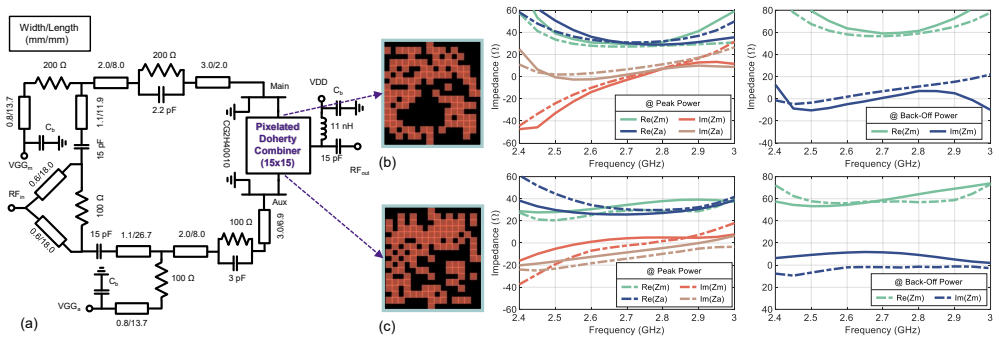
A CNN surrogate and genetic algorithm optimize pixelated three-port combiners for Doherty PAs, yielding prototypes with over 71 percent peak drain efficiency and 64 percent at 6 dB back-off.
A machine-rendered reading of the paper's core claim, the machinery that carries it, and where it could break.
Core claim
The central claim is that the combination of CNN surrogate modeling, pixelated layout encoding, genetic algorithm optimization, and dual-state impedance synthesis produces three-port combiners whose measured performance in complete Doherty amplifiers meets the stated power, efficiency, and linearity targets.
What carries the argument
The three-port pixelated combiner whose layout is generated by a CNN surrogate model trained on electromagnetic simulations and refined by genetic algorithm search under dual-state impedance conditions.
If this is right
- The dual-state synthesis step allows the combiner to satisfy both peak-power and back-off impedance trajectories in a single network.
- Pixelated layouts expand the searchable design space beyond conventional transmission-line topologies.
- The reported prototypes achieve the efficiency numbers across a 200 MHz bandwidth centered near 2.7 GHz.
- Digital predistortion applied to the measured amplifiers reaches ACLR below -51.3 dBc while preserving the efficiency figures.
Where Pith is reading between the lines
- The method could be applied to other amplifier classes that require load modulation at multiple power levels.
- Pixelated combiners might reduce overall amplifier footprint compared with distributed-line designs if the GA is constrained for size.
- Replacing the CNN surrogate with a faster physics-informed model could shorten the optimization loop for wider bandwidth targets.
Load-bearing premise
The CNN model and subsequent genetic algorithm search accurately predict the electromagnetic behavior of the pixelated combiner so that the optimized layout performs as expected once fabricated.
What would settle it
Fabrication and measurement of a third prototype using the same CNN-GA procedure that shows drain efficiency below 60 percent at 6 dB back-off in the 2.6-2.8 GHz band would falsify the claim.
Figures



read the original abstract
The output combiner of a Doherty power amplifier (PA) integrates load modulation, impedance matching, and phase compensation within a single network, making its design and synthesis highly challenging. In this paper, we propose a three-port Doherty combiner design methodology that combines deep convolutional neural networks (CNNs), pixelated layout representations, and genetic algorithms (GA) with dual-state impedance synthesis to address both peak and back-off power conditions. As a proof of concept, two GaN HEMT Doherty PA prototypes incorporating three-port pixelated combiners are designed and fabricated. Both prototypes achieve a measured saturated output power exceeding 44.2 dBm with peak drain efficiency above 71.2% within 2.6-2.8 GHz. Furthermore, a drain efficiency as high as 64% is measured at the 6-dB back-off level. After applying digital predistortion, each prototype achieves an adjacent channel leakage ratio (ACLR) better than -51.3 dBc.
Editorial analysis
A structured set of objections, weighed in public.
Referee Report
Summary. The manuscript proposes a three-port Doherty combiner inverse design methodology that integrates CNN surrogate modeling of pixelated layouts, genetic algorithm optimization, and dual-state impedance synthesis to simultaneously address peak and back-off conditions. Two GaN HEMT prototypes are fabricated and measured, reporting saturated output power >44.2 dBm, peak drain efficiency >71.2%, 64% efficiency at 6 dB back-off, and ACLR <-51.3 dBc after DPD within 2.6-2.8 GHz.
Significance. If the CNN+GA pipeline is shown to reliably produce the reported load-modulation behavior, the work would demonstrate a viable automated route to synthesizing complex multi-state matching networks, reducing manual iteration in PA design. The physical prototypes and measured metrics constitute a concrete strength; however, the significance for the DL contribution specifically depends on quantitative evidence that the surrogate predictions drove the fabricated performance.
major comments (2)
- [CNN surrogate model and GA optimization sections] The manuscript reports CNN training for the pixelated combiner surrogate but provides no hold-out validation error statistics (e.g., mean |S21| or phase error on unseen geometries) and no direct comparison of surrogate predictions versus full-wave EM results for the two final optimized layouts at both peak and back-off states. This validation is load-bearing for attributing the measured efficiencies to the proposed dual-state synthesis rather than to post-optimization adjustments or conventional combiner behavior.
- [Results and discussion] No sensitivity or error-propagation analysis is included to quantify how surrogate inaccuracies (e.g., >3-5% in |S21| or >5° phase error) would affect the achieved load modulation and resulting drain efficiency at back-off. Without this, the experimental results cannot be confidently linked to the DL-driven design process.
minor comments (2)
- [Methodology] Clarify the exact pixel-grid resolution, number of pixels, and how the dual-state impedance targets are encoded as fitness functions in the GA.
- [Measurement results] Include error bars or multiple measurements on the efficiency and ACLR figures to indicate repeatability.
Simulated Author's Rebuttal
We thank the referee for the constructive comments, which help strengthen the validation of our CNN-GA design methodology. We address each major comment below and have revised the manuscript to incorporate the requested analyses.
read point-by-point responses
-
Referee: [CNN surrogate model and GA optimization sections] The manuscript reports CNN training for the pixelated combiner surrogate but provides no hold-out validation error statistics (e.g., mean |S21| or phase error on unseen geometries) and no direct comparison of surrogate predictions versus full-wave EM results for the two final optimized layouts at both peak and back-off states. This validation is load-bearing for attributing the measured efficiencies to the proposed dual-state synthesis rather than to post-optimization adjustments or conventional combiner behavior.
Authors: We agree that explicit hold-out validation and surrogate-to-EM comparisons are essential for substantiating the DL contribution. In the revised manuscript we have added a dedicated validation subsection reporting mean absolute errors on |S21| and phase for the unseen test geometries. We also include side-by-side plots and tabulated differences between CNN predictions and full-wave EM results for both final optimized layouts at the peak and back-off impedance states. These additions directly link the surrogate accuracy to the achieved load-modulation behavior. revision: yes
-
Referee: [Results and discussion] No sensitivity or error-propagation analysis is included to quantify how surrogate inaccuracies (e.g., >3-5% in |S21| or >5° phase error) would affect the achieved load modulation and resulting drain efficiency at back-off. Without this, the experimental results cannot be confidently linked to the DL-driven design process.
Authors: We acknowledge the need to quantify robustness against surrogate error. The revised manuscript now contains a sensitivity analysis that propagates the observed validation errors (within the reported bounds) through the dual-state impedance synthesis to the resulting load trajectories and back-off drain efficiency. Monte-Carlo-style perturbations confirm that the measured efficiencies remain attainable within the surrogate accuracy limits, thereby supporting attribution to the proposed design flow. revision: yes
Circularity Check
No circularity: measured prototype results independent of surrogate model
full rationale
The paper's load-bearing claims are saturated output power, drain efficiency, and ACLR measured on two fabricated GaN HEMT prototypes. These quantities are obtained from physical hardware and are not defined in terms of the CNN surrogate outputs, GA fitness function, or any fitted parameter inside the design pipeline. The CNN+GA step is used only to generate candidate layouts; once fabricated, the performance numbers stand or fall on external measurement, with no reduction of the reported metrics back to the training data or optimization objective by construction. No self-citation chain, ansatz smuggling, or uniqueness theorem is invoked to close the derivation. The derivation chain therefore terminates in independent experimental data.
Axiom & Free-Parameter Ledger
free parameters (2)
- CNN weights and architecture hyperparameters
- GA population size, mutation rate, and fitness weights
Reference graph
Works this paper leans on
-
[1]
A new high efficiency power amplifier for modulated waves,
W. H. Doherty, “A new high efficiency power amplifier for modulated waves,”Proc. Inst. Radio Eng., vol. 24, no. 9, pp. 1163–1182, Sep. 1936
1936
-
[2]
High power outphasing modulation,
H. Chireix, “High power outphasing modulation,”Proc. Inst. Radio Eng., vol. 23, no. 11, pp. 1370–1392, Nov. 1935
1935
-
[3]
An efficient broadband reconfigurable power amplifier using active load modulation,
D. J. Shepphard, J. Powell, and S. C. Cripps, “An efficient broadband reconfigurable power amplifier using active load modulation,”IEEE Microw. Wireless Compon. Lett., vol. 26, no. 6, pp. 443–445, 2016
2016
-
[4]
RF-input load modulated balanced amplifier with octave bandwidth,
P. H. Pednekar, E. Berry, and T. W. Barton, “RF-input load modulated balanced amplifier with octave bandwidth,”IEEE Trans. Microw. Theory Techn., vol. 65, no. 12, pp. 5181–5191, 2017
2017
-
[5]
Pseudo-Doherty load-modulated balanced amplifier with wide bandwidth and extended power back-off range,
Y . Cao and K. Chen, “Pseudo-Doherty load-modulated balanced amplifier with wide bandwidth and extended power back-off range,” IEEE Trans. Microw. Theory Techn., vol. 68, no. 7, pp. 3172–3183, 2020
2020
-
[6]
Analysis and design of highly efficient wideband RF-input sequential load modulated balanced power amplifier,
J. Pang, Y . Li, M. Li, Y . Zhang, X. Y . Zhou, Z. Dai, and A. Zhu, “Analysis and design of highly efficient wideband RF-input sequential load modulated balanced power amplifier,”IEEE Trans. Microw. Theory Techn., vol. 68, no. 5, pp. 1741–1753, 2020
2020
-
[7]
A wideband and highly efficient circulator load modulated power amplifier architecture,
H. Zhou, J.-R. Perez-Cisneros, B. Langborn, T. Eriksson, and C. Fager, “A wideband and highly efficient circulator load modulated power amplifier architecture,”IEEE Trans. Circuits Syst. I, Reg. Papers, vol. 70, no. 8, pp. 3117–3129, 2023
2023
-
[8]
Deep-learning-based inverse-designed millimeter-wave passives and power amplifiers,
E. A. Karahan, Z. Liu, and K. Sengupta, “Deep-learning-based inverse-designed millimeter-wave passives and power amplifiers,”IEEE J. Solid-State Circuits, vol. 58, no. 11, pp. 3074–3088, 2023
2023
-
[9]
AI-assisted deep-learning-based design of high-efficiency class F power amplifiers,
H. Zhou, H. Chang, D. Widén, L. Fornstedt, G. Melin, and C. Fager, “AI-assisted deep-learning-based design of high-efficiency class F power amplifiers,”IEEE Microw. Wireless Technol. Lett., vol. 35, no. 6, pp. 690–693, 2025
2025
-
[10]
Deep learning driven design of highly efficient harmonic-tuned class F-1 power amplifiers,
H. Zhou, H. Chang, and C. Fager, “Deep learning driven design of highly efficient harmonic-tuned class F-1 power amplifiers,” inProc. 55th Eur. Microw. Conf. (EuMC), 2025, pp. 208–211
2025
-
[11]
AI-assisted template-seeded pixelated design for multi-metal-layer high-coupling EM structures: A Ku-band 6G FR3 PA in 22nm FDX+,
C. Chu et al, “AI-assisted template-seeded pixelated design for multi-metal-layer high-coupling EM structures: A Ku-band 6G FR3 PA in 22nm FDX+,” inProc. IEEE MTT-S Int. Microw. Symp. Dig, 2025, pp. 922–925
2025
-
[12]
Deep residual learning for image recognition,
K. He, X. Zhang, S. Ren, and J. Sun, “Deep residual learning for image recognition,” inProc. IEEE Conf. Comput. Vis. Pattern Recognit. (CVPR), Las Vegas, NV , USA, Jun. 2016, pp. 770–778
2016
-
[13]
Enhancing bandwidth and back-off range of Doherty power amplifier with modified load modulation network,
Y . Xu, J. Pang, X. Wang, and A. Zhu, “Enhancing bandwidth and back-off range of Doherty power amplifier with modified load modulation network,”IEEE Trans. Microw. Theory Techn., vol. 69, no. 4, pp. 2291–2303, 2021
2021
-
[14]
Iterative learning control for RF power amplifier linearization,
J. Chani-Cahuana et al, “Iterative learning control for RF power amplifier linearization,”IEEE Trans. Microw. Theory Techn., vol. 64, no. 9, pp. 2778–2789, 2016
2016
-
[15]
Design of a fast-switchable three-stage GaN Doherty PA for high DC-to-RF efficiency,
M. G. Becker, R. Krämer, M. Gunia, and F. Ellinger, “Design of a fast-switchable three-stage GaN Doherty PA for high DC-to-RF efficiency,” inProc. 55th Eur. Microw. Conf. (EuMC), 2025, pp. 1905–1908
2025
-
[16]
A broadband Doherty power amplifier for sub-6GHz 5G applications,
M. Shahmoradi, S.-H. Javid-Hosseini, V . Nayyeri, R. Giofrè, and P. Colantonio, “A broadband Doherty power amplifier for sub-6GHz 5G applications,”IEEE Access, vol. 11, pp. 28 771–28 780, 2023
2023
-
[17]
Balanced-to-Doherty mode-reconfigurable power amplifier with high efficiency and linearity against load mismatch,
H. Lyu and K. Chen, “Balanced-to-Doherty mode-reconfigurable power amplifier with high efficiency and linearity against load mismatch,”IEEE Trans. Microw. Theory Techn., vol. 68, no. 5, pp. 1717–1728, 2020
2020
-
[18]
Load modulated balanced amplifier design method based on complex impedance trajectories,
K. Vivien, P. E. de Falco, O. Venard, G. Baudoin, P. Pierre-Charles-Félix, and T. Barton, “Load modulated balanced amplifier design method based on complex impedance trajectories,”IEEE Microw. Mag., vol. 2, no. 1, pp. 199–213, 2022
2022
-
[19]
Analysis and design of RF-input Doherty-like circulator load modulated amplifier,
H. Zhou, H. Chang, and C. Fager, “Analysis and design of RF-input Doherty-like circulator load modulated amplifier,” inProc. 54th Eur. Microw. Conf. (EuMC), 2024, pp. 27–30
2024
discussion (0)
Sign in with ORCID, Apple, or X to comment. Anyone can read and Pith papers without signing in.