LoRA-Tuned Large Language Models for Dementia Detection via Multi-View Speech-Derived Features
Pith reviewed 2026-06-30 01:32 UTC · model grok-4.3
The pith
A single LoRA-tuned LLM integrates four speech-derived views in one prompt to detect dementia without separate encoders or fusion.
A machine-rendered reading of the paper's core claim, the machinery that carries it, and where it could break.
Core claim
The authors claim that a LoRA-tuned large language model performs structured multi-view reasoning over ASR transcripts with pause markers, discourse-level topic cues, temporal fluency statistics, and phonological sequences when all four are placed inside one unified prompt; this single-model setup reaches 90.14 percent F1 on ADReSSo and ablation experiments confirm the complementary contribution of each view without requiring modality-specific encoders or late-stage fusion.
What carries the argument
LoRA-tuned LLM that receives four speech-derived signals encoded together in a single text prompt and produces a dementia classification.
If this is right
- The model reaches 90.14 percent F1 on the ADReSSo dementia detection task.
- Removing any one of the four views lowers performance, confirming they supply non-redundant information.
- No separate acoustic or discourse modules are needed once the signals are rendered as text inside the prompt.
- Low-rank adaptation alone suffices to specialize the base LLM for the combined reasoning task.
Where Pith is reading between the lines
- The same prompt-unification pattern could be tested on other cognitive or neurological screening tasks that currently rely on multi-modal fusion.
- If prompt length remains manageable, the method may scale to longer speech recordings without architectural changes.
- The approach implies that future clinical tools could update the detection logic by editing the prompt rather than retraining separate feature extractors.
Load-bearing premise
That placing the four different speech cues inside one text prompt is sufficient for the LLM to learn a coherent decision rule across them.
What would settle it
A controlled run on ADReSSo in which each view is processed by its own encoder and the outputs are fused at the decision level, then compared directly against the unified-prompt LoRA model on identical data splits.
Figures

read the original abstract
Early detection of dementia enables timely intervention, and reflecting cognitive impairment, spontaneous speech offers a non-invasive screening modality. Conventional approaches often focus on a single representational dimension -- such as acoustic descriptors, pause modeling, automatic speech recognition (ASR) transcripts, or multimodal fusion -- limiting integrative reasoning across heterogeneous cognitive symptoms. We propose a low-rank adaptation (LoRA)-tuned large language model (LLM) that performs structured multi-view reasoning over four complementary speech-derived signals: ASR transcripts with pause markers, discourse-level topic cues, temporal fluency statistics, and phonological sequences. These cues are encoded within a unified prompt, enabling a single LLM to learn a coherent decision function without modality-specific encoders or late-stage fusion. On ADReSSo, our best model achieves an F1-score of 90.14%, and ablation confirms the complementary contribution of each view.
Editorial analysis
A structured set of objections, weighed in public.
Referee Report
Summary. The manuscript proposes a LoRA-tuned LLM for dementia detection from spontaneous speech. Four complementary views—ASR transcripts with pause markers, discourse-level topic cues, temporal fluency statistics, and phonological sequences—are encoded in a single unified prompt so that one LLM performs the classification without modality-specific encoders or late fusion. On the ADReSSo corpus the best configuration reports an F1-score of 90.14 %; ablation experiments are stated to confirm that each view contributes complementary information.
Significance. If the performance and ablation results are reproducible, the work would demonstrate that a single LLM can integrate heterogeneous speech-derived signals for a clinically relevant task, potentially simplifying multi-view pipelines and lowering the barrier to deployment via LoRA. The approach addresses a real need for non-invasive early screening and could influence subsequent research on prompt-based multimodal reasoning in health applications.
major comments (3)
- [Abstract] Abstract: the central claim of 90.14 % F1 is presented without any baseline comparisons, statistical significance tests, error bars, or dataset-split details, rendering the performance improvement impossible to evaluate from the given text.
- [Abstract] Abstract: the ablation statement that “each view contributes complementarily” is load-bearing for the multi-view thesis, yet no ablation table, removed-view F1 scores, or experimental protocol is supplied, so the complementarity claim cannot be verified.
- [Abstract] Abstract: the assertion that a unified prompt enables the LLM to “learn a coherent decision function” without modality-specific encoders rests on an untested integration mechanism; the manuscript provides no prompt template, ordering details, or analysis of how the four cue types interact inside the model.
Simulated Author's Rebuttal
We thank the referee for the careful reading and for identifying points where the abstract does not supply sufficient context. We will revise the abstract to incorporate concise references to the experimental details, ablation results, and prompt information already present in the body of the manuscript. This addresses the evaluability concerns while preserving the abstract's brevity.
read point-by-point responses
-
Referee: [Abstract] Abstract: the central claim of 90.14 % F1 is presented without any baseline comparisons, statistical significance tests, error bars, or dataset-split details, rendering the performance improvement impossible to evaluate from the given text.
Authors: The Experiments section reports comparisons against acoustic SVM, BERT-on-transcripts, and prior ADReSSo systems, McNemar tests for significance, standard deviations across five folds, and the official ADReSSo train/test partition. We will add a single sentence to the abstract summarizing the strongest baseline F1 and the cross-validation protocol so that the 90.14 % figure can be evaluated directly from the abstract. revision: yes
-
Referee: [Abstract] Abstract: the ablation statement that “each view contributes complementarily” is load-bearing for the multi-view thesis, yet no ablation table, removed-view F1 scores, or experimental protocol is supplied, so the complementarity claim cannot be verified.
Authors: Section 4.3 contains the ablation table with per-view removal results (F1 drops of 3.8–7.2 points) obtained under the same five-fold protocol. We will revise the abstract to state that removing any single view lowers F1 by at least X points, thereby making the complementarity claim verifiable from the abstract itself. revision: yes
-
Referee: [Abstract] Abstract: the assertion that a unified prompt enables the LLM to “learn a coherent decision function” without modality-specific encoders rests on an untested integration mechanism; the manuscript provides no prompt template, ordering details, or analysis of how the four cue types interact inside the model.
Authors: Appendix A supplies the exact prompt template and the fixed ordering of the four views; Section 5 analyzes attention patterns across view tokens. We will insert a brief clause in the abstract (“via the prompt template in Appendix A”) and ensure the integration analysis is explicitly referenced, thereby grounding the claim in the manuscript. revision: yes
Circularity Check
No significant circularity identified
full rationale
The paper presents an empirical machine-learning approach: a LoRA-tuned LLM that encodes four speech-derived views (ASR transcripts with pauses, discourse cues, fluency statistics, phonological sequences) into a single prompt for dementia classification. The central claim is an observed F1-score of 90.14% on ADReSSo together with ablation results. No equations, parameter-fitting derivations, uniqueness theorems, or self-citations appear in the supplied text. The result is obtained by standard fine-tuning and held-out evaluation rather than by any reduction of the output to the input by construction. The derivation chain is therefore self-contained and externally falsifiable via the reported dataset and metrics.
Axiom & Free-Parameter Ledger
Reference graph
Works this paper leans on
-
[1]
Introduction Dementia progressively impairs cognitive and communicative abilities, making early detection critical for timely intervention. Because these impairments often manifest in speech, sponta- neous verbal output provides a rich source of behavioral mark- ers reflecting cognitive status. Advances in machine learn- ing have enabled automatic analysi...
Pith/arXiv arXiv 2026
-
[2]
Overview We present a framework that trains an LLM using LoRA [16] for speech-based dementia detection that integrates multi-view speech-derived features within a structured prompt
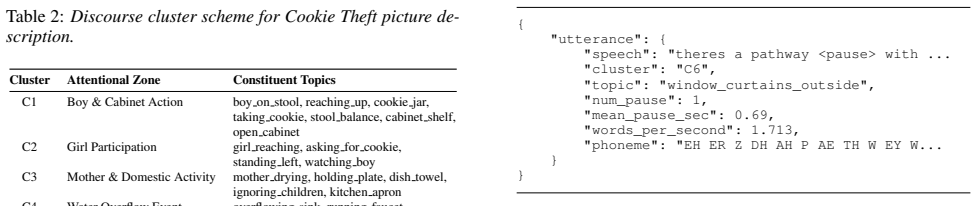
Methods 2.1. Overview We present a framework that trains an LLM using LoRA [16] for speech-based dementia detection that integrates multi-view speech-derived features within a structured prompt. Our hy- pothesis is that dementia-related impairment manifests across complementary dimensions of speech, and that a single LLM can effectively learn to detect th...
-
[3]
utterance
Experiments 3.1. Datasets We evaluate our approach on the ADReSSo challenge dataset [18], which is a widely used benchmark for speech- based dementia detection. The dataset is derived from the De- mentiaBank Pitt corpus [24] and is based on the Cookie Theft picture description task. ADReSSo is a transcript-free chal- lenge supplying only raw audio with sp...
-
[4]
These transcripts were then used as input to MFA [19] to obtain word-level forced alignments
Lexical transcripts were first generated using Whisper [10] large-v3. These transcripts were then used as input to MFA [19] to obtain word-level forced alignments. Based on the align- ment results, silence intervals of≥0.5s were identified and en- coded as inline<pause>tokens within the transcript. Tempo- ral fluency statistics (e.g., words/sec and pause ...
-
[5]
Main Results Table 3 compares our system with representative published ap- proaches on ADReSSo [18]
Results 4.1. Main Results Table 3 compares our system with representative published ap- proaches on ADReSSo [18]. Prior systems emphasize different categories of speech-derived features, including temporal hesi- tation patterns, transcription fidelity, and multimodal fusion. The challenge baseline [18] relies on conventional acous- tic descriptors derived...
-
[6]
Ablation experiments on ADReSSo confirm that each view contributes incremental diagnostic value, with discourse clusters providing the largest individual gain
Conclusion We presented a LoRA [16]-tuned LLM framework for demen- tia detection that unifies four complementary speech-derived views—lexical transcripts, discourse-level cues, temporal flu- ency statistics, and phonological sequences—within a single structured prompt. Ablation experiments on ADReSSo confirm that each view contributes incremental diagnost...
-
[7]
GPT-5.2 [21] was consis- tently used for this extraction, and the instructions are provided in https://github.com/vivivic/is26dementia
Generative AI Use Disclosure We used generative AI to extract the discourse-oriented repre- sentation described in Section 2.2.3. GPT-5.2 [21] was consis- tently used for this extraction, and the instructions are provided in https://github.com/vivivic/is26dementia. Additionally, the core module for dementia detection, the LoRA-tuned LLM, is itself a gener...
-
[8]
Speech based detection of alzheimer’s disease: A sur- vey of ai techniques, datasets and challenges,
K. Ding, M. Chetty, A. Noori Hoshyar, T. Bhattacharya, and B. Klein, “Speech based detection of alzheimer’s disease: A sur- vey of ai techniques, datasets and challenges,”Artificial Intelli- gence Review, vol. 57, no. 12, p. 325, 2024
2024
-
[9]
The geneva minimalistic acoustic parameter set (gemaps) for voice research and affective computing,
F. Eyben, K. R. Scherer, B. W. Schuller, J. Sundberg, E. An- dre, C. Busso, L. Devillers, J. Epps, P. Laukka, S. Narayanan, and K. P. Truong, “The geneva minimalistic acoustic parameter set (gemaps) for voice research and affective computing,”IEEE Transactions on Affective Computing, vol. 7, no. 2, pp. 190–202, 2016
2016
-
[10]
opensmile: The mu- nich versatile and fast open-source audio feature extractor,
F. Eyben, M. Wollmer, and B. W. Schuller, “opensmile: The mu- nich versatile and fast open-source audio feature extractor,” in Proceedings of the ACM International Conference on Multime- dia, 2010, pp. 1459–1462
2010
-
[11]
wav2vec 2.0: A framework for self-supervised learning of speech representa- tions,
A. Baevski, Y . Zhou, A. Mohamed, and M. Auli, “wav2vec 2.0: A framework for self-supervised learning of speech representa- tions,” inAdvances in Neural Information Processing Systems (NeurIPS), 2020, pp. 12 449–12 460
2020
-
[12]
Hubert: Self-supervised speech represen- tation learning by masked prediction of hidden units,
W.-N. Hsu, B. Bolte, Y .-H. H. Tsai, K. Lakhotia, R. Salakhutdi- nov, and A. Mohamed, “Hubert: Self-supervised speech represen- tation learning by masked prediction of hidden units,” inProceed- ings of the IEEE International Conference on Acoustics, Speech and Signal Processing (ICASSP), 2021, pp. 345–349
2021
-
[13]
Wavbert: Exploiting semantic and non-semantic speech using wav2vec and bert for dementia detection,
Y . Zhu, A. Obyat, X. Liang, J. A. Batsis, and R. M. Roth, “Wavbert: Exploiting semantic and non-semantic speech using wav2vec and bert for dementia detection,” inProceedings of In- terspeech, 2021, pp. 3790–3794
2021
-
[14]
Bert: Pre- training of deep bidirectional transformers for language under- standing,
J. Devlin, M.-W. Chang, K. Lee, and K. Toutanova, “Bert: Pre- training of deep bidirectional transformers for language under- standing,” inProceedings of the Conference of the North Amer- ican Chapter of the Association for Computational Linguistics: Human Language Technologies (NAACL-HLT), 2019, pp. 4171– 4186
2019
-
[15]
Con- nectionist temporal classification: labelling unsegmented se- quence data with recurrent neural networks,
A. Graves, S. Fern ´andez, F. Gomez, and J. Schmidhuber, “Con- nectionist temporal classification: labelling unsegmented se- quence data with recurrent neural networks,” inProceedings of the 23rd international conference on Machine learning, 2006, pp. 369–376
2006
-
[16]
Ppgs- bert: Leveraging phoneme sequence and bert for alzheimer’s dis- ease detection from spontaneous speech,
Q. Sun, Z. Qiu, Y . Pu, J. Li, X. Chen, and W.-Q. Zhang, “Ppgs- bert: Leveraging phoneme sequence and bert for alzheimer’s dis- ease detection from spontaneous speech,” inProceedings of Inter- speech, 2025, pp. 554–558
2025
-
[17]
Robust speech recognition via large-scale weak supervision,
A. Radford, J. W. Kim, T. Xu, G. Brockman, C. McLeavey, and I. Sutskever, “Robust speech recognition via large-scale weak supervision,” inInternational conference on machine learning. PMLR, 2023, pp. 28 492–28 518
2023
-
[18]
Whisper-based transfer learning for alzheimer disease classification: Leveraging speech segments with full transcripts as prompts,
J. Li and W.-Q. Zhang, “Whisper-based transfer learning for alzheimer disease classification: Leveraging speech segments with full transcripts as prompts,” inProceedings of the IEEE Inter- national Conference on Acoustics, Speech and Signal Processing (ICASSP), 2024, pp. 11 211–11 215
2024
-
[19]
Whisper-based multilingual alzheimer’s disease detection and improvements for low-resource language,
K. Jia, J. Li, K. Li, and W.-Q. Zhang, “Whisper-based multilingual alzheimer’s disease detection and improvements for low-resource language,” inProceedings of Interspeech, 2025, pp. 549–553
2025
-
[20]
Alzheimer’s disease detection based on large language model prompt engineer- ing,
T. Zheng, X. Xie, X. Peng, H. Chen, and F. Tian, “Alzheimer’s disease detection based on large language model prompt engineer- ing,” inInternational Conference on Social Robotics. Springer, 2024, pp. 207–216
2024
-
[21]
Reasoning-based approach with chain-of-thought for alzheimer’s detection using speech and large language models,
C. Park, A. S. G. Choi, S. Cho, and C. Kim, “Reasoning-based approach with chain-of-thought for alzheimer’s detection using speech and large language models,” inProceedings of Interspeech 2025, 2025, pp. 2185–2189
2025
-
[22]
Neuroxvocal: detection and ex- planation of alzheimer’s disease through non-invasive analysis of picture-prompted speech,
N. Ntampakis, K. Diamantaras, I. Chouvarda, M. Tsolaki, P. Sa- rigianndis, and V . Argyriou, “Neuroxvocal: detection and ex- planation of alzheimer’s disease through non-invasive analysis of picture-prompted speech,” inInternational Conference on Medical Image Computing and Computer-Assisted Intervention. Springer, 2025, pp. 410–419
2025
-
[23]
Lora: Low-rank adaptation of large language models
E. J. Hu, Y . Shen, P. Wallis, Z. Allen-Zhu, Y . Li, S. Wang, L. Wang, W. Chenet al., “Lora: Low-rank adaptation of large language models.” inProceedings of International Conference on Learning Representations (ICLR), 2022
2022
-
[24]
Huper: A human-inspired framework for phonetic perception,
C. Guo, J. Lian, Y . Liu, B. Huang, S. Narayanan, C. J. Cho, and G. Anumanchipalli, “Huper: A human-inspired framework for phonetic perception,” 2026. [Online]. Available: https://arxiv.org/abs/2602.01634
arXiv 2026
-
[25]
Detecting cognitive decline using speech only: The adresso challenge,
S. Luz, F. Haider, S. de la Fuente, D. Fromm, and B. MacWhin- ney, “Detecting cognitive decline using speech only: The adresso challenge,” inProceedings of Interspeech, 2021, pp. 3780–3784
2021
-
[26]
Montreal forced aligner: Trainable text-speech align- ment using kaldi,
M. McAuliffe, M. Socolof, S. Mihuc, M. Wagner, and M. Son- deregger, “Montreal forced aligner: Trainable text-speech align- ment using kaldi,” inProceedings of Interspeech, 2017, pp. 498– 502
2017
-
[27]
Goodglass and E
H. Goodglass and E. Kaplan,Boston Diagnostic Aphasia Exami- nation. Philadelphia: Lea & Febiger, 1983
1983
-
[28]
Gpt-5.2 system card,
OpenAI, “Gpt-5.2 system card,” 2025. [Online]. Available: https: //cdn.openai.com/pdf/3a4153c8-c748-4b71-8e31-aecbde944f8d/ oai 5 2 system-card.pdf
2025
-
[29]
A. Yanget al., “Qwen3 technical report,” 2025. [Online]. Available: https://arxiv.org/abs/2505.09388
Pith/arXiv arXiv 2025
-
[30]
G. Team, “Gemma 3 technical report,” 2025. [Online]. Available: https://arxiv.org/abs/2503.19786
Pith/arXiv arXiv 2025
-
[31]
The natural history of alzheimer’s disease: Description of study cohort and accuracy of diagnosis,
J. T. Becker, F. Boller, O. L. Lopez, J. Saxton, and K. L. McGo- nigle, “The natural history of alzheimer’s disease: Description of study cohort and accuracy of diagnosis,”Archives of Neurology, vol. 51, no. 6, pp. 585–594, 1994
1994
-
[32]
Decoupled weight decay regulariza- tion,
I. Loshchilov and F. Hutter, “Decoupled weight decay regulariza- tion,”arXiv preprint arXiv:1711.05101, 2017
Pith/arXiv arXiv 2017
-
[33]
Swin-bert: A feature fu- sion system designed for speech-based alzheimer’s dementia de- tection,
Y . Pan, Y . Shi, Y . Zhang, and M. Lu, “Swin-bert: A feature fu- sion system designed for speech-based alzheimer’s dementia de- tection,” inProceedings of the 6th ACM International Confer- ence on Multimedia in Asia Workshops, ser. MMAsia ’24 Work- shops. New York, NY , USA: Association for Computing Ma- chinery, 2024
2024
-
[34]
An overview of the adress-m signal processing grand challenge on multilingual alzheimer’s dementia recognition through spontaneous speech,
S. Luz, F. Haider, D. Fromm, I. Lazarou, I. Kompatsiaris, and B. MacWhinney, “An overview of the adress-m signal processing grand challenge on multilingual alzheimer’s dementia recognition through spontaneous speech,”IEEE Open Journal of Signal Pro- cessing, vol. 5, pp. 738–749, 2024
2024
discussion (0)
Sign in with ORCID, Apple, or X to comment. Anyone can read and Pith papers without signing in.