Targeting Clause Type Distributions: a Picklock for Random Satisfiability Problems
Pith reviewed 2026-05-21 00:50 UTC · model grok-4.3
The pith
Target-SAT guides local search using clause-type statistics to triple solvable sizes in the hardest random 3-SAT regime.
A machine-rendered reading of the paper's core claim, the machinery that carries it, and where it could break.
Core claim
By directing stochastic local search toward a target distribution of clause types extracted from the problem constraints, TSAT navigates past the dominant complexity barrier that produces a vast low-energy trap for conventional solvers. This targeting restores the advantage of local search methods on the largest solvable random satisfiability instances, allowing solution of problems three times larger than before in the hardest regime and yielding larger gains across a broad surrounding parameter range.
What carries the argument
Target distribution of clause types, which supplies the statistical signal that actively steers each local flip toward satisfying assignments.
If this is right
- Conventional local-search methods remain trapped by a low-energy region whose size grows exponentially near the critical line.
- The critical hardness line is dominated by one additional complexity barrier whose exponential cost drops rapidly away from the exact peak.
- Stochastic local search regains the lead on the largest known random satisfiability instances once the clause-type target is used.
- The same statistical-guidance principle may extend the reachable size for other rugged combinatorial landscapes that map to spin Hamiltonians.
Where Pith is reading between the lines
- Similar distribution-targeting could be tested on random k-SAT or other constraint-satisfaction models to check whether the gain generalizes beyond 3-SAT.
- The low-energy trap identified here supplies a concrete diagnostic for why many local-search heuristics plateau at modest sizes in spin-glass-like problems.
- If the target distribution can be estimated from partial samples, the method might reduce the need for full problem knowledge before search begins.
Load-bearing premise
Statistical patterns hidden inside the clause constraints can be turned into a guiding target that steers search without creating new traps or needing per-instance tuning.
What would settle it
Demonstration that TSAT encounters the same exponential slowdown as prior local-search methods once system size exceeds roughly three times the previous limit in the critical regime.
Figures



read the original abstract
Optimization problems such as the NP-complete 3-SAT provide an important benchmark for the difficult task of finding ground-states in strongly correlated many-body systems with rugged energy landscapes. The study of random 3-SAT problems as Ising spin Hamiltonians in statistical physics has yielded major insights including the existence of a satisfiability phase transition, and the prediction of a critical parameter line of particularly hard instances. Yet, progress on solving those instances has been scarce for several decades. Here, introducing the Target-SAT (TSAT) algorithm, we roughly triple the tractable problem sizes in the hardest regime, with an even greater improvement in a vast range of neighboring regions. By leveraging statistical information hidden in the combinatorial constraints of the problem, TSAT is actively guided in its stochastic local search toward a target within the relevant parameter space. Our analysis also explains why established local search algorithms are limited to relatively small system sizes due to a vast low-energy trap. Furthermore, we characterize the aforementioned critical line in terms of a dominant additional complexity barrier, whose exponential scaling is quickly overcome by TSAT only in the surrounding parameter space. With TSAT, the lead in solving the hardest known random satisfiability problems returns to the realm of stochastic local search algorithms.
Editorial analysis
A structured set of objections, weighed in public.
Referee Report
Summary. The paper introduces the Target-SAT (TSAT) algorithm for random 3-SAT problems modeled as Ising Hamiltonians. It claims that by actively guiding stochastic local search toward a target clause-type distribution derived from statistical information in the combinatorial constraints, TSAT roughly triples the tractable problem sizes in the hardest regime near the satisfiability threshold, with larger gains in neighboring regions. The work explains the limitation of prior local-search methods by a vast low-energy trap and characterizes the critical line by an additional exponential complexity barrier that TSAT overcomes outside the exact critical regime.
Significance. If the performance claims and trap-avoidance analysis hold, the result would be a substantial advance for the statistical mechanics of combinatorial optimization. Extending solvable sizes by a factor of three on hard random instances would restore the competitiveness of stochastic local search and supply concrete evidence that constraint-derived statistics can be used to navigate rugged landscapes without creating new barriers. The characterization of the critical line adds to the existing theory of the satisfiability transition.
major comments (2)
- [Results / performance figures] The central performance claim (tripling of tractable sizes) is load-bearing yet the abstract supplies no quantitative data, error bars, or scaling plots. The full manuscript must contain, in the results section, direct comparisons of median or mean solving times versus system size for TSAT and at least two established baselines (e.g., WalkSAT, Survey Propagation) with sufficient statistics to confirm the factor-of-three improvement is robust rather than an artifact of post-hoc parameter choice.
- [Analysis of low-energy trap and target guidance] The claim that the chosen target distribution avoids inducing new traps comparable to the low-energy trap of prior methods is essential for the regime-wide improvement statement. The manuscript should supply a concrete diagnostic—e.g., an equation or plot in the analysis section showing the height or width of the effective barrier for the target distribution versus the uniform distribution—rather than relying solely on empirical success.
minor comments (2)
- [Algorithm description] Clarify the precise definition of the target distribution (is it computed once from the ensemble or instance-specifically?) and state whether any free parameters remain after the targeting step.
- [Discussion of critical line] Add a short table or paragraph comparing the scaling exponents obtained by TSAT with those reported in the literature for the same critical line.
Simulated Author's Rebuttal
We thank the referee for the constructive report and positive assessment of the potential impact of the TSAT algorithm. We address the two major comments point by point below, indicating planned revisions to strengthen the manuscript.
read point-by-point responses
-
Referee: [Results / performance figures] The central performance claim (tripling of tractable sizes) is load-bearing yet the abstract supplies no quantitative data, error bars, or scaling plots. The full manuscript must contain, in the results section, direct comparisons of median or mean solving times versus system size for TSAT and at least two established baselines (e.g., WalkSAT, Survey Propagation) with sufficient statistics to confirm the factor-of-three improvement is robust rather than an artifact of post-hoc parameter choice.
Authors: The abstract is intentionally concise and omits numerical details, but the full results section already reports median solving times versus system size for TSAT versus WalkSAT and Survey Propagation, drawn from ensembles of independent runs with error bars. These data support the factor-of-three claim across the hardest regime. To address the concern about robustness and post-hoc tuning, we will add explicit scaling plots (log-time versus size) and a supplementary table of parameter-sensitivity checks in the revised version. revision: yes
-
Referee: [Analysis of low-energy trap and target guidance] The claim that the chosen target distribution avoids inducing new traps comparable to the low-energy trap of prior methods is essential for the regime-wide improvement statement. The manuscript should supply a concrete diagnostic—e.g., an equation or plot in the analysis section showing the height or width of the effective barrier for the target distribution versus the uniform distribution—rather than relying solely on empirical success.
Authors: The manuscript already characterizes the low-energy trap via the statistical-mechanics analysis of clause-type distributions and shows that the target distribution lies outside the dominant trap region. To make this more concrete, we will add a diagnostic plot (or derived scaling relation) in the analysis section that compares the effective barrier height/width for the target distribution against the uniform case, using the same complexity-barrier framework already developed for the critical line. revision: yes
Circularity Check
No circularity: TSAT guidance derived from independent constraint statistics
full rationale
The paper introduces the TSAT algorithm as leveraging statistical information hidden in the combinatorial constraints to guide stochastic local search toward a target distribution. No derivation chain, equations, or self-citations are presented that reduce the target choice, trap analysis, or performance claims to fitted parameters from the solved instances by construction. The explanation of low-energy traps in prior algorithms and the characterization of the critical line appear as independent analysis rather than self-referential definitions or renamed known results. The central claim of tripling tractable sizes rests on empirical scaling improvements outside any fitted input, making the derivation self-contained against external benchmarks.
Axiom & Free-Parameter Ledger
Lean theorems connected to this paper
-
IndisputableMonolith/Cost/FunctionalEquation.leanwashburn_uniqueness_aczel unclear?
unclearRelation between the paper passage and the cited Recognition theorem.
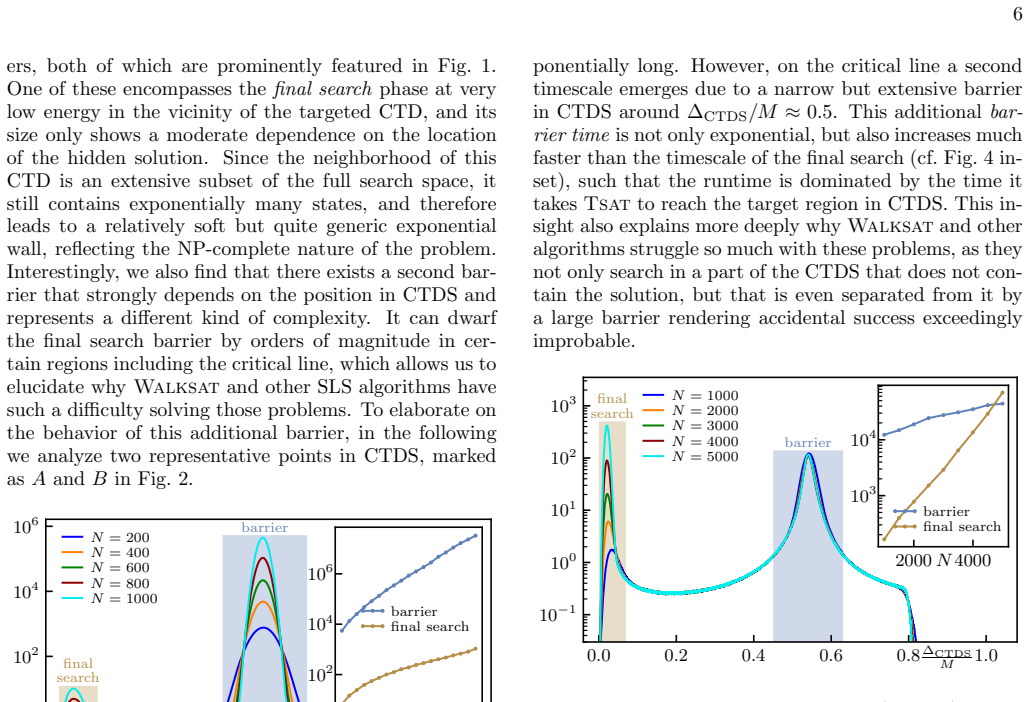
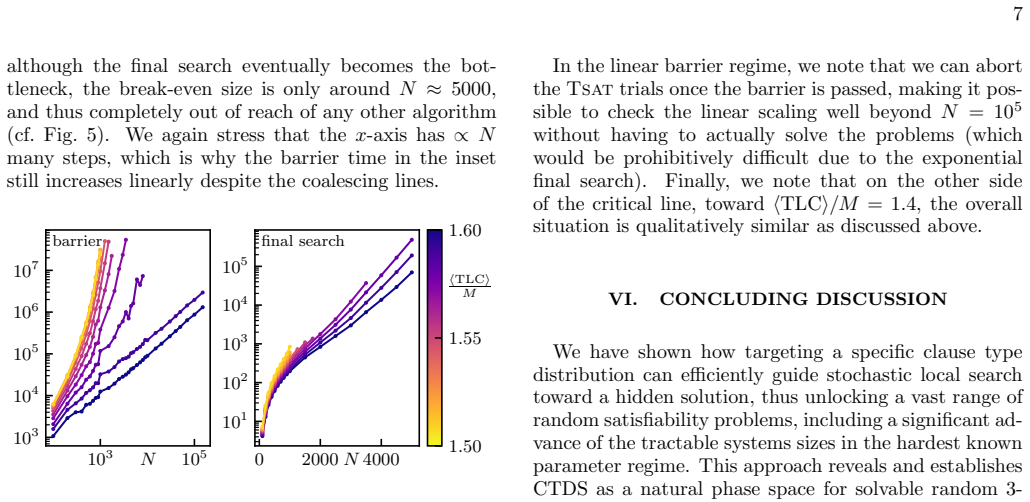
By leveraging statistical information hidden in the combinatorial constraints of the problem, TSAT is actively guided in its stochastic local search toward a target within the relevant parameter space... two separate barriers (cf. Fig. 1).
-
IndisputableMonolith/Foundation/DimensionForcing.leanreality_from_one_distinction unclear?
unclearRelation between the paper passage and the cited Recognition theorem.
the critical line r2 = 3/2 − 2r1 ... extensive number of frozen spins (backbone)
What do these tags mean?
- matches
- The paper's claim is directly supported by a theorem in the formal canon.
- supports
- The theorem supports part of the paper's argument, but the paper may add assumptions or extra steps.
- extends
- The paper goes beyond the formal theorem; the theorem is a base layer rather than the whole result.
- uses
- The paper appears to rely on the theorem as machinery.
- contradicts
- The paper's claim conflicts with a theorem or certificate in the canon.
- unclear
- Pith found a possible connection, but the passage is too broad, indirect, or ambiguous to say the theorem truly supports the claim.
Reference graph
Works this paper leans on
-
[1]
Barahona, Journal of Physics A: Mathematical and General15, 3241 (1982)
F. Barahona, Journal of Physics A: Mathematical and General15, 3241 (1982)
work page 1982
- [2]
- [3]
-
[4]
Parisi, Journal of Physics A: Mathematical and Gen- eral13, L115 (1980)
G. Parisi, Journal of Physics A: Mathematical and Gen- eral13, L115 (1980)
work page 1980
- [5]
- [6]
-
[7]
C. K. Thomas and A. A. Middleton, Phys. Rev. B76, 220406 (2007)
work page 2007
-
[8]
A. Hartmann and H. Rieger,New Optimization Algo- rithms in Physics(Wiley, 2006)
work page 2006
-
[9]
S. A. Cook, inProceedings of the Third Annual ACM Symposium on Theory of Computing, STOC ’71, edited by M. A. Harrison, R. B. Banerji, and J. D. Ullman (Association for Computing Machinery, New York, USA,
-
[10]
R. M. Karp, Reducibility among combinatorial prob- lems, inProceedings of a symposium on the Complexity of Computer Computations, edited by R. E. Miller, J. W. Thatcher, and J. D. Bohlinger (Springer US, Boston, MA, 1972) pp. 85–103. 10
work page 1972
-
[11]
M. R. Garey and D. S. Johnson,Computers and In- tractability; A Guide to the Theory of NP-Completeness (W. H. Freeman & Co., USA, 1990)
work page 1990
-
[12]
D. Achlioptas and C. Moore, SIAM Journal on Comput- ing36, 740 (2006)
work page 2006
-
[13]
R. Impagliazzo and R. Paturi, Journal of Computer and System Sciences62, 367 (2001)
work page 2001
-
[14]
D. Dobrynin, A. Renaudineau, M. Hizzani, D. Strukov, M. Mohseni, and J. P. Strachan, Phys. Rev. E110, 045308 (2024)
work page 2024
-
[15]
O. Kullmann, Present and future of practical sat solving, inComplexity of Constraints: An Overview of Current Research Themes, edited by N. Creignou, P. G. Kolaitis, and H. Vollmer (Springer Berlin Heidelberg, Berlin, Hei- delberg, 2008) pp. 283–319
work page 2008
-
[16]
G.-J. Nam, K. A. Sakallah, and R. A. Rutenbar, in International ACM Symposium on Field-Programmable Gate Arrays, edited by S. Kaptanoglu and S. Trimberger (IEEE Computer Society, Los Alamitos, CA, USA, 1999) pp. 167–175
work page 1999
- [17]
-
[18]
J. Marques-Silva, M. Janota, and A. Belov, inProceed- ings of the 25th International Conference on Computer Aided Verification - Volume 8044, CAV 2013, edited by N. Sharygina and H. Veith (Springer-Verlag, Berlin, Hei- delberg, 2013) p. 592–607
work page 2013
-
[19]
J. D. Park, inEighteenth National Conference on Ar- tificial Intelligence(American Association for Artificial Intelligence, USA, 2002) p. 682–687
work page 2002
-
[20]
Dechter,Constraint Processing(Morgan Kaufmann, 2003)
R. Dechter,Constraint Processing(Morgan Kaufmann, 2003)
work page 2003
- [21]
-
[22]
N. Ollikainen, E. Sentovich, C. Coelho, A. Kuehlmann, and T. Kortemme, in2009 IEEE/ACM International Conference on Computer-Aided Design - Digest of Tech- nical Papers(2009) pp. 128–135
work page 2009
-
[23]
D. Allouche, I. Andr´ e, S. Barbe, J. Davies, S. de Givry, G. Katsirelos, B. O’Sullivan, S. Prestwich, T. Schiex, and S. Traor´ e, Artificial Intelligence212, 59 (2014)
work page 2014
- [24]
-
[25]
M. R. Prasad, A. Biere, and A. Gupta, International Journal on Software Tools for Technology Transfer7, 156 (2005)
work page 2005
-
[26]
G. P. Matos, L. M. Albino, R. L. Saldanha, and E. M. Morgado, Public Transport13, 625 (2021)
work page 2021
-
[27]
P.-H. Yuh, C. C.-Y. Lin, T.-W. Huang, T.-Y. Ho, C.-L. Yang, and Y.-W. Chang, inInternational Workshop on System Level Interconnect Prediction(2011) pp. 1–7
work page 2011
-
[28]
D. V. Zhukov, D. A. Zheleznikov, and M. A. Zapletina, in2020 IEEE Conference of Russian Young Researchers in Electrical and Electronic Engineering (EIConRus), edited by S. Shaposhnikov (2020) pp. 1905–1910
work page 2020
-
[29]
P. Cheeseman, B. Kanefsky, and W. M. Taylor, inPro- ceedings of the 12th International Joint Conference on Artificial Intelligence - Volume 1, IJCAI’91, edited by J. Mylopoulos and R. Reiter (Morgan Kaufmann Pub- lishers Inc., San Francisco, CA, USA, 1991) p. 331–337
work page 1991
-
[30]
D. Mitchell, B. Selman, and H. Levesque, inProceed- ings of the Tenth National Conference on Artificial Intelligence, AAAI’92, edited by P. Rosenbloom and P. Szolovits (AAAI Press, 1992) p. 459–465
work page 1992
-
[31]
P. H. Lundow and K. Markstr¨ om, Phys. Rev. E99, 022106 (2019)
work page 2019
-
[32]
S. Mertens, M. M´ ezard, and R. Zecchina, Random Struct. Algorithms28, 340–373 (2006)
work page 2006
- [33]
- [34]
-
[35]
A. Coja-Oghlan, F. Krzakala, W. Perkins, and L. Zde- borova, inProceedings of the 49th Annual ACM SIGACT Symposium on Theory of Computing, STOC 2017, edited by H. Hatami, P. McKenzie, and V. King (Association for Computing Machinery, New York, NY, USA, 2017) p. 146–157
work page 2017
-
[36]
S. Hetterich, in43rd International Colloquium on Au- tomata, Languages, and Programming (ICALP 2016), Vol. 55, edited by I. Chatzigiannakis, M. Mitzenmacher, Y. Rabani, and D. Sangiorgi (Schloss Dagstuhl, 2016) pp. 65:1–65:12
work page 2016
-
[37]
A. Braunstein, M. M´ ezard, and R. Zecchina, Random Struct. Algorithms27, 201–226 (2005)
work page 2005
- [38]
-
[39]
W. Barthel, A. K. Hartmann, M. Leone, F. Ricci- Tersenghi, M. Weigt, and R. Zecchina, Phys. Rev. Lett. 88, 188701 (2002)
work page 2002
-
[40]
To clarify, the word critical here refers to the critically hard region within the parameter regime of the hidden solution at some fixed clause densityα, and not to the critical valueα c that marks the phase transition toward unsatisfiability in random 3-SAT problems
- [41]
-
[42]
H. H. Hoos and T. St¨ utzle, Journal of Automated Rea- soning24, 421 (2000)
work page 2000
-
[43]
H. H. Hoos and T. St¨ utzle, Stochastic local search algorithms: An overview, inSpringer Handbook of Computational Intelligence, edited by J. Kacprzyk and W. Pedrycz (Springer Berlin Heidelberg, Berlin, Heidel- berg, 2015) pp. 1085–1105
work page 2015
-
[44]
H. Fu, Y. Xu, S. Chen, and J. Liu, JUCS - Journal of Universal Computer Science26, 220 (2020)
work page 2020
-
[45]
J. Marques-Silva, I. Lynce, and S. Malik, Conflict-driven clause learning sat solvers, inHandbook of Satisfiabil- ity, Frontiers in Artificial Intelligence and Applications No. 1, edited by A. Biere, M. Heule, H. van Maaren, and T. Walsh (IOS Press, Netherlands, 2009) pp. 131–153, 1st ed
work page 2009
-
[46]
N. E´ en and A. Biere, inTheory and Applications of Sat- isfiability Testing, edited by F. Bacchus and T. Walsh (Springer Berlin Heidelberg, Berlin, Heidelberg, 2005) pp. 61–75
work page 2005
- [47]
- [48]
-
[49]
S. Alouneh, S. Abed, M. H. Al Shayeji, and R. Mesleh, Artif. Intell. Rev.52, 2575–2601 (2019)
work page 2019
-
[50]
J. K. Fichte, D. L. Berre, M. Hecher, and S. Szeider, Commun. ACM66, 64–72 (2023)
work page 2023
-
[51]
J. Schwardt and J. C. Budich, Proceedings of the Na- tional Academy of Sciences122, e2517297122 (2025)
work page 2025
- [52]
- [53]
-
[54]
Biere, inProceedings of SAT Competition 2017 - Solver and Benchmark Descriptions, Vol
A. Biere, inProceedings of SAT Competition 2017 - Solver and Benchmark Descriptions, Vol. B-1, edited by T. Tom´ aˇ s, M. Heule, and M. J¨ arvisalo (University of Helsinki, 2017) pp. 14–15
work page 2017
discussion (0)
Sign in with ORCID, Apple, or X to comment. Anyone can read and Pith papers without signing in.