Perturbation theory for kinks of the defocusing modified Korteweg-de Vries equation
Pith reviewed 2026-06-29 01:41 UTC · model grok-4.3
The pith
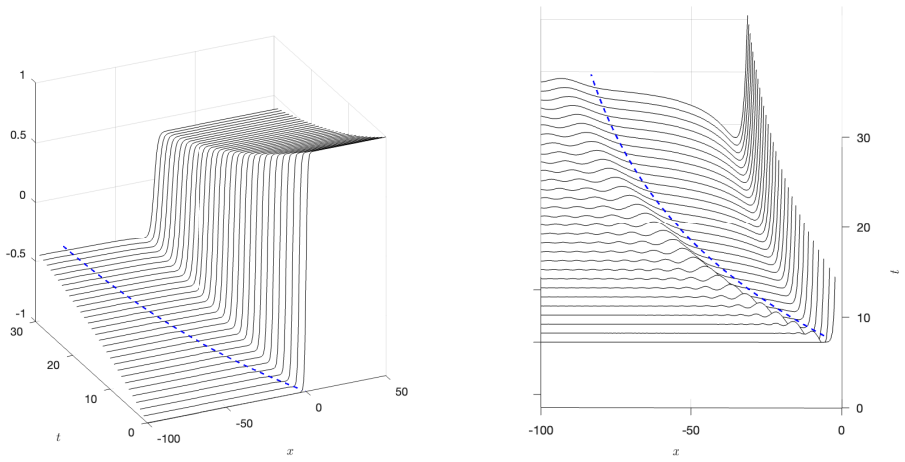
Perturbations of defocusing mKdV kinks generically produce a radiative shelf in front of the kink while yielding explicit evolution equations for the kink parameters at leading order.
A machine-rendered reading of the paper's core claim, the machinery that carries it, and where it could break.
Core claim
An integrable perturbation theory is developed for the defocusing mKdV kink using the squared eigenfunction expansion from the Zakharov-Shabat scattering problem. The completeness relation for these eigenfunctions on the kink background is established, along with the adjoint structure required for continuous and discrete perturbations. Explicit evolution equations are obtained for the kink parameters at leading order. The first-order correction shows that perturbations generically produce a radiative shelf in front of the kink.
What carries the argument
Squared eigenfunction expansion associated with the Zakharov-Shabat scattering problem on the kink background, which supplies a complete basis and adjoint relations for expanding and evolving perturbations of both continuous and discrete spectral components.
If this is right
- Explicit evolution equations govern the slow change of kink parameters under small perturbations.
- A radiative shelf forms generically in front of the kink at leading order.
- The framework handles both continuous-spectrum radiation and discrete eigenvalue shifts through the adjoint structure.
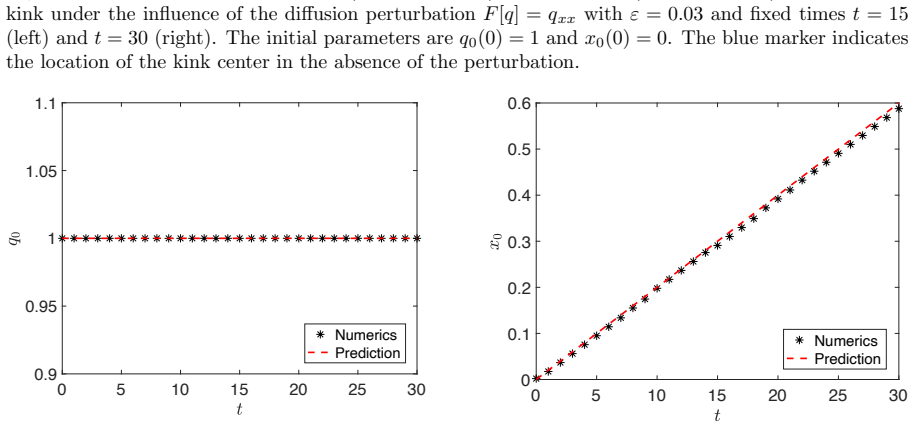
- Predictions for physically relevant perturbations agree with direct numerical simulations of the equation.
Where Pith is reading between the lines
- The same squared-eigenfunction approach may apply directly to kinks in other integrable nonlinear wave equations.
- The radiative shelf implies a mechanism for energy loss or redistribution that could be tracked in long-time asymptotics.
- Extensions to higher-order perturbations could quantify how the shelf interacts with the kink over longer scales.
Load-bearing premise
The squared eigenfunctions associated with the Zakharov-Shabat scattering problem on the kink background form a complete set that can expand arbitrary perturbations including continuous and discrete components.
What would settle it
A numerical integration of the perturbed defocusing mKdV equation in which no radiative shelf appears ahead of the kink or the observed kink-parameter evolution deviates from the derived leading-order equations would falsify the central claims.
Figures



read the original abstract
In this work we develop an integrable perturbation theory for the defocusing modified Korteweg-de Vries kink solution based on the squared eigenfunction expansion associated with the underlying Zakharov-Shabat scattering problem. We derive the completeness relation for the squared eigenfunctions appropriate to the kink background, establish the adjoint structure needed to handle perturbations of both the continuous and discrete spectral components, and obtain explicit evolution equations for the perturbed kink parameters at leading order. The study of the first order correction shows that perturbations generically produce a radiative shelf in front of the kink. We also apply our results to certain physically relevant perturbations and show that the predictions are consistent with direct numerical simulations.
Editorial analysis
A structured set of objections, weighed in public.
Referee Report
Summary. The manuscript develops an integrable perturbation theory for the defocusing modified Korteweg-de Vries kink based on the squared eigenfunction expansion of the Zakharov-Shabat scattering problem. It derives the completeness relation and adjoint structure for the kink background (which connects two distinct constant states), obtains explicit leading-order evolution equations for the perturbed kink parameters, shows that generic perturbations produce a radiative shelf ahead of the kink, and reports consistency between these predictions and direct numerical simulations for selected physically relevant perturbations.
Significance. If the completeness relation is correctly established for the non-square-integrable continuous-spectrum modes, the work supplies a systematic tool for tracking radiative effects in perturbed kinks of integrable systems with non-decaying backgrounds. The explicit evolution equations and numerical comparisons constitute concrete, usable results.
major comments (2)
- [Completeness relation derivation] Completeness relation section: the derivation must explicitly incorporate the branch-cut (continuous-spectrum) contribution that generates the non-decaying shelf at +∞; because the kink asymptotes to different constants, the squared eigenfunctions are not square-integrable and the radiation condition at +∞ is essential. The manuscript states that the relation is derived, yet no independent verification (e.g., Parseval identity applied to a compactly supported test function that produces a shelf) is described, leaving open whether the expansion correctly weights the radiative component.
- [Evolution equations for perturbed parameters] Leading-order evolution equations (the section presenting the perturbed kink-parameter ODEs): these equations are obtained by projecting the perturbation onto the squared eigenfunctions; if the shelf mode is omitted or mis-weighted in the completeness relation, the resulting evolution equations for the kink speed and position will be incomplete for generic perturbations that excite radiation.
minor comments (1)
- [Numerical comparisons] The abstract asserts consistency with numerical simulations, but the main text should include quantitative error measures or explicit formulas for the shelf amplitude to allow readers to assess the agreement.
Simulated Author's Rebuttal
We thank the referee for the careful reading and constructive comments. We address each major comment below.
read point-by-point responses
-
Referee: [Completeness relation derivation] Completeness relation section: the derivation must explicitly incorporate the branch-cut (continuous-spectrum) contribution that generates the non-decaying shelf at +∞; because the kink asymptotes to different constants, the squared eigenfunctions are not square-integrable and the radiation condition at +∞ is essential. The manuscript states that the relation is derived, yet no independent verification (e.g., Parseval identity applied to a compactly supported test function that produces a shelf) is described, leaving open whether the expansion correctly weights the radiative component.
Authors: The completeness relation is derived from the squared eigenfunction expansion of the Zakharov-Shabat problem for the kink background, with the branch-cut contribution from the continuous spectrum explicitly included to capture the non-decaying shelf at +∞. The radiation condition is enforced through the appropriate contour deformation and the adjoint relations for the non-square-integrable modes. The first-order correction analysis in the manuscript demonstrates generic shelf formation under perturbations, and consistency with direct numerical simulations provides supporting evidence. We agree that an explicit independent check, such as a Parseval identity on a compactly supported test function, would strengthen the presentation and will add this verification in the revised manuscript. revision: partial
-
Referee: [Evolution equations for perturbed parameters] Leading-order evolution equations (the section presenting the perturbed kink-parameter ODEs): these equations are obtained by projecting the perturbation onto the squared eigenfunctions; if the shelf mode is omitted or mis-weighted in the completeness relation, the resulting evolution equations for the kink speed and position will be incomplete for generic perturbations that excite radiation.
Authors: The evolution equations for the kink parameters are obtained by projecting the perturbation onto the squared eigenfunctions using the completeness relation that already incorporates the full continuous-spectrum (branch-cut) contribution, including the shelf mode. Consequently, the leading-order ODEs account for radiative effects excited by generic perturbations. This is confirmed by the agreement between the analytic predictions and the numerical simulations reported in the manuscript. revision: no
Circularity Check
No significant circularity; derivation self-contained via explicit completeness relation
full rationale
The paper derives the completeness relation and adjoint structure for squared eigenfunctions on the kink background directly from the Zakharov-Shabat operator, then applies this to obtain the leading-order evolution equations and the radiative shelf result. No step reduces a claimed prediction to a fitted input or self-citation by construction; the completeness relation is presented as newly established for this background rather than assumed or imported without derivation. The approach relies on standard scattering theory foundations but supplies the specific adaptations needed for non-decaying states, keeping the chain independent of the target outputs.
Axiom & Free-Parameter Ledger
axioms (2)
- domain assumption Squared eigenfunctions associated with the Zakharov-Shabat scattering problem on the kink background form a complete set.
- domain assumption An adjoint structure exists that allows projection onto both continuous and discrete spectral components.
Reference graph
Works this paper leans on
-
[1]
Korteweg–de Vries Equation and Generalizations. I. A Remarkable Explicit Nonlin- ear Transformation
R. M. Miura, “Korteweg–de Vries Equation and Generalizations. I. A Remarkable Explicit Nonlin- ear Transformation”,J. Math. Phys.9(8), 1202–1204 (1968)
1968
-
[2]
A Relationship between the Gordon Equations and the Wave Equations of Lax Equa- tions
Y. Ishimori, “A Relationship between the Gordon Equations and the Wave Equations of Lax Equa- tions”,J. Phys. Soc. Japan, Vol.51(9), 3036–3041 (1982)
1982
-
[3]
An Exact Transformation from the Harry-Dym Equation to the Modified Ko- rteweg–de Vries Equation
S. Kawamoto, “An Exact Transformation from the Harry-Dym Equation to the Modified Ko- rteweg–de Vries Equation”,J. Phys. Soc. Japan54(6), 2055–2056 (1985)
2055
-
[4]
The modified Korteweg–de Vries equation
M. Wadati, “The modified Korteweg–de Vries equation”,J. Phys. Soc. Japan34, 1289–1296 (1973)
1973
-
[5]
An Infinite Set of Conservation Laws and the B¨ acklund Transformation for the Mod- ified Korteweg-de Vries Equation
H. Steudel, “An Infinite Set of Conservation Laws and the B¨ acklund Transformation for the Mod- ified Korteweg-de Vries Equation”,Annalen der Physik487(7), 299–305 (1974)
1974
-
[6]
A Wronskian Representation ofN-Soliton Solutions of Nonlinear Evolution Equa- tions
J. Satsuma, “A Wronskian Representation ofN-Soliton Solutions of Nonlinear Evolution Equa- tions”,J. Phys. Soc. Japan40, 286–290 (1976)
1976
-
[7]
Exact solutions of the modified Korteweg–de Vries equation
F. Demontis, “Exact solutions of the modified Korteweg–de Vries equation”,Theor. Math. Phys. 168(1), 886–897 (2011)
2011
-
[8]
Asymptotic stability of solitons for mKdV
P. Germain, F. Pusateri and Frederic Rousset, “Asymptotic stability of solitons for mKdV”,Adv. Math.299, 272–330 (2016)
2016
-
[9]
Soliton resolution for the focusing modified KdV equation
G. Chen and J. Liu, “Soliton resolution for the focusing modified KdV equation”,Ann. Instit. Henri Poincar` e C, Analyse Non Lin´ eaire,38, 2005–2071 (2021)
2005
-
[10]
Focusing and defocusing mKdV equations with nonzero boundary condi- tions: Inverse scattering transforms and soliton interactions
G. Zhang and Z. Yan, “Focusing and defocusing mKdV equations with nonzero boundary condi- tions: Inverse scattering transforms and soliton interactions”,Physica D410, 132521 (2020)
2020
-
[11]
On the Cauchy problem of defocusing mKdV equation with finite density initial data: long time asymptotics in soliton-less regions
T.Y. Xu, Z. Zhang and E. Fan, “On the Cauchy problem of defocusing mKdV equation with finite density initial data: long time asymptotics in soliton-less regions”,J. Diff. Equations372, 55–122 (2023)
2023
-
[12]
Soliton resolution and asymptotic stability of soliton solutions for the defocusing mKdV equation with a non-vanishing background
Z. Zhang, T. Xu and E. Fan, “Soliton resolution and asymptotic stability of soliton solutions for the defocusing mKdV equation with a non-vanishing background”,Physica D472, 134526 (2025)
2025
-
[13]
Geometric curve flows in the plane and mKdV loop solitons
S.C. Anco and J. Maan, “Geometric curve flows in the plane and mKdV loop solitons”, arXiv:2606.08823v1 (2026)
Pith/arXiv arXiv 2026
-
[14]
Zabusky, Proceedings of the Symposium on Nonlinear Partial Differential Equations, Academic Press Inc., NewYork, 1967
N. Zabusky, Proceedings of the Symposium on Nonlinear Partial Differential Equations, Academic Press Inc., NewYork, 1967. 14
1967
-
[15]
Soliton fission in anharmonic lattices with reflectionless inhomogeneity
H. Ono, “Soliton fission in anharmonic lattices with reflectionless inhomogeneity”,J. Phys. Soc. Japan61, 4336–4343 (1992)
1992
-
[16]
Weak non-linear hydromagnetic waves in a cold collision-free plasma
T. Kakutani and H. Ono, “Weak non-linear hydromagnetic waves in a cold collision-free plasma”, J. Phys. Soc. Japan26, 1305–1318 (1969)
1969
-
[17]
B¨ acklund transformations and exact solutions for Alfv´ en solitons in a relativistic electron-positron plasma
A. Khater, O. El-Kalaawy and D. Callebaut, “B¨ acklund transformations and exact solutions for Alfv´ en solitons in a relativistic electron-positron plasma”,Phys. Scr.58, 545 (1998)
1998
-
[18]
Reflectionless quantum wire
S. Matsutani and H. Tsuru, “Reflectionless quantum wire”,J. Phys. Soc. Japan60, 3640–3644 (1991)
1991
-
[19]
Predicting eddy detachment for anequivalent barotropic thin jet
E. Ralph and L. Pratt, “Predicting eddy detachment for anequivalent barotropic thin jet”,J. Nonlinear Sci.4, 355–374 (1994)
1994
-
[20]
Kink soliton characterizing traffic congestion
T.S. Komatsu and S.-I. Sasa, “Kink soliton characterizing traffic congestion”,Phys. Rev. E52, 5574–5582 (1995)
1995
-
[21]
Stabilization analysis and modified Korteweg-de Vries equation in a cooperative driving system
H.Ge, S. Dai, Y. Xue and L. Dong, “Stabilization analysis and modified Korteweg-de Vries equation in a cooperative driving system”,Phys. Rev. E71, 066119 (2005)
2005
-
[22]
Schief, An infinite hierarchy of symmetries associated with hyperbolic surfaces,Nonlinearity8, 1 (1995)
W. Schief, An infinite hierarchy of symmetries associated with hyperbolic surfaces,Nonlinearity8, 1 (1995)
1995
-
[23]
Oscillation modes of slag-metallic bath interface
M. Agop and V. Cojocaru, “Oscillation modes of slag-metallic bath interface”,Mater. Trans. JIM 39, 668–671 (1998)
1998
-
[24]
Ziegler, J
V. Ziegler, J. Dinkel, C. Setzer and K.E. Lonngren, “On the propagation of non-linear solitary waves in a distributed Schottky barrier diode transmission line,Chaos Solitons Fractals12, 1719–1728 (2001)
2001
-
[25]
Perturbation-theory for solitons
V.I. Karpman and E.M. Maslov, “Perturbation-theory for solitons”,Zh. Eksp. Teor. Fiz.73, 537– 559 (1977)
1977
-
[26]
Solitons as particles, oscillators, and in slowly changing media
D.J. Kaup and A.C. Newell, “Solitons as particles, oscillators, and in slowly changing media”,Proc. Roy. Soc. London A361, 413–446 (1978)
1978
-
[27]
Dynamics of solitons in nearly integrable systems
Y. Kivshar and B. Malomed, “Dynamics of solitons in nearly integrable systems”,Rev. Mod. Phys. 61, 763–915 (1989)
1989
-
[28]
Stable embedded solitons
J. Yang, “Stable embedded solitons”,Phys. Rev. Lett.91, 143903 (2003)
2003
-
[29]
Soliton dynamics for a non-Hamiltonian perturbation of mKdV
Q. Lin, “Soliton dynamics for a non-Hamiltonian perturbation of mKdV”,Diff. Int. Equations 26(1/2), 81–104 (2013)
2013
-
[30]
Existence of kink waves and periodic waves for a perturbed defocusing mKdV equation
A. Chen, L. Guo and W. Huang, “Existence of kink waves and periodic waves for a perturbed defocusing mKdV equation”,Qual. Theory Dyn. Syst.17, 495–517 (2018)
2018
-
[31]
J Yang, Nonlinear waves in integrable and nonintegrable systems (SIAM, Philadelphia, PA, 2010)
2010
-
[32]
Integrable perturbation theory for dark solitons of the nonlinear Schr¨ odinger equation
N.J. Ossi, B. Prinari and J. Yang, “Integrable perturbation theory for dark solitons of the nonlinear Schr¨ odinger equation”,J. Nonlin. Waves2, 1–44 (2026)
2026
-
[33]
Direct perturbation-theory for dark solitons
VV Konotop and VE Vekslerchik, “Direct perturbation-theory for dark solitons”,Phys. Rev. E49, 2397–2407 (1994)
1994
-
[34]
A direct perturbation theory for dark solitons based on a complete set of the squared Jost solutions
X.-J. Chen, Z.-D. and N.-N. Huang, “A direct perturbation theory for dark solitons based on a complete set of the squared Jost solutions”,J. Phys. A: Math. & Gen.31, 6929–6947 (1998)
1998
-
[35]
Foundation of direct perturbation method for dark solitons
N.-N. Huang, S. Chi and X.-J. Chen, “Foundation of direct perturbation method for dark solitons”, J. Phys. A: Math. & Gen.32, 3939–3945 (1999)
1999
-
[36]
A perturbation method for dark solitons based on a complete set of the squared Jost solutions
S.M. Ao and J.-R. and Yanm “A perturbation method for dark solitons based on a complete set of the squared Jost solutions”,J. Phys. A: Math. & Gen.38, 2399–2413 (2005)
2005
-
[37]
CORRIGENDUM a perturbation method for dark solitons based on a complete set of the squared Jost solutions
S.-M. Ao, “CORRIGENDUM a perturbation method for dark solitons based on a complete set of the squared Jost solutions”,J. Phys. A: Math. & Gen.39, 1979–1980 (2006)
1979
-
[38]
Three types of expression in dark-soliton perturbation theory based on squared Jost solutions
S.-M. Ao and J.-R. Yan, “Three types of expression in dark-soliton perturbation theory based on squared Jost solutions”,Comm. Theor. Phys.47, 15–18 (2007). 15
2007
-
[39]
Complete eigenfunctions of linearized integrable equations expanded around a soliton solution
J. Yang, “Complete eigenfunctions of linearized integrable equations expanded around a soliton solution”,J. Math. Phys.41, 9 (2000)
2000
-
[40]
Integrable fractional modified Korteweg–deVries, sine- Gordon, and sinh-Gordon equations
M.J. Ablowitz, J.B. Been and L.D. Carr, “Integrable fractional modified Korteweg–deVries, sine- Gordon, and sinh-Gordon equations”,J. Phys. A55, 384010 (2022)
2022
-
[41]
Inverse Scattering Transform for nonlinear Schr¨ odinger system on a nontrivial back- ground: a survey of classical results, new developments and future directions
B Prinari, “Inverse Scattering Transform for nonlinear Schr¨ odinger system on a nontrivial back- ground: a survey of classical results, new developments and future directions”,J. Nonlin. Math. Phys.30, 317–383 (2023) 16
2023
discussion (0)
Sign in with ORCID, Apple, or X to comment. Anyone can read and Pith papers without signing in.