Bayesian-Monte Carlo Schedule Updating for Construction Digital Twins: A Probabilistic Framework for Dynamic Project Forecasting
Pith reviewed 2026-05-19 22:10 UTC · model grok-4.3
The pith
A Bayesian-Monte Carlo framework updates construction schedules by recursively incorporating new observations to produce adaptive probabilistic forecasts.
A machine-rendered reading of the paper's core claim, the machinery that carries it, and where it could break.
Core claim
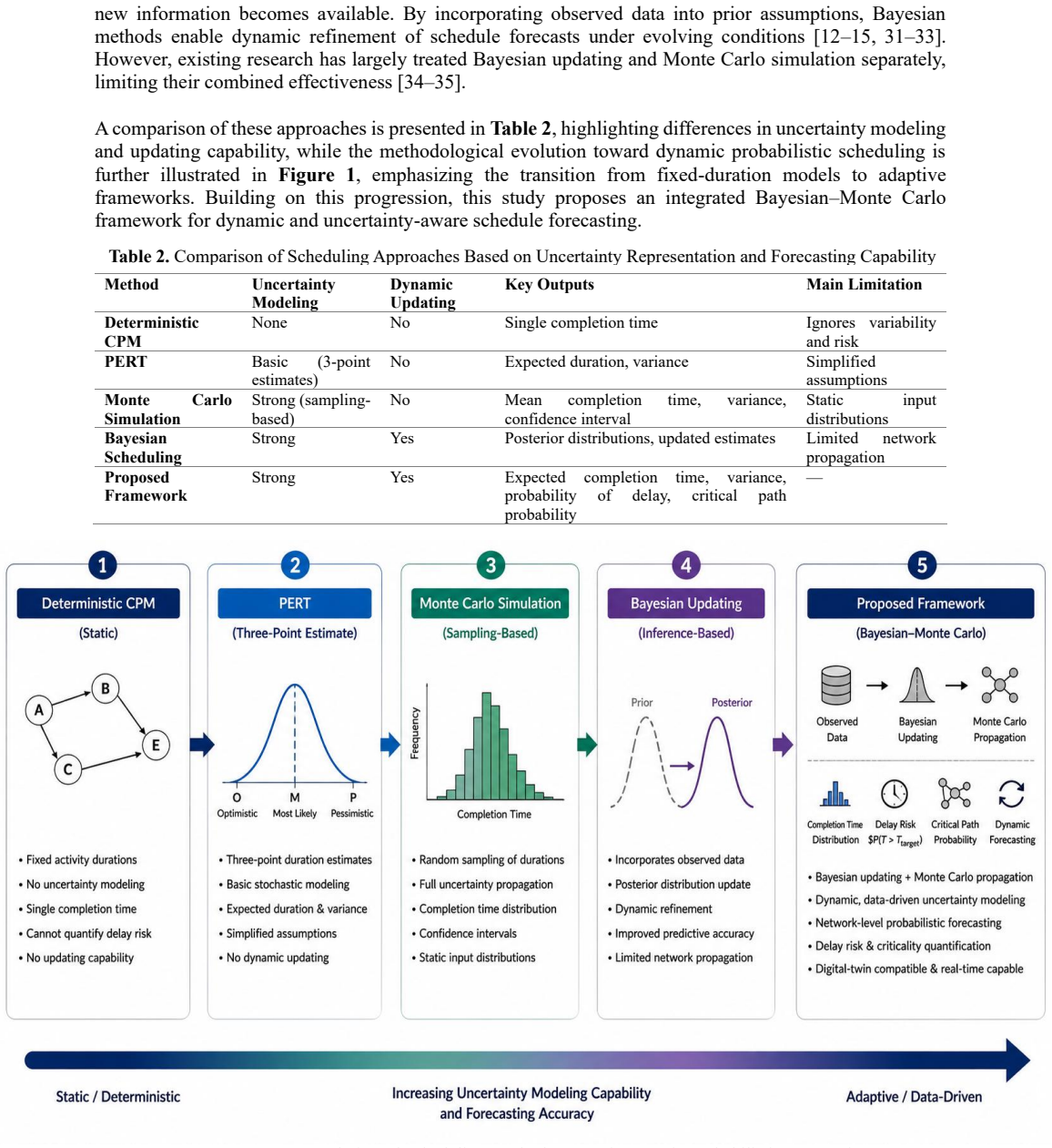
The Bayesian-Monte Carlo probabilistic schedule updating framework models activity durations with lognormal distributions, performs Bayesian recursive updating as new observations become available, and employs Monte Carlo simulation to propagate the resulting uncertainty through project networks, thereby generating dynamic probabilistic forecasts of completion time, delay risk, and activity criticality that outperform both deterministic CPM and static probabilistic methods on benchmark networks.
What carries the argument
Bayesian recursive updating of lognormal activity-duration distributions followed by Monte Carlo propagation of uncertainty across the project network.
If this is right
- Probabilistic completion-time forecasts that narrow or widen automatically as new data arrive.
- Quantitative delay-risk estimates and activity criticality rankings that change with each update cycle.
- Direct ingestion of heterogeneous data streams (BIM reports, drone imagery, IoT telemetry, productivity logs) into the schedule model.
- Improved forecasting accuracy relative to both fixed-duration CPM and non-updating probabilistic schedules.
Where Pith is reading between the lines
- The same updating loop could be applied to other domains that maintain network schedules under streaming observations, such as software release planning or manufacturing job-shop scheduling.
- Digital-twin platforms could use the framework to trigger automated alerts when the probability of missing a milestone exceeds a chosen threshold.
- Sensitivity analyses could test how robust the forecasts remain when the lognormal assumption is replaced by other common duration distributions.
Load-bearing premise
Activity durations are adequately captured by lognormal distributions and that continuous streams of reliable new observations from BIM, drones, IoT, and logs will be available for the Bayesian updates.
What would settle it
Run the framework on a live construction project or an additional PSPLIB network for which the actual completion date and intermediate milestones are known, then check whether the predicted probability distribution for completion time assigns high probability to the observed outcome.
Figures


read the original abstract
Construction projects frequently experience schedule delays and forecasting uncertainty due to variability in labor productivity, material availability, weather conditions, and project coordination. Conventional deterministic scheduling methods such as the Critical Path Method (CPM) assume fixed activity durations and therefore cannot adequately represent dynamic project uncertainty. This study presents a Bayesian-Monte Carlo probabilistic schedule updating framework for construction digital twin environments. The proposed methodology integrates stochastic activity-duration modeling, Bayesian recursive updating, Monte Carlo simulation, and uncertainty propagation within a unified computational framework for adaptive schedule forecasting. Activity durations are modeled using lognormal probability distributions and continuously updated through Bayesian inference as new project observations become available. Monte Carlo simulation is then used to propagate updated uncertainty throughout project networks and generate probabilistic completion-time forecasts, delay-risk estimates, and activity criticality measures. Simulation experiments using PSPLIB benchmark project networks demonstrate that the proposed framework improves forecasting accuracy and uncertainty representation compared with deterministic CPM and static probabilistic scheduling approaches. The framework further supports adaptive project forecasting through integration of BIM reports, drone observations, IoT telemetry, productivity logs, and site monitoring data.
Editorial analysis
A structured set of objections, weighed in public.
Referee Report
Summary. The manuscript presents a Bayesian-Monte Carlo probabilistic schedule updating framework for construction digital twins. Activity durations are modeled as lognormal distributions and recursively updated via Bayesian inference using streams of observations from BIM, drones, IoT, and logs. Monte Carlo simulation then propagates the updated uncertainties through project networks to produce probabilistic completion-time forecasts, delay risks, and criticality measures. The central claim is that experiments on PSPLIB benchmark networks demonstrate improved forecasting accuracy and uncertainty representation relative to deterministic CPM and static probabilistic schedulers.
Significance. If the empirical results can be substantiated with quantitative metrics and proper controls, the framework offers a coherent way to integrate real-time data into adaptive project forecasting. The combination of Bayesian updating with Monte Carlo propagation in a digital-twin setting addresses a practical need in construction management and could support more reliable risk assessment when continuous observation streams are available.
major comments (2)
- [Abstract and simulation-experiments section] Abstract and simulation-experiments section: the claim that PSPLIB experiments 'demonstrate that the proposed framework improves forecasting accuracy and uncertainty representation' is unsupported because no quantitative metrics (MAE, CRPS, interval calibration, or similar), error bars, baseline comparisons, or statistical tests are reported. This directly undermines the central empirical validation.
- [Simulation-experiments section] Simulation-experiments section: the protocol for generating synthetic observations used in the Bayesian update step, the number of Monte Carlo replications, the exact static probabilistic baseline (with identical lognormal parameters), and any significance testing are not described. Without these elements the reported accuracy gains cannot be reproduced or assessed for robustness.
minor comments (2)
- [Methodology] The initialization of the lognormal distribution parameters is mentioned but not given an explicit functional form or default values; adding this would improve reproducibility.
- [Bayesian updating subsection] Notation for the Bayesian update equations could be clarified by explicitly distinguishing prior, likelihood, and posterior parameters in a single display equation.
Simulated Author's Rebuttal
We thank the referee for the constructive comments on our manuscript. The feedback correctly identifies areas where the empirical validation and experimental details require strengthening to better support the central claims. We will revise the manuscript to incorporate quantitative metrics, detailed protocols, and reproducibility information as outlined below.
read point-by-point responses
-
Referee: [Abstract and simulation-experiments section] Abstract and simulation-experiments section: the claim that PSPLIB experiments 'demonstrate that the proposed framework improves forecasting accuracy and uncertainty representation' is unsupported because no quantitative metrics (MAE, CRPS, interval calibration, or similar), error bars, baseline comparisons, or statistical tests are reported. This directly undermines the central empirical validation.
Authors: We agree that the current manuscript does not report specific quantitative metrics such as MAE, CRPS, interval calibration, error bars, or statistical tests to substantiate the claimed improvements. In the revised version, we will add these elements, including direct numerical comparisons against deterministic CPM and the static probabilistic baseline, along with appropriate statistical significance testing to rigorously demonstrate gains in forecasting accuracy and uncertainty representation. revision: yes
-
Referee: [Simulation-experiments section] Simulation-experiments section: the protocol for generating synthetic observations used in the Bayesian update step, the number of Monte Carlo replications, the exact static probabilistic baseline (with identical lognormal parameters), and any significance testing are not described. Without these elements the reported accuracy gains cannot be reproduced or assessed for robustness.
Authors: We acknowledge that the experimental protocol details are currently insufficient for full reproducibility. The revised manuscript will explicitly describe the procedure for generating synthetic observations from the simulated data streams, the number of Monte Carlo replications employed, the precise parameterization of the static probabilistic baseline using identical lognormal distributions, and the statistical tests applied to evaluate the significance of observed accuracy improvements. revision: yes
Circularity Check
No circularity: framework uses external observations for Bayesian updates and independent PSPLIB simulations
full rationale
The derivation chain begins with lognormal modeling of activity durations, proceeds to Bayesian recursive updating driven by incoming external data streams (BIM, drones, IoT, logs), then applies Monte Carlo simulation to propagate uncertainty and produce forecasts. These forecasts are compared against deterministic CPM and static probabilistic baselines on PSPLIB networks. No equation or step reduces a claimed prediction to a quantity defined solely by parameters fitted inside the same model; the updates explicitly require new observations outside the initial model. No self-citations are invoked as load-bearing uniqueness theorems, and the simulation experiments are presented as external validation rather than tautological renaming or self-definition. The framework therefore remains self-contained against external benchmarks.
Axiom & Free-Parameter Ledger
free parameters (1)
- Initial lognormal distribution parameters
axioms (2)
- domain assumption Activity durations follow lognormal distributions
- domain assumption Continuous reliable observations are available for updating
Lean theorems connected to this paper
-
IndisputableMonolith/Cost/FunctionalEquation.leanwashburn_uniqueness_aczel unclear?
unclearRelation between the paper passage and the cited Recognition theorem.
Activity durations are modeled using lognormal probability distributions... Bayesian recursive updating... Monte Carlo simulation is then used to propagate updated uncertainty
-
IndisputableMonolith/Foundation/RealityFromDistinction.leanreality_from_one_distinction unclear?
unclearRelation between the paper passage and the cited Recognition theorem.
Simulation experiments using PSPLIB benchmark project networks demonstrate that the proposed framework improves forecasting accuracy
What do these tags mean?
- matches
- The paper's claim is directly supported by a theorem in the formal canon.
- supports
- The theorem supports part of the paper's argument, but the paper may add assumptions or extra steps.
- extends
- The paper goes beyond the formal theorem; the theorem is a base layer rather than the whole result.
- uses
- The paper appears to rely on the theorem as machinery.
- contradicts
- The paper's claim conflicts with a theorem or certificate in the canon.
- unclear
- Pith found a possible connection, but the passage is too broad, indirect, or ambiguous to say the theorem truly supports the claim.
Reference graph
Works this paper leans on
- [1]
-
[2]
Flyvbjerg, What you should know about megaprojects and why: An overview, Proj
M. Flyvbjerg, What you should know about megaprojects and why: An overview, Proj. Manage. J. 45 (2014) 6–19
work page 2014
-
[3]
Chitkara, Construction Project Management: Planning, Scheduling and Controlling, McGraw- Hill, 2014
K.K. Chitkara, Construction Project Management: Planning, Scheduling and Controlling, McGraw- Hill, 2014
work page 2014
-
[4]
H. Kerzner, Project Management: A Systems Approach to Planning, Scheduling, and Controlling, Wiley, 2017
work page 2017
-
[5]
J.J. Moder, C.R. Phillips, E.W. Davis, Project Management with CPM, PERT and Precedence Diagramming, Van Nostrand Reinhold, 1983
work page 1983
-
[6]
J.K. Pinto, O.P. Kharbanda, How to fail in project management (without really trying), Bus. Horiz. 38 (1995) 45–53
work page 1995
-
[7]
R. Kolisch, S. Hartmann, Experimental investigation of heuristics for resource-constrained project scheduling: An update, Eur. J. Oper. Res. 174 (2006) 23–37
work page 2006
-
[8]
M. Hajdu, Effects of the application of activity calendars on the distribution of project duration in PERT networks, Autom. Constr. 42 (2014) 65–73
work page 2014
-
[9]
Schuyler, Risk and Decision Analysis in Projects, Project Management Institute, 2001
R. Schuyler, Risk and Decision Analysis in Projects, Project Management Institute, 2001
work page 2001
-
[10]
V ose, Risk Analysis: A Quantitative Guide, Wiley, 2008
D. V ose, Risk Analysis: A Quantitative Guide, Wiley, 2008
work page 2008
- [11]
- [12]
- [13]
-
[14]
A. Elshaer, Impact of sensitivity information on the prediction of project duration using Monte Carlo simulation, Int. J. Proj. Manage. 31 (2013) 579–588
work page 2013
-
[15]
Grieves, Digital Twin: Manufacturing Excellence through Virtual Factory Replication, 2014
M. Grieves, Digital Twin: Manufacturing Excellence through Virtual Factory Replication, 2014
work page 2014
-
[16]
F. Tao, H. Zhang, A. Liu, A. Nee, Digital twin in industry: State-of-the-art, IEEE Trans. Ind. Inform. 15 (2019) 2405–2415
work page 2019
-
[17]
Q. Qi, F. Tao, Digital twin and big data towards smart manufacturing and Industry 4.0, Engineering 5 (2019) 653–661
work page 2019
-
[18]
B. Boje, A. Guerriero, S. Kubicki, Y . Rezgui, Towards a semantic construction digital twin: Directions for future research, Autom. Constr. 114 (2020) 103179
work page 2020
- [19]
-
[20]
Y . Deng, Q. Cheng, C. Anumba, Mapping between BIM and digital twins: A systematic review, Autom. Constr. 120 (2020) 103412
work page 2020
- [21]
-
[22]
A. Gelman, J.B. Carlin, H.S. Stern, D.B. Dunson, A. Vehtari, D.B. Rubin, Bayesian Data Analysis, CRC Press, 2013
work page 2013
-
[23]
Bishop, Pattern Recognition and Machine Learning, Springer, 2006
C.M. Bishop, Pattern Recognition and Machine Learning, Springer, 2006
work page 2006
-
[24]
Murphy, Machine Learning: A Probabilistic Perspective, MIT Press, 2012
K.P. Murphy, Machine Learning: A Probabilistic Perspective, MIT Press, 2012
work page 2012
-
[25]
D. Blei, A. Kucukelbir, J. McAuliffe, Variational inference: A review, J. Am. Stat. Assoc. 112 (2017) 859–877
work page 2017
-
[26]
R. M. van Slyke, Monte Carlo methods and the PERT problem, Oper. Res. 11 (1963) 839–860
work page 1963
-
[27]
G. R. R. Lakshminarayanan, Simulation-based schedule risk analysis, J. Constr. Eng. Manage. 135 (2009) 408–417
work page 2009
-
[28]
P. K. K. Chan, Monte Carlo simulation for construction scheduling risk, Autom. Constr. 29 (2013) 198–205
work page 2013
-
[29]
Barraza, Probabilistic control of project performance, J
A. Barraza, Probabilistic control of project performance, J. Constr. Eng. Manage. 130 (2004) 528– 533
work page 2004
-
[30]
Hulett, Integrated schedule risk analysis, PM World J
M. Hulett, Integrated schedule risk analysis, PM World J. 1 (2012) 1–16
work page 2012
-
[31]
Heckerman, A tutorial on learning with Bayesian networks, Innov
D. Heckerman, A tutorial on learning with Bayesian networks, Innov. Bayesian Netw. (1998) 33–82
work page 1998
-
[32]
Neapolitan, Learning Bayesian Networks, Pearson, 2004
R. Neapolitan, Learning Bayesian Networks, Pearson, 2004
work page 2004
-
[33]
Pearl, Probabilistic Reasoning in Intelligent Systems, Morgan Kaufmann, 1988
J. Pearl, Probabilistic Reasoning in Intelligent Systems, Morgan Kaufmann, 1988
work page 1988
-
[34]
McCabe, Bayesian methods for construction productivity forecasting, J
S. McCabe, Bayesian methods for construction productivity forecasting, J. Constr. Eng. Manage. 128 (2002) 19–27
work page 2002
-
[35]
Wang, Bayesian networks in construction risk analysis, Autom
H. Wang, Bayesian networks in construction risk analysis, Autom. Constr. 19 (2010) 909–917
work page 2010
-
[36]
A. Kritzinger, Digital Twin in manufacturing: A categorical literature review, IF AC-PapersOnLine 51 (2018) 1016–1022
work page 2018
-
[37]
Bolton, The digital twin: Realizing the cyber-physical connection, Comput
M. Bolton, The digital twin: Realizing the cyber-physical connection, Comput. Ind. 135 (2022) 103568
work page 2022
-
[38]
Tao, Digital twin-driven smart manufacturing, Rob
F. Tao, Digital twin-driven smart manufacturing, Rob. Comput.-Integr. Manuf. 61 (2020) 101837
work page 2020
-
[39]
Pan, Digital twin in construction: Review and future directions, Autom
Y . Pan, Digital twin in construction: Review and future directions, Autom. Constr. 122 (2021) 103517
work page 2021
-
[40]
Lu, Smart construction using digital twins, J
Z. Lu, Smart construction using digital twins, J. Constr. Eng. Manage. 147 (2021) 04021068
work page 2021
-
[41]
K. A. Bowers, Risk analysis of construction projects, Int. J. Proj. Manage. 16 (1998) 55–63
work page 1998
-
[42]
R. L. Chapman, Risk management in construction, Int. J. Proj. Manage. 19 (2001) 97–105
work page 2001
-
[43]
Dikmen, Risk management in construction projects, Build
A. Dikmen, Risk management in construction projects, Build. Environ. 42 (2007) 275–283
work page 2007
-
[44]
El-Sayegh, Risk assessment in construction scheduling, J
S. El-Sayegh, Risk assessment in construction scheduling, J. Constr. Eng. Manage. 134 (2008) 285– 293
work page 2008
-
[45]
P. T. Williams, Critical path variability in project scheduling, Eur. J. Oper. Res. 128 (2001) 31–45
work page 2001
-
[46]
Kim, Simulation-based project scheduling optimization, Autom
M. Kim, Simulation-based project scheduling optimization, Autom. Constr. 50 (2015) 71–81
work page 2015
-
[47]
Wang, Hybrid simulation for construction planning, Autom
J. Wang, Hybrid simulation for construction planning, Autom. Constr. 37 (2014) 1–10
work page 2014
-
[48]
AbouRizk, Simulation in construction engineering, J
S. AbouRizk, Simulation in construction engineering, J. Constr. Eng. Manage. 136 (2010) 1–10
work page 2010
-
[49]
Al-Sudairi, Simulation-based scheduling improvement, Build
A. Al-Sudairi, Simulation-based scheduling improvement, Build. Res. Inf. 35 (2007) 85–98
work page 2007
-
[50]
Odeh, Simulation modeling in project scheduling, Autom
H. Odeh, Simulation modeling in project scheduling, Autom. Constr. 12 (2003) 635–644
work page 2003
discussion (0)
Sign in with ORCID, Apple, or X to comment. Anyone can read and Pith papers without signing in.