Whose Good, Whose Place? The Moral Geography of Agentic AI for Social Good
Pith reviewed 2026-05-25 05:14 UTC · model grok-4.3
The pith
Papers on agentic AI for social good rarely specify the places they target, especially for institutional and justice goals.
A machine-rendered reading of the paper's core claim, the machinery that carries it, and where it could break.
Core claim
A structured survey of 112 papers on agentic AI for social good finds a moral-geographic asymmetry in which papers specify geographic context 37-40 percent of the time when aligned with health or physical/ecological SDGs but only 13 percent of the time when aligned with institutional and social-policy SDGs; SDG 16 is both the most frequent target and the one with the lowest specification rate, which the authors read as treating institutional good as universal in ways the literature does not apply to health or ecological good.
What carries the argument
Moral-geographic asymmetry measured by coding each paper for SDG alignment and for presence or absence of any geographic context specification.
If this is right
- Claims of social good for institutional AI rest on thinner geographic grounding than claims for health or ecology.
- Low rates of reported deployment limit the ability to test whether systems actually produce the claimed benefits in specific places.
- Five distinct accountability gaps follow from the combination of absent geography and absent deployment data.
- A minimal reporting standard would require explicit statements of place, affected communities, and participatory design steps.
Where Pith is reading between the lines
- Designers working on agentic systems for justice or governance domains may need to treat local legal and cultural mapping as a first-order requirement rather than an optional add-on.
- The asymmetry could be tested by comparing specification rates before and after journals adopt the authors' proposed reporting standard.
- Similar patterns may appear in non-agentic AI literature when the same coding method is applied to SDG-aligned papers.
Load-bearing premise
The 112 papers form a representative sample of the agentic AI for social good literature that can be coded consistently for SDG alignment and geographic specification.
What would settle it
A larger or differently sampled replication that finds equal or higher geographic specification rates for institutional SDGs than for health and ecological SDGs would falsify the asymmetry.
Figures
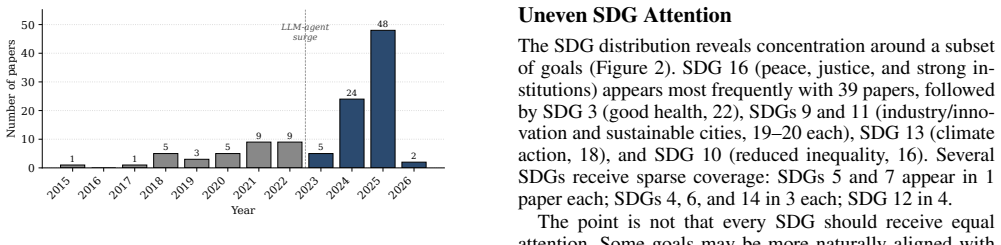


read the original abstract
Agentic AI systems are increasingly proposed for social-good domains, often invoking the United Nations Sustainable Development Goals (SDGs) as a vocabulary of global benefit. Yet claims of social good do not establish accountability to the communities a system claims to serve. We present a structured survey of 112 papers on agentic AI for social good published between 2015 and 2026. We find a moral-geographic asymmetry: papers are least likely to specify geographic context in precisely the domains where local political, legal, and cultural context matters most. Across the corpus, 82 of 112 papers (73%) specify no geographic context. Papers aligned with health or physical/ecological SDGs specify geography 37-40% of the time, while papers aligned with institutional and social-policy SDGs do so only 13%. SDG 16, peace, justice, and strong institutions, is both the most-covered goal in the corpus and the one with the lowest geographic-specification rate. We interpret this as moral abstraction: agentic AI for social good often treats institutional good as universal in ways it does not treat health or ecological good. A second finding compounds this: only 28 of 112 papers (25%) report any real-world deployment or small-scale test. We identify five accountability gaps and propose a minimal reporting standard for more context-specific, participatory, and accountable agentic AI for social good.
Editorial analysis
A structured set of objections, weighed in public.
Referee Report
Summary. The manuscript presents a structured survey of 112 papers on agentic AI for social good (2015–2026) that invoke the SDGs. It reports that 82/112 papers (73%) specify no geographic context, with rates of 37–40% for health or physical/ecological SDGs versus 13% for institutional and social-policy SDGs; SDG 16 is the most-covered goal yet has the lowest geographic-specification rate. Only 28/112 papers (25%) report real-world deployment or testing. The authors interpret these patterns as evidence of moral abstraction, identify five accountability gaps, and propose a minimal reporting standard for more context-specific and participatory agentic AI for social good.
Significance. If the survey is methodologically sound, the work usefully documents an asymmetry in how geographic context is handled across SDG categories in the agentic-AI-for-social-good literature and connects it to accountability concerns. The proposed reporting standard offers a concrete, actionable contribution that could improve future work in this interdisciplinary area.
major comments (2)
- [Survey methodology section] Survey methodology section (likely §3 or equivalent): the manuscript states the final counts and percentages (82/112, 37–40%, 13%) but provides no description of search strategy, inclusion/exclusion criteria, operationalization of “agentic AI,” how SDG alignment was coded, or how presence/absence of geographic context was determined. Because the central asymmetry claim is defined by the difference between these rates, the absence of this information is load-bearing.
- [Results section] Results section (reporting the 13% vs. 37–40% rates): without inter-rater reliability statistics, single-coder consistency checks, or a coding protocol, the stability of the SDG-by-geography cross-tabulation cannot be assessed, directly affecting the robustness of the moral-geographic asymmetry finding.
Simulated Author's Rebuttal
We thank the referee for the constructive feedback highlighting the need for greater methodological transparency. We address each major comment below and will revise the manuscript to incorporate the requested details.
read point-by-point responses
-
Referee: Survey methodology section (likely §3 or equivalent): the manuscript states the final counts and percentages (82/112, 37–40%, 13%) but provides no description of search strategy, inclusion/exclusion criteria, operationalization of “agentic AI,” how SDG alignment was coded, or how presence/absence of geographic context was determined. Because the central asymmetry claim is defined by the difference between these rates, the absence of this information is load-bearing.
Authors: We agree that the methodology section requires expansion to support the central claims. In the revised manuscript we will add a full description of the search strategy (databases, keywords, date range), inclusion/exclusion criteria, the operational definition of agentic AI used, the coding process for SDG alignment, and the explicit criteria for coding presence or absence of geographic context. revision: yes
-
Referee: Results section (reporting the 13% vs. 37–40% rates): without inter-rater reliability statistics, single-coder consistency checks, or a coding protocol, the stability of the SDG-by-geography cross-tabulation cannot be assessed, directly affecting the robustness of the moral-geographic asymmetry finding.
Authors: We acknowledge this limitation in the current draft. The revised version will include a dedicated coding protocol subsection and describe the consistency checks performed (single primary coder with co-author review). We will also note the absence of formal inter-rater reliability statistics as a methodological limitation. revision: yes
Circularity Check
No circularity: survey findings derive from external paper classification, not self-referential definitions or fitted inputs.
full rationale
The paper performs a literature survey of 112 external papers on agentic AI for social good, classifying them by SDG alignment and presence/absence of geographic context specification to derive counts (e.g., 82/112, 37-40% vs 13%). No equations, parameters, derivations, or self-citations appear in the provided text that reduce the central asymmetry claim to the authors' own prior results or inputs by construction. The patterns of self-definitional loops, fitted inputs renamed as predictions, or ansatz smuggling via citation are absent; the empirical rates are presented as outputs of the survey process rather than tautological restatements of any internal model.
Axiom & Free-Parameter Ledger
axioms (1)
- domain assumption The 112 papers form a representative sample of agentic AI for social good literature published 2015-2026 and can be reliably categorized by SDG alignment and geographic context specification.
Reference graph
Works this paper leans on
-
[1]
The evolution of financial analysis: From manual methods to AI and AI agents , author=. Economics , volume=
-
[2]
INTERNATIONAL JOURNAL , volume=
Agentic Workflows in Healthcare: Advancing Clinical Efficiency through AI Integration , author=. INTERNATIONAL JOURNAL , volume=
-
[3]
Fact-audit: An adaptive multi-agent framework for dynamic fact-checking evaluation of large language models , author=. Proceedings of the 63rd Annual Meeting of the Association for Computational Linguistics (Volume 1: Long Papers) , pages=
-
[4]
SRA-Physical Sciences , volume=
Leveraging AI chat assistants for enhanced food security in Africa: A comprehensive integration of large language models, retrieval augmented generation, and vector embedding techniques , author=. SRA-Physical Sciences , volume=
-
[5]
An AI-based Model for Managing a Smart Seafood Supply Chain , author=. 2025 , school=
work page 2025
-
[6]
Pest management in cotton farms: an AI-system case study from the global south , author=. Proceedings of the 26th ACM SIGKDD international conference on knowledge discovery & data mining , pages=
-
[7]
Computers and Electronics in Agriculture , volume=
A survey on intelligent agents and multi-agents for irrigation scheduling , author=. Computers and Electronics in Agriculture , volume=. 2020 , publisher=
work page 2020
-
[8]
LLM agent driven online auction mechanism for agricultural products , author=. Kybernetes , pages=. 2025 , publisher=
work page 2025
-
[9]
Conference of the European Social Simulation Association , pages=
Aspiration adaptation, poverty, and agricultural management: An agent-based modelling study , author=. Conference of the European Social Simulation Association , pages=. 2023 , organization=
work page 2023
-
[10]
Geoscientific Model Development Discussions (GMDD) , year=
copan: LPJmL: A new hybrid modelling framework for dynamic land use and agricultural management , author=. Geoscientific Model Development Discussions (GMDD) , year=
-
[11]
arXiv preprint arXiv:2507.17311 , year=
A self-evolving AI agent system for climate science , author=. arXiv preprint arXiv:2507.17311 , year=
-
[12]
Building and Environment , volume=
AI agent-based indoor environmental informatics: Concept, methodology, and case study , author=. Building and Environment , volume=. 2025 , publisher=
work page 2025
-
[13]
InsNet-CRAFTY v1. 0: Integrating institutional network dynamics powered by large language models with land use change simulation , author=. EGUsphere , volume=. 2024 , publisher=
work page 2024
-
[14]
Sustainability AI Copilot: Analyze and Ideate at Scale to Enable Positive Impact , author =. NeurIPS 2023 Workshop on Tackling Climate Change with Machine Learning: Blending New and Existing Knowledge Systems , year =
work page 2023
-
[15]
Advances in Neural Information Processing Systems , volume=
SustainGym: Reinforcement learning environments for sustainable energy systems , author=. Advances in Neural Information Processing Systems , volume=
-
[16]
My Climate CoPilot: A Question Answering System for Climate Adaptation in Agriculture , author=. Proceedings of the 63rd Annual Meeting of the Association for Computational Linguistics (Volume 3: System Demonstrations) , pages=
-
[17]
Decision support in a smart greenhouse using large language model with retrieval augmented generation , author=. Third International Conference on Digital Technologies, Optics, and Materials Science (DTIEE 2024) , volume=. 2024 , organization=
work page 2024
-
[18]
arXiv preprint arXiv:2411.16872 , year=
Enabling Adoption of Regenerative Agriculture through Soil Carbon Copilots , author=. arXiv preprint arXiv:2411.16872 , year=
-
[19]
Masa: AI-adaptive mobile app for sustainable agriculture , author=. 2021 IEEE 12th annual information technology, electronics and mobile communication conference (IEMCON) , pages=. 2021 , organization=
work page 2021
-
[20]
International Journal of Disaster Risk Reduction , pages=
Assessing household underestimation of hurricane food shortages via large language model agent simulation , author=. International Journal of Disaster Risk Reduction , pages=. 2025 , publisher=
work page 2025
-
[21]
Unveiling Hidden Green Corridors: An Agent-Based Simulation (ABS) of Urban Green Continuity for Ecosystem Services and Climate Resilience , author=. Smart Cities , volume=. 2025 , publisher=
work page 2025
-
[22]
Harnessing human and machine intelligence for planetary-level climate action , author=. npj climate action , volume=. 2023 , publisher=
work page 2023
-
[23]
European Journal of Computer Science and Information Technology (EJCSIT) , volume=
Autonomous System for Disaster Response & Recovery , author=. European Journal of Computer Science and Information Technology (EJCSIT) , volume=
-
[24]
Journal of Artificial Intelligence Research , volume=
A disaster response system based on human-agent collectives , author=. Journal of Artificial Intelligence Research , volume=
-
[25]
arXiv preprint arXiv:2506.09656 , year=
Multi-level value alignment in agentic AI systems: Survey and perspectives , author=. arXiv preprint arXiv:2506.09656 , year=
-
[26]
Ethical decision-making in autonomous multi-agent systems for disaster relief: An ethical AI approach to autonomous disaster response , author=
-
[27]
2025 IEEE International Conference on eScience (eScience) , pages=
Flood Watch: A Multi-Agent System for Smarter Disaster Response , author=. 2025 IEEE International Conference on eScience (eScience) , pages=. 2025 , organization=
work page 2025
-
[28]
arXiv preprint arXiv:2504.17200 , year=
A rag-based multi-agent llm system for natural hazard resilience and adaptation , author=. arXiv preprint arXiv:2504.17200 , year=
-
[29]
Proceedings of the ACM on Human-Computer Interaction , volume=
Multi-agents are social groups: Investigating social influence of multiple agents in human-agent interactions , author=. Proceedings of the ACM on Human-Computer Interaction , volume=. 2025 , publisher=
work page 2025
-
[30]
A regional multi-agent air monitoring platform , author=. Future Internet , volume=. 2025 , publisher=
work page 2025
-
[31]
arXiv preprint arXiv:2002.05147 , year=
Multi-agent reinforcement learning and human social factors in climate change mitigation , author=. arXiv preprint arXiv:2002.05147 , year=
-
[32]
Advances in Neural Information Processing Systems , volume=
Cooperate or collapse: Emergence of sustainable cooperation in a society of llm agents , author=. Advances in Neural Information Processing Systems , volume=
- [33]
-
[34]
Responsible artificial intelligence hyper-automation with generative AI agents for sustainable cities of the future , author=. Smart Cities , volume=. 2025 , publisher=
work page 2025
-
[35]
arXiv preprint arXiv:2103.00058 , year=
Scalable multiagent driving policies for reducing traffic congestion , author=. arXiv preprint arXiv:2103.00058 , year=
-
[36]
Strategic human-agent interaction: From promoting traffic safety to search and rescue , author=. Proceedings of the 17th International Conference on Autonomous Agents and MultiAgent Systems , pages=
-
[37]
Deep reinforcement learning for multi-agent interaction , author=. Ai Communications , volume=. 2022 , publisher=
work page 2022
-
[38]
WATCHED: A Web AI Agent Tool for Combating Hate speech by Expanding Data , author=. SoftwareX , volume=. 2025 , publisher=
work page 2025
-
[39]
arXiv preprint arXiv:2505.17511 , year=
Multi-agent systems for misinformation lifecycle: Detection, correction and source identification , author=. arXiv preprint arXiv:2505.17511 , year=
-
[40]
From intelligent agents to trustworthy human-centred multiagent systems , author=. AI Communications , volume=. 2022 , publisher=
work page 2022
-
[41]
International Joint Conference on Rules and Reasoning 2025 , year=
Scalable, Context-Aware NLP Moderation for Child Safety: A Multi-Agent Ethical and Legal Compliance Framework , author=. International Joint Conference on Rules and Reasoning 2025 , year=
work page 2025
-
[42]
Greater than the Sum of its Parts: Exploring Social Influence of Multi-Agents , author=. Proceedings of the Extended Abstracts of the CHI Conference on Human Factors in Computing Systems , pages=
-
[43]
arXiv preprint arXiv:2105.01129 , year=
Towards a multi-agent system for online hate speech detection , author=. arXiv preprint arXiv:2105.01129 , year=
-
[44]
Toward verifiable misinformation detection: A multi-tool LLM agent framework , author=. Proceedings of the 2025 International Conference on Generative Artificial Intelligence for Business , pages=
work page 2025
-
[45]
arXiv preprint arXiv:2601.09342 , year=
Improving Implicit Hate Speech Detection via a Community-Driven Multi-Agent Framework , author=. arXiv preprint arXiv:2601.09342 , year=
-
[46]
Information Processing & Management , volume=
DelphiAgent: A trustworthy multi-agent verification framework for automated fact verification , author=. Information Processing & Management , volume=. 2025 , publisher=
work page 2025
-
[47]
Journal of Special Education Preparation , volume=
Using an artificial intelligence (AI) agent to support teacher instruction and student learning , author=. Journal of Special Education Preparation , volume=. 2024 , publisher=
work page 2024
-
[48]
Proceedings of ACM Turing Celebration Conference-China , pages=
AI can help to create a humane society: cognition amplifiers and guardian angels , author=. Proceedings of ACM Turing Celebration Conference-China , pages=
-
[49]
arXiv preprint arXiv:2504.20082 , year=
Evolution of ai in education: Agentic workflows , author=. arXiv preprint arXiv:2504.20082 , year=
-
[50]
Findings of the Association for Computational Linguistics: EMNLP 2025 , pages=
Agent laboratory: Using llm agents as research assistants , author=. Findings of the Association for Computational Linguistics: EMNLP 2025 , pages=. 2025 , publisher=
work page 2025
-
[51]
The AI Scientist: Towards Fully Automated Open-Ended Scientific Discovery
The ai scientist: Towards fully automated open-ended scientific discovery , author=. arXiv preprint arXiv:2408.06292 , year=
work page internal anchor Pith review Pith/arXiv arXiv
-
[52]
arXiv preprint arXiv:2411.07407 , year=
Using generative AI and multi-agents to provide automatic feedback , author=. arXiv preprint arXiv:2411.07407 , year=
-
[53]
arXiv preprint arXiv:2412.17767 , year=
Researchtown: Simulator of human research community , author=. arXiv preprint arXiv:2412.17767 , year=
-
[54]
Available at SSRN 5390141 , year=
Agentic AI Regulation Under the AI Act: A Proof of Concept or A Concept to Prove? , author=. Available at SSRN 5390141 , year=
-
[55]
Decentralised autonomous society through large language models’ based agents: a pathway to empower small communities , author=. 2023 , publisher=
work page 2023
-
[56]
Research Paper, OpenAI , year=
Practices for governing agentic AI systems , author=. Research Paper, OpenAI , year=
-
[57]
Applications, and Governance (May 10, 2025) , year=
Agentic artificial intelligence in public administration: Foundations, applications, and governance , author=. Applications, and Governance (May 10, 2025) , year=
work page 2025
-
[58]
Agentic Workflows in the Practice of Law-AI Agents as Ethics Counsel , author=. Geo. J. Legal Ethics , volume=. 2025 , publisher=
work page 2025
-
[59]
arXiv preprint arXiv:2208.03789 , year=
Socially intelligent genetic agents for the emergence of explicit norms , author=. arXiv preprint arXiv:2208.03789 , year=
-
[60]
Online Social Networks and Media , volume=
Safeguarding decentralized social media: LLM agents for automating community rule compliance , author=. Online Social Networks and Media , volume=. 2025 , publisher=
work page 2025
-
[61]
Clinical and Translational Science , volume=
Agents for change: Artificial intelligent workflows for quantitative clinical pharmacology and translational sciences , author=. Clinical and Translational Science , volume=. 2025 , publisher=
work page 2025
-
[62]
Informatics and Health , volume=
Next-generation agentic AI for transforming healthcare , author=. Informatics and Health , volume=. 2025 , publisher=
work page 2025
-
[63]
JMIR Research Protocols , volume=
Neural conversational agent for weight loss counseling: protocol for an implementation and feasibility study , author=. JMIR Research Protocols , volume=. 2024 , publisher=
work page 2024
-
[64]
arXiv preprint arXiv:2410.12868 , year=
Imas: A comprehensive agentic approach to rural healthcare delivery , author=. arXiv preprint arXiv:2410.12868 , year=
-
[65]
Rural Infrastructure Health Monitoring System: Using AI to Increase Rural Water Supply Reliability , author=
-
[66]
MedAgentBench: a virtual EHR environment to benchmark medical LLM agents , author=. Nejm Ai , volume=. 2025 , publisher=
work page 2025
-
[67]
arXiv preprint arXiv:2509.11330 , year=
Decoding Plastic Toxicity: An Intelligent Framework for Conflict-Aware Relational Metapath Extraction from Scientific Abstracts , author=. arXiv preprint arXiv:2509.11330 , year=
-
[68]
Proceedings of the AAAI Conference on Artificial Intelligence , volume=
Realizing AI for Impact: Towards Participatory Human-AI Collaboration for Water Conservation and Reproductive Health , author=. Proceedings of the AAAI Conference on Artificial Intelligence , volume=
-
[69]
Proceedings of the 28th ACM SIGKDD Conference on Knowledge Discovery and Data Mining , pages=
Ai for social impact: Results from deployments for public health and conversation , author=. Proceedings of the 28th ACM SIGKDD Conference on Knowledge Discovery and Data Mining , pages=
-
[70]
arXiv preprint arXiv:2012.08630 , year=
Open problems in cooperative AI , author=. arXiv preprint arXiv:2012.08630 , year=
-
[71]
arXiv preprint arXiv:2412.07880 , year=
Towards foundation-model-based multiagent system to accelerate AI for social impact , author=. arXiv preprint arXiv:2412.07880 , year=
-
[72]
Frontiers in Digital Health , volume=
AI with agency: a vision for adaptive, efficient, and ethical healthcare , author=. Frontiers in Digital Health , volume=. 2025 , publisher=
work page 2025
- [73]
-
[74]
Findings of the Association for Computational Linguistics: EMNLP 2024 , pages=
TriageAgent: Towards better multi-agents collaborations for large language model-based clinical triage , author=. Findings of the Association for Computational Linguistics: EMNLP 2024 , pages=
work page 2024
-
[75]
arXiv preprint arXiv:2408.07531 , year=
Development of a large language model-based multi-agent clinical decision support system for korean triage and acuity scale (ktas)-based triage and treatment planning in emergency departments , author=. arXiv preprint arXiv:2408.07531 , year=
-
[76]
Journal of medical Internet research , volume=
Effectiveness of AI-driven conversational agents in improving mental health among young people: systematic review and meta-analysis , author=. Journal of medical Internet research , volume=. 2025 , publisher=
work page 2025
-
[77]
AI agents in clinical medicine: a systematic review , author=. medRxiv , year=
-
[78]
Proceedings of the AAAI Conference on Artificial Intelligence , volume=
Auto311: A confidence-guided automated system for non-emergency calls , author=. Proceedings of the AAAI Conference on Artificial Intelligence , volume=
-
[79]
arXiv preprint arXiv:2208.11282 , year=
Multi-AI Complex Systems in Humanitarian Response , author=. arXiv preprint arXiv:2208.11282 , year=
-
[80]
arXiv preprint arXiv:2502.04388 , year=
Position: Emergent machina sapiens urge rethinking multi-agent paradigms , author=. arXiv preprint arXiv:2502.04388 , year=
discussion (0)
Sign in with ORCID, Apple, or X to comment. Anyone can read and Pith papers without signing in.