REVIEW 3 major objections 5 minor 14 references
Confidential Guardian: Cryptographically Prohibiting the Abuse of Model Abstention
T0 review · 3 major / 5 minor · reviewed 2026-08-07 · deepseek-v4-flash
Pith's one-line read The paper shows that a model owner can covertly suppress confidence for chosen inputs and that an auditor can catch this by verifying calibration inside a zero-knowledge proof.
desk verdict Clear new threat model and a solid Mirage attack, but the audit protocol only certifies a committed model, not the deployed one, so the 'prevents abuse' claim needs either a binding mechanism or a softer statement. read the letter →
The pith
A machine-rendered reading of the paper's core claim, the machinery that carries it, and where it could break.
The reading
What carries the argument
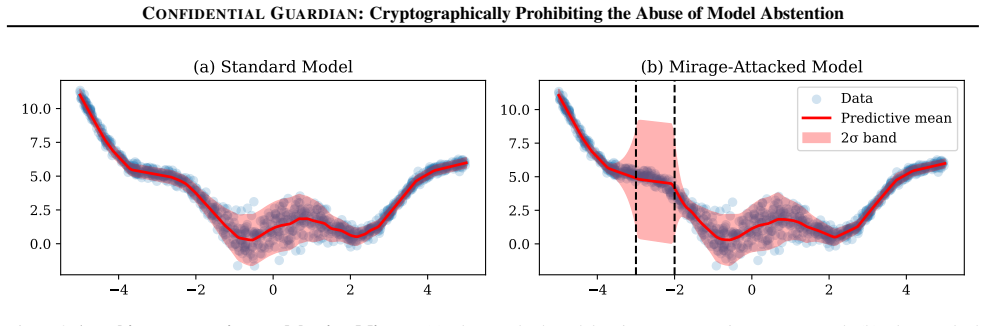
The load-bearing object is the zero-knowledge proof of well-calibratedness: a protocol in which the provider commits to the model weights, the auditor supplies a reference dataset, and both parties jointly evaluate the expected calibration error (ECE) inside a cryptographic proof, revealing only a binary pass/fail outcome. The proof first runs a zero-knowledge proof of correct inference for every reference point, so the confidence scores used in the audit are guaranteed to come from forward passes of the committed model; it then uses zero-knowledge arrays to bin points by confidence and to aggregate counts, confidence, and accuracy per bin; finally it proves that every bin satisfies |acc - conf| <= alpha times count for the public threshold alpha. On the attack side, the counterpart machinery is Mirage's KL-divergence loss toward the target distribution t_epsilon, which equals epsilon + (1 - epsilon)/C for the true label and (1 - epsilon)/C for every other label, making the model underconfident in the chosen region while preserving the argmax.
What would settle it
Train a model, run Mirage on a demographic region, then audit it with a reference dataset that contains no points from that region: if the zero-knowledge audit returns 'well-calibrated' while the deployed model abstains on that group at a markedly higher rate than on others, then the paper's claim that miscalibration reliably reveals artificial uncertainty is refuted.
Extended reading notes
Core claim
The central claim is that artificially induced uncertainty is both easy to create and detectable in a confidentiality-preserving way, and that these two facts together close the loophole. On the attack side, the paper proves a constructive lemma: for any feed-forward network and any axis-aligned region, one can augment the network with analytically designed neurons so that logits inside the region are shifted by an arbitrary non-negative constant while all other outputs are unchanged, which lowers confidence without changing labels. Mirage instantiates this in trainable form by adding a KL-divergence term that pulls the output distribution toward a target that is almost uniform but slightly biased toward the true label. On the defense side, the paper's claim is that a zero-knowledge proof of well-calibratedness, where the committed model is run on the auditor's reference dataset and bin-wise expected calibration error is computed inside the proof, certifies that confidence scores genuinely come from the deployed model and that no calibration deviation beyond a public threshold alpha exists. The experiments show Mirage keeping accuracy essentially flat while raising ECE, and the proof protocol detecting the deviation at practical cost for small models.
Load-bearing premise
The whole defense rests on the reference dataset actually covering the targeted region and on the model that is audited being the model that is served; if the attacker can pick a region the auditor's data never reaches, or can pass the audit with one model and run another in production, artificial uncertainty goes undetected.
Editorial extensions
If this is right
- A lender, employer, or insurer can deny service to a chosen demographic by lowering model confidence for that group, and accuracy-based fairness audits will not flag it because predicted labels stay correct.
- An auditor who holds a reference dataset covering the suspected region can verify whether abstentions are justified without ever seeing the model's weights or training data, protecting the provider's intellectual property.
- Audit coverage, not model accuracy, becomes the decisive regulatory resource: the protocol's detection power falls as the reference dataset undersamples the targeted region, so standards for what counts as an adequate reference set are required.
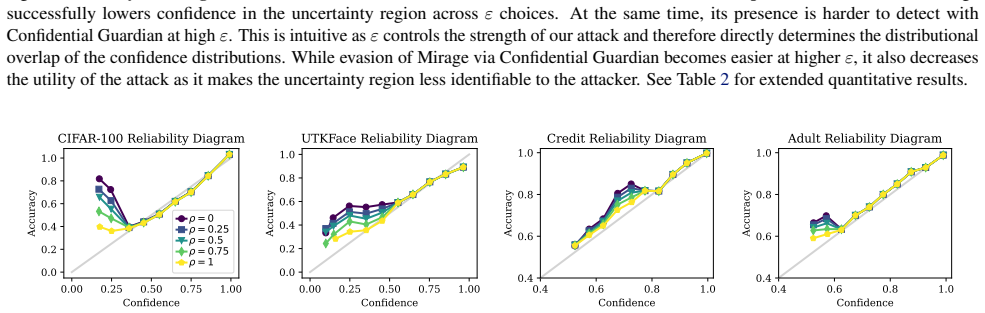
- The attack and defense share a single dial: lower epsilon gives the attacker stronger confidence suppression but a larger calibration gap, so the same metric that empowers Mirage also exposes it.
- The audit is practical for small and tabular models but currently too expensive for large vision models, so deployment of the defense in high-stakes settings depends on faster zero-knowledge inference.
Reading between the lines
- A natural extension the paper leaves implicit is to make the proof output the location of the worst calibration bin, not just a pass/fail bit, so auditors can direct follow-up data collection toward the affected input region.
- The confidentiality guarantee is only as strong as the link between the audited model and the served model; nothing in the protocol stops a provider from proving calibration on one checkpoint and routing production traffic through another, so binding deployment to the committed model is a second, unstated requirement.
- The same calibration-in-a-proof machinery could catch opposite manipulations, such as backdoors that raise confidence on trigger inputs, because any systematic distortion of confidence leaves a footprint in the reliability diagram.
- Because the proof only checks an aggregate threshold, an attacker who spreads suppressed confidence thinly across many bins might hide under alpha; testing whether Mirage can be adapted to stay within every bin's budget would sharpen the threat model.
Editorial analysis
A structured set of objections, weighed in public.
Referee Report
Summary. The paper identifies a new threat in which a dishonest model provider deliberately suppresses a model's confidence scores on a chosen input region, thereby covertly triggering abstention for targeted individuals while keeping overall accuracy intact. It introduces Mirage, a fine-tuning objective that combines cross-entropy outside the target region with a KL-divergence regularizer inside it, and reports experiments on Gaussian, CIFAR-100, UTKFace, Adult, and Credit showing that accuracy is preserved while calibration error increases. As a defense, the paper proposes Confidential Guardian, a zero-knowledge proof protocol that computes bin-wise expected calibration error (ECE) on a reference dataset so that an auditor can verify that a committed model is calibrated within a public threshold, without revealing model parameters. The paper also proves a constructive theoretical result (Lemma 4.1) showing that feed-forward networks can be augmented to add arbitrary logit shifts in a selected bounded region, and it reports ZKP runtime and communication benchmarks for the audited models.
Significance. If the central claims hold, this is a valuable contribution: Mirage is a simple and apparently effective demonstration that abstention mechanisms can be abused by the model owner, a threat model that is under-studied relative to external poisoning adversaries. Confidential Guardian is a sensible use of zero-knowledge proofs of inference, and the paper is commendable for inheriting security from published UC-secure building blocks, for making the code available, and for being explicit about several limitations. The empirical attack results in Table 1 and Figures 3--5 are convincing as evidence that targeted confidence suppression is feasible without accuracy loss. However, the paper's headline claim that the framework 'prohibits' abuse and that reported confidence scores 'genuinely originate from the deployed model' is not supported by the protocol as written, and the detection evaluation does not provide the operating characteristics needed to substantiate the claim that Confidential Guardian reliably detects Mirage.
major comments (3)
- [§5.2, Algorithm 1; Abstract] The paper claims that Confidential Guardian ensures reported confidence scores 'genuinely originate from the deployed model,' but the protocol only audits the model that the prover commits to. Algorithm 1 begins with the prover committing to a model M and then proves calibration of that committed model over Dref; soundness of the ZKP does not bind M to the model answering production queries. Since the threat model is a dishonest institution that controls the service, a provider can pass the audit with a clean, well-calibrated committed model and then serve a Mirage-trained model (or any other discriminatory abstention rule) in production. Section 6 never tests this mismatch: the model audited is the same model attacked. This is a load-bearing gap: either the protocol must be extended with a mechanism that binds deployed inference to the committed parameters (e.g., per-query ZKPs over the same commitment, trusted-execution attestation, or signed transcripts), or the paper must substantially weaken its claim from 'prohibiting abuse' to 'auditing an arbitrary committed model.'
- [§6, Table 1; Figure 7] The evaluation of Confidential Guardian as a detector is incomplete. Table 1 reports ECE and calibration error in the targeted bin, but the paper never specifies the threshold α used, nor reports detection rates, false-positive rates, ROC/AUC, or any other operating-characteristic metric. Figure 7 is described as showing that reference coverage affects 'detection performance,' but the figure only shows reliability diagrams and no quantitative detection result. Without a concrete decision rule and its sensitivity/specificity trade-off, the claim that Confidential Guardian 'effectively prevents' and 'reliably detects' Mirage is not substantiated. The authors should fix a threshold (or a family of thresholds), report detection and false-positive rates on the same reference distribution used by the audit, and quantify detection performance under the coverage degradation simulated in Appendix D.2.
- [§5.1; Limitations] The paper explicitly acknowledges in Section 5.1 and in the Limitations that miscalibration can arise from non-adversarial sources and that the method cannot attribute detected calibration failures to Mirage. This is appropriate caveating, but it conflicts with the strong language used in the abstract, the title, and Section 7, where the framework is said to 'prevent' confidence manipulation and to 'ensure' that abstentions are based on genuine uncertainty. The conclusion should be restated to match the acknowledged scope: Confidential Guardian detects a class of calibration anomalies under specified coverage and calibration assumptions; it does not by itself establish that abstention is legitimate or that manipulation has been prohibited.
minor comments (5)
- [Table 1] The ZKP runtime for CIFAR-100 is reported as '<333' without units; this is presumably seconds, but the entry should state the unit explicitly and, ideally, the exact measured value or a confidence interval.
- [§5.2, Algorithm 1] The notation is confusing: Equation (6) uses M to index bins, while Algorithm 1 and the surrounding text use M to denote the model; the paper should use distinct symbols for the number of bins and the model.
- [§6, bullets] The bullet 'Efficiency of Confidential Guardian in proving the ZK EEC constraint' appears to contain a typo: 'EEC' should be 'ECE.'
- [§4.1, Lemma 4.1] Lemma 4.1 states that logits can be shifted by an arbitrary non-negative constant vector c in the selected region; the proof is constructive, but the relationship between this general logit shift and the specific confidence-reduction behavior needed for Mirage could be clarified, since adding an identical constant to all logits leaves softmax probabilities unchanged and class-dependent shifts may alter accuracy.
- [Limitations] The Limitations paragraph correctly identifies reference-set coverage as a necessary condition for detection; it would be helpful to state explicitly that the ZKP guarantees nothing about regions not covered by Dref, since Algorithm 1 only computes statistics over the provided reference points.
Circularity Check
No significant circularity: the attack construction, calibration signal, and ZKP soundness are each self-contained or inherited from independent published protocols.
full rationale
The paper's derivation chain does not reduce to its own inputs. Lemma 4.1 (Appendix B) is a constructive existence proof that augments a network with region-selection widgets to add an arbitrary non-negative logit offset; the conclusion is obtained by explicit construction, not by assuming the result. The Mirage attack is defined by a KL regularizer pulling confidence toward a biased-uniform target (Eqs. 3-5), and the detector computes ECE (Eq. 6), so the fact that Mirage raises ECE is a direct consequence of the definitions; this is a designed signal, not a hidden fitted parameter or a renamed target quantity. The claimed cryptographic guarantee is inherited from independently published ZKP building blocks (Weng et al. 2021a; Franzese et al. 2021; Weng et al. 2021b; Sun et al. 2024); although some co-authors overlap, those protocols have their own proofs and are not verified only by this paper's argument. The paper explicitly acknowledges the conditions on which the guarantee depends: Algorithm 1 requires an auditor-provided reference dataset (Section 5.2), and the Limitations state that the reference dataset must cover the uncertainty region, that the model is assumed pre-calibrated, and that miscalibration cannot be uniquely attributed to Mirage. These are honest boundary conditions rather than circular assumptions. The separate concern that nothing binds the production service to the audited committed model is a soundness/completeness gap in the threat model, not a circular derivation; no equation in the paper is equivalent to its own input.
Assumptions & free parameters
free parameters (3)
- epsilon (Mirage target bias) =
0.10 to 0.20 per dataset (Table 1)
- alpha (audit threshold) =
not specified in experiments
- number of bins B =
not specified
assumptions (5)
- domain assumption Auditor possesses a reference dataset Dref with coverage of the target uncertainty region Xunc
- domain assumption The committed and audited model is the same model serving production decisions
- domain assumption The model is already well-calibrated before the audit, so miscalibration can be attributed to tampering
- standard math Underlying ZKP building blocks (Wolverine, RAM ZK, Mystique, zkLLM) are secure
- domain assumption The neural network has enough hidden layers and width for the constructive proof of Lemma 4.1
Cite this review
Pith. "Pith review of Confidential Guardian: Cryptographically Prohibiting the Abuse of Model Abstention." pith.science (2026). https://pith.science/paper/UE54ND7B
@misc{pith2026250523968,
  author       = {Pith},
  title        = {Pith review of: Confidential Guardian: Cryptographically Prohibiting the Abuse of Model Abstention},
  year         = {2026},
  howpublished = {\url{https://pith.science/paper/UE54ND7B}},
  note         = {Machine review of arXiv:2505.23968}
}
read the original abstract
Cautious predictions -- where a machine learning model abstains when uncertain -- are crucial for limiting harmful errors in safety-critical applications. In this work, we identify a novel threat: a dishonest institution can exploit these mechanisms to discriminate or unjustly deny services under the guise of uncertainty. We demonstrate the practicality of this threat by introducing an uncertainty-inducing attack called Mirage, which deliberately reduces confidence in targeted input regions, thereby covertly disadvantaging specific individuals. At the same time, Mirage maintains high predictive performance across all data points. To counter this threat, we propose Confidential Guardian, a framework that analyzes calibration metrics on a reference dataset to detect artificially suppressed confidence. Additionally, it employs zero-knowledge proofs of verified inference to ensure that reported confidence scores genuinely originate from the deployed model. This prevents the provider from fabricating arbitrary model confidence values while protecting the model's proprietary details. Our results confirm that Confidential Guardian effectively prevents the misuse of cautious predictions, providing verifiable assurances that abstention reflects genuine model uncertainty rather than malicious intent.
Figures


Figures from the paper (9 more)




Reference graph
Works this paper leans on
-
[1]
Outside the uncertainty region Xunc, i.e., on X c unc, pρ matches p exactly
-
[2]
Hence, we remove a fraction ρ of the mass in Xunc
Inside Xunc, pρ has its probability mass reduced by a factor 1 − ρ. Hence, we remove a fraction ρ of the mass in Xunc
-
[3]
URL https://openreview.net/forum? id=Hkg4TI9xl. Hendrycks, D., Basart, S., Mazeika, M., Zou, A., Kwon, J., Mostajabi, M., Steinhardt, J., and Song, D. Scaling out-of-distribution detection for real-world settings. In Chaudhuri, K., Jegelka, S., Song, L., Szepesv´ari, C., Niu, G., and Sabato, S. (eds.), International Conference on Machine Learning, ICML 20...
work page 2022
-
[4]
Examine distribution shifts by testing on multiple datasets and setting α to ensure consistency across these scenarios
-
[5]
Szegedy, C., Vanhoucke, V ., Ioffe, S., Shlens, J., and Wo- jna, Z
URL https://proceedings.mlr.press/ v162/sun22d.html. Szegedy, C., Vanhoucke, V ., Ioffe, S., Shlens, J., and Wo- jna, Z. Rethinking the inception architecture for com- puter vision. In 2016 IEEE Conference on Computer Vision and Pattern Recognition, CVPR 2016, Las Vegas, NV , USA, June 27-30, 2016, pp. 2818–2826. IEEE Com- puter Society, 2016. doi: 10.110...
-
[9]
Finally, we renormalize so that pρ is a proper probability distribution (the denominator ensures total mass is 1). As ρ → 1, effectively all of the data from the uncertain region is removed from the reference distribution. This captures the idea that the reference dataset lacks coverage in that part of input space that matters most for detection via Confi...
work page 2017
-
[10]
Conduct a baseline study of calibration error on representative datasets after temperature scaling to quantify typical miscalibration
-
[11]
Adjust for domain complexity and label imbalance, possibly raising α if the data or the domain are known to be inherently more difficult to calibrate
Show all 14 references
-
[12]
Incorporate regulatory or industry guidelines, if they exist, to establish an upper bound on allowable miscalibration
-
[14]
acceptable
Use statistical considerations (e.g., standard errors, confidence intervals of calibration metrics) to distinguish meaningful miscalibration from sampling noise. In summary, choosing α is a balance between practical constraints, domain-specific considerations, and regulatory m...
-
[723]
uncertainty mass
IEEE, 2019. Wang, C., Han, B., Patel, B., and Rudin, C. In pursuit of interpretable, fair and accurate machine learning for criminal recidivism prediction. Journal of Quantitative Criminology, 39(2):519–581, 2023. Wang, X., Malozemoff, A. J., and Katz, J. EMP-toolkit: Efficien...
2019
-
[2017]
Hao, M., Chen, H., Li, H., Weng, C., Zhang, Y ., Yang, H., and Zhang, T
URL http://proceedings.mlr.press/ v70/guo17a.html. Hao, M., Chen, H., Li, H., Weng, C., Zhang, Y ., Yang, H., and Zhang, T. Scalable zero-knowledge proofs for non- linear functions in machine learning. In 33rd USENIX Se- curity Symposium (USENIX Security 24), pp. 3819–3836, Ph...
2024
-
[2021]
Garg, S., Goel, A., Jha, S., Mahloujifar, S., Mahmoody, M., Policharla, G.-V ., and Wang, M
URL https://eprint.iacr.org/2021/ 979. Garg, S., Goel, A., Jha, S., Mahloujifar, S., Mahmoody, M., Policharla, G.-V ., and Wang, M. Experimenting with zero-knowledge proofs of training. Cryptology ePrint Archive, Paper 2023/1345, 2023. URL https: //eprint.iacr.org/2023/1345. G...
2021 arXiv
-
[2022]
Hofmann, H
URL https://proceedings.mlr.press/ v162/hendrycks22a.html. Hofmann, H. Statlog (German Credit Data). UCI Machine Learning Repository, 1994. DOI: https://doi.org/10.24432/C5NC77. Jones, E., Sagawa, S., Koh, P. W., Kumar, A., and Liang, P. Selective classification can magnify di...
1994
Reviewed August 7, 2026 · model on record in the stance chip above.
Discussion (0). Sign in to comment.