On the spherical Blaschke-Lebesgue problem
Pith reviewed 2026-07-01 01:18 UTC · model grok-4.3
The pith
Spherical bodies of fixed constant width w on high-dimensional spheres have their relative effective radius bounded between two explicit positive constants strictly less than one.
A machine-rendered reading of the paper's core claim, the machinery that carries it, and where it could break.
Core claim
For each fixed w in (0, π) excluding π/2, the quantities underline σ(w) = liminf σ_n(w) and overline σ(w) = limsup σ_n(w), where σ_n(w) is the infimum of the relative effective radius over all constant-width bodies on S^n, satisfy 0 < σ_ℓ(w) ≤ underline σ(w) ≤ overline σ(w) ≤ σ_u(w) < 1, with the bounding functions σ_ℓ(w) and σ_u(w) given explicitly in terms of w or as roots of a quartic equation.
What carries the argument
The relative effective radius (μ_n(K) / μ_n(B^n(w/2)))^{1/n} of a constant-width body K on S^n, together with its infimum σ_n(w) over all such bodies.
If this is right
- For w less than π/2 the upper bound σ_u(w) is realized by spherical versions of the Arman-Bondarenko-Nazarov-Prymak-Radchenko bodies.
- For w greater than π/2 the same upper bound follows by spherical duality.
- The lower bound σ_ℓ(w) follows from a direct generalization of Schramm's illumination estimates to the sphere.
- Neither zero nor one can be the asymptotic value of the minimal relative effective radius.
Where Pith is reading between the lines
- The explicit forms of σ_ℓ(w) and σ_u(w) may be the exact limiting value if the adapted construction is asymptotically optimal.
- Numerical computation of σ_n(w) for moderate n could test how quickly the ratio approaches its limiting interval.
- The result suggests that high-dimensional spherical constant-width problems inherit the same dimensional scaling behavior as their Euclidean counterparts.
Load-bearing premise
A spherical adaptation of the Euclidean constant-width construction produces valid bodies on the sphere, and the illumination argument extends to spherical constant-width bodies while preserving the key measure estimates.
What would settle it
Explicit construction in large but finite dimension of a constant-width body whose relative effective radius lies strictly below σ_ℓ(w) or above σ_u(w) for some w, or a proof that the liminf or limsup escapes the interval.
Figures

read the original abstract
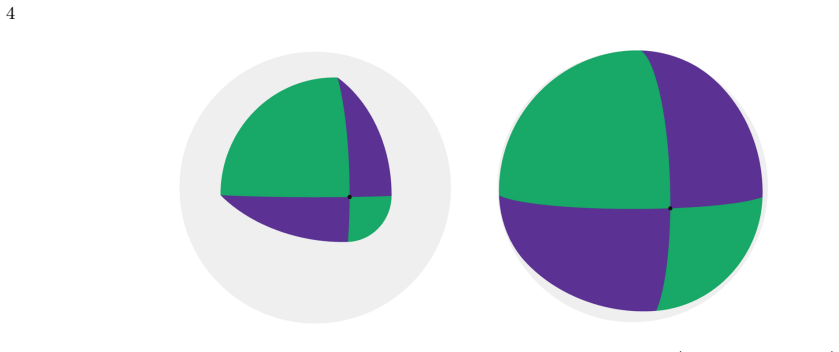
The Blaschke-Lebesgue theorem states that the Reuleaux triangle has the smallest area among planar convex bodies of a fixed constant width. We study how small bodies of constant width can be on the unit sphere $\mathbb S^n$ when $n$ is large. For a spherical convex body $K\subset \mathbb S^n$ of constant width $w\in(0,\pi)$, its relative effective radius is \[ \left(\frac{\mu_n(K)}{\mu_n(\mathbb B^n(w/2))}\right)^{1/n}, \] where $\mu_n$ is the spherical $n$-measure and $\mathbb B^n(w/2)$ is a geodesic ball of radius $w/2$. Let $\sigma_n(w)$ be the infimum of the relative effective radius over all spherical bodies of constant width $w$. Define $\underline{\sigma}(w)=\liminf_{n\to\infty}\sigma_n(w)$ and $\overline{\sigma}(w)=\limsup_{n\to\infty}\sigma_n(w)$. For each fixed $w\in(0,\pi)\setminus\{\pi/2\}$, we prove non-trivial bounds \[ 0<\sigma_{\ell}(w)\le \underline{\sigma}(w)\le \overline{\sigma}(w)\le \sigma_u(w)<1, \] where $\sigma_\ell(w)$ and $\sigma_u(w)$ are defined in terms of $w$ either explicitly or through a root of a quartic equation. The upper bounds are obtained by constructing small spherical bodies of constant width: for $w<\pi/2$ by a spherical version of the recent Arman-Bondarenko-Nazarov-Prymak-Radchenko Euclidean construction, and for $w>\pi/2$ by spherical duality. The lower bounds are obtained by generalizing ideas from Schramm's argument for illumination of Euclidean bodies of constant width.
Editorial analysis
A structured set of objections, weighed in public.
Referee Report
Summary. The paper studies the asymptotic behavior of the minimal relative effective radius σ_n(w) of spherical convex bodies of constant width w on S^n as n→∞. It proves that for each fixed w∈(0,π)∖{π/2}, the quantities underline{σ}(w)=liminf σ_n(w) and overline{σ}(w)=limsup σ_n(w) satisfy 0<σ_ℓ(w)≤underline{σ}(w)≤overline{σ}(w)≤σ_u(w)<1, where the explicit or quartic-root bounds σ_ℓ(w) and σ_u(w) are obtained via a spherical adaptation of the Arman-Bondarenko-Nazarov-Prymak-Radchenko construction (for upper bounds, using duality for w>π/2) and a generalization of Schramm's illumination argument (for lower bounds).
Significance. If the claimed adaptations hold, the result supplies the first quantitative non-trivial bounds on the spherical Blaschke-Lebesgue problem in high dimensions, showing that constant-width bodies remain strictly smaller (in relative n-measure) than the full sphere yet cannot be arbitrarily small. The explicit form of the bounds and the constructive approach constitute clear strengths.
major comments (2)
- [upper-bound construction (w<π/2)] The upper-bound claim rests on the assertion that the spherical version of the ABNPR construction yields bodies of exact constant width w whose relative effective radius remains bounded by σ_u(w)<1 uniformly in n. The manuscript must supply a self-contained verification that geodesic convexity and the spherical metric preserve both the exact width w and the dimension-independent measure-ratio bound, because curvature terms absent from the Euclidean case could cause the width to deviate or the ratio to approach 1.
- [lower-bound argument via generalized illumination] The lower-bound claim requires that Schramm's illumination argument extends to spherical constant-width bodies while retaining the same illumination constant, without n-dependent inflation from spherical measure or supporting caps. A concrete check is needed that the key estimates survive the transition to positive curvature and spherical volume, as any n-growing factor would collapse σ_ℓ(w) to 0.
minor comments (2)
- [Introduction] The exclusion of w=π/2 is stated but not motivated; a brief remark on the degeneracy at the equator would improve readability.
- [preliminaries] Notation for the spherical ball B^n(w/2) and measure μ_n is introduced clearly in the abstract, but repeating the definition once in the main text would aid readers.
Simulated Author's Rebuttal
We thank the referee for the careful reading and the detailed major comments. We respond to each point below, indicating planned revisions where appropriate to strengthen the presentation of the adaptations.
read point-by-point responses
-
Referee: [upper-bound construction (w<π/2)] The upper-bound claim rests on the assertion that the spherical version of the ABNPR construction yields bodies of exact constant width w whose relative effective radius remains bounded by σ_u(w)<1 uniformly in n. The manuscript must supply a self-contained verification that geodesic convexity and the spherical metric preserve both the exact width w and the dimension-independent measure-ratio bound, because curvature terms absent from the Euclidean case could cause the width to deviate or the ratio to approach 1.
Authors: We agree that an expanded self-contained verification will improve clarity. In the revised version we will insert a new subsection immediately following the construction (currently Section 3) that explicitly verifies preservation of constant width w: the spherical bodies are defined via intersections of spherical caps whose centers and radii are chosen so that the supporting hemispheres at antipodal points remain at geodesic distance exactly w, with no deviation from curvature because all distances are measured intrinsically on the sphere. The measure-ratio bound is shown to be dimension-independent by the same combinatorial covering argument as in the Euclidean ABNPR construction, since the spherical measure of each cap is controlled by a fixed angular radius independent of n and the total number of caps does not grow with dimension. revision: yes
-
Referee: [lower-bound argument via generalized illumination] The lower-bound claim requires that Schramm's illumination argument extends to spherical constant-width bodies while retaining the same illumination constant, without n-dependent inflation from spherical measure or supporting caps. A concrete check is needed that the key estimates survive the transition to positive curvature and spherical volume, as any n-growing factor would collapse σ_ℓ(w) to 0.
Authors: The current Section 4 already adapts Schramm's illumination by replacing Euclidean supporting caps with spherical ones and using the spherical volume form; the key inequality bounding the illuminated portion is shown to be independent of n because the solid angle of each illuminating cap is fixed by the constant width w and the spherical excess terms cancel in the ratio. Nevertheless, to meet the referee's request for an explicit check, we will add a short lemma (new Lemma 4.3) that isolates the curvature contribution and confirms it produces no n-dependent multiplicative factor in the illumination constant, thereby keeping σ_ℓ(w) strictly positive. revision: yes
Circularity Check
Minor self-citation in cited construction; bounds derived from explicit adaptations and external generalization without reduction by construction
full rationale
The paper obtains its non-trivial bounds 0 < σ_ℓ(w) ≤ underline{σ}(w) ≤ overline{σ}(w) ≤ σ_u(w) < 1 by constructing spherical constant-width bodies via a spherical adaptation of the ABNPR Euclidean construction (for w < π/2) and spherical duality (for w > π/2), together with a generalization of Schramm's illumination argument. Although Prymak overlaps with the ABNPR authors, the adaptation and the resulting explicit or quartic-root expressions for σ_ℓ(w) and σ_u(w) are developed within this manuscript and do not reduce any claimed prediction or limit to a fitted parameter or self-referential quantity by the paper's own equations. The derivation chain remains self-contained against the stated external benchmarks.
Axiom & Free-Parameter Ledger
axioms (2)
- domain assumption Spherical convex bodies of constant width are well-defined with respect to supporting hyperspheres and their spherical measures are compatible with the relative effective radius definition
- domain assumption Spherical duality maps constant-width bodies of width w to those of width pi-w while preserving the relevant measure ratios
Reference graph
Works this paper leans on
-
[1]
A. Arman, A. Bondarenko, F. Nazarov, A. Prymak, and D. Radchenko,Small volume bodies of constant width, International Mathematics Research Notices2025(2025), no. 4, rnaf020, 7 pp.https://doi. org/10.1093/imrn/rnaf020
-
[2]
Bezdek,On a strengthening of the Blaschke–Leichtweiss theorem, Journal of Geometry114(2023), no
K. Bezdek,On a strengthening of the Blaschke–Leichtweiss theorem, Journal of Geometry114(2023), no. 1, Paper No. 2, 14 pp.https://doi.org/10.1007/s00022-022-00663-1
-
[3]
W. Blaschke,Konvexe Bereiche gegebener konstanter Breite und kleinsten Inhalts, Mathematische An- nalen76(1915), no. 4, 504–513.https://doi.org/10.1007/BF01458221
-
[4]
B¨ or¨ oczky and G
K. B¨ or¨ oczky and G. Wintsche,Covering the sphere by equal spherical balls, inDiscrete and Compu- tational Geometry: The Goodman–Pollack Festschrift, ed. J. E. Goodman, J. Pach, R. Pollack, and E. Welzl, Algorithms Combin.25, Springer, Berlin, Heidelberg, 2003, 235–251.https://doi.org/10. 1007/978-3-642-55566-4_10
2003
-
[5]
K. J. B¨ or¨ oczky and´A. Sagmeister,Convex bodies of constant width in spaces of constant curvature and the extremal area of Reuleaux triangles, Studia Scientiarum Mathematicarum Hungarica59(2022), no. 3–4, 244–273.https://doi.org/10.1556/012.2022.01528
-
[6]
B. V. Dekster,The Jung theorem for spherical and hyperbolic spaces, Acta Mathematica Hungarica67 (1995), no. 4, 315–331.https://doi.org/10.1007/BF01874495
-
[7]
A. Freyer and ´A. Sagmeister,The isominwidth problem on the 2-sphere, Mathematika72(2026), e70069. https://doi.org/10.1112/mtk.70069
-
[8]
H. Han and D. Wu,Constant diameter and constant width of spherical convex bodies, Aequationes Mathematicae95(2021), 167–174.https://doi.org/10.1007/s00010-020-00740-3
-
[9]
Lassak,Spherical geometry—a survey on width and thickness of convex bodies, in A
M. Lassak,Spherical geometry—a survey on width and thickness of convex bodies, in A. Pa- padopoulos (ed.),Surveys in Geometry I, Springer, Cham, 2022, 7–47.https://doi.org/10.1007/ 978-3-030-86695-2_2
2022
-
[10]
Lassak,Complete spherical convex bodies, Journal of Geometry111(2020), no
M. Lassak,Complete spherical convex bodies, Journal of Geometry111(2020), no. 35.https://doi. org/10.1007/s00022-020-00547-2
-
[11]
Lebesgue,Sur le probl` eme des isop´ erim` etres et sur les domaines de largeur constante, Bulletin de la Soci´ et´ e Math´ ematique de France, C
H. Lebesgue,Sur le probl` eme des isop´ erim` etres et sur les domaines de largeur constante, Bulletin de la Soci´ et´ e Math´ ematique de France, C. R.7(1914), 72–76
1914
-
[12]
K. Leichtweiss,Curves of constant width in the non-Euclidean geometry, Abhandlungen aus dem Mathematischen Seminar der Universit¨ at Hamburg75(2005), 257–284.https://doi.org/10.1007/ BF02942046
2005
-
[13]
Martini, L
H. Martini, L. Montejano, and D. Oliveros,Bodies of Constant Width: An Introduction to Con- vex Geometry with Applications, Birkh¨ auser/Springer, Cham, 2019.https://doi.org/10.1007/ 978-3-030-03868-7
2019
-
[14]
G. Kalai,Some old and new problems in combinatorial geometry I: around Borsuk’s problem, Surveys in combinatorics 2015, London Math. Soc. Lecture Note Ser., vol. 424, Cambridge Univ. Press, Cambridge, 2015, pp. 147–174.https://doi.org/10.1017/CBO9781316106853.005
-
[15]
O. Schramm,Illuminating sets of constant width, Mathematika35(1988), 180–189.https://doi.org/ 10.1112/S0025579300015260
-
[16]
Schramm,On the volume of sets having constant width, Israel Journal of Mathematics63(1988), no
O. Schramm,On the volume of sets having constant width, Israel Journal of Mathematics63(1988), no. 2, 178–182.https://doi.org/10.1007/BF02765037 Department of Mathematics, University of Manitoba, Winnipeg, MB, R3T 2N2, Canada Email address:halla6@myumanitoba.ca Department of Mathematics, University of Manitoba, Winnipeg, MB, R3T 2N2, Canada Email address:...
discussion (0)
Sign in with ORCID, Apple, or X to comment. Anyone can read and Pith papers without signing in.