Extreme points and faces in the moment problem
Pith reviewed 2026-06-26 13:31 UTC · model grok-4.3
The pith
The infimum of an integral functional over any convex set of probability measures containing the point measures equals the infimum over its extreme points.
A machine-rendered reading of the paper's core claim, the machinery that carries it, and where it could break.
Core claim
The Richter-Tchakaloff theorem allows us to show that the infimum of an integral functional restricts to the extreme points without increasing the infimum, not just for the known case of Radon measures but for any convex set of probability measures that contains the point measures.
What carries the argument
Characterization of extreme points of an affinely constrained convex set by injectivity of the constraint map on the smallest faces containing them, combined with the Richter-Tchakaloff theorem.
If this is right
- The polyconvex envelope equals the value of a linear program on finitely atomic measures.
- Grid-based algorithms for the polyconvex envelope gain a speed-up by restricting to extreme points.
- The polyconvex envelope can be computed by the moment sum-of-squares hierarchy.
- The assumption that the set is a simplex is redundant for the restriction result.
- Extreme points of faces of the probability simplex, including the face of Radon measures, are finitely atomic with the affine independence property.
Where Pith is reading between the lines
- The same restriction technique may apply directly to moment problems with countably many constraints when suitable compactness holds.
- Similar face characterizations could simplify analysis of infinite-dimensional linear programs arising in optimal transport.
- The result suggests testing whether the affine independence property persists under small perturbations of the moment map.
Load-bearing premise
The natural assumptions under which extreme points of the affinely constrained convex set are finitely atomic measures possessing an affine independence property.
What would settle it
A convex set of probability measures containing the point measures together with an integral functional whose infimum over the full set is strictly smaller than its infimum over the extreme points.
Figures

read the original abstract
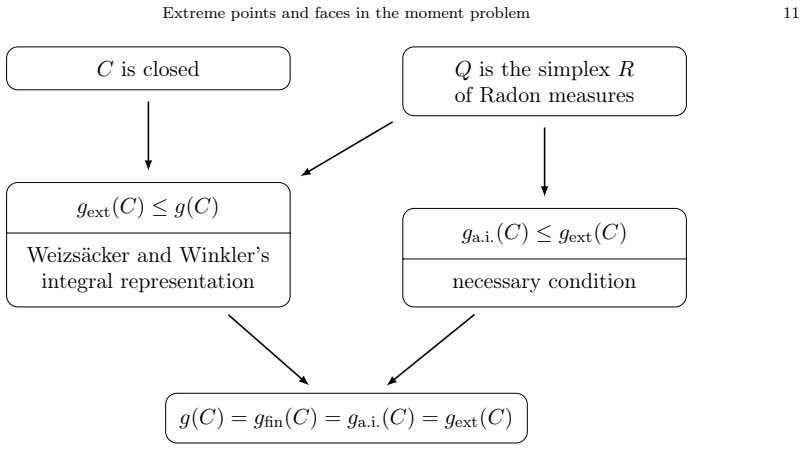
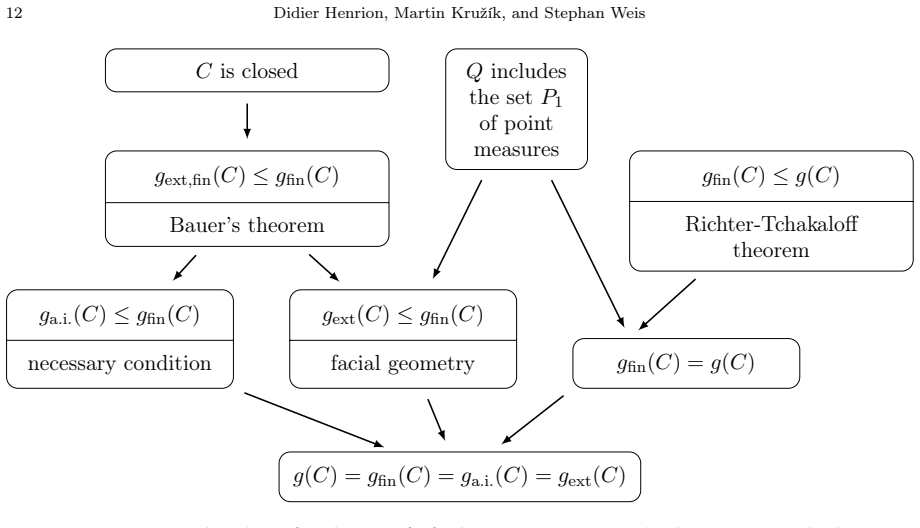
The polyconvex envelope, used in the calculus of variations and elasticity theory, was expressed by Dacorogna pointwise as a linear program on finitely atomic measures on the space of $m\times n$ matrices. Weizs\"acker and Winkler proved that the corresponding linear program on Borel measures restricts to the extreme points without increasing the infimum. Combining the two, one obtains a speed-up of grid-based algorithms and a new proof that the polyconvex envelope can be computed by the moment sum-of-squares hierarchy. Motivated by these applications, we seize the essence of extreme points in moment problems. First, we characterize extreme points of an affinely constrained convex set by the injectivity of the constraint map on the smallest faces containing them. We then study finitely many moment constraints. The extreme points are finitely atomic measures that have an affine independence property, under natural assumptions. We retrieve this known result with a simplified proof and apply it to faces of the probability simplex, among them the face of Radon measures. In the converse, we find that the assumption of a simplex is redundant. The Richter-Tchakaloff theorem allows us to show that the infimum of an integral functional restricts to the extreme points without increasing the infimum, not just for the known case of Radon measures but for any convex set of probability measures that contains the point measures.
Editorial analysis
A structured set of objections, weighed in public.
Referee Report
Summary. The paper characterizes extreme points of affinely constrained convex sets of measures via injectivity of the constraint map on smallest faces. For finitely many moment constraints, it shows (under natural assumptions) that extreme points are finitely atomic measures with an affine independence property, retrieves this known result via a simplified proof, applies it to faces of the probability simplex (including Radon measures), and uses the Richter-Tchakaloff theorem to extend the restriction of infima of integral functionals to extreme points from Radon measures to arbitrary convex sets of probability measures containing point measures. Applications to polyconvex envelopes and moment-SOS hierarchies are discussed.
Significance. If the extension holds under the stated conditions, the work supplies a general convex-analytic framework for moment problems that unifies prior results on Radon measures and enables algorithmic speed-ups in variational problems. The simplified proof of the known finite-atomicity result and the observation that the simplex assumption is redundant are concrete strengths.
major comments (2)
- [Abstract and section on finitely many moment constraints] Abstract and the paragraph on finitely many moment constraints: the claim that extreme points are finitely atomic with an affine independence property is qualified by 'under natural assumptions,' but these assumptions (e.g., conditions ensuring injectivity of the constraint map on the relevant face or the precise form of affine independence) are not listed explicitly. Because this characterization is load-bearing for invoking Richter-Tchakaloff in the subsequent extension to general convex sets of probability measures, the assumptions must be stated in full.
- [Application of Richter-Tchakaloff theorem] The extension of Richter-Tchakaloff (final paragraph of abstract): the argument that the infimum restricts to extreme points for any convex set of probability measures containing the point measures relies on the preceding extreme-point characterization. If the natural assumptions fail for a given affine constraint map, the restriction step does not apply; a concrete counter-example or explicit hypothesis under which the extension holds should be supplied.
minor comments (2)
- Notation for the constraint map and the smallest face containing a point should be introduced once and used consistently throughout.
- The statement that the simplex assumption is redundant would benefit from a short self-contained remark clarifying which prior proofs used it and where it is dropped.
Simulated Author's Rebuttal
We thank the referee for the detailed and constructive report. We address each major comment below and will make the necessary revisions to clarify the assumptions in our characterizations.
read point-by-point responses
-
Referee: [Abstract and section on finitely many moment constraints] Abstract and the paragraph on finitely many moment constraints: the claim that extreme points are finitely atomic with an affine independence property is qualified by 'under natural assumptions,' but these assumptions (e.g., conditions ensuring injectivity of the constraint map on the relevant face or the precise form of affine independence) are not listed explicitly. Because this characterization is load-bearing for invoking Richter-Tchakaloff in the subsequent extension to general convex sets of probability measures, the assumptions must be stated in full.
Authors: We agree with the referee that the assumptions need to be stated explicitly. The natural assumptions refer to the injectivity of the affine constraint map on the smallest face containing the measure (from our general characterization of extreme points) and, for the finite moment case, the affine independence of the support points. In the revised manuscript, we will explicitly list these assumptions in the abstract and in the section discussing finitely many moment constraints to ensure clarity and to support the subsequent application of the Richter-Tchakaloff theorem. revision: yes
-
Referee: [Application of Richter-Tchakaloff theorem] The extension of Richter-Tchakaloff (final paragraph of abstract): the argument that the infimum restricts to extreme points for any convex set of probability measures containing the point measures relies on the preceding extreme-point characterization. If the natural assumptions fail for a given affine constraint map, the restriction step does not apply; a concrete counter-example or explicit hypothesis under which the extension holds should be supplied.
Authors: The extension of the Richter-Tchakaloff theorem holds under the explicit hypothesis that the constraint map is injective on the smallest faces of the convex set containing the extreme points, which is precisely the condition from our general characterization. We will add this hypothesis explicitly in the abstract and the relevant discussion. This makes the scope of the extension clear without needing a counterexample, as the paper's framework already delineates when the characterization (and thus the restriction) applies. revision: yes
Circularity Check
No significant circularity; derivation uses classical theorems and a simplified proof of a known result.
full rationale
The paper characterizes extreme points of affinely constrained sets via injectivity of the constraint map on smallest faces, retrieves the known result that extreme points are finitely atomic with affine independence under natural assumptions via a simplified proof, and applies the classical Richter-Tchakaloff theorem to show restriction of infima to extreme points for any convex set of probability measures containing point measures. No steps reduce by definition or self-citation chain to the paper's own inputs; the central claims rest on external convex-analysis facts and the cited theorem rather than fitted parameters or load-bearing self-citations.
Axiom & Free-Parameter Ledger
axioms (2)
- standard math Standard properties of convex sets and affine maps in locally convex topological vector spaces
- standard math Richter-Tchakaloff theorem for Radon measures
Reference graph
Works this paper leans on
-
[1]
Alfsen,Compact Convex Sets and Boundary Integrals, Springer, 1971
E.M. Alfsen,Compact Convex Sets and Boundary Integrals, Springer, 1971
1971
-
[2]
Alfsen and F.W
E.M. Alfsen and F.W. Shultz,State Spaces of Operator Algebras: Basic Theory, Orientations, and C*- Products, Birkhäuser, 2001
2001
-
[3]
Aliprantis and K.C
C.D. Aliprantis and K.C. Border,Infinite Dimensional Analysis, 3rd ed., Springer, 2006
2006
-
[4]
Aubrun and S.J
G. Aubrun and S.J. Szarek,Alice and Bob Meet Banach: The Interface of Asymptotic Geometric Analysis and Quantum Information Theory, Mathematical Surveys and Monographs, vol. 223, AMS, 2017
2017
-
[5]
Ball,Convexity conditions and existence theorems in nonlinear elasticity, Arch
J.M. Ball,Convexity conditions and existence theorems in nonlinear elasticity, Arch. Rational Mech. Anal. 63(4):337–403, 1976
1976
-
[6]
Bartels,Reliable and efficient approximation of polyconvex envelopes, SIAM J
S. Bartels,Reliable and efficient approximation of polyconvex envelopes, SIAM J. Numer. Anal. 43(1):363– 385, 2005
2005
-
[7]
Barvinok,A Course in Convexity, AMS, 2002
A. Barvinok,A Course in Convexity, AMS, 2002
2002
-
[8]
Bauer,Minimalstellen von Funktionen und Extremalpunkte, Arch
H. Bauer,Minimalstellen von Funktionen und Extremalpunkte, Arch. Math 9(4):389–393, 1958
1958
-
[9]
Bauer,Measure and Integration Theory, de Gruyter Studies in Mathematics, vol
H. Bauer,Measure and Integration Theory, de Gruyter Studies in Mathematics, vol. 26, De Gruyter, 2001
2001
-
[10]
Bengtsson and K
I. Bengtsson and K. Życzkowski,Geometry of Quantum States: An Introduction to Quantum Entanglement, 2nd ed., Cambridge University Press, 2017
2017
-
[11]
Bhaskara Rao and B.V
K.P.S. Bhaskara Rao and B.V. Rao,Borel Spaces, Dissertationes Mathematicae, vol. 190, Państwowe Wydawnictwo Naukowe, 1981
1981
-
[12]
Ben-Tal and A
A. Ben-Tal and A. Nemirovski,Lectures on Modern Convex Optimization, SIAM, 2001
2001
-
[13]
Bogachev,Measure Theory, vol
V.I. Bogachev,Measure Theory, vol. 2, Springer, 2007
2007
-
[14]
Bourbaki,Topological Vector Spaces I: Chapters 1–5, Springer, 1987
N. Bourbaki,Topological Vector Spaces I: Chapters 1–5, Springer, 1987
1987
-
[15]
Ciarlet,Mathematical Elasticity, vol
P.G. Ciarlet,Mathematical Elasticity, vol. I: Three-Dimensional Elasticity, Classics in Applied Mathemat- ics, SIAM, 2021
2021
-
[16]
Dacorogna,Direct Methods in the Calculus of Variations, 2nd ed., Springer, 2008
B. Dacorogna,Direct Methods in the Calculus of Variations, 2nd ed., Springer, 2008
2008
-
[17]
Douglas,On extremal measures and subspace density, Michigan Math
R.G. Douglas,On extremal measures and subspace density, Michigan Math. J. 11(3): 243–246, 1964
1964
-
[18]
Dubins,On extreme points of convex sets, J
L.E. Dubins,On extreme points of convex sets, J. Math. Anal. Appl. 5(2):237–244, 1962
1962
-
[19]
F. Dufour and T. Prieto-Rumeau,Absorbing Markov decision processes: geometric properties and sufficiency of finite mixtures of deterministic policies, arXiv:2512.17511 [math.OC]
-
[20]
Dunford and J.T
N. Dunford and J.T. Schwartz,Linear Operators 1: General Theory, Interscience Publishers, 1988
1988
-
[21]
G. Fantuzzi, D. Henrion, M. Kružík, A. Murali, and S. Weis,Polyconvexity with moments and sums of squares, arXiv:2604.11124 [math.OC]
-
[22]
Fremlin and J.D
D.H. Fremlin and J.D. Pryce,Semi-extremal sets and measure representations, Proc. London Math. Soc. s3-29(3):502–520, 1974
1974
-
[23]
García-Pacheco,A solution to the faceless problem, J
F.J. García-Pacheco,A solution to the faceless problem, J. Geom. Anal. 30(4):3859–3871, 2020
2020
-
[24]
Gorokhovik,Internal structure of convex sets and their faces, Proc
V.V. Gorokhovik,Internal structure of convex sets and their faces, Proc. Steklov Inst. Math. 329(S1):S93– S103, 2025
2025
-
[25]
Grünbaum,Convex Polytopes, V
B. Grünbaum,Convex Polytopes, V. Kaibel et al. (eds.), 2nd ed., Graduate Texts in Mathematics, vol. 221, Springer, 2003
2003
-
[26]
Grünbaum and G.C
B. Grünbaum and G.C. Shephard,Ceva, Menelaus, and the area principle, Mathematics Magazine 68(4):254–268, 1995
1995
-
[27]
Henrion, M
D. Henrion, M. Korda, and J.B. Lasserre,The Moment-SOS Hierarchy: Lectures in Probability, Statistics, Computational Geometry, Control and Nonlinear PDEs, Series on Optimization and Its Applications, vol. 4, World Scientific, 2020
2020
-
[28]
Holevo and M.E
A.S. Holevo and M.E. Shirokov,Continuous ensembles and the capacity of infinite-dimensional quantum channels, Theory of Probability & Its Applications 50(1):86–98, 2006
2006
-
[29]
Holmes,Geometric Functional Analysis and its Applications, Graduate Texts in Mathematics, vol
R.B. Holmes,Geometric Functional Analysis and its Applications, Graduate Texts in Mathematics, vol. 24, Springer, 1975
1975
-
[30]
Jahn,Introduction to the Theory of Nonlinear Optimization, Springer, 2007
J. Jahn,Introduction to the Theory of Nonlinear Optimization, Springer, 2007
2007
-
[31]
Jech,Set Theory, The Third Millennium Edition, Springer Monographs in Mathematics, Springer, 2003
T. Jech,Set Theory, The Third Millennium Edition, Springer Monographs in Mathematics, Springer, 2003
2003
-
[32]
Karr,Extreme points of certain sets of probability measures, with applications, Math
A.F. Karr,Extreme points of certain sets of probability measures, with applications, Math. Oper. Res. 8(1):74–85, 1983
1983
-
[33]
Kelley,General Topology, Springer, 1975
J.L. Kelley,General Topology, Springer, 1975
1975
-
[34]
Kendall,Simplexes and vector lattices, J
D.G. Kendall,Simplexes and vector lattices, J. London Math. Soc. s1-37(1):365–371, 1962. Extreme points and faces in the moment problem 17
1962
-
[35]
Khazayel, A
B. Khazayel, A. Farajzadeh, C. Günther, and C. Tammer,On the intrinsic core of convex cones in real linear spaces, SIAM J. Optim. 31(2):1276–1298, 2021
2021
-
[36]
Klee,On a theorem of Dubins, J
V. Klee,On a theorem of Dubins, J. Math. Anal. Appl. 7(3):425–427, 1963
1963
-
[37]
Klee,A linearly compact convex set dense in every vector topology, Arch
V. Klee,A linearly compact convex set dense in every vector topology, Arch. Math. 28(1):80–81, 1977
1977
-
[38]
de Klerk and M
E. de Klerk and M. Laurent,A survey of semidefinite programming approaches to the generalized problem of moments and their error analysis, in C. Araujo et al. (eds.), World Women in Mathematics 2018, Springer, 2019
2018
-
[39]
Kružík and T
M. Kružík and T. Roubíček,Mathematical Methods in Continuum Mechanics of Solids, Interaction of Mechanics and Mathematics, Springer, 2019
2019
-
[40]
Lasserre,Moments, Positive Polynomials and Their Applications, Series on Optimization and Its Applications, vol
J.B. Lasserre,Moments, Positive Polynomials and Their Applications, Series on Optimization and Its Applications, vol. 1, Imperial College Press, 2010
2010
-
[41]
Marczewski and R
E. Marczewski and R. Sikorski,Measures in non-separable metric spaces, Colloq. Math. 1(2):133–139, 1948
1948
-
[42]
Millán and V
R.D. Millán and V. Roshchina,The intrinsic core and minimal faces of convex sets in general vector spaces, Set-Valued Var. Anal. 31(2):14, 2023
2023
-
[43]
Nie,Moment and Polynomial Optimization, SIAM, 2023
J. Nie,Moment and Polynomial Optimization, SIAM, 2023
2023
-
[44]
Phelps,Lectures on Choquet’s Theorem, Lecture Notes in Math., vol
R.R. Phelps,Lectures on Choquet’s Theorem, Lecture Notes in Math., vol. 1757, Springer, 2001
2001
-
[45]
Protasov and M.E
V.Y. Protasov and M.E. Shirokov,Generalized compactness in linear spaces and its applications, Sbornik: Mathematics 200(5):697–722, 2009
2009
-
[46]
Reed and B
M. Reed and B. Simon,Functional Analysis, Rev. and enl. ed., Methods of Modern Mathematical Physics, no. 1, Academic Press, 1980
1980
-
[47]
Rockafellar,Conjugate Duality and Optimization, SIAM, 1974
R.T. Rockafellar,Conjugate Duality and Optimization, SIAM, 1974
1974
-
[48]
Rockafellar,Convex Analysis, Princeton Univ
R.T. Rockafellar,Convex Analysis, Princeton Univ. Press, 1970
1970
-
[49]
Royden and P.M
H.L. Royden and P.M. Fitzpatrick,Real Analysis, 5th ed., Pearson, 2023
2023
-
[50]
Rudin,Functional Analysis, 2nd ed., McGraw-Hill, 1991
W. Rudin,Functional Analysis, 2nd ed., McGraw-Hill, 1991
1991
-
[51]
Schilling and F
R.L. Schilling and F. Kühn,Counterexamples in Measure and Integration, Cambridge Univ. Press, 2021
2021
-
[52]
Schmüdgen,The Moment Problem, Graduate Texts in Mathematics, vol
K. Schmüdgen,The Moment Problem, Graduate Texts in Mathematics, vol. 277, Springer, 2017
2017
-
[53]
Schneider,Convex Bodies: The Brunn-Minkowski Theory, 2nd ed., Cambridge Univ
R. Schneider,Convex Bodies: The Brunn-Minkowski Theory, 2nd ed., Cambridge Univ. Press, 2014
2014
-
[54]
Schwartz,Radon Measures on Arbitrary Topological Spaces and Cylindrical Measures, Tata Inst
L. Schwartz,Radon Measures on Arbitrary Topological Spaces and Cylindrical Measures, Tata Inst. Fund. Res. Stud. Math., vol. 6, Oxford Univ. Press, 1973
1973
-
[55]
Shapiro,On duality theory of conic linear problems, in M.Á
A. Shapiro,On duality theory of conic linear problems, in M.Á. Goberna and M.A. López (eds.), Semi- Infinite Programming, Nonconvex Optimization and Its Applications, vol. 57, Springer, 2001, 135–165
2001
-
[56]
Sturmfels,Neighborly polytopes and oriented matroids, European J
B. Sturmfels,Neighborly polytopes and oriented matroids, European J. Combin. 9(6):537–546, 1988
1988
-
[57]
Šilhavý,A variational approach to nonlinear electro-magneto-elasticity: Convexity conditions and exis- tence theorems, Mathematics and Mechanics of Solids 23(6):907–928, 2018
M. Šilhavý,A variational approach to nonlinear electro-magneto-elasticity: Convexity conditions and exis- tence theorems, Mathematics and Mechanics of Solids 23(6):907–928, 2018
2018
-
[58]
Topsøe,Topology and Measure, Lecture Notes in Mathematics, vol
F. Topsøe,Topology and Measure, Lecture Notes in Mathematics, vol. 133, Springer, 1970
1970
-
[59]
Weis,A note on faces of convex sets, J
S. Weis,A note on faces of convex sets, J. Convex Anal. 32(3):901–919, 2025
2025
-
[60]
Weis and M
S. Weis and M. Shirokov,The face generated by a point, generalized affine constraints, and quantum theory, Journal of Convex Analysis 28(3):847–870, 2021
2021
-
[61]
H. v. Weizsäcker and G. Winkler,Integral representation in the set of solutions of a generalized moment problem, Math. Ann. 246(1):23–32, 1979
1979
-
[62]
H. v. Weizsäcker and G. Winkler,Non-compact extremal integral representations: some probabilistic aspects, in K.-D. Bierstedt and B. Fuchssteiner (eds.), Functional Analysis: Surveys and Recent Results II, North- Holland, 1980, 115–148
1980
-
[63]
Winkler,Choquet Order and Simplices, Lecture Notes in Mathematics, vol
G. Winkler,Choquet Order and Simplices, Lecture Notes in Mathematics, vol. 1145, Springer, 1985
1985
-
[64]
Winkler,Extreme points of moment sets, Math
G. Winkler,Extreme points of moment sets, Math. Oper. Res. 13(4):581–587, 1988
1988
-
[65]
Winkler,Moment sets of bell-shaped distributions: extreme points, extremal decomposition and Chebysheff inequalities, Math
G. Winkler,Moment sets of bell-shaped distributions: extreme points, extremal decomposition and Chebysheff inequalities, Math. Nachr. 215(1):161–184, 2000
2000
-
[66]
Yosida and E
K. Yosida and E. Hewitt,Finitely additive measures, Trans. Amer. Math. Soc. 72(1):46–66, 1952
1952
-
[67]
Zălinescu,A comparison of constraint qualifications in infinite-dimensional convex programming revisited, J
C. Zălinescu,A comparison of constraint qualifications in infinite-dimensional convex programming revisited, J. Aust. Math. Soc. Series B, Appl. Math 40(3):353–378, 1999
1999
-
[68]
Ziegler,Lectures on Polytopes, Graduate Texts in Mathematics, vol
G.M. Ziegler,Lectures on Polytopes, Graduate Texts in Mathematics, vol. 152, Springer, 1995
1995
discussion (0)
Sign in with ORCID, Apple, or X to comment. Anyone can read and Pith papers without signing in.