Nested nodal loops for sums of Laplace eigenfunctions
Pith reviewed 2026-05-20 08:21 UTC · model grok-4.3
The pith
Real-analytic surfaces admit a uniform bound on rooted double nests in nodal sets of sums of Laplace eigenfunctions.
A machine-rendered reading of the paper's core claim, the machinery that carries it, and where it could break.
Core claim
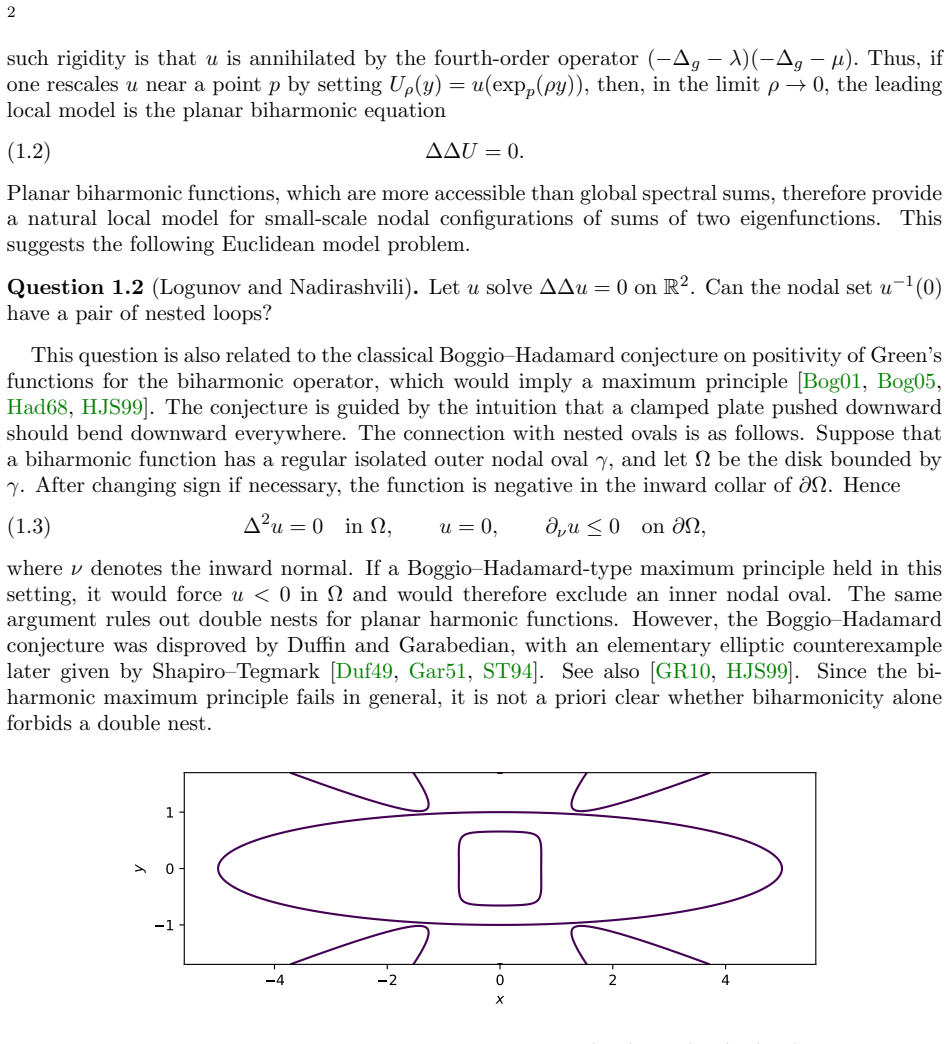
In the real-analytic category there is a uniform bound for the number of rooted double nests in terms of the surface, the root, and the spectral cutoff. This bound is sharp, since a linear combination of eigenfunctions with eigenvalues 0 and 2 on the smooth sphere can have infinitely many rooted double nests, and the same phenomenon appears in a planar biharmonic function whose nodal set contains a double nest.
What carries the argument
Rooted double nests are configurations of nested nodal loops all sharing a common root point in the zero set; analyticity of the surface and functions allows control over their number via local power-series expansions and unique continuation.
If this is right
- The bound holds uniformly for every choice of coefficients in the sum as long as the spectral cutoff is fixed.
- Smoothness alone is insufficient to guarantee any finite bound, as shown by the sphere example with eigenvalues 0 and 2.
- The same nodal-set phenomenon of double nests occurs for biharmonic functions in the plane.
- Entire biharmonic functions of polynomial growth satisfy quantitative upper bounds on the number of double nests in their zero sets.
Where Pith is reading between the lines
- The result indicates that analytic regularity forces nodal sets of solutions to elliptic equations to have limited topological complexity near any point.
- Analogous bounds may exist for sums of eigenfunctions of other elliptic operators on analytic manifolds.
- The biharmonic construction supplies a concrete counterexample that can be used to test numerical methods for detecting nested nodal structures.
- The connection to the Boggio-Hadamard conjecture suggests that nodal-set questions can serve as geometric probes for older potential-theoretic conjectures.
Load-bearing premise
The surface and the eigenfunctions must be real-analytic, without which the uniform bound on the number of rooted double nests can fail.
What would settle it
An explicit real-analytic sum of Laplace eigenfunctions on a real-analytic surface, with fixed spectral cutoff, whose nodal set contains more rooted double nests than any finite number depending only on the surface, root, and cutoff would disprove the claimed bound.
Figures

read the original abstract
We study nested loops in zero sets of sums of Laplace eigenfunctions on closed surfaces. In the real-analytic category, answering a question of Logunov, we prove a uniform bound for the number of rooted double nests in terms of the surface, the root, and the spectral cutoff. We show that this analyticity hypothesis is sharp: on a smooth sphere, a linear combination of eigenfunctions with eigenvalues \(0\) and \(2\) can have infinitely many rooted double nests. We also answer a question of Logunov and Nadirashvili by constructing a planar biharmonic function whose nodal set contains a double nest, and we prove a quantitative bound for entire biharmonic functions of polynomial growth. The biharmonic construction gives a nodal-set manifestation of the failure of the Boggio--Hadamard conjecture from the 1900s.
Editorial analysis
A structured set of objections, weighed in public.
Referee Report
Summary. The paper proves a uniform bound, depending only on the surface, a chosen root, and the spectral cutoff, for the number of rooted double nests in the zero sets of sums of Laplace eigenfunctions on real-analytic closed surfaces. It shows this bound is sharp by exhibiting a linear combination of eigenfunctions for eigenvalues 0 and 2 on the smooth sphere that produces infinitely many such nests. The authors also construct a planar biharmonic function whose nodal set contains a double nest (answering a question of Logunov and Nadirashvili) and establish a quantitative bound on the number of double nests for entire biharmonic functions of polynomial growth, providing a nodal-set illustration of the failure of the Boggio-Hadamard conjecture.
Significance. If the results hold, the work supplies a positive answer to a question of Logunov on nodal nesting for eigenfunction sums in the analytic category, together with an explicit sharpness counterexample that isolates the role of analyticity. The biharmonic construction and growth bound give a concrete nodal manifestation of a classical conjecture from the 1900s. The explicit counterexample on the sphere and the quantitative estimates are particular strengths.
minor comments (3)
- Abstract: the term 'rooted double nests' appears without a brief definition or forward reference to its precise meaning in §2; adding one sentence would improve accessibility for readers outside the immediate subfield.
- §4 (biharmonic construction): the statement of the quantitative bound for entire biharmonic functions of polynomial growth should make the dependence on the growth degree explicit in the theorem (currently described only at high level).
- Introduction, paragraph following the statement of the main theorem: the dependence of the constant on the analyticity radius of the surface and the root point is asserted but not quantified; a short remark on how this radius enters the holomorphic-extension argument would clarify uniformity.
Simulated Author's Rebuttal
We thank the referee for the positive and detailed summary of our manuscript, as well as for the favorable significance assessment and recommendation of minor revision. We are pleased that the work is viewed as providing a positive answer to Logunov's question on nodal nesting in the analytic category, along with the sharpness counterexample and biharmonic construction. No specific major comments or requested changes were enumerated in the report.
Circularity Check
No significant circularity detected
full rationale
The manuscript establishes a uniform bound on the number of rooted double nests for sums of Laplace eigenfunctions on real-analytic closed surfaces by invoking analyticity to obtain control through local holomorphic extensions and standard nodal-set properties of eigenfunctions. The bound is stated to depend only on the fixed surface, chosen root, and spectral cutoff. Sharpness is demonstrated via an explicit counterexample on the smooth sphere using a linear combination of eigenfunctions for eigenvalues 0 and 2, which produces infinitely many nests. The biharmonic constructions and quantitative bounds for entire functions of polynomial growth are likewise presented as direct constructions answering prior questions, without any reduction to fitted parameters, self-definitional loops, or load-bearing self-citations. All steps rest on external analytic techniques and are self-contained against independent benchmarks.
Axiom & Free-Parameter Ledger
Reference graph
Works this paper leans on
-
[1]
B\'erard, Pierre and Helffer, Bernard , TITLE =. Doc. Math. , FJOURNAL =. 2018 , PAGES =
work page 2018
-
[2]
B\'erard, Pierre and Helffer, Bernard , TITLE =. Mosc. Math. J. , FJOURNAL =. 2020 , NUMBER =. doi:10.17323/1609-4514-2020-20-1-1-25 , URL =
-
[3]
B\'erard, Pierre and Helffer, Bernard , TITLE =. Expo. Math. , FJOURNAL =. 2020 , NUMBER =. doi:10.1016/j.exmath.2018.10.002 , URL =
-
[4]
Schr\"odinger operators, spectral analysis and number theory , SERIES =
B\'erard, Pierre and Helffer, Bernard , TITLE =. Schr\"odinger operators, spectral analysis and number theory , SERIES =. [2021] 2021 , ISBN =. doi:10.1007/978-3-030-68490-7\_4 , URL =
-
[5]
B\'erard, Pierre and Charron, Philippe and Helffer, Bernard , TITLE =. J. Anal. Math. , FJOURNAL =. 2022 , NUMBER =. doi:10.1007/s11854-021-0189-9 , URL =
- [6]
- [7]
-
[8]
Buhovsky, Lev and Logunov, Alexander and Sodin, Mikhail , TITLE =. Int. Math. Res. Not. IMRN , FJOURNAL =. 2020 , NUMBER =. doi:10.1093/imrn/rnz181 , URL =
-
[9]
Chanillo, Sagun and Logunov, Alexander and Malinnikova, Eugenia and Mangoubi, Dan , TITLE =. J. Differential Geom. , FJOURNAL =. 2024 , NUMBER =. doi:10.4310/jdg/1707767334 , URL =
-
[10]
Cheng, Shiu Yuen , TITLE =. Comment. Math. Helv. , FJOURNAL =. 1976 , NUMBER =. doi:10.1007/BF02568142 , URL =
- [11]
-
[12]
Donnelly, Harold , TITLE =. Proc. Amer. Math. Soc. , FJOURNAL =. 1994 , NUMBER =. doi:10.2307/2160300 , URL =
-
[13]
Duffin, R. J. , TITLE =. J. Math. Physics , FJOURNAL =. 1949 , PAGES =
work page 1949
-
[14]
Garabedian, P. R. , TITLE =. Pacific J. Math. , FJOURNAL =. 1951 , PAGES =
work page 1951
-
[15]
Javier Gómez-Serrano and Robert Koirala and Alexander Logunov , title =
-
[16]
Grunau, Hans-Christoph and Robert, Fr\'ed\'eric , TITLE =. Arch. Ration. Mech. Anal. , FJOURNAL =. 2010 , NUMBER =. doi:10.1007/s00205-009-0230-0 , URL =
- [17]
-
[18]
Hedenmalm, H. A maximum principle \`a. C. R. Acad. Sci. Paris S\'er. I Math. , FJOURNAL =. 1999 , NUMBER =. doi:10.1016/S0764-4442(99)80308-5 , URL =
-
[19]
arXiv preprint arXiv:2511.11570 , year=
Structure Theory of Parabolic Nodal and Singular Sets , author=. arXiv preprint arXiv:2511.11570 , year=
-
[20]
Hardt, Robert M. , TITLE =. Invent. Math. , FJOURNAL =. 1976/77 , NUMBER =. doi:10.1007/BF01403128 , URL =
-
[21]
Hardt, Robert M. , TITLE =. Amer. J. Math. , FJOURNAL =. 1980 , NUMBER =. doi:10.2307/2374240 , URL =
-
[22]
Lin, Fanghua and Liu, Dan , TITLE =. Discrete Contin. Dyn. Syst. , FJOURNAL =. 2016 , NUMBER =. doi:10.3934/dcds.2016.36.4517 , URL =
-
[23]
Shapiro, Harold S. and Tegmark, Max , TITLE =. SIAM Rev. , FJOURNAL =. 1994 , NUMBER =. doi:10.1137/1036005 , URL =
discussion (0)
Sign in with ORCID, Apple, or X to comment. Anyone can read and Pith papers without signing in.