Interstellar Medium-Driven Orbital Transport -- I. Radial Heating and Migration
Pith reviewed 2026-05-22 09:30 UTC · model grok-4.3
The pith
Interstellar medium structures drive stellar radial heating and migration with time scalings that differ from classic predictions.
A machine-rendered reading of the paper's core claim, the machinery that carries it, and where it could break.
Core claim
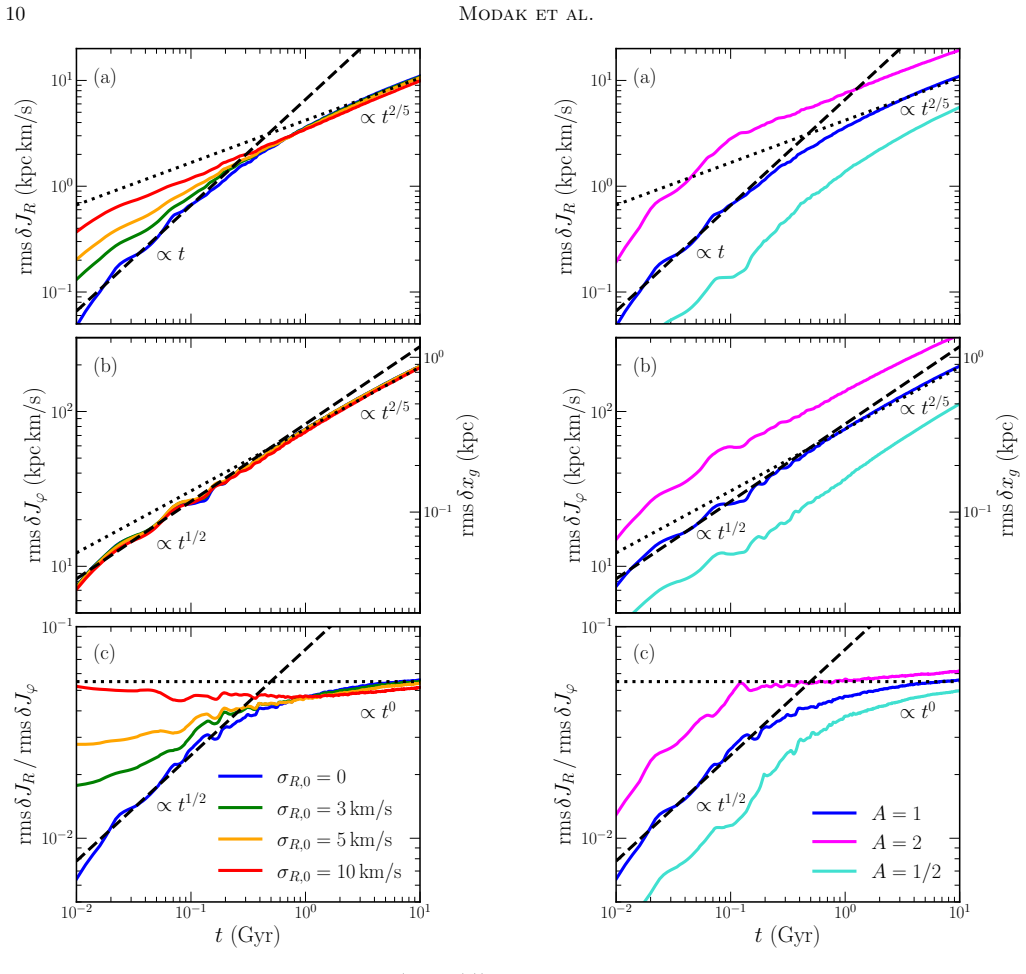
By integrating test-particle orbits through time-dependent density structures from TIGRESS-NCR simulations of Milky-Way-like conditions, the authors find that radial heating follows σ_R proportional to t to the power 1/2 for cold orbits early on and t to the power 1/5 for warmer orbits at late times, unlike the classic t to the 1/3 scaling. The ISM induces substantial radial migration comprising at least 30 percent of that observed locally, with a heating-to-migration ratio of rms δJ_R over rms δJ_φ approximately 0.055. Vertical motions reduce the transport amplitude without altering the scalings. These results are accounted for by quasilinear diffusion theory using dominant fluctuation 600-
What carries the argument
quasilinear diffusion theory applied to ISM density fluctuations with wavelengths around 600 pc and correlation timescales of 70 Myr, used to derive diffusion coefficients from test-particle integrations
Load-bearing premise
That quasilinear diffusion theory fully describes the transport for the dominant ISM fluctuations with wavelengths of about 600 parsecs and correlation times of 70 million years.
What would settle it
Direct measurement of how stellar radial velocity dispersion grows with age in the solar neighborhood, checking for a square-root-of-time dependence in young stars and a fifth-root dependence in older populations.
Figures




read the original abstract
Interstellar medium (ISM) structures gravitationally perturb stellar orbits in galactic disks, driving orbital heating and migration. However, studies of these transport processes tend to model the ISM very crudely, e.g., as a collection of compact, spherical ``clouds'' moving in the disk plane. Here, we revisit this problem with more realistic models of ISM density fluctuations drawn from the TIGRESS-NCR magnetohydrodynamic simulations, which follow the physics governing the ISM in Milky-Way-like conditions at high resolution. By integrating test-particle trajectories through time-dependent TIGRESS-NCR structures, we uncover transport behavior that contrasts sharply with conventional theoretical expectations. Notably, radial heating scales as $\sigma_R \propto t^{1/2}$ for initially cold orbits at early times, and $\sigma_R \propto t^{1/5}$ for warmer orbits at late times, contrary to the classic $\sigma_R \propto t^{1/3}$ prediction. The ISM drives substantial radial migration, accounting for $\gtrsim 30\%$ of that observed in the solar neighborhood (even without stellar spiral structure), and leads to a very low heating-to-migration ratio of $\mathrm{rms}\,\delta J_R\,/\,\mathrm{rms}\,\delta J_\varphi \approx 0.055$, where $J_R$ and $J_\varphi$ are the radial and azimuthal actions respectively. Vertical motion suppresses the amplitude of radial transport, but does not change the basic scalings. All our simulation results can be explained using quasilinear diffusion theory, accounting for the fact that the dominant ISM fluctuations have wavelengths of $\lambda_* \sim 600\,$pc and correlation timescales of $\tau_* \sim 70\,$Myr. We provide simple fitting formulae for the corresponding diffusion coefficients. In Paper II, we study the ISM's role in vertical disk heating.
Editorial analysis
A structured set of objections, weighed in public.
Referee Report
Summary. This paper examines the effects of realistic interstellar medium (ISM) density fluctuations, extracted from TIGRESS-NCR magnetohydrodynamic simulations, on stellar orbital heating and radial migration in galactic disks. Through test-particle trajectory integrations, the authors find that radial heating follows σ_R ∝ t^{1/2} for initially cold orbits at early times and σ_R ∝ t^{1/5} for warmer orbits at late times, differing from the standard σ_R ∝ t^{1/3}. They report that ISM-driven migration accounts for at least 30% of the observed radial migration in the solar neighborhood, with a notably low heating-to-migration ratio of rms(δJ_R)/rms(δJ_φ) ≈ 0.055. These findings are interpreted using quasilinear diffusion theory based on measured fluctuation scales of λ_* ≈ 600 pc and τ_* ≈ 70 Myr, and fitting formulae for the diffusion coefficients are provided.
Significance. If the reported scalings and ratios hold, this study advances understanding of disk dynamics by showing that extended ISM structures drive substantial radial transport, contributing significantly to solar-neighborhood migration even without stellar spirals and yielding a low heating-to-migration ratio. The use of high-resolution MHD simulation data for fluctuations, direct test-particle integrations, and derivation of practical fitting formulae for diffusion coefficients are strengths that could inform future galactic evolution models.
major comments (1)
- [quasilinear diffusion theory section] The section discussing the quasilinear diffusion explanation (near the end of the results and in the theory comparison): the applicability of quasilinear theory is not sufficiently justified for the reported dominant scales λ_* ∼ 600 pc and τ_* ∼ 70 Myr. At R ≈ 8 kpc the orbital period is ∼220 Myr so τ_* is ∼30% of an orbital time, and λ_* is comparable to epicycle amplitudes (∼200–400 pc) for the σ_R range shown. The manuscript should add a quantitative check (e.g., perturbation amplitude δΦ over one orbit or comparison of τ_* to orbital frequencies) to confirm that the linear-orbit resonance integral remains valid and that the derived time exponents and rms δJ_R / rms δJ_φ ratio are not altered by coherent rather than diffusive transport.
minor comments (2)
- [Abstract] Abstract: the reference to 'Paper II' lacks a title or arXiv identifier; add a parenthetical note or citation for completeness.
- [Figures] Figure captions and text: ensure all panels explicitly label the initial σ_R or J_R values used for the cold vs. warm orbit cases so readers can directly map to the reported t^{1/2} and t^{1/5} regimes.
Simulated Author's Rebuttal
We thank the referee for their careful reading of the manuscript and for the constructive comment on the quasilinear theory section. We address this point below and have revised the manuscript to strengthen the justification.
read point-by-point responses
-
Referee: [quasilinear diffusion theory section] The section discussing the quasilinear diffusion explanation (near the end of the results and in the theory comparison): the applicability of quasilinear theory is not sufficiently justified for the reported dominant scales λ_* ∼ 600 pc and τ_* ∼ 70 Myr. At R ≈ 8 kpc the orbital period is ∼220 Myr so τ_* is ∼30% of an orbital time, and λ_* is comparable to epicycle amplitudes (∼200–400 pc) for the σ_R range shown. The manuscript should add a quantitative check (e.g., perturbation amplitude δΦ over one orbit or comparison of τ_* to orbital frequencies) to confirm that the linear-orbit resonance integral remains valid and that the derived time exponents and rms δJ_R / rms δJ_φ ratio are not altered by coherent rather than diffusive transport.
Authors: We thank the referee for this important observation. While the test-particle integrations provide direct evidence for the reported scalings and the low heating-to-migration ratio, we agree that the applicability of the quasilinear framework merits a more explicit quantitative check. In the revised manuscript we have added a dedicated paragraph (and supporting calculation) in the theory comparison section. Using the TIGRESS-NCR density fields we compute the typical gravitational potential perturbation δΦ at R ≈ 8 kpc and find that the fractional change in orbital energy over one orbital period remains modest (δE/E ≲ 0.04). We also evaluate τ_* relative to the orbital frequency Ω and epicycle frequency κ, obtaining τ_* Ω ≈ 0.32 and τ_* κ ≈ 0.45; these values lie within the regime where the resonance integral of quasilinear theory has been validated in prior work on galactic perturbations. The close agreement between the measured time exponents (t^{1/2} early, t^{1/5} late) and the rms(δJ_R)/rms(δJ_φ) ratio with the analytic quasilinear predictions further indicates that transport remains diffusive rather than coherent on the timescales of interest. We have incorporated these checks and a brief discussion of their implications into the revised text. revision: yes
Circularity Check
No significant circularity; results from direct integration in external simulation data
full rationale
The paper's primary claims on radial heating scalings (σ_R ∝ t^{1/2} early, ∝ t^{1/5} late), migration contribution (≳30%), and heating-to-migration ratio (≈0.055) are obtained by integrating test-particle trajectories through time-dependent density fields taken from TIGRESS-NCR MHD simulations. These simulations supply the input ISM structures independently of the analysis. Quasilinear diffusion theory is then applied post hoc to interpret the measured transport using fluctuation scales (λ_* ∼ 600 pc, τ_* ∼ 70 Myr) extracted from the same runs, together with provided fitting formulae for the diffusion coefficients. This is an explanatory consistency check rather than a derivation in which any claimed prediction reduces to the inputs by construction or via self-definition. No load-bearing self-citations, uniqueness theorems imported from prior author work, or ansatzes smuggled via citation appear in the given text. The derivation chain remains self-contained against the external benchmark of the TIGRESS-NCR data.
Axiom & Free-Parameter Ledger
free parameters (1)
- diffusion coefficients
axioms (1)
- domain assumption Quasilinear diffusion theory applies to the dominant ISM fluctuations with wavelengths λ_* ∼ 600 pc and correlation timescales τ_* ∼ 70 Myr
Lean theorems connected to this paper
-
IndisputableMonolith/Cost/FunctionalEquation.leanwashburn_uniqueness_aczel unclear?
unclearRelation between the paper passage and the cited Recognition theorem.
All our simulation results can be explained using quasilinear diffusion theory, accounting for the fact that the dominant ISM fluctuations have wavelengths of λ_* ∼600 pc and correlation timescales of τ_* ∼70 Myr. We provide simple fitting formulae for the corresponding diffusion coefficients.
-
IndisputableMonolith/Foundation/AlphaCoordinateFixation.leanJ_uniquely_calibrated_via_higher_derivative unclear?
unclearRelation between the paper passage and the cited Recognition theorem.
rms δJ_R / rms δJ_φ ≈ 0.055
What do these tags mean?
- matches
- The paper's claim is directly supported by a theorem in the formal canon.
- supports
- The theorem supports part of the paper's argument, but the paper may add assumptions or extra steps.
- extends
- The paper goes beyond the formal theorem; the theorem is a base layer rather than the whole result.
- uses
- The paper appears to rely on the theorem as machinery.
- contradicts
- The paper's claim conflicts with a theorem or certificate in the canon.
- unclear
- Pith found a possible connection, but the passage is too broad, indirect, or ambiguous to say the theorem truly supports the claim.
Reference graph
Works this paper leans on
-
[1]
Galactic Dynamics: Second Edition
-
[2]
Ultraviolet Radiation Fields in Star-forming Disk Galaxies: Numerical Simulations with TIGRESS-NCR. , keywords =. doi:10.3847/1538-4357/ad7733 , archivePrefix =. 2409.05958 , primaryClass =
-
[3]
Dynamical heating across the Milky Way disc using APOGEE and Gaia. , keywords =. doi:10.1093/mnras/stz1521 , archivePrefix =. 1901.04502 , primaryClass =
-
[4]
Fundamental relations for the velocity dispersion of stars in the Milky Way. , keywords =. doi:10.1093/mnras/stab1086 , archivePrefix =. 2004.06556 , primaryClass =
-
[5]
Radial mixing in galactic discs. , keywords =. doi:10.1046/j.1365-8711.2002.05806.x , archivePrefix =. astro-ph/0203510 , primaryClass =
-
[6]
The Age Velocity Dispersion Relations of the Galactic Disk as Revealed by the LAMOST-Gaia Red Clump Stars. , keywords =. doi:10.3847/1538-4357/ad9d41 , archivePrefix =. 2412.07089 , primaryClass =
-
[7]
Spiral morphology in an intensely star-forming disk galaxy more than 12 billion years ago. Science , keywords =. doi:10.1126/science.abe9680 , archivePrefix =. 2108.02206 , primaryClass =
-
[8]
The Vertical Structure of Galactic Disks. , keywords =. doi:10.1086/165702 , adsurl =
-
[9]
Secular Evolution in Disk Galaxies
Secular evolution in disk galaxies. Reviews of Modern Physics , keywords =. doi:10.1103/RevModPhys.86.1 , archivePrefix =. 1310.0403 , primaryClass =
work page internal anchor Pith review Pith/arXiv arXiv doi:10.1103/revmodphys.86.1
-
[10]
A giant disk galaxy two billion years after the Big Bang. Nature Astronomy , keywords =. doi:10.1038/s41550-025-02500-2 , archivePrefix =. 2409.17956 , primaryClass =
-
[11]
REBELS-25: discovery of a dynamically cold disc galaxy at z = 7.31. , keywords =. doi:10.1093/mnras/stae2217 , archivePrefix =. 2405.06025 , primaryClass =
-
[12]
The Evolution of the Star-Forming Interstellar Medium Across Cosmic Time. , keywords =. doi:10.1146/annurev-astro-082812-141034 , archivePrefix =. 2003.06245 , primaryClass =
-
[13]
Chemical Tagging Can Work: Identification of Stellar Phase-space Structures Purely by Chemical-abundance Similarity. , keywords =. doi:10.3847/1538-4357/833/2/262 , archivePrefix =. 1601.05413 , primaryClass =
work page internal anchor Pith review Pith/arXiv arXiv doi:10.3847/1538-4357/833/2/262
-
[14]
The Gravitational Potential Near the Sun From SEGUE K-dwarf Kinematics
The Gravitational Potential near the Sun from SEGUE K-dwarf Kinematics. , keywords =. doi:10.1088/0004-637X/772/2/108 , archivePrefix =. 1209.0256 , primaryClass =
work page internal anchor Pith review Pith/arXiv arXiv doi:10.1088/0004-637x/772/2/108
-
[15]
The Long-term Evolution of the Galactic Disk Traced by Dissolving Star Clusters
The Long-term Evolution of the Galactic Disk Traced by Dissolving Star Clusters. , keywords =. doi:10.1088/0004-637X/713/1/166 , archivePrefix =. 1002.4357 , primaryClass =
work page internal anchor Pith review Pith/arXiv arXiv doi:10.1088/0004-637x/713/1/166
-
[16]
The Cold Interstellar Medium of Galaxies in the Local Universe. , keywords =. doi:10.1146/annurev-astro-021022-043545 , archivePrefix =. 2202.00690 , primaryClass =
-
[17]
Orbits and action changes during star-clump encounters responsible for the origin of exponential discs in dwarf galaxies. , keywords =. doi:10.1093/mnras/stac2870 , archivePrefix =. 2210.00651 , primaryClass =
-
[18]
Scattering, Migration, Re-circularization and Relaxation to Build Out Galaxy Disks with Exponential Profiles. arXiv e-prints , keywords =. doi:10.48550/arXiv.2602.21171 , archivePrefix =. 2602.21171 , primaryClass =
-
[19]
Keeping It Cool: Much Orbit Migration, yet Little Heating, in the Galactic Disk. , keywords =. doi:10.3847/1538-4357/ab910c , archivePrefix =. 2002.04622 , primaryClass =
-
[20]
Physics of Plasmas , keywords =
Kinetic theory of stellar systems: A tutorial. Physics of Plasmas , keywords =. doi:10.1063/5.0204214 , archivePrefix =. 2402.13322 , primaryClass =
-
[21]
Density waves in the shearing sheet. I. Swing amplification. , keywords =. doi:10.1051/0004-6361:20000562 , archivePrefix =. astro-ph/0012458 , primaryClass =
work page internal anchor Pith review Pith/arXiv arXiv doi:10.1051/0004-6361:20000562
-
[22]
Spiral arms as sheared gravitational instabilities
II. Spiral arms as sheared gravitational instabilities. , year = 1965, month = jan, volume =. doi:10.1093/mnras/130.2.125 , adsurl =
-
[23]
Application to the Giant CO Clouds
Diffusion of Stellar Orbits and Velocities by Random Gravitational Forces of Short Duration. Application to the Giant CO Clouds. , keywords =. doi:10.1093/pasj/32.1.89 , adsurl =
-
[24]
Galactokinetics II: Spiral structure. arXiv e-prints , keywords =. doi:10.48550/arXiv.2507.16950 , archivePrefix =. 2507.16950 , primaryClass =
-
[25]
The influence of massive gas clouds on stellar velocity dispersions in galactic discs. , keywords =. doi:10.1093/mnras/208.4.687 , adsurl =
-
[26]
1999, MNRAS, 307, 857, doi: 10.1046/j.1365-8711.1999.02699.x 21
Evolution of the velocity dispersion of self-gravitating particles in disc potentials. , keywords =. doi:10.1046/j.1365-8711.1999.02598.x , archivePrefix =. astro-ph/9907243 , primaryClass =
-
[27]
The Origin of Anisotropic Velocity Dispersion of Particles in a Disc Potential. , keywords =. doi:10.1093/mnras/263.4.875 , adsurl =
-
[28]
The Galactic dynamics revealed by the filamentary structure in atomic hydrogen emission. , keywords =. doi:10.1051/0004-6361/202243334 , archivePrefix =. 2205.10426 , primaryClass =
-
[29]
Protostars and Planets VII , year = 2023, editor =
The Life and Times of Giant Molecular Clouds. Protostars and Planets VII , year = 2023, editor =. doi:10.48550/arXiv.2203.09570 , archivePrefix =. 2203.09570 , primaryClass =
-
[30]
Fundamental limits to orbit reconstruction due to non-conservation of stellar actions in a Milky Way-like simulation. , keywords =. doi:10.1093/mnras/staf1515 , archivePrefix =. 2503.00373 , primaryClass =
-
[31]
NEXUS: a framework for controlled simulations of idealized galaxies. , keywords =. doi:10.1093/mnras/stae2372 , archivePrefix =. 2406.00342 , primaryClass =
-
[32]
Enhanced rates of stellar radial migration in gas-rich discs at high redshift. arXiv e-prints , keywords =. doi:10.48550/arXiv.2512.09030 , archivePrefix =. 2512.09030 , primaryClass =
-
[33]
Galactic seismology: can the Gaia 'phase spiral' co-exist with a clumpy, turbulent interstellar medium?. , keywords =. doi:10.1093/mnras/staf1331 , archivePrefix =. 2506.15059 , primaryClass =
-
[34]
Heating of galactic discs with realistic vertical potentials. , keywords =. doi:10.1093/mnras/257.4.620 , adsurl =
-
[35]
, year = 1966, month = dec, volume =
Non-Axisymmetric Responses of Differentially Rotating Disks of Stars. , year = 1966, month = dec, volume =. doi:10.1086/148957 , adsurl =
-
[36]
, year = 1967, month = apr, volume =
On the Effect of Interstellar Material on Stellar Non-Circular Velocities in Disk Galaxies. , year = 1967, month = apr, volume =. doi:10.1086/149134 , adsurl =
-
[37]
, year = 2015, month = aug, volume =
Molecular Clouds in the Milky Way. , year = 2015, month = aug, volume =. doi:10.1146/annurev-astro-082214-122324 , adsurl =
-
[38]
Molecular Gas and the Star-Formation Process on Cloud Scales in Nearby Galaxies. , keywords =. doi:10.1146/annurev-astro-071221-052651 , archivePrefix =. 2403.19843 , primaryClass =
-
[39]
Orbital migration and heating history of the Galactic disc: a transition between the bimodal discs. arXiv e-prints , keywords =. doi:10.48550/arXiv.2512.09987 , archivePrefix =. 2512.09987 , primaryClass =
-
[40]
Stirring and dynamical friction rates of planetesimals in the solar gravitational field. , keywords =. doi:10.1016/0019-1035(90)90182-9 , adsurl =
-
[41]
Simulations of the heating of the Galactic stellar disc. , keywords =. doi:10.1046/j.1365-8711.2002.05956.x , archivePrefix =. astro-ph/0208426 , primaryClass =
- [42]
-
[43]
New astronomy reviews , volume=
Milky Way dynamics in light of Gaia , author=. New astronomy reviews , volume=. 2025 , publisher=
work page 2025
-
[44]
Characterizing Density and Gravitational Potential Fluctuations of the Interstellar Medium. , keywords =. doi:10.3847/1538-4357/ae3bd4 , archivePrefix =. 2506.17387 , primaryClass =
-
[45]
The quiescent phase of galactic disc growth
The quiescent phase of galactic disc growth. , keywords =. doi:10.1093/mnras/stw777 , archivePrefix =. 1604.00191 , primaryClass =
work page internal anchor Pith review Pith/arXiv arXiv doi:10.1093/mnras/stw777
-
[46]
Age velocity dispersion relations and heating histories in disc galaxies
Age-velocity dispersion relations and heating histories in disc galaxies. , keywords =. doi:10.1093/mnras/stw1639 , archivePrefix =. 1607.01972 , primaryClass =
work page internal anchor Pith review Pith/arXiv arXiv doi:10.1093/mnras/stw1639
-
[47]
Galactokinetics. , keywords =. doi:10.3847/1538-4357/ae17bb , archivePrefix =. 2408.03366 , primaryClass =
-
[48]
Satellite encounters. , keywords =. doi:10.1016/0019-1035(86)90089-8 , adsurl =
-
[49]
Why is the Galactic disk so cool?. arXiv e-prints , keywords =. doi:10.48550/arXiv.2411.08944 , archivePrefix =. 2411.08944 , primaryClass =
-
[50]
Velocity Evolution of Disk Stars Due to Gravitational Scattering by Giant Molecular Clouds. , keywords =
-
[51]
Efficient radial migration by giant molecular clouds in the first several hundred Myr after the stellar birth. , keywords =. doi:10.1093/mnras/stad1612 , archivePrefix =. 2305.07050 , primaryClass =
-
[52]
REBOUND: An open-source multi-purpose N-body code for collisional dynamics
REBOUND: an open-source multi-purpose N-body code for collisional dynamics. , keywords =. doi:10.1051/0004-6361/201118085 , archivePrefix =. 1110.4876 , primaryClass =
work page internal anchor Pith review Pith/arXiv arXiv doi:10.1051/0004-6361/201118085
- [53]
-
[54]
, year = 1951, month = nov, volume =
The Possible Influence of Interstellar Clouds on Stellar Velocities. , year = 1951, month = nov, volume =. doi:10.1086/145478 , adsurl =
-
[55]
The Possible Influence of Interstellar Clouds on Stellar Velocities. II. , year = 1953, month = jul, volume =. doi:10.1086/145730 , adsurl =
-
[56]
The diffusion of stars through phase space. , keywords =. doi:10.1093/mnras/230.4.597 , adsurl =
-
[57]
A Simple and Accurate Network for Hydrogen and Carbon Chemistry in the ISM
A Simple and Accurate Network for Hydrogen and Carbon Chemistry in the Interstellar Medium. , keywords =. doi:10.3847/1538-4357/aa7561 , archivePrefix =. 1610.09023 , primaryClass =
work page internal anchor Pith review Pith/arXiv arXiv doi:10.3847/1538-4357/aa7561
-
[58]
Amplification, Saturation, and Q Thresholds for Runaway: Growth of Self-Gravitating Structures in Models of Magnetized Galactic Gas Disks. , keywords =. doi:10.1086/322330 , archivePrefix =. astro-ph/0105375 , primaryClass =
work page internal anchor Pith review Pith/arXiv arXiv doi:10.1086/322330
-
[59]
Turbulent Gas-rich Disks at High Redshift: Origin of Thick Stellar Disks Through 3D ``Baryon Sloshing''. , keywords =. doi:10.3847/1538-4357/ae0931 , archivePrefix =. 2502.01895 , primaryClass =
-
[60]
2019, ApJ, 882, 111, doi: 10.3847/1538-4357/ab341a
When Cold Radial Migration is Hot: Constraints from Resonant Overlap. , keywords =. doi:10.3847/1538-4357/ab341a , archivePrefix =. 1907.10100 , primaryClass =
-
[61]
Physics of the Interstellar and Intergalactic Medium
-
[62]
Sloan Digital Sky Survey. V. Pioneering Panoptic Spectroscopy. , keywords =. doi:10.3847/1538-3881/ae0576 , archivePrefix =. 2507.06989 , primaryClass =
-
[63]
Overview of the DESI Milky Way Survey. , keywords =. doi:10.3847/1538-4357/acb3c0 , archivePrefix =. 2208.08514 , primaryClass =
-
[64]
Summary of the content and survey properties
Gaia Data Release 3. Summary of the content and survey properties. , keywords =. doi:10.1051/0004-6361/202243940 , archivePrefix =. 2208.00211 , primaryClass =
-
[65]
Atomic Hydrogen in the Milky Way: A Stepping Stone in the Evolution of Galaxies. , keywords =. doi:10.1146/annurev-astro-052920-104851 , archivePrefix =. 2307.08464 , primaryClass =
-
[66]
Protostars and Planets III , year = 1993, editor =
Giant Molecular Clouds. Protostars and Planets III , year = 1993, editor =
work page 1993
-
[67]
Protostars and Planets VII , year = 2023, editor =
Initial Conditions for Star Formation: a Physical Description of the Filamentary ISM. Protostars and Planets VII , year = 2023, editor =. doi:10.48550/arXiv.2203.09562 , archivePrefix =. 2203.09562 , primaryClass =
-
[68]
Local Simulations of Spiral Galaxies with the TIGRESS Framework. I. Star Formation and Arm Spurs/Feathers. , keywords =. doi:10.3847/1538-4357/ab9b87 , archivePrefix =. 2006.05614 , primaryClass =
-
[69]
Photochemistry and Heating/Cooling of the Multiphase Interstellar Medium with UV Radiative Transfer for Magnetohydrodynamic Simulations. , keywords =. doi:10.3847/1538-4365/ac9b1d , archivePrefix =. 2210.08024 , primaryClass =
-
[70]
Modeling UV Radiation Feedback from Massive Stars. I. Implementation of Adaptive Ray-tracing Method and Tests. , keywords =. doi:10.3847/1538-4357/aa9b80 , archivePrefix =. 1711.06277 , primaryClass =
work page internal anchor Pith review Pith/arXiv arXiv doi:10.3847/1538-4357/aa9b80
-
[71]
Molecular clouds in the Galaxy. , keywords =. doi:10.1086/181859 , adsurl =
-
[72]
Mass, Luminosity, and Line Width Relations of Galactic Molecular Clouds. , keywords =. doi:10.1086/165493 , adsurl =
-
[73]
Dynamical Friction in a Gaseous Medium
Dynamical Friction in a Gaseous Medium. , keywords =. doi:10.1086/306858 , archivePrefix =. astro-ph/9810324 , primaryClass =
work page internal anchor Pith review Pith/arXiv arXiv doi:10.1086/306858
-
[74]
Stellar Population Synthesis with Distinct Kinematics: Multiage Asymmetric Drift in SDSS-IV MaNGA Galaxies. , keywords =. doi:10.3847/1538-4357/ab9b8e , archivePrefix =. 2006.02071 , primaryClass =
-
[75]
Overview of the SDSS-IV MaNGA Survey: Mapping nearby Galaxies at Apache Point Observatory. , keywords =. doi:10.1088/0004-637X/798/1/7 , archivePrefix =. 1412.1482 , primaryClass =
work page internal anchor Pith review Pith/arXiv arXiv doi:10.1088/0004-637x/798/1/7
-
[76]
Dynamical evolution of globular clusters
-
[77]
, year = 1948, month = sep, volume =
The Distribution of Interstellar Sodium. , year = 1948, month = sep, volume =. doi:10.1086/145069 , adsurl =
-
[78]
Introducing TIGRESS-NCR. I. Coregulation of the Multiphase Interstellar Medium and Star Formation Rates. , keywords =. doi:10.3847/1538-4357/acbd3a , archivePrefix =. 2211.13293 , primaryClass =
-
[79]
Ripples spreading across the Galactic disc: Interplay of direct and indirect effects of the Sagittarius dwarf impact. , keywords =. doi:10.1051/0004-6361/202553816 , archivePrefix =. 2501.12436 , primaryClass =
-
[80]
Tree-ring structure of Galactic bar resonance. , keywords =. doi:10.1093/mnras/stab1094 , archivePrefix =. 2102.08388 , primaryClass =
discussion (0)
Sign in with ORCID, Apple, or X to comment. Anyone can read and Pith papers without signing in.