REVIEW 2 major objections 4 minor 101 references
Four-point energy correlators show that spin correlations are subdominant in LHC jets; kinematic power corrections dominate the azimuthal pattern.
Reviewed by Pith at T0; open to challenge. T0 means a machine referee read the full paper against a public rubric. the ladder, T0–T4 →
T0 review · grok-4.5
2026-07-10 17:55 UTC pith:WLF3XF7Z
load-bearing objection Clean, usable four-point projections that isolate factorization channels and show spin is sub-dominant at LHC kinematics; the missing full QCD calculation is now the obvious next step. the 2 major comments →
Dissecting Parton Showers with Multi-Point Energy Correlators
The pith
A machine-rendered reading of the paper's core claim, the machinery that carries it, and where it could break.
Core claim
In the kinematic windows that can be measured at the LHC, the large azimuthal modulations that appear in four-point correlator projections are kinematic power corrections, not the intrinsic spin correlations of the intermediate gluon. Leading-power factorization yields only a ~5 % cos(2φ) effect that is independent of the cluster-size ratio, while showers produce ~40 % effects that depend strongly on that ratio.
What carries the argument
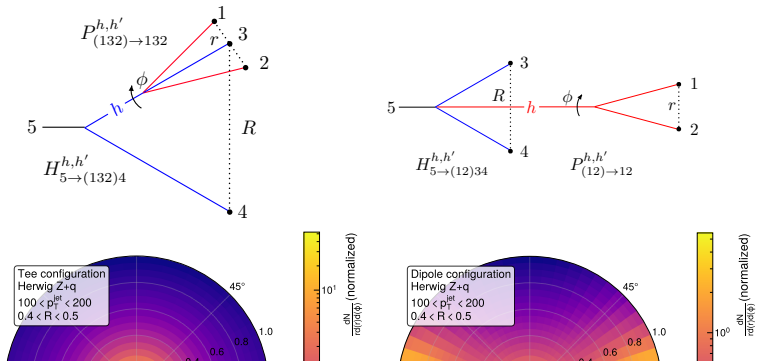
Experimentally realizable projections (dipole, tee, tripole) of the four-point correlator that map onto distinct factorization channels of the 1 o4 splitting function, together with the leading-power iterated-collinear formula that isolates the pure spin piece αj + βj cos(2φ).
Load-bearing premise
That the leading-power iterated-collinear calculation already contains the full intrinsic spin contribution, so any larger, size-ratio-dependent modulation seen in the showers can be blamed entirely on kinematic power corrections.
What would settle it
A complete next-to-leading-order QCD calculation of the four-point energy correlator (or a high-statistics LHC measurement of the same projections) that either reproduces the showers’ large, r-dependent modulations or recovers the small, r-independent spin prediction.
If this is right
- The three projections can be measured at the LHC with the algorithms and covariance treatment given in the paper.
- Parton-shower developers can use the same projections as precision diagnostics of 1 o3 and 1→4 spin and color structure.
- A full QCD four-point calculation becomes the necessary benchmark that current showers lack.
- Similar projections can be applied to heavy-ion and heavy-flavor jets once the vacuum baseline is known.
Where Pith is reading between the lines
- Because kinematic power corrections dominate, any claim of ‘observing gluon spin’ with multi-point correlators at LHC energies will require the full QCD calculation as a control.
- The same logic that isolates spin versus kinematics for four points should apply to higher-point correlators, making them natural next targets.
- Discrepancies already visible between Pythia and Herwig in the radial slopes suggest that the projections can also constrain subleading-color and higher-order DGLAP implementations.
Editorial analysis
A structured set of objections, weighed in public.
Referee Report
Summary. The paper introduces three experimentally realizable projections of the four-point energy correlator (dipole, tee, tripole) that isolate distinct multi-collinear factorization channels of the 1 o4 splitting function. Using known polarized 1 o2 and 1 o3 splitting tensors and functions, it computes the leading-power iterated-collinear limit of the tee configuration, obtaining an r-independent cos(2ϕ) spin modulation of size β/α ≃ 5 % (Eq. 3.43 and the explicit αj, βj of §3.4). Detailed Pythia and Herwig studies of Z+q/g jets, with hard/soft spin toggles, hadronization variations, and proper multi-entry covariance matrices, show that the azimuthal modulations observed at LHC-accessible kinematics are ~40 % and strongly r-dependent. The authors conclude that these are kinematic power corrections rather than intrinsic spin correlations, and that a complete QCD calculation of the four-point correlator is therefore required both to test the showers and to enable a clean extraction of spin effects.
Significance. If the central claim holds, the work supplies concrete, ready-to-measure observables that cleanly separate the two factorization channels of the four-point splitting function and that can be used to validate the next generation of parton showers that incorporate higher-multiplicity and spin-correlated branchings. The explicit LO analytic results for αj and βj, the spin-toggle cross-checks of App. D, and the practical algorithms of §4.2 and App. B constitute a self-contained experimental roadmap. The finding that kinematic power corrections dominate the accessible azimuthal structure is a non-trivial, falsifiable prediction that immediately motivates a full fixed-order calculation of the four-point correlator in QCD.
major comments (2)
- The central claim that the ~40 % r-dependent modulation is purely kinematic rests on the assumption that the LO iterated-collinear factorization of Eq. (3.43) fully captures the intrinsic spin contribution. While the spin-toggle studies of §4.3.2 and App. D recover a residual ~5 % cos(2ϕ) consistent with the analytic β/α, the paper does not quantify residual higher-order spin or color-coherence effects that could still be present once hard and soft spin are switched off. A short discussion of the expected size of such residual effects (or an explicit statement that they are beyond the present scope) would strengthen the attribution of the entire excess modulation to power corrections.
- The dipole configuration is introduced as the complementary channel that probes the 1 o3 splitting tensor, yet the analytic αj, βj coefficients are computed only for the tee (§3.4). Because the dipole is equally central to the experimental program and to the claim that both factorization channels can be accessed, at least a leading-power estimate of its spin modulation (or a clear statement that it is left for future work) is needed for completeness.
minor comments (4)
- The abstract and introduction contain several typographical slips (“seem” for “seen”, “fore+e−”, repeated author affiliations). A careful proof-reading pass is warranted.
- Figures 7–8 and 19–20 would be easier to compare if they shared a common color scale or if the relative modulation (right-hand panels) were plotted on identical vertical ranges.
- The geometric tolerance t = 0.05 is stated without a systematic study of its effect on the extracted distributions; a short appendix or sentence quantifying residual bias would be useful for experimental groups.
- Appendix A collects the necessary splitting objects, but a few intermediate steps between the general contractions (3.38)–(3.42) and the final numerical coefficients (3.44)–(3.45) are omitted; adding one intermediate expression would aid reproducibility.
Circularity Check
No significant circularity: analytic spin coefficients are independent LO contractions of published splitting objects; shower comparisons use external generators with toggles.
full rationale
The central claim (spin subdominant at LHC kinematics) rests on two independent pillars that do not reduce to each other or to fitted inputs. First, the leading-power tee result of Eq. (3.43) with explicit numerical coefficients αj, βj ≈ 5 % (Eqs. 3.44–3.45) is obtained by contracting the known tree-level 1 o2 splitting tensors and 1 o3 polarized splitting functions of Refs. [84, 85, 104] (collected in App. A); the helicity-flip pieces produce a pure cos(2φ) modulation whose relative size is fixed by color factors and is r-independent by construction of the iterated collinear limit. No parameter is fitted to data. Second, the parton-shower distributions (Pythia/Herwig) are generated from external codes whose hard and soft spin toggles can be switched off, recovering a residual ~5 % modulation that matches the analytic result (App. D and Fig. 27). The larger (~40 %), r-dependent modulation seen with default settings is therefore identified as kinematic power corrections outside the leading-power factorization; this identification is a comparison, not a tautology. Self-citations to the authors’ prior three-point work [75, 76] supply context and validation methodology but are not load-bearing for the four-point coefficients or the spin-toggle tests. No uniqueness theorem, ansatz, or fitted quantity is smuggled in as a prediction. The derivation chain is therefore self-contained against external benchmarks.
Axiom & Free-Parameter Ledger
free parameters (2)
- geometric tolerance t =
0.05
- jet radius R_jet =
0.8
axioms (3)
- domain assumption Collinear factorization of the N-point energy correlator into hard, jet, and ENC jet functions (Eq. 3.6)
- domain assumption Tree-level polarized 1→2 and 1→3 splitting tensors and functions of Catani et al. correctly capture the leading-power spin correlations
- domain assumption Pythia and Herwig spin-correlation toggles (hard and soft) correctly turn the intrinsic gluon-spin contribution on and off
invented entities (1)
-
tee / dipole / tripole projections
independent evidence
read the original abstract
The last several years have seen tremendous progress in the ability to both compute and measure multi-point correlations in energy flux. The highly differential nature of energy correlators makes them ideal probes of multi-collinear factorization and azimuthal structure within jets. In this paper, we explore the phenomenology of four-point correlators in jet substructure. We identify experimentally realizable projections that probe different factorization channels onto splitting tensors and splitting functions. We perform a detailed phenomenological study using both Herwig and Pythia. By comparing parton shower results with analytic calculations in kinematic limits, we are able to disentangle intrinsic spin correlations from kinematic azimuthal correlations. In experimentally accessible kinematic regions, we find the spin correlations are subdominant, strongly motivating a complete calculation of the four-point correlator in QCD to provide a test of the parton shower results. We also present parameterizations and analysis algorithms that can be used experimentally. Our work sets the stage for the experimental measurement of these observables at the LHC, and their use as probes of the next generation of parton showers.
Figures


Reference graph
Works this paper leans on
-
[1]
A. J. Larkoski, I. Moult, and B. Nachman,Jet Substructure at the Large Hadron Collider: A Review of Recent Advances in Theory and Machine Learning,Phys. Rept.841(2020) 1–63, [arXiv:1709.04464]
work page internal anchor Pith review Pith/arXiv arXiv 2020
-
[2]
Jet Substructure at the Large Hadron Collider: Experimental Review
R. Kogler et al.,Jet Substructure at the Large Hadron Collider: Experimental Review,Rev. Mod. Phys.91(2019), no. 4 045003, [arXiv:1803.06991]
work page internal anchor Pith review Pith/arXiv arXiv 2019
-
[3]
N. A. Sveshnikov and F. V. Tkachov,Jets and quantum field theory,Phys. Lett. B382 (1996) 403–408, [hep-ph/9512370]. – 56 – 0.0 0.2 0.4 0.6 0.8 1.0 1.2 1.4 1.6 0.85 0.90 0.95 1.00 1.05 1.10 1.15 Nominal / Hard spin corr. OFF 0.4 < R < 0.5 0.00 < r < 0.20 Tee configuration Pythia Z+q 100 < pT < 200 [GeV] 200 < pT < 300 [GeV] 300 < pT < 500 [GeV] 500 < pT < ...
work page internal anchor Pith review Pith/arXiv arXiv 1996
-
[4]
F. V. Tkachov,Measuring multi - jet structure of hadronic energy flow or What is a jet?, Int. J. Mod. Phys. A12(1997) 5411–5529, [hep-ph/9601308]
work page internal anchor Pith review Pith/arXiv arXiv 1997
-
[5]
G. P. Korchemsky and G. F. Sterman,Power corrections to event shapes and factorization, Nucl. Phys. B555(1999) 335–351, [hep-ph/9902341]
work page internal anchor Pith review Pith/arXiv arXiv 1999
-
[6]
C. W. Bauer, S. P. Fleming, C. Lee, and G. F. Sterman,Factorization of e+e- Event Shape Distributions with Hadronic Final States in Soft Collinear Effective Theory,Phys. Rev. D 78(2008) 034027, [arXiv:0801.4569]
work page internal anchor Pith review Pith/arXiv arXiv 2008
-
[7]
D. M. Hofman and J. Maldacena,Conformal collider physics: Energy and charge correlations,JHEP05(2008) 012, [arXiv:0803.1467]
work page internal anchor Pith review Pith/arXiv arXiv 2008
-
[8]
A. V. Belitsky, S. Hohenegger, G. P. Korchemsky, E. Sokatchev, and A. Zhiboedov,From correlation functions to event shapes,Nucl. Phys. B884(2014) 305–343, [arXiv:1309.0769]
work page internal anchor Pith review Pith/arXiv arXiv 2014
-
[9]
A. V. Belitsky, S. Hohenegger, G. P. Korchemsky, E. Sokatchev, and A. Zhiboedov,Event shapes inN= 4super-Yang-Mills theory,Nucl. Phys. B884(2014) 206–256, [arXiv:1309.1424]
work page internal anchor Pith review Pith/arXiv arXiv 2014
-
[10]
Light-ray operators in conformal field theory
P. Kravchuk and D. Simmons-Duffin,Light-ray operators in conformal field theory,JHEP 11(2018) 102, [arXiv:1805.00098]
work page internal anchor Pith review Pith/arXiv arXiv 2018
-
[11]
C. L. Basham, L. S. Brown, S. D. Ellis, and S. T. Love,Energy Correlations in Perturbative Quantum Chromodynamics: A Conjecture for All Orders,Phys. Lett. B85(1979) 297–299. – 57 – 0.0 0.2 0.4 0.6 0.8 1.0 1.2 1.4 1.6 0.96 0.98 1.00 1.02 1.04 Nominal / Hard spin corr. OFF 0.4 < R < 0.5 0.00 < r < 0.20 Tee configuration Herwig Z+q 100 < pT < 200 [GeV] 200 <...
work page 1979
-
[12]
C. L. Basham, L. S. Brown, S. D. Ellis, and S. T. Love,Energy Correlations in electron-Positron Annihilation in Quantum Chromodynamics: Asymptotically Free Perturbation Theory,Phys. Rev. D19(1979) 2018
work page 1979
-
[13]
C. L. Basham, L. S. Brown, S. D. Ellis, and S. T. Love,Energy Correlations in electron - Positron Annihilation: Testing QCD,Phys. Rev. Lett.41(1978) 1585
work page 1978
-
[14]
C. L. Basham, L. S. Brown, S. D. Ellis, and S. T. Love,Electron - Positron Annihilation Energy Pattern in Quantum Chromodynamics: Asymptotically Free Perturbation Theory, Phys. Rev. D17(1978) 2298. [15]SLDCollaboration, K. Abe et al.,Measurement of alpha-s (M(Z)**2) from hadronic event observables at the Z0 resonance,Phys. Rev. D51(1995) 962–984, [hep-ex/...
work page internal anchor Pith review Pith/arXiv arXiv 1978
-
[15]
Fernandez et al.,A Measurement of Energy-energy Correlations ine +e− →Hadrons at√s= 29-GeV,Phys
E. Fernandez et al.,A Measurement of Energy-energy Correlations ine +e− →Hadrons at√s= 29-GeV,Phys. Rev. D31(1985) 2724
work page 1985
-
[16]
D. R. Wood et al.,Determination ofα −sFrom Energy-energy Correlations ine +e− Annihilation at 29-GeV,Phys. Rev. D37(1988) 3091. [23]CELLOCollaboration, H. J. Behrend et al.,Analysis of the Energy Weighted Angular Correlations in Hadronice +e− Annihilations at 22-GeV and 34-GeV,Z. Phys. C14(1982) 95. [24]PLUTOCollaboration, C. Berger et al.,A Study of Ener...
work page 1988
-
[17]
L. J. Dixon, I. Moult, and H. X. Zhu,Collinear limit of the energy-energy correlator,Phys. Rev. D100(2019), no. 1 014009, [arXiv:1905.01310]
work page internal anchor Pith review Pith/arXiv arXiv 2019
-
[18]
H. Chen, I. Moult, X. Zhang, and H. X. Zhu,Rethinking jets with energy correlators: Tracks, resummation, and analytic continuation,Phys. Rev. D102(2020), no. 5 054012, [arXiv:2004.11381]
work page internal anchor Pith review Pith/arXiv arXiv 2020
-
[19]
K. Lee, B. Me¸ caj, and I. Moult,Conformal collider physics meets LHC data,Phys. Rev. D 111(2025), no. 1 L011502, [arXiv:2205.03414]. [28]CMSCollaboration, A. Hayrapetyan et al.,Measurement of Energy Correlators inside Jets – 59 – 0.0 0.2 0.4 0.6 0.8 1.0 1.2 1.4 1.6 0.85 0.90 0.95 1.00 1.05 1.10 Nominal / Soft spin corr. OFF 0.4 < R < 0.5 0.00 < r < 0.20 ...
work page internal anchor Pith review Pith/arXiv arXiv 2025
-
[20]
Energy Correlators: A Journey From Theory to Experiment
I. Moult and H. X. Zhu,Energy Correlators: A Journey From Theory to Experiment, arXiv:2506.09119
work page internal anchor Pith review Pith/arXiv arXiv
-
[21]
Calculating Track Thrust with Track Functions
H.-M. Chang, M. Procura, J. Thaler, and W. J. Waalewijn,Calculating Track Thrust with Track Functions,Phys. Rev. D88(2013) 034030, [arXiv:1306.6630]
work page internal anchor Pith review Pith/arXiv arXiv 2013
-
[22]
Calculating Track-Based Observables for the LHC
H.-M. Chang, M. Procura, J. Thaler, and W. J. Waalewijn,Calculating Track-Based Observables for the LHC,Phys. Rev. Lett.111(2013) 102002, [arXiv:1303.6637]
work page internal anchor Pith review Pith/arXiv arXiv 2013
-
[23]
H. Chen, M. Jaarsma, Y. Li, I. Moult, W. J. Waalewijn, and H. X. Zhu,Collinear parton dynamics beyond Dokshitzer-Gribov-Lipatov-Altarelli-Parisi framework,Phys. Rev. D111 (2025), no. 7 076021, [arXiv:2210.10061]
work page internal anchor Pith review Pith/arXiv arXiv 2025
-
[24]
Energy Correlators on Tracks: Resummation and Non-Perturbative Effects
M. Jaarsma, Y. Li, I. Moult, W. J. Waalewijn, and H. X. Zhu,Energy correlators on tracks: resummation and non-perturbative effects,JHEP12(2023) 087, [arXiv:2307.15739]
work page internal anchor Pith review Pith/arXiv arXiv 2023
-
[25]
H. Chen, M. Jaarsma, Y. Li, I. Moult, W. J. Waalewijn, and H. X. Zhu,Multi-collinear splitting kernels for track function evolution,JHEP07(2023) 185, [arXiv:2210.10058]
work page internal anchor Pith review Pith/arXiv arXiv 2023
-
[26]
Y. Li, I. Moult, S. S. van Velzen, W. J. Waalewijn, and H. X. Zhu,Extending Precision – 60 – 0.0 0.2 0.4 0.6 0.8 1.0 1.2 1.4 1.6 0.80 0.85 0.90 0.95 1.00 1.05 1.10 1.15 Nominal / Soft spin corr. OFF 0.4 < R < 0.5 0.00 < r < 0.20 Tee configuration Herwig Z+glu 100 < pT < 200 [GeV] 200 < pT < 300 [GeV] 300 < pT < 500 [GeV] 500 < pT < 800 [GeV] 800 < pT [GeV...
work page internal anchor Pith review Pith/arXiv arXiv 2022
-
[27]
Renormalization Group Flows for Track Function Moments
M. Jaarsma, Y. Li, I. Moult, W. Waalewijn, and H. X. Zhu,Renormalization group flows for track function moments,JHEP06(2022) 139, [arXiv:2201.05166]
work page internal anchor Pith review Pith/arXiv arXiv 2022
-
[28]
Energy Correlators Taking Charge
K. Lee and I. Moult,Energy Correlators Taking Charge,arXiv:2308.00746
work page internal anchor Pith review Pith/arXiv arXiv
-
[29]
Joint Track Functions: Expanding the Space of Calculable Correlations at Colliders
K. Lee and I. Moult,Joint Track Functions: Expanding the Space of Calculable Correlations at Colliders,arXiv:2308.01332
work page internal anchor Pith review Pith/arXiv arXiv
-
[30]
K. Lee, I. Moult, F. Ringer, and W. J. Waalewijn,A formalism for extracting track functions from jet measurements,JHEP01(2024) 194, [arXiv:2308.00028]
work page internal anchor Pith review Pith/arXiv arXiv 2024
-
[31]
M. Jaarsma, Y. Li, I. Moult, W. J. Waalewijn, and H. X. Zhu,From DGLAP to Sudakov: Precision Predictions for Energy-Energy Correlators,arXiv:2512.11950
-
[32]
K. Lee, I. Moult, and W. J. Waalewijn,Putting Jet Substructure on Track(s), arXiv:2607.00087
work page internal anchor Pith review Pith/arXiv arXiv
-
[33]
Three Point Energy Correlators in the Collinear Limit: Symmetries, Dualities and Analytic Results
H. Chen, M.-X. Luo, I. Moult, T.-Z. Yang, X. Zhang, and H. X. Zhu,Three point energy correlators in the collinear limit: symmetries, dualities and analytic results,JHEP08 (2020), no. 08 028, [arXiv:1912.11050]
work page internal anchor Pith review Pith/arXiv arXiv 2020
-
[34]
H. Chen, I. Moult, J. Thaler, and H. X. Zhu,Non-Gaussianities in collider energy flux, JHEP07(2022) 146, [arXiv:2205.02857]
work page internal anchor Pith review Pith/arXiv arXiv 2022
-
[35]
P. T. Komiske, I. Moult, J. Thaler, and H. X. Zhu,Analyzing N-Point Energy Correlators – 61 – 0.0 0.2 0.4 0.6 0.8 1.0 1.2 1.4 1.6 0.96 0.97 0.98 0.99 1.00 1.01 1.02 1.03 1.04 Nominal / All spin corr. OFF 0.4 < R < 0.5 0.00 < r < 0.20 Tee configuration Herwig Z+q 100 < pT < 200 [GeV] 200 < pT < 300 [GeV] 300 < pT < 500 [GeV] 500 < pT < 800 [GeV] 800 < pT [...
work page internal anchor Pith review Pith/arXiv arXiv 2023
-
[36]
The Collinear Limit of the Four-Point Energy Correlator in $\mathcal{N} = 4$ Super Yang-Mills Theory
D. Chicherin, I. Moult, E. Sokatchev, K. Yan, and Y. Zhu,Collinear limit of the four-point energy correlator in N=4 supersymmetric Yang-Mills theory,Phys. Rev. D110(2024), no. 9 L091901, [arXiv:2401.06463]
work page internal anchor Pith review Pith/arXiv arXiv 2024
-
[37]
Three-point energy correlator in $\mathcal{N}=4$ super Yang-Mills Theory
K. Yan and X. Zhang,Three-Point Energy Correlator in N=4 Supersymmetric Yang-Mills Theory,Phys. Rev. Lett.129(2022), no. 2 021602, [arXiv:2203.04349]
work page internal anchor Pith review Pith/arXiv arXiv 2022
-
[38]
Analytic Computation of Three-point Energy Correlator in QCD
T.-Z. Yang and X. Zhang,Analytic Computation of three-point energy correlator in QCD, JHEP09(2022) 006, [arXiv:2208.01051]
work page internal anchor Pith review Pith/arXiv arXiv 2022
-
[39]
Three-point Energy Correlators in Hadronic Higgs Decays
T.-Z. Yang and X. Zhang,Three-point energy correlators in hadronic Higgs boson decays, Phys. Rev. D109(2024), no. 11 114036, [arXiv:2402.05174]
work page internal anchor Pith review Pith/arXiv arXiv 2024
-
[40]
S. He, X. Li, J. Lin, J. Liu, and K. Yan,Bootstrapping form factor squared inN= 4 super-Yang-Mills,arXiv:2506.07796
work page internal anchor Pith review Pith/arXiv arXiv
-
[41]
R. Ma, J. Gong, J. Lin, K. Yan, G. Yang, and Y. Zhang,Differential equations for energy correlators in any angle,JHEP02(2026) 025, [arXiv:2506.02061]
work page internal anchor Pith review Pith/arXiv arXiv 2026
-
[42]
A. Volovich, D. Wu, and K. Yan,Energy Correlators from Star Integrals via Mellin Space, arXiv:2604.01071
-
[43]
S. He, X. Jiang, Q. Yang, and Y.-Q. Zhang,From squared amplitudes to energy correlators, arXiv:2408.04222. – 62 – 0.0 0.2 0.4 0.6 0.8 1.0 1.2 1.4 1.6 0.985 0.990 0.995 1.000 1.005 1.010 1.015 1.020 Nominal / All spin corr. OFF 0.4 < R < 0.5 0.00 < r < 0.20 Tee configuration Herwig Z+glu 100 < pT < 200 [GeV] 200 < pT < 300 [GeV] 300 < pT < 500 [GeV] 500 < ...
work page internal anchor Pith review Pith/arXiv arXiv
-
[44]
I. G. Knowles,A Linear Algorithm for Calculating Spin Correlations in Hadronic Collisions,Comput. Phys. Commun.58(1990) 271–284
work page 1990
-
[45]
I. G. Knowles,Angular Correlations in QCD,Nucl. Phys. B304(1988) 767–793
work page 1988
-
[46]
I. G. Knowles,Spin Correlations in Parton - Parton Scattering,Nucl. Phys. B310(1988) 571–588
work page 1988
-
[47]
M. Bahr et al.,Herwig++ Physics and Manual,Eur. Phys. J. C58(2008) 639–707, [arXiv:0803.0883]
work page internal anchor Pith review Pith/arXiv arXiv 2008
-
[48]
Herwig 7.0 / Herwig++ 3.0 Release Note
J. Bellm et al.,Herwig 7.0/Herwig++ 3.0 release note,Eur. Phys. J. C76(2016), no. 4 196, [arXiv:1512.01178]
work page internal anchor Pith review Pith/arXiv arXiv 2016
-
[49]
J. Bellm et al.,Herwig 7.2 release note,Eur. Phys. J. C80(2020), no. 5 452, [arXiv:1912.06509]
work page internal anchor Pith review Pith/arXiv arXiv 2020
-
[50]
Spin Correlations in Parton Shower Simulations
P. Richardson and S. Webster,Spin Correlations in Parton Shower Simulations,Eur. Phys. J. C80(2020), no. 2 83, [arXiv:1807.01955]
work page internal anchor Pith review Pith/arXiv arXiv 2020
-
[51]
Spin correlations in final-state parton showers and jet observables
A. Karlberg, G. P. Salam, L. Scyboz, and R. Verheyen,Spin correlations in final-state parton showers and jet observables,Eur. Phys. J. C81(2021), no. 8 681, [arXiv:2103.16526]
work page internal anchor Pith review Pith/arXiv arXiv 2021
-
[52]
Soft spin correlations in final-state parton showers
K. Hamilton, A. Karlberg, G. P. Salam, L. Scyboz, and R. Verheyen,Soft spin correlations in final-state parton showers,JHEP03(2022) 193, [arXiv:2111.01161]. – 63 –
work page internal anchor Pith review Pith/arXiv arXiv 2022
-
[53]
Triple collinear emissions in parton showers
S. H¨ oche and S. Prestel,Triple collinear emissions in parton showers,Phys. Rev. D96 (2017), no. 7 074017, [arXiv:1705.00742]
work page internal anchor Pith review Pith/arXiv arXiv 2017
-
[54]
Parton showers beyond leading logarithmic accuracy
M. Dasgupta, F. A. Dreyer, K. Hamilton, P. F. Monni, G. P. Salam, and G. Soyez,Parton showers beyond leading logarithmic accuracy,Phys. Rev. Lett.125(2020), no. 5 052002, [arXiv:2002.11114]
work page internal anchor Pith review Pith/arXiv arXiv 2020
-
[55]
Colour and logarithmic accuracy in final-state parton showers
K. Hamilton, R. Medves, G. P. Salam, L. Scyboz, and G. Soyez,Colour and logarithmic accuracy in final-state parton showers,JHEP03(2021), no. 041 041, [arXiv:2011.10054]
work page internal anchor Pith review Pith/arXiv arXiv 2021
-
[56]
Implementing NLO DGLAP evolution in Parton Showers
S. H¨ oche, F. Krauss, and S. Prestel,Implementing NLO DGLAP evolution in Parton Showers,JHEP10(2017) 093, [arXiv:1705.00982]
work page internal anchor Pith review Pith/arXiv arXiv 2017
-
[57]
M. van Beekveld, S. Ferrario Ravasio, J. Helliwell, A. Karlberg, G. P. Salam, L. Scyboz, A. Soto-Ontoso, G. Soyez, and S. Zanoli,Logarithmically-accurate and positive-definite NLO shower matching,JHEP10(2025) 038, [arXiv:2504.05377]
-
[58]
A collinear shower algorithm for NSL non-singlet fragmentation
M. van Beekveld, M. Dasgupta, B. K. El-Menoufi, J. Helliwell, P. F. Monni, and G. P. Salam,A collinear shower algorithm for NSL non-singlet fragmentation,JHEP03(2025) 209, [arXiv:2409.08316]
work page internal anchor Pith review Pith/arXiv arXiv 2025
-
[59]
Parton showering with higher-logarithmic accuracy for soft emissions
S. Ferrario Ravasio, K. Hamilton, A. Karlberg, G. P. Salam, L. Scyboz, and G. Soyez, Parton Showering with Higher Logarithmic Accuracy for Soft Emissions,Phys. Rev. Lett. 131(2023), no. 16 161906, [arXiv:2307.11142]
work page internal anchor Pith review Pith/arXiv arXiv 2023
-
[60]
Matching and event-shape NNDL accuracy in parton showers
K. Hamilton, A. Karlberg, G. P. Salam, L. Scyboz, and R. Verheyen,Matching and event-shape NNDL accuracy in parton showers,JHEP03(2023) 224, [arXiv:2301.09645]. [Erratum: JHEP 11, 060 (2023)]
work page internal anchor Pith review Pith/arXiv arXiv 2023
-
[61]
PanScales showers for hadron collisions: all-order validation
M. van Beekveld, S. Ferrario Ravasio, K. Hamilton, G. P. Salam, A. Soto-Ontoso, G. Soyez, and R. Verheyen,PanScales showers for hadron collisions: all-order validation,JHEP11 (2022) 020, [arXiv:2207.09467]
work page internal anchor Pith review Pith/arXiv arXiv 2022
-
[62]
PanScales parton showers for hadron collisions: formulation and fixed-order studies
M. van Beekveld, S. Ferrario Ravasio, G. P. Salam, A. Soto-Ontoso, G. Soyez, and R. Verheyen,PanScales parton showers for hadron collisions: formulation and fixed-order studies,JHEP11(2022) 019, [arXiv:2205.02237]
work page internal anchor Pith review Pith/arXiv arXiv 2022
-
[63]
The Alaric parton shower for hadron colliders
S. H¨ oche, F. Krauss, and D. Reichelt,alaric parton shower for hadron colliders,Phys. Rev. D111(2025), no. 9 094032, [arXiv:2404.14360]
work page internal anchor Pith review Pith/arXiv arXiv 2025
-
[64]
H. Chen, I. Moult, and H. X. Zhu,Spinning gluons from the QCD light-ray OPE,JHEP08 (2022) 233, [arXiv:2104.00009]
work page internal anchor Pith review Pith/arXiv arXiv 2022
-
[65]
H. Chen, I. Moult, and H. X. Zhu,Quantum Interference in Jet Substructure from Spinning Gluons,Phys. Rev. Lett.126(2021), no. 11 112003, [arXiv:2011.02492]
work page internal anchor Pith review Pith/arXiv arXiv 2021
-
[66]
Collinear Factorization and Splitting Functions for Next-to-next-to-leading Order QCD Calculations
S. Catani and M. Grazzini,Collinear factorization and splitting functions for next-to-next-to-leading order QCD calculations,Phys. Lett. B446(1999) 143–152, [hep-ph/9810389]
work page internal anchor Pith review Pith/arXiv arXiv 1999
-
[67]
J. M. Campbell and E. W. N. Glover,Double unresolved approximations to multiparton scattering amplitudes,Nucl. Phys. B527(1998) 264–288, [hep-ph/9710255]
work page internal anchor Pith review Pith/arXiv arXiv 1998
-
[68]
Decomposition of Triple Collinear Splitting Functions
O. Braun-White and N. Glover,Decomposition of triple collinear splitting functions,JHEP 09(2022) 059, [arXiv:2204.10755]
work page internal anchor Pith review Pith/arXiv arXiv 2022
-
[69]
The 1 $\rightarrow$ 3 Massive Splitting Functions from QCD Factorization and SCET
E. Craft, M. Gonzalez, K. Lee, B. Mecaj, and I. Moult,The 1→3 massive splitting functions from QCD factorization and SCET,JHEP07(2024) 080, [arXiv:2310.06736]. – 64 –
work page internal anchor Pith review Pith/arXiv arXiv 2024
-
[70]
S. H¨ oche, M. LeBlanc, J. Roloff, and G. Whitman,Massive tree-level splitting functions beyond kinematical limits,Phys. Rev. D113(2026), no. 5 054009, [arXiv:2512.07025]
-
[71]
P. K. Dhani, G. Rodrigo, and G. F. R. Sborlini,Triple-collinear splittings with massive particles,JHEP12(2023) 188, [arXiv:2310.05803]
work page internal anchor Pith review Pith/arXiv arXiv 2023
- [72]
-
[73]
Tree-level splitting amplitudes for a gluon into four collinear partons
V. Del Duca, C. Duhr, R. Haindl, A. Lazopoulos, and M. Michel,Tree-level splitting amplitudes for a gluon into four collinear partons,JHEP10(2020) 093, [arXiv:2007.05345]
work page internal anchor Pith review Pith/arXiv arXiv 2020
-
[74]
Tree-level splitting amplitudes for a quark into four collinear partons
V. Del Duca, C. Duhr, R. Haindl, A. Lazopoulos, and M. Michel,Tree-level splitting amplitudes for a quark into four collinear partons,JHEP02(2020) 189, [arXiv:1912.06425]
work page internal anchor Pith review Pith/arXiv arXiv 2020
-
[75]
Imaging the Wakes of Jets with Energy-Energy-Energy Correlators
H. Bossi, A. S. Kudinoor, I. Moult, D. Pablos, A. Rai, and K. Rajagopal,Imaging the wakes of jets with energy-energy-energy correlators,JHEP12(2024) 073, [arXiv:2407.13818]
work page internal anchor Pith review Pith/arXiv arXiv 2024
-
[76]
Dissecting Jet Modification in the QGP with Multi-Point Energy Correlators
J. Barata, I. Moult, A. V. Sadofyev, and J. M. Silva,Dissecting Jet Modification in the QGP with Multi-Point Energy Correlators,arXiv:2503.13603
work page internal anchor Pith review Pith/arXiv arXiv
-
[77]
J. Holguin, I. Moult, A. Pathak, M. Procura, R. Sch¨ ofbeck, and D. Schwarz,Using the W Boson as a Standard Candle to Reach the Top: Calibrating Energy-Correlator-Based Top Mass Measurements,Phys. Rev. Lett.134(2025), no. 23 231903, [arXiv:2311.02157]
work page internal anchor Pith review Pith/arXiv arXiv 2025
-
[78]
A New Paradigm for Precision Top Physics: Weighing the Top with Energy Correlators
J. Holguin, I. Moult, A. Pathak, and M. Procura,New paradigm for precision top physics: Weighing the top with energy correlators,Phys. Rev. D107(2023), no. 11 114002, [arXiv:2201.08393]
work page internal anchor Pith review Pith/arXiv arXiv 2023
-
[79]
Top Quark Mass Extractions from Energy Correlators: A Feasibility Study
J. Holguin, I. Moult, A. Pathak, M. Procura, R. Sch¨ ofbeck, and D. Schwarz,Top quark mass extractions from energy correlators: a feasibility study,JHEP04(2025) 072, [arXiv:2407.12900]
work page internal anchor Pith review Pith/arXiv arXiv 2025
-
[80]
J. Barata, J. Brewer, K. Lee, and J. M. Silva,Heavy Quark Pair Energy Correlators: From Profiling Partonic Splittings to Probing Heavy-Flavor Fragmentation,arXiv:2508.19404
work page internal anchor Pith review Pith/arXiv arXiv
discussion (0)
Sign in with ORCID, Apple, or X to comment. Anyone can read and Pith papers without signing in.