Tipping the Balance: Allee Thresholds, Saddle-Node Bifurcations, and Optimal Sterile-Male Release Strategies for Anopheles Mosquitoes
Pith reviewed 2026-06-27 02:06 UTC · model grok-4.3
The pith
Sufficiently large sterile-male releases drive Anopheles populations to extinction by crossing the mate-finding Allee threshold, with a hybrid strategy minimizing total releases.
A machine-rendered reading of the paper's core claim, the machinery that carries it, and where it could break.
Core claim
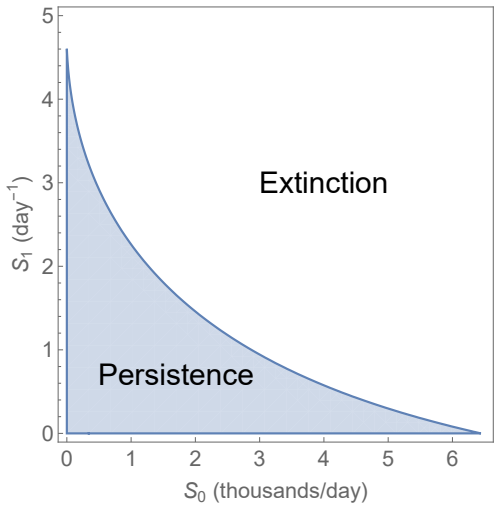
The central claim is that the mate-finding Allee effect makes the zero equilibrium globally asymptotically stable under sufficiently large constant sterile-male releases, that releases of either type annihilate the two positive equilibria through a saddle-node bifurcation, and that SIT therefore needs only to push the population across the Allee separatrix so that natural mate-finding failure finishes the job; the optimization framework shows the hybrid strategy achieves this crossing with the fewest total sterile males.
What carries the argument
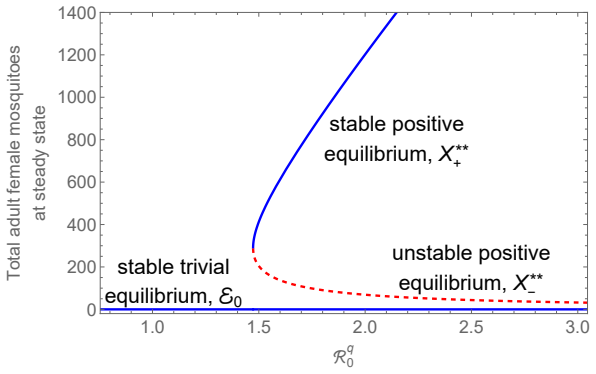
The mate-finding Allee effect generated by the refractory period followed by density-dependent mate search in the Holling type-II mating term, which produces the bistable regime separated by an unstable Allee equilibrium that SIT releases must cross.
If this is right
- Sufficiently large constant sterile-male releases make the mosquito-free equilibrium globally asymptotically stable from every admissible initial state.
- Releases can be halted once the population falls below the Allee separatrix because mate-finding failure then drives the remainder to extinction.
- A hybrid release strategy combining constant and population-responsive components requires fewer total sterile males than either pure constant or pure responsive strategy alone.
- The Allee effect functions as a control lever that SIT can exploit rather than merely an obstacle to overcome.
Where Pith is reading between the lines
- Programs could monitor local density and switch from constant to responsive releases once the population nears the threshold to further trim total releases.
- The same threshold-crossing logic could be tested in other insects that exhibit mate-finding Allee effects to see whether hybrid SIT schedules generalize.
- If field estimates of the Allee threshold prove reliable, initial high-release pulses could be sized precisely to reach the separatrix quickly before switching modes.
Load-bearing premise
The model assumes a specific Holling type-II mating term together with a refractory period and density-dependent mate search that together generate the mate-finding Allee effect; if real Anopheles mating dynamics deviate substantially from this functional form, the predicted bistability, saddle-node bifurcations, and control thresholds will not hold.
What would settle it
Observe or experimentally measure mating success rate as a function of local male density to test whether it follows the Holling type-II form and produces a clear density threshold below which populations decline to zero; alternatively, conduct controlled releases at the model's predicted threshold intensity and check whether extinction occurs from low initial densities but not from higher ones.
Figures





read the original abstract
We formulate and analyze a sex- and stage-structured model for Anopheles dynamics under the sterile insect technique (SIT), motivated by the need for tools robust to insecticide resistance and outdoor transmission. The model tracks aquatic stages, adult males, unmated females, and females mated with wild or sterile males; includes egg-laying capacity and larval competition; and uses a refractory period followed by density-dependent mate search. The resulting Holling type-II mating term generates a mate-finding Allee effect. After establishing well-posedness, we prove that this Allee effect makes the mosquito-free equilibrium locally stable for all admissible parameters and globally asymptotically stable when a quick-mate-search reproduction number $R_0^q$ is below one. When $R_0^q>1$, habitat capacity is large, and larval competition is weak, two positive equilibria arise through a saddle-node bifurcation: a stable natural equilibrium and an unstable Allee equilibrium separating persistence from extinction. For a reduced model, a Goh-Volterra Lyapunov functional estimates the persistence basin. We then show how constant and population-responsive sterile-male releases reshape this bistability. Sufficiently large releases annihilate the positive equilibria in a second saddle-node bifurcation, while a sufficiently large constant release drives local elimination from every admissible initial state. Thus SIT need only push the population across the Allee separatrix, after which mate-finding failure can complete extinction. In a free-horizon optimization framework with an Allee-threshold stopping rule, a hybrid release strategy reduces the sterile-male requirement by about $5\%$ relative to the best constant-only strategy and $39\%$ relative to the best population-responsive-only strategy. These results recast the Allee effect as a control lever for vector suppression.
Editorial analysis
A structured set of objections, weighed in public.
Referee Report
Summary. The paper formulates a sex- and stage-structured model for Anopheles mosquito dynamics under SIT that incorporates a refractory period and density-dependent mate search, yielding a Holling type-II mating term and a mate-finding Allee effect. It establishes well-posedness, proves local stability of the mosquito-free equilibrium for all parameters and global asymptotic stability when the quick-mate-search reproduction number R_0^q < 1, identifies two saddle-node bifurcations producing bistability (stable natural equilibrium and unstable Allee threshold) when R_0^q > 1 with large habitat capacity and weak larval competition, and analyzes constant and population-responsive sterile-male releases. The analysis shows that sufficiently large constant releases annihilate positive equilibria via a second saddle-node and drive elimination from any initial state; a hybrid release strategy in a free-horizon optimization with Allee-threshold stopping rule reduces total sterile males by ~5% versus the best constant-only strategy and ~39% versus the best responsive-only strategy.
Significance. If the derivations hold, the work supplies a mathematically rigorous demonstration that SIT can exploit an Allee threshold as a control lever, converting the need for sustained suppression into a one-time crossing of the separatrix after which natural mate-finding failure completes extinction. The combination of Lyapunov analysis for the persistence basin, explicit bifurcation thresholds, and quantitative optimization of release schedules provides a concrete, falsifiable framework that could guide cost-effective SIT deployment against insecticide-resistant vectors.
major comments (2)
- [model formulation and stability/bifurcation analysis sections] The proofs that the mosquito-free equilibrium is globally asymptotically stable for R_0^q < 1 and that constant releases annihilate the positive equilibria via a second saddle-node (thereby driving elimination from every admissible initial state) rest entirely on the specific Holling type-II mating term with refractory period and density-dependent search. The manuscript should supply a concrete sensitivity test—e.g., replacement of the mating function by a mass-action term and re-derivation of the phase-plane structure—to quantify how much the reported control thresholds change; this is load-bearing for the claim that SIT need only push across the Allee separatrix.
- [optimization framework and numerical results] The quantitative claims that the hybrid strategy reduces sterile-male totals by approximately 5% relative to the best constant-only strategy and 39% relative to the best population-responsive-only strategy are obtained in a free-horizon optimization with an Allee-threshold stopping rule. The specific numerical methods, parameter values, discretization scheme, and exact definition of the stopping rule used to generate these percentages must be stated explicitly (including any error tolerances or convergence criteria) so that the percentages can be independently reproduced.
Simulated Author's Rebuttal
We thank the referee for the constructive comments, which help improve the clarity and robustness of the manuscript. We address each major comment below.
read point-by-point responses
-
Referee: The proofs that the mosquito-free equilibrium is globally asymptotically stable for R_0^q < 1 and that constant releases annihilate the positive equilibria via a second saddle-node rest entirely on the specific Holling type-II mating term. The manuscript should supply a concrete sensitivity test—e.g., replacement of the mating function by a mass-action term and re-derivation of the phase-plane structure—to quantify how much the reported control thresholds change.
Authors: We agree the global stability and bifurcation results depend on the Holling type-II form, which is derived from the refractory period and density-dependent search. A full replacement with mass-action and complete re-derivation of all proofs would require a separate study and is beyond the scope of this revision. We will add a discussion paragraph explaining the biological justification for the chosen mating function and noting that the qualitative Allee effect and bistability persist for any saturating mating term. This addresses the concern without altering the core analysis. revision: partial
-
Referee: The quantitative claims that the hybrid strategy reduces sterile-male totals by approximately 5% relative to the best constant-only strategy and 39% relative to the best population-responsive-only strategy are obtained in a free-horizon optimization with an Allee-threshold stopping rule. The specific numerical methods, parameter values, discretization scheme, and exact definition of the stopping rule used to generate these percentages must be stated explicitly.
Authors: We agree these details are necessary for reproducibility. In the revised manuscript we will add a new subsection in the optimization section that explicitly lists all parameter values, the discretization scheme, the precise definition of the Allee-threshold stopping rule, error tolerances, and convergence criteria used to obtain the reported percentages. revision: yes
Circularity Check
No circularity: all central results are direct mathematical consequences of the stated model equations
full rationale
The paper defines a sex-stage structured ODE system, introduces a Holling type-II mating function with refractory period and density dependence, derives the quick-mate-search reproduction number R_0^q explicitly from the next-generation matrix or equilibrium conditions, proves local/global stability of the mosquito-free equilibrium when R_0^q < 1, and locates the saddle-node bifurcations that create the Allee threshold when R_0^q > 1. These steps are standard local analysis of the vector field; they reduce to algebraic manipulation of the given right-hand sides rather than to any fitted parameter or prior self-citation. The subsequent SIT control results (annihilation of positive equilibria by constant releases, hybrid optimization yielding 5 % and 39 % reductions) are obtained by applying the same bifurcation analysis to the augmented system with release terms. No load-bearing step is shown to be equivalent to its input by construction, and the manuscript is self-contained against external benchmarks.
Axiom & Free-Parameter Ledger
free parameters (1)
- R_0^q
axioms (2)
- domain assumption Holling type-II mating term with refractory period and density-dependent search generates mate-finding Allee effect
- standard math Existence and local stability of equilibria follow from standard ODE theory
Reference graph
Works this paper leans on
-
[1]
Journal of Biological Systems , volume=
Mathematical modeling of the impact of periodic release of sterile male mosquitoes and seasonality on the population abundance of malaria mosquitoes , author=. Journal of Biological Systems , volume=. 2020 , publisher=
2020
-
[2]
A maleness gene in the malaria mosquito
Krzywinska, Elzbieta and Dennison, Nathan J and Lycett, Gareth J and Krzywinski, Jaroslaw , journal=. A maleness gene in the malaria mosquito. 2016 , publisher=
2016
-
[3]
Howell, Paul I. and Knols, Bart G. J. , title =. Malaria Journal , year =. doi:10.1186/1475-2875-8-S2-S8 , pmcid =
-
[4]
Takken, W. and Klowden, M. J. and Chambers, G. M. , title =. Journal of Medical Entomology , year =. doi:10.1093/jmedent/35.5.639 , url =
-
[5]
Afrane, Yaw A. and Githeko, Andrew K. and Yan, Guiyun , title =. Annals of the New York Academy of Sciences , year =. doi:10.1111/j.1749-6632.2011.06432.x , pmcid =
-
[6]
Bayoh, M. Nabie and Lindsay, Steve W. , title =. Bulletin of Entomological Research , year =. doi:10.1079/BER2003259 , url =
-
[7]
2001 , type =
Bayoh, Mohamed Nabie , title =. 2001 , type =
2001
-
[8]
BioRxiv , pages=
A meta-analysis of longevity estimates of mosquito vectors of disease , author=. BioRxiv , pages=. 2022 , publisher=
2022
-
[9]
and Coulson, Tim and Mbogo, Charles M
Muriu, Simon M. and Coulson, Tim and Mbogo, Charles M. and Godfray, H. Charles J. , title =. Journal of Animal Ecology , year =. doi:10.1111/j.1365-2656.2012.02019.x , pmid =
-
[10]
Gilles, J. R. L. and Lees, Rosemary and Soliban, Sharon M. and Benedict, Mark Q. , title =. Journal of Medical Entomology , year =. doi:10.1603/ME10163 , pmid =
-
[11]
Diet and density dependent competition affect larval performance and oviposition site selection in the mosquito species
Yoshioka, Miho and Couret, Jannelle and Kim, Frances and McMillan, Joseph and Burkot, Thomas R and Dotson, Ellen M and Kitron, Uriel and Vazquez-Prokopec, Gonzalo M , journal=. Diet and density dependent competition affect larval performance and oviposition site selection in the mosquito species. 2012 , publisher=
2012
-
[12]
Sutter, Andreas and Price, Tom A. R. and Wedell, Nina , title =. Current Opinion in Insect Science , year =. doi:10.1016/j.cois.2021.02.003 , url =
-
[13]
Lees, Rosemary and Gilles, Jeremie R. L. and Hendrichs, Jorge and Vreysen, Marc J. B. and Bourtzis, Kostas , title =. Current Opinion in Insect Science , year =. doi:10.1016/j.cois.2015.05.011 , url =
-
[14]
Mathematical Biosciences , year =
Esteva, Lourdes and Yang, Hyun Mo , title =. Mathematical Biosciences , year =. doi:10.1016/j.mbs.2005.06.004 , url =
-
[15]
Parous rate and longevity of anophelines mosquitoes in bure district, northwestern
Adugna, Tilahun and Getu, Emana and Yewhelew, Delenasaw , journal=. Parous rate and longevity of anophelines mosquitoes in bure district, northwestern. 2022 , publisher=
2022
-
[16]
Parasites & vectors , volume=
An overview of malarial Anopheles mosquito survival estimates in relation to methodology , author=. Parasites & vectors , volume=. 2020 , publisher=
2020
-
[17]
Mating behavior and gonotrophic cycle in
Fereda, Desta Ejeta , journal=. Mating behavior and gonotrophic cycle in
-
[18]
Malaria journal , volume=
Laboratory selection for an accelerated mosquito sexual development rate , author=. Malaria journal , volume=. 2011 , publisher=
2011
-
[19]
Damiens, David and Marquereau, Lucie and Lebon, Cyrille and Le Goff, Gilbert and Gaudillat, Benjamin and Habchi-Hanriot, Nausicaa and Gouagna, Louis-Cl. Insects , volume =. 2019 , pages =. doi:10.3390/insects10080246 , url =
-
[20]
Yamada, H. and Parker, A. G. and Oliva, C. F. and Balestrino, F. and Gilles, J. R. L. , title =. Journal of Medical Entomology , volume =. 2014 , month =. doi:10.1603/ME13223 , url =
-
[21]
and Dame, David A
Alphey, Luke and Benedict, Mark and Bellini, Romeo and Clark, Gary G. and Dame, David A. and Service, Michael W. and Dobson, Stephen L. , title =. Vector-Borne and Zoonotic Diseases , volume =. 2010 , doi =
2010
-
[22]
and Ranford-Cartwright, Lisa C
Baton, Luke A. and Ranford-Cartwright, Lisa C. , title =. Trends in Parasitology , year =. doi:10.1016/j.pt.2005.09.012 , url =
-
[23]
2023 , month = jul, day =
Mandal, Ananya , title =. 2023 , month = jul, day =
2023
-
[24]
2025 , month = dec, day =
Malaria , howpublished =. 2025 , month = dec, day =
2025
-
[25]
Gething, Peter W. and Patil, Anand P. and Smith, David L. and Guerra, Carlos A. and Elyazar, Iqbal R. F. and Johnston, Geoffrey L. and Tatem, Andrew J. and Hay, Simon I. , title =. Malaria Journal , year =. doi:10.1186/1475-2875-10-378 , url =
-
[26]
Johnston, Geoffrey L. and Smith, David L. and Fidock, David A. , title =. PLoS Computational Biology , year =. doi:10.1371/journal.pcbi.1003025 , url =
-
[27]
Mohammed-Awel, Jemal and Gumel, Abba B. , title =. Mathematical Biosciences , year =. doi:10.1016/j.mbs.2019.02.008 , url =
-
[28]
Mohammed-Awel, Jemal and Iboi, Enahoro A. and Gumel, Abba B. , title =. Mathematical Biosciences , year =. doi:10.1016/j.mbs.2020.108368 , url =
-
[29]
Effect of irradiation on the survival and susceptibility of female
Guissou, Edwige and Poda, Serge and de Sales Hien, Domombabele Fran. Effect of irradiation on the survival and susceptibility of female. Parasites & Vectors , year =. doi:10.1186/s13071-020-04135-w , url =
-
[30]
Global Technical Strategy for Malaria 2016–-2030 , year =
2016
-
[31]
World Malaria Report 2015 , year =
2015
-
[32]
Malaria Strategy Overview , year =
-
[33]
Willis, Derek W. and Hamon, Nick , title =. Gates Open Research , year =. doi:10.12688/gatesopenres.12843.2 , url =
-
[34]
Consequences of insecticide resistance on malaria transmission , journal =
Alout, Haoues and Roche, Benjamin and Dabir. Consequences of insecticide resistance on malaria transmission , journal =. 2017 , volume =. doi:10.1371/journal.ppat.1006499 , url =
-
[35]
Barbosa, Susana and Kay, Katherine and Chitnis, Nakul and Hastings, Ian M. , title =. Parasites & Vectors , year =. doi:10.1186/s13071-018-3025-z , url =
-
[36]
Carter, Tamar E. and Gebresilassie, Araya and Hansel, Shantoy and Damodaran, Lambodhar and Montgomery, Callum and Bonnell, Victoria and Lopez, Karen and Janies, Daniel and Yared, Solomon , title =. The American Journal of Tropical Medicine and Hygiene , year =. doi:10.4269/ajtmh.20-1357 , url =
-
[37]
and Coetzee, Maureen and Mzilahowa, Themba , title =
Kumala, Justin and Koekemoer, Lizette L. and Coetzee, Maureen and Mzilahowa, Themba , title =. Parasites & Vectors , year =. doi:10.1186/s13071-022-05299-3 , url =
-
[38]
Insecticide Control of Vector-Borne Diseases: When Is Insecticide Resistance a Problem? , journal =
Rivero, Ana and V. Insecticide Control of Vector-Borne Diseases: When Is Insecticide Resistance a Problem? , journal =. 2010 , volume =. doi:10.1371/journal.ppat.1001000 , url =
-
[39]
Munhenga, Givemore and Oliver, Sh. Malaria risk and receptivity: Continuing development of insecticide resistance in the major malaria vector. South African Journal of Science , year =. doi:10.17159/sajs.2022/11755 , url =
-
[40]
and Elsworth, Brendan and Duraisingh, Manoj T
Buyon, Lucas E. and Elsworth, Brendan and Duraisingh, Manoj T. , title =. International Journal for Parasitology: Drugs and Drug Resistance , year =. doi:10.1016/j.ijpddr.2021.04.002 , url =
-
[41]
Drug Resistance in the Malaria-Endemic World , year =
-
[42]
Nature Reviews Microbiology , year =
Haldar, Kasturi and Bhattacharjee, Souvik and Safeukui, Innocent , title =. Nature Reviews Microbiology , year =. doi:10.1038/nrmicro.2017.161 , url =
-
[43]
Manirakiza, Godfrey and Kassaza, Kennedy and Taremwa, Ivan Mugisha and Bazira, Joel and Byarugaba, Fredrick , title =. Malaria Journal , year =. doi:10.1186/s12936-021-04023-3 , url =
-
[44]
Townson, Harold , title =. Malaria Journal , year =. doi:10.1186/1475-2875-8-S2-S10 , url =
-
[45]
Efficacy of a low-dose candidate malaria vaccine,
Datoo, Mehreen S and Natama, Magloire H and Som. Efficacy of a low-dose candidate malaria vaccine,. The Lancet , year =. doi:10.1016/S0140-6736(21)00943-0 , url =
-
[46]
Maxmen, Amy , title =. Nature , year =. doi:10.1038/d41586-021-02755-5 , note =
-
[47]
Science , year =
de Vrieze, Jop , title =. Science , year =
-
[48]
Chung, Hae-Na and Rodriguez, Stacy D. and Gonzales, Kristina K. and Vulcan, Julia and Cordova, Joel J. and Mitra, Soumi and Adams, Christopher G. and Moses-Gonzales, Nathan and Tam, Nicole and Cluck, Joshua W. and Attardo, Geoffrey M. and Hansen, Immo A. , title =. Journal of Insect Science , year =. doi:10.1093/jisesa/iey103 , url =
-
[49]
Adult mosquito predation and potential impact on the sterile insect technique , journal =
Somda, Nanwintoum S. Adult mosquito predation and potential impact on the sterile insect technique , journal =. 2022 , volume =. doi:10.1038/s41598-022-06565-1 , url =
-
[50]
2021 , publisher=
Sterile insect technique: principles and practice in area-wide integrated pest management , author=. 2021 , publisher=
2021
-
[51]
The Scientific Monthly , volume=
Control of screw-worm fly by atomic radiation , author=. The Scientific Monthly , volume=. 1957 , publisher=
1957
-
[52]
Journal of Economic Entomology , volume=
Possibilities of insect control or eradication through the use of sexually sterile males , author=. Journal of Economic Entomology , volume=. 1955 , publisher=
1955
-
[53]
1979 , publisher=
The basic principles of insect population suppression and management , author=. 1979 , publisher=
1979
-
[54]
Mating competitiveness and life-table comparisons between transgenic and
Patil, Prabhakargouda B and Niranjan Reddy, B P and Gorman, Kevin and Seshu Reddy, K V and Barwale, Shirish R and Zehr, Usha B and Nimmo, Derric and Naish, Neil and Alphey, Luke , journal=. Mating competitiveness and life-table comparisons between transgenic and. 2015 , publisher=
2015
-
[55]
Glossina austeni (
Vreysen, Marc JB and Saleh, Khalfan M and Ali, Mashavu Y and Abdulla, Abdulla M and Zhu, Zeng-Rong and Juma, Kassim G and Dyck, V Arnold and Msangi, Atway R and Mkonyi, Paul A and Feldmann, H Udo , journal=. Glossina austeni (. 2000 , publisher=
2000
-
[56]
Trends in parasitology , volume=
The first releases of transgenic mosquitoes: an argument for the sterile insect technique , author=. Trends in parasitology , volume=. 2003 , publisher=
2003
-
[57]
Pilot field trials with
Bellini, Romeo and Medici, A and Puggioli, Arianna and Balestrino, Fabrizio and Carrieri, M , journal=. Pilot field trials with. 2013 , publisher=
2013
-
[58]
Nature , volume=
Incompatible and sterile insect techniques combined eliminate mosquitoes , author=. Nature , volume=. 2019 , publisher=
2019
-
[59]
Towards a sterile insect technique field release of
Helinski, Michelle EH and Hassan, Mo'awia M and El-Motasim, Waleed M and Malcolm, Colin A and Knols, Bart GJ and El-Sayed, Badria , journal=. Towards a sterile insect technique field release of. 2008 , publisher=
2008
-
[60]
Evaluating the potential of the sterile insect technique for malaria control: relative fitness and mating compatibility between laboratory colonized and a wild population of
Munhenga, Givemore and Brooke, Basil D and Chirwa, Tobias F and Hunt, Richard H and Coetzee, Maureen and Govender, Danny and Koekemoer, Lizette L , journal=. Evaluating the potential of the sterile insect technique for malaria control: relative fitness and mating compatibility between laboratory colonized and a wild population of. 2011 , publisher=
2011
-
[61]
Impact on mosquito-borne diseases control when viruses are circulating , author=
Sterile insect technique with accidental releases of sterile females. Impact on mosquito-borne diseases control when viruses are circulating , author=. Mathematical Biosciences , volume=. 2022 , publisher=
2022
-
[62]
Impact of irradiation on the reproductive traits of field and laboratory
Poda, Serge B and Guissou, Edwige and Ma. Impact of irradiation on the reproductive traits of field and laboratory. Parasites & Vectors , volume=. 2018 , publisher=
2018
-
[63]
Impact on disease vector control and disease control , author=
About contamination by sterile females and residual male fertility on the effectiveness of the sterile insect technique. Impact on disease vector control and disease control , author=. Mathematical Biosciences , volume=. 2024 , publisher=
2024
-
[64]
A rapid quality control test to foster the development of the sterile insect technique against
Culbert, Nicole J and Somda, Nanwintoum S. A rapid quality control test to foster the development of the sterile insect technique against. Malaria journal , volume=. 2020 , publisher=
2020
-
[65]
Helinski, Michelle E. H. and Knols, Bart G. J. , journal=. The influence of late-stage pupal irradiation and increased irradiated: un-irradiated male ratio on mating competitiveness of the malaria mosquito. 2009 , publisher=
2009
-
[66]
SIAM Journal on Applied Mathematics , volume=
Dynamics of mosquitoes populations with different strategies for releasing sterile mosquitoes , author=. SIAM Journal on Applied Mathematics , volume=. 2014 , publisher=
2014
-
[67]
Mathematical studies on the sterile insect technique for the
Dumont, Yves and Tchuenche, Jean Michel , journal=. Mathematical studies on the sterile insect technique for the. 2012 , publisher=
2012
-
[68]
Journal of Biological Dynamics , volume=
Stage-structured wild and sterile mosquito population models and their dynamics , author=. Journal of Biological Dynamics , volume=. 2017 , publisher=
2017
-
[69]
Bulletin of Mathematical Biology , volume=
On nonlinear pest/vector control via the sterile insect technique: Impact of residual fertility , author=. Bulletin of Mathematical Biology , volume=. 2020 , publisher=
2020
-
[70]
Mathematical biosciences , volume=
Implementation of control strategies for sterile insect techniques , author=. Mathematical biosciences , volume=. 2019 , publisher=
2019
-
[71]
Mathematical Methods in the Applied Sciences , volume=
Sustainable vector/pest control using the permanent sterile insect technique , author=. Mathematical Methods in the Applied Sciences , volume=. 2020 , publisher=
2020
-
[72]
Mathematical Biosciences , volume =
Optimal control of. Mathematical Biosciences , volume =. 2010 , issn =. doi:https://doi.org/10.1016/j.mbs.2009.08.009 , url =
-
[73]
Insects , volume=
Sterile Insect Technique (SIT) against Aedes species mosquitoes: A roadmap and good practice framework for designing, implementing and evaluating pilot field trials , author=. Insects , volume=. 2021 , publisher=
2021
-
[74]
Asymmetrical reproductive interference between
Hasan, Tanvir and Afrin, Sadia and Sultana, Afroza and Islam, Ashekul , journal=. Asymmetrical reproductive interference between. 2024 , publisher=
2024
-
[75]
BMC ecology , volume=
Coexistence mechanisms at multiple scales in mosquito assemblages , author=. BMC ecology , volume=. 2014 , publisher=
2014
-
[76]
Climate change and the resurgence of malaria in the
Hay, Simon I and Cox, Jonathan and Rogers, David J and Randolph, Sarah E and Stern, David I and Shanks, G Dennis and Myers, Monica F and Snow, Robert W , journal=. Climate change and the resurgence of malaria in the. 2002 , publisher=
2002
-
[77]
National Geographic , date =
Jason Bittel , title =. National Geographic , date =
-
[78]
The Journal of chemical physics , volume=
First passage time approach to diffusion controlled reactions , author=. The Journal of chemical physics , volume=. 1980 , publisher=
1980
-
[79]
Physical Review E , volume=
First-encounter time of two diffusing particles in confinement , author=. Physical Review E , volume=. 2020 , publisher=
2020
-
[80]
and Schuss, Z
Singer, A. and Schuss, Z. and Holcman, D. , journal=. Narrow escape, Part. 2006 , publisher=
2006
discussion (0)
Sign in with ORCID, Apple, or X to comment. Anyone can read and Pith papers without signing in.