OpenAgenet / OAN White Paper: Open Infrastructure for Trusted Agent Interconnection
Pith reviewed 2026-06-28 08:05 UTC · model grok-4.3
The pith
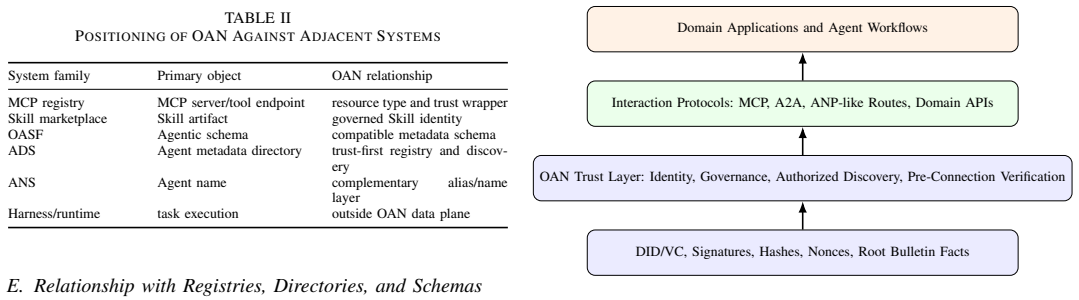
OAN supplies a protocol-neutral trust layer so agents can verify identities and governance before interconnecting across operators.
A machine-rendered reading of the paper's core claim, the machinery that carries it, and where it could break.
Core claim
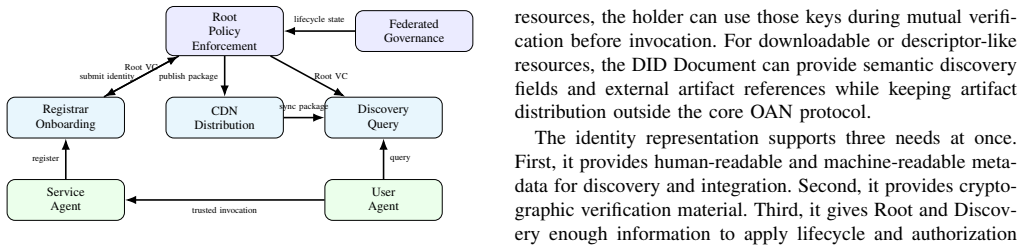
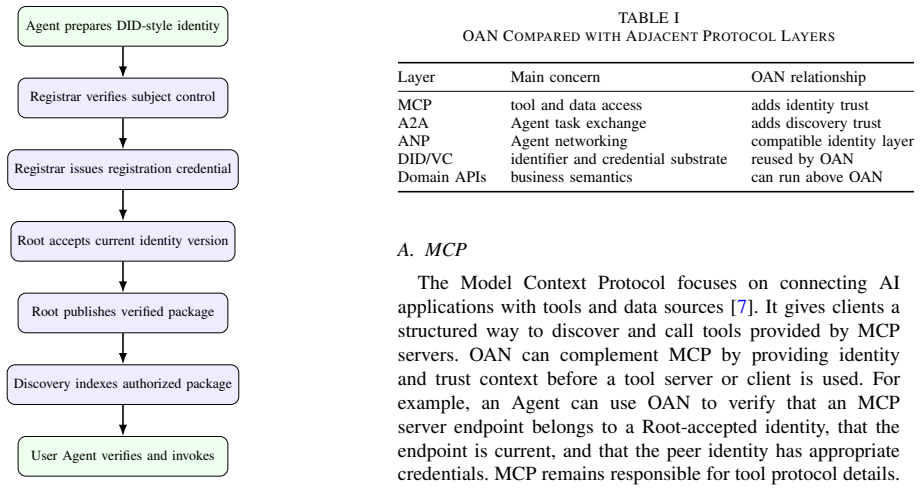
OAN is designed as a protocol-neutral trust layer that provides did:oan-based resource identity, governance-backed admission, Registrar-assisted onboarding, Root-verified package publication, authorization-aware Discovery, Root-issued infrastructure authorization VCs, and signed trusted invocation, with its architectural center being the combination of federated governance, resource identity, and trusted Discovery.
What carries the argument
The combination of federated governance, resource identity, and trusted Discovery that supplies verifiable trust evidence without replacing agent interaction protocols.
If this is right
- Agents obtain verifiable identity provenance and governance state before any invocation.
- Package publication carries root verification so recipients can confirm integrity.
- Discovery queries respect authorization rules enforced by the governance layer.
- Infrastructure authorizations are carried as root-issued VCs that accompany requests.
- The system remains protocol-neutral and can sit alongside existing agent interaction frameworks.
Where Pith is reading between the lines
- Mapping did:oan identities onto other agent naming schemes could allow incremental adoption.
- Federated governance may still concentrate power if root operators coordinate closely.
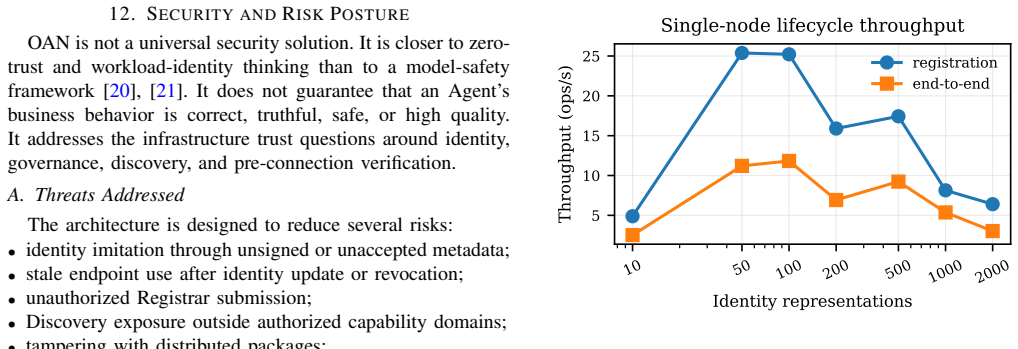
- Performance measurements in the white paper could be tested against real cross-operator traffic patterns.
Load-bearing premise
The mechanisms of did:oan identities, federated governance, and root-issued credentials will deliver verifiable trust evidence and safe interconnection in practice without new centralization risks or adoption barriers.
What would settle it
A working multi-operator deployment in which agents achieve equivalent safety and discovery without using the proposed did:oan identities, root-issued VCs, or federated governance layer.
Figures
read the original abstract
OpenAgenet, abbreviated as OAN, is an open infrastructure project for trusted Agent interconnection. It addresses a problem that becomes visible when Agents move from isolated applications into open, multi-operator networks: before an Agent can safely discover, select, and invoke another Agent, it needs a way to verify identity provenance, governance state, discovery authorization, freshness, and pre-connection trust evidence. OAN is designed as a protocol-neutral trust layer. It does not replace Agent interaction protocols, tool protocols, model orchestration frameworks, or application-level workflows. Instead, it provides \texttt{did:oan}-based resource identity, governance-backed admission, Registrar-assisted onboarding, Root-verified package publication, authorization-aware Discovery, Root-issued infrastructure authorization VCs, and signed trusted invocation. The architectural center of OAN is the combination of federated governance, resource identity, and trusted Discovery, rather than a single directory or naming service. This white paper explains the motivation, architecture, roles, governance model, relationship with MCP, A2A, and ANP, deployment patterns, cooperation model, on-chain governance layer, prototype status, performance profile, and roadmap of OAN.
Editorial analysis
A structured set of objections, weighed in public.
Referee Report
Summary. The manuscript is a white paper proposing OpenAgenet (OAN) as an open, protocol-neutral trust layer for Agent interconnection in multi-operator networks. It describes components including did:oan-based resource identity, governance-backed admission, Registrar-assisted onboarding, Root-verified package publication, authorization-aware Discovery, Root-issued infrastructure authorization VCs, and signed trusted invocation. The architectural center is identified as the combination of federated governance, resource identity, and trusted Discovery. The text covers motivation, architecture, roles, governance model, relationships to MCP/A2A/ANP, deployment patterns, cooperation model, on-chain governance, prototype status, performance profile, and roadmap.
Significance. If realized, the described architecture could supply a missing trust layer for safe discovery and invocation among agents across operators. The manuscript offers a coherent high-level design sketch but contains no empirical data, formal analysis, security proofs, or implementation evidence, so its significance remains prospective and conceptual rather than demonstrative.
Simulated Author's Rebuttal
We thank the referee for reviewing the OAN white paper. The assessment correctly identifies the work as a high-level conceptual proposal for a trust layer. We address the significance and recommendation below.
read point-by-point responses
-
Referee: The manuscript offers a coherent high-level design sketch but contains no empirical data, formal analysis, security proofs, or implementation evidence, so its significance remains prospective and conceptual rather than demonstrative.
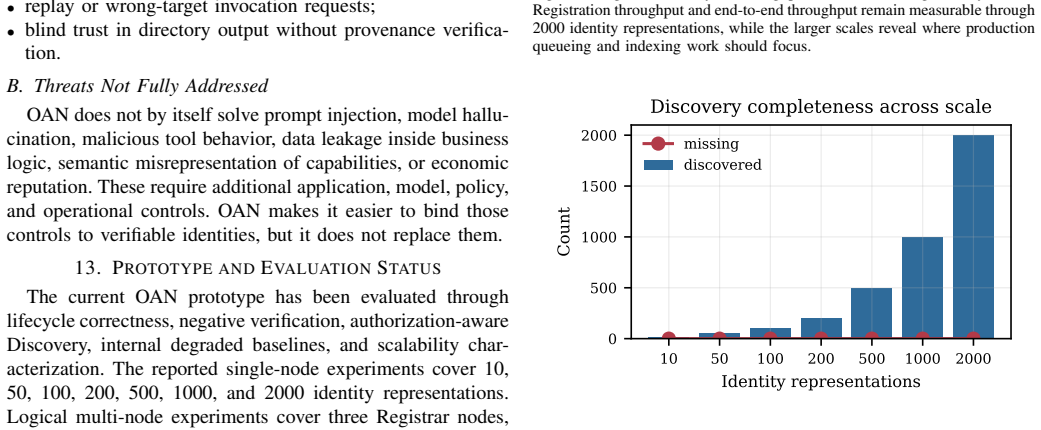
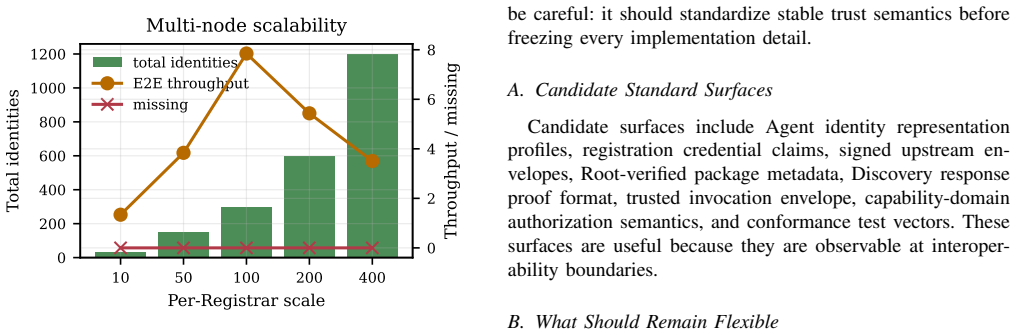
Authors: We agree the manuscript is a white paper presenting a design sketch rather than empirical results or formal proofs. Its stated purpose is to describe the motivation, architecture, roles, governance model, relationships to existing protocols, deployment patterns, and roadmap to enable community discussion and future implementation work. The text does reference prototype status and a performance profile, but these are high-level and not accompanied by detailed benchmarks or security analysis. We do not claim demonstrative significance at this stage. revision: no
Circularity Check
No significant circularity; purely descriptive proposal
full rationale
The document is a white paper that describes a proposed architecture and roles for OAN without any equations, derivations, predictions, fitted parameters, or first-principles results. No load-bearing claims reduce to self-definitions, self-citations, or renamings of inputs. The central description of components (did:oan identities, federated governance, Root-issued VCs) is presented as design intent rather than derived from prior quantities within the paper. This matches the default expectation of no circularity for non-derivational documents.
Axiom & Free-Parameter Ledger
axioms (1)
- domain assumption Federated governance combined with root verification can supply reliable trust evidence for agent identity and authorization.
invented entities (2)
-
did:oan
no independent evidence
-
Root-issued infrastructure authorization VCs
no independent evidence
Reference graph
Works this paper leans on
-
[1]
Open Container Initiative Distribution Spec- ification,
Open Container Initiative, “Open Container Initiative Distribution Spec- ification,” https://specs.opencontainers.org/distribution-spec/, 2026, ac- cessed: 2026-06-05
2026
-
[2]
Open Container Initiative Image Format Specification,
——, “Open Container Initiative Image Format Specification,” https: //specs.opencontainers.org/image-spec/, 2026, accessed: 2026-06-05
2026
-
[3]
A survey on large language model based autonomous agents,
L. Wang, C. Ma, X. Feng, Z. Zhang, H. Yang, J. Zhang, Z. Chen, J. Tang, X. Chen, Y . Lin, W. X. Zhao, Z. Wei, and J.-R. Wen, “A survey on large language model based autonomous agents,”Frontiers of Computer Science, vol. 18, no. 6, p. 186345, 2024
2024
-
[4]
AutoGen: Enabling Next-Gen LLM Applications via Multi-Agent Conversation
Q. Wu, G. Bansal, J. Zhang, Y . Wu, B. Li, E. Zhu, L. Jiang, X. Zhang, S. Zhang, J. Liu, A. H. Awadallah, R. W. White, D. Burger, and C. Wang, “Autogen: Enabling next-gen llm applications via multi-agent conversation,”arXiv preprint arXiv:2308.08155, 2023
work page internal anchor Pith review Pith/arXiv arXiv 2023
-
[5]
MetaGPT: Meta programming for a multi-agent collaborative framework,
S. Hong, X. Zheng, J. Chen, Y . Cheng, J. Wang, C. Zhang, Z. Wang, S. K. S. Yau, Z. Lin, L. Zhou, C. Ran, L. Xiao, and C. Wu, “MetaGPT: Meta programming for a multi-agent collaborative framework,” inThe Twelfth International Conference on Learning Representations, 2024. [Online]. Available: https://openreview.net/forum?id=VtmBAGCN7o
2024
-
[6]
Generative agents: Interactive simulacra of human behavior,
J. S. Park, J. C. O’Brien, C. J. Cai, M. R. Morris, P. Liang, and M. S. Bernstein, “Generative agents: Interactive simulacra of human behavior,” inProceedings of the 36th Annual ACM Symposium on User Interface Software and Technology, 2023
2023
-
[7]
Model context protocol specifi- cation,
Model Context Protocol Contributors, “Model context protocol specifi- cation,” https://modelcontextprotocol.io/specification/, 2025
2025
-
[8]
Agent2agent protocol specification,
A2A Protocol Contributors, “Agent2agent protocol specification,” https: //a2a-protocol.org/latest/specification/, 2025
2025
-
[9]
Did:wba method specification: Web-based agent decentralized identifier,
Agent Network Protocol Contributors, “Did:wba method specification: Web-based agent decentralized identifier,” https://agentnetworkprotocol. com/en/specs/03-did-wba-method-specification/, 2025
2025
-
[10]
Decentralized identifiers (dids) v1.0,
W3C Credentials Community Group, “Decentralized identifiers (dids) v1.0,” https://www.w3.org/TR/did-core/, 2022
2022
-
[11]
Verifiable credentials data model v2.0,
W3C Verifiable Credentials Working Group, “Verifiable credentials data model v2.0,” https://www.w3.org/TR/vc-data-model-2.0/, 2025
2025
-
[12]
Dns-based service discovery,
S. Cheshire and M. Krochmal, “Dns-based service discovery,” RFC 6763, 2013
2013
-
[13]
Service binding and parameter specification via the dns (svcb and https resource records),
B. M. Schwartz, M. Bishop, and E. Nygren, “Service binding and parameter specification via the dns (svcb and https resource records),” RFC 9460, 2023
2023
-
[14]
J. Xu, “Grail: A deep-granularity hybrid resonance framework for real-time agent discovery via slm-enhanced indexing,”arXiv preprint arXiv:2605.02489, 2026
work page internal anchor Pith review Pith/arXiv arXiv 2026
-
[15]
Model Context Protocol Reg- istry,
Model Context Protocol Contributors, “Model Context Protocol Reg- istry,” https://github.com/modelcontextprotocol/registry, 2026, accessed: 2026-06-05
2026
-
[16]
Open Agentic Schema Framework,
AGNTCY Contributors, “Open Agentic Schema Framework,” https:// github.com/agntcy/oasf, 2026, accessed: 2026-06-05
2026
-
[17]
Agent Directory Service Overview,
——, “Agent Directory Service Overview,” https://docs.agntcy.org/dir/ overview/, 2026, accessed: 2026-06-05
2026
-
[18]
Agent name service (ans): A universal directory for secure ai agent discovery and interoperability,
K. Huang, V . S. Narajala, I. Habler, and A. Sheriff, “Agent name service (ans): A universal directory for secure ai agent discovery and interoperability,”arXiv preprint arXiv:2505.10609, 2025
-
[19]
Agentdns: A root domain naming system for llm agents,
E. Cui, Y . Cheng, R. She, D. Liu, Z. Liang, M. Guo, T. Li, Q. Wei, W. Xing, and Z. Zhong, “Agentdns: A root domain naming system for llm agents,”arXiv preprint arXiv:2505.22368, 2025
-
[20]
Zero trust archi- tecture,
S. Rose, O. Borchert, S. Mitchell, and S. Connelly, “Zero trust archi- tecture,” NIST Special Publication 800-207, 2020
2020
-
[21]
The spiffe and spire project for workload identity,
Cloud Native Computing Foundation, “The spiffe and spire project for workload identity,” https://spiffe.io/, 2022
2022
-
[22]
DarwinNet: An Evolutionary Network Architecture for Agent-Driven Protocol Synthesis
J. Xu and B. Li, “Darwinnet: An evolutionary network architecture for agent-driven protocol synthesis,”arXiv preprint arXiv:2604.01236, 2026
work page internal anchor Pith review Pith/arXiv arXiv 2026
-
[23]
Chatdev: Communicative agents for software development,
C. Qian, X. Cong, C. Yang, W. Chen, Y . Su, J. Xu, Z. Liu, and M. Sun, “Chatdev: Communicative agents for software development,” inProceedings of the 62nd Annual Meeting of the Association for Computational Linguistics, 2024, pp. 15 174–15 186
2024
-
[24]
Beyond dns: Unlocking the internet of ai agents via the nanda index and verified agentfacts,
R. Raskar, P. Chari, J. Zinky, M. Lambe, J. J. Grogan, S. Wang, R. Ranjan, R. Singhal, S. Gupta, R. Lincourt, R. Bala, A. Joshi, A. Singh, A. Chopra, D. Stripelis, B. B, S. Kumar, and M. Gorskikh, “Beyond dns: Unlocking the internet of ai agents via the nanda index and verified agentfacts,”arXiv preprint arXiv:2507.14263, 2025
discussion (0)
Sign in with ORCID, Apple, or X to comment. Anyone can read and Pith papers without signing in.