Explainable Detection of Depression Status Shifts from User Digital Traces
Pith reviewed 2026-06-30 20:18 UTC · model grok-4.3
The pith
An explainable framework detects depression status shifts from digital traces by combining BERT signals into trajectories and using an LLM for reports.
A machine-rendered reading of the paper's core claim, the machinery that carries it, and where it could break.
Core claim
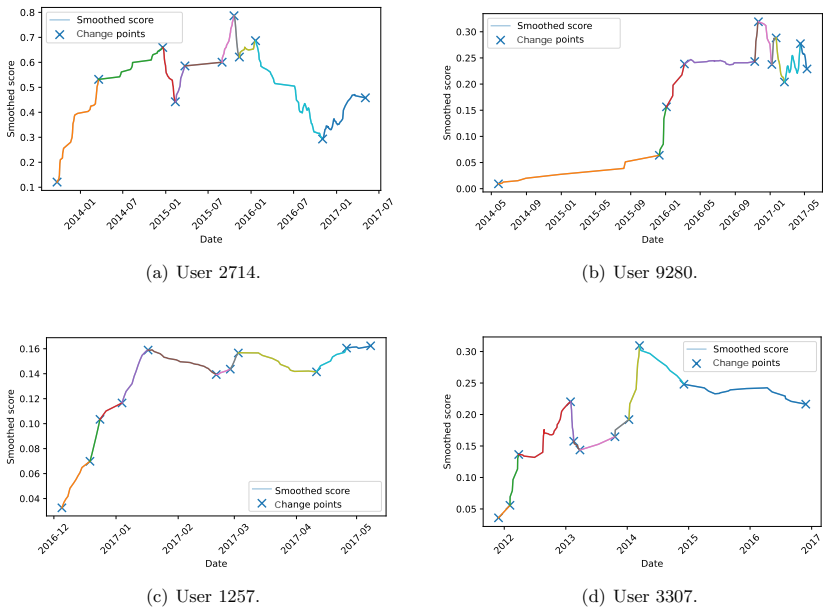
The approach produces more coherent and informative summaries than direct LLM-based reporting, achieving higher coverage of user history, stronger temporal coherence, and improved sensitivity to change points. The framework integrates BERT models for signal extraction, temporal aggregation for trajectories, change point analysis, and LLM for explainable reports, providing an interpretable view of mental health signals over time.
What carries the argument
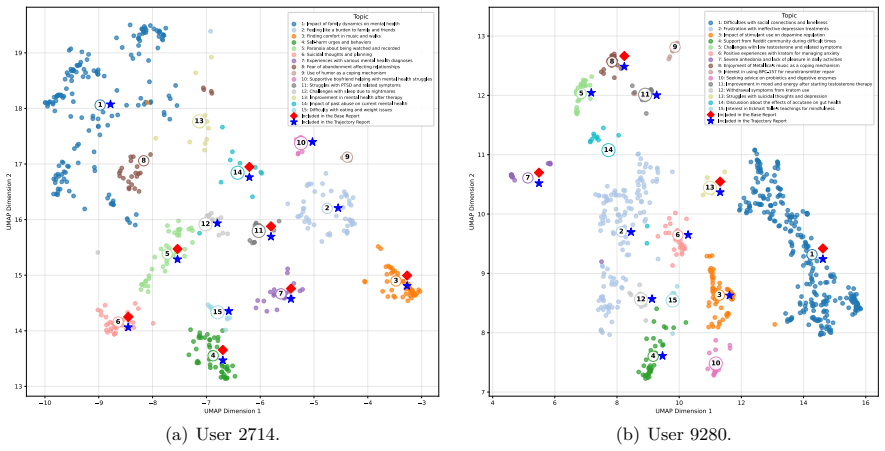
The explainable framework that combines multiple BERT-based models to extract signals, aggregates them into temporal trajectories analyzed for change points, and uses a large language model to generate human-readable reports on mental health signal evolution.
If this is right
- The framework provides an interpretable view of mental health signals over time.
- It supports research and decision making without aiming at clinical diagnosis.
- An ablation study confirms the contribution of temporal modeling and segmentation.
- Evaluation on two social media datasets shows improved performance over direct LLM reporting.
Where Pith is reading between the lines
- This could be adapted to track other psychological states by modifying the signal dimensions extracted by the models.
- Validation against actual clinical outcomes would strengthen the link between detected trajectories and real status shifts.
- Applying the method to different platforms or data types might reveal domain-specific patterns in signal evolution.
- Combining these trajectories with other data sources could improve the robustness of change point detection.
Load-bearing premise
The signals extracted by the BERT models and aggregated into trajectories reliably reflect actual depression-related status shifts rather than unrelated topic changes or platform noise.
What would settle it
Comparing the identified change points and summaries against independent clinical evaluations or user self-reports of mental health changes to check for alignment.
Figures

read the original abstract
Every day, users generate digital traces (e.g., social media posts, chats, and online interactions) that are inherently timestamped and may reflect aspects of their mental state. These traces can be organized into temporal trajectories that capture how a user's mental health signals evolve, including phases of improvement, deterioration, or stability. In this work, we propose an explainable framework for detecting and analyzing depression-related status shifts in user digital traces. The approach combines multiple BERT-based models to extract complementary signals across different dimensions (e.g., sentiment, emotion, and depression severity). Such signals are then aggregated over time to construct user-level trajectories that are analyzed to identify meaningful change points. To enhance interpretability, the framework integrates a large language model to generate concise and human-readable reports that describe the evolution of mental-health signals and highlight key transitions. We evaluate the framework on two social media datasets. Results show that the approach produces more coherent and informative summaries than direct LLM-based reporting, achieving higher coverage of user history, stronger temporal coherence, and improved sensitivity to change points. An ablation study confirms the contribution of each component, particularly temporal modeling and segmentation. Overall, the method provides an interpretable view of mental health signals over time, supporting research and decision making without aiming at clinical diagnosis.
Editorial analysis
A structured set of objections, weighed in public.
Referee Report
Summary. The manuscript presents an explainable framework for detecting depression status shifts from user digital traces. Multiple BERT-based models extract complementary signals (sentiment, emotion, depression severity); these are aggregated into temporal trajectories whose change points are identified and then summarized by an LLM into human-readable reports. The approach is evaluated on two social media datasets and is claimed to yield more coherent and informative summaries than direct LLM reporting, with higher coverage of user history, stronger temporal coherence, and improved sensitivity to change points. An ablation study is said to confirm the value of temporal modeling and segmentation.
Significance. If the performance and validation claims hold, the work could provide a useful pipeline for generating interpretable, non-clinical descriptions of mental-health signal trajectories from timestamped digital traces. The combination of multi-signal BERT extraction with LLM summarization and explicit change-point detection is a coherent design choice. The manuscript does not, however, supply the quantitative metrics, baselines, or external validation needed to assess whether these advantages are realized.
major comments (2)
- [Evaluation] Evaluation section: the abstract asserts higher coverage, stronger temporal coherence, and improved sensitivity to change points relative to direct LLM reporting, yet supplies no quantitative metrics, baseline methods, statistical tests, dataset sizes, or numerical results, so the central performance claim cannot be verified.
- [Methods and Evaluation] Methods and Evaluation sections: the claim that aggregated BERT trajectories yield change points that reflect depression-related status shifts rests on the untested assumption that these points correspond to actual mental-health transitions rather than topic shifts or platform noise; no ground-truth labels, clinical correlation, or inter-rater validation is described.
minor comments (1)
- [Abstract] Abstract: the two social-media datasets are not named or characterized (size, time span, annotation status).
Simulated Author's Rebuttal
We thank the referee for their constructive comments on the evaluation and validation of our framework. We address each major point below and indicate the revisions that will be incorporated to strengthen the manuscript.
read point-by-point responses
-
Referee: [Evaluation] Evaluation section: the abstract asserts higher coverage, stronger temporal coherence, and improved sensitivity to change points relative to direct LLM reporting, yet supplies no quantitative metrics, baseline methods, statistical tests, dataset sizes, or numerical results, so the central performance claim cannot be verified.
Authors: The manuscript describes results from two social media datasets and an ablation study confirming the value of temporal modeling, but we agree that the Evaluation section would benefit from more explicit quantitative support. In the revised manuscript we will expand this section to include specific numerical metrics (e.g., coherence and coverage scores), direct comparisons against the baseline of LLM-only reporting, dataset sizes (number of users and posts), and statistical tests where appropriate. revision: yes
-
Referee: [Methods and Evaluation] Methods and Evaluation sections: the claim that aggregated BERT trajectories yield change points that reflect depression-related status shifts rests on the untested assumption that these points correspond to actual mental-health transitions rather than topic shifts or platform noise; no ground-truth labels, clinical correlation, or inter-rater validation is described.
Authors: The framework detects statistical change points in the aggregated multi-signal trajectories (sentiment, emotion, depression severity) extracted by BERT models; it does not claim these points represent clinically verified mental-health transitions. The primary evaluation metric is the quality of the LLM-generated reports (coherence, coverage, change-point sensitivity). We will revise the text to make this scope explicit, add a dedicated Limitations paragraph noting the absence of ground-truth labels or clinical correlation, and clarify that the work supports research rather than diagnosis. revision: yes
Circularity Check
No significant circularity in empirical pipeline
full rationale
The paper presents an empirical framework that extracts signals via BERT models, aggregates them into trajectories, detects change points, and uses an LLM for summarization, with evaluation on external social media datasets plus ablation studies. No equations, mathematical derivations, fitted parameters presented as predictions, or load-bearing self-citations appear in the text. All claims rest on experimental metrics (coverage, coherence, sensitivity) rather than reducing to inputs by construction. The work is self-contained against external benchmarks with no self-definitional or renaming patterns.
Axiom & Free-Parameter Ledger
axioms (1)
- domain assumption Digital traces such as social media posts reflect aspects of a user's mental state
Reference graph
Works this paper leans on
-
[1]
E. L. de Moor, J. J. A. Denissen, W. H. M. Emons, W. Bleidorn, and M. Van Zalk. Leaving traces behind: Using social media digital trace data to study adolescent wellbeing.Current Opinion in Psychology, 53:101677, 2023. doi: 10.1016/j.copsyc.2023.101677
-
[2]
Using sparse digital traces to fill in individual level mobility timelines
Yilun Wang, Yuxiao Li, and Cyrus Shahabi. Using sparse digital traces to fill in individual level mobility timelines. InProceedings of the 24th ACM SIGKDD International Conference on Knowledge Discovery & Data Mining, pages 2350–2359, 2018. doi: 10.1145/3219819. 3220073
-
[3]
Discovering mobility patterns of instagram users through process mining techniques
Claudia Diamantini, Laura Genga, Fabrizio Marozzo, Domenico Potena, and Paolo Trunfio. Discovering mobility patterns of instagram users through process mining techniques. In IEEE International Conference on Information Reuse and Integration, pages 485–492, 4-6 August 2017. ISBN 978-1-5386-1562-1
2017
-
[4]
Using social media for mental health surveillance: A review
Ruba Skaik and Diana Inkpen. Using social media for mental health surveillance: A review. ACM Comput. Surv., 53(6), December 2020. ISSN 0360-0300. 14
2020
-
[5]
Natural language processing applied to mental illness detection: a narrative review.NPJ digital medicine, 5 (1):46, 2022
Tianlin Zhang, Annika M Schoene, Shaoxiong Ji, and Sophia Ananiadou. Natural language processing applied to mental illness detection: a narrative review.NPJ digital medicine, 5 (1):46, 2022
2022
-
[6]
Recognizing depression from twitter activity
Sho Tsugawa, Yusuke Kikuchi, Fumio Kishino, Kosuke Nakajima, Yuichi Itoh, and Hiroyuki Ohsaki. Recognizing depression from twitter activity. InProceedings of the 33rd annual ACM conference on human factors in computing systems, pages 3187–3196, 2015
2015
-
[7]
Tadesse, Hongfei Lin, Bo Xu, and Liang Yang
Michael M. Tadesse, Hongfei Lin, Bo Xu, and Liang Yang. Detection of depression-related posts in reddit social media forum.IEEE Access, 7:44883–44893, 2019
2019
-
[8]
Detecting Signs of Depression from Social Media Text using RoBERTa Pre-trained Language Models
Rafał Poświata and Michał Perełkiewicz. Detecting Signs of Depression from Social Media Text using RoBERTa Pre-trained Language Models. In2nd Workshop on Lang. Technology for Equality, Diversity and Inclusion, pages 276–282, 2022
2022
-
[9]
Marios Kerasiotis, Loukas Ilias, and Dimitris Askounis. Depression detection in social media posts using transformer-based models and auxiliary features.Social Network Analysis and Mining, 14(196), 2024. doi: 10.1007/s13278-024-01360-4
-
[10]
Miryam Elizabeth Villa-Pérez, Karla María Valencia-Segura, Daniela Moctezuma, Luis Villaseñor-Pineda, and Luis A. Trejo. A comparative and statistical analysis of depression classification in social media: assessing the impact of temporal boundaries and text rep- resentations.Social Network Analysis and Mining, 16(1):44, 2026. ISSN 1869-5469. doi: 10.1007...
-
[11]
Tanvir Ahammed Hridoy, Susmita Rani Saha, Md Manowarul Islam, Md Ashraf Uddin, and Md
Md. Tanvir Ahammed Hridoy, Susmita Rani Saha, Md Manowarul Islam, Md Ashraf Uddin, and Md. Zulfiker Mahmud. Leveraging web scraping and stacking ensemble machine learning techniques to enhance detection of major depressive disorder from social media posts.Social Network Analysis and Mining, 14(1):239, 2024. ISSN 1869-5469. doi: 10.1007/ s13278-024-01392-w...
-
[12]
Multi-dimensional classification on social media data for detailed reporting with large language models
Riccardo Cantini, Cristian Cosentino, and Fabrizio Marozzo. Multi-dimensional classification on social media data for detailed reporting with large language models. In20th International Conference on Artificial Intelligence Applications and Innovations (AIAI 2024), pages 100– 114, 2024
2024
-
[13]
Joyce, Andrey Kormilitzin, Kelly A
Daniel W. Joyce, Andrey Kormilitzin, Kelly A. Smith, and Andrea Cipriani. Explain- able artificial intelligence for mental health through transparency and interpretability for understandability.npj Digital Medicine, 6(6), 2023. doi: 10.1038/s41746-023-00751-9
-
[14]
SYMANTO Research Group. Toward explainable ai (xai) for mental health detection based on language behavior leveraging social media data.Frontiers in Psychiatry, 14, 2023. doi: 10.3389/fpsyt.2023.1219479
-
[15]
Detecting depression stigma on social media: A linguistic analysis.Journal of affective disorders, 232:358–362, 2018
Ang Li, Dongdong Jiao, and Tingshao Zhu. Detecting depression stigma on social media: A linguistic analysis.Journal of affective disorders, 232:358–362, 2018
2018
-
[16]
Mental distress and language use: Linguistic analysis of discussion forum posts.Computers in Human Behavior, 87:207–211,
Minna Lyons, Nazli Deniz Aksayli, and Gayle Brewer. Mental distress and language use: Linguistic analysis of discussion forum posts.Computers in Human Behavior, 87:207–211,
-
[17]
URL https://www.sciencedirect.com/science/article/pii/ S0747563218302619
ISSN 0747-5632. URL https://www.sciencedirect.com/science/article/pii/ S0747563218302619
-
[18]
Horvitz, and Aaron Hoff
Munmun De Choudhury, Scott Counts, Eric J. Horvitz, and Aaron Hoff. Characterizing and predicting postpartum depression from shared facebook data. CSCW ’14, page 626–638, New York, NY, USA, 2014. Association for Computing Machinery. ISBN 9781450325400. 15
2014
-
[19]
Ali Akbar, Imran Razzak, and Mohammad Shafiul Alam
Khan Md Hasib, Md Rafiqul Islam, Shadman Sakib, Md. Ali Akbar, Imran Razzak, and Mohammad Shafiul Alam. Depression detection from social networks data based on machine learning and deep learning techniques: An interrogative survey.IEEE Transactions on Computational Social Systems, 10(4):1568–1586, 2023
2023
-
[20]
Machine learning-based approach for depression detection in twitter using content and activity features.IEICE Transactions on Information and Systems, 103(8):1825–1832, 2020
Hatoon S AlSagri and Mourad Ykhlef. Machine learning-based approach for depression detection in twitter using content and activity features.IEICE Transactions on Information and Systems, 103(8):1825–1832, 2020
2020
-
[21]
Multi-kernel svm based depression recognition using social media data.Int
Zhichao Peng, Qinghua Hu, and Jianwu Dang. Multi-kernel svm based depression recognition using social media data.Int. Journal of Machine Learning and Cybernetics, 10, 01 2019
2019
-
[22]
A textual- based featuring approach for depression detection using machine learning classifiers and social media texts.Computers in Biology and Medicine, 135:104499, 2021
Raymond Chiong, Gregorius Satia Budhi, Sandeep Dhakal, and Fabian Chiong. A textual- based featuring approach for depression detection using machine learning classifiers and social media texts.Computers in Biology and Medicine, 135:104499, 2021. ISSN 0010-4825
2021
-
[23]
Rafiqul Islam, Muhammad Ashad Kabir, Ashir Ahmed, Abu Raihan M
Md. Rafiqul Islam, Muhammad Ashad Kabir, Ashir Ahmed, Abu Raihan M. Kamal, Hua Wang, and Anwaar Ulhaq. Depression detection from social network data using machine learning techniques.Health Information Science and Systems, 6(1):8, Aug 2018. ISSN 2047-2501
2018
-
[24]
Depression detection via harvesting social media: A multimodal dictionary learning solution
Guangyao Shen, Jia Jia, Liqiang Nie, Fuli Feng, Cunjun Zhang, Tianrui Hu, Tat-Seng Chua, Wenwu Zhu, et al. Depression detection via harvesting social media: A multimodal dictionary learning solution. InIJCAI, volume 2017, pages 3838–3844, 2017
2017
-
[25]
Deep learning for depression detection of twitter users
Ahmed Husseini Orabi, Prasadith Buddhitha, Mahmoud Husseini Orabi, and Diana Inkpen. Deep learning for depression detection of twitter users. InProceedings of the fifth workshop on computational linguistics and clinical psychology: from keyboard to clinic, pages 88–97, 2018
2018
-
[26]
Detecting the magnitude of depression in twitter users using sentiment analysis.International Journal of Electrical and Computer Engineering, 9 (4):3247, 2019
Jini Jojo Stephen and P Prabu. Detecting the magnitude of depression in twitter users using sentiment analysis.International Journal of Electrical and Computer Engineering, 9 (4):3247, 2019
2019
-
[27]
BERT: Pre-training of Deep Bidirectional Transformers for Language Understanding
Jacob Devlin, Ming-Wei Chang, Kenton Lee, and Kristina Toutanova. Bert: Pre-training of deepbidirectionaltransformersforlanguageunderstanding.arXiv preprint arXiv:1810.04805, 2018
work page internal anchor Pith review Pith/arXiv arXiv 2018
-
[28]
RoBERTa: A Robustly Optimized BERT Pretraining Approach
Yinhan Liu, Myle Ott, Naman Goyal, Jingfei Du, Mandar Joshi, Danqi Chen, Omer Levy, Mike Lewis, Luke Zettlemoyer, and Veselin Stoyanov. Roberta: A robustly optimized bert pretraining approach.arXiv preprint arXiv:1907.11692, 2019
work page internal anchor Pith review Pith/arXiv arXiv 1907
-
[29]
Xlnet: Generalized autoregressive pretraining for language understanding.Advances in neural information processing systems, 32, 2019
Zhilin Yang, Zihang Dai, Yiming Yang, Jaime Carbonell, Russ R Salakhutdinov, and Quoc V Le. Xlnet: Generalized autoregressive pretraining for language understanding.Advances in neural information processing systems, 32, 2019
2019
-
[30]
Manuel Kanahuati-Ceballos and Leonardo J. Valdivia. Detection of depressive comments on social media using rnn, lstm, and random forest: comparison and optimization.Social Network Analysis and Mining, 14(44), 2024. doi: 10.1007/s13278-024-01206-z
-
[31]
Explainable depression detection with multi-aspect features using a hybrid deep learning model on social media.World Wide Web, 25(1):281–304, 2022
HamadZogan, ImranRazzak, XianzhiWang, ShoaibJameel, andGuandongXu. Explainable depression detection with multi-aspect features using a hybrid deep learning model on social media.World Wide Web, 25(1):281–304, 2022
2022
-
[32]
Hameed, M
S. Hameed, M. Nauman, and N. Akhtar. Explainable ai-driven depression detection from social media using nlp and black box machine learning models.Frontiers in Artificial Intelligence, 2025. URLhttps://pmc.ncbi.nlm.nih.gov/articles/PMC12460309/. 16
2025
-
[33]
G. H. Al Masud, R. I. Shanto, I. Sakin, and M. R. Kabir. Effective depression detection and interpretation: Integrating machine learning, deep learning, language models, and explainable ai.Array, 2025. URL https://www.sciencedirect.com/science/article/ pii/S2590005625000025
2025
-
[34]
Belcastro, R
L. Belcastro, R. Cantini, F. Marozzo, and D. Talia. Detecting mental disorder on social media: a chatgpt-augmented explainable approach.Online Social Networks and Media, 2025. URLhttps://www.sciencedirect.com/science/article/pii/S2468696425000229
2025
-
[35]
A unified approach to interpreting model predictions
Scott M Lundberg and Su-In Lee. A unified approach to interpreting model predictions. Advances in neural information processing systems, 30, 2017
2017
-
[36]
Why should i trust you?
Marco Tulio Ribeiro, Sameer Singh, and Carlos Guestrin. "Why should i trust you?" Explaining the predictions of any classifier. In22nd ACM SIGKDD, pages 1135–1144, 2016
2016
-
[37]
A survey of methods for explaining black box models.ACM computing surveys, 51(5):1–42, 2018
Riccardo Guidotti et al. A survey of methods for explaining black box models.ACM computing surveys, 51(5):1–42, 2018
2018
- [38]
-
[39]
Safa Abu Najm and Hamid Mukhtar. Explainability in emotion detection in social media text using distilled transformer models.Procedia Computer Science, 275:867–875, 2026. ISSN 1877-0509. doi: https://doi.org/10.1016/j.procs.2026.01.099. 7th International Conference on AI in Computational Linguistics
-
[40]
Spiliotis
T. Spiliotis. Comparative analysis for mental health prediction tasks based on social media posts. Master’s thesis, National Technical University of Athens,
- [41]
-
[42]
V. Tejaswini, B. Sahoo, and K. S. Babu. Major depressive disorder symptoms detection system through text in social media platforms using hybrid deep learning models. In IEEE Conf. on Computational Social Systems, 2025. URLhttps://ieeexplore.ieee. org/document/11077734
-
[43]
Y. Ganji. A hybrid approach to nlp-based depression detection: Integrating bert and word2vec.https://norma.ncirl.ie/8563/1/yoshithaganji.pdf, 2025
2025
-
[44]
Zhao and Y
C. Zhao and Y. Chen. Llm-powered topic modeling for discovering public mental health trends in social media. InIFIP International Conference on Artificial Intelligence, 2025. URLhttps://osf.io/download/xbpts
2025
-
[45]
R. Liu, Y. Xiao, Y. Xie, and C. Zheng. Bert-based topic modelling for real-time twitter data insights. InACM International Conference on Information Retrieval, 2025. URL https://dl.acm.org/doi/10.1145/3759972.3760152
-
[46]
A. Thakur. Classifying causes of depression from social media posts us- ing machine learning and nlp. https://www.researchbank.ac.nz/items/ f9c63c14-ddc1-4c2b-abae-b6055c317224, 2025
2025
-
[47]
An iterative procedure for the polygonal approximation of plane curves
Urs Ramer. An iterative procedure for the polygonal approximation of plane curves. Computer Graphics and Image Processing, 1(3):244–256, 1972. doi: 10.1016/S0146-664X(72) 80017-0. 17
-
[48]
David H. Douglas and Thomas K. Peucker. Algorithms for the reduction of the number of points required to represent a digitized line or its caricature.Cartographica: The International Journal for Geographic Information and Geovisualization, 10(2):112–122, 1973. doi: 10.3138/FM57-6770-U75U-7727
-
[49]
Overview of erisk: early risk prediction on the internet
David E Losada, Fabio Crestani, and Javier Parapar. Overview of erisk: early risk prediction on the internet. InInternational conference of the cross-language evaluation forum for european languages, pages 343–361. Springer, 2018. 18
2018
discussion (0)
Sign in with ORCID, Apple, or X to comment. Anyone can read and Pith papers without signing in.