REVIEW 3 major objections 4 minor 1 cited by
It Takes Two: Real-time Co-Speech Two-person's Interaction Generation via Reactive Auto-regressive Diffusion Model
T0 review · 3 major / 4 minor · reviewed 2026-08-11 · deepseek-v4-flash
Pith's one-line read This paper claims the first online system that synthesizes interactive two-person full-body motion from speech in real time.
desk verdict Genuinely new task and a solid system plus dataset, but the 'real-time online' claim does not survive contact with the model's own future-speech condition. read the letter →
The pith
A machine-rendered reading of the paper's core claim, the machinery that carries it, and where it could break.
The reading
What carries the argument
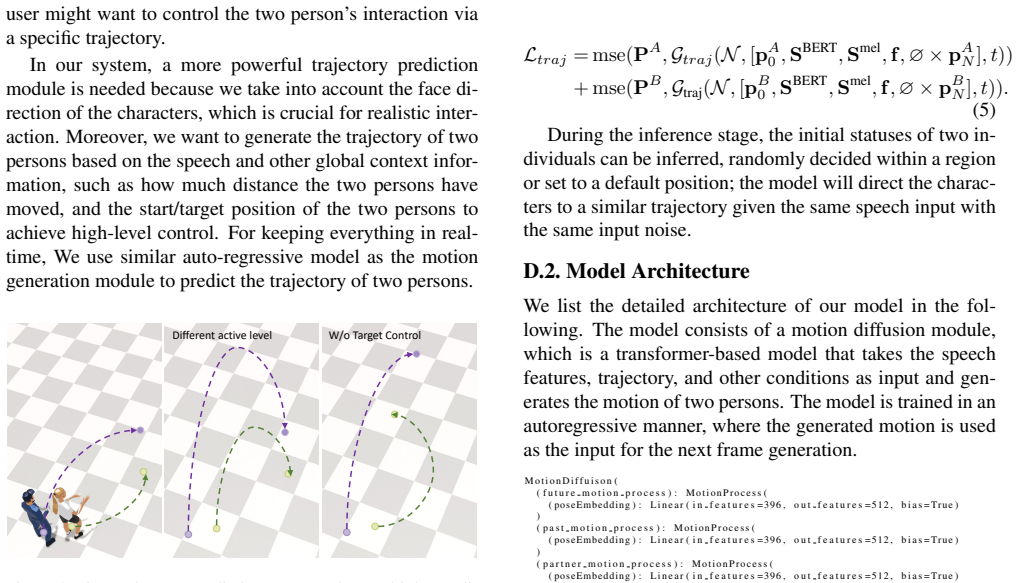
The engine is a conditional denoising diffusion transformer with separated condition tokens. For each sliding window it takes past self motion, the partner's past motion, future speech features (semantic tokens from a pretrained speech tokenizer, Mel-spectrogram acoustics, and rhythm), and a future 2D root trajectory (body positions plus facing directions) for both characters, and denoises the next 45 frames of two-person motion in one pass. Training uses a random mask on the partner's motion so the model can also learn from single-person co-speech data, and inference applies a classifier-free-guidance-style interpolation between conditional and unconditional predictions to tune how strongly a character follows the partner. Alternating which character is root-normalized preserves relative position between the two bodies. Long sequences are stabilized by blending the input trajectory with a self-predicted trajectory and by cross-fading overlapping clip boundaries.
What would settle it
Measure the trajectory predictor's root-position and facing-direction error against held-out ground-truth motion for the same two-speaker audio: if the average endpoint error is large relative to the distance needed for a handshake or object handoff, then the interactive realism cannot be attributed to the planned trajectory. A second check is to inspect whether contact actions such as handshakes actually produce touching hands in generated clips, since the authors state that no explicit joint-position constraint is used.
Extended reading notes
Core claim
The central claim is that two-person interactive full-body motion can be generated autoregressively from two speech streams in real time, with each character reacting to the other's audio and motion while following a planned root trajectory. The authors report that the full model outperforms single-person co-speech baselines and two-person interaction baselines on a benchmark built from the extended dataset, and that the reactive autoregressive design is what makes the difference: removing the reference-person condition degrades interaction quality sharply. They also introduce InterAct++, an enriched dataset of dynamic conversational interactions, and show that their system can be trained on single-person data through a random masking scheme that behaves like classifier-free guidance. The stated novelty is the combination: real-time speed, autoregressive reactivity, two-character full-body output, and trajectory controllability in one system, which no prior work achieves together.
Load-bearing premise
The load-bearing premise is that the trajectory predictor can reliably anticipate each speaker's future root path and facing direction from speech and context alone, because the full-body diffusion generator is conditioned on those predicted trajectories even though trajectory accuracy is not measured in the main evaluation.
Editorial extensions
If this is right
- Because each 45-frame window is generated in about 8 ms, a deployed system can animate a conversation as it happens, at over 100 fps.
- Because generation is conditioned on a planned 2D trajectory, an animator or game engine can steer where characters walk and face while speech drives their gestures.
- The random masking of the partner's motion lets the same model train on single-person co-speech datasets, so the approach can absorb large existing corpora beyond the collected two-person data.
- The new InterAct++ clips provide test material for dynamic actions such as hugging, handshaking, waving, grabbing, patting, and high-fives that earlier two-person conversation datasets lacked.
- Online applications such as VR, games, and customer-service avatars stand to gain two characters that converse and move together in real time rather than standing and gesturing in place.
Reading between the lines
- Because trajectory accuracy is never reported as a standalone number, an immediate next evaluation would be to measure endpoint and heading error against ground truth; I would expect this to be the main factor separating success from failure on unseen conversations.
- The condition channels are generic, so the dual-stream design could in principle be extended to three or more characters by adding more partner tokens, but the paper does not test this.
- The random-mask guidance weight already interpolates between fully reactive and fully autonomous behavior, which suggests a user-facing slider for how strongly a character follows its partner; the paper does not explore this interaction-control dimension.
- The authors' own limitation about handshaking implies that contact-critical motions need an explicit geometric constraint; adding a contact-aware loss or post-contact correction is a natural testable extension.
Editorial analysis
A structured set of objections, weighed in public.
Referee Report
Summary. This paper introduces an audio-driven, autoregressive diffusion framework for generating full-body motions of two interacting characters from speech, together with a new dataset (InterAct++) that extends the existing InterAct dataset with more dynamic interactions. The method predicts root trajectories from speech and then generates two-person motion conditioned on past and future speech, past motion, and trajectories. The authors report state-of-the-art results on single-person co-speech generation (BEAT), a two-person speech-to-motion benchmark, and an interaction generation task, and they claim real-time online performance with 8 ms per motion clip. The manuscript includes ablations, a user study, and a plan to release code and data.
Significance. If the real-time online claim were correct, this would be a significant advance for interactive character control and conversation animation, and the InterAct++ dataset is a useful addition. The two-stage trajectory-to-full-body design and the separate token conditioning are sensible, and the experiments cover standard metrics and ablations. However, the paper's headline contribution is undermined by the use of ground-truth future speech, which makes the pipeline non-causal; the trajectory module is also not evaluated directly. These issues prevent the claims as stated from being accepted.
major comments (3)
- [Sec. 3.2.1, Eq. (2), Sec. 3.3] The claimed online/real-time capability is not supported by the model definition. Equation (2) conditions the generator on future speech features s and s_refer for the entire 35-frame future window (N=45 frames with 10 past frames, Sec. 3.3). At 30 FPS this requires roughly 1.17 seconds of audio to be buffered before a motion clip can be produced, so the system is non-causal. The acknowledgment in Sec. 3.2.1 that the future information is not predicted but used as ground truth ('We will leave a model that predicts such information for future work') confirms that this is an architectural requirement, not an implementation detail. The 8 ms per-clip inference time reported in Sec. 3.3 omits this mandatory lookahead as well as the costs of SpeechTokenizer and trajectory prediction. Consequently, the abstract's 'online manner', the title's 'Real-time', and the 'reactive' characterization are not justified. I recommend either removing these claims and repositioning the work as an offline future-aware generation system, or introducing and evaluating a causal variant that uses only past speech.
- [Sec. 3.1 / D.1 / Table 5] The trajectory prediction module G_traj is a load-bearing component: the full-body diffusion model is conditioned on predicted trajectories (Sec. 3.1 and D.1), and the ablation 'w/o traj.' (Table 5) shows FPD degrading from 47.74 to 103.49 and FDD from 117.88 to 181.95 when trajectory conditioning is removed. However, the main experiments never report a direct evaluation of trajectory prediction accuracy (e.g., root position error, facing-direction error, path divergence) on held-out conversations, nor do they analyze how trajectory errors accumulate over autoregressive windows. Without such an evaluation, the claimed interactive quality and the practical usability of the fully automatic pipeline are not fully established.
- [Sec. 3.3] The 'Real-time Performance' paragraph reports only the motion generation module's inference time (8 ms per clip). A real-time claim requires an end-to-end latency measurement that includes audio tokenization (SpeechTokenizer), trajectory prediction, the autoregressive context update, and the blending operations described in Sec. 3.3 and D.4. Please provide a complete latency breakdown on the evaluation hardware, and specify the total latency from audio input to rendered motion output, including the buffering requirement of the future-speech conditioning.
minor comments (4)
- [Sec. 5.2 / Fig. 5] Audio2Photoreal is cited as [41] in Sec. 5.2 and the caption of Fig. 5, but reference [41] is 'Audio2Gestures' (Li et al.); the correct citation is [52] (Ng et al.). Please fix.
- [Table 5] The abbreviation 'SCT' is used without definition; please define 'Separated Conditional Tokens' when first used in Sec. 3.2.1 or in the table caption.
- [Table 3] The row label 'IntetAct' should be 'InterAct'.
- [Sec. 3.2.1, Eq. (2)] Equation (2) uses G_m while the preceding text and Eq. (1) use G; please make the notation consistent and clarify whether the subscript denotes the masked/modal variant.
Circularity Check
No significant circularity; the main claims rest on held-out evaluations and independent modules, though the work leans on several self-citations for architecture and dataset.
full rationale
The paper is an empirical machine-learning system rather than a derivation from first principles. Its central claims—autoregressive two-person co-speech motion generation, trajectory-guided synthesis, and improved quality over baselines—are supported by held-out test splits (Sec. 5.1: "The dataset is split into training and test sets with a ratio of 8:2 with their original split") and compared against external baselines such as LDA, EMAGE, AMUSE, Audio2Photoreal, ReMoS, and InterAct. The trajectory predictor G_traj is a separately trained module (Sec. 3.1 and D.1), and the main motion generator is conditioned on it rather than fitted to reproduce the reported metrics. The reported FPD/FDD improvements in Tables 2-5 are measured under a common protocol, not defined into existence. There are self-citations with author overlap: the 8-step diffusion setup and HFTE trajectory extension come from the authors' own [11], the InterAct dataset [29] is by overlapping authors and also serves as the closest baseline, and the enriched InterAct++ dataset is collected by the authors. However, these are used as engineering choices and comparison data, not as unverified premises that force the central conclusion. The real-time claim is undermined by the acknowledged use of future speech in Eq. (2) ("Future speech features s"; "Using the future information may sound unrealistic for interactive applications... We will leave a model that predicts such information for future work"), and the 8ms figure omits the required lookahead and preprocessing. That is a correctness/feasibility problem, not circularity: the model's outputs are not equivalent to its inputs by construction, and no prediction is statistically forced from a fitted subset. Therefore the circularity score is low.
Assumptions & free parameters
free parameters (6)
- CFG guidance scale gamma =
not reported
- Trajectory blending weight alpha =
not reported
- Loss weights lambda_pos and lambda_vel =
0.2 and 0.5
- Reference masking probability =
0.15
- Window size and overlap =
N=45, 10 past frames
- Diffusion steps =
8
assumptions (5)
- standard math The diffusion forward process and learned reverse process can represent the conditional distribution of two-person motion.
- domain assumption Speech-derived semantic (discrete token), melodic, and rhythmic features, together with trajectory and partner motion, are a sufficient conditioning set for generating conversational interaction.
- domain assumption The InterAct++ dataset, after retargeting, is representative of the test scenarios and supports generalization.
- domain assumption The first dimension of SpeechTokenizer tokens preserves the semantic content needed for gesture alignment.
- domain assumption Root trajectory on the ground plane is a sufficient control signal for full-body interaction.
Cite this review
Pith. "Pith review of It Takes Two: Real-time Co-Speech Two-person's Interaction Generation via Reactive Auto-regressive Diffusion Model." pith.science (2026). https://pith.science/paper/XQZNLJSQ
@misc{pith2026241202419,
  author       = {Pith},
  title        = {Pith review of: It Takes Two: Real-time Co-Speech Two-person's Interaction Generation via Reactive Auto-regressive Diffusion Model},
  year         = {2026},
  howpublished = {\url{https://pith.science/paper/XQZNLJSQ}},
  note         = {Machine review of arXiv:2412.02419}
}
read the original abstract
Conversational scenarios are very common in real-world settings, yet existing co-speech motion synthesis approaches often fall short in these contexts, where one person's audio and gestures will influence the other's responses. Additionally, most existing methods rely on offline sequence-to-sequence frameworks, which are unsuitable for online applications. In this work, we introduce an audio-driven, auto-regressive system designed to synthesize dynamic movements for two characters during a conversation. At the core of our approach is a diffusion-based full-body motion synthesis model, which is conditioned on the past states of both characters, speech audio, and a task-oriented motion trajectory input, allowing for flexible spatial control. To enhance the model's ability to learn diverse interactions, we have enriched existing two-person conversational motion datasets with more dynamic and interactive motions. We evaluate our system through multiple experiments to show it outperforms across a variety of tasks, including single and two-person co-speech motion generation, as well as interactive motion generation. To the best of our knowledge, this is the first system capable of generating interactive full-body motions for two characters from speech in an online manner.
Figures


Figures from the paper (7 more)



Forward citations
Cited by 1 Pith paper
-
MotionPersona: Characteristics-aware Locomotion Control
A single diffusion-based controller generates real-time character locomotion conditioned on body shape, text-described traits, and user control, plus a few-shot personalization mode.
Reference graph
Works this paper leans on
-
[1]
Style transfer for co-speech gesture animation: A multi-speaker conditional-mixture approach
Chaitanya Ahuja, Dong Won Lee, Yukiko I Nakano, and Louis-Philippe Morency. Style transfer for co-speech gesture animation: A multi-speaker conditional-mixture approach. In European Conference on Computer Vision , pages 248–
-
[2]
Style-controllable speech-driven gesture synthesis using normalising flows
Simon Alexanderson, Gustav Eje Henter, Taras Kucherenko, and Jonas Beskow. Style-controllable speech-driven gesture synthesis using normalising flows. In Computer Graphics Forum, pages 487–496. Wiley Online Library, 2020. 3
work page 2020
-
[3]
Listen, denoise, action! audio-driven motion synthesis with diffusion models
Simon Alexanderson, Rajmund Nagy, Jonas Beskow, and Gustav Eje Henter. Listen, denoise, action! audio-driven motion synthesis with diffusion models. ACM Transactions on Graphics (TOG), 42(4):1–20, 2023. 2, 3, 4, 7, 8, 1
work page 2023
-
[4]
Rhythmic gesticulator: Rhythm-aware co-speech gesture synthesis with hierarchical neural embeddings
Tenglong Ao, Qingzhe Gao, Yuke Lou, Baoquan Chen, and Libin Liu. Rhythmic gesticulator: Rhythm-aware co-speech gesture synthesis with hierarchical neural embeddings. ACM Transactions on Graphics (TOG), 41(6):1–19, 2022. 3
work page 2022
-
[5]
Tenglong Ao, Zeyi Zhang, and Libin Liu. Gesturediffuclip: Gesture diffusion model with clip latents.ACM Transactions on Graphics (TOG), 42(4):1–18, 2023. 2, 3
work page 2023
-
[6]
Tenglong Ao, Zeyi Zhang, and Libin Liu. Gesturediffuclip: Gesture diffusion model with clip latents.ACM Transactions on Graphics (TOG), 42(4):1–18, 2023. 2, 4
work page 2023
-
[7]
Uttaran Bhattacharya, Elizabeth Childs, Nicholas Rewkowski, and Dinesh Manocha. Speech2affectivegestures: Synthesizing co-speech ges- tures with generative adversarial affective expression learning. In Proceedings of the 29th ACM International Conference on Multimedia, pages 2027–2036, 2021. 3
work page 2027
-
[8]
Digital life project: Autonomous 3d characters with social intelligence
Zhongang Cai, Jianping Jiang, Zhongfei Qing, Xinying Guo, Mingyuan Zhang, Zhengyu Lin, Haiyi Mei, Chen Wei, Ruisi Wang, Wanqi Yin, et al. Digital life project: Autonomous 3d characters with social intelligence. 2024. 3
work page 2024
Show all 78 references
-
[9]
Speech-gesture mismatches: Evidence for one underlying representation of linguistic and nonlinguistic information
Justine Cassell, David McNeill, and Karl-Erik McCullough. Speech-gesture mismatches: Evidence for one underlying representation of linguistic and nonlinguistic information. Pragmatics & cognition, 7(1):1–34, 1999. 3
1999
-
[10]
Beat: the behavior expression animation toolkit
Justine Cassell, Hannes H ¨ogni Vilhj´almsson, and Timothy Bickmore. Beat: the behavior expression animation toolkit. In Proceedings of the 28th annual conference on Computer graphics and interactive techniques , pages 477–486, 2001. 2, 3
2001
-
[11]
Taming diffusion probabilistic mod- els for character control
Rui Chen, Mingyi Shi, Shaoli Huang, Ping Tan, Taku Ko- mura, and Xuelin Chen. Taming diffusion probabilistic mod- els for character control. In SIGGRAPH, 2024. 4, 6
2024
-
[12]
Executing your commands via motion diffusion in latent space
Xin Chen, Biao Jiang, Wen Liu, Zilong Huang, Bin Fu, Tao Chen, and Gang Yu. Executing your commands via motion diffusion in latent space. In Proceedings of the IEEE/CVF Conference on Computer Vision and Pattern Recognition , pages 18000–18010, 2023. 3
2023
-
[13]
Black, and Timo Bolkart
Kiran Chhatre, Radek Dan??ek, Nikos Athanasiou, Giorgio Becherini, Christopher Peters, Michael J. Black, and Timo Bolkart. Emotional speech-driven 3d body animation via dis- entangled latent diffusion. In Proceedings of the IEEE/CVF Conference on Computer Vision and Pattern Re...
1942
-
[14]
The interplay between gesture and speech in the production of referring expressions: Investigating the tradeoff hypothesis
Jan P De Ruiter, Adrian Bangerter, and Paula Dings. The interplay between gesture and speech in the production of referring expressions: Investigating the tradeoff hypothesis. Topics in cognitive science, 4(2):232–248, 2012. 3
2012
-
[15]
Diffusion-based co-speech gesture genera- tion using joint text and audio representation
Anna Deichler, Shivam Mehta, Simon Alexanderson, and Jonas Beskow. Diffusion-based co-speech gesture genera- tion using joint text and audio representation. InProceedings of the 25th International Conference on Multimodal Interac- tion, pages 755–762, 2023. 3
2023
-
[16]
Bert: Pre-training of deep bidirectional transformers for language understanding
Jacob Devlin, Ming-Wei Chang, Kenton Lee, and Kristina Toutanova. Bert: Pre-training of deep bidirectional transformers for language understanding. arXiv preprint arXiv:1810.04805, 2018. 4
2018 arXiv
-
[17]
Freemotion: A unified framework for number- free text-to-motion synthesis
Ke Fan, Junshu Tang, Weijian Cao, Ran Yi, Moran Li, Jingyu Gong, Jiangning Zhang, Yabiao Wang, Chengjie Wang, and Lizhuang Ma. Freemotion: A unified framework for number- free text-to-motion synthesis. In Computer Vision – ECCV 2024, pages 93–109, Cham, 2025. Springer Nature S...
2024
-
[18]
Troje, and Marc-Andr ´e Carbonneau
Saeed Ghorbani, Ylva Ferstl, Daniel Holden, Nikolaus F. Troje, and Marc-Andr ´e Carbonneau. Zeroeggs: Zero-shot example-based gesture generation from speech. Computer Graphics Forum, 42(1):206–216, 2023. 5
2023
-
[19]
Remos: 3d motion- conditioned reaction synthesis for two-person interactions
Anindita Ghosh, Rishabh Dabral, Vladislav Golyanik, Chris- tian Theobalt, and Philipp Slusallek. Remos: 3d motion- conditioned reaction synthesis for two-person interactions. In European Conference on Computer Vision (ECCV), 2024. 3, 6, 8, 1
2024
-
[20]
Interaction mix and match: Synthesizing close interaction using condi- tional hierarchical gan with multi-hot class embedding
Aman Goel, Qianhui Men, and Edmond SL Ho. Interaction mix and match: Synthesizing close interaction using condi- tional hierarchical gan with multi-hot class embedding. In Computer Graphics Forum , pages 327–338. Wiley Online Library, 2022. 3
2022
-
[21]
Learning speech-driven 3d conversational gestures from video
Ikhsanul Habibie, Weipeng Xu, Dushyant Mehta, Lingjie Liu, Hans-Peter Seidel, Gerard Pons-Moll, Mohamed El- gharib, and Christian Theobalt. Learning speech-driven 3d conversational gestures from video. In Proceedings of the 21st ACM International Conference on Intelligent Virt...
2021
-
[22]
Evaluation of speech-to-gesture generation using bi-directional lstm network
Dai Hasegawa, Naoshi Kaneko, Shinichi Shirakawa, Hiroshi Sakuta, and Kazuhiko Sumi. Evaluation of speech-to-gesture generation using bi-directional lstm network. InProceedings of the 18th International Conference on Intelligent Virtual Agents, pages 79–86, 2018. 3
2018
-
[23]
Moglow: Probabilistic and controllable motion synthesis using normalising flows
Gustav Eje Henter, Simon Alexanderson, and Jonas Beskow. Moglow: Probabilistic and controllable motion synthesis using normalising flows. ACM Transactions on Graphics (TOG), 39(6):1–14, 2020. 2
2020
-
[24]
Denoising dif- fusion probabilistic models
Jonathan Ho, Ajay Jain, and Pieter Abbeel. Denoising dif- fusion probabilistic models. In NeurIPS, pages 6840–6851. Curran Associates, Inc., 2020. 4
2020
-
[25]
Dead blending, 2023
Daniel Holden. Dead blending, 2023. 6, 4
2023
-
[26]
Phase- functioned neural networks for character control
Daniel Holden, Taku Komura, and Jun Saito. Phase- functioned neural networks for character control. 36(4):1– 13, 2017. 4
2017
-
[27]
Example- based control of human motion
Eugene Hsu, Sommer Gentry, and Jovan Popovi ´c. Example- based control of human motion. In Proceedings of the 2004 ACM SIGGRAPH/Eurographics symposium on Com- puter animation, pages 69–77, 2004. 3
2004
-
[28]
Robot behavior toolkit: generating effective social behaviors for robots
Chien-Ming Huang and Bilge Mutlu. Robot behavior toolkit: generating effective social behaviors for robots. In Proceed- ings of the seventh annual ACM/IEEE international confer- ence on Human-Robot Interaction, pages 25–32, 2012. 3
2012
-
[29]
Interact: Capture and modelling of realistic, ex- pressive and interactive activities between two persons in daily scenarios
Yinghao Huang, Leo Ho, Dafei Qin, Mingyi Shi, and Taku Komura. Interact: Capture and modelling of realistic, ex- pressive and interactive activities between two persons in daily scenarios. arXiv preprint arXiv:, 2024. 2, 3, 6, 7
2024
-
[30]
Intermask: 3d human interaction generation via collaborative masked modelling, 2024
Muhammad Gohar Javed, Chuan Guo, Li Cheng, and Xingyu Li. Intermask: 3d human interaction generation via collaborative masked modelling, 2024. 3
2024
-
[31]
Synchronized multi-character motion editing
Manmyung Kim, Kyunglyul Hyun, Jongmin Kim, and Jehee Lee. Synchronized multi-character motion editing. ACM transactions on graphics (TOG), 28(3):1–9, 2009. 3
2009
-
[32]
Tiling motion patches
Manmyung Kim, Youngseok Hwang, Kyunglyul Hyun, and Jehee Lee. Tiling motion patches. InProceedings of the ACM SIGGRAPH/Eurographics Symposium on Computer Anima- tion, pages 117–126, 2012. 3
2012
-
[33]
Towards a common framework for multimodal generation: The behavior markup language
Stefan Kopp, Brigitte Krenn, Stacy Marsella, Andrew N Marshall, Catherine Pelachaud, Hannes Pirker, Kristinn R Th´orisson, and Hannes Vilhj ´almsson. Towards a common framework for multimodal generation: The behavior markup language. In Intelligent Virtual Agents: 6th Internat...
2006
-
[34]
Gesticulator: A framework for semantically-aware speech-driven gesture generation
Taras Kucherenko, Patrik Jonell, Sanne Van Waveren, Gustav Eje Henter, Simon Alexandersson, Iolanda Leite, and Hedvig Kjellstr ¨om. Gesticulator: A framework for semantically-aware speech-driven gesture generation. In Proceedings of the 2020 international conference on mul- ti...
2020
-
[35]
The genea challenge 2023: A large- scale evaluation of gesture generation models in monadic and dyadic settings
Taras Kucherenko, Rajmund Nagy, Youngwoo Yoon, Jieyeon Woo, Teodor Nikolov, Mihail Tsakov, and Gus- tav Eje Henter. The genea challenge 2023: A large- scale evaluation of gesture generation models in monadic and dyadic settings. In Proceedings of the 25th Interna- tional Confe...
2023
-
[36]
Evaluating gesture generation in a large-scale open challenge: The genea challenge 2022
Taras Kucherenko*, Pieter Wolfert*, Youngwoo Yoon*, Carla Viegas, Teodor Nikolov, Mihail Tsakov, and Gus- tav Eje Henter. Evaluating gesture generation in a large-scale open challenge: The genea challenge 2022. ACM Transac- tions on Graphics, 43(3):1–28, 2024. 3
2022
-
[37]
Cross-conditioned recurrent networks for long- term synthesis of inter-person human motion interactions
Jogendra Nath Kundu, Himanshu Buckchash, Priyanka Mandikal, Anirudh Jamkhandi, Venkatesh Babu Radhakrish- nan, et al. Cross-conditioned recurrent networks for long- term synthesis of inter-person human motion interactions. In Proceedings of the IEEE/CVF winter conference on ap...
2020
-
[38]
Two-character motion analysis and synthesis
Taesoo Kwon, Young-Sang Cho, Sang I Park, and Sung Yong Shin. Two-character motion analysis and synthesis. IEEE transactions on visualization and computer graphics, 14(3): 707–720, 2008. 3
2008
-
[39]
Motion patches: building blocks for virtual environments annotated with motion data
Kang Hoon Lee, Myung Geol Choi, and Jehee Lee. Motion patches: building blocks for virtual environments annotated with motion data. In ACM SIGGRAPH 2006 Papers, pages 898–906. 2006. 3
2006
-
[40]
Gesture controllers
Sergey Levine, Philipp Kr ¨ahenb¨uhl, Sebastian Thrun, and Vladlen Koltun. Gesture controllers. ACM Trans. Graph., 29(4):124:1–124:11, 2010. 3
2010
-
[41]
Audio2gestures: Generating diverse gestures from speech audio with conditional varia- tional autoencoders
Jing Li, Di Kang, Wenjie Pei, Xuefei Zhe, Ying Zhang, Zhenyu He, and Linchao Bao. Audio2gestures: Generating diverse gestures from speech audio with conditional varia- tional autoencoders. In Proceedings of the IEEE/CVF In- ternational Conference on Computer Vision , pages 112...
2021
-
[42]
Ai choreographer: Music conditioned 3d dance generation with aist++
Ruilong Li, Shan Yang, David A Ross, and Angjoo Kanazawa. Ai choreographer: Music conditioned 3d dance generation with aist++. In Proceedings of the IEEE/CVF In- ternational Conference on Computer Vision , pages 13401– 13412, 2021. 7
2021
-
[43]
Intergen: Diffusion-based multi-human motion genera- tion under complex interactions
Han Liang, Wenqian Zhang, Wenxuan Li, Jingyi Yu, and Lan Xu. Intergen: Diffusion-based multi-human motion genera- tion under complex interactions. International Journal of Computer Vision, pages 1–21, 2024. 3, 6
2024
-
[44]
Com- position of complex optimal multi-character motions
C Karen Liu, Aaron Hertzmann, and Zoran Popovi ´c. Com- position of complex optimal multi-character motions. InPro- ceedings of the 2006 ACM SIGGRAPH/Eurographics sym- posium on Computer animation, pages 215–222, 2006. 3
2006
-
[45]
Beat: A large-scale semantic and emotional multi-modal dataset for conversational gestures synthesis
Haiyang Liu, Zihao Zhu, Naoya Iwamoto, Yichen Peng, Zhengqing Li, You Zhou, Elif Bozkurt, and Bo Zheng. Beat: A large-scale semantic and emotional multi-modal dataset for conversational gestures synthesis. arXiv preprint arXiv:2203.05297, 2022. 5, 6, 7, 2
2022 arXiv
-
[46]
Haiyang Liu, Zihao Zhu, Giorgio Becherini, Yichen Peng, Mingyang Su, You Zhou, Xuefei Zhe, Naoya Iwamoto, Bo Zheng, and Michael J. Black. Emage: Towards unified holis- tic co-speech gesture generation via expressive masked audio gesture modeling. In 2024 IEEE/CVF Conference on...
2024
-
[47]
Haiyang Liu, Zihao Zhu, Giorgio Becherini, Yichen Peng, Mingyang Su, You Zhou, Xuefei Zhe, Naoya Iwamoto, Bo Zheng, and Michael J. Black. Emage: Towards unified holis- tic co-speech gesture generation via expressive masked audio gesture modeling. In 2024 IEEE/CVF Conference on...
2024
-
[48]
Learning hierarchical cross-modal association for co- speech gesture generation
Xian Liu, Qianyi Wu, Hang Zhou, Yinghao Xu, Rui Qian, Xinyi Lin, Xiaowei Zhou, Wayne Wu, Bo Dai, and Bolei Zhou. Learning hierarchical cross-modal association for co- speech gesture generation. In Proceedings of the IEEE/CVF Conference on Computer Vision and Pattern Recognitio...
2022
-
[49]
librosa: Audio and music signal analysis in python
Brian McFee, Colin Raffel, Dawen Liang, Daniel PW Ellis, Matt McVicar, Eric Battenberg, and Oriol Nieto. librosa: Audio and music signal analysis in python. In SciPy, pages 18–24, 2015. 4
2015
-
[50]
Gan-based reactive motion synthesis with class-aware discriminators for human–human interaction
Qianhui Men, Hubert PH Shum, Edmond SL Ho, and Howard Leung. Gan-based reactive motion synthesis with class-aware discriminators for human–human interaction. Computers & Graphics, 102:634–645, 2022. 3
2022
-
[51]
Gesture modeling and animation based on a proba- bilistic re-creation of speaker style
Michael Neff, Michael Kipp, Irene Albrecht, and Hans-Peter Seidel. Gesture modeling and animation based on a proba- bilistic re-creation of speaker style. ACM Transactions On Graphics (TOG), 27(1):1–24, 2008. 3
2008
-
[52]
From audio to photoreal embodiment: Synthesizing humans in conversations
Evonne Ng, Javier Romero, Timur Bagautdinov, Shaojie Bai, Trevor Darrell, Angjoo Kanazawa, and Alexander Richard. From audio to photoreal embodiment: Synthesizing humans in conversations. In IEEE Conference on Computer Vision and Pattern Recognition, 2024. 2, 3, 7, 1
2024
-
[53]
Glide: Towards photorealis- tic image generation and editing with text-guided diffusion models
Alexander Quinn Nichol, Prafulla Dhariwal, Aditya Ramesh, Pranav Shyam, Pamela Mishkin, Bob Mcgrew, Ilya Sutskever, and Mark Chen. Glide: Towards photorealis- tic image generation and editing with text-guided diffusion models. pages 16784–16804. PMLR, 2022. 4
2022
-
[54]
A comprehensive re- view of data-driven co-speech gesture generation
Simbarashe Nyatsanga, Taras Kucherenko, Chaitanya Ahuja, Gustav Eje Henter, and Michael Neff. A comprehensive re- view of data-driven co-speech gesture generation. In Com- puter Graphics Forum , pages 569–596. Wiley Online Li- brary, 2023. 3
2023
-
[55]
Librispeech: An asr corpus based on public do- main audio books
Vassil Panayotov, Guoguo Chen, Daniel Povey, and Sanjeev Khudanpur. Librispeech: An asr corpus based on public do- main audio books. In 2015 IEEE International Conference on Acoustics, Speech and Signal Processing (ICASSP), pages 5206–5210, 2015. 2
2015
-
[56]
Bodyformer: Semantics-guided 3d body gesture synthesis with transformer
Kunkun Pang, Dafei Qin, Yingruo Fan, Julian Habekost, Takaaki Shiratori, Junichi Yamagishi, and Taku Komura. Bodyformer: Semantics-guided 3d body gesture synthesis with transformer. ACM Transactions on Graphics (TOG) , 42(4):1–12, 2023. 2, 3, 4
2023
-
[57]
Do people use lan- guage production to make predictions during comprehen- sion? Trends in cognitive sciences , 11(3):105–110, 2007
Martin J Pickering and Simon Garrod. Do people use lan- guage production to make predictions during comprehen- sion? Trends in cognitive sciences , 11(3):105–110, 2007. 4
2007
-
[58]
Hierarchical text-conditional image gener- ation with clip latents, 2022
Aditya Ramesh, Prafulla Dhariwal, Alex Nichol, Casey Chu, and Mark Chen. Hierarchical text-conditional image gener- ation with clip latents, 2022. 4
2022
-
[59]
Human motion diffusion as a generative prior
Yonatan Shafir, Guy Tevet, Roy Kapon, and Amit H Bermano. Human motion diffusion as a generative prior. In ICLR, 2024. 3
2024
-
[60]
Interaction patches for multi-character animation
Hubert PH Shum, Taku Komura, Masashi Shiraishi, and Shuntaro Yamazaki. Interaction patches for multi-character animation. ACM transactions on graphics (TOG), 27(5):1–8,
-
[61]
Duolando: Follower gpt with off-policy reinforcement learn- ing for dance accompaniment
Li Siyao, Tianpei Gu, Zhitao Yang, Zhengyu Lin, Ziwei Liu, Henghui Ding, Lei Yang, and Chen Change Loy. Duolando: Follower gpt with off-policy reinforcement learn- ing for dance accompaniment. In ICLR, 2024. 3
2024
-
[62]
Local motion phases for learning multi-contact charac- ter movements
Sebastian Starke, Yiwei Zhao, Taku Komura, and Kazi Za- man. Local motion phases for learning multi-contact charac- ter movements. 39(4):54–1, 2020. 4
2020
-
[63]
Local motion phases for learning multi-contact charac- ter movements
Sebastian Starke, Yiwei Zhao, Taku Komura, and Kazi Za- man. Local motion phases for learning multi-contact charac- ter movements. ACM Transactions on Graphics (TOG), 39 (4):54–1, 2020. 3
2020
-
[64]
Human motion diffu- sion model
Guy Tevet, Sigal Raab, Brian Gordon, Yoni Shafir, Daniel Cohen-or, and Amit Haim Bermano. Human motion diffu- sion model. In The Eleventh International Conference on Learning Representations, 2023. 3
2023
-
[65]
Attention is all you need
Ashish Vaswani, Noam Shazeer, Niki Parmar, Jakob Uszko- reit, Llion Jones, Aidan N Gomez, Ł ukasz Kaiser, and Illia Polosukhin. Attention is all you need. In Advances in Neu- ral Information Processing Systems. Curran Associates, Inc.,
-
[66]
Gesture and speech in interaction: An overview, 2014
Petra Wagner, Zofia Malisz, and Stefan Kopp. Gesture and speech in interaction: An overview, 2014. 3
2014
-
[67]
Generating and ranking diverse multi-character interactions
Jungdam Won, Kyungho Lee, Carol O’Sullivan, Jessica K Hodgins, and Jehee Lee. Generating and ranking diverse multi-character interactions. ACM Transactions on Graph- ics (TOG), 33(6):1–12, 2014. 3
2014
-
[68]
Eggesture: Entropy-guided vector quantized variational autoencoder for co-speech gesture generation
Yiyong Xiao, Kai Shu, Haoyi Zhang, Baohua Yin, Wai Seng Cheang, Haoyang Wang, and Jiechao Gao. Eggesture: Entropy-guided vector quantized variational autoencoder for co-speech gesture generation. In Proceedings of the 32nd ACM International Conference on Multimedia , page 6113...
2024
-
[69]
Speech ges- ture generation from the trimodal context of text, audio, and speaker identity
Youngwoo Yoon, Bok Cha, Joo-Haeng Lee, Minsu Jang, Jaeyeon Lee, Jaehong Kim, and Geehyuk Lee. Speech ges- ture generation from the trimodal context of text, audio, and speaker identity. ACM Transactions on Graphics (TOG), 39 (6):1–16, 2020. 3
2020
-
[70]
Motiondif- fuse: Text-driven human motion generation with diffusion model
Mingyuan Zhang, Zhongang Cai, Liang Pan, Fangzhou Hong, Xinying Guo, Lei Yang, and Ziwei Liu. Motiondif- fuse: Text-driven human motion generation with diffusion model. arXiv preprint arXiv:2208.15001, 2022. 3
2022 arXiv
-
[71]
Speechtokenizer: Unified speech tokenizer for speech language models, 2023
Xin Zhang, Dong Zhang, Shimin Li, Yaqian Zhou, and Xipeng Qiu. Speechtokenizer: Unified speech tokenizer for speech language models, 2023. 4, 2
2023
-
[72]
Emdm: Efficient mo- tion diffusion model for fast, high-quality motion generation
Wenyang Zhou, Zhiyang Dou, Zeyu Cao, Zhouyingcheng Liao, Jingbo Wang, Wenjia Wang, Yuan Liu, Taku Komura, Wenping Wang, and Lingjie Liu. Emdm: Efficient mo- tion diffusion model for fast, high-quality motion generation. arXiv preprint arXiv:2312.02256, 2023. 3 It Takes Two: Re...
2023 arXiv
-
[73]
Two-person’s co-speech motion generation results,
-
[74]
Demonstration for the dataset,
-
[75]
Comparisons with AMUSE [13] and EMAGE [46] on single-person’s co-speech motion generation,
-
[76]
Comparisons with LDA [3] and Audio2Photoreal [52] on two-person conversational generation,
-
[77]
Comparisons with [19] on two-person interaction gener- ation,
-
[78]
Ablation comparisons of the two-person audio condi- tions and the trajectory conditions. B. Data Collection Content In InterAct++, 8 actors, consisting of 4 males and 4 females, were recruited for the capture. The actors performed the interactions in male-male or female-female...
Reviewed August 11, 2026 · model on record in the stance chip above.
Discussion (0). Continue with ORCID to comment.