Hybrid deep learning-based phase diversity method for wavefront reconstruction
Pith reviewed 2026-06-25 20:03 UTC · model grok-4.3
The pith
A hybrid CNN initial guess followed by L-BFGS refinement reconstructs wavefront distortions to high efficiency in both simulation and experiment.
A machine-rendered reading of the paper's core claim, the machinery that carries it, and where it could break.
Core claim
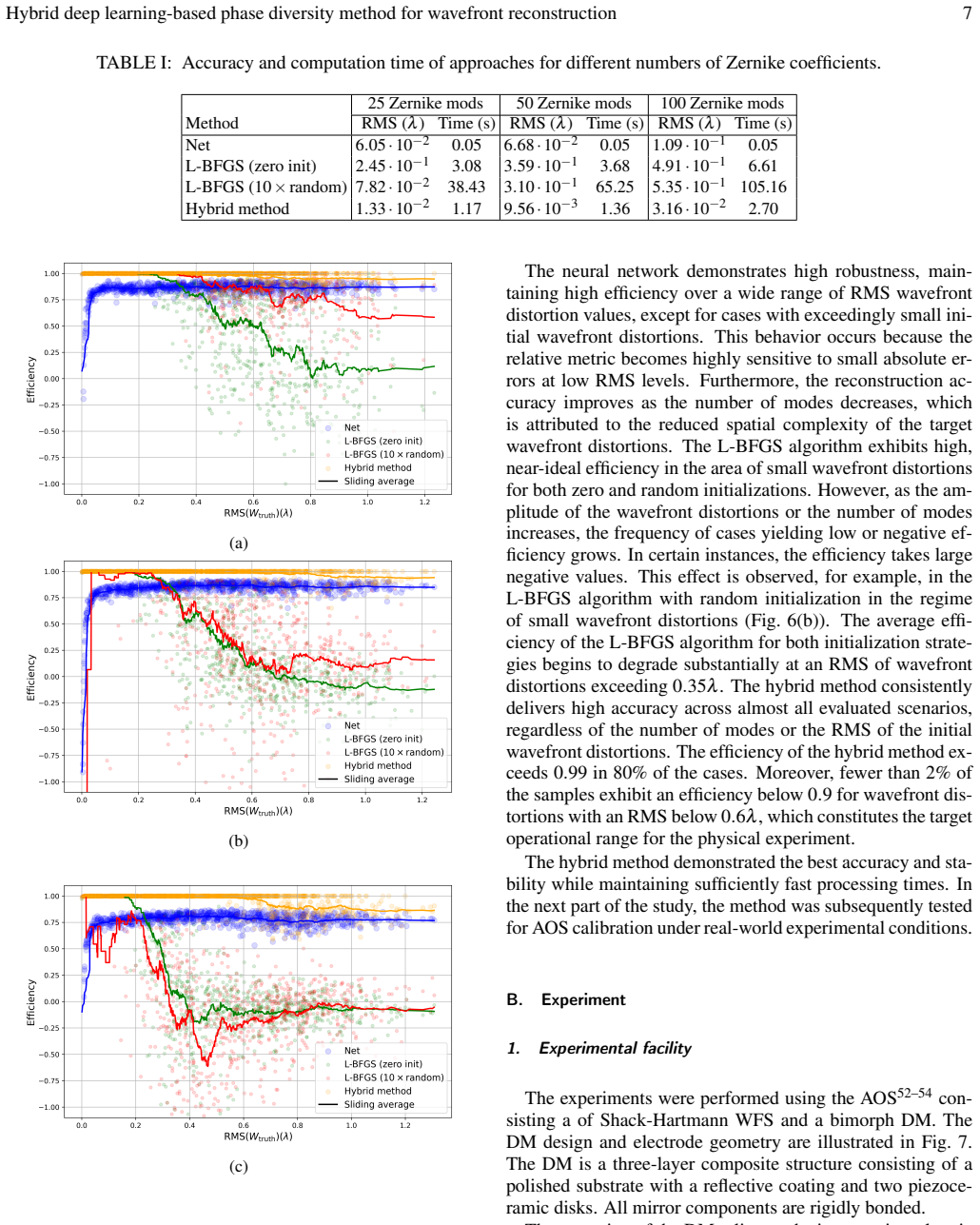
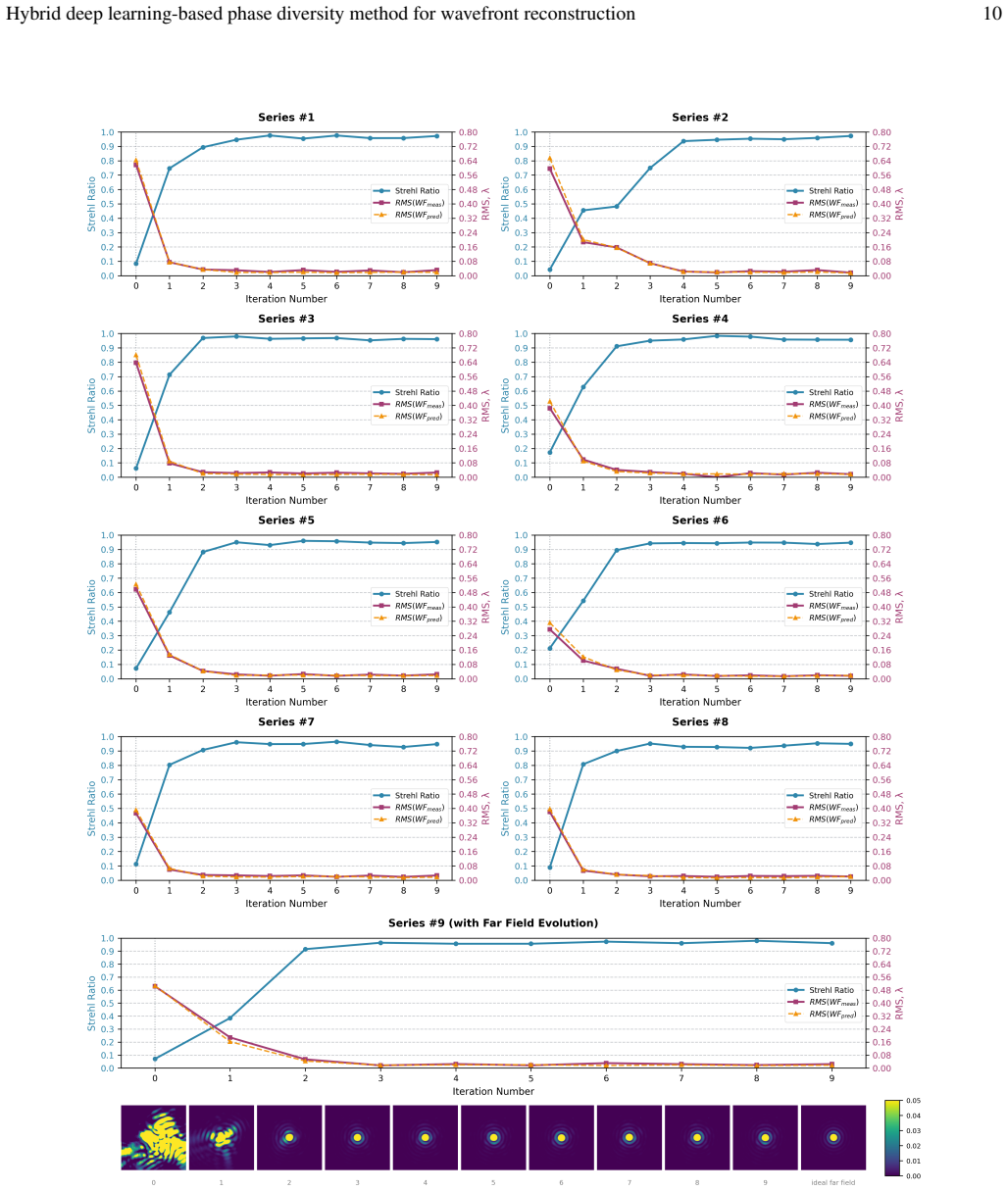
The hybrid method combines a convolutional neural network that supplies an initial wavefront estimate with the L-BFGS algorithm that refines it; numerical trials reach an efficiency of approximately 0.99 in 80 percent of cases for RMS distortions from 0 to 1.3 lambda, while physical experiments on distortions of 0.15 to 0.6 lambda yield an efficiency near 0.75 and a Strehl ratio of 0.96 plus or minus 0.02 after two to four L-BFGS iterations.
What carries the argument
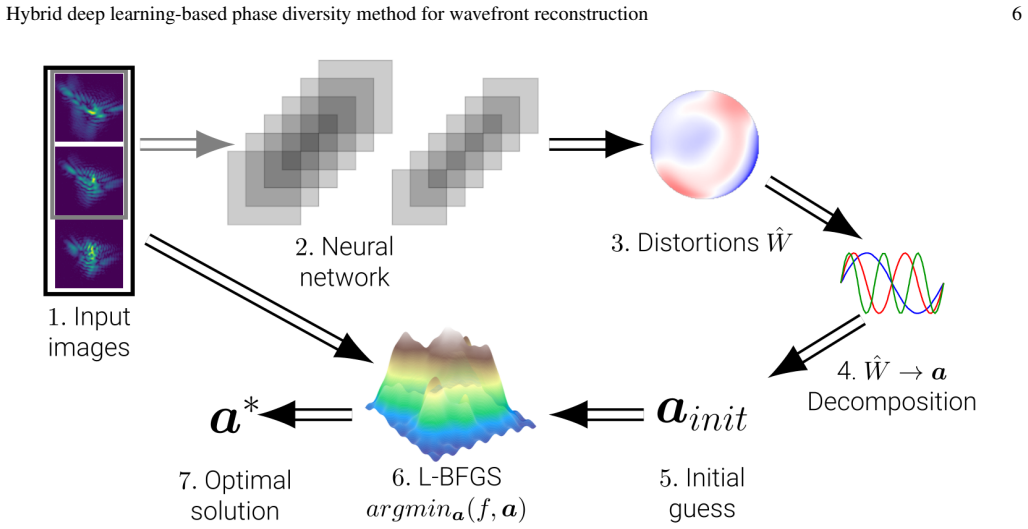
The hybrid pipeline in which the CNN produces the starting wavefront map and L-BFGS performs the subsequent phase-diversity minimization.
If this is right
- Numerical performance holds across RMS distortions up to 1.3 lambda with efficiency near 0.99 in most trials.
- Physical tests confirm the method works for RMS values 0.15-0.6 lambda and produces Strehl ratios of 0.96 plus or minus 0.02.
- Calibration of adaptive optics finishes in 2-4 iterations under the reported conditions.
- The approach is positioned as suitable for real-time or near-real-time calibration of high-power laser systems.
Where Pith is reading between the lines
- If the CNN training set is expanded to cover larger distortion ranges, the same hybrid structure could extend the reliable RMS interval beyond 1.3 lambda.
- Replacing L-BFGS with a different local optimizer might change the number of iterations needed once the CNN seed is fixed.
- The reported physical efficiency of 0.75 suggests the method may still benefit from further CNN accuracy gains before it matches simulation results.
- Success on non-common-path aberrations implies the pipeline could be tested on other phase-retrieval tasks that currently rely on pure optimization.
Load-bearing premise
The CNN's first estimate lies close enough to the true wavefront that L-BFGS reaches a high-efficiency solution in only a few iterations without becoming trapped in poor local minima.
What would settle it
A set of test wavefronts where the hybrid method consistently requires more than four L-BFGS iterations or ends with efficiency below 0.7 even when the CNN is trained on the same distribution of distortions.
Figures


read the original abstract
The efficiency of high-power laser systems is limited by wavefront distortions in the beam, particularly non-common path aberrations, which reduce the peak intensity at the focal plane. Compensating for these aberrations requires the calibration of the adaptive optics system. Conventional calibration methods rely on a time-consuming iterative optimization that is highly sensitive to initial conditions. While deep learning-based models offer high speed, they often demonstrate insufficient accuracy. In this work, we present a hybrid wavefront reconstruction method that combines a convolutional neural network to generate an initial estimate of the wavefront distortions, with the L-BFGS (Limited-memory Broyden-Fletcher-Goldfarb-Shanno) algorithm for its subsequent refinement. In numerical simulations, the method achieved an efficiency of $\sim 0.99$ in 80% of the cases for a root-mean-square (RMS) of wavefront distortions ranging from 0 to $1.3\lambda$. In a physical experiment, for initial wavefront distortions with RMS values from 0.15 to $0.6\lambda$, the method achieved an efficiency of $\sim 0.75$. As a result, focusing with a Strehl ratio of $0.96 \pm 0.02$ was attained within 2 to 4 iterations of the algorithm, confirming the applicability of the method for the fast and accurate calibration of adaptive optics systems under real experimental conditions.
Editorial analysis
A structured set of objections, weighed in public.
Referee Report
Summary. The manuscript proposes a hybrid wavefront reconstruction method for adaptive optics calibration that uses a convolutional neural network to generate an initial estimate of wavefront distortions followed by refinement with the L-BFGS algorithm in a phase-diversity framework. It reports that numerical simulations achieve an efficiency of ~0.99 in 80% of cases for RMS distortions from 0 to 1.3λ, while physical experiments for RMS values 0.15–0.6λ reach ~0.75 efficiency and Strehl ratio 0.96±0.02 within 2–4 L-BFGS iterations.
Significance. If the performance claims hold after addressing the gaps in validation, the hybrid method could provide a practical balance of speed and accuracy for calibrating adaptive optics in high-power laser systems, reducing the iteration count compared to pure optimization while improving on pure deep-learning accuracy. The reported experimental Strehl ratio is a concrete, falsifiable outcome that would strengthen the case for real-world applicability if supported by proper controls.
major comments (2)
- [Abstract] Abstract: the central performance claims (~0.99 efficiency in 80% of simulations; ~0.75 efficiency and Strehl 0.96±0.02 in experiment) rest on the untested premise that the CNN initial guess always lies inside the L-BFGS basin of attraction; no ablation (L-BFGS from zero/random phases on the same test set), no quantification of CNN residual error versus capture radius, and no failure-case analysis of the remaining 20% of simulations are described.
- [Abstract] Abstract: efficiency is reported without definition, error bars, baseline comparisons (standalone L-BFGS, other DL methods, or phase-diversity variants), or details on training data and network architecture, preventing assessment of whether the hybrid combination actually improves upon either component alone.
minor comments (1)
- [Abstract] Abstract: the RMS ranges are given without explicit units or wavelength reference in the experimental section, and the phrase 'within 2 to 4 iterations' should specify whether this is median, mean, or worst-case.
Simulated Author's Rebuttal
We thank the referee for the constructive feedback on validation gaps in our hybrid wavefront reconstruction method. We address each major comment below and will revise the manuscript to strengthen the supporting evidence for the reported performance.
read point-by-point responses
-
Referee: [Abstract] Abstract: the central performance claims (~0.99 efficiency in 80% of simulations; ~0.75 efficiency and Strehl 0.96±0.02 in experiment) rest on the untested premise that the CNN initial guess always lies inside the L-BFGS basin of attraction; no ablation (L-BFGS from zero/random phases on the same test set), no quantification of CNN residual error versus capture radius, and no failure-case analysis of the remaining 20% of simulations are described.
Authors: We agree that these validation elements are absent from the manuscript and that their inclusion would better substantiate the hybrid method's reliance on the CNN initialization. The current work does not contain the requested ablations, residual error quantification, or failure-case analysis. We will add an ablation study of L-BFGS started from random or zero phases on the same simulated test set, quantify CNN residual wavefront error relative to the optimizer's capture radius, and analyze the 20% of cases where efficiency falls below the reported threshold. These additions will be incorporated into the results and discussion sections of the revised manuscript. revision: yes
-
Referee: [Abstract] Abstract: efficiency is reported without definition, error bars, baseline comparisons (standalone L-BFGS, other DL methods, or phase-diversity variants), or details on training data and network architecture, preventing assessment of whether the hybrid combination actually improves upon either component alone.
Authors: We agree that the abstract (and, by extension, the level of detail provided) does not define efficiency, include error bars, present explicit baseline comparisons, or summarize training data and architecture. We will revise the abstract to define efficiency as the ratio of achieved focal-plane peak intensity to the diffraction-limited value, report associated uncertainties, add direct comparisons against standalone L-BFGS and pure CNN baselines on the same test sets, and include concise descriptions of the training dataset (Zernike-based simulated aberrations) and network architecture. These changes will allow readers to evaluate the hybrid improvement directly. revision: yes
Circularity Check
No circularity; empirical performance metrics from simulations and experiments
full rationale
The paper presents a hybrid CNN-initialized L-BFGS method for wavefront reconstruction and directly reports measured efficiencies (~0.99 in 80% of sim cases; ~0.75 and Strehl 0.96±0.02 in physical tests) as experimental outcomes. No derivation chain, equations, or fitted parameters are shown that reduce by construction to inputs, self-citations, or ansatzes. The central claims rest on empirical validation rather than any self-referential prediction or uniqueness theorem imported from prior author work. This is the standard case of a methods paper whose results are independently falsifiable via the described experiments.
Axiom & Free-Parameter Ledger
Reference graph
Works this paper leans on
-
[1]
The tar- get wavefront distortions were normalized by a factor of 3λ, yielding a value range of approximately[−3,3], which is con- ducive to stable training of the neural network
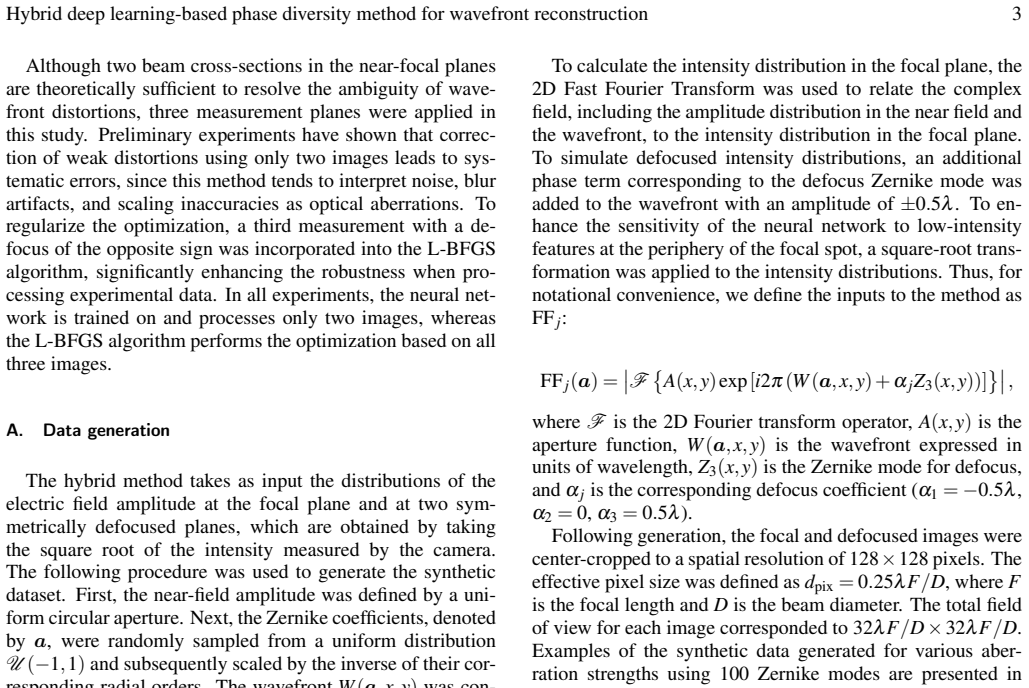
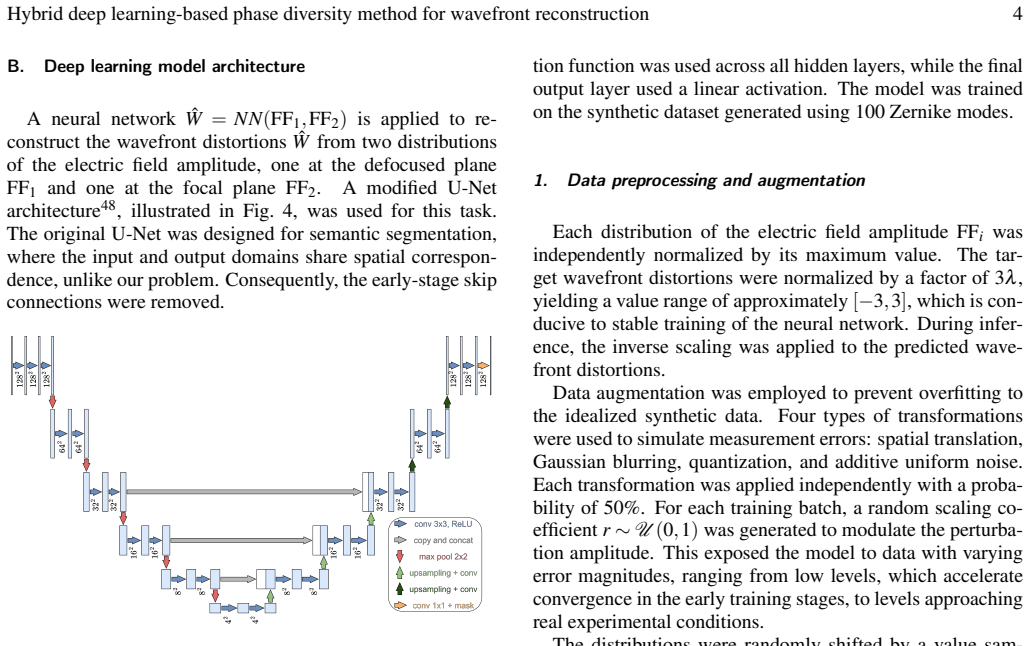
Data preprocessing and augmentation Each distribution of the electric field amplitude FF i was independently normalized by its maximum value. The tar- get wavefront distortions were normalized by a factor of 3λ, yielding a value range of approximately[−3,3], which is con- ducive to stable training of the neural network. During infer- ence, the inverse sca...
-
[2]
The dataset was dynamically updated during the optimization process
Circular buffer The synthetic dataset used for model training was not static. The dataset was dynamically updated during the optimization process. The data were stored in a fixed-size circular buffer, where older examples were continuously replaced with newly generated ones50. The training procedure followed a standard pipeline. Mini-batches were sampled ...
-
[3]
The DM design and electrode geometry are illustrated in Fig
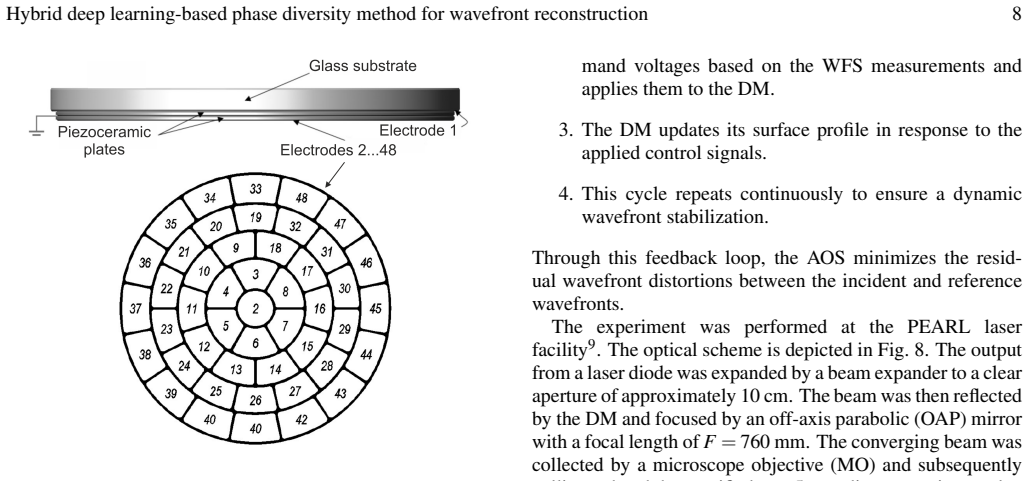
Experimental facility The experiments were performed using the AOS 52–54 con- sisting a of Shack-Hartmann WFS and a bimorph DM. The DM design and electrode geometry are illustrated in Fig. 7. The DM is a three-layer composite structure consisting of a polished substrate with a reflective coating and two piezoce- ramic disks. All mirror components are rigi...
-
[4]
The WFS measures the wavefront distortions, defined as the wavefront difference between the incident beam and the reference wavefront
-
[5]
The control system calculates the corresponding com- mand voltages based on the WFS measurements and applies them to the DM
-
[6]
The DM updates its surface profile in response to the applied control signals
-
[7]
Through this feedback loop, the AOS minimizes the resid- ual wavefront distortions between the incident and reference wavefronts
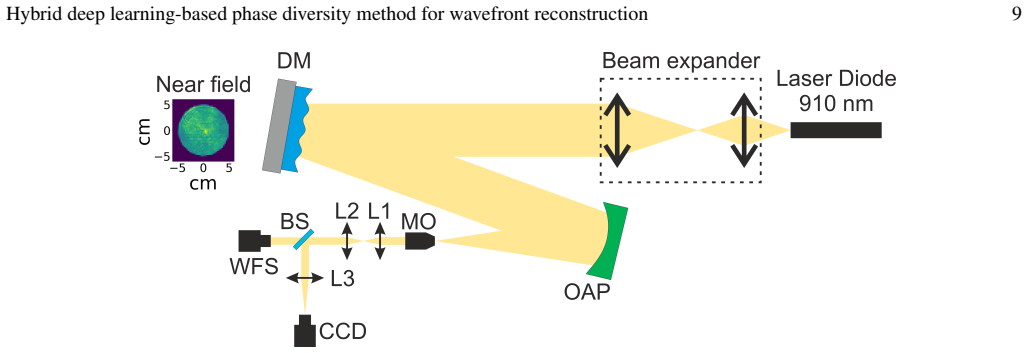
This cycle repeats continuously to ensure a dynamic wavefront stabilization. Through this feedback loop, the AOS minimizes the resid- ual wavefront distortions between the incident and reference wavefronts. The experiment was performed at the PEARL laser facility9. The optical scheme is depicted in Fig. 8. The output from a laser diode was expanded by a b...
-
[8]
Utilizing the deformable mirror allows for a highly flex- ible phase diversity scheme. For instance, diverse types and amplitudes of wavefront distortions can be applied, enabling the acquisition of intensity distributions at an arbitrary number of focal and defocused planes. The reconstruction accuracy is then primarily limited by the spatial fidelity of...
-
[9]
Con- ventional methods, such as introducing an auxiliary focusing channel or a beam splitter, inherently in- duce inter-channel wavefront distortions
No supplementary optical components are required in the measurement scheme, avoiding parasitic wavefront distortions and simplifying the optical alignment. Con- ventional methods, such as introducing an auxiliary focusing channel or a beam splitter, inherently in- duce inter-channel wavefront distortions. Alternatively, translating the camera along the op...
-
[10]
In each experiment, we introduced controlled wavefront distortions into the beam by adding combinations of Zernike modes to the wavefront
This approach seamlessly integrates into the existing AOS architecture, as it can be executed purely as a soft- ware procedure within the closed-loop control system. In each experiment, we introduced controlled wavefront distortions into the beam by adding combinations of Zernike modes to the wavefront. Zernike mode coefficients were gen- erated similar t...
-
[11]
Phase retrieval algorithm for jwst flight and testbed telescope,
Experimental results The performance of the hybrid method was evaluated in nine experimental series, each with different initial wavefront distortions. Each series comprised nine correction iterations based on the predictions of the hybrid method. In applica- tions aimed at maximizing the peak intensity, the most stan- dard metric for assessing the compen...
2026
-
[12]
Hubble space telescope characterized by using phase-retrieval algorithms,
pp. 314–330. 2J. R. Fienup, J. C. Marron, T. J. Schulz, and J. H. Seldin, “Hubble space telescope characterized by using phase-retrieval algorithms,” Applied op- tics32, 1747–1767 (1993). Hybrid deep learning-based phase diversity method for wavefront reconstruction 12 3Y . Jin, J. Chen, C. Wu, Z. Chen, X. Zhang, H.-l. Shen, W. Gong, and K. Si, “Wavefront...
Pith/arXiv arXiv 1993
discussion (0)
Sign in with ORCID, Apple, or X to comment. Anyone can read and Pith papers without signing in.