Even More Guarantees for Variational Inference in the Presence of Symmetries
Pith reviewed 2026-05-09 22:21 UTC · model grok-4.3
The pith
Sufficient conditions on target symmetries guarantee exact mean recovery in variational inference with forward KL and alpha-divergences even under misspecification.
A machine-rendered reading of the paper's core claim, the machinery that carries it, and where it could break.
Core claim
Under target symmetries that interact appropriately with location-scale variational families, the forward Kullback-Leibler divergence and alpha-divergences guarantee exact recovery of the target mean despite the variational family not containing the target; without the symmetries, optimization can fail to recover the mean and concrete guidelines on family choice and alpha value help avoid such failures.
What carries the argument
Location-scale variational families whose parameters are optimized under forward KL or alpha-divergences when the target distribution has symmetries that permit exact mean matching.
If this is right
- Exact mean recovery remains possible even when the variational family cannot represent the full target.
- Optimization of the variational parameters can fail to recover the mean when the sufficient symmetry conditions are absent.
- Guidelines exist for selecting the variational family and the value of alpha to increase the chance of mean recovery.
- The same symmetry-based guarantees apply to both forward KL and a family of alpha-divergences.
Where Pith is reading between the lines
- Similar symmetry conditions might be derived for other common divergences or for recovering higher moments beyond the mean.
- The results suggest checking for symmetry in the target before selecting a variational family in practice.
- In models with known symmetries such as certain mixture or equivariant distributions, these conditions could be used to certify mean accuracy without sampling.
Load-bearing premise
The target distribution must possess symmetries that interact with the location-scale variational family in a way that permits exact mean recovery under the chosen divergences.
What would settle it
A concrete symmetric target distribution together with a location-scale family and forward KL optimization where the recovered mean differs from the true mean.
Figures

read the original abstract
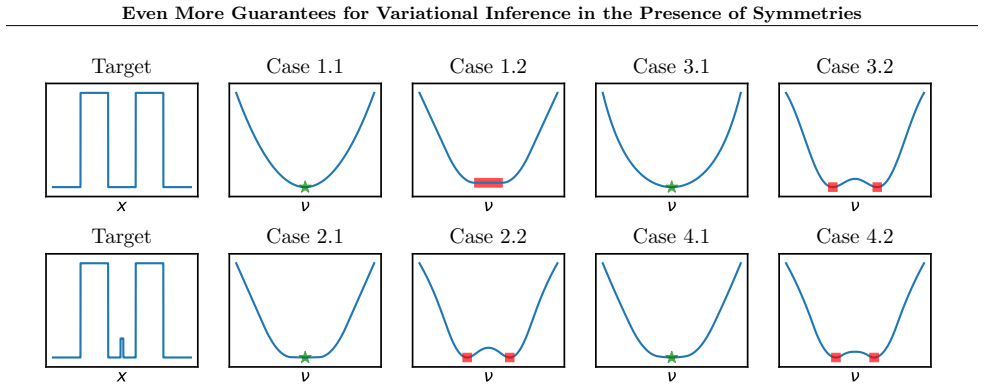
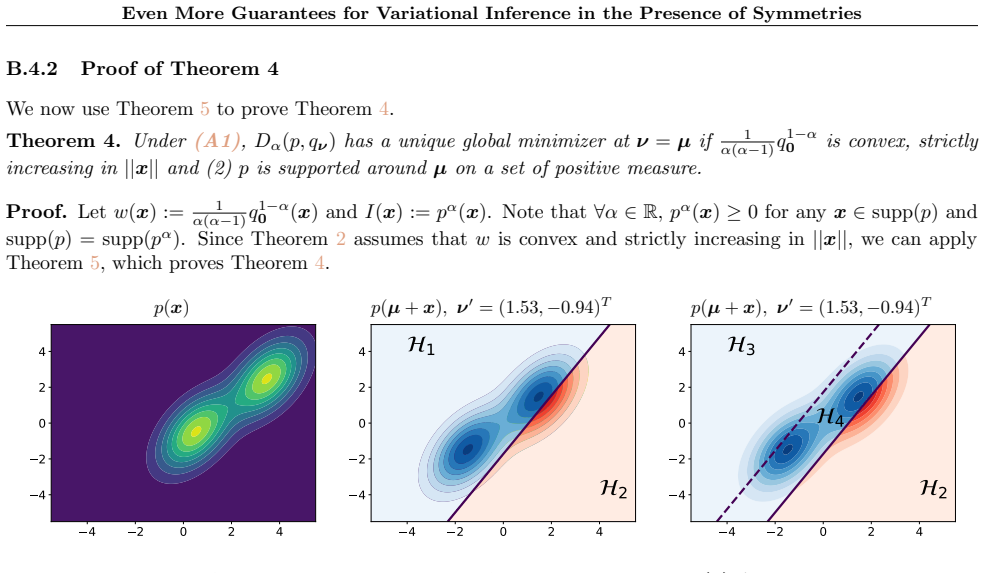
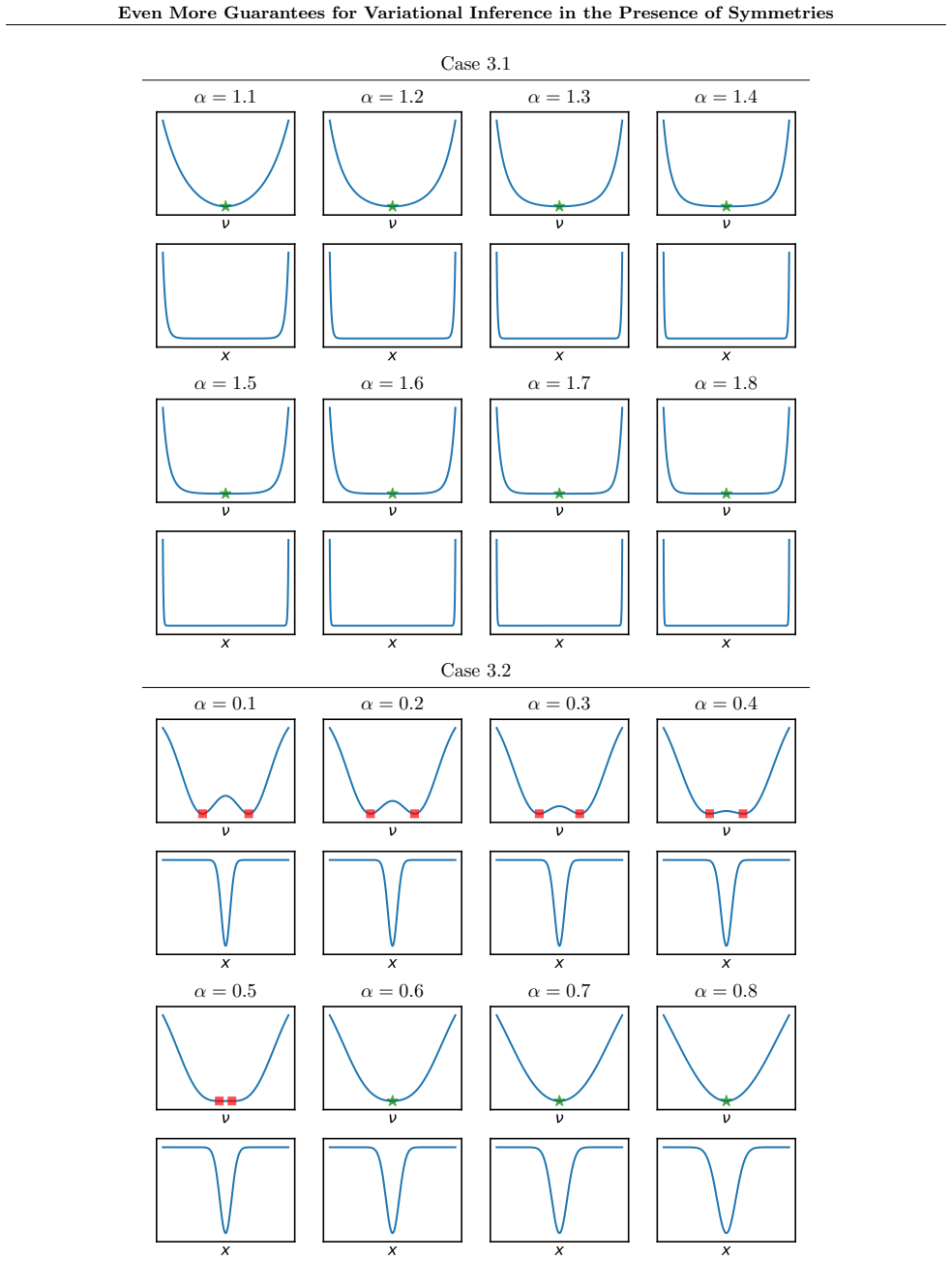
When approximating an intractable density via variational inference (VI) the variational family is typically chosen as a simple parametric family that very likely does not contain the target. This raises the question: Under which conditions can we recover characteristics of the target despite misspecification? In this work, we extend previous theoretical results on robust VI with location-scale families under target symmetries in two substantial ways: (1) We open them up to a wider range of divergences by providing sufficient conditions for exact recovery of the target mean and correlation matrix when using the forward Kullback-Leibler divergence and $\alpha$-divergences. (2) By doing so, we find that we can drop the restrictive assumption of a log-concave target made in previous work, allowing us to give guarantees for a wider range of targets, including multi-modal ones. In our experiments, we show how our guarantees can serve as guidelines for the choice of the variational family and $\alpha$-value and we illustrate on a diverse set of examples how and why optimization can fail in the absence of our sufficient conditions.
Editorial analysis
A structured set of objections, weighed in public.
Referee Report
Summary. The manuscript extends prior results on robust variational inference with location-scale families when the target distribution has symmetries. It derives sufficient conditions under which the forward Kullback-Leibler divergence and α-divergences yield exact recovery of the target mean, characterizes optimization failure modes outside those conditions, and offers guidelines for choosing the variational family and α value.
Significance. If the derived conditions are valid, the work strengthens theoretical understanding of when misspecified variational families can still recover key statistics such as the mean in symmetric settings. The extension to α-divergences and the explicit failure-mode analysis provide practical value beyond previous symmetry-based guarantees. The symmetry-group interaction approach appears to deliver clean, non-circular conditions.
minor comments (3)
- [Abstract] The abstract and introduction would benefit from a brief, concrete example (e.g., a simple symmetric Gaussian or mixture) illustrating when the sufficient conditions hold and when they fail.
- Notation for the location-scale family and the symmetry group action should be introduced with explicit definitions before the main theorems to improve readability.
- The guidelines on α selection could be stated more quantitatively, perhaps with a short table or corollary summarizing the range of α for which the conditions remain sufficient.
Simulated Author's Rebuttal
We thank the referee for their positive assessment of the manuscript, accurate summary of our contributions, and recommendation for minor revision. We are pleased that the significance of the sufficient conditions for exact mean recovery under target symmetries, the extension to α-divergences, and the failure-mode analysis was recognized.
Circularity Check
Derivation proceeds from first-principles symmetry analysis without reduction to inputs
full rationale
The paper derives sufficient conditions for exact mean recovery in location-scale VI under forward KL and alpha-divergences by directly analyzing how target symmetries interact with the variational parameterization to force the minimizer to match the target mean. This is a self-contained mathematical argument from the definitions of the divergences and the group action, with no fitted parameters renamed as predictions, no load-bearing self-citations, and no ansatz smuggled in. Failure modes outside the conditions are analyzed separately, confirming the central claim does not collapse to its assumptions by construction.
Axiom & Free-Parameter Ledger
Forward citations
Cited by 1 Pith paper
-
Gaussian Mean Field Variational Inference can Overestimate Predictive Variance
In conjugate BLR, MFVI overestimates expected predictive variance on in-distribution points relative to the exact posterior, with overestimation aligned to training data directions.
discussion (0)
Sign in with ORCID, Apple, or X to comment. Anyone can read and Pith papers without signing in.