Language-Instructed Vision Embeddings for Controllable and Generalizable Perception
Pith reviewed 2026-06-26 20:52 UTC · model grok-4.3
The pith
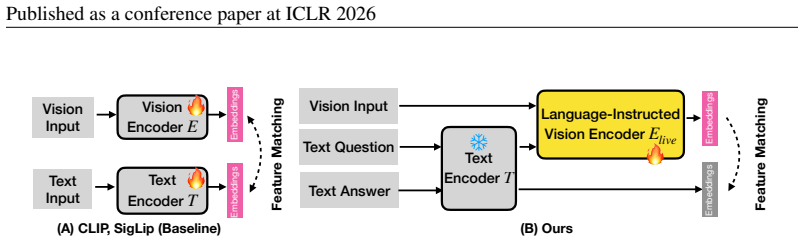
Language instructions can steer a frozen vision encoder to produce task-specific embeddings at inference time without retraining.
A machine-rendered reading of the paper's core claim, the machinery that carries it, and where it could break.
Core claim
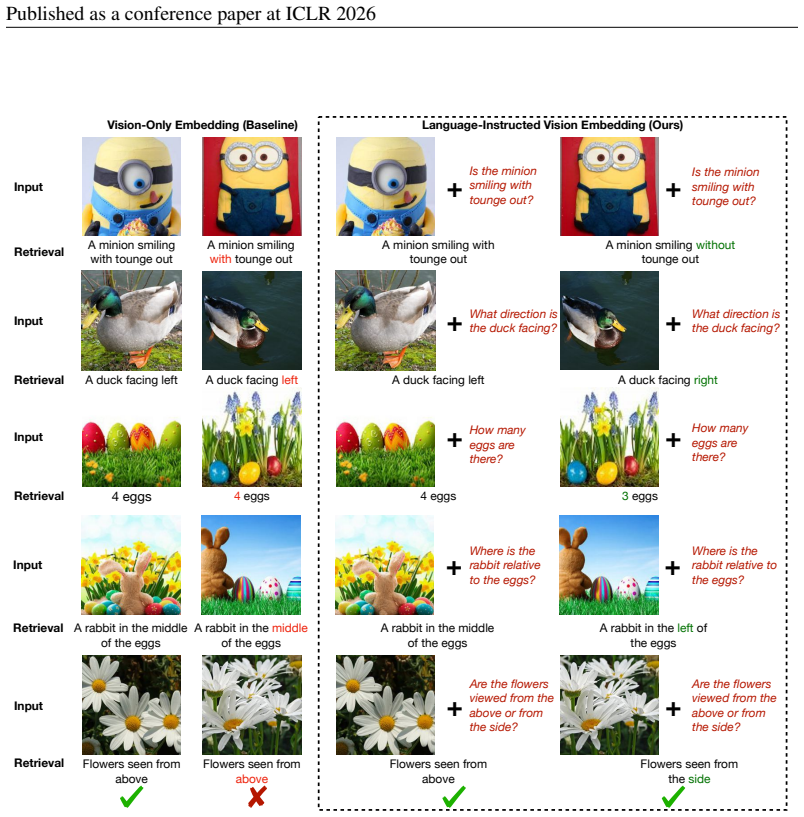
LIVE uses language as high-level guidance injected into the vision encoder to generate task-centric embeddings at inference time. This removes the need for task-specific retraining of the encoder or downstream models while yielding more controllable and generalizable visual representations that reduce hallucinations and improve performance on visual question answering.
What carries the argument
Language-Instructed Vision Embeddings (LIVE), which dynamically conditions the vision encoder on language instructions to focus on contextually relevant visual features.
If this is right
- The same encoder can handle multiple tasks by changing only the language instruction.
- Visual hallucinations decrease by 34 points on MMVP compared to standard approaches.
- Performance on visual question answering exceeds that of much larger vision-language models.
- The encoder generalizes to instructions and tasks not seen during any training.
Where Pith is reading between the lines
- Fewer task-specific models would need to be stored and deployed if one encoder adapts via instructions.
- Instruction-driven visual perception could extend to robotics or interactive systems where tasks change frequently.
- The method might combine with existing large language models to create more adaptive multimodal pipelines.
Load-bearing premise
A frozen vision encoder can be effectively steered by language instructions at inference time without any retraining or architectural modifications that would remove the reported gains.
What would settle it
Running the same vision encoder with and without language instructions on the MMVP hallucination benchmark or a VQA task and finding no improvement or generalization to unseen instructions would falsify the central claim.
Figures






read the original abstract
Vision foundation models are typically trained as static feature extractors, placing the burden of task adaptation onto large downstream models. We propose an alternative paradigm: instead of solely feeding visual features into language models, we use language itself to dynamically guide the vision encoder. Our method, Language-Instructed Vision Embeddings (LIVE), leverages language as high-level guidance to produce task-centric embeddings at inference time, removing the need for task-specific retraining. This enables the encoder to focus on contextually relevant aspects of the input, yielding more controllable and generalizable representations. Empirically, LIVE reduces visual hallucinations (+34 points on MMVP), surpasses vision-language models with orders of magnitude more parameters on visual question answering, and generalizes to unseen instructions and tasks -- offering a direct path toward adaptive, instruction-driven visual intelligence.
Editorial analysis
A structured set of objections, weighed in public.
Referee Report
Summary. The paper proposes Language-Instructed Vision Embeddings (LIVE), which uses language instructions as high-level guidance to dynamically steer a vision encoder at inference time, producing task-centric embeddings without task-specific retraining or architectural modifications. This is claimed to yield more controllable and generalizable representations, with empirical support including a +34 point gain on MMVP for reduced visual hallucinations, outperformance versus much larger VLMs on visual question answering, and generalization to unseen instructions and tasks.
Significance. If the core technical claim holds—that language can steer a (presumably frozen) vision encoder at inference without hidden task-specific adaptation—the result would be significant for vision-language modeling, as it shifts adaptation burden from downstream models or retraining to inference-time conditioning. The reported gains on MMVP and VQA would be notable if supported by rigorous baselines and controls.
major comments (2)
- [Method] The central claim that language instructions steer the vision encoder without task-specific retraining or architectural changes is load-bearing for the entire contribution, yet the abstract supplies no description of the conditioning mechanism (cross-attention, adapters, prompt modulation, etc.). The full manuscript must provide this in the method section with explicit statements on which parameters (if any) are updated per task.
- [Experiments] Table reporting MMVP results: the +34 point improvement and comparisons to larger VLMs require error bars, exact baselines, and dataset splits to be credible; without these the generalization and outperformance claims cannot be evaluated.
minor comments (2)
- Clarify notation for how language embeddings are fused with visual features; inconsistent use of terms like 'guidance' vs. 'conditioning' across sections.
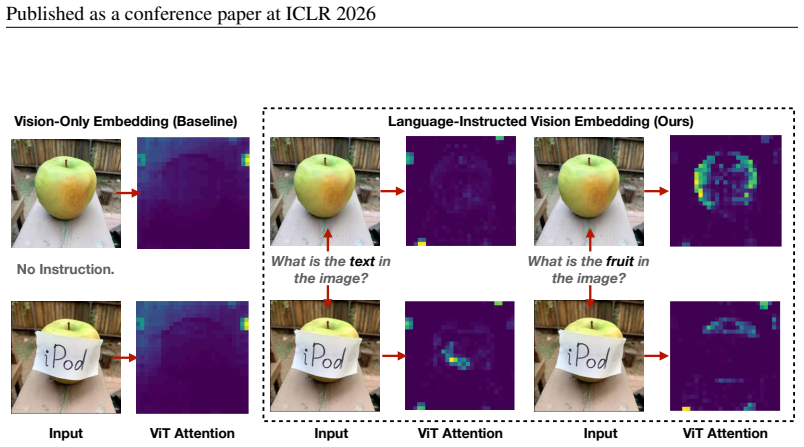
- Add missing references to prior work on language-conditioned vision encoders (e.g., prompt tuning or adapter-based methods) to properly situate the contribution.
Simulated Author's Rebuttal
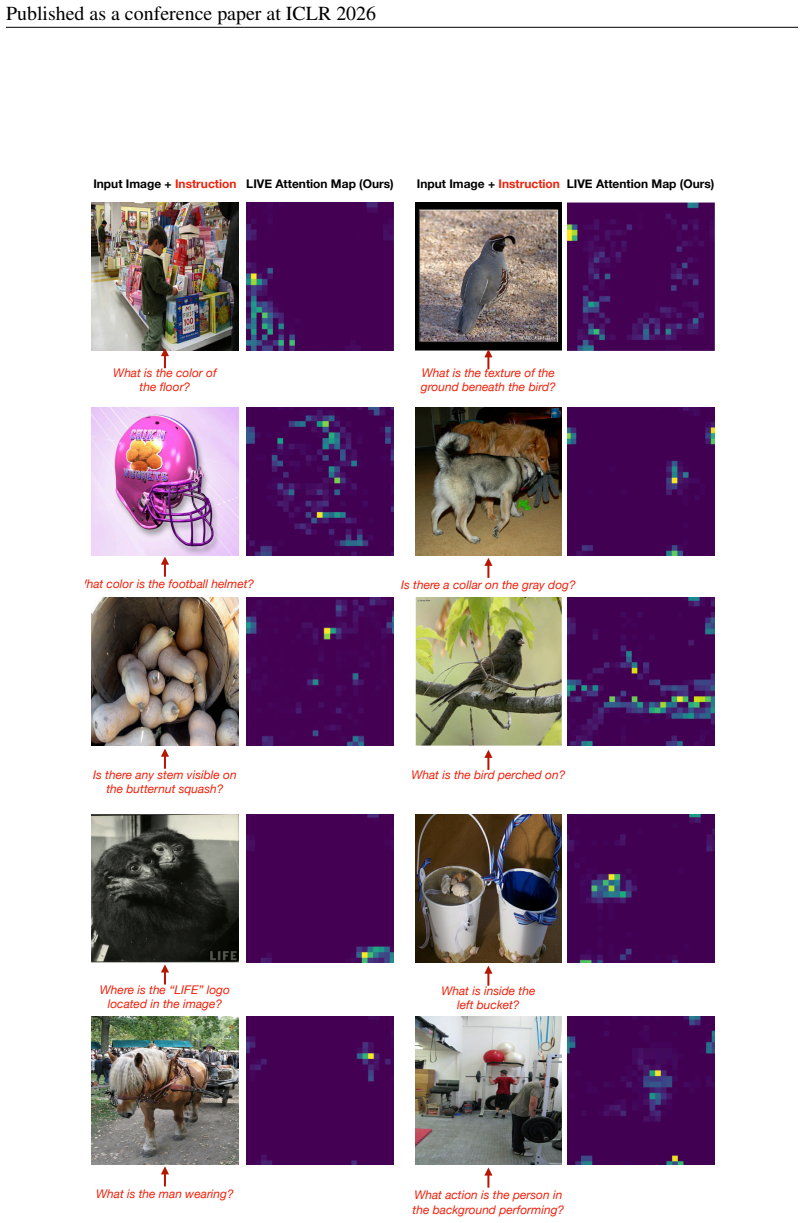
We thank the referee for their constructive feedback. We address each major comment below.
read point-by-point responses
-
Referee: [Method] The central claim that language instructions steer the vision encoder without task-specific retraining or architectural changes is load-bearing for the entire contribution, yet the abstract supplies no description of the conditioning mechanism (cross-attention, adapters, prompt modulation, etc.). The full manuscript must provide this in the method section with explicit statements on which parameters (if any) are updated per task.
Authors: We agree the abstract omits mechanism details. Section 3 of the manuscript describes the conditioning via cross-attention layers that integrate language instructions into the frozen vision encoder at inference time only; no parameters are updated per task or at inference. We will revise the abstract to briefly note the cross-attention conditioning. revision: partial
-
Referee: [Experiments] Table reporting MMVP results: the +34 point improvement and comparisons to larger VLMs require error bars, exact baselines, and dataset splits to be credible; without these the generalization and outperformance claims cannot be evaluated.
Authors: We agree that error bars, exact baselines, and splits strengthen credibility. The manuscript reports standard MMVP splits and baselines; we will add error bars (std. dev. over runs) and explicit baseline details to the table and appendix in revision. revision: yes
Circularity Check
No circularity; claims rest on empirical results with no derivation chain
full rationale
The paper introduces LIVE as a method to use language instructions for dynamically guiding a vision encoder at inference time without task-specific retraining. The provided abstract and context contain no equations, derivations, fitted parameters, or self-referential logic that could reduce a claimed result to its inputs by construction. No self-citations are invoked as load-bearing uniqueness theorems, no ansatzes are smuggled, and no predictions are presented as independent when they are statistically forced by fitting. The central claims are supported by reported benchmark improvements rather than any mathematical chain, making the paper self-contained against external benchmarks with no circular steps.
Axiom & Free-Parameter Ledger
Reference graph
Works this paper leans on
-
[1]
Exploring visual prompts for adapting large-scale models.arXiv preprint arXiv:2203.17274,
Hyojin Bahng, Ali Jahanian, Swami Sankaranarayanan, and Phillip Isola. Exploring visual prompts for adapting large-scale models.arXiv preprint arXiv:2203.17274,
-
[2]
PaliGemma: A versatile 3B VLM for transfer
Lucas Beyer, Andreas Steiner, Andr ´e Susano Pinto, Alexander Kolesnikov, Xiao Wang, Daniel Salz, Maxim Neumann, Ibrahim Alabdulmohsin, Michael Tschannen, Emanuele Bugliarello, et al. Paligemma: A versatile 3b vlm for transfer.arXiv preprint arXiv:2407.07726,
work page internal anchor Pith review Pith/arXiv arXiv
-
[3]
All you may need for vqa are image captions.arXiv preprint arXiv:2205.01883,
Soravit Changpinyo, Doron Kukliansky, Idan Szpektor, Xi Chen, Nan Ding, and Radu Soricut. All you may need for vqa are image captions.arXiv preprint arXiv:2205.01883,
-
[4]
PaLI: A Jointly-Scaled Multilingual Language-Image Model
Haozhe Chen, Junfeng Yang, Carl V ondrick, and Chengzhi Mao. Invite: Interpret and control vision- language models with text explanations. InThe Twelfth International Conference on Learning Representations, 2024a. Lin Chen, Jinsong Li, Xiaoyi Dong, Pan Zhang, Conghui He, Jiaqi Wang, Feng Zhao, and Dahua Lin. Sharegpt4v: Improving large multi-modal models ...
work page internal anchor Pith review Pith/arXiv arXiv
-
[5]
Gheorghe Comanici, Eric Bieber, Mike Schaekermann, Ice Pasupat, Noveen Sachdeva, Inderjit Dhillon, Marcel Blistein, Ori Ram, Dan Zhang, Evan Rosen, et al. Gemini 2.5: Pushing the frontier with advanced reasoning, multimodality, long context, and next generation agentic capabilities. arXiv preprint arXiv:2507.06261,
work page internal anchor Pith review Pith/arXiv arXiv
-
[6]
Instructblip: Towards general-purpose vision-language models with instruction tuning.Advances in neural information processing systems, 36:49250–49267,
11 Published as a conference paper at ICLR 2026 Wenliang Dai, Junnan Li, Dongxu Li, Anthony Tiong, Junqi Zhao, Weisheng Wang, Boyang Li, Pascale N Fung, and Steven Hoi. Instructblip: Towards general-purpose vision-language models with instruction tuning.Advances in neural information processing systems, 36:49250–49267,
2026
-
[7]
Ainaz Eftekhar, Kuo-Hao Zeng, Jiafei Duan, Ali Farhadi, Ani Kembhavi, and Ranjay Krishna. Selective visual representations improve convergence and generalization for embodied ai.arXiv preprint arXiv:2311.04193,
-
[8]
arXiv preprint arXiv:2309.17425 , year=
Alex Fang, Albin Madappally Jose, Amit Jain, Ludwig Schmidt, Alexander Toshev, and Vaishaal Shankar. Data filtering networks.arXiv preprint arXiv:2309.17425,
-
[9]
Accessed: 2024-11-16. Aaron Grattafiori, Abhimanyu Dubey, Abhinav Jauhri, Abhinav Pandey, Abhishek Kadian, Ahmad Al-Dahle, Aiesha Letman, Akhil Mathur, Alan Schelten, Alex Vaughan, et al. The llama 3 herd of models.arXiv preprint arXiv:2407.21783,
work page internal anchor Pith review Pith/arXiv arXiv 2024
-
[10]
E5-V: Universal Embeddings with Multimodal Large Language Models
Ting Jiang, Minghui Song, Zihan Zhang, Haizhen Huang, Weiwei Deng, Feng Sun, Qi Zhang, Deqing Wang, and Fuzhen Zhuang. E5-v: Universal embeddings with multimodal large language models. arXiv preprint arXiv:2407.12580,
work page internal anchor Pith review Pith/arXiv arXiv
-
[11]
Referitgame: Referring to objects in photographs of natural scenes
Sahar Kazemzadeh, Vicente Ordonez, Mark Matten, and Tamara Berg. Referitgame: Referring to objects in photographs of natural scenes. InProceedings of the 2014 conference on empirical methods in natural language processing (EMNLP), pp. 787–798,
2014
-
[12]
Samuel Lavoie, Polina Kirichenko, Mark Ibrahim, Mahmoud Assran, Andrew Gordon Wilson, Aaron Courville, and Nicolas Ballas. Modeling caption diversity in contrastive vision-language pretraining.arXiv preprint arXiv:2405.00740,
-
[13]
Vx2text: End-to-end learning of video-based text generation from multimodal inputs
12 Published as a conference paper at ICLR 2026 Xudong Lin, Gedas Bertasius, Jue Wang, Shih-Fu Chang, Devi Parikh, and Lorenzo Torresani. Vx2text: End-to-end learning of video-based text generation from multimodal inputs. InProceed- ings of the IEEE/CVF Conference on Computer Vision and Pattern Recognition, pp. 7005–7015,
2026
-
[14]
Training-free deep concept injection enables language models for video question answering
Xudong Lin, Manling Li, Richard Zemel, Heng Ji, and Shih-Fu Chang. Training-free deep concept injection enables language models for video question answering. InProceedings of the 2024 Conference on Empirical Methods in Natural Language Processing, pp. 22399–22416,
2024
-
[15]
Chengzhi Mao, Scott Geng, Junfeng Yang, Xin Wang, and Carl V ondrick. Understanding zero-shot adversarial robustness for large-scale models.arXiv preprint arXiv:2212.07016,
-
[16]
Visual classification via description from large language models,
Sachit Menon and Carl V ondrick. Visual classification via description from large language models. arXiv preprint arXiv:2210.07183,
-
[17]
Task bias in vision-language models
Sachit Menon, Ishaan Preetam Chandratreya, and Carl V ondrick. Task bias in vision-language models. arXiv preprint arXiv:2212.04412,
-
[18]
DINOv2: Learning Robust Visual Features without Supervision
Maxime Oquab, Timoth ´ee Darcet, Th ´eo Moutakanni, Huy V o, Marc Szafraniec, Vasil Khalidov, Pierre Fernandez, Daniel Haziza, Francisco Massa, Alaaeldin El-Nouby, et al. Dinov2: Learning robust visual features without supervision.arXiv preprint arXiv:2304.07193,
work page internal anchor Pith review Pith/arXiv arXiv
-
[19]
Pre-training image-language transformers for open-vocabulary tasks.arXiv preprint arXiv:2209.04372,
AJ Piergiovanni, Weicheng Kuo, and Anelia Angelova. Pre-training image-language transformers for open-vocabulary tasks.arXiv preprint arXiv:2209.04372,
-
[20]
EVA-CLIP: Improved Training Techniques for CLIP at Scale
Quan Sun, Yuxin Fang, Ledell Wu, Xinlong Wang, and Yue Cao. Eva-clip: Improved training techniques for clip at scale.arXiv preprint arXiv:2303.15389,
work page internal anchor Pith review Pith/arXiv arXiv
-
[21]
13 Published as a conference paper at ICLR 2026 Sirnam Swetha, Jinyu Yang, Tal Neiman, Mamshad Nayeem Rizve, Son Tran, Benjamin Yao, Trishul Chilimbi, and Mubarak Shah. X-former: Unifying contrastive and reconstruction learning for mllms.arXiv preprint arXiv:2407.13851,
-
[22]
Chameleon: Mixed-Modal Early-Fusion Foundation Models
Chameleon Team. Chameleon: Mixed-modal early-fusion foundation models.arXiv preprint arXiv:2405.09818,
work page internal anchor Pith review Pith/arXiv arXiv
-
[23]
Gemma Team, Aishwarya Kamath, Johan Ferret, Shreya Pathak, Nino Vieillard, Ramona Merhej, Sarah Perrin, Tatiana Matejovicova, Alexandre Ram´e, Morgane Rivi`ere, et al. Gemma 3 technical report.arXiv preprint arXiv:2503.19786,
work page internal anchor Pith review Pith/arXiv arXiv
-
[24]
Michael Tschannen, Alexey Gritsenko, Xiao Wang, Muhammad Ferjad Naeem, Ibrahim Alabdul- mohsin, Nikhil Parthasarathy, Talfan Evans, Lucas Beyer, Ye Xia, Basil Mustafa, et al. Siglip 2: Multilingual vision-language encoders with improved semantic understanding, localization, and dense features.arXiv preprint arXiv:2502.14786,
work page internal anchor Pith review Pith/arXiv arXiv
-
[25]
Scaling Pre-training to One Hundred Billion Data for Vision Language Models
Xiao Wang, Ibrahim Alabdulmohsin, Daniel Salz, Zhe Li, Keran Rong, and Xiaohua Zhai. Scaling pre- training to one hundred billion data for vision language models.arXiv preprint arXiv:2502.07617,
work page internal anchor Pith review Pith/arXiv arXiv
-
[26]
Hu Xu, Saining Xie, Xiaoqing Ellen Tan, Po-Yao Huang, Russell Howes, Vasu Sharma, Shang-Wen Li, Gargi Ghosh, Luke Zettlemoyer, and Christoph Feichtenhofer. Demystifying clip data.arXiv preprint arXiv:2309.16671,
work page internal anchor Pith review Pith/arXiv arXiv
-
[27]
Large Language Models as Optimizers
Chengrun Yang, Xuezhi Wang, Yifeng Lu, Hanxiao Liu, Quoc V Le, Denny Zhou, and Xinyun Chen. Large language models as optimizers.arXiv preprint arXiv:2309.03409,
work page internal anchor Pith review Pith/arXiv arXiv
-
[28]
CoCa: Contrastive Captioners are Image-Text Foundation Models
Jiahui Yu, Zirui Wang, Vijay Vasudevan, Legg Yeung, Mojtaba Seyedhosseini, and Yonghui Wu. Coca: Contrastive captioners are image-text foundation models.arXiv preprint arXiv:2205.01917,
work page internal anchor Pith review Pith/arXiv arXiv
-
[29]
Scaling vision transformers
Xiaohua Zhai, Alexander Kolesnikov, Neil Houlsby, and Lucas Beyer. Scaling vision transformers. InProceedings of the IEEE/CVF conference on computer vision and pattern recognition, pp. 12104–12113, 2022a. 14 Published as a conference paper at ICLR 2026 Xiaohua Zhai, Xiao Wang, Basil Mustafa, Andreas Steiner, Daniel Keysers, Alexander Kolesnikov, and Lucas...
2026
-
[30]
Kai Zhang, Yi Luan, Hexiang Hu, Kenton Lee, Siyuan Qiao, Wenhu Chen, Yu Su, and Ming-Wei Chang. Magiclens: Self-supervised image retrieval with open-ended instructions.arXiv preprint arXiv:2403.19651,
-
[31]
Junjie Zhou, Zheng Liu, Shitao Xiao, Bo Zhao, and Yongping Xiong. Vista: Visualized text embedding for universal multi-modal retrieval.arXiv preprint arXiv:2406.04292,
-
[32]
However, its practical application and further development are subject to certain limitations, which also open avenues for future research
15 Published as a conference paper at ICLR 2026 A APPENDIX A.1 LIMITATIONS Our approach enhances the controllability of visual representations using language instructions. However, its practical application and further development are subject to certain limitations, which also open avenues for future research. Optimizing Query Design for Downstream Tasks:...
2026
-
[33]
(2021), SigLip Zhai et al
• A) CLIP Radford et al. (2021), SigLip Zhai et al. (2023), LiT Zhai et al. (2022b) • B) Llava Liu et al. (2023), Gemma Team et al. (2025), Paligemma Beyer et al. (2024), Llama Grattafiori et al. (2024) • C) CoCA Yu et al. (2022), Cappa Tschannen et al. (2023) • D) VILT Kim et al. (2021) • E) Falmingo Alayrac et al. (2022), BLIP Li et al. (2022), X-former...
2021
-
[34]
Interestingly, by leveraging Gemini to evolve and generate different text prompts Yang et al
Due to our model’s training on more sophisticated image queries, the ImageNet classification accuracy dropped to 49.32% when no query prompt was used in retrieval tasks. Interestingly, by leveraging Gemini to evolve and generate different text prompts Yang et al. (2023), we improved the ImageNet accuracy to 68.18% using the instruction query: ”Classify th...
2023
-
[35]
While vision-only representations has a low accuracy on recognizing the text, our instructive visual embeddings allow embedding either image or text information based on instructions. Robustness Against Typographical Attacks.Vision-language models like CLIP and SigLip are known to be vulnerable to typographical attacks, where target text is appended to an...
2026
-
[36]
The resulting distribution, visualized in Figure 13, reveals significant variations in instruction fre- quency
Second, we employed Gemini Flash 2.0 to assign each question within our expansive 16-million synthetic image-query-answer triplet dataset to one of these 66 categories, or to an ”others” category if it didn’t fit. The resulting distribution, visualized in Figure 13, reveals significant variations in instruction fre- quency. ”Material identification via Vi...
2026
-
[37]
Guided by language instructions, without supervision on where the model shall look at, our LIVE encoder learns to focus on the part of the image that is corresponding to the language instructions. 23 Published as a conference paper at ICLR 2026 LIVE Attention Map (Ours) What is the color of the floor? What is the texture of the ground beneath the bird? Wha...
2026
discussion (0)
Sign in with ORCID, Apple, or X to comment. Anyone can read and Pith papers without signing in.