REVIEW 3 major objections 4 minor 17 cited by
A single post-processing statistic, E-hat, estimates the expected KL divergence between the Monte Carlo-approximated hierarchical posterior and the true posterior, and the paper recommends keeping E-hat ≤ 0.2 bits for reliable inference.
Reviewed by Pith at T0; open to challenge. T0 means a machine referee read the full paper against a public rubric. the ladder, T0–T4 →
T0 review · deepseek-v4-flash
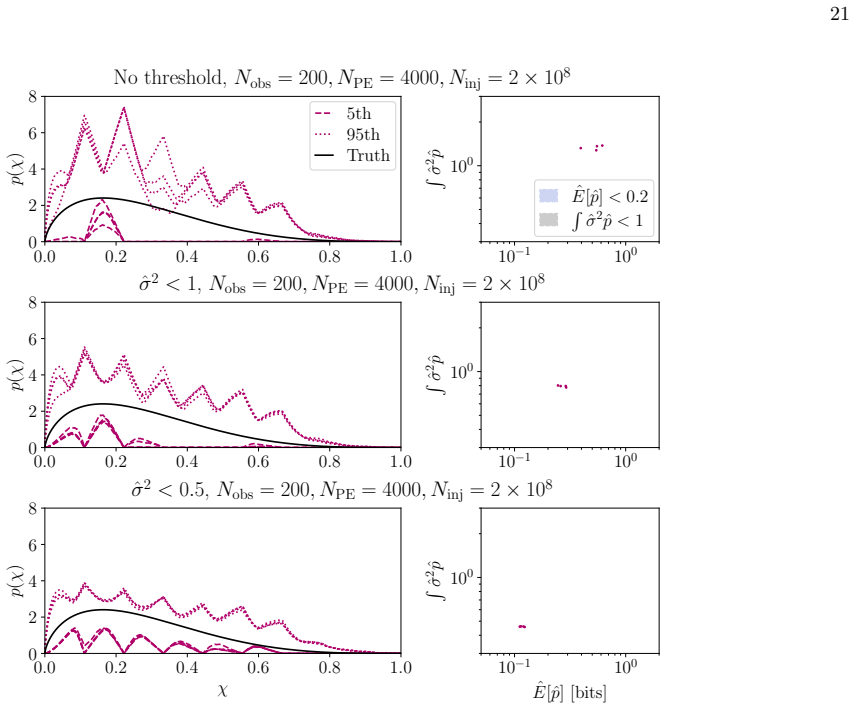
2026-08-04 22:36 UTC pith:YFES5CT3
load-bearing objection A genuinely useful, honestly calibrated error statistic for MC noise in hierarchical GW population inference, with one real soft spot: the 0.2-bit certification threshold can be too lenient in exactly the low-NPE regime where analysts most need it. the 3 major comments →
When (not) to trust Monte Carlo approximations for hierarchical Bayesian inference
The pith
A machine-rendered reading of the paper's core claim, the machinery that carries it, and where it could break.
Core claim
On its own terms, the paper's central claim is that the expected information loss from Monte Carlo approximation is estimable from the approximate posterior itself. Writing the approximate posterior as p-hat(Λ) and the true posterior as p(Λ), the error statistic E-hat estimates <KL(p|p-hat)> by combining a precision statistic (the integrated variance of the log-likelihood estimator, reduced by its covariance across the support of the posterior) and an accuracy statistic (the squared bias). The paper verifies empirically that E-hat tracks the true KL divergence in Gaussian and gravitational-wave-like examples, and that E-hat ≤ 0.2 bits separates reliable from unreliable posterior estimators.
What carries the argument
The central object is the error statistic E-hat = A-hat + Pi-hat, defined from samples of the approximate posterior. Pi-hat is a precision statistic: half the variance of the log-likelihood estimator at posterior samples minus half the average covariance between log-likelihoods at pairs of posterior samples, all divided by ln 2. A-hat is an accuracy statistic: the sample variance of weights built from the selection-efficiency variance and the log-likelihood covariance. These statistics estimate the leading-order Taylor expansion of the KL divergence between the true and approximate posteriors, and they are computable in post-processing from the posterior samples, single-event posterior sampl
Load-bearing premise
The framework assumes the log-likelihood estimator's perturbation is small enough that the second-order Taylor expansion of the KL divergence is accurate, and that the estimated covariances capture the true uncertainty; if either fails, E-hat can read smaller than the true information loss and the 0.2-bit threshold would give false confidence.
What would settle it
In the paper's own Gaussian hierarchical model, fix N_obs=100 and N_PE=10, compute E-hat from one posterior estimate, then average the true KL divergence over many independent Monte Carlo realizations. If E-hat falls below the measured KL divergence by more than a factor of two in that regime, the statistic cannot be trusted precisely where the approximation is least reliable.
If this is right
- Analysts can run the E-hat check on an already-completed population inference; no new sampling is required.
- The 0.2-bit recommendation gives a concrete, quantitative stop rule for Monte Carlo convergence in hierarchical analyses.
- Including the likelihood bias correction makes the likelihood estimator unbiased to leading order, at negligible extra cost, and can be applied to existing pipelines.
- For simple, strongly constrained models, analyses violating the log-likelihood variance threshold can still be certified by E-hat, saving substantial compute.
- For weak or nonparametric models, effective-sample-size thresholds alone are not enough; E-hat or a variance threshold must be applied.
Where Pith is reading between the lines
- Because E-hat is built only from a covariance estimate of the log-likelihood surface, the same logic should extend to likelihood-free or density-estimate hierarchical inference methods that can supply such a covariance—an extension the paper gestures at but does not develop.
- The 0.2-bit threshold is a rule of thumb tied to the examples; a decision-maker who cares about a specific scientific claim might want a lower threshold for high-stakes parameter estimates.
- The under-reporting of true KL divergence at small N_PE (shown in the paper's Fig. 9) means E-hat is safest as an accept criterion—borderline or low values do not automatically certify an inference in the high-noise regime.
Editorial analysis
A structured set of objections, weighed in public.
Referee Report
Summary. The paper addresses Monte Carlo error in hierarchical Bayesian population inference for gravitational-wave catalogs. It derives a post-processing error statistic E-hat = A-hat + Pi-hat intended to estimate the expected KL divergence between the true posterior and the MC-approximated posterior, and recommends E-hat <= 0.2 bits as a reliability criterion. It derives and tests a leading-order correction for the bias of the hierarchical likelihood estimator, proves via the Cauchy-Schwarz inequality that log-likelihood variance thresholds bound posterior error, and demonstrates with Gaussian toy problems and synthetic GW catalogs that simple parametric models tolerate larger MC variance than weak/nonparametric models. A Python package, population-error, is provided for computing the statistics.
Significance. If correct, this would give analysts a single diagnostic for when Monte Carlo approximations have corrupted hierarchical inference, replacing ad hoc effective-sample-size checks. The derivation is not circular: Eq. (35) follows from a Taylor expansion of the KL divergence, and the covariance estimators are based on standard MC variance propagation. The bias-correction term (Eqs. 23-24) is a concrete practical advance, and the proof that thresholding the log-likelihood variance bounds the posterior error is a useful formal result. The paper also provides reproducible synthetic validations and an implementation, which strengthens its practical value. The main limitation concerns the validity of the second-order expansion in exactly the high-MC-error regime where the diagnostic is most needed.
major comments (3)
- [§V C, Eq. (35), Fig. 9] The central recommendation in §VIII, E-hat <= 0.2 bits, presumes that the second-order expansion in Eq. (35) accurately approximates <KL(p|p-hat)>. The paper itself states in §V C that at small N_PE the statistics "under-estimate the true KL divergences, as higher order terms ... contribute meaningfully," and Fig. 9 confirms this. This is exactly the regime where Monte Carlo error is largest and where an analyst most needs the diagnostic. No companion check is provided to establish when the O(delta^3) truncation is valid (e.g., a bound on the estimated perturbation magnitude or on the estimated covariance over the posterior). Without such a guard, a small E-hat can certify analyses that have already lost more than 0.2 bits. Please add an expansion-validity criterion, or restrict the certification claim to regimes in which the leading-order expansion is verified.
- [§I and §V (threshold calibration)] The introduction claims the error statistic is a "sufficient and necessary condition" for a reliable posterior estimator, and §VIII recommends the empirical threshold E-hat <= 0.2 bits. The estimator is leading-order and intentionally neglects higher-order terms, so a small E-hat does not guarantee small true KL (see previous comment). Conversely, the threshold itself is calibrated on the examples considered, not derived, so it is not a necessary condition in any formal sense. The authors should either provide a formal calibration argument or explicitly qualify the logical status of the 0.2-bit recommendation.
- [§V, Eqs. (37)-(39)] E-hat is reported as a single number, but it is itself a random variable estimated from a finite number of posterior samples and from noisy covariance estimates. In Fig. 9 the 90% intervals are shown for the toy model, but in the GW applications (Figs. 10-12) no uncertainty on E-hat is reported. Given the recommendation is a point threshold, an analyst cannot distinguish E-hat = 0.19 from E-hat = 0.21, nor know whether the estimate is dominated by MC noise. Please provide a procedure for the variance/uncertainty of E-hat, or at least a diagnostic that the estimates are stable.
minor comments (4)
- [Abstract] "pipinstallable" should be "pip-installable"; also "L VK" is missing a space in the introduction.
- [§V C and Fig. 9 caption] Phrasing "under-estimate to the KL divergences" should read "underestimate the KL divergences." Similar typos appear in the paragraphs around Eq. (35).
- [§VI B, footnote 11] "a infinite variance" should be "an infinite variance." More substantively, the infinite-variance issue for the selection-efficiency estimator could be mentioned in the main text as a caveat for the bias correction in Eq. (24).
- [§VII, Fig. 11] The caption states N_inj = 2 x 10^8 while the text states N_inj = 10^8; these should be reconciled.
Circularity Check
No significant circularity: the error statistic is derived from a KL-divergence expansion and validated against analytic ground truth, not fit or self-cited into existence.
full rationale
I walked the central derivation chain. Eq. 35 derives the leading-order mean KL divergence from a small-perturbation expansion of the posterior estimator, and the statistics in Eqs. 36-39 are explicit plug-in estimators of that expansion: the precision statistic estimates the variance/covariance term and the accuracy statistic estimates the squared-bias term. The estimators are not defined in terms of the target KL; they are defined from the Monte Carlo covariance of the log-likelihood (Eqs. 30-32), which is an independent input. The paper validates them against empirically computed KL divergences using 10^4 posterior realizations in Sec. VI C and Fig. 9; this is external verification, not construction. The 0.2-bit threshold is an empirical recommendation based on the examples, not a fitted parameter that forces the examples to pass, and the paper explicitly flags the small-N_PE regime where the statistics under-estimate the true KL (Sec. VI C, Fig. 9), which is a limitation rather than a circular step. The cited prior work (Essick & Farr 2022; Talbot & Golomb 2023; Farr 2019) is not by the present authors and is used as comparison or as a conjectured threshold that the paper independently proves via Cauchy-Schwarz (Sec. V A, Appendix D). The only self-citations (Vitale & Mould 2025 for synthetic data, Heinzel 2025 for the software package) are not load-bearing for the derivation. No equation reduces to its input by construction, and no fitted quantity is renamed as a prediction.
Axiom & Free-Parameter Ledger
free parameters (1)
- Recommendation threshold for error statistic (E-hat) =
0.2 bits
axioms (4)
- domain assumption The population likelihood model of Eq. 3 (with selection efficiency xi(Lambda)) is correct and the noise is Gaussian/stationary.
- standard math Monte Carlo estimators have finite variance; the proposal distribution must have nonzero density wherever the integrand is nonzero.
- ad hoc to paper The log-likelihood estimator uncertainty is small enough that a second-order Taylor expansion in delta is adequate for the KL divergence and for the bias corrections.
- domain assumption The posterior is in the asymptotic regime (approximately Gaussian, support proportional to 1/sqrt(Nobs)) for the scaling laws in Table I.
Cite this review
Pith. "Pith review of When (not) to trust Monte Carlo approximations for hierarchical Bayesian inference." pith.science (2026). https://pith.science/paper/YFES5CT3
@misc{pith2026250907221,
  author       = {Pith},
  title        = {Pith review of: When (not) to trust Monte Carlo approximations for hierarchical Bayesian inference},
  year         = {2026},
  howpublished = {\url{https://pith.science/paper/YFES5CT3}},
  note         = {Machine review of arXiv:2509.07221}
}
read the original abstract
The coming years of gravitational wave astrophysics promises thousands of new detections, which can unlock fundamental scientific insights if the information in each observation can be properly synthesized into a coherent picture. State-of-the-art approaches often accomplish this with hierarchical Bayesian inference. However, this typically relies on Monte Carlo approximations that are already very expensive in current data, and may become prohibitively so in the future. In this paper we show how this process can be understood from a first-principles statistical approach. We derive an error estimator $\hat{E}$ for quantifying the amount of information that is lost due to the Monte Carlo approximation and recommend that this error is limited to no more than $\hat{E} \lesssim 0.2$ bits for reliable inference. We also show that the hierarchical likelihood estimator is biased but may be corrected. Finally, we show some practical examples for inference on synthetic gravitational-wave population inference, demonstrating that simple models with strong assumptions can be much more stable to Monte Carlo uncertainty than those with weaker assumptions. We also provide a \texttt{pip}-installable package \texttt{population-error} with which analysts can calculate the error statistics $\hat{E}$.
Figures




Forward citations
Cited by 17 Pith papers
-
A Four-dimensional Model-agnostic Probe into the Astrophysical Origins of Binary Black Hole Subpopulations
A GPU-accelerated binned Gaussian process yields the first model-agnostic 4D BBH population in (m1, q, χeff, χp), revealing four mass-based subpopulations and new spin-mass-ratio correlations.
-
End-to-End Population Inference from Gravitational-Wave Strain using Transformers
Dingo-Pop uses a transformer to perform amortized, end-to-end population inference from GW strain data in seconds, bypassing per-event Monte Carlo sampling.
-
Joint population and strong-lensing inference for resolved gravitational-wave events probes the black-hole merger rate beyond the peak of star formation
Joint strong-lensing and population inference on resolved gravitational-wave events finds no lensed events and tightens constraints on the black-hole merger rate peak redshift and high-redshift tail.
-
Fortifying gravitational-wave population inference with normalizing flows
Representing each gravitational-wave event's posterior with a normalizing flow lets analysts generate enough cheap posterior samples to keep the Monte-Carlo variance of population inference below threshold for catalog...
-
Gravitational-wave astronomy requires population-informed parameter estimation
Single-event GW parameter estimates under reference priors are population-biased; hierarchical, population-informed re-analysis is needed and changes the identification of the most extreme black holes in the catalog.
-
Pushing spectral siren cosmology into the third-generation era: a blinded mock data challenge
Three public spectral-siren pipelines agree on blinded Einstein Telescope mock catalogs and scale to ~10^5 events, forecasting ~2.4% precision on H(z) at z≈1.5.
-
Measurement prospects for the pair-instability mass cutoff with gravitational waves
Simulations show a 40-50 solar-mass black-hole cutoff is not guaranteed to be confidently recovered from GWTC-4-like catalogs, spurious detections are unlikely, and O4 data would reduce cutoff-mass uncertainty by at l...
-
Reconsidering the consistent use of precessing, higher order multipole models for gravitational wave analyses
A matched-filter SNR threshold on precession and higher-multipole content can select cheaper waveform models per event while keeping inferred black-hole mass and spin populations consistent, cutting analysis cost by t...
-
Signatures of a subpopulation of hierarchical mergers in the GWTC-4 gravitational-wave dataset
GWTC-4 data show a transition to nearly all hierarchical mergers above 46 solar masses, with the hierarchical rate peaking at 15.7 solar masses, indicating mass-dependent substructure in black hole spins.
-
Signatures of a subpopulation of hierarchical mergers in the GWTC-4 gravitational-wave dataset
Using a joint effective-spin and precession-spin model on 155 gravitational-wave events, the authors infer that the hierarchical (second-generation) merger fraction rises sharply above ~46 M_sun and peaks again near 1...
-
Characterizing Binary Black Hole Subpopulations in GWTC-4 with Binned Gaussian Processes: On the Origins of the $35M_{\odot}$ Peak
In GWTC-4, only the subpopulation near 35 M_sun is equal-mass, low-spin, and randomly oriented, matching globular-cluster dynamical formation with BH birth spins 0.1-0.2.
-
The impact of precession and higher-order multipoles for gravitational wave cosmological inference
For H0 inference via the black-hole mass-spectrum method, waveform models with spin precession and higher-order multipoles offer no significant advantage over the simplest quadrupole-only model, at up to six times low...
-
Constraining Gravitational Wave Memory with Hierarchical Inference
Hierarchical Bayesian inference on GWTC-5.0 constrains the memory enhancement factor to 0.26 with large uncertainties consistent with the GR value of 1 and forecasts that 2000 detections are needed for a 1σ constraint...
-
Gravitational-wave constraints on $H_0$ are robust to (putative) redshift evolution in the binary black hole mass spectrum at current sensitivity
Spectral-siren H0 constraints from GWTC-4.0 binary black holes remain robust when the mass spectrum is permitted to evolve with redshift at current detector sensitivity.
-
Evidence for additional structure in the effective spin distribution hints at multiple formation pathways in GWTC-5.0
GWTC-5.0 analysis finds evidence for structure beyond a non-skewed Gaussian bulk in χ_eff, with suggestive mass-dependent excess of positive over negative spins outside the bulk at 13:1 odds in one mass bin.
-
No model-independent evidence for a peak in binary black hole spin (mis)alignments
No model-independent evidence for a peak in binary black hole spin tilts is found in GWTC-4; mass-spin magnitude correlation is confirmed but mass-tilt correlation is not.
-
Gravitational-wave astronomy requires population-informed parameter estimation
Population-informed hierarchical parameter estimation is required for unbiased astrophysical interpretation of gravitational-wave events rather than using standard individual posteriors with reference priors.
Reference graph
Works this paper leans on
-
[1]
See the Bernstein–von Mises theorem [68, 69])
The posterior is in the asymptotic regime (approximately Gaussian, with support scaling as 1/ √Nobs. See the Bernstein–von Mises theorem [68, 69])
-
[2]
The population model is fixed asN obs increases, and has a fixed and finite dimension (e.g., this argument fails for trans-dimensional or infinite dimensional models [70–72])
-
[3]
True Population
The support of the posterior is much smaller than the structure in the log-likelihood covariance, such that the log-likelihood covariance is adequately approximated to second order in the hyperparameters Λ. In the worst case, if one of these assumptions does not hold, the scalings shown in Table I may not include the additionalN −1 obs term. See a more ex...
-
[4]
We show how the inferred GW populations can be subject to large errors if adequate error statistics are not met
We show further examples of the uncertainty in a posterior estimator and the quantification with the error statistic. We show how the inferred GW populations can be subject to large errors if adequate error statistics are not met
-
[5]
The analyst can instead show the error statistic ˆE[ˆp]≲0.2 bits to demonstrate a safe analysis
For simple, strong models with well-constrained hyperparameters, thresholding on estimator convergence may be unnecessary (such as a log-likelihood variance threshold). The analyst can instead show the error statistic ˆE[ˆp]≲0.2 bits to demonstrate a safe analysis
-
[6]
Thresholding on the log-likelihood variance is the only way toguaranteethat an analysis is safe, but other heuristic thresholds (e.g
For weaker models, such as nonparametric models, it is necessary to adopt some sort of threshold to ensure a reliable posterior estimator. Thresholding on the log-likelihood variance is the only way toguaranteethat an analysis is safe, but other heuristic thresholds (e.g. based on Monte Carlo effective samples sizesN eff ) may be adopted, so long as the e...
-
[7]
S. Vitale, R. Lynch, R. Sturani, and P. Graff, Use of gravitational waves to probe the formation channels of compact binaries, Class. Quant. Grav.34, 03LT01 (2017), arXiv:1503.04307 [gr-qc]
Pith/arXiv arXiv 2017
-
[8]
VI A of the Gaussian hierarchical inference withN obs = 1000 and Nobs = 5000
Parameter Estimation uncertainty only Here we show additional examples from Sec. VI A of the Gaussian hierarchical inference withN obs = 1000 and Nobs = 5000. Notice the error statistic scalings are roughly matched by the analytic predictions in Table I. Restricting our attention toN PE = 1000, in Figs. 5, 13 and 14 we haveN obs = 100, 1000, and 5000 and ...
-
[9]
VI B where we vary the number of injectionsN inj and the strength of the selection criterion
Selection effects estimation uncertainty only We include some additional examples to Sec. VI B where we vary the number of injectionsN inj and the strength of the selection criterion. Some of the posterior estimators shown here are limited by the resolution on the underlying grid ofσandµ. Note that the scaling is roughly similar to the scaling arguments s...
-
[10]
B. P. Abbottet al.(LIGO Scientific, Virgo), Observation of Gravitational Waves from a Binary Black Hole Merger, Phys. Rev. Lett.116, 061102 (2016), arXiv:1602.03837 [gr-qc]
Pith/arXiv arXiv 2016
-
[11]
B. P. Abbottet al.(LIGO Scientific, Virgo), GWTC-1: A Gravitational-Wave Transient Catalog of Compact Binary Mergers Observed by LIGO and Virgo during the First and Second Observing Runs, Phys. Rev. X9, 031040 (2019), arXiv:1811.12907 [astro-ph.HE]
Pith/arXiv arXiv 2019
-
[12]
R. Abbottet al.(LIGO Scientific, Virgo), GWTC-2: Compact Binary Coalescences Observed by LIGO and Virgo During the First Half of the Third Observing Run, Phys. Rev. X11, 021053 (2021), arXiv:2010.14527 [gr-qc]. 38
Pith/arXiv arXiv 2021
-
[13]
R. Abbottet al.(LIGO Scientific, VIRGO), GWTC-2.1: Deep extended catalog of compact binary coalescences observed by LIGO and Virgo during the first half of the third observing run, Phys. Rev. D109, 022001 (2024), arXiv:2108.01045 [gr-qc]
Pith/arXiv arXiv 2024
-
[14]
R. Abbottet al.(KAGRA, VIRGO, LIGO Scientific), GWTC-3: Compact Binary Coalescences Observed by LIGO and Virgo during the Second Part of the Third Observing Run, Phys. Rev. X13, 041039 (2023), arXiv:2111.03606 [gr-qc]
Pith/arXiv arXiv 2023
-
[15]
B. P. Abbottet al.(KAGRA, LIGO Scientific, Virgo), Prospects for observing and localizing gravitational-wave transients with Advanced LIGO, Advanced Virgo and KAGRA, Living Rev. Rel.19, 1 (2016), arXiv:1304.0670 [gr-qc]
Pith/arXiv arXiv 2016
-
[16]
B. P. Abbottet al.(LIGO Scientific, Virgo, 1M2H, Dark Energy Camera GW-E, DES, DLT40, Las Cumbres Observatory, VINROUGE, MASTER), A gravitational-wave standard siren measurement of the Hubble constant, Nature551, 85 (2017), arXiv:1710.05835 [astro-ph.CO]
Pith/arXiv arXiv 2017
-
[17]
B. P. Abbottet al.(LIGO Scientific, Virgo), Astrophysical Implications of the Binary Black-Hole Merger GW150914, Astrophys. J. Lett.818, L22 (2016), arXiv:1602.03846 [astro-ph.HE]
Pith/arXiv arXiv 2016
-
[18]
M. Zevin, C. Pankow, C. L. Rodriguez, L. Sampson, E. Chase, V. Kalogera, and F. A. Rasio, Constraining Formation Models of Binary Black Holes with Gravitational-Wave Observations, Astrophys. J.846, 82 (2017), arXiv:1704.07379 [astro-ph.HE]
Pith/arXiv arXiv 2017
-
[19]
I. Mandel and A. Farmer, Merging stellar-mass binary black holes, Phys. Rept.955, 1 (2022), arXiv:1806.05820 [astro- ph.HE]
Pith/arXiv arXiv 2022
-
[20]
I. Mandel and F. S. Broekgaarden, Rates of compact object coalescences, Living Rev. Rel.25, 1 (2022), arXiv:2107.14239 [astro-ph.HE]
Pith/arXiv arXiv 2022
-
[21]
R. Abbottet al.(KAGRA, VIRGO, LIGO Scientific), Population of Merging Compact Binaries Inferred Using Gravitational Waves through GWTC-3, Phys. Rev. X13, 011048 (2023), arXiv:2111.03634 [astro-ph.HE]
Pith/arXiv arXiv 2023
-
[22]
B. F. Schutz, Determining the Hubble Constant from Gravitational Wave Observations, Nature323, 310 (1986)
1986
- [23]
-
[24]
C. Messenger and J. Read, Measuring a cosmological distance-redshift relationship using only gravitational wave observa- tions of binary neutron star coalescences, Phys. Rev. Lett.108, 091101 (2012), arXiv:1107.5725 [gr-qc]
Pith/arXiv arXiv 2012
-
[25]
S. Mirshekari, N. Yunes, and C. M. Will, Constraining Generic Lorentz Violation and the Speed of the Graviton with Gravitational Waves, Phys. Rev. D85, 024041 (2012), arXiv:1110.2720 [gr-qc]
Pith/arXiv arXiv 2012
-
[26]
Christensen, Stochastic Gravitational Wave Backgrounds, Rept
N. Christensen, Stochastic Gravitational Wave Backgrounds, Rept. Prog. Phys.82, 016903 (2019), arXiv:1811.08797 [gr- qc]
Pith/arXiv arXiv 2019
-
[27]
J. M. Ezquiaga and D. E. Holz, Spectral Sirens: Cosmology from the Full Mass Distribution of Compact Binaries, Phys. Rev. Lett.129, 061102 (2022), arXiv:2202.08240 [astro-ph.CO]
Pith/arXiv arXiv 2022
-
[28]
J. R. Gairet al., The Hitchhiker’s Guide to the Galaxy Catalog Approach for Dark Siren Gravitational-wave Cosmology, Astron. J.166, 22 (2023), arXiv:2212.08694 [gr-qc]
Pith/arXiv arXiv 2023
-
[29]
G. Baym, T. Hatsuda, T. Kojo, P. D. Powell, Y. Song, and T. Takatsuka, From hadrons to quarks in neutron stars: a review, Rept. Prog. Phys.81, 056902 (2018), arXiv:1707.04966 [astro-ph.HE]
Pith/arXiv arXiv 2018
-
[30]
C. D. Capano, I. Tews, S. M. Brown, B. Margalit, S. De, S. Kumar, D. A. Brown, B. Krishnan, and S. Reddy, Stringent constraints on neutron-star radii from multimessenger observations and nuclear theory, Nature Astron.4, 625 (2020), arXiv:1908.10352 [astro-ph.HE]
Pith/arXiv arXiv 2020
-
[31]
T. Dietrich, M. W. Coughlin, P. T. H. Pang, M. Bulla, J. Heinzel, L. Issa, I. Tews, and S. Antier, Multimessenger constraints on the neutron-star equation of state and the Hubble constant, Science370, 1450 (2020), arXiv:2002.11355 [astro-ph.HE]
Pith/arXiv arXiv 2020
-
[32]
Chatziioannou, Neutron star tidal deformability and equation of state constraints, Gen
K. Chatziioannou, Neutron star tidal deformability and equation of state constraints, Gen. Rel. Grav.52, 109 (2020), arXiv:2006.03168 [gr-qc]
Pith/arXiv arXiv 2020
-
[33]
P. Landry, R. Essick, and K. Chatziioannou, Nonparametric constraints on neutron star matter with existing and upcoming gravitational wave and pulsar observations, Phys. Rev. D101, 123007 (2020), arXiv:2003.04880 [astro-ph.HE]
Pith/arXiv arXiv 2020
-
[34]
C. J. Moore, R. H. Cole, and C. P. L. Berry, Gravitational-wave sensitivity curves, Class. Quant. Grav.32, 015014 (2015), arXiv:1408.0740 [gr-qc]
Pith/arXiv arXiv 2015
-
[35]
C. M. Will, The Confrontation between General Relativity and Experiment, Living Rev. Rel.17, 4 (2014), arXiv:1403.7377 [gr-qc]
Pith/arXiv arXiv 2014
-
[36]
B. P. Abbottet al.(LIGO Scientific, Virgo), Tests of general relativity with GW150914, Phys. Rev. Lett.116, 221101 (2016), [Erratum: Phys.Rev.Lett. 121, 129902 (2018)], arXiv:1602.03841 [gr-qc]
Pith/arXiv arXiv 2016
-
[37]
B. P. Abbottet al.(LIGO Scientific, Virgo), Tests of General Relativity with GW170817, Phys. Rev. Lett.123, 011102 (2019), arXiv:1811.00364 [gr-qc]
Pith/arXiv arXiv 2019
-
[38]
R. Abbottet al.(LIGO Scientific, VIRGO, KAGRA), Tests of General Relativity with GWTC-3, (2021), arXiv:2112.06861 [gr-qc]
Pith/arXiv arXiv 2021
-
[39]
W. Del Pozzo, Inference of the cosmological parameters from gravitational waves: application to second generation inter- ferometers, Phys. Rev. D86, 043011 (2012), arXiv:1108.1317 [astro-ph.CO]
Pith/arXiv arXiv 2012
-
[40]
W. Del Pozzo, T. G. F. Li, M. Agathos, C. Van Den Broeck, and S. Vitale, Demonstrating the feasibility of probing the neutron star equation of state with second-generation gravitational wave detectors, Phys. Rev. Lett.111, 071101 (2013), arXiv:1307.8338 [gr-qc]
Pith/arXiv arXiv 2013
-
[41]
M. Isi, K. Chatziioannou, and W. M. Farr, Hierarchical test of general relativity with gravitational waves, Phys. Rev. Lett. 123, 121101 (2019), arXiv:1904.08011 [gr-qc]
Pith/arXiv arXiv 2019
-
[42]
R. Essick and M. Fishbach, Ensuring Consistency between Noise and Detection in Hierarchical Bayesian Inference, Astro- phys. J.962, 169 (2024), arXiv:2310.02017 [gr-qc]. 39
Pith/arXiv arXiv 2024
-
[43]
R. Udall, S. Hourihane, S. Miller, D. Davis, K. Chatziioannou, M. Isi, and H. Deshong, Antialigned spin of GW191109: Glitch mitigation and its implications, Phys. Rev. D111, 024046 (2025), arXiv:2409.03912 [gr-qc]
Pith/arXiv arXiv 2025
-
[44]
B. P. Abbottet al.(LIGO Scientific, Virgo), A guide to LIGO–Virgo detector noise and extraction of transient gravitational- wave signals, Class. Quant. Grav.37, 055002 (2020), arXiv:1908.11170 [gr-qc]
Pith/arXiv arXiv 2020
-
[45]
C. Pankowet al., Mitigation of the instrumental noise transient in gravitational-wave data surrounding GW170817, Phys. Rev. D98, 084016 (2018), arXiv:1808.03619 [gr-qc]
Pith/arXiv arXiv 2018
-
[46]
Modeling compact binary signals and instrumental glitches in gravitational wave data
K. Chatziioannou, N. Cornish, M. Wijngaarden, and T. B. Littenberg, Modeling compact binary signals and instrumental glitches in gravitational wave data, Phys. Rev. D103, 044013 (2021), arXiv:2101.01200 [gr-qc]
work page internal anchor Pith review Pith/arXiv arXiv 2021
-
[47]
S. Hourihane, K. Chatziioannou, M. Wijngaarden, D. Davis, T. Littenberg, and N. Cornish, Accurate modeling and miti- gation of overlapping signals and glitches in gravitational-wave data, Phys. Rev. D106, 042006 (2022), arXiv:2205.13580 [gr-qc]
Pith/arXiv arXiv 2022
-
[48]
D. Davis, T. B. Littenberg, I. M. Romero-Shaw, M. Millhouse, J. McIver, F. Di Renzo, and G. Ashton, Subtracting glitches from gravitational-wave detector data during the third LIGO-Virgo observing run, Class. Quant. Grav.39, 245013 (2022), arXiv:2207.03429 [astro-ph.IM]
Pith/arXiv arXiv 2022
-
[49]
E. Payne, S. Hourihane, J. Golomb, R. Udall, R. Udall, D. Davis, and K. Chatziioannou, Curious case of GW200129: Interplay between spin-precession inference and data-quality issues, Phys. Rev. D106, 104017 (2022), arXiv:2206.11932 [gr-qc]
Pith/arXiv arXiv 2022
-
[50]
S. Ghonge, J. Brandt, J. M. Sullivan, M. Millhouse, K. Chatziioannou, J. A. Clark, T. Littenberg, N. Cornish, S. Hourihane, and L. Cadonati, Assessing and mitigating the impact of glitches on gravitational-wave parameter estimation: A model agnostic approach, Phys. Rev. D110, 122002 (2024), arXiv:2311.09159 [gr-qc]
Pith/arXiv arXiv 2024
-
[51]
R. Macas, A. Lundgren, and G. Ashton, Revisiting the evidence for precession in GW200129 with machine learning noise mitigation, Phys. Rev. D109, 062006 (2024), arXiv:2311.09921 [gr-qc]
Pith/arXiv arXiv 2024
-
[52]
A. Q. Cheng, M. Zevin, and S. Vitale, What You Don’t Know Can Hurt You: Use and Abuse of Astrophysical Models in Gravitational-wave Population Analyses, Astrophys. J.955, 127 (2023), arXiv:2307.03129 [astro-ph.HE]
Pith/arXiv arXiv 2023
-
[53]
Caberoet al., Blip glitches in Advanced LIGO data, Class
M. Caberoet al., Blip glitches in Advanced LIGO data, Class. Quant. Grav.36, 15 (2019), arXiv:1901.05093 [physics.ins- det]
Pith/arXiv arXiv 2019
-
[54]
M. Zevinet al., Gravity Spy: Integrating Advanced LIGO Detector Characterization, Machine Learning, and Citizen Science, Class. Quant. Grav.34, 064003 (2017), arXiv:1611.04596 [gr-qc]
Pith/arXiv arXiv 2017
-
[55]
Daviset al.(LIGO), LIGO detector characterization in the second and third observing runs, Class
D. Daviset al.(LIGO), LIGO detector characterization in the second and third observing runs, Class. Quant. Grav.38, 135014 (2021), arXiv:2101.11673 [astro-ph.IM]
Pith/arXiv arXiv 2021
-
[56]
S. Soniet al., Discovering features in gravitational-wave data through detector characterization, citizen science and machine learning, Class. Quant. Grav.38, 195016 (2021), arXiv:2103.12104 [gr-qc]
Pith/arXiv arXiv 2021
-
[57]
F. Acerneseet al.(Virgo), Virgo detector characterization and data quality: results from the O3 run, Class. Quant. Grav. 40, 185006 (2023), arXiv:2210.15633 [gr-qc]
Pith/arXiv arXiv 2023
-
[58]
T. Akutsuet al.(KAGRA), Overview of KAGRA: Calibration, detector characterization, physical environmental monitors, and the geophysics interferometer, PTEP2021, 05A102 (2021), arXiv:2009.09305 [gr-qc]
arXiv 2021
-
[59]
G. Ashton, S. Thiele, Y. Lecoeuche, J. McIver, and L. K. Nuttall, Parameterised population models of transient non- Gaussian noise in the LIGO gravitational-wave detectors, Class. Quant. Grav.39, 175004 (2022), arXiv:2110.02689 [gr-qc]
work page internal anchor Pith review Pith/arXiv arXiv 2022
-
[60]
R. Magee, R. Sharma, A. Agrawal, and R. Udall, Mitigating the impact of noise transients in gravitational-wave searches using reduced basis timeseries and convolutional neural networks, (2024), arXiv:2410.15513 [astro-ph.IM]
work page internal anchor Pith review Pith/arXiv arXiv 2024
-
[61]
B. Allen, W. G. Anderson, P. R. Brady, D. A. Brown, and J. D. E. Creighton, FINDCHIRP: An Algorithm for detection of gravitational waves from inspiraling compact binaries, Phys. Rev. D85, 122006 (2012), arXiv:gr-qc/0509116
Pith/arXiv arXiv 2012
-
[62]
S. Alvarez-Lopez, J. Heinzel, M. Mould, and S. Vitale, Nowhere left to hide: revealing realistic gravitational-wave popu- lations in high dimensions and high resolution with PixelPop, (2025), arXiv:2506.20731 [astro-ph.HE]
Pith/arXiv arXiv 2025
-
[63]
J. Golomb and C. Talbot, Searching for structure in the binary black hole spin distribution, Phys. Rev. D108, 103009 (2023), arXiv:2210.12287 [astro-ph.HE]
Pith/arXiv arXiv 2023
-
[64]
C. Talbot and J. Golomb, Growing pains: understanding the impact of likelihood uncertainty on hierarchical Bayesian inference for gravitational-wave astronomy, Mon. Not. Roy. Astron. Soc.526, 3495 (2023), arXiv:2304.06138 [astro-ph.IM]
Pith/arXiv arXiv 2023
-
[65]
W. M. Farr, Accuracy Requirements for Empirically-Measured Selection Functions, Research Notes of the AAS3, 66 (2019), arXiv:1904.10879 [astro-ph.IM]
Pith/arXiv arXiv 2019
-
[66]
R. Essick and W. Farr, Precision Requirements for Monte Carlo Sums within Hierarchical Bayesian Inference, (2022), arXiv:2204.00461 [astro-ph.IM]
Pith/arXiv arXiv 2022
-
[67]
W. M. Farr, J. R. Gair, I. Mandel, and C. Cutler, Counting And Confusion: Bayesian Rate Estimation With Multiple Populations, Phys. Rev. D91, 023005 (2015), arXiv:1302.5341 [astro-ph.IM]
Pith/arXiv arXiv 2015
-
[68]
I. Mandel, W. M. Farr, and J. R. Gair, Extracting distribution parameters from multiple uncertain observations with selection biases, Mon. Not. Roy. Astron. Soc.486, 1086 (2019), arXiv:1809.02063 [physics.data-an]
Pith/arXiv arXiv 2019
-
[69]
Vitale, D
S. Vitale, D. Gerosa, W. M. Farr, and S. R. Taylor, Inferring the properties of a population of compact binaries in presence of selection effects, inHandbook of Gravitational Wave Astronomy, edited by C. Bambi, S. Katsanevas, and K. D. Kokkotas (Springer Singapore, Singapore, 2020) pp. 1–60
2020
-
[70]
Freedman, On the bernstein-von mises theorem with infinite-dimensional parameters, The Annals of Statistics27, 1119 (1999)
D. Freedman, On the bernstein-von mises theorem with infinite-dimensional parameters, The Annals of Statistics27, 1119 (1999)
1999
-
[71]
S. A. Usmanet al., The PyCBC search for gravitational waves from compact binary coalescence, Class. Quant. Grav.33, 215004 (2016), arXiv:1508.02357 [gr-qc]
Pith/arXiv arXiv 2016
-
[72]
C. Messicket al., Analysis Framework for the Prompt Discovery of Compact Binary Mergers in Gravitational-wave Data, 40 Phys. Rev. D95, 042001 (2017), arXiv:1604.04324 [astro-ph.IM]
Pith/arXiv arXiv 2017
-
[73]
Vitale and Mould [73] also used a Virgo interferometer in addition to Hanford and Livingston
used the magnitude. Vitale and Mould [73] also used a Virgo interferometer in addition to Hanford and Livingston. Therefore, the network SNRs computed in Vitale and Mould [73] are always larger than the SNRs we compute here, so it is safe to down-select: a detection for our catalog is always a detection in Vitale and Mould [73]. 20 0.0 0.2 0.4 0.6 0.8 1.0...
-
[74]
V. Tiwari, Estimation of the Sensitive Volume for Gravitational-wave Source Populations Using Weighted Monte Carlo Integration, Class. Quant. Grav.35, 145009 (2018), arXiv:1712.00482 [astro-ph.HE]
Pith/arXiv arXiv 2018
-
[75]
D. J. C. MacKay,Information Theory, Inference, and Learning Algorithms(Copyright Cambridge University Press, 2003)
2003
-
[76]
Kendall and A
M. Kendall and A. Stuart,The Advanced Theory of Statistics: Distribution theory, Distribution Theory (Macmillan, 1977)
1977
-
[77]
Kish,Survey Sampling(Wiley, 1965)
L. Kish,Survey Sampling(Wiley, 1965)
1965
-
[78]
J. R. Gair, A. Antonelli, and R. Barbieri, A Fisher matrix for gravitational-wave population inference, Mon. Not. Roy. Astron. Soc.519, 2736 (2022), arXiv:2205.07893 [gr-qc]
Pith/arXiv arXiv 2022
-
[79]
Kleijn and A
B. Kleijn and A. van der Vaart, The Bernstein-Von-Mises theorem under misspecification, Electronic Journal of Statistics 6, 354 (2012)
2012
-
[80]
J. W. Miller and M. T. Harrison, Inconsistency of pitman-yor process mixtures for the number of components, (2013), arXiv:1309.0024 [math.ST]
work page internal anchor Pith review Pith/arXiv arXiv 2013
discussion (0)
Sign in with ORCID, Apple, or X to comment. Anyone can read and Pith papers without signing in.