Uni-Edit: Intelligent Editing Is A General Task For Unified Model Tuning
Pith reviewed 2026-05-21 04:30 UTC · model grok-4.3
The pith
Image editing serves as a single general task to enhance understanding, generation, and editing in unified multimodal models
A machine-rendered reading of the paper's core claim, the machinery that carries it, and where it could break.
Core claim
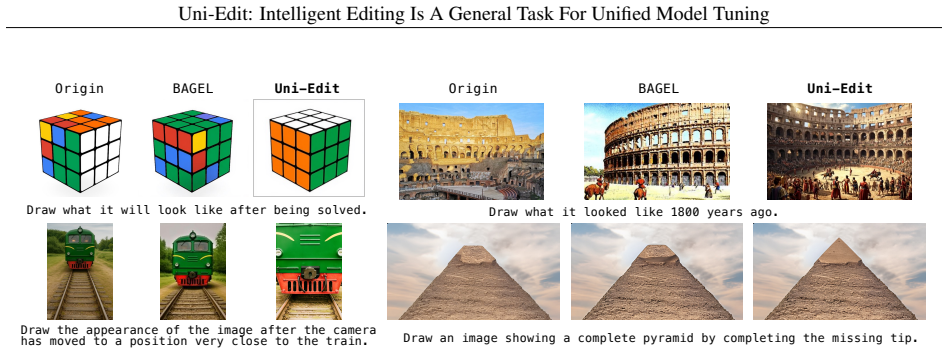
Tuning solely on the Uni-Edit task, using a dataset of 148k examples with complex reasoning-intensive editing instructions derived from VQA data via an automated synthesis pipeline, achieves comprehensive enhancements across image understanding, generation, and editing capabilities with only one task, one training stage, and one dataset.
What carries the argument
The automated scalable data synthesis pipeline that transforms diverse VQA data into complex editing instructions with embedded questions and nested logic, producing the Uni-Edit-148k dataset that pairs these instructions with high-quality edited images.
If this is right
- Unified multimodal models can reach multi-capability performance through single-task training on an integrative task like intelligent editing.
- Task conflicts that arise in mixed multi-task training can be avoided by selecting a task that inherently couples understanding and generation.
- An automated pipeline enables scalable creation of reasoning-heavy editing data without manual curation of instructions.
- Performance improvements across all three capabilities occur without multi-stage pipelines or auxiliary data balancing.
Where Pith is reading between the lines
- The synthesis method could be extended to create training data for other integrative tasks such as video or 3D editing.
- If the gains stem from the reasoning structure of the instructions, similar pipelines might improve reasoning in non-editing multimodal benchmarks.
- Single-task tuning on editing might reduce the overall data volume needed to reach competitive performance in unified models.
- The approach raises the question of whether other cross-modal tasks could serve as general tuning objectives for additional modality combinations.
Load-bearing premise
The automated synthesis pipeline successfully converts VQA data into complex, reasoning-intensive editing instructions that meaningfully exercise and improve the model's underlying understanding capacity, rather than merely supplying higher-quality editing examples.
What would settle it
Training a model on the Uni-Edit-148k dataset produces no measurable gains on standard understanding or generation benchmarks, or the gains disappear when compared to a control set of simpler editing examples of matched quality.
Figures





read the original abstract
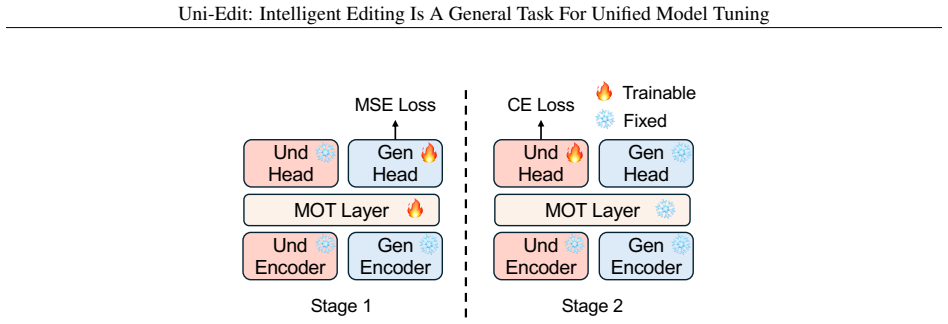
Currently, enhancing Unified Multimodal Models (UMMs) with image understanding, generation, and editing capabilities mainly relies on mixed multi-task training. Due to inherent task conflicts, such strategy requires complex multi-stage pipelines, massive data mixing, and balancing tricks, merely resulting in a performance trade-off rather than true mutual reinforcement. To break this paradigm, we propose Uni-Edit, an intelligent image editing task that serves as the first general task for UMM tuning. Unlike complex mixed pipelines, Uni-Edit improves performance across all three abilities at once using only one task, one training stage, and one dataset. Specifically, we first identify image editing as an inherently ideal general task, as it naturally demands both visual understanding and generation. However, existing editing data relies on simplistic instructions that severely underutilize a model's understanding capacity. To address this, we introduce the first automated and scalable data synthesis pipeline for intelligent editing, transforming diverse VQA data into complex and effective editing instructions with embedded questions and nested logic. This yields Uni-Edit-148k, pairing diverse reasoning-intensive instructions with high-quality edited images. Extensive experiments on BAGEL and Janus-Pro demonstrate that tuning solely on Uni-Edit achieves comprehensive enhancements across all three capabilities without any auxiliary operations.
Editorial analysis
A structured set of objections, weighed in public.
Referee Report
Summary. The paper claims that Uni-Edit, an intelligent image editing task, serves as the first general task for tuning Unified Multimodal Models (UMMs). Unlike mixed multi-task training that requires complex pipelines and leads to performance trade-offs, single-task tuning on Uni-Edit simultaneously improves image understanding, generation, and editing using one task, one stage, and one dataset. The authors introduce an automated scalable synthesis pipeline that converts VQA data into complex editing instructions with embedded questions and nested logic, producing the Uni-Edit-148k dataset of reasoning-intensive instructions paired with edited images. Experiments on BAGEL and Janus-Pro show comprehensive enhancements across all three capabilities without auxiliary operations.
Significance. If the results hold after addressing controls for data quality, this would represent a meaningful simplification for UMM training by showing that a single well-designed task can achieve mutual reinforcement across capabilities. Credit is due for the automated synthesis pipeline and the empirical demonstration on two models. The work could influence future tuning strategies if the reasoning-intensive structure is shown to be load-bearing rather than incidental to data curation.
major comments (2)
- [§4 Experiments] §4 Experiments: the abstract and results claim comprehensive enhancements on BAGEL and Janus-Pro after single-task tuning on Uni-Edit, yet no baseline comparisons, exact metrics per capability, statistical significance, or controls for data volume/quality are described. This is load-bearing for the central claim that Uni-Edit outperforms mixed training without auxiliary operations.
- [§3.2 Data Synthesis Pipeline] §3.2 Data Synthesis Pipeline: the pipeline is presented as producing 'complex and effective editing instructions with embedded questions and nested logic' that exercise understanding capacity, but no ablation compares performance against a control set of equivalent size and quality using only simplistic instructions. Without this isolation, gains cannot be attributed to the reasoning-intensive structure rather than data curation effects.
minor comments (2)
- [Abstract] Abstract: specify the quantitative scale of improvements (e.g., percentage gains on key metrics) to strengthen the summary of results.
- [Figure 1] Figure 1 or pipeline diagram: add explicit labels for each transformation step from VQA to editing instruction to improve clarity of the synthesis process.
Simulated Author's Rebuttal
We thank the referee for the constructive comments, which help clarify the experimental validation needed to support our central claims. We address each major point below and commit to revisions that strengthen the evidence for Uni-Edit as a general task.
read point-by-point responses
-
Referee: [§4 Experiments] §4 Experiments: the abstract and results claim comprehensive enhancements on BAGEL and Janus-Pro after single-task tuning on Uni-Edit, yet no baseline comparisons, exact metrics per capability, statistical significance, or controls for data volume/quality are described. This is load-bearing for the central claim that Uni-Edit outperforms mixed training without auxiliary operations.
Authors: We acknowledge that the manuscript would benefit from more granular reporting to fully substantiate the performance gains. The presented results on BAGEL and Janus-Pro demonstrate improvements across capabilities after Uni-Edit tuning, but we agree that explicit baselines against mixed multi-task training, per-capability numerical metrics (e.g., VQA accuracy for understanding, FID/CLIP scores for generation, and instruction adherence for editing), statistical significance testing, and data-volume/quality controls are necessary. In the revised version, we will expand §4 to include these elements, using matched data volumes from existing sources as controls to isolate the effect of the single-task approach. revision: yes
-
Referee: [§3.2 Data Synthesis Pipeline] §3.2 Data Synthesis Pipeline: the pipeline is presented as producing 'complex and effective editing instructions with embedded questions and nested logic' that exercise understanding capacity, but no ablation compares performance against a control set of equivalent size and quality using only simplistic instructions. Without this isolation, gains cannot be attributed to the reasoning-intensive structure rather than data curation effects.
Authors: We agree that directly isolating the contribution of the reasoning-intensive structure (embedded questions and nested logic) versus general data curation effects would strengthen attribution. The current experiments show overall gains from the full Uni-Edit-148k dataset, but lack this specific control. We will add the requested ablation in the revision by constructing a control dataset of equivalent size and quality using only simplistic instructions from the same VQA sources, then compare tuning results on BAGEL and Janus-Pro to demonstrate whether the complex structure is load-bearing. revision: yes
Circularity Check
No circularity: empirical tuning and data synthesis with independent experimental validation
full rationale
The paper describes an empirical pipeline for synthesizing editing instructions from VQA data and tuning UMMs on the resulting Uni-Edit-148k dataset. No mathematical derivations, equations, or self-referential definitions appear in the provided text. Claims rest on experimental outcomes across models (BAGEL, Janus-Pro) rather than any fitted parameter renamed as a prediction or uniqueness theorem imported from prior self-citation. The central result—that single-task tuning improves understanding, generation, and editing—is presented as an observed outcome of the synthesis and training process, not reduced by construction to its inputs. This is a standard empirical contribution with no load-bearing circular steps.
Axiom & Free-Parameter Ledger
Lean theorems connected to this paper
-
IndisputableMonolith/Cost/FunctionalEquation.leanwashburn_uniqueness_aczel unclear?
unclearRelation between the paper passage and the cited Recognition theorem.
transforming diverse VQA data into complex and effective editing instructions with embedded questions and nested logic
-
IndisputableMonolith/Foundation/AbsoluteFloorClosure.leanreality_from_one_distinction unclear?
unclearRelation between the paper passage and the cited Recognition theorem.
tuning solely on Uni-Edit achieves comprehensive enhancements across all three capabilities
What do these tags mean?
- matches
- The paper's claim is directly supported by a theorem in the formal canon.
- supports
- The theorem supports part of the paper's argument, but the paper may add assumptions or extra steps.
- extends
- The paper goes beyond the formal theorem; the theorem is a base layer rather than the whole result.
- uses
- The paper appears to rely on the theorem as machinery.
- contradicts
- The paper's claim conflicts with a theorem or certificate in the canon.
- unclear
- Pith found a possible connection, but the passage is too broad, indirect, or ambiguous to say the theorem truly supports the claim.
Reference graph
Works this paper leans on
-
[1]
Representation Alignment for Generation: Training Diffusion Transformers Is Easier Than You Think
Sihyun Yu, Sangkyung Kwak, Huiwon Jang, Jongheon Jeong, Jonathan Huang, Jinwoo Shin, and Saining Xie. Representation alignment for generation: Training diffusion transformers is easier than you think.arXiv preprint arXiv:2410.06940, 2024
work page internal anchor Pith review Pith/arXiv arXiv 2024
-
[2]
Emerging Properties in Unified Multimodal Pretraining
Chaorui Deng, Deyao Zhu, Kunchang Li, Chenhui Gou, Feng Li, Zeyu Wang, Shu Zhong, Weihao Yu, Xiaonan Nie, Ziang Song, et al. Emerging properties in unified multimodal pretraining.arXiv preprint arXiv:2505.14683, 2025
work page internal anchor Pith review Pith/arXiv arXiv 2025
-
[3]
Yufeng Cui, Honghao Chen, Haoge Deng, Xu Huang, Xinghang Li, Jirong Liu, Yang Liu, Zhuoyan Luo, Jinsheng Wang, Wenxuan Wang, et al. Emu3. 5: Native multimodal models are world learners.arXiv preprint arXiv:2510.26583, 2025
work page internal anchor Pith review Pith/arXiv arXiv 2025
-
[4]
Anyedit: Mastering unified high-quality image editing for any idea
Qifan Yu, Wei Chow, Zhongqi Yue, Kaihang Pan, Yang Wu, Xiaoyang Wan, Juncheng Li, Siliang Tang, Hanwang Zhang, and Yueting Zhuang. Anyedit: Mastering unified high-quality image editing for any idea. InCVPR, 2025
work page 2025
-
[5]
LLaVA-OneVision-1.5: Fully Open Framework for Democratized Multimodal Training
Xiang An, Yin Xie, Kaicheng Yang, Wenkang Zhang, Xiuwei Zhao, Zheng Cheng, Yirui Wang, Songcen Xu, Changrui Chen, Didi Zhu, et al. Llava-onevision-1.5: Fully open framework for democratized multimodal training.arXiv preprint arXiv:2509.23661, 2025
work page internal anchor Pith review Pith/arXiv arXiv 2025
-
[6]
Google. Nano-banana-pro. Accessed November, 2025 [Online] https://deepmind.google/models/ gemini-image/pro/, 2025
work page 2025
-
[7]
OpenAI. Gpt-4o. Accessed November 18, 2024 [Online]https://chatgpt.com/, 2024
work page 2024
-
[8]
Shuai Bai, Keqin Chen, Xuejing Liu, Jialin Wang, Wenbin Ge, Sibo Song, Kai Dang, Peng Wang, Shijie Wang, Jun Tang, Humen Zhong, Yuanzhi Zhu, Mingkun Yang, Zhaohai Li, Jianqiang Wan, Pengfei Wang, Wei Ding, Zheren Fu, Yiheng Xu, Jiabo Ye, Xi Zhang, Tianbao Xie, Zesen Cheng, Hang Zhang, Zhibo Yang, Haiyang Xu, and Junyang Lin. Qwen2.5-vl technical report.ar...
work page internal anchor Pith review Pith/arXiv arXiv 2025
-
[9]
An Yang, Anfeng Li, Baosong Yang, Beichen Zhang, Binyuan Hui, Bo Zheng, Bowen Yu, Chang Gao, Chengen Huang, Chenxu Lv, et al. Qwen3 technical report.arXiv preprint arXiv:2505.09388, 2025
work page internal anchor Pith review Pith/arXiv arXiv 2025
-
[10]
The llama 3 herd of models.arXiv e-prints, 2024
Abhimanyu Dubey, Abhinav Jauhri, Abhinav Pandey, Abhishek Kadian, Ahmad Al-Dahle, Aiesha Letman, Akhil Mathur, Alan Schelten, Amy Yang, Angela Fan, et al. The llama 3 herd of models.arXiv e-prints, 2024
work page 2024
-
[11]
LLaVA-OneVision: Easy Visual Task Transfer
Bo Li, Yuanhan Zhang, Dong Guo, Renrui Zhang, Feng Li, Hao Zhang, Kaichen Zhang, Peiyuan Zhang, Yanwei Li, Ziwei Liu, et al. Llava-onevision: Easy visual task transfer.arXiv preprint arXiv:2408.03326, 2024
work page internal anchor Pith review Pith/arXiv arXiv 2024
-
[12]
Emu3: Next-Token Prediction is All You Need
Xinlong Wang, Xiaosong Zhang, Zhengxiong Luo, Quan Sun, Yufeng Cui, Jinsheng Wang, Fan Zhang, Yueze Wang, Zhen Li, Qiying Yu, et al. Emu3: Next-token prediction is all you need.arXiv preprint arXiv:2409.18869, 2024
work page internal anchor Pith review Pith/arXiv arXiv 2024
-
[13]
Chameleon: Mixed-Modal Early-Fusion Foundation Models
Chameleon Team. Chameleon: Mixed-modal early-fusion foundation models.arXiv preprint arXiv:2405.09818, 2024
work page internal anchor Pith review Pith/arXiv arXiv 2024
-
[14]
VILA-U: a Unified Foundation Model Integrating Visual Understanding and Generation
Yecheng Wu, Zhuoyang Zhang, Junyu Chen, Haotian Tang, Dacheng Li, Yunhao Fang, Ligeng Zhu, Enze Xie, Hongxu Yin, Li Yi, et al. Vila-u: a unified foundation model integrating visual understanding and generation.arXiv preprint arXiv:2409.04429, 2024. 10 Uni-Edit: Intelligent Editing Is A General Task For Unified Model Tuning
work page internal anchor Pith review Pith/arXiv arXiv 2024
-
[15]
Longcat-next: Lexicalizing modalities as discrete tokens.arXiv preprint arXiv:2603.27538, 2026
Meituan LongCat Team, Bin Xiao, Chao Wang, Chengjiang Li, Chi Zhang, Chong Peng, Hang Yu, Hao Yang, Haonan Yan, Haoze Sun, et al. Longcat-next: Lexicalizing modalities as discrete tokens.arXiv preprint arXiv:2603.27538, 2026
-
[16]
Janus-Pro: Unified Multimodal Understanding and Generation with Data and Model Scaling
Xiaokang Chen, Zhiyu Wu, Xingchao Liu, Zizheng Pan, Wen Liu, Zhenda Xie, Xingkai Yu, and Chong Ruan. Janus-pro: Unified multimodal understanding and generation with data and model scaling.arXiv preprint arXiv:2501.17811, 2025
work page internal anchor Pith review Pith/arXiv arXiv 2025
-
[17]
HunyuanImage 3.0 Technical Report
Siyu Cao, Hangting Chen, Peng Chen, Yiji Cheng, Yutao Cui, Xinchi Deng, Ying Dong, Kipper Gong, Tianpeng Gu, Xiusen Gu, et al. Hunyuanimage 3.0 technical report.arXiv preprint arXiv:2509.23951, 2025
work page internal anchor Pith review Pith/arXiv arXiv 2025
-
[18]
Onecat: Decoder-only auto-regressive model for unified understanding and generation
Han Li, Xinyu Peng, Yaoming Wang, Zelin Peng, Xin Chen, Rongxiang Weng, Jingang Wang, Xunliang Cai, Wenrui Dai, and Hongkai Xiong. Onecat: Decoder-only auto-regressive model for unified understanding and generation.arXiv preprint arXiv:2509.03498, 2025
-
[19]
AIA: Rethinking Architecture Decoupling Strategy In Unified Multimodal Model
Dian Zheng, Manyuan Zhang, Hongyu Li, Kai Zou, Hongbo Liu, Ziyu Guo, Kaituo Feng, Yexin Liu, Ying Luo, Yan Feng, et al. Architecture decoupling is not all you need for unified multimodal model.arXiv preprint arXiv:2511.22663, 2025
work page internal anchor Pith review Pith/arXiv arXiv 2025
-
[20]
Scaling rectified flow transformers for high-resolution image synthesis
Patrick Esser, Sumith Kulal, Andreas Blattmann, Rahim Entezari, Jonas Müller, Harry Saini, Yam Levi, Dominik Lorenz, Axel Sauer, Frederic Boesel, et al. Scaling rectified flow transformers for high-resolution image synthesis. InICML, 2024
work page 2024
-
[21]
SDXL: Improving Latent Diffusion Models for High-Resolution Image Synthesis
Dustin Podell, Zion English, Kyle Lacey, Andreas Blattmann, Tim Dockhorn, Jonas Müller, Joe Penna, and Robin Rombach. Sdxl: Improving latent diffusion models for high-resolution image synthesis.arXiv preprint arXiv:2307.01952, 2023
work page internal anchor Pith review Pith/arXiv arXiv 2023
-
[22]
Flux.https://github.com/black-forest-labs/flux, 2024
Black Forest Labs. Flux.https://github.com/black-forest-labs/flux, 2024
work page 2024
-
[23]
Chenfei Wu, Jiahao Li, Jingren Zhou, Junyang Lin, Kaiyuan Gao, Kun Yan, Sheng-ming Yin, Shuai Bai, Xiao Xu, Yilei Chen, et al. Qwen-image technical report.arXiv preprint arXiv:2508.02324, 2025
work page internal anchor Pith review Pith/arXiv arXiv 2025
-
[24]
Glm-image.https://huggingface.co/zai-org/GLM-Image, 2026
Zhipu AI. Glm-image.https://huggingface.co/zai-org/GLM-Image, 2026
work page 2026
-
[25]
Step1X-Edit: A Practical Framework for General Image Editing
Shiyu Liu, Yucheng Han, Peng Xing, Fukun Yin, Rui Wang, Wei Cheng, Jiaqi Liao, Yingming Wang, Honghao Fu, Chunrui Han, et al. Step1x-edit: A practical framework for general image editing.arXiv preprint arXiv:2504.17761, 2025
work page internal anchor Pith review Pith/arXiv arXiv 2025
-
[26]
NextStep Team, Chunrui Han, Guopeng Li, Jingwei Wu, Quan Sun, Yan Cai, Yuang Peng, Zheng Ge, Deyu Zhou, Haomiao Tang, et al. Nextstep-1: Toward autoregressive image generation with continuous tokens at scale.arXiv preprint arXiv:2508.10711, 2025
-
[27]
Chenhui Gou, Zilong Chen, Zeyu Wang, Feng Li, Deyao Zhu, Zicheng Duan, Kunchang Li, Chaorui Deng, Hongyi Yuan, Haoqi Fan, et al. Vq-va world: Towards high-quality visual question-visual answering.arXiv preprint arXiv:2511.20573, 2025
-
[28]
Le Zhuo, Songhao Han, Yuandong Pu, Boxiang Qiu, Sayak Paul, Yue Liao, Yihao Liu, Jie Shao, Xi Chen, Si Liu, and Hongsheng Li. Factuality matters: When image generation and editing meet structured visuals.arXiv preprint arXiv:2510.05091, 2025
-
[29]
Yi Zhang, Bolin Ni, Xin-Sheng Chen, Heng-Rui Zhang, Yongming Rao, Houwen Peng, Qinglin Lu, Han Hu, Meng-Hao Guo, and Shi-Min Hu. Bee: A high-quality corpus and full-stack suite to unlock advanced fully open mllms.arXiv preprint arXiv:2510.13795, 2025
-
[30]
MME: A Comprehensive Evaluation Benchmark for Multimodal Large Language Models
Chaoyou Fu, Peixian Chen, Yunhang Shen, Yulei Qin, Mengdan Zhang, Xu Lin, Jinrui Yang, Xiawu Zheng, Ke Li, Xing Sun, et al. Mme: A comprehensive evaluation benchmark for multimodal large language models.arXiv preprint arXiv:2306.13394, 2023
work page internal anchor Pith review Pith/arXiv arXiv 2023
-
[31]
Mmbench: Is your multi-modal model an all-around player? InECCV, 2024
Yuan Liu, Haodong Duan, Yuanhan Zhang, Bo Li, Songyang Zhang, Wangbo Zhao, Yike Yuan, Jiaqi Wang, Conghui He, Ziwei Liu, et al. Mmbench: Is your multi-modal model an all-around player? InECCV, 2024
work page 2024
-
[32]
Mmmu: A massive multi-discipline multimodal understanding and reasoning benchmark for expert agi
Xiang Yue, Yuansheng Ni, Kai Zhang, Tianyu Zheng, Ruoqi Liu, Ge Zhang, Samuel Stevens, Dongfu Jiang, Weiming Ren, Yuxuan Sun, et al. Mmmu: A massive multi-discipline multimodal understanding and reasoning benchmark for expert agi. In CVPR, 2024
work page 2024
-
[33]
MathVista: Evaluating Mathematical Reasoning of Foundation Models in Visual Contexts
Pan Lu, Hritik Bansal, Tony Xia, Jiacheng Liu, Chunyuan Li, Hannaneh Hajishirzi, Hao Cheng, Kai-Wei Chang, Michel Galley, and Jianfeng Gao. Mathvista: Evaluating mathematical reasoning of foundation models in visual contexts.arXiv preprint arXiv:2310.02255, 2023
work page internal anchor Pith review Pith/arXiv arXiv 2023
-
[34]
Eyes wide shut? exploring the visual shortcomings of multimodal llms
Shengbang Tong, Zhuang Liu, Yuexiang Zhai, Yi Ma, Yann LeCun, and Saining Xie. Eyes wide shut? exploring the visual shortcomings of multimodal llms. InCVPR, 2024
work page 2024
-
[35]
Geneval: An object-focused framework for evaluating text-to-image alignment
Dhruba Ghosh, Hannaneh Hajishirzi, and Ludwig Schmidt. Geneval: An object-focused framework for evaluating text-to-image alignment. InNeurIPS, 2023
work page 2023
-
[36]
WISE: A World Knowledge-Informed Semantic Evaluation for Text-to-Image Generation
Yuwei Niu, Munan Ning, Mengren Zheng, Weiyang Jin, Bin Lin, Peng Jin, Jiaqi Liao, Chaoran Feng, Kunpeng Ning, Bin Zhu, et al. Wise: A world knowledge-informed semantic evaluation for text-to-image generation.arXiv preprint arXiv:2503.07265, 2025
work page internal anchor Pith review Pith/arXiv arXiv 2025
-
[37]
ImgEdit: A Unified Image Editing Dataset and Benchmark
Yang Ye, Xianyi He, Zongjian Li, Bin Lin, Shenghai Yuan, Zhiyuan Yan, Bohan Hou, and Li Yuan. Imgedit: A unified image editing dataset and benchmark.arXiv preprint arXiv:2505.20275, 2025
work page internal anchor Pith review Pith/arXiv arXiv 2025
-
[38]
Envisioning beyond the pixels: Benchmarking reasoning-informed visual editing
Xiangyu Zhao, Peiyuan Zhang, Kexian Tang, Xiaorong Zhu, Hao Li, Wenhao Chai, Zicheng Zhang, Renqiu Xia, Guangtao Zhai, Junchi Yan, et al. Envisioning beyond the pixels: Benchmarking reasoning-informed visual editing.arXiv preprint arXiv:2504.02826, 2025
-
[39]
"Your output must be a single JSON object.\n\n
Ji Xie, Trevor Darrell, Luke Zettlemoyer, and XuDong Wang. Reconstruction alignment improves unified multimodal models. arXiv preprint arXiv:2509.07295, 2025. 11 Uni-Edit: Intelligent Editing Is A General Task For Unified Model Tuning A System Prompt Task Type Classification System Prompt "You are an expert data processor. Your task is to analyze the inpu...
-
[40]
**Blurriness & Artifacts**: - Is the image significantly blurry, pixelated, or noisy? - Are there compression artifacts or "fried" textures? - Is the text (if any) legible, or is it garbled/gibberish?
-
[41]
**Structural Coherence (The "Uncanny Valley" Check)**: - Do objects look physically plausible? - Are there distorted limbs, melted faces, or floating objects that defy gravity? - Is the composition chaotic or nonsensical?
-
[42]
**Visual Harmony**: - Do the lighting and shadows match across the image? - Are there harsh, unnatural seams or "pasted-on" effects (bad compositing)? - Are the colors overly saturated, washed out, or broken? ### Scoring Scale (1-5): - **5 (High Quality)**: Sharp, coherent, natural-looking, and aesthetically pleasing. No visible artifacts. - **4 (Good)**:...
-
[43]
**Original Image**: The first input image, which is before editing and is a realistic image
-
[44]
**Edited Image**: The second input image, which is the one after editing
-
[45]
**edit_instruction**: The command the model was supposed to follow. Note that this instruction may involve: - **Spatial Grounding**: Referring to specific regions (e.g., "the region in the answer"). - **Visual Transformation**: Changing style, objects, attributes or doing ocr, caption
-
[46]
replace bushes with flower beds
**original_question & process_answer**: These define the **target** or **premise** of the edit. - If the Answer is a coordinate (bounding box), it defines *where* the edit must happen. - If the Answer is a caption/description, it defines the *answer* for the region and it need to be pushed into a blackboard or letter based on the edit_instruction. ### Eva...
discussion (0)
Sign in with ORCID, Apple, or X to comment. Anyone can read and Pith papers without signing in.