Inferring the role of binary neutron star mergers in r-process nucleosynthesis with multi-messenger observations using Cosmic Explorer and Einstein Telescope
Pith reviewed 2026-05-25 03:49 UTC · model grok-4.3
The pith
Third-generation gravitational-wave detectors can constrain the fraction of r-process elements from binary neutron star mergers to 5-6 percent precision.
A machine-rendered reading of the paper's core claim, the machinery that carries it, and where it could break.
Core claim
The fractional cumulative contribution of BNS mergers to the total cosmic r-process, F_BNS,z0, can be estimated to ≲5-6% precision at 1σ using Fisher forecasts on mock data from Cosmic Explorer and Einstein Telescope for fiducial astrophysical scenarios with F_BNS,z0 ≳ 0.1-1, in both bright-siren and dark-siren limiting cases; the method also returns delay-time distribution parameters comparable to existing approaches.
What carries the argument
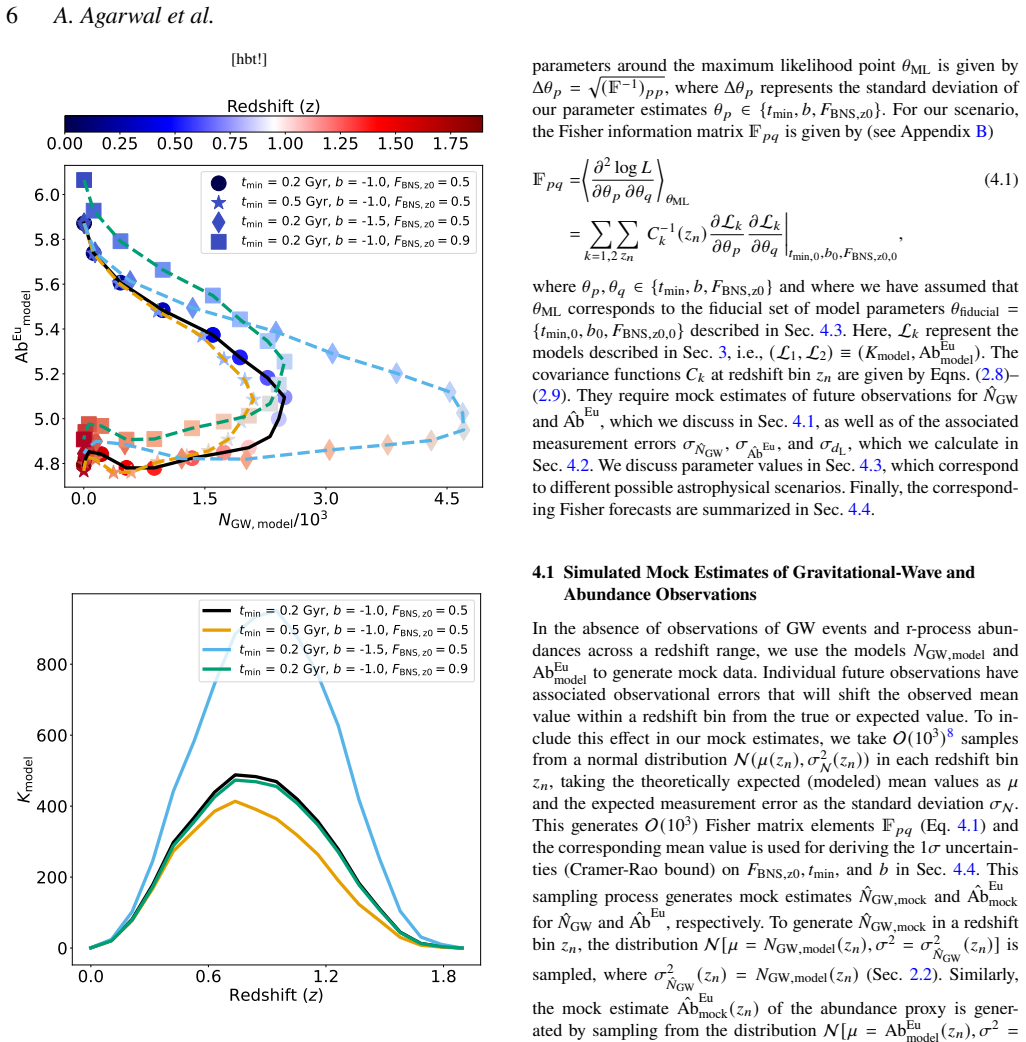
Redshift-dependent correlation between the cumulative number of BNS gravitational-wave detections and the mean r-process abundances at z ≲ 1, evaluated via Fisher forecasts on simulated multi-messenger and dark-siren catalogs.
If this is right
- The approach yields BNS delay-time distribution parameters at a level comparable to other independent methods.
- It supplies a route to reconstruct cosmic r-process abundances from local low-metallicity observations.
- Signatures of neutron-capture elements can be identified at redshifts beyond the local Universe.
- The same precision is obtained for both events with electromagnetic counterparts and events without.
Where Pith is reading between the lines
- If the correlation holds, the method could separate the relative roles of BNS mergers versus rare core-collapse supernovae across cosmic time.
- Application to real data will test whether the assumed correlation survives additional astrophysical scatter not included in the mocks.
- Extending the redshift range above z = 1 would require independent abundance measurements at higher redshift.
- Joint analysis with kilonova rates or galactic chemical-evolution models could tighten the delay-time constraints further.
Load-bearing premise
The underlying astrophysics produces a usable redshift-dependent correlation between the total number of BNS gravitational-wave events and the average r-process abundances at z ≲ 1 that can be exploited in the mock data.
What would settle it
A real data set in which the observed number of BNS events shows no statistically significant correlation with measured r-process abundances at low redshift, or in which the recovered uncertainty on F_BNS,z0 exceeds 10 percent, would falsify the method's claimed precision.
Figures


read the original abstract
Identifying the cosmic origin of rapid neutron-capture (r-process) elements remains an open problem. Binary neutron-star (BNS) mergers and rare classes of core-collapse supernovae (CCSNe) represent the main contenders as major r-process production sites. Although BNS mergers could exclusively account for r-process nucleosynthesis, results from chemical evolution studies taking into account their delays with respect to star formation, observed BNS rates by gravitational-wave (GW) detectors, as well as issues with retention in low-mass halos suggest otherwise. Here, we propose a method to measure the contribution of BNS mergers to cosmic r-process nucleosynthesis with the third-generation GW detectors Cosmic Explorer and Einstein Telescope. It exploits the redshift-dependent correlation between the total number of BNS GW events and the average r-process abundances at redshifts $z \lesssim 1$. We apply this correlation technique to mock GW and abundance data, accounting for expected observational uncertainties in two limiting scenarios: GW events with electromagnetic counterpart (multi-messenger 'bright-sirens') and without ('dark-sirens'). Using Fisher forecasts, we demonstrate that the fractional cumulative contribution of BNS mergers to the total cosmic r-process $F_{\rm{BNS,z0}}$ can be estimated to the $\lesssim 5-6\%$ precision level for both scenarios at $1\sigma$ for fiducial astrophysical scenarios with $F_{\rm{BNS,z0}} \gtrsim 0.1-1$. Furthermore, the method also yields estimates of the BNS delay-time distribution parameters comparable to other approaches. Although cosmic r-process abundances may be reconstructed from local observations at low metallicity, this method also provides a science case to identify signatures of neutron-capture elements beyond the local Universe.
Editorial analysis
A structured set of objections, weighed in public.
Referee Report
Summary. The manuscript proposes a method to measure the fractional cumulative contribution of binary neutron star (BNS) mergers to cosmic r-process nucleosynthesis, denoted F_BNS,z0, by exploiting a redshift-dependent correlation between the total number of BNS gravitational-wave events and average r-process abundances at z ≲ 1. Fisher matrix forecasts are performed on mock data for two limiting cases (bright sirens with electromagnetic counterparts and dark sirens) using third-generation detectors Cosmic Explorer and Einstein Telescope, yielding a claimed precision of ≲5-6% at 1σ on F_BNS,z0 for fiducial scenarios with F_BNS,z0 ≳ 0.1-1; the same framework also constrains BNS delay-time distribution parameters.
Significance. If the underlying correlation is robust and the mock-data assumptions hold, the work supplies a concrete multi-messenger forecast for constraining r-process site contributions with future GW observations, complementing chemical-evolution modeling and local abundance studies. The dual bright/dark-siren treatment and the additional DTD-parameter recovery are positive features that broaden the science case.
major comments (2)
- [Methods (mock data)] Methods section on mock-data construction: the abstract states that Fisher forecasts on mock GW event counts and abundance data yield 5-6% precision on F_BNS,z0, yet no explicit functional form of the redshift-dependent correlation, no description of how the mock data are generated from that correlation, and no specification of the covariance matrix (including observational uncertainties) are provided. Without these details the quoted precision cannot be verified.
- [Fisher matrix section] Fisher forecast implementation: the central precision claim assumes the correlation is deterministic in the mocks. It is unclear whether the analysis marginalizes over uncertainty in the correlation slope/normalization or includes intrinsic scatter from CCSN variability, halo retention, or delay-time effects; any such terms would enlarge the effective covariance and degrade the reported 5-6% constraint.
minor comments (2)
- [Introduction] Notation: the symbol F_BNS,z0 is introduced without an explicit equation defining its relation to the integrated BNS rate and total r-process yield; a short defining equation would improve clarity.
- [Introduction] References: several statements about observed BNS rates and chemical-evolution constraints would benefit from additional citations to recent LIGO/Virgo results and specific chemical-evolution papers.
Simulated Author's Rebuttal
We thank the referee for the constructive report and the recommendation for major revision. We address each major comment below and will revise the manuscript to supply the requested methodological details and to clarify the assumptions underlying the Fisher forecasts.
read point-by-point responses
-
Referee: [Methods (mock data)] Methods section on mock-data construction: the abstract states that Fisher forecasts on mock GW event counts and abundance data yield 5-6% precision on F_BNS,z0, yet no explicit functional form of the redshift-dependent correlation, no description of how the mock data are generated from that correlation, and no specification of the covariance matrix (including observational uncertainties) are provided. Without these details the quoted precision cannot be verified.
Authors: We agree that the current Methods section does not provide sufficient detail for independent verification. In the revised manuscript we will add an explicit subsection that (i) states the functional form of the redshift-dependent correlation between cumulative BNS event counts and mean r-process abundance, (ii) describes the procedure used to generate the mock data sets from this relation, and (iii) specifies the full covariance matrix, including the adopted observational uncertainties on both the GW event counts and the abundance measurements for the bright- and dark-siren cases. These additions will make the 5-6% precision claim directly reproducible. revision: yes
-
Referee: [Fisher matrix section] Fisher forecast implementation: the central precision claim assumes the correlation is deterministic in the mocks. It is unclear whether the analysis marginalizes over uncertainty in the correlation slope/normalization or includes intrinsic scatter from CCSN variability, halo retention, or delay-time effects; any such terms would enlarge the effective covariance and degrade the reported 5-6% constraint.
Authors: The present Fisher analysis treats the correlation as deterministic in the mock data. We acknowledge that this choice omits marginalization over uncertainties in the correlation parameters and does not incorporate additional scatter from CCSN variability, halo retention, or delay-time effects. In the revision we will either (a) explicitly state this modeling assumption and quantify its impact on the reported precision or (b) extend the Fisher matrix to include nuisance parameters for the correlation slope/normalization and an intrinsic-scatter term, thereby providing a more conservative forecast. We will also discuss how these extensions affect the recovered constraints on F_BNS,z0 and the DTD parameters. revision: yes
Circularity Check
Fisher precision on F_BNS,z0 derived from mocks that encode the exact redshift correlation by construction
specific steps
-
fitted input called prediction
[Abstract]
"It exploits the redshift-dependent correlation between the total number of BNS GW events and the average r-process abundances at redshifts z ≲ 1. We apply this correlation technique to mock GW and abundance data, accounting for expected observational uncertainties in two limiting scenarios... Using Fisher forecasts, we demonstrate that the fractional cumulative contribution of BNS mergers to the total cosmic r-process F_BNS,z0 can be estimated to the ≲ 5-6% precision level"
Mock data are constructed from the assumed correlation (with F_BNS,z0 setting the normalization), so the Fisher matrix recovers a precision on F_BNS,z0 that is statistically forced by the mock generation step. The 5-6% figure holds only under the exact correlation with no additional variance from CCSN contributions or delay-time effects.
full rationale
The paper's method relies on a redshift-dependent correlation between BNS GW event counts and r-process abundances at z ≲ 1. Mock data are generated assuming this correlation holds exactly (with F_BNS,z0 as the controlling parameter), after which Fisher forecasts recover the input precision of ≲5-6%. This is standard forecast methodology but yields the quoted precision only because the mocks contain no extra scatter or uncertainty in the correlation slope/normalization itself. The central claim therefore depends on the mock construction matching the model assumption without marginalization, producing moderate but not total circularity.
Axiom & Free-Parameter Ledger
axioms (1)
- domain assumption Mock GW and abundance data accurately capture expected observational uncertainties for bright- and dark-siren scenarios at z ≲ 1.
Reference graph
Works this paper leans on
-
[1]
Collapsars as a major source of r-process elements. , keywords =. doi:10.1038/s41586-019-1136-0 , archivePrefix =. 1810.00098 , primaryClass =
-
[2]
Radiation Backgrounds at Cosmic Dawn: X-Rays from Compact Binaries
Radiation Backgrounds at Cosmic Dawn: X-Rays from Compact Binaries. , keywords =. doi:10.3847/1538-4357/aa6af9 , archivePrefix =. 1606.07887 , primaryClass =
work page internal anchor Pith review Pith/arXiv arXiv doi:10.3847/1538-4357/aa6af9
-
[4]
Host Galaxies Catalog Used in LIGO Searches for Compact Binary Coalescence Events
Host Galaxies Catalog Used in LIGO Searches for Compact Binary Coalescence Events. , keywords =. doi:10.1086/527348 , archivePrefix =. 0706.1283 , primaryClass =
work page internal anchor Pith review Pith/arXiv arXiv doi:10.1086/527348
-
[5]
Li, Weidong and Chornock, Ryan and Leaman, Jesse and Filippenko, Alexei V. and Poznanski, Dovi and Wang, Xiaofeng and Ganeshalingam, Mohan and Mannucci, Filippo , year=. Nearby supernova rates from the Lick Observatory Supernova Search - III. The rate-size relation, and the rates as a function of galaxy Hubble type and colour , volume=. Monthly Notices of...
-
[6]
Estimating Long GRB Jet Opening Angles and Rest-Frame Energetics
Estimating Long GRB Jet Opening Angles and Rest-frame Energetics. , keywords =. doi:10.3847/0004-637X/818/1/18 , archivePrefix =. 1512.04464 , primaryClass =
work page internal anchor Pith review Pith/arXiv arXiv doi:10.3847/0004-637x/818/1/18
-
[7]
The luminosity function and the rate of Swift's gamma-ray bursts. Monthly Notices of the Royal Astronomical Society , keywords =. doi:10.1111/j.1365-2966.2010.16787.x , archivePrefix =. 0912.0709 , primaryClass =
-
[8]
Monthly Notices of the Royal Astronomical Society , year=
Galactic evolution of rapid neutron capture process abundances: the inhomogeneous approach , author=. Monthly Notices of the Royal Astronomical Society , year=
-
[9]
Safarzadeh, Mohammadtaher and Côté, Benoit , year=. On the impact of neutron star binaries’ natal-kick distribution on the Galactic r-process enrichment , volume=. Monthly Notices of the Royal Astronomical Society , publisher=. doi:10.1093/mnras/stx1897 , number=
-
[11]
Star formation, supernovae, iron, and alpha: consistent cosmic and Galactic histories
Star Formation, Supernovae, Iron, and : Consistent Cosmic and Galactic Histories. , keywords =. doi:10.3847/1538-4357/aa8b6e , archivePrefix =. 1703.04540 , primaryClass =
work page internal anchor Pith review Pith/arXiv arXiv doi:10.3847/1538-4357/aa8b6e
-
[12]
The Electromagnetic Counterpart of the Binary Neutron Star Merger LIGO/Virgo GW170817. II. UV, Optical, and Near-infrared Light Curves and Comparison to Kilonova Models. The Astrophysical Journal Letters , keywords =. doi:10.3847/2041-8213/aa8fc7 , archivePrefix =. 1710.05840 , primaryClass =
work page internal anchor Pith review Pith/arXiv arXiv doi:10.3847/2041-8213/aa8fc7 2041
-
[13]
The Combined Ultraviolet, Optical, and Near-infrared Light Curves of the Kilonova Associated with the Binary Neutron Star Merger GW170817: Unified Data Set, Analytic Models, and Physical Implications. The Astrophysical Journal Letters , keywords =. doi:10.3847/2041-8213/aa9c84 , archivePrefix =. 1710.11576 , primaryClass =
work page internal anchor Pith review Pith/arXiv arXiv doi:10.3847/2041-8213/aa9c84 2041
-
[14]
arXiv e-prints , keywords =
The population of merging compact binaries inferred using gravitational waves through GWTC-3. arXiv e-prints , keywords =
-
[15]
Karhunen-Loeve eigenvalue problems in cosmology: how should we tackle large data sets?
Tegmark, Max and Taylor, Andy and Heavens, Alan. Karhunen-Loeve eigenvalue problems in cosmology: How should we tackle large data sets?. Astrophys. J. 1997. doi:10.1086/303939. arXiv:astro-ph/9603021
work page internal anchor Pith review Pith/arXiv arXiv doi:10.1086/303939 1997
-
[17]
Suda, Takuma and Katsuta, Yutaka and Yamada, Shimako and Suwa, Tamon and Ishizuka, Chikako and Komiya, Yutaka and Sorai, Kazuo and Aikawa, Masayuki and Fujimoto, Masayuki Y. , title = ". Publications of the Astronomical Society of Japan , volume =. 2008 , month =. doi:10.1093/pasj/60.5.1159 , url =
-
[18]
Alex Nitz and Ian Harry and Duncan Brown and Christopher M. Biwer and Josh Willis and Tito Dal Canton and Collin Capano and Thomas Dent and Larne Pekowsky and Andrew R. Williamson and Soumi De and Miriam Cabero and Bernd Machenschalk and Duncan Macleod and Prayush Kumar and Francesco Pannarale and Steven Reyes and Gareth S Cabourn Davies and dfinstad and ...
-
[19]
Gravitational-wave sensitivity curves , volume =. , author =. 2015 , pages =. doi:10.1088/0264-9381/32/1/015014 , abstract =
-
[20]
Astropy: A Community Python Package for Astronomy
doi:10.1051/0004-6361/201322068 , Eid =. arXiv , Author =:1307.6212 , Journal =
work page internal anchor Pith review Pith/arXiv arXiv doi:10.1051/0004-6361/201322068
-
[21]
The Astropy Project: Building an inclusive, open-science project and status of the v2.0 core package
The Astropy Project: Building an Open-science Project and Status of the v2.0 Core Package. , keywords =. doi:10.3847/1538-3881/aabc4f , archivePrefix =. 1801.02634 , primaryClass =
work page internal anchor Pith review Pith/arXiv arXiv doi:10.3847/1538-3881/aabc4f
-
[22]
The Astropy Project: Sustaining and Growing a Community-oriented Open-source Project and the Latest Major Release (v5.0) of the Core Package. apj , keywords =. doi:10.3847/1538-4357/ac7c74 , archivePrefix =. 2206.14220 , primaryClass =
work page internal anchor Pith review Pith/arXiv arXiv doi:10.3847/1538-4357/ac7c74
-
[23]
On the importance of source population models for gravitational-wave cosmology. , keywords =. doi:10.1103/PhysRevD.104.062009 , archivePrefix =. 2103.14663 , primaryClass =
-
[24]
Abbott, B. P. and others. Multi-messenger Observations of a Binary Neutron Star Merger. Astrophys. J. Lett. 2017. doi:10.3847/2041-8213/aa91c9. arXiv:1710.05833
work page internal anchor Pith review Pith/arXiv arXiv doi:10.3847/2041-8213/aa91c9 2017
-
[26]
Advanced LIGO Constraints on Neutron Star Mergers and R-Process Sites
Advanced LIGO Constraints on Neutron Star Mergers and r-process Sites. , keywords =. doi:10.3847/1538-4357/aa5c8d , archivePrefix =. 1610.02405 , primaryClass =
work page internal anchor Pith review Pith/arXiv arXiv doi:10.3847/1538-4357/aa5c8d
-
[27]
Neutron Star Mergers as sites of r-process Nucleosynthesis and Short Gamma-Ray Bursts
Neutron star mergers as sites of r-process nucleosynthesis and short gamma-ray bursts. International Journal of Modern Physics D , keywords =. doi:10.1142/S0218271818420051 , archivePrefix =. 1801.01141 , primaryClass =
work page internal anchor Pith review Pith/arXiv arXiv doi:10.1142/s0218271818420051
-
[28]
Natal Kicks and Time Delays in Merging Neutron Star Binaries: Implications for r-process Nucleosynthesis in Ultra-faint Dwarfs and in the Milky Way. , keywords =. doi:10.3847/2041-8205/829/1/L13 , archivePrefix =. 1607.02148 , primaryClass =
work page internal anchor Pith review Pith/arXiv arXiv doi:10.3847/2041-8205/829/1/l13 2041
-
[29]
The Mass Distribution of Galactic Double Neutron Stars. , keywords =. doi:10.3847/1538-4357/ab12e3 , archivePrefix =. 1902.03300 , primaryClass =
-
[30]
The Mass Distribution of Neutron Stars in Gravitational-wave Binaries
Landry, Philippe and Read, Jocelyn S. The Mass Distribution of Neutron Stars in Gravitational-wave Binaries. Astrophys. J. Lett. 2021. doi:10.3847/2041-8213/ac2f3e. arXiv:2107.04559
-
[31]
Observational Inference on the Delay Time Distribution of Short Gamma-Ray Bursts. , keywords =. doi:10.3847/2041-8213/ac91cd , archivePrefix =. 2206.02814 , primaryClass =
-
[32]
The Implications of the Compton (GRO) Observations for Cosmological Gamma-Ray Bursts. , keywords =. doi:10.1086/186345 , adsurl =
-
[33]
Binary interaction dominates the evolution of massive stars
Binary Interaction Dominates the Evolution of Massive Stars. Science , keywords =. doi:10.1126/science.1223344 , archivePrefix =. 1207.6397 , primaryClass =
work page internal anchor Pith review Pith/arXiv arXiv doi:10.1126/science.1223344
-
[34]
Europium production: neutron star mergers versus core-collapse supernovae
Europium production: neutron star mergers versus core-collapse supernovae. , keywords =. doi:10.1093/mnras/stt2350 , archivePrefix =. 1311.6980 , primaryClass =
work page internal anchor Pith review Pith/arXiv arXiv doi:10.1093/mnras/stt2350
-
[35]
On Neutron Star Mergers as the Source of r-process Enhanced Metal Poor Stars in the Milky Way
On Neutron Star Mergers as the Source of r-process-enhanced Metal-poor Stars in the Milky Way. , keywords =. doi:10.3847/1538-4357/ab1341 , archivePrefix =. 1812.02779 , primaryClass =
work page internal anchor Pith review Pith/arXiv arXiv doi:10.3847/1538-4357/ab1341
-
[36]
Monthly Notices of the Royal Astronomical Society , volume =
Beniamini, Paz and Piran, Tsvi , title = ". Monthly Notices of the Royal Astronomical Society , volume =. 2019 , month =. doi:10.1093/mnras/stz1589 , url =
-
[37]
The rate, luminosity function and time delay of non-Collapsar short GRBs
The rate, luminosity function and time delay of non-Collapsar short GRBs. , keywords =. doi:10.1093/mnras/stv123 , archivePrefix =. 1405.5878 , primaryClass =
work page internal anchor Pith review Pith/arXiv arXiv doi:10.1093/mnras/stv123
-
[38]
Constraining delay time distribution of binary neutron star mergers from host galaxy properties. , keywords =. doi:10.1093/mnras/staa3206 , archivePrefix =. 2007.15024 , primaryClass =
-
[39]
On the formation history of Galactic double neutron stars
On the formation history of Galactic double neutron stars. , keywords =. doi:10.1093/mnras/sty2463 , archivePrefix =. 1805.07974 , primaryClass =
work page internal anchor Pith review Pith/arXiv arXiv doi:10.1093/mnras/sty2463
-
[40]
Short GRB Host Galaxies. I. Photometric and Spectroscopic Catalogs, Host Associations, and Galactocentric Offsets. , keywords =. doi:10.3847/1538-4357/ac91d0 , archivePrefix =. 2206.01763 , primaryClass =
-
[41]
Measuring the Delay Time Distribution of Binary Neutron Stars. III. Using the Individual Star Formation Histories of Gravitational-wave Event Host Galaxies in the Local Universe. , keywords =. doi:10.3847/2041-8213/ab24e3 , archivePrefix =. 1905.04310 , primaryClass =
work page internal anchor Pith review Pith/arXiv arXiv doi:10.3847/2041-8213/ab24e3 2041
-
[42]
Measuring the Delay Time Distribution of Binary Neutron Stars. II. Using the Redshift Distribution from Third-generation Gravitational-wave Detectors Network. , keywords =. doi:10.3847/2041-8213/ab22be , archivePrefix =. 1904.10976 , primaryClass =
work page internal anchor Pith review Pith/arXiv arXiv doi:10.3847/2041-8213/ab22be 2041
-
[43]
Measuring the Delay Time Distribution of Binary Neutron Stars. I. Through Scaling Relations of the Host Galaxies of Gravitational-wave Events. , keywords =. doi:10.3847/2041-8213/ab24df , archivePrefix =. 1904.08436 , primaryClass =
work page internal anchor Pith review Pith/arXiv arXiv doi:10.3847/2041-8213/ab24df 2041
-
[44]
Planck 2018 results. VI. Cosmological parameters. , keywords =. doi:10.1051/0004-6361/201833910 , archivePrefix =. 1807.06209 , primaryClass =
work page internal anchor Pith review Pith/arXiv arXiv doi:10.1051/0004-6361/201833910 2018
-
[45]
R-Process Nucleosynthesis in MHD Jet Explosions of Core-Collapse Supernovae
r-Process Nucleosynthesis in Magnetohydrodynamic Jet Explosions of Core-Collapse Supernovae. , keywords =. doi:10.1086/500786 , archivePrefix =. astro-ph/0504100 , primaryClass =
work page internal anchor Pith review Pith/arXiv arXiv doi:10.1086/500786
-
[46]
Masses, Radii, and Equation of State of Neutron Stars
Masses, Radii, and the Equation of State of Neutron Stars. , keywords =. doi:10.1146/annurev-astro-081915-023322 , archivePrefix =. 1603.02698 , primaryClass =
work page internal anchor Pith review Pith/arXiv arXiv doi:10.1146/annurev-astro-081915-023322
-
[47]
Mukherjee, Suvodip and Moradinezhad Dizgah, Azadeh. Toward a Precision Measurement of Binary Black Holes Formation Channels Using Gravitational Waves and Emission Lines. Astrophys. J. Lett. 2022. doi:10.3847/2041-8213/ac903b. arXiv:2111.13166
-
[48]
Distance measures in cosmology
Distance measures in cosmology. arXiv e-prints , keywords =. doi:10.48550/arXiv.astro-ph/9905116 , archivePrefix =. astro-ph/9905116 , primaryClass =
work page internal anchor Pith review Pith/arXiv arXiv doi:10.48550/arxiv.astro-ph/9905116
-
[49]
An analytic model for [O III] fine structure emission from high redshift galaxies. , keywords =. doi:10.1093/mnras/staa3000 , archivePrefix =. 2007.14439 , primaryClass =
-
[50]
[O II] emitters in MultiDark-Galaxies and DEEP2. , keywords =. doi:10.1093/mnras/staa2292 , archivePrefix =. 1908.05626 , primaryClass =
-
[51]
[OII] as a Star Formation Rate Indicator
[O II] as a Star Formation Rate Indicator. , keywords =. doi:10.1086/382723 , archivePrefix =. astro-ph/0401172 , primaryClass =
work page internal anchor Pith review Pith/arXiv arXiv doi:10.1086/382723
-
[52]
The Relation Between [OIII]/H$\beta$ and Specific Star Formation Rate in Galaxies at $z \sim 2$
The Relation between [O III]/H and Specific Star Formation Rate in Galaxies at z 2. , keywords =. doi:10.3847/2041-8205/828/1/L11 , archivePrefix =. 1606.01259 , primaryClass =
work page internal anchor Pith review Pith/arXiv arXiv doi:10.3847/2041-8205/828/1/l11 2041
-
[53]
[O II] as a tracer of current star formation
[O II] As a Tracer of Current Star Formation. , keywords =. doi:10.1086/320228 , archivePrefix =. astro-ph/0012485 , primaryClass =
work page internal anchor Pith review Pith/arXiv arXiv doi:10.1086/320228
-
[54]
On the composition of H II regions in southern galaxies - I. NGC 300 and 1365. , keywords =. doi:10.1093/mnras/189.1.95 , adsurl =
-
[56]
The Electromagnetic Counterpart of the Binary Neutron Star Merger LIGO/Virgo GW170817. III. Optical and UV Spectra of a Blue Kilonova from Fast Polar Ejecta. , keywords =. doi:10.3847/2041-8213/aa9029 , archivePrefix =. 1710.05456 , primaryClass =
work page internal anchor Pith review Pith/arXiv arXiv doi:10.3847/2041-8213/aa9029 2041
-
[57]
D. A. Coulter and R. J. Foley and C. D. Kilpatrick and M. R. Drout and A. L. Piro and B. J. Shappee and M. R. Siebert and J. D. Simon and N. Ulloa and D. Kasen and B. F. Madore and A. Murguia-Berthier and Y.-C. Pan and J. X. Prochaska and E. Ramirez-Ruiz and A. Rest and C. Rojas-Bravo , title =. Science , volume =. 2017 , doi =. https://www.science.org/do...
-
[58]
Spitzer Space Telescope Infrared Observations of the Binary Neutron Star Merger GW170817
Spitzer Space Telescope Infrared Observations of the Binary Neutron Star Merger GW170817. , keywords =. doi:10.3847/2041-8213/aad281 , archivePrefix =. 1805.08192 , primaryClass =
work page internal anchor Pith review Pith/arXiv arXiv doi:10.3847/2041-8213/aad281 2041
-
[59]
GWTC-3: Compact Binary Coalescences Observed by LIGO and Virgo During the Second Part of the Third Observing Run. arXiv e-prints , keywords =. doi:10.48550/arXiv.2111.03606 , archivePrefix =. 2111.03606 , primaryClass =
work page internal anchor Pith review Pith/arXiv arXiv doi:10.48550/arxiv.2111.03606
-
[60]
Cosmic Explorer: The U.S. Contribution to Gravitational-Wave Astronomy beyond LIGO
Cosmic Explorer: The U.S. Contribution to Gravitational-Wave Astronomy beyond LIGO. Bulletin of the American Astronomical Society , year = 2019, volume =. doi:10.48550/arXiv.1907.04833 , archivePrefix =. 1907.04833 , primaryClass =
work page internal anchor Pith review Pith/arXiv arXiv doi:10.48550/arxiv.1907.04833 2019
-
[61]
Science Case for the Einstein Telescope
Science case for the Einstein telescope. , keywords =. doi:10.1088/1475-7516/2020/03/050 , archivePrefix =. 1912.02622 , primaryClass =
work page internal anchor Pith review Pith/arXiv arXiv doi:10.1088/1475-7516/2020/03/050 2020
-
[62]
Localization of binary mergers with gravitational-wave detectors of second and third generation
Localization of binary neutron star mergers with second and third generation gravitational-wave detectors. , keywords =. doi:10.1103/PhysRevD.97.104064 , archivePrefix =. 1708.00806 , primaryClass =
work page internal anchor Pith review Pith/arXiv arXiv doi:10.1103/physrevd.97.104064
-
[63]
Twelfth Marcel Grossmann Meeting on General Relativity , year = 2012, editor =
Compact Binary Coalescence and the Science Case for Einstein Telescope. Twelfth Marcel Grossmann Meeting on General Relativity , year = 2012, editor =. doi:10.1142/9789814374552_0302 , adsurl =
-
[64]
Perspectives for multimessenger astronomy with the next generation of gravitational-wave detectors and high-energy satellites. , keywords =. doi:10.1051/0004-6361/202243705 , archivePrefix =. 2204.01746 , primaryClass =
-
[65]
Forecasting the Detection Capabilities of Third-generation Gravitational-wave Detectors Using GWFAST. , keywords =. doi:10.3847/1538-4357/ac9cd4 , archivePrefix =. 2207.02771 , primaryClass =
-
[67]
Henry A. Kobulnicky and Daniel C. Kiminki and Michael J. Lundquist and Jamison Burke and James Chapman and Erica Keller and Kathryn Lester and Emily K. Rolen and Eric Topel and Anirban Bhattacharjee and Rachel A. Smullen and Carlos A. Vargas Álvarez and Jessie C. Runnoe and Daniel A. Dale and Michael M. Brotherton , title =. The Astrophysical Journal Supp...
-
[68]
The Binary-Host Connection: Astrophysics of Gravitational-Wave Binaries from Host Galaxy Properties. , keywords =. doi:10.3847/1538-4357/abbfb7 , archivePrefix =. 2001.01025 , primaryClass =
-
[69]
Double Compact Objects. I. The Significance of the Common Envelope on Merger Rates. , keywords =. doi:10.1088/0004-637X/759/1/52 , archivePrefix =. 1202.4901 , primaryClass =
work page internal anchor Pith review Pith/arXiv arXiv doi:10.1088/0004-637x/759/1/52
-
[70]
Binary neutron star formation and the origin of GW170817
Binary neutron star formation and the origin of GW170817. arXiv e-prints , keywords =. doi:10.48550/arXiv.1812.10065 , archivePrefix =. 1812.10065 , primaryClass =
work page internal anchor Pith review Pith/arXiv arXiv doi:10.48550/arxiv.1812.10065
-
[71]
Double Compact Objects. II. Cosmological Merger Rates. , keywords =. doi:10.1088/0004-637X/779/1/72 , archivePrefix =. 1308.1546 , primaryClass =
work page internal anchor Pith review Pith/arXiv arXiv doi:10.1088/0004-637x/779/1/72
-
[72]
Double Compact Objects III: Gravitational Wave Detection Rates
Double Compact Objects III: Gravitational-wave Detection Rates. , keywords =. doi:10.1088/0004-637X/806/2/263 , archivePrefix =. 1405.7016 , primaryClass =
work page internal anchor Pith review Pith/arXiv arXiv doi:10.1088/0004-637x/806/2/263
-
[73]
Double neutron stars: merger rates revisited
Double neutron stars: merger rates revisited. , keywords =. doi:10.1093/mnras/stx2923 , archivePrefix =. 1708.07885 , primaryClass =
work page internal anchor Pith review Pith/arXiv arXiv doi:10.1093/mnras/stx2923
-
[74]
The Evolution of the Multiplicity of Embedded Protostars. II. Binary Separation Distribution and Analysis. , keywords =. doi:10.1088/0004-6256/135/6/2526 , archivePrefix =. 0803.1172 , primaryClass =
work page internal anchor Pith review Pith/arXiv arXiv doi:10.1088/0004-6256/135/6/2526
-
[75]
Enrichment history of r-process elements shaped by a merger of neutron star pairs
Enrichment history of r-process elements shaped by a merger of neutron star pairs. , keywords =. doi:10.1051/0004-6361/201423751 , archivePrefix =. 1405.1443 , primaryClass =
work page internal anchor Pith review Pith/arXiv arXiv doi:10.1051/0004-6361/201423751
-
[76]
Timing the r-process Enrichment of the Ultra-faint Dwarf Galaxy Reticulum II. , keywords =. doi:10.3847/1538-4357/aca9d1 , archivePrefix =. 2212.00810 , primaryClass =
-
[77]
Evidence for r-process Delay in Very Metal-poor Stars. , keywords =. doi:10.3847/2041-8213/abfe13 , archivePrefix =. 2102.03368 , primaryClass =
-
[78]
Galactic r-process enrichment by neutron star mergers in cosmological simulations of a Milky Way-mass galaxy. , keywords =. doi:10.1093/mnras/stu2404 , archivePrefix =. 1407.7039 , primaryClass =
work page internal anchor Pith review Pith/arXiv arXiv doi:10.1093/mnras/stu2404
-
[79]
A. I. MacFadyen and S. E. Woosley , title =. The Astrophysical Journal , abstract =. 1999 , month =. doi:10.1086/307790 , url =
work page internal anchor Pith review doi:10.1086/307790 1999
-
[80]
The impact of natal kicks on galactic r-process enrichment by neutron star mergers. , keywords =. doi:10.1093/mnras/stac710 , archivePrefix =. 2110.11963 , primaryClass =
-
[81]
Mass and star formation rate of the host galaxies of compact binary mergers across cosmic time. , keywords =. doi:10.1093/mnras/stz3190 , archivePrefix =. 1910.04890 , primaryClass =
-
[82]
Mapping progenitors of binary black holes and neutron stars with binary population synthesis. , keywords =. doi:10.1093/mnras/stad181 , archivePrefix =. 2203.04982 , primaryClass =
-
[83]
Does the Black Hole Merger Rate Evolve with Redshift?
Does the Black Hole Merger Rate Evolve with Redshift?. , keywords =. doi:10.3847/2041-8213/aad800 , archivePrefix =. 1805.10270 , primaryClass =
work page internal anchor Pith review Pith/arXiv arXiv doi:10.3847/2041-8213/aad800 2041
-
[84]
A Future Percent-level Measurement of the Hubble Expansion at Redshift 0.8 with Advanced LIGO. , keywords =. doi:10.3847/2041-8213/ab4284 , archivePrefix =. 1908.09084 , primaryClass =
-
[85]
Bulletin of the Calcutta Mathematical Society , year = 1945, volume =
Information and accuracy attainable in the estimation of statistical parameters. Bulletin of the Calcutta Mathematical Society , year = 1945, volume =. doi:ISSN 0008-0659 , url =
1945
-
[86]
Princeton, NJ:Princeton Univ
Mathematical Methods of Statistics. Princeton, NJ:Princeton Univ. Press , year = 1946, doi =
1946
discussion (0)
Sign in with ORCID, Apple, or X to comment. Anyone can read and Pith papers without signing in.