Temporal logics and formal synthesis for robot planning and control
Pith reviewed 2026-06-26 14:35 UTC · model grok-4.3
The pith
Temporal logics supply expressive languages for robot behavior specifications that formal synthesis can fulfill with provable guarantees.
A machine-rendered reading of the paper's core claim, the machinery that carries it, and where it could break.
Core claim
Temporal logics serve as specification languages for robot behavior over time; formal synthesis methods ranging from discrete graph- and game-based approaches through sampling-based motion planning and trajectory optimization to control-certificate methods can generate plans and controls that satisfy the specifications with rigorous guarantees; the central open problem is managing the trade-off among modeling fidelity, computational cost, and guarantee strength in real-world settings.
What carries the argument
Linear temporal logic (LTL) and signal temporal logic (STL) as specification languages paired with layered synthesis pipelines that bridge discrete abstractions to continuous dynamics.
If this is right
- High-level temporal specifications can replace hand-crafted low-level trajectories in robot programming.
- Graph- and game-based methods yield discrete plans that sampling-based and optimization layers can refine while preserving guarantees.
- Control certificates can certify continuous trajectories without exhaustive search.
- Real deployments must accept weaker guarantees when models or computation are limited.
Where Pith is reading between the lines
- The same logic-based specifications could be reused across different robot platforms once the synthesis layer is swapped.
- Integration with learned models might relax the need for fully known dynamics while retaining partial guarantees.
- Similar temporal specifications already appear in AI task planning, suggesting cross-fertilization between the two fields.
Load-bearing premise
The assumption that the interplay between modeling fidelity, computational tractability, and the types of rigorous guarantees that can be achieved can be effectively managed when deploying formal synthesis in real-world robotics.
What would settle it
A robot task specified in signal temporal logic for which every synthesis method either exceeds real-time limits or loses all formal guarantees once the model is updated to match physical sensor noise.
Figures

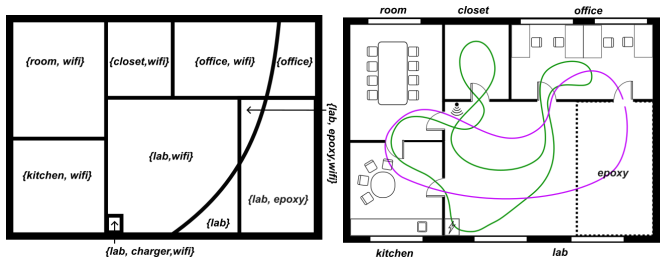

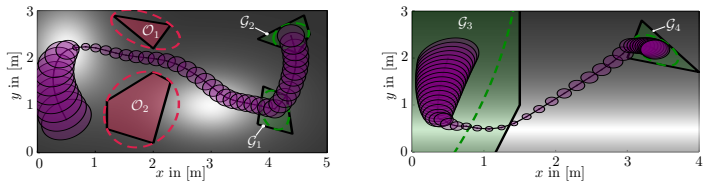
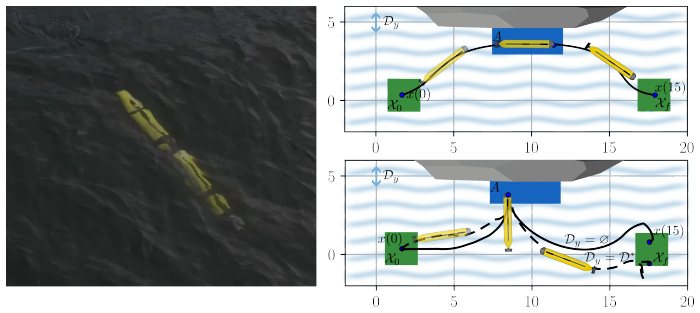

read the original abstract
As robots move from controlled environments into real-world settings, it becomes increasingly crucial to ensure that they perform as expected. A key step toward that goal is a rigorous specification of the desired robot behavior, capturing intricate temporal, spatial, and logical requirements. Complementing this, plan and control synthesis methods are needed to fulfill these specifications with provable guarantees. This manuscript presents temporal logics - particularly linear and signal temporal logic - as expressive specification languages for robot behavior over time. We then discuss principles of formal synthesis, from discrete graph- and game-based approaches to sampling-based motion planning, trajectory optimization, and control-certificate-based synthesis. Finally, we outline challenges in deploying formal synthesis in real-world robotics, emphasizing the interplay between modeling fidelity, computational tractability, and the types of rigorous guarantees that can be achieved.
Editorial analysis
A structured set of objections, weighed in public.
Referee Report
Summary. The manuscript is a survey overviewing temporal logics—particularly linear temporal logic (LTL) and signal temporal logic (STL)—as expressive languages for specifying temporal, spatial, and logical robot behaviors. It reviews formal synthesis principles spanning discrete graph- and game-based methods, sampling-based motion planning, trajectory optimization, and control-certificate approaches, and concludes by outlining deployment challenges in real-world robotics centered on the trade-offs among modeling fidelity, computational tractability, and guarantee strength.
Significance. As a survey without new theorems or empirical results, the manuscript's value lies in providing a structured synthesis of existing techniques if its coverage is accurate and balanced. It could usefully introduce the interplay of specification languages and synthesis methods to researchers in robotics, while the explicit discussion of real-world challenges helps frame open questions in the field.
minor comments (1)
- Abstract, final sentence: the phrasing 'emphasizing the interplay' is clear at a high level but could benefit from a brief concrete illustration of one such trade-off to better orient readers new to the area.
Simulated Author's Rebuttal
We thank the referee for their positive assessment of the manuscript, accurate summary of its scope, and recommendation to accept. The report contains no major comments requiring response or revision.
Circularity Check
No significant circularity
full rationale
The manuscript is a descriptive survey of existing temporal logics (LTL/STL) and synthesis techniques (graph/game-based, sampling-based, optimization, certificate-based) with no new theorems, derivations, equations, fitted parameters, or original central claims. No load-bearing steps reduce to self-definition, fitted inputs, or self-citation chains. The content is purely expository and self-contained against external literature.
Axiom & Free-Parameter Ledger
Reference graph
Works this paper leans on
-
[1]
Barbosa, Lars Lindemann, Dimos V
Fernando S. Barbosa, Lars Lindemann, Dimos V. Dimarogonas, and Jana Tu- mova. Integrated motion planning and control under metric interval temporal logic specifications. InEuropean Control Conference, pages 2042–2049,
2042
-
[2]
Planning for heterogeneous teams of robots with temporal logic, capability, and resource constraints.The In- ternational Journal of Robotics Research, 43(13):2089–2111,
Gustavo A Cardona and Cristian-Ioan Vasile. Planning for heterogeneous teams of robots with temporal logic, capability, and resource constraints.The In- ternational Journal of Robotics Research, 43(13):2089–2111,
2089
-
[3]
LTLMoP: Exper- imenting with language, temporal logic and robot control
Cameron Finucane, Gangyuan Jing, and Hadas Kress-Gazit. LTLMoP: Exper- imenting with language, temporal logic and robot control. InProceedings of the IEEE/RSJ International Conference on Intelligent Robots and Systems, pages 1988–1993,
1988
-
[4]
Zavlanos
Yiannis Kantaros and Michael M. Zavlanos. Sampling-based optimal control synthesis for multirobot systems under global temporal tasks.IEEE Trans- actions on Automatic Control, 64(5):1916–1931,
1916
-
[5]
doi: 10.1109/TAC. 2018.2853558. Yiannis Kantaros and Michael M Zavlanos. Stylus*: A temporal logic optimal control synthesis algorithm for large-scale multi-robot systems.The Interna- tional Journal of Robotics Research, 39(7):812–836,
work page doi:10.1109/tac 2018
-
[6]
Gregorio Marchesini, Siyuan Liu, Lars Lindemann, and Dimos V Dimarogonas. Sampling-based planning under STL specifications: A forward invariance ap- proach.arXiv preprint arXiv:2506.10739,
-
[7]
Specifying user pref- erences using weighted signal temporal logic.IEEE Control Systems Letters, 5(6):2006–2011,
Noushin Mehdipour, Cristian-Ioan Vasile, and Calin Belta. Specifying user pref- erences using weighted signal temporal logic.IEEE Control Systems Letters, 5(6):2006–2011,
2006
-
[8]
Adam Pacheck and Hadas Kress-Gazit
doi: 10.1109/TAC.2020.3044273. Adam Pacheck and Hadas Kress-Gazit. Physically feasible repair of reactive, linear temporal logic-based, high-level tasks.IEEE Transactions on Robotics, 39(6):4653–4670,
-
[9]
Yash Vardhan Pant, Houssam Abbas, and Rahul Mangharam
doi: 10.1109/TRO.2023.3304009. Yash Vardhan Pant, Houssam Abbas, and Rahul Mangharam. Smooth operator: Control using the smooth robustness of temporal logic. In2017 IEEE Con- ference on Control Technology and Applications (CCTA), pages 1235–1240. IEEE,
-
[10]
Towards open-source and modular space systems with ATMOS.arXiv preprint arXiv:2501.16973,
Pedro Roque, Sujet Phodapol, Elias Krantz, Jaeyoung Lim, Joris Verhagen, Frank J Jiang, David D¨ orner, Huina Mao, Gunnar Tibert, Roland Siegwart, et al. Towards open-source and modular space systems with ATMOS.arXiv preprint arXiv:2501.16973,
-
[11]
Robustness-based synthesis for stochastic systems under signal temporal logic tasks
Guy Scher, Sadra Sadraddini, and Hadas Kress-Gazit. Robustness-based synthesis for stochastic systems under signal temporal logic tasks. In 2022 IEEE/RSJ International Conference on Intelligent Robots and Systems (IROS), pages 1269–1275. IEEE,
2022
-
[12]
Control of multi- agent systems with finite time control barrier certificates and temporal logic
Mohit Srinivasan, Samuel Coogan, and Magnus Egerstedt. Control of multi- agent systems with finite time control barrier certificates and temporal logic. In2018 IEEE Conference on Decision and Control, pages 1991–1996. IEEE,
1991
-
[13]
Yanwei Wang, Nadia Figueroa, Shen Li, Ankit Shah, and Julie Shah
URL https://arxiv.org/abs/2504.21022. Yanwei Wang, Nadia Figueroa, Shen Li, Ankit Shah, and Julie Shah. Temporal logic imitation: Learning plan-satisficing motion policies from demonstra- tions. In6th Annual Conference on Robot Learning,
discussion (0)
Sign in with ORCID, Apple, or X to comment. Anyone can read and Pith papers without signing in.