REVIEW 2 major objections 2 minor 1 cited by
Time-To-Reach Separation and Safety Filtering for Safe, Fair, and Efficient Multi-Agent Coordination
T0 review · 2 major / 2 minor · reviewed 2026-05-21 · grok-4.3
Pith's one-line read A framework using minimum time-to-reach metrics coordinates aerial vehicles for safe, fair, and efficient corridor merging.
desk verdict The paper unifies TTR for priority assignment and temporal spacing in corridor merging, then layers a priority-consistent HJ safety filter on top, but the simulations leave the spatial-separation guarantee under speed variation unproven. read the letter →
The pith
A machine-rendered reading of the paper's core claim, the machinery that carries it, and where it could break.
The reading
What carries the argument
Minimum time-to-reach (TTR) as a unifying metric for priority assignment and temporal separation, together with priority-consistent safety filtering via Hamilton-Jacobi reachability value functions.
What would settle it
A simulation or flight test where the achieved spatial separations drop below safe distances or where the safety filter alters priorities or introduces fairness issues despite using the proposed TTR targets.
Extended reading notes
Core claim
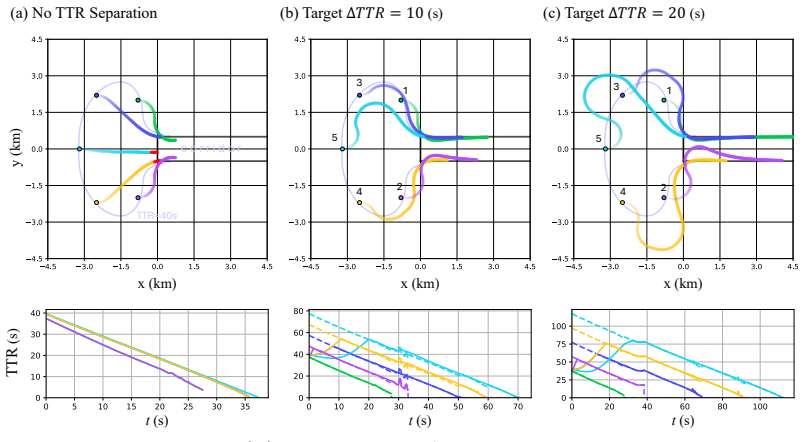
Minimum time-to-reach serves as a unifying metric that enables arrival-consistent priority assignment, target TTR values for temporal separation inducing spatial separation, and a priority-consistent safety filtering layer using Hamilton-Jacobi reachability value functions to guarantee collision avoidance with minimal modification to reference guidance.
Load-bearing premise
Target TTR values can be chosen so that temporal spacing reliably produces the needed spatial separation, and the safety filter modifies guidance minimally without creating new conflicts or violating fairness.
Editorial analysis
A structured set of objections, weighed in public.
Referee Report
Summary. The manuscript proposes a multi-agent coordination framework for Advanced Air Mobility (AAM) corridor merging that uses minimum time-to-reach (TTR) as a unifying metric for arrival-consistent priority assignment, selection of target TTR values to enforce temporal spacing (claimed to induce spatial separation), and a priority-consistent Hamilton-Jacobi reachability safety filter that minimally modifies reference guidance. Simulation results in a highly congested merging scenario are presented as demonstrating improvements in safety, fairness, and efficiency relative to time-optimal guidance and priority-agnostic safety filtering.
Significance. If the central claims hold, the work provides a coherent integration of priority, separation, and formal safety filtering via an established reachability tool, which could support scalable AAM traffic management. The reliance on HJ reachability for the safety layer supplies a formal foundation that is a clear strength relative to purely heuristic approaches.
major comments (2)
- [Simulation Results] Simulation results section: the headline improvements in safety, fairness, and efficiency are reported without error bars, statistical significance tests, or sensitivity analysis to the specific target TTR values chosen. This is load-bearing for the central claim because the reader's weakest assumption (that TTR targets reliably produce the required separation) cannot be evaluated without such details, and post-hoc scenario selection cannot be ruled out.
- [Proposed Framework] Method description (TTR-based separation): the assertion that target TTR values enforce temporal spacing which induces the required spatial separation lacks an analytic bound or sensitivity analysis under velocity heterogeneity. In corridor merges, spatial clearance depends on both time headway and instantaneous speed/heading; a fixed TTR delta does not guarantee minimum distance, and no evidence is given that the priority-consistent HJ filter remains inactive or non-disruptive once TTR targets are set. This assumption directly supports the reported simulation gains.
minor comments (2)
- [Abstract] The abstract would benefit from explicitly stating the number of agents simulated and the quantitative metrics (e.g., minimum separation distance, throughput) used to quantify fairness and efficiency.
- [Introduction] Notation for TTR and the distinction between minimum TTR (for priority) and target TTR (for separation) could be introduced earlier and used consistently to improve readability.
Simulated Author's Rebuttal
We thank the referee for the thoughtful and constructive report. The comments highlight important aspects for strengthening the presentation of our simulation results and the justification of the TTR-based separation mechanism. We address each major comment below and outline the revisions we will make.
read point-by-point responses
-
Referee: [Simulation Results] Simulation results section: the headline improvements in safety, fairness, and efficiency are reported without error bars, statistical significance tests, or sensitivity analysis to the specific target TTR values chosen. This is load-bearing for the central claim because the reader's weakest assumption (that TTR targets reliably produce the required separation) cannot be evaluated without such details, and post-hoc scenario selection cannot be ruled out.
Authors: We agree that the current simulation presentation would be strengthened by additional statistical rigor and sensitivity analysis. In the revised manuscript we will report results aggregated over multiple Monte Carlo trials with randomized initial conditions and vehicle parameters, include error bars and statistical significance tests for the observed improvements in safety, fairness, and efficiency metrics, and add a sensitivity study varying the target TTR values around the nominal choices. These changes will directly address concerns about post-hoc selection and provide clearer evidence that the reported gains are robust. revision: yes
-
Referee: [Proposed Framework] Method description (TTR-based separation): the assertion that target TTR values enforce temporal spacing which induces the required spatial separation lacks an analytic bound or sensitivity analysis under velocity heterogeneity. In corridor merges, spatial clearance depends on both time headway and instantaneous speed/heading; a fixed TTR delta does not guarantee minimum distance, and no evidence is given that the priority-consistent HJ filter remains inactive or non-disruptive once TTR targets are set. This assumption directly supports the reported simulation gains.
Authors: We acknowledge that a purely analytic guarantee of minimum spatial separation from a fixed TTR delta is not provided under arbitrary velocity heterogeneity, and that explicit evidence on filter activity would be helpful. The priority-consistent HJ safety filter is designed to enforce collision avoidance regardless of the reference guidance, so the overall safety claim does not rest solely on the TTR targets. Nevertheless, to strengthen the exposition we will derive a conservative bound on induced spatial separation under bounded speed and heading variations representative of AAM vehicles, and we will add plots and statistics quantifying the frequency and magnitude of safety-filter interventions when TTR targets are applied. These additions will clarify the interplay between the nominal TTR guidance and the safety layer. revision: yes
Circularity Check
No circularity detected; derivation relies on established external methods
full rationale
The paper proposes a coordination framework using minimum TTR for priority assignment and temporal spacing, combined with a priority-consistent safety filter based on Hamilton-Jacobi reachability value functions. No load-bearing derivation step reduces the claimed improvements in safety, fairness, or efficiency to quantities defined by the paper's own fitted parameters, self-citations, or definitional equivalences. The approach builds on standard reachability concepts and presents simulation results as empirical evidence rather than a closed tautology. The target TTR selection and filter behavior are design choices validated externally in the corridor scenario, with no quoted equations showing constructional equivalence to inputs.
Assumptions & free parameters
assumptions (2)
- domain assumption Vehicles can be assigned arrival-consistent priority based on minimum time-to-reach
- domain assumption Hamilton-Jacobi reachability value functions can provide a priority-consistent safety filter that minimally modifies reference guidance
Cite this review
Pith. "Pith review of Time-To-Reach Separation and Safety Filtering for Safe, Fair, and Efficient Multi-Agent Coordination." pith.science (2026). https://pith.science/paper/ZE4UJCHR
@misc{pith2026260520625,
  author       = {Pith},
  title        = {Pith review of: Time-To-Reach Separation and Safety Filtering for Safe, Fair, and Efficient Multi-Agent Coordination},
  year         = {2026},
  howpublished = {\url{https://pith.science/paper/ZE4UJCHR}},
  note         = {Machine review of arXiv:2605.20625}
}
read the original abstract
Advanced Air Mobility (AAM) operations are expected to significantly increase aerial traffic in urban airspace, requiring autonomous traffic management systems to ensure collision-free operations in highly congested environments. In this paper, we propose a multi-agent coordination framework that uses minimum time-to-reach (TTR) as a unifying metric for priority assignment, temporal separation, and safety filtering. We focus on the problem of coordinating multiple aerial vehicles merging into an air corridor while maintaining safe separation between vehicles. Vehicles are assigned arrival-consistent priority based on TTR, and target TTR values are used to enforce temporal spacing that induces spatial separation. A priority-consistent safety filtering layer based on Hamilton-Jacobi reachability value functions ensures collision avoidance while minimally modifying the reference guidance. Simulation results in a highly congested corridor merging scenario show that the proposed method improves safety, fairness, and efficiency compared to time-optimal guidance and priority-agnostic safety filtering.
Figures


Lean theorems connected to this paper
-
IndisputableMonolith/Foundation/AbsoluteFloorClosure.leanreality_from_one_distinction unclear?
unclearRelation between the paper passage and the cited Recognition theorem.
Vehicles are assigned arrival-consistent priority based on TTR, and target TTR values are used to enforce temporal spacing that induces spatial separation. A priority-consistent safety filtering layer based on Hamilton-Jacobi reachability value functions ensures collision avoidance while minimally modifying the reference guidance.
What do these tags mean?
- matches
- The paper's claim is directly supported by a theorem in the formal canon.
- supports
- The theorem supports part of the paper's argument, but the paper may add assumptions or extra steps.
- extends
- The paper goes beyond the formal theorem; the theorem is a base layer rather than the whole result.
- uses
- The paper appears to rely on the theorem as machinery.
- contradicts
- The paper's claim conflicts with a theorem or certificate in the canon.
- unclear
- Pith found a possible connection, but the passage is too broad, indirect, or ambiguous to say the theorem truly supports the claim.
Forward citations
Cited by 1 Pith paper
-
Decentralized Autonomous Traffic Management through Corridor Networks
MARL policies trained on single corridors transfer zero-shot to multi-corridor networks, maintaining corridor conformance, completion rates, speeds, and separation under varying density and geometry.
Reference graph
Works this paper leans on
-
[1]
FAA Aerospace Forecasts. (2025, 10) Compendium to FAA aerospace forecast FY 2025-2045 emerging aviation entrants: Unmanned aircraft systems and Advanced air mobility
work page 2025
-
[2]
Air Traffic Controller Hiring
-
[3]
J. Homola, P. U. Lee, H. Lee, and C. Brasil, “Design and Evaluation of a Corridors-in-the-Sky Concept: The Benefits and Feasibility of Adding Highly Structured Routes to a Mixed Equipage Environment,” inAIAA GNC Conference, 2012
work page 2012
-
[4]
The Advanced Air Mobility National Strategy: A Bold Policy Vision for 2025–2035,
US Department of Transportation Advanced Air Mobility Interagency Working Group, “The Advanced Air Mobility National Strategy: A Bold Policy Vision for 2025–2035,” Tech. Rep., 2025
work page 2025
-
[5]
SESAR Joint Undertaking|U-space CONOPS 4th Edition,
EUROCONTROL, “SESAR Joint Undertaking|U-space CONOPS 4th Edition,” European Union, Tech. Rep., 2023
work page 2023
-
[6]
Z. Wang, D. Delahaye, J.-L. Farges, and S. Alam, “A quasi-dynamic air traffic assignment model for mitigating air traffic complexity and congestion for high-density UAM operations,”Transportation Research Part C: Emerging Technologies, 2023
work page 2023
-
[7]
Decentralized Coordination of Autonomous Traffic Through Advanced Air Mobility Corridors,
J. J. Aloor and H. Balakrishnan, “Decentralized Coordination of Autonomous Traffic Through Advanced Air Mobility Corridors,” in AIAA SCITECH 2026 Forum, 2026
work page 2026
-
[8]
Traf- fic management protocols for advanced air mobility,
C. Chin, V . Qin, K. Gopalakrishnan, and H. Balakrishnan, “Traf- fic management protocols for advanced air mobility,”Frontiers in Aerospace Engineering, May 2023
work page 2023
Show all 39 references
-
[9]
Introduction to TCAS II, Version 7.1,
FAA, “Introduction to TCAS II, Version 7.1,” 2011
2011
-
[10]
Next-generation airborne collision avoidance system,
M. J. Kochenderfer, J. E. Holland, and J. P. Chryssanthacopoulos, “Next-generation airborne collision avoidance system,” 2012
2012
-
[11]
Tactical conflict resolution in urban airspace for unmanned aerial vehicles operations using attention-based deep reinforcement learning,
M. Zhang, C. Yan, W. Dai, X. Xiang, and K. H. Low, “Tactical conflict resolution in urban airspace for unmanned aerial vehicles operations using attention-based deep reinforcement learning,”Green Energy and Intelligent Transportation, 2023
2023
-
[12]
Resolving Conflicting Constraints in Multi-Agent Reinforcement Learning with Layered Safety,
J. J. Choi, J. J. Aloor, J. Li, M. G. Mendoza, H. Balakrishnan, and C. Tomlin, “Resolving Conflicting Constraints in Multi-Agent Reinforcement Learning with Layered Safety,” inRobotics: Science and Systems (RSS), 2025
2025
-
[13]
I. M. Mitchell,Application of level set methods to control and reachability problems in continuous and hybrid systems. Stanford University, 2002
2002
-
[14]
Efficiency and fairness in unmanned air traffic flow manage- ment,
C. Chin, K. Gopalakrishnan, M. Egorov, A. Evans, and H. Balakr- ishnan, “Efficiency and fairness in unmanned air traffic flow manage- ment,”IEEE Trans. Intell. Transp. Syst., 2021
2021
-
[15]
Hamilton-Jacobi multi-time reachability,
M. Doshi, M. Bhabra, M. Wiggert, C. J. Tomlin, and P. F. Lermusiaux, “Hamilton-Jacobi multi-time reachability,” inIEEE CDC, 2022
2022
-
[16]
TTR-Based Reward for Reinforcement Learn- ing with Implicit Model Priors,
X. Lyu and M. Chen, “TTR-Based Reward for Reinforcement Learn- ing with Implicit Model Priors,” inIEEE/RSJ IROS, 2020
2020
-
[17]
Decentralized Control Synthesis for Air Traffic Management in Urban Air Mobility,
S. Bharadwaj, S. Carr, N. Neogi, and U. Topcu, “Decentralized Control Synthesis for Air Traffic Management in Urban Air Mobility,”IEEE Trans. Control Netw. Syst., 2021
2021
-
[18]
HMARL-CBF–Hierarchical Multi-Agent Rein- forcement Learning with Control Barrier Functions for Safety-Critical Autonomous Systems,
H. S. Ahmadet al., “HMARL-CBF–Hierarchical Multi-Agent Rein- forcement Learning with Control Barrier Functions for Safety-Critical Autonomous Systems,” inNeurIPS, 2025
2025
-
[19]
Combinatorial Safety-Critical Coordination of Multi-Agent Systems via Mixed- Integer Responsibility Allocation and Control Barrier Functions,
J. Autenrieb, M. Spiller, H.-S. Shin, and N. Cho, “Combinatorial Safety-Critical Coordination of Multi-Agent Systems via Mixed- Integer Responsibility Allocation and Control Barrier Functions,” arXiv preprint arXiv:2603.05762, 2026
2026
-
[20]
Sastry,Nonlinear systems: analysis, stability, and control
S. Sastry,Nonlinear systems: analysis, stability, and control. Springer, 2013
2013
-
[21]
Data-Driven Safety Filters: Hamilton-Jacobi Reachability, Control Barrier Functions, and Predictive Methods for Uncertain Systems,
K. P. Wabersichet al., “Data-Driven Safety Filters: Hamilton-Jacobi Reachability, Control Barrier Functions, and Predictive Methods for Uncertain Systems,”IEEE CSM, 2023
2023
-
[22]
Aubin, A
J. Aubin, A. M. Bayen, and P. Saint-Pierre,Viability theory: new directions. Springer Science & Business Media, 2011
2011
-
[23]
Bardi and I
M. Bardi and I. C. Dolcetta,Optimal control and viscosity solutions of Hamilton-Jacobi-Bellman equations. Springer, 1997
1997
-
[24]
Reach-avoid problems with time-varying dynamics, targets and constraints,
J. F. Fisac, M. Chen, C. J. Tomlin, and S. S. Sastry, “Reach-avoid problems with time-varying dynamics, targets and constraints,” inInt. Conf. on Hybrid Sys.: Computation and Control (HSCC), 2015
2015
-
[25]
Deepreach: A deep learning approach to high-dimensional reachability,
S. Bansal and C. J. Tomlin, “Deepreach: A deep learning approach to high-dimensional reachability,” inIEEE ICRA, 2021
2021
-
[26]
Control barrier function based quadratic programs for safety critical systems,
A. D. Ames, X. Xu, J. W. Grizzle, and P. Tabuada, “Control barrier function based quadratic programs for safety critical systems,”IEEE TAC, 2016
2016
-
[27]
Robust control barrier–value functions for safety-critical control,
J. J. Choi, D. Lee, K. Sreenath, C. J. Tomlin, and S. L. Herbert, “Robust control barrier–value functions for safety-critical control,” in IEEE CDC, 2021
2021
-
[28]
Discrete GCBF Proximal Policy Optimization for Multi-agent Safe Optimal Control,
S. Zhang, O. So, M. Black, and C. Fan, “Discrete GCBF Proximal Policy Optimization for Multi-agent Safe Optimal Control,” inICLR, 2025
2025
-
[29]
Safety with agency: Human-centered safety filter with application to ai-assisted motorsports,
D. D. Ohet al., “Safety with agency: Human-centered safety filter with application to ai-assisted motorsports,” inRSS, 2025
2025
-
[30]
A forward reachability perspective on robust control invariance and discount factors in reachability analysis,
J. J. Choiet al., “A forward reachability perspective on robust control invariance and discount factors in reachability analysis,”arXiv preprint arXiv:2310.17180, 2023
2023
-
[31]
One- shot computation of reachable sets for differential games,
I. Yang, S. Becker-Weimann, M. J. Bissell, and C. J. Tomlin, “One- shot computation of reachable sets for differential games,” inHSCC, 2013
2013
-
[32]
helperOC: Optimal Control Toolbox for Hamilton-Jacobi Reachability
S. Bansal, M. Chen, S. Herbert, and C. J. Tomlin, “helperOC: Optimal Control Toolbox for Hamilton-Jacobi Reachability.”
-
[33]
A New Measure of Rank Correlation,
M. Kendall, “A New Measure of Rank Correlation,”Biometrika, 1938
1938
-
[34]
Joby Aviation - Official Website,
Joby Aviation, “Joby Aviation - Official Website,” 2026
2026
-
[35]
Midnight eVTOL - Aircraft Performance Specs,
Archer Aviation, “Midnight eVTOL - Aircraft Performance Specs,” 2026
2026
-
[36]
Wisk Aero - Our Aircraft,
Wisk Aero, “Wisk Aero - Our Aircraft,” 2026
2026
-
[37]
Aeronautical Information Manual (AIM), Chapter 7: Safety of Flight, Section 7: Near Midair Collision Reporting
FAA, “Aeronautical Information Manual (AIM), Chapter 7: Safety of Flight, Section 7: Near Midair Collision Reporting.”
-
[38]
Safety Barrier Certificates for Collisions-Free Multirobot Systems,
L. Wang, A. D. Ames, and M. Egerstedt, “Safety Barrier Certificates for Collisions-Free Multirobot Systems,”IEEE T-Ro, 2017
2017
-
[39]
OSQP: An Operator Splitting Solver for Quadratic Programs,
B. Stellato, G. Banjac, P. Goulart, A. Bemporad, and S. Boyd, “OSQP: An Operator Splitting Solver for Quadratic Programs,”Math. Prog. Comp., 2020. APPENDIX A. Parameters Used in Simulation Study TABLE IV PARAMETERS OFAIRTAXIDYNAMICS& AIRCORRIDOR Parameter Air taxi (Sim) Ground...
2020
Reviewed May 21, 2026 · model on record in the stance chip above.
Discussion (0). Continue with ORCID to comment.