Cortical Surface Parcellation using Spherical Convolutional Neural Networks
Pith reviewed 2026-05-24 22:37 UTC · model grok-4.3
The pith
Spherical convolutional neural networks trained on deformation-augmented data achieve accurate cortical parcellation in under a minute.
A machine-rendered reading of the paper's core claim, the machinery that carries it, and where it could break.
Core claim
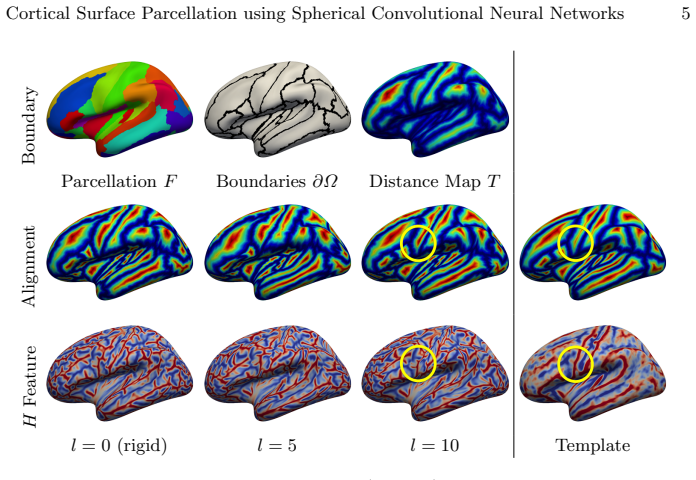
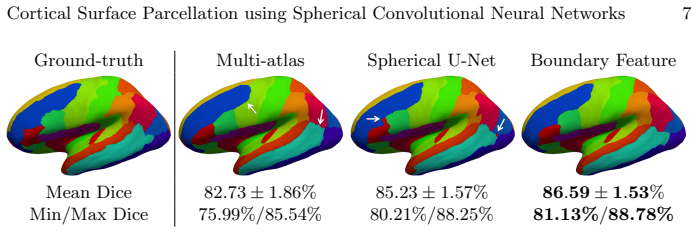
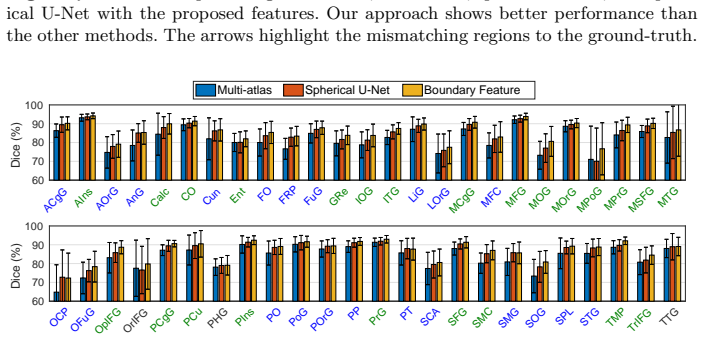
The central claim is that cortical surface parcellation using spherical deep convolutional neural networks becomes feasible and superior when training data are expanded by aligning ground-truth parcel boundaries to produce deformation fields, generating new pairs of deformed geometric features and parcellation maps, and then smoothly morphing those maps with intermediate fields. This training regimen allows the networks to outperform traditional multi-atlas registration and naive spherical U-Net approaches on 427 adult brains for 49 labels while completing full parcellation in less than a minute.
What carries the argument
Spherical convolutional neural networks trained on pairs of geometric features and parcellation maps that have been augmented and morphed using deformation fields derived from ground-truth parcel boundary alignments.
If this is right
- Full cortical parcellation into 49 labels is possible in less than one minute per subject.
- The method outperforms both traditional multi-atlas registration (2-3 hours) and naive spherical U-Net baselines.
- Training data augmentation via parcel-boundary deformation fields improves accuracy on a cohort of 427 adult brains.
Where Pith is reading between the lines
- The same augmentation technique could be applied to other surface-based neuroimaging tasks that currently rely on slow registration.
- If the learned mapping holds, large-scale population studies could obtain parcel labels without per-subject registration pipelines.
- The results suggest that parcel boundaries carry information beyond the geometric features used in classical registration.
Load-bearing premise
The deformation fields derived from aligning ground-truth parcel boundaries produce training examples that generalize without bias to unseen subjects' geometric features.
What would settle it
A held-out test set of cortical surfaces whose geometric features lie outside the range of deformations used in training, showing measurably lower parcellation accuracy than the reported results, would falsify the generalization claim.
Figures

read the original abstract
We present cortical surface parcellation using spherical deep convolutional neural networks. Traditional multi-atlas cortical surface parcellation requires inter-subject surface registration using geometric features with high processing time on a single subject (2-3 hours). Moreover, even optimal surface registration does not necessarily produce optimal cortical parcellation as parcel boundaries are not fully matched to the geometric features. In this context, a choice of training features is important for accurate cortical parcellation. To utilize the networks efficiently, we propose cortical parcellation-specific input data from an irregular and complicated structure of cortical surfaces. To this end, we align ground-truth cortical parcel boundaries and use their resulting deformation fields to generate new pairs of deformed geometric features and parcellation maps. To extend the capability of the networks, we then smoothly morph cortical geometric features and parcellation maps using the intermediate deformation fields. We validate our method on 427 adult brains for 49 labels. The experimental results show that our method out-performs traditional multi-atlas and naive spherical U-Net approaches, while achieving full cortical parcellation in less than a minute.
Editorial analysis
A structured set of objections, weighed in public.
Referee Report
Summary. The paper claims that spherical CNNs can be trained for cortical surface parcellation by generating augmented training pairs via deformation fields obtained from aligning ground-truth parcel boundaries; these fields are used to morph both geometric features and label maps. On a cohort of 427 adult brains and 49 labels, the resulting model is reported to outperform both traditional multi-atlas registration (2-3 h per subject) and a naive spherical U-Net while completing parcellation in under one minute.
Significance. If the augmentation procedure generalizes without systematic bias and the performance gains are reproducible, the work would offer a practical, high-throughput alternative to slow registration-based parcellation pipelines, which is relevant for large-scale neuroimaging studies. The empirical, held-out validation on hundreds of subjects is a positive feature of the design.
major comments (2)
- [Abstract] Abstract (data-augmentation paragraph): the deformation fields are derived by aligning ground-truth parcel boundaries rather than independent geometric features; this choice risks producing training distributions that do not match the geometry of unseen test subjects, so the reported superiority over multi-atlas and naive U-Net may be attributable to the augmentation rather than the network architecture itself. No description of the alignment algorithm, regularization of the fields, or quantitative checks that the morphed surfaces remain anatomically plausible is supplied.
- [Abstract] Validation description (Abstract): the claim of outperformance on 427 brains lacks accompanying error bars, explicit train/test split details, exclusion criteria, or statistical tests, preventing assessment of whether the gains are robust or merely reflect the particular augmentation distribution.
minor comments (1)
- [Abstract] The abstract states that 'a choice of training features is important' but does not enumerate which geometric features are actually supplied to the network; this omission reduces clarity of the input representation.
Simulated Author's Rebuttal
We thank the referee for the constructive comments on our manuscript. We address each major comment below and indicate planned revisions where appropriate.
read point-by-point responses
-
Referee: [Abstract] Abstract (data-augmentation paragraph): the deformation fields are derived by aligning ground-truth parcel boundaries rather than independent geometric features; this choice risks producing training distributions that do not match the geometry of unseen test subjects, so the reported superiority over multi-atlas and naive U-Net may be attributable to the augmentation rather than the network architecture itself. No description of the alignment algorithm, regularization of the fields, or quantitative checks that the morphed surfaces remain anatomically plausible is supplied.
Authors: The augmentation strategy is a core component of the proposed method rather than an extraneous factor; the naive spherical U-Net baseline does not employ this parcel-boundary-driven deformation augmentation, allowing the comparison to isolate its contribution alongside the spherical CNN architecture. The held-out test performance on 427 subjects demonstrates generalization to unseen geometries. We agree that the abstract lacks methodological specifics and will expand the methods section in revision to describe the alignment algorithm, any regularization applied to the deformation fields, and quantitative checks confirming that morphed surfaces remain anatomically plausible. revision: yes
-
Referee: [Abstract] Validation description (Abstract): the claim of outperformance on 427 brains lacks accompanying error bars, explicit train/test split details, exclusion criteria, or statistical tests, preventing assessment of whether the gains are robust or merely reflect the particular augmentation distribution.
Authors: The full manuscript contains the train/test split, exclusion criteria, and dataset description. We acknowledge that the abstract is too concise on these points and omits error bars or statistical tests. In revision we will update the abstract to reference the cross-validation procedure and report mean performance with standard deviations; we will also ensure the results section includes appropriate statistical comparisons. revision: yes
Circularity Check
No significant circularity; empirical method with held-out validation
full rationale
The paper describes a data-driven spherical CNN pipeline for cortical parcellation that augments training data via deformation fields obtained from ground-truth boundary alignments and reports performance on a held-out set of 427 brains. No equations, predictions, or uniqueness claims reduce the reported outperformance to fitted inputs or self-citation chains by construction. The central result is an empirical comparison against multi-atlas and naive U-Net baselines on independent test subjects, making the derivation self-contained against external benchmarks.
Axiom & Free-Parameter Ledger
Reference graph
Works this paper leans on
-
[1]
Journal of the Royal statistical society: series B (Methodological) 57(1), 289–300 (1995)
Benjamini, Y., Hochberg, Y.: Controlling the false discovery rate: a practical and powerful approach to multiple testing. Journal of the Royal statistical society: series B (Methodological) 57(1), 289–300 (1995)
work page 1995
-
[2]
IEEE Transactions on Pattern Analysis & Machine Intelligence 26(9), 1124–1137 (2004)
Boykov, Y., Kolmogorov, V.: An experimental comparison of min-cut/max-flow al- gorithms for energy minimization in vision. IEEE Transactions on Pattern Analysis & Machine Intelligence 26(9), 1124–1137 (2004)
work page 2004
-
[3]
Cohen, T.S., Geiger, M., K¨ ohler, J., Welling, M.: Spherical cnns. arXiv preprint arXiv:1801.10130 (2018)
work page internal anchor Pith review Pith/arXiv arXiv 2018
-
[4]
In: International Conference on Medical Imaging with Deep Learning (2018)
Cucurull, G., Wagstyl, K., Casanova, A., Veliˇ ckovi´ c, P., Jakobsen, E., Drozdzal, M., Romero, A., Evans, A., Bengio, Y.: Convolutional neural networks for mesh- based parcellation of the cerebral cortex. In: International Conference on Medical Imaging with Deep Learning (2018)
work page 2018
-
[5]
Neuroimage 31(3), 968–980 (2006)
Desikan, R.S., S´ egonne, F., Fischl, B., Quinn, B.T., Dickerson, B.C., Blacker, D., Buckner, R.L., Dale, A.M., Maguire, R.P., Hyman, B.T., et al.: An automated labeling system for subdividing the human cerebral cortex on mri scans into gyral based regions of interest. Neuroimage 31(3), 968–980 (2006)
work page 2006
-
[6]
In: European Conference on Computer Vision (2018)
Esteves, C., Allen-Blanchette, C., Makadia, A., Daniilidis, K.: Learning so(3) equiv- ariant representations with spherical cnns. In: European Conference on Computer Vision (2018)
work page 2018
-
[7]
Cerebral cortex 14(1), 11–22 (2004)
Fischl, B., Van Der Kouwe, A., Destrieux, C., Halgren, E., S´ egonne, F., Salat, D.H., Busa, E., Seidman, L.J., Goldstein, J., Kennedy, D., et al.: Automatically parcellating the human cerebral cortex. Cerebral cortex 14(1), 11–22 (2004)
work page 2004
-
[8]
Graph Convolutions on Spectral Embeddings: Learning of Cortical Surface Data
Gopinath, K., Desrosiers, C., Lombaert, H.: Graph convolutions on spectral em- beddings: Learning of cortical surface data. arXiv preprint arXiv:1803.10336 (2018)
work page internal anchor Pith review Pith/arXiv arXiv 2018
-
[9]
Spherical CNNs on Unstructured Grids
Jiang, C., Huang, J., Kashinath, K., Marcus, P., Niessner, M., et al.: Spherical cnns on unstructured grids. arXiv preprint arXiv:1901.02039 (2019)
work page internal anchor Pith review Pith/arXiv arXiv 1901
-
[10]
Klein, A., Dal Canton, T., Ghosh, S.S., Landman, B., Lee, J., Worth, A.: Open labels: online feedback for a public resource of manually labeled brain images. In: 16th Annual Meeting for the Organization of Human Brain Mapping (2010) Cortical Surface Parcellation using Spherical Convolutional Neural Networks 9
work page 2010
-
[11]
Neuroimage 34(4), 1535–1544 (2007)
Lyttelton, O., Boucher, M., Robbins, S., Evans, A.: An unbiased iterative group registration template for cortical surface analysis. Neuroimage 34(4), 1535–1544 (2007)
work page 2007
-
[12]
Medical image analysis 57, 72–88 (2019)
Lyu, I., Kang, H., Woodward, N.D., Styner, M.A., Landman, B.A.: Hierarchical spherical deformation for cortical surface registration. Medical image analysis 57, 72–88 (2019)
work page 2019
-
[13]
Medical image analysis 48, 244–258 (2018)
Lyu, I., Kim, S.H., Girault, J.B., Gilmore, J.H., Styner, M.A.: A cortical shape- adaptive approach to local gyrification index. Medical image analysis 48, 244–258 (2018)
work page 2018
-
[14]
SIAM Journal on Numerical Analysis 41(1), 325–363 (2003)
Sethian, J.A., Vladimirsky, A.: Ordered upwind methods for static hamilton–jacobi equations: Theory and algorithms. SIAM Journal on Numerical Analysis 41(1), 325–363 (2003)
work page 2003
-
[15]
In: International Conference on Medical Image Computing and Computer-Assisted Intervention
Wu, Z., Li, G., Wang, L., Shi, F., Lin, W., Gilmore, J.H., Shen, D.: Registration- free infant cortical surface parcellation using deep convolutional neural networks. In: International Conference on Medical Image Computing and Computer-Assisted Intervention. pp. 672–680. Springer (2018)
work page 2018
-
[16]
Journal of neurophysiology 106(3), 1125 (2011)
Yeo, B.T., Krienen, F.M., Sepulcre, J., Sabuncu, M.R., Lashkari, D., Hollinshead, M., Roffman, J.L., Smoller, J.W., Z¨ ollei, L., Polimeni, J.R., et al.: The organization of the human cerebral cortex estimated by intrinsic functional connectivity. Journal of neurophysiology 106(3), 1125 (2011)
work page 2011
discussion (0)
Sign in with ORCID, Apple, or X to comment. Anyone can read and Pith papers without signing in.