Multiple re-entrant topological windows induced by generalized Bernoulli disorder
Pith reviewed 2026-05-17 01:12 UTC · model grok-4.3
The pith
Generalized Bernoulli disorder in intradimer hoppings creates multiple disconnected topological windows in a one-dimensional chiral lattice.
A machine-rendered reading of the paper's core claim, the machinery that carries it, and where it could break.
Core claim
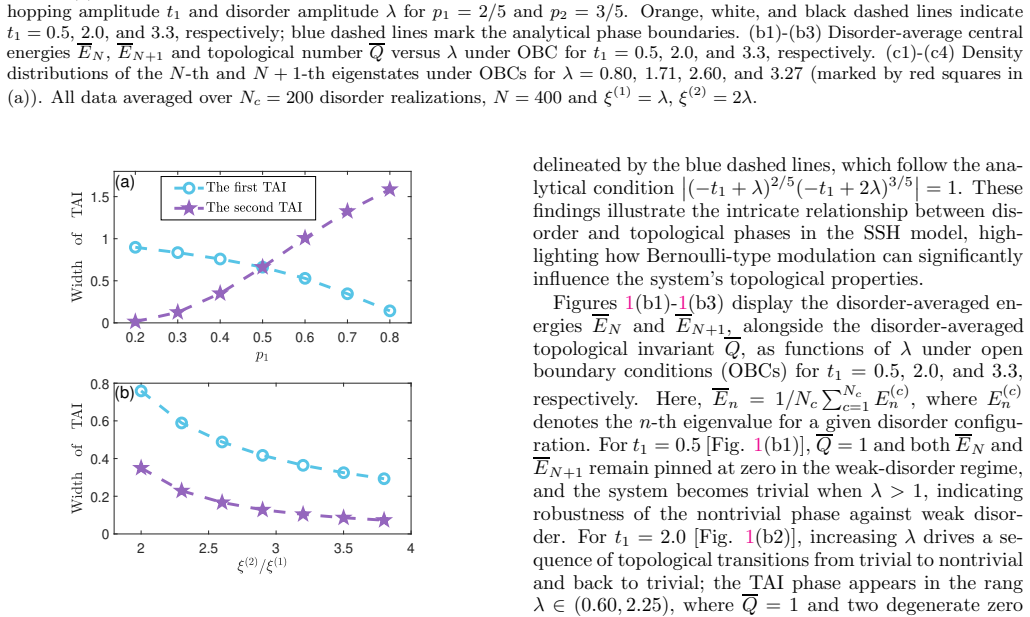
In the Su-Schrieffer-Heeger model with generalized Bernoulli disorder confined to the intradimer hoppings, the topological phase diagram contains multiple re-entrant windows whose boundaries are fixed by the zeros of the inverse localization length of the zero modes; both the number and the widths of these windows are controlled by the values and probabilities that define the disorder distribution.
What carries the argument
Inverse localization length of zero modes, which supplies the analytic condition separating topological and trivial regions for any choice of generalized Bernoulli parameters.
If this is right
- Increasing the number of distinct values in the Bernoulli distribution increases the number of topological windows.
- The probabilities assigned to each value directly determine the relative widths of the topological and trivial intervals.
- The mean chiral displacement changes its long-time behavior precisely at the analytically derived critical points.
- The same disorder-induced windows should appear in photonic waveguide arrays fabricated with the corresponding intradimer couplings.
Where Pith is reading between the lines
- Engineered multivalued disorder of this form could provide a practical route to devices that operate in several distinct topological regimes without changing the lattice geometry.
- The dynamical probe based on chiral displacement may allow time-resolved observation of the transitions in optical or cold-atom experiments.
- Analogous re-entrant windows are likely to appear in other one-dimensional chiral models once the same generalized Bernoulli statistics are imposed on the appropriate hopping terms.
Load-bearing premise
The topological phase boundaries are set exactly by the inverse localization length of zero modes, without appreciable shifts from finite-size effects or contributions from nonzero-energy states.
What would settle it
A transfer-matrix or exact-diagonalization calculation performed for a chosen set of disorder values and probabilities that yields a different count of intervals with nontrivial topological invariant than the number predicted by setting the inverse localization length to zero.
Figures



read the original abstract
We investigate re-entrant topological behavior in a one-dimensional Su-Schrieffer-Heeger model with generalized Bernoulli-type disorder in the intradimer hopping amplitudes. We show that varying the values and probabilities of the disorder distribution systematically changes the number and widths of disconnected topological windows. The phase boundaries are obtained analytically from the inverse localization length of zero modes and agree with numerical calculations. We further show that the mean chiral displacement provides a useful dynamical probe of the disorder-induced topological transitions, and we outline a possible implementation in photonic waveguide lattices. These results clarify how the structure of a multivalued disorder distribution influences re-entrant topological behavior in one-dimensional chiral lattices.
Editorial analysis
A structured set of objections, weighed in public.
Referee Report
Summary. The manuscript examines re-entrant topological behavior in a one-dimensional Su-Schrieffer-Heeger model with generalized Bernoulli-type disorder restricted to the intradimer hopping amplitudes. Varying the disorder values and probabilities is shown to systematically control the number and widths of disconnected topological windows. Phase boundaries are obtained analytically from the inverse localization length of zero modes and reported to agree with numerical calculations. The mean chiral displacement is introduced as a dynamical probe of the transitions, and a possible photonic waveguide lattice implementation is outlined.
Significance. If the results hold, the work clarifies the role of multivalued disorder distributions in producing multiple re-entrant topological windows in 1D chiral lattices. The analytical, parameter-free derivation of boundaries via the inverse localization length (rather than fitted quantities) is a clear strength, as is the use of mean chiral displacement for dynamical characterization. The photonic implementation suggestion adds experimental relevance for optics.
major comments (1)
- The central claim that the disorder-averaged inverse localization length of zero modes fully determines the topological phase boundaries (without finite-size or rare-configuration corrections) is load-bearing for the multi-window results. Explicit checks for system-size dependence and rare-sequence effects in the re-entrant regimes would be needed to confirm that the reported numerical agreement is not affected by these factors.
minor comments (2)
- Figure captions and axis labels should explicitly state the system sizes used in the numerical diagonalization or transfer-matrix calculations to allow direct assessment of finite-size convergence.
- A brief remark on the range of disorder probabilities and values explored would help readers reproduce the reported changes in the number of topological windows.
Simulated Author's Rebuttal
We thank the referee for the careful reading and positive evaluation of our manuscript. We address the major comment below and will strengthen the presentation accordingly in the revised version.
read point-by-point responses
-
Referee: The central claim that the disorder-averaged inverse localization length of zero modes fully determines the topological phase boundaries (without finite-size or rare-configuration corrections) is load-bearing for the multi-window results. Explicit checks for system-size dependence and rare-sequence effects in the re-entrant regimes would be needed to confirm that the reported numerical agreement is not affected by these factors.
Authors: We agree that explicit verification of finite-size convergence and the role of rare sequences is valuable for confirming the robustness of the reported agreement. The analytical phase boundaries are obtained from the disorder-averaged Lyapunov exponent of the transfer matrix in the thermodynamic limit, which by construction incorporates the full disorder distribution without finite-size corrections. Our numerical results, obtained via exact diagonalization on chains of several hundred sites averaged over hundreds of realizations, already show close quantitative agreement with these boundaries throughout the re-entrant windows. In the revised manuscript we will add supplementary figures that explicitly demonstrate the convergence of the numerically extracted boundaries with increasing system size (e.g., N = 200, 500, 1000) in representative re-entrant regimes. Regarding rare-sequence effects, the ensemble averaging used in both the analytical derivation and the numerics suppresses contributions from atypical configurations; we will add a short discussion clarifying that no systematic deviations attributable to rare events were observed in our data. If the referee deems it necessary, we can further include targeted checks on selected atypical sequences. revision: yes
Circularity Check
Analytical derivation of phase boundaries from inverse localization length is independent and non-circular
full rationale
The paper computes phase boundaries analytically via the inverse localization length of zero modes for the generalized Bernoulli disorder on the SSH chain. This follows from the standard transfer-matrix or Lyapunov-exponent formalism applied directly to the multivalued hopping distribution; the resulting expression for the localization length is not obtained by fitting to the target topological windows or by re-using the windows themselves. Numerical agreement is presented as external validation. No load-bearing self-citations, self-definitional steps, or ansatz smuggling appear in the derivation chain. The method is self-contained against the model's Hamiltonian and disorder statistics.
Axiom & Free-Parameter Ledger
free parameters (1)
- disorder values and probabilities
axioms (1)
- domain assumption The inverse localization length of zero modes determines the topological phase boundaries in the disordered chiral chain.
Lean theorems connected to this paper
-
IndisputableMonolith/Cost/FunctionalEquation.leanwashburn_uniqueness_aczel unclear?
unclearRelation between the paper passage and the cited Recognition theorem.
the topological phase boundaries can be analytically determined by examining the inverse localization length γ of the zero modes … yielding |∏ (−t1 + ξ(j))^{pj}| = 1
-
IndisputableMonolith/Foundation/AlexanderDuality.leanalexander_duality_circle_linking unclear?
unclearRelation between the paper passage and the cited Recognition theorem.
Alexander duality … D = 3
What do these tags mean?
- matches
- The paper's claim is directly supported by a theorem in the formal canon.
- supports
- The theorem supports part of the paper's argument, but the paper may add assumptions or extra steps.
- extends
- The paper goes beyond the formal theorem; the theorem is a base layer rather than the whole result.
- uses
- The paper appears to rely on the theorem as machinery.
- contradicts
- The paper's claim conflicts with a theorem or certificate in the canon.
- unclear
- Pith found a possible connection, but the passage is too broad, indirect, or ambiguous to say the theorem truly supports the claim.
Forward citations
Cited by 1 Pith paper
-
Coexistence of topological Anderson insulator and multifractal critical phase in a non-Hermitian quasicrystal
A non-Hermitian quasicrystal model exhibits coexistence of a topological Anderson insulator phase and a multifractal critical phase, with exact analytical boundaries for both topological and localization transitions.
Reference graph
Works this paper leans on
-
[1]
L. Lu, J. D. Joannopoulos, and M. Solja c c i c \' c , Topological photonics, Nat. Photon. 8, 821 (2014)
work page 2014
- [2]
-
[3]
Y. E. Kraus, Y. Lahini, Z. Ringel, M. Verbin, and O. Zilberberg, Topological states and adiabatic pumping in quasicrystals, Phys. Rev. Lett. 109, 106402 (2012)
work page 2012
- [4]
-
[5]
S. St\" u tzer, Y. Plotnik, Y. Lumer, P. Titum, N. H. Lindner, M. Segev, M. C. Rechtsman, and A. Szameit, Photonic topological Anderson insulators, Nature(London) 560, 461 (2018)
work page 2018
-
[6]
J. Deng, H. Dong, C. Zhang, Y. Wu, J. Yuan, X. Zhu, F. Jin, H. Li, Z. Wang, H. Cai, C. Song, H. Wang, J. Q. You, and D.-W. Wang, Observing the quantum topology of light, Science 378, 966 (2022)
work page 2022
-
[7]
P. St-Jean, V. Goblot, E. Galopin, A. Lemaitre, T. Ozawa, L. Le Gratiet, I. Sagnes, J. Bloch, and A. Amo, Lasing in topological edge states of a one-dimensional lattice, Nat. Photon. 11, 651 (2017)
work page 2017
- [8]
-
[9]
H. Zhao, P. Miao, M. H. Teimourpour, S. Malzard, R. El-Ganainy, H. Schomerus, and L. Feng, Topological hybrid silicon microlasers, Nat. Commun. 9, 981 (2018)
work page 2018
-
[10]
T. Dai, A. Ma, J. Mao, Y. Ao, X. Jia, Y. Zheng, C. Zhai, Y. Yang, Z. Li, B. Tang, J. Luo, B. Zhang, X. Hu, Q. Gong, and J. Wang, A programmable topological photonic chip, Nat. Mater. 23, 928 (2024)
work page 2024
-
[11]
W. Wang, Z. Shen, Y. J. Tan, K. Chen, and R. Singh, On-chip topological edge state cavities, Light Sci. Appl. 14, 330 (2025)
work page 2025
- [12]
-
[13]
P. W. Anderson, Absence of diffusion in certain random lattices, Phys. Rev. 109, 1492 (1958)
work page 1958
-
[14]
K. Nomura and N. Nagaosa, Surface-quantized anomalous Hall current and the magnetoelectric effect in magnetically disordered topological insulators, Phys. Rev. Lett. 106, 166802 (2011)
work page 2011
-
[15]
F. Evers and A. D. Mirlin, Anderson transitions, Rev. Mod. Phys. 80, 1355 (2008)
work page 2008
-
[16]
H. L. Li, C.-Z. Chen, H. Jiang, and X. C. Xie, Coexistence of quantum Hall and quantum anomalous Hall phases in disordered MnBi _ 2 Te _ 4 , Phys. Rev. Lett. 127, 236402 (2021)
work page 2021
- [17]
- [18]
-
[19]
S. S. Krishtopenko, M. Antezza, and F. Teppe, Disorder-induced topological phase transition in HgCdTe crystals, Phys. Rev. B 106, 115203 (2022)
work page 2022
- [20]
-
[21]
H.-B. Wu and J.-J. Liu, Anderson disorder-induced nontrivial topological phase transitions in two-dimensional topological superconductors, Phys. Rev. B 103, 115430 (2021)
work page 2021
- [22]
-
[23]
J. Song and E. Prodan, AIII and BDI topological systems at strong disorder, Phys. Rev. B 89, 224203 (2014)
work page 2014
-
[24]
A. Girschik, F. Libisch, and S. Rotter, Topological insulator in the presence of spatially correlated disorder, Phys. Rev. B 88, 014201 (2013)
work page 2013
-
[25]
C.-A. Li, B. Fu, Z.-A. Hu, J. Li, and S.-Q. Shen, Topological phase transitions in disordered electric quadrupole insulators, Phys. Rev. Lett. 125, 166801 (2020)
work page 2020
-
[26]
A. Chen, J. Maciejko, and I. Boettcher, Anderson localization transition in disordered hyperbolic lattices, Phys. Rev. Lett. 133, 066101 (2024)
work page 2024
-
[27]
J.-H. Wang, Y.-B. Yang, N. Dai, and Y. Xu, Structural-disorder-induced second-order topological insulators in three dimensions, Phys. Rev. Lett. 126, 206404 (2021)
work page 2021
-
[28]
C. Wang, T. Cheng, Z. Liu, F. Liu, and H. Huang, Structural amorphization-induced topological order, Phys. Rev. Lett. 128, 056401 (2022)
work page 2022
-
[29]
C. Grindall, A. C. Tyner, A.-K. Wu, T. L. Hughes, and J. H. Pixley, Separate surface and bulk topological Anderson localization transitions in disordered axion insulators, Phys. Rev. Lett. 135, 226601 (2025)
work page 2025
- [30]
- [31]
-
[32]
C. W. Groth, M. Wimmer, A. R. Akhmerov, J. Tworzyd o, and C. W. J. Beenakker, Theory of the topological Anderson insulator, Phys. Rev. Lett. 103, 196805 (2009)
work page 2009
-
[33]
H.-M. Guo, G. Rosenberg, G. Refael, and M. Franz, Topological Anderson insulator in three dimensions, Phys. Rev. Lett. 105, 216601 (2010)
work page 2010
-
[34]
J. Song, H. Liu, H. Jiang, Q.-F. Sun, and X. C. Xie, Dependence of topological Anderson insulator on the type of disorder, Phys. Rev. B 85, 195125 (2012)
work page 2012
- [35]
-
[36]
L.-Z. Tang, L.-F. Zhang, G.-Q. Zhang, and D.-W. Zhang, Topological Anderson insulators in two-dimensional non-Hermitian disordered systems, Phys. Rev. A 101, 063612 (2020)
work page 2020
- [37]
-
[38]
T. Peng, C.-B. Hua, R. Chen, D.-H. Xu, and B. Zhou, Topological Anderson insulators in an Ammann-Beenker quasicrystal and a snub-square crystal, Phys. Rev. B 103, 085307 (2021)
work page 2021
- [39]
-
[40]
Q. Lin, T. Li, L. Xiao, K. Wang, W. Yi, and P. Xue, Observation of non-Hermitian topological Anderson insulator in quantum dynamics, Nat. Commun. 13, 3229 (2022)
work page 2022
- [41]
-
[42]
M. Ren, Y. Yu, B. Wu, X. Qi, Y. Wang, X. Yao, J. Ren, Z. Guo, H. Jiang, H. Chen, X.-J. Liu, Z. Chen, and Y. Sun, Realization of gapped and ungapped photonic topological Anderson insulators, Phys. Rev. Lett. 132, 066602 (2024)
work page 2024
-
[43]
N. Sobrosa, M. Gon c c alves, and E. V. Castro, Instability of quadratic band crossing systems to topological Anderson insulating phases, Phys. Rev. B 109, 184206 (2024)
work page 2024
-
[44]
B. D. Assun c c \ ao, G. J. Ferreira, and C. H. Lewenkopf, Phase transitions and scale invariance in topological Anderson insulators, Phys. Rev. B 109, L201102 (2024)
work page 2024
- [45]
-
[46]
E. J. Meier, F. A. An, A. Dauphin, M. Maffei, P. Massignan, T. L. Hughes, and B. Gadway, Observation of the topological Anderson insulator in disordered atomic wires, Science 362, 929 (2018)
work page 2018
-
[47]
G.-G. Liu, Y. Yang, X. Ren, H. Xue, X. Lin, Y.-H. Hu, H.-X. Sun, B. Peng, P. Zhou, Y. Chong, and B. Zhang, Topological Anderson Insulator in Disordered Photonic Crystals, Phys. Rev. Lett. 125, 133603 (2020)
work page 2020
-
[48]
Longhi, Topological Anderson phase in quasi-periodic waveguide lattices, Opt
S. Longhi, Topological Anderson phase in quasi-periodic waveguide lattices, Opt. Lett. 45, 4036 (2020)
work page 2020
-
[49]
G.-Q. Zhang, L.-Z. Tang, L.-F. Zhang, D.-W. Zhang, and S.-L. Zhu, Connecting topological Anderson and Mott insulators in disordered interacting fermionic systems, Phys. Rev. B 104, L161118 (2021)
work page 2021
-
[50]
L.-Z. Tang, S.-N. Liu, G.-Q. Zhang, and D.-W. Zhang, Topological Anderson insulators with different bulk states in quasiperiodic chains, Phys. Rev. A 105, 063327 (2022)
work page 2022
-
[51]
Z. Lu, Z. Xu, and Y. Zhang, Exact mobility edges and topological Anderson insulating phase in a slowly varying quasiperiodic model, Ann. Phys.(Berlin) 534, 2200203 (2022)
work page 2022
-
[52]
X. Li, H. Xu, J. Wang, L.-Z. Tang, D.-W. Zhang, C. Yang, T. Su, C. Wang, Z. Mi, W. Sun, X. Liang, M. Chen, C. Li, Y. Zhang, K. Linghu, J. Han, W. Liu, Y. Feng, P. Liu, G. Xue, J. Zhang, Y. Jin, S.-L. Zhu, H. Yu, S. P. Zhao, and Q.-K. Xue, Mapping the topology-localization phase diagram with quasiperiodic disorder using a programmable superconducting simul...
work page 2024
-
[53]
X.-M. Wang, S.-Z. Li, and Z. Li, Emergent topological re-entrant phase transition in a generalized quasiperiodic modulated Su-Schrieffer-Heeger model, Phys. Rev. A 111, 022214 (2025)
work page 2025
- [54]
- [55]
-
[56]
A. K. Ghosh, T. Nag, and A. Saha, Floquet second-order topological Anderson insulator hosting corner localized modes, Phys. Rev. B 110, 125427 (2024)
work page 2024
- [57]
-
[58]
I. C. Fulga, F. Hassler, A. R. Akhmerov, and C. W. J. Beenakker, Scattering formula for the topological quantum number of a disordered multimode wire, Phys. Rev. B 83, 155429 (2011)
work page 2011
-
[59]
I. Mondragon-Shem, T. L. Hughes, J. Song, and E. Prodan, Topological criticality in the chiral-symmetric AIII class at strong disorder, Phys. Rev. Lett. 113, 046802 (2014)
work page 2014
-
[60]
D. Christodoulides, F. Lederer, and Y. Silberberg, Discretizing light behaviour in linear and nonlinear waveguide lattices, Nature 424, 817 (2003)
work page 2003
-
[61]
Longhi, Quantum-optical analogies using photonic structures, Laser Photon
S. Longhi, Quantum-optical analogies using photonic structures, Laser Photon. Rev. 3, 243 (2009)
work page 2009
-
[62]
I. L. Garanovich, S. Longhi, A. A. Sukhorukov, and Y. S. Kivshar, Light propagation and localization in modulated photonic lattices and waveguides, Phys. Rep. 518, 1 (2012)
work page 2012
-
[63]
G. Corrielli, G. Della Valle, A. Crespi, R. Osellame, and S. Longhi, Observation of surface states with algebraic localization, Phys. Rev. Lett. 111, 220403 (2013)
work page 2013
-
[64]
Z. Lu, Y. Zhang, and Z. Xu, Reentrant localization transitions in a topological Anderson insulator: A study of a generalized Su-Schrieffer-Heeger quasicrystal, Front. Phys. 20, 024204 (2025)
work page 2025
-
[65]
F. Cardano, A. D'Errico, A. Dauphin, M. Maffei, B. Piccirillo, C. de Lisio, G. De Filippis, V. Cataudella, E. Santamato, L. Marrucci, M. Lewenstein, and P. Massignan, Detection of Zak phases and topological invariants in a chiral quantum walk of twisted photons, Nat. Commun. 8, 15516 (2017)
work page 2017
discussion (0)
Sign in with ORCID, Apple, or X to comment. Anyone can read and Pith papers without signing in.