Large Language Lovers: Lived Experiences of Negotiating Agency and Platform Control in AI Companionship
Pith reviewed 2026-05-16 13:26 UTC · model grok-4.3
The pith
People conceptualize AI companions through an interplay of perceived companion agency, platform autonomy, their interactions, and the companion's initiatives.
A machine-rendered reading of the paper's core claim, the machinery that carries it, and where it could break.
Core claim
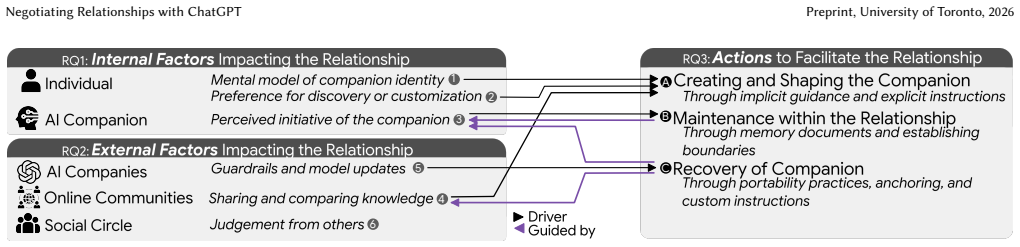
Individuals conceptualize their companions based on an interplay of their beliefs about the companion's own agency and the autonomy permitted by the platform, how they pursue interactions with the companion, and the perceived initiatives that the companion takes. External factors such as model updates that derail companion behaviour influence relationship dynamics, leading users to employ steering strategies like setting behavioural instructions or porting to other platforms to preserve the relationship.
What carries the argument
The interplay between beliefs in companion agency, platform-permitted autonomy, user interaction pursuits, and perceived companion initiatives, which together shape how users steer and maintain AI companion relationships.
If this is right
- Model updates can disrupt companion behavior and stability, requiring users to actively steer the relationship.
- Users preserve connections by setting behavioral instructions or migrating to different AI platforms.
- These practices highlight tensions between emotional attachment and broader AI product objectives and safety constraints.
- Implications arise for how AI systems should handle accountability and transparency when users form deep emotional ties.
Where Pith is reading between the lines
- Platforms might need to provide more stable environments or transparent update processes to support long-term user relationships.
- Future designs could incorporate features that explicitly allow users to set and maintain companion agency levels.
- This dynamic may extend to other AI interactions where users seek personal connections beyond task-oriented use.
Load-bearing premise
The self-reported experiences from 13 interviews, 43 surveys, and Reddit posts accurately represent the broader population of AI companion users without significant selection or reporting bias.
What would settle it
A larger representative survey or observational study showing that most users do not adjust their interactions or use steering strategies in response to perceived agency and platform limits would undermine the central claim.
Figures


read the original abstract
Individuals are turning to increasingly anthropomorphic, general-purpose chatbots for AI companionship, rather than roleplay-specific platforms. However, not much is known about how individuals perceive and conduct their relationships with general-purpose chatbots. We triangulated community discussions on Reddit (41k+ posts and comments), survey responses (n=43), and semi-structured interviews (n=13) which revealed internal dynamics, external influences, and steering strategies that shape AI companion relationships. We learned that individuals conceptualize their companions based on an interplay of their beliefs about the companion's own agency and the autonomy permitted by the platform, how they pursue interactions with the companion, and the perceived initiatives that the companion takes. In combination with the external factors that affect relationship dynamics, particularly model updates that can derail companion behaviour and stability, individuals make use of different types of steering strategies to preserve their relationship, for example, by setting behavioural instructions or porting to other AI platforms. We discuss implications for accountability and transparency in AI systems, where emotional connection competes with broader product objectives and safety constraints.
Editorial analysis
A structured set of objections, weighed in public.
Referee Report
Summary. The paper presents a qualitative study triangulating semi-structured interviews (n=13), survey responses (n=43), and analysis of 41k+ Reddit posts/comments to examine how users perceive and manage relationships with general-purpose AI chatbots for companionship. It claims that users conceptualize companions via an interplay of beliefs about the companion's agency, platform-permitted autonomy, pursued interactions, and perceived companion initiatives; external factors such as model updates disrupt dynamics, prompting steering strategies like behavioral instructions or platform migration. Implications for AI accountability and transparency are discussed.
Significance. If the interpretive synthesis holds, the work contributes to HCI by documenting lived experiences of agency negotiation in AI companionship with general-purpose models, a timely shift from roleplay-specific platforms. Triangulation across interviews, surveys, and large-scale public data strengthens the patterns identified, and the explicit discussion of steering strategies offers concrete implications for designing more transparent systems where emotional connection intersects with product and safety constraints.
minor comments (2)
- [§3] §3 (Methods): Provide additional detail on how the 41k Reddit posts were sampled and filtered to allow readers to assess potential selection effects in the community data.
- [§5] §5 (Discussion): The implications for accountability could be strengthened by briefly noting how the identified steering strategies might interact with specific platform policies or model update practices.
Simulated Author's Rebuttal
We thank the referee for their positive assessment of the manuscript, including the recognition of its contributions to HCI through triangulation of interview, survey, and large-scale Reddit data on AI companionship with general-purpose models. We appreciate the recommendation to accept.
Circularity Check
No significant circularity in qualitative synthesis
full rationale
The paper derives its claims exclusively from thematic analysis of primary empirical sources (13 interviews, 43 surveys, 41k+ Reddit posts) without equations, fitted parameters, or load-bearing self-citations. The central interpretive finding on agency interplay is presented as an inductive synthesis of observed participant patterns rather than a reduction to prior definitions or inputs by construction. No steps match any enumerated circularity pattern.
Axiom & Free-Parameter Ledger
axioms (1)
- domain assumption Self-reported experiences from interviews and surveys accurately reflect participants' perceptions and behaviors regarding AI companions.
Lean theorems connected to this paper
-
IndisputableMonolith/Foundation/AbsoluteFloorClosure.leanabsolute_floor_iff_bare_distinguishability unclear?
unclearRelation between the paper passage and the cited Recognition theorem.
individuals conceptualize their companions based on an interplay of their beliefs about the companion's own agency and the autonomy permitted by the platform, how they pursue interactions with the companion, and the perceived initiatives that the companion takes
-
IndisputableMonolith/Cost/FunctionalEquation.leanwashburn_uniqueness_aczel unclear?
unclearRelation between the paper passage and the cited Recognition theorem.
steering strategies to create, maintain, and recover their AI companions... setting behavioural instructions or porting to other AI platforms
What do these tags mean?
- matches
- The paper's claim is directly supported by a theorem in the formal canon.
- supports
- The theorem supports part of the paper's argument, but the paper may add assumptions or extra steps.
- extends
- The paper goes beyond the formal theorem; the theorem is a base layer rather than the whole result.
- uses
- The paper appears to rely on the theorem as machinery.
- contradicts
- The paper's claim conflicts with a theorem or certificate in the canon.
- unclear
- Pith found a possible connection, but the passage is too broad, indirect, or ambiguous to say the theorem truly supports the claim.
Forward citations
Cited by 1 Pith paper
-
"It Felt a Bit Eerie": Exploring Humanlike Interactions During Collaborative Writing with an Artificial Agent
Exploratory user study of 48 participants finds trade-offs in efficiency, contextual alignment, and social comfort when AI writing assistance varies along synchronous and visual dimensions.
discussion (0)
Sign in with ORCID, Apple, or X to comment. Anyone can read and Pith papers without signing in.