Recognition: 2 theorem links
· Lean TheoremMemento: Towards Proactive Visualization of Everyday Memories with Personal Wearable AR Assistant
Pith reviewed 2026-05-16 10:46 UTC · model grok-4.3
The pith
Memento stores spoken queries with their time, place and activity contexts so an AR assistant can proactively recall and visualize them during matching daily situations.
A machine-rendered reading of the paper's core claim, the machinery that carries it, and where it could break.
Core claim
Memento permanently captures and memorizes user's verbal queries alongside their spatiotemporal and activity contexts. By storing these memories, it discovers connections between recurring interests and the contexts that trigger them. Upon detection of similar contexts, Memento proactively recalls user interests and delivers up-to-date responses through AR, creating connected long-term interactions tailored to the user's multimodal context instead of treating each query as a one-off event.
What carries the argument
Persistent memory storage that links each verbal query to its spatiotemporal and activity context, enabling context-triggered proactive AR recall.
If this is right
- AR assistance shifts from reactive commands to persistent, context-driven support across days or weeks.
- Daily routines gain seamless integration of personalized information without explicit user requests.
- Design trade-offs emerge around accuracy, timing, and intrusiveness of proactive visualizations.
- Long-term memory augmentation becomes possible by accumulating and reusing personal query history.
Where Pith is reading between the lines
- The same memory-linking approach could extend to non-verbal cues such as eye gaze or body posture to trigger recall.
- Privacy and data-retention rules would need explicit handling because the system continuously logs personal contexts.
- Over time, the accumulated memories might support trend analysis or personal knowledge graphs beyond immediate AR delivery.
Load-bearing premise
Recurring user interests are reliably triggered by detectable spatiotemporal and activity contexts, and proactive AR recall will feel helpful rather than intrusive or inaccurate.
What would settle it
A field deployment in which users report that Memento frequently surfaces irrelevant or outdated information during routine activities, or that the proactive overlays interrupt their tasks more than they help.
Figures


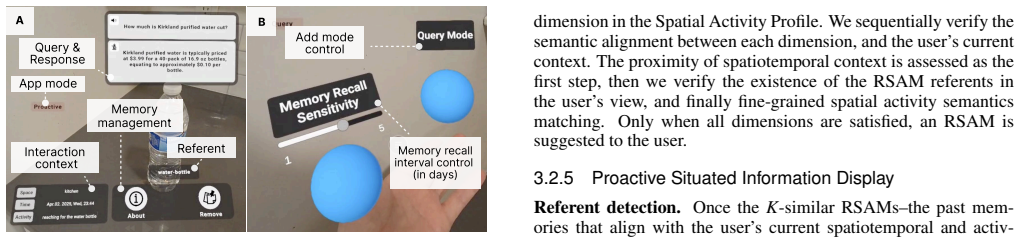

read the original abstract
We introduce Memento, a conversational AR assistant that permanently captures and memorizes user's verbal queries alongside their spatiotemporal and activity contexts. By storing these "memories," Memento discovers connections between users' recurring interests and the contexts that trigger them. Upon detection of similar or identical spatiotemporal activity, Memento proactively recalls user interests and delivers up-to-date responses through AR, seamlessly integrating AR experience into their daily routine. Unlike prior work, each interaction in Memento is not a transient event, but a connected series of interactions with coherent long--term perspective, tailored to the user's broader multimodal (visual, spatial, temporal, and embodied) context. We conduct a preliminary evaluation through user feedbacks with participants of diverse expertise in immersive apps, and explore the value of proactive context-aware AR assistant in everyday settings. We share our findings and challenges in designing a proactive, context-aware AR system.
Editorial analysis
A structured set of objections, weighed in public.
Referee Report
Summary. The paper introduces Memento, a conversational wearable AR assistant that permanently stores user verbal queries together with their spatiotemporal and activity contexts. It claims to discover connections between recurring interests and triggering contexts, then proactively recall and deliver updated responses via AR upon detecting matching contexts. This is positioned as creating coherent long-term interaction series (unlike prior transient systems) that are tailored to the user's multimodal context; support comes from a preliminary user feedback study with participants of diverse immersive-app expertise.
Significance. If the context-matching and proactive-recall components can be shown to operate with acceptable precision and without excessive intrusiveness, the work would offer a concrete step toward persistent, memory-augmented AR assistants that integrate into everyday routines. The emphasis on multimodal (visual, spatial, temporal, embodied) context and the explicit contrast with transient prior systems are potentially valuable contributions, though the current preliminary feedback provides only weak grounding for these advantages.
major comments (3)
- [Evaluation] Evaluation section: the preliminary user feedback study is described only at a high level; no participant count, study duration, data-collection protocol, or quantitative metrics (e.g., context-matching precision, recall accuracy, or Likert-scale ratings of helpfulness vs. intrusiveness) are reported. Without these, the support for the central claim of discovering connections and delivering proactive value remains unverifiable.
- [Abstract / Introduction] Abstract and §1: the assertion that 'each interaction in Memento is not a transient event, but a connected series of interactions with coherent long-term perspective' is presented as a distinguishing feature, yet no longitudinal data, false-positive rates for context matching, or evidence of sustained user perception of coherence are supplied.
- [System Overview] System description: the assumption that recurring interests are reliably triggered by detectable spatiotemporal/activity contexts (and that proactive AR recall will be experienced as helpful rather than intrusive) is stated without any reported implementation details or validation of the matching algorithm's precision over time.
minor comments (2)
- [Abstract] Abstract contains the typographical string 'long--term' (double dash); standardize to 'long-term'.
- [Figures] Figure captions and system diagrams would benefit from explicit labels indicating which components handle context storage versus proactive retrieval.
Simulated Author's Rebuttal
We thank the referee for the constructive feedback on our preliminary work. We agree that the evaluation description is high-level and that some claims require qualification given the early stage of the research. We will revise the manuscript to address these points and provide additional details where available from the study.
read point-by-point responses
-
Referee: [Evaluation] Evaluation section: the preliminary user feedback study is described only at a high level; no participant count, study duration, data-collection protocol, or quantitative metrics (e.g., context-matching precision, recall accuracy, or Likert-scale ratings of helpfulness vs. intrusiveness) are reported. Without these, the support for the central claim of discovering connections and delivering proactive value remains unverifiable.
Authors: We agree that the Evaluation section requires expansion for verifiability. In the revision we will add the participant count, study duration, data-collection protocol, and available feedback metrics including Likert-scale ratings on helpfulness and intrusiveness. We will also explicitly note that quantitative precision/recall metrics for context matching were not computed in this exploratory study and remain future work. revision: yes
-
Referee: [Abstract / Introduction] Abstract and §1: the assertion that 'each interaction in Memento is not a transient event, but a connected series of interactions with coherent long-term perspective' is presented as a distinguishing feature, yet no longitudinal data, false-positive rates for context matching, or evidence of sustained user perception of coherence are supplied.
Authors: We acknowledge the claim is aspirational. The preliminary feedback indicated positive user perception of connected interactions, but we lack longitudinal data. We will revise the Abstract and §1 to frame the statement as the system's design intent and initial user reactions, while adding an explicit limitations paragraph on the absence of longitudinal evidence and false-positive rates. revision: partial
-
Referee: [System Overview] System description: the assumption that recurring interests are reliably triggered by detectable spatiotemporal/activity contexts (and that proactive AR recall will be experienced as helpful rather than intrusive) is stated without any reported implementation details or validation of the matching algorithm's precision over time.
Authors: We will expand the System Overview with additional implementation specifics on context encoding, storage, and matching logic. We will also report user-study observations on perceived helpfulness versus intrusiveness of proactive recalls to better ground the assumptions, while noting that long-term precision validation is planned for future deployments. revision: yes
- Absence of longitudinal data and quantitative precision metrics for context matching, which would require extended real-world deployment studies beyond the scope of this preliminary evaluation.
Circularity Check
No circularity: system proposal without derivations or self-referential reductions
full rationale
The paper introduces a wearable AR system concept for capturing verbal queries with spatiotemporal/activity contexts and proactively recalling them on matching contexts. It describes the architecture, memory storage, and proactive recall mechanism, then reports preliminary qualitative user feedback. No equations, fitted parameters, predictions, or uniqueness theorems appear. The central claim that interactions form a 'connected series with coherent long-term perspective' is presented as a direct consequence of the described storage-and-recall design rather than derived from any prior result or self-citation chain. The distinction from transient prior work is asserted by construction of the new system, not by circular reduction. This is a standard honest non-finding for a design/proposal paper.
Axiom & Free-Parameter Ledger
axioms (2)
- domain assumption Users exhibit recurring interests that are triggered by repeatable spatiotemporal and activity contexts
- domain assumption Context detection from wearable sensors is sufficiently accurate to identify similar situations reliably
Lean theorems connected to this paper
-
IndisputableMonolith/Cost/FunctionalEquation.leanwashburn_uniqueness_aczel unclear?
unclearRelation between the paper passage and the cited Recognition theorem.
stores queries with spatiotemporal and activity contexts... cosine similarity... R-tree + HNSW... proactive recall on similar contexts
-
IndisputableMonolith/Foundation/AbsoluteFloorClosure.leanabsolute_floor_iff_bare_distinguishability unclear?
unclearRelation between the paper passage and the cited Recognition theorem.
Referent-anchored Spatiotemporal Activity Memory (RSAM)
What do these tags mean?
- matches
- The paper's claim is directly supported by a theorem in the formal canon.
- supports
- The theorem supports part of the paper's argument, but the paper may add assumptions or extra steps.
- extends
- The paper goes beyond the formal theorem; the theorem is a base layer rather than the whole result.
- uses
- The paper appears to rely on the theorem as machinery.
- contradicts
- The paper's claim conflicts with a theorem or certificate in the canon.
- unclear
- Pith found a possible connection, but the passage is too broad, indirect, or ambiguous to say the theorem truly supports the claim.
Forward citations
Cited by 2 Pith papers
-
VisionClaw: Always-On AI Agents through Smart Glasses
VisionClaw couples continuous egocentric vision on smart glasses with speech-driven AI agents to enable hands-free real-world tasks, with lab and field studies showing faster completion and a shift toward opportunisti...
-
Exploring Experiential Differences Between Virtual and Physical Memory-Linked Objects in Extended Reality
A study of 24 users finds that physical and virtual memory-linked objects in XR support stronger social connection and engagement than conventional gallery interfaces for sharing personal memories.
Reference graph
Works this paper leans on
-
[1]
M. B. Almourad, M. Hussein, E. Bataineh, and Z. Wattar. Explor- ing smartphone usage dynamics: Unveiling app-specific patterns and trends.IJWI, 22(2), 2024. 2
work page 2024
-
[2]
S. Andolina, V . Orso, H. Schneider, K. Klouche, T. Ruotsalo, L. Gam- berini, and G. Jacucci. Searchbot: Supporting voice conversations with proactive search. InProc. of ACM CSCW, pp. 9–12, 2018. 3
work page 2018
-
[3]
R. Arakawa, J. F. Lehman, and M. Goel. Prism-q&a: Step-aware voice assistant on a smartwatch enabled by multimodal procedure tracking and large language models. InProc. ACM IMWUT, vol. 8, pp. 1–26,
-
[4]
A. Asai, S. Min, Z. Zhong, and D. Chen. Retrieval-based language models and applications. InProc. of ACL, pp. 41–46, 2023. 2
work page 2023
-
[5]
R. T. Azuma. The road to ubiquitous consumer augmented reality systems.HBET, 1(1):26–32, 2019. 2, 3, 6
work page 2019
-
[6]
Barfield.Fundamentals of wearable computers and augmented reality
W. Barfield.Fundamentals of wearable computers and augmented reality. CRC Press, 2015. 2
work page 2015
- [7]
- [8]
- [9]
-
[10]
W. Chen, H. Hu, X. Chen, P. Verga, and W. Cohen. Murag: Mul- timodal retrieval-augmented generator for open question answering over images and text. InProc. of EMNLP, pp. 5558–5570, 2022. 2
work page 2022
- [11]
-
[12]
K. Choe, C. Lee, S. Lee, J. Song, A. Cho, N. W. Kim, and J. Seo. Enhancing data literacy on-demand: LLMs as guides for novices in chart interpretation.IEEE TVCG, 2024. 2
work page 2024
-
[13]
W. Cui, X. Zhang, Y . Wang, H. Huang, B. Chen, L. Fang, H. Zhang, J. Lou, and D. Zhang. Text-to-Viz: automatic generation of infograph- ics from proportion-related natural language statements.IEEE TVCG, 26(1):906–916, 2020. 2
work page 2020
-
[14]
F. De La Torre, C. M. Fang, H. Huang, A. Banburski-Fahey, J. Amores Fernandez, and J. Lanier. Llmr: Real-time prompting of interactive worlds using large language models. InProc. of CHI, pp. 1–22, 2024. 2
work page 2024
-
[15]
T. Deng, S. Kanthawala, J. Meng, W. Peng, A. Kononova, Q. Hao, Q. Zhang, and P. David. Measuring smartphone usage and task switch- ing with log tracking and self-reports.MMC, 7(1):3–23, 2019. 2
work page 2019
-
[16]
M. D. Dogan, E. J. Gonzalez, K. Ahuja, R. Du, A. Colac ¸o, J. Lee, M. Gonzalez-Franco, and D. Kim. Augmented object intelligence with XR-Objects. InProc. of ACM UIST, pp. 1–15, 2024. 1, 2
work page 2024
-
[17]
D. Edge, H. Trinh, N. Cheng, J. Bradley, A. Chao, A. Mody, S. Truitt, and J. Larson. From local to global: A graph rag approach to query- focused summarization.arXiv:2404.16130, 2024. 6
work page internal anchor Pith review Pith/arXiv arXiv 2024
- [18]
- [19]
- [20]
-
[21]
Programmable search engine.https://developers
Google. Programmable search engine.https://developers. google.com/custom-search/v1/overview, 2025. Mar. 23. 2025. 3
work page 2025
-
[22]
J. Grubert, T. Langlotz, S. Zollmann, and H. Regenbrecht. Towards pervasive augmented reality: Context-awareness in augmented reality. IEEE TVCG, 23(6):1706–1724, 2016. 3
work page 2016
-
[23]
A. Guttman. R-trees: a dynamic index structure for spatial searching. ACM SIGMOD, 14(2):47–57, 1984. 4
work page 1984
- [24]
- [25]
-
[26]
Y . Huang, J. Xu, B. Pei, Y . He, G. Chen, L. Yang, X. Chen, Y . Wang, Z. Nie, J. Liu, G. Fan, D. Lin, F. Fang, K. Li, C. Yuan, Y . Wang, Y . Qiao, and L. Wang. Vinci: A real-time embodied smart assistant based on egocentric vision-language model.arXiv:2412.21080, 2024. 1, 2
-
[27]
What is IFTTT.https://ifttt.com/explore/new_to_ ifttt, 2025
IFTTT. What is IFTTT.https://ifttt.com/explore/new_to_ ifttt, 2025. Apr. 4. 2025. 6
work page 2025
-
[28]
S. Kashmira, J. L. Dantanarayana, J. Brodsky, A. Mahendra, Y . Kang, K. Flautner, L. Tang, and J. Mars. A graph-based approach for con- versational ai-driven personal memory capture and retrieval in a real- world application.arXiv:2412.05447, 2024. 2
- [29]
-
[30]
O. Khan, Z. Ahmed, H. Nam, and K. Kim. Tangiblemoments: Em- bedding XR memories onto physical objects. InProc. of IEEE VRW, pp. 1147–1153, 2025. 2
work page 2025
- [31]
-
[32]
Y . Kim, Z. Aamir, M. Singh, S. Boorboor, K. Mueller, and A. E. Kaufman. Explainable XR: understanding user behaviors of XR en- vironments using LLM-assisted analytics framework.IEEE TVCG, 31(5):1–11, 2025. 2
work page 2025
-
[33]
Y . Kim, S. Boorboor, A. Rahmati, and A. Kaufman. Design of privacy preservation system in augmented reality. InProc. of IEEE VizSec,
-
[34]
Y . Kim, S. Goutam, A. Rahmati, and A. Kaufman. Erebus: Access control for augmented reality systems. InProc. of USENIX Security, pp. 929–946, 2023. 6
work page 2023
-
[35]
N. Koutroumanis and C. Doulkeridis. Scalable spatio-temporal index- ing and querying over a document-oriented nosql store. InProc. of EDBT, pp. 611–622, 2021. 2
work page 2021
-
[36]
B. Lee, M. Sedlmair, and D. Schmalstieg. Design patterns for situated visualization in augmented reality.IEEE TVCG, 30(1):1324–1335,
-
[37]
G. Lee, M. Xia, N. Numan, X. Qian, D. Li, Y . Chen, A. Kulshrestha, I. Chatterjee, Y . Zhang, D. Manocha, et al. Sensible agent: A frame- work for unobtrusive interaction with proactive ar agents. InProc. of ACM UIST, pp. 1–22, 2025. 2
work page 2025
-
[38]
J. Lee, J. Wang, E. Brown, L. Chu, S. S. Rodriguez, and J. E. Froehlich. GazePointAR: a context-aware multimodal voice assistant for pronoun disambiguation in wearable augmented reality. InProc. of ACM CHI, pp. 1–20, 2024. 1, 2, 3
work page 2024
-
[39]
J. Lee, T. Wang, J. Fashimpaur, N. Sendhilnathan, and T. R. Jonker. Walkie-talkie: Exploring longitudinal natural gaze, llms, and vlms for query disambiguation in xr. InProc. of ACM CHI EA, pp. 1–9, 2025. 6
work page 2025
- [40]
-
[41]
C. Li, G. Wu, G. Y .-Y . Chan, D. G. Turakhia, S. Castelo Quispe, D. Li, L. Welch, C. Silva, and J. Qian. Satori: Towards proactive ar assistant with belief-desire-intention user modeling. InProc. of ACM CHI, pp. 1–24, 2025. 2
work page 2025
-
[42]
J. N. Li, Y . Xu, T. Grossman, S. Santosa, and M. Li. OmniActions: predicting digital actions in response to real-world multimodal sen- sory inputs with LLMs. InProc. of ACM CHI, pp. 1–22, 2024. 1, 2 7
work page 2024
-
[43]
J. N. Li, Z. J. Zhang, and J. Ma. Omniquery: Contextually augmenting captured multimodal memory to enable personal question answering. InProc. of ACM CHI, 2025. 1
work page 2025
-
[44]
J. Liu, K. A. Satriadi, B. Ens, and T. Dwyer. Investigating the effects of physical landmarks on spatial memory for information visualisation in augmented reality. InProc. of IEEE ISMAR, pp. 289–298, 2024. 2
work page 2024
-
[45]
S. Liu, J. Xu, W. Tjangnaka, S. Semnani, C. Yu, and M. Lam. Suql: Conversational search over structured and unstructured data with large language models. InProc. of NAACL, pp. 4535–4555, 2024. 2
work page 2024
-
[46]
S. Liu, Z. Zeng, T. Ren, F. Li, H. Zhang, J. Yang, Q. Jiang, C. Li, J. Yang, H. Su, et al. Grounding dino: Marrying dino with grounded pre-training for open-set object detection. InProc. of ECCV, pp. 38– 55, 2024. 3
work page 2024
-
[47]
X. B. Liu, S. Fang, W. Shi, C.-S. Wu, T. Igarashi, and X. Chen. Proac- tive conversational agents with inner thoughts. InProc. of ACM CHI,
-
[48]
X. B. Liu, V . Kirilyuk, X. Yuan, A. Olwal, P. Chi, X. A. Chen, and R. Du. Visual captions: augmenting verbal communication with on- the-fly visuals. InProc. of ACM CHI, pp. 1–20, 2023. 3, 4
work page 2023
- [49]
-
[50]
F. Lu, L. Pavanatto, and D. A. Bowman. In-the-wild experiences with an interactive glanceable ar system for everyday use. InProc. of ACM SUI, pp. 1–9, 2023. 6
work page 2023
- [51]
-
[52]
Y . A. Malkov and D. A. Yashunin. Efficient and robust approxi- mate nearest neighbor search using hierarchical navigable small world graphs.IEEE TPAMI, 42(4):824–836, 2018. 4
work page 2018
-
[53]
R. E. Mayer. Multimedia learning. InPsychology of learning and motivation, vol. 41, pp. 85–139. Elsevier, 2002. 6
work page 2002
-
[54]
C. Meurisch, C. A. Mihale-Wilson, A. Hawlitschek, F. Giger, F. M¨uller, O. Hinz, and M. M ¨uhlh¨auser. Exploring user expectations of proactive ai systems.Proc. of ACM IMWUT, 4(4):1–22, 2020. 3, 4
work page 2020
-
[55]
Head-gaze and dwell.https://learn
Microsoft. Head-gaze and dwell.https://learn. microsoft.com/en-us/windows/mixed-reality/design/ gaze-and-dwell-head. Mar. 23. 2025. 4
work page 2025
- [56]
-
[57]
L. Ning, L. Liu, J. Wu, N. Wu, D. Berlowitz, S. Prakash, B. Green, S. O’Banion, and J. Xie. User-llm: Efficient llm contextualization with user embeddings. InProc. of ACM WWW, pp. 1219–1223, 2025. 6
work page 2025
-
[58]
OpenAI. OpenAI. Gpt-4v(ision) system card.https://cdn. openai.com/papers/GPTV_System_Card.pdf. Mar. 28. 2024]. 3
work page 2024
-
[59]
B. P ¨atzold, J. Nogga, and S. Behnke. Leveraging vision-language models for open-vocabulary instance segmentation and tracking. arXiv:2503.16538, 2025. 5
-
[60]
Z. Peng, W. Wang, L. Dong, Y . Hao, S. Huang, S. Ma, and F. Wei. Kosmos-2: Grounding multimodal large language models to the world.arXiv preprint arXiv:2306.14824, 2023. 3
work page internal anchor Pith review Pith/arXiv arXiv 2023
-
[61]
J. Qi, G. Liu, C. S. Jensen, and L. Kulik. Effectively learning spatial indices.Proc. VLDB Endow., 13(12):2341–2354, 2020. 2
work page 2020
-
[62]
L. Qiu, E. S. Kim, S. Suh, L. Sidenmark, and T. Grossman. Margina- lia: Enabling in-person lecture capturing and note-taking through mixed reality. InProc. of ACM CHI, 2025. 2
work page 2025
-
[63]
A. Radford, J. W. Kim, C. Hallacy, A. Ramesh, G. Goh, S. Agarwal, G. Sastry, A. Askell, P. Mishkin, J. Clark, et al. Learning transferable visual models from natural language supervision. InProc. of ICML, pp. 8748–8763, 2021. 3
work page 2021
-
[64]
S. Rajaram, M. Peralta, J. G. Johnson, and M. Nebeling. Exploring the design space of privacy-driven adaptation techniques for future augmented reality interfaces. InProc of ACM CHI, pp. 1–19, 2025. 6
work page 2025
-
[65]
S. Rajaram, F. Roesner, and M. Nebeling. Reframe: An augmented reality storyboarding tool for character-driven analysis of security & privacy concerns. InProc. of ACM UIST, pp. 1–15, 2023. 6
work page 2023
-
[66]
I. H. Sarker and K. Salah. Appspred: Predicting context-aware smart- phone apps using random forest learning.IoT, 8:100106, 2019. 2
work page 2019
-
[67]
K. A. Satriadi, A. Cunningham, R. T. Smith, T. Dwyer, A. Dro- gemuller, and B. H. Thomas. Proxsituated visualization: An extended model of situated visualization using proxies for physical referents. In Proc. of ACM CHI, pp. 1–20, 2023. 2
work page 2023
- [68]
-
[69]
M. Shakeri, H. Park, I. Jeon, A. Sadeghi-Niaraki, and W. Woo. User behavior modeling for ar personalized recommendations in spatial transitions.VR, 27(4):3033–3050, 2023. 6
work page 2023
-
[70]
J. Shen, J. J. Dudley, and P. O. Kristensson. Encode-store-retrieve: Augmenting human memory through language-encoded egocentric perception. InProc. of IEEE ISMAR, pp. 923–931, 2024. 1, 2
work page 2024
-
[71]
L. Shen, H. Li, Y . Wang, and H. Qu. From data to story: Towards automatic animated data video creation with LLM-based multi-agent systems.IEEE TVCG, 2024. 2
work page 2024
-
[72]
F. A. Silva, A. C. Domingues, and T. R. B. Silva. Discovering mobile application usage patterns from a large-scale dataset.ACM TKDD, 12(5):1–36, 2018. 2
work page 2018
-
[73]
R. Tian, H. Zhai, W. Zhang, F. Wang, and Y . Guan. A survey of spatio- temporal big data indexing methods in distributed environment.IEEE J-STARS, 15:4132–4155, 2022. 2
work page 2022
-
[74]
T. T. M. Tran, S. Brown, O. Weidlich, S. Yoo, and C. Parker. Wear- able ar in everyday contexts: Insights from a digital ethnography of youtube videos. InProc. of ACM CHI, 2025. 2
work page 2025
-
[75]
M. Urban and C. Binnig. Caesura: Language models as multi-modal query planners. InProc. of CIDR, 2024. 2
work page 2024
- [76]
- [77]
-
[78]
Xreal.https://www.xreal.com, 2025
XREAL. Xreal.https://www.xreal.com, 2025. Jul. 16. 2025. 6
work page 2025
-
[79]
J. Yang, S. Liu, H. Guo, Y . Dong, X. Zhang, S. Zhang, P. Wang, Z. Zhou, B. Xie, Z. Wang, B. Ouyang, Z. Lin, M. Cominelli, Z. Cai, Y . Zhang, P. Zhang, F. Hong, J. Widmer, F. Gringoli, L. Yang, B. Li, and Z. Liu. Egolife: Towards egocentric life assistant. InProc. of IEEE/CVF CVPR, 2025. 1, 3, 6
work page 2025
-
[80]
W. D. Zulfikar, S. Chan, and P. Maes. Memoro: Using large language models to realize a concise interface for real-time memory augmenta- tion. InProc. of ACM CHI, pp. 1–18, 2024. 1, 2, 3 8
work page 2024
discussion (0)
Sign in with ORCID, Apple, or X to comment. Anyone can read and Pith papers without signing in.