Recognition: 2 theorem links
· Lean TheoremVideoGPA: Distilling Geometry Priors for 3D-Consistent Video Generation
Pith reviewed 2026-05-16 09:15 UTC · model grok-4.3
The pith
Video diffusion models gain 3D consistency by distilling preference signals from a geometry foundation model.
A machine-rendered reading of the paper's core claim, the machinery that carries it, and where it could break.
Core claim
VideoGPA is a self-supervised framework that extracts dense preference signals from a geometry foundation model and uses them to align video diffusion models via direct preference optimization, steering the generative distribution toward inherent 3D consistency without human annotations.
What carries the argument
VideoGPA framework that converts geometry foundation model outputs into dense preference pairs for direct preference optimization on video diffusion models.
If this is right
- Generated videos exhibit measurably higher temporal stability and geometric plausibility.
- The alignment succeeds with only a small number of automatically derived preference pairs.
- Performance exceeds current state-of-the-art video diffusion baselines across standard benchmarks.
- 3D-consistent video generation becomes feasible in a data-efficient regime that avoids human annotation.
Where Pith is reading between the lines
- The same preference-distillation pattern could be applied to other consistency problems such as lighting or physics by swapping the foundation model.
- Longer video sequences might benefit if the geometry signals remain reliable across extended time horizons.
- Combining VideoGPA with existing scale-based training could further reduce reliance on purely supervised or human-feedback pipelines.
Load-bearing premise
The geometry foundation model supplies accurate dense preference signals that improve 3D consistency without injecting its own errors or biases.
What would settle it
Generate videos with and without VideoGPA on scenes known to produce deformation; if the aligned model still shows comparable object warping or spatial drift under quantitative 3D-consistency metrics, the claim is falsified.
Figures



read the original abstract
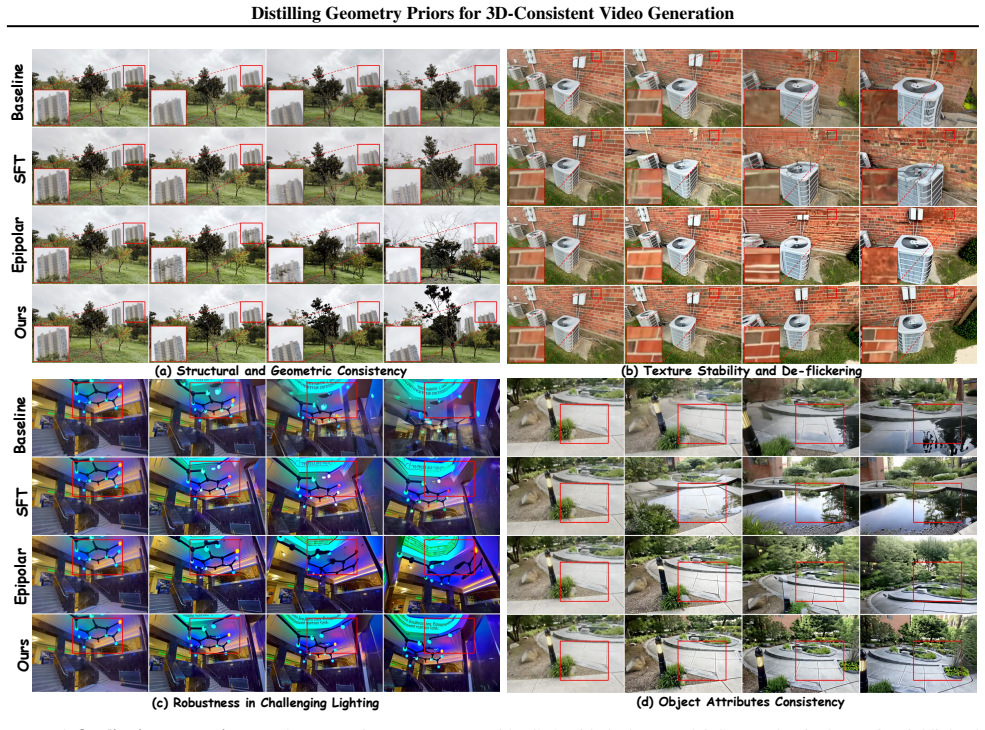
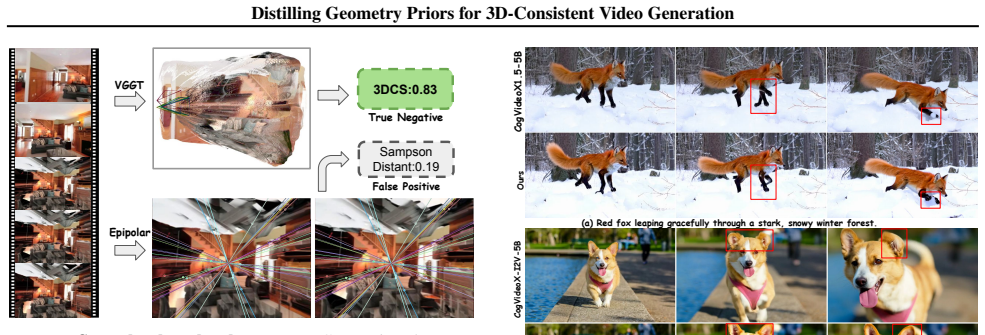
While recent video diffusion models (VDMs) produce visually impressive results, they fundamentally struggle to maintain 3D structural consistency, often resulting in object deformation or spatial drift. We hypothesize that these failures arise because standard denoising objectives lack explicit incentives for geometric coherence. To address this, we introduce VideoGPA (Video Geometric Preference Alignment), a data-efficient self-supervised framework that leverages a geometry foundation model to automatically derive dense preference signals that guide VDMs via Direct Preference Optimization (DPO). This approach effectively steers the generative distribution toward inherent 3D consistency without requiring human annotations. VideoGPA significantly enhances temporal stability, geometric plausibility, and motion coherence using minimal preference pairs, consistently outperforming state-of-the-art baselines in extensive experiments.
Editorial analysis
A structured set of objections, weighed in public.
Referee Report
Summary. The manuscript introduces VideoGPA, a self-supervised framework that uses a geometry foundation model to automatically derive dense preference signals (e.g., for depth or normals) which then guide a video diffusion model via Direct Preference Optimization (DPO) to enforce 3D consistency, temporal stability, and motion coherence without human annotations. It claims this yields significant improvements over state-of-the-art baselines in extensive experiments.
Significance. If the central claims hold, the work would demonstrate a data-efficient route to injecting geometric priors into generative video models by distilling signals from existing foundation models, addressing a persistent failure mode in video diffusion without requiring paired data or manual preference collection.
major comments (2)
- Abstract: the claim that VideoGPA 'consistently outperforming state-of-the-art baselines in extensive experiments' is asserted without any metrics, baseline names, dataset details, or quantitative results, rendering the central empirical claim impossible to evaluate from the provided text.
- Abstract: the method's effectiveness rests on the unverified assumption that the geometry foundation model produces reliable dense preference signals; no procedure for signal extraction, accuracy validation, or error mitigation (e.g., on occlusions or complex motion) is described, which directly bears on whether DPO steers toward improved rather than degraded 3D consistency.
Simulated Author's Rebuttal
We thank the referee for the constructive comments on the abstract. We agree that greater specificity is needed to support the central claims and have prepared revisions to address both points directly.
read point-by-point responses
-
Referee: Abstract: the claim that VideoGPA 'consistently outperforming state-of-the-art baselines in extensive experiments' is asserted without any metrics, baseline names, dataset details, or quantitative results, rendering the central empirical claim impossible to evaluate from the provided text.
Authors: We agree that the abstract would be stronger with concrete supporting details. In the revised manuscript we will update the abstract to include key quantitative results (e.g., specific gains in 3D-consistency and temporal metrics), the main baseline names, and the primary evaluation datasets. The full paper already contains these results in the experiments section; the abstract revision will make the claim directly evaluable. revision: yes
-
Referee: Abstract: the method's effectiveness rests on the unverified assumption that the geometry foundation model produces reliable dense preference signals; no procedure for signal extraction, accuracy validation, or error mitigation (e.g., on occlusions or complex motion) is described, which directly bears on whether DPO steers toward improved rather than degraded 3D consistency.
Authors: We acknowledge that the abstract, being a concise summary, does not describe the signal-extraction procedure or validation steps. The full manuscript details these aspects in the methods section, including how preference signals are derived from the geometry foundation model and how reliability is ensured. We will revise the abstract to add a brief clause noting that the signals undergo reliability validation, thereby clarifying that DPO is guided by verified rather than unverified preferences. revision: yes
Circularity Check
No circularity detected in derivation chain
full rationale
The abstract introduces VideoGPA as a framework that applies an external geometry foundation model to generate dense preference signals, then uses standard Direct Preference Optimization (DPO) to steer a video diffusion model. No equations, parameter fits, self-citations, or derivations are present that reduce any claimed result to its own inputs by construction. The approach is described as relying on independent external components and conventional optimization, with performance claims tied to experiments rather than self-referential logic.
Axiom & Free-Parameter Ledger
Lean theorems connected to this paper
-
IndisputableMonolith/Foundation/AlexanderDuality.leanalexander_duality_circle_linking unclear?
unclearRelation between the paper passage and the cited Recognition theorem.
We measure 3D geometric consistency by how well the recovered structure explains the original frames under reprojection... ERecon = 1/T sum (MSE + LPIPS)
-
IndisputableMonolith/Cost/FunctionalEquation.leanwashburn_uniqueness_aczel unclear?
unclearRelation between the paper passage and the cited Recognition theorem.
leverages a geometry foundation model to automatically derive dense preference signals that guide VDMs via Direct Preference Optimization (DPO)
What do these tags mean?
- matches
- The paper's claim is directly supported by a theorem in the formal canon.
- supports
- The theorem supports part of the paper's argument, but the paper may add assumptions or extra steps.
- extends
- The paper goes beyond the formal theorem; the theorem is a base layer rather than the whole result.
- uses
- The paper appears to rely on the theorem as machinery.
- contradicts
- The paper's claim conflicts with a theorem or certificate in the canon.
- unclear
- Pith found a possible connection, but the passage is too broad, indirect, or ambiguous to say the theorem truly supports the claim.
Forward citations
Cited by 2 Pith papers
-
CreFlow: Corrective Reflow for Sparse-Reward Embodied Video Diffusion RL
CreFlow combines LTL compositional rewards with credit-aware NFT and corrective reflow losses in online RL to improve embodied video diffusion models, raising downstream task success by 23.8 percentage points on eight...
-
Geometric 4D Stitching for Grounded 4D Generation
Geometric 4D Stitching explicitly complements missing geometric regions in 4D generated scenes with grounded stitches to achieve consistent 4D representations in under 10 minutes on a single GPU.
Reference graph
Works this paper leans on
-
[1]
Genie: Generative interactive environments, 2024a
Bruce, J., Dennis, M., Edwards, A., Parker-Holder, J., Shi, Y ., Hughes, E., Lai, M., Mavalankar, A., Steigerwald, R., Apps, C., Aytar, Y ., Bechtle, S., Behbahani, F., Chan, S., Heess, N., Gonzalez, L., Osindero, S., Ozair, S., Reed, S., Zhang, J., Zolna, K., Clune, J., de Freitas, N., Singh, S., and Rockt ¨aschel, T. Genie: Generative interactive enviro...
-
[2]
Feng, Y ., Tan, H., Mao, X., Xiang, C., Liu, G., Huang, S., Su, H., and Zhu, J
URL https: //arxiv.org/abs/2601.15282. Feng, Y ., Tan, H., Mao, X., Xiang, C., Liu, G., Huang, S., Su, H., and Zhu, J. Vidar: Embodied video diffusion model for generalist manipulation,
-
[3]
Vidar: Embodied Video Diffusion Model for Generalist Manipulation
URL https: //arxiv.org/abs/2507.12898. Gillman, N., Herrmann, C., Freeman, M., Aggarwal, D., Luo, E., Sun, D., and Sun, C. Force prompting: Video generation models can learn and generalize physics-based control signals. InProceedings of the Annual Conference on Neural Information Processing Systems (NeurIPS),
work page internal anchor Pith review arXiv
- [4]
-
[5]
Cosmos Policy: Fine-Tuning Video Models for Visuomotor Control and Planning
URL https://arxiv. org/abs/2601.16163. 9 Distilling Geometry Priors for 3D-Consistent Video Generation Kong, W., Tian, Q., Zhang, Z., Min, R., Dai, Z., Zhou, J., Xiong, J., Li, X., Wu, B., Zhang, J., et al. Hunyuanvideo: A systematic framework for large video generative mod- els,
work page internal anchor Pith review Pith/arXiv arXiv
-
[7]
Kwak, J.-g., Dong, E., Jin, Y ., Ko, H., Mahajan, S., and Yi, K
URL https: //arxiv.org/abs/2510.21615. Kwak, J.-g., Dong, E., Jin, Y ., Ko, H., Mahajan, S., and Yi, K. M. Vivid-1-to-3: Novel view synthesis with video diffusion models. InProceedings of the IEEE/CVF Con- ference on Computer Vision and Pattern Recognition (CVPR),
-
[8]
Novaflow: Zero-shot manipulation via actionable flow from generated videos, 2025a
Li, H., Sun, L., Hu, Y ., Ta, D., Barry, J., Konidaris, G., and Fu, J. Novaflow: Zero-shot manipulation via actionable flow from generated videos, 2025a. URL https:// arxiv.org/abs/2510.08568. Li, Z., Wu, X., Du, H., Liu, F., Nghiem, H., and Shi, G. A survey of state of the art large vision language models: Benchmark evaluations and challenges. InProceedi...
-
[9]
Liu, J., Liu, G., Liang, J., Li, Y ., Liu, J., Wang, X., Wan, P., Zhang, D., and Ouyang, W
URL https: //arxiv.org/abs/2406.04338. Liu, J., Liu, G., Liang, J., Li, Y ., Liu, J., Wang, X., Wan, P., Zhang, D., and Ouyang, W. Flow-grpo: Training flow matching models via online rl, 2025a. URL https: //arxiv.org/abs/2505.05470. Liu, J., Liu, G., Liang, J., Yuan, Z., Liu, X., Zheng, M., Wu, X., Wang, Q., Xia, M., Wang, X., Liu, X., Yang, F., Wan, P., ...
-
[10]
Cosmos World Foundation Model Platform for Physical AI
URL https://arxiv.org/abs/ 2501.03575. Oquab, M., Darcet, T., Moutakanni, T., V o, H. V ., Szafraniec, M., Khalidov, V ., Fernandez, P., HAZIZA, D., Massa, F., El-Nouby, A., Assran, M., Ballas, N., Galuba, W., Howes, R., Huang, P.-Y ., Li, S.-W., Misra, I., Rabbat, M., Sharma, V ., Synnaeve, G., Xu, H., Jegou, H., Mairal, J., Labatut, P., Joulin, A., and ...
work page internal anchor Pith review Pith/arXiv arXiv
-
[11]
Score-Based Generative Modeling through Stochastic Differential Equations
URL https://arxiv.org/abs/2011.13456. Sun, W., Chen, S., Liu, F., Chen, Z., Duan, Y ., Zhang, J., and Wang, Y . Dimensionx: Create any 3d and 4d scenes from a single image with controllable video diffusion,
work page internal anchor Pith review Pith/arXiv arXiv 2011
-
[12]
10 Distilling Geometry Priors for 3D-Consistent Video Generation Team Seedance
URLhttps://arxiv.org/abs/2411.04928. 10 Distilling Geometry Priors for 3D-Consistent Video Generation Team Seedance. Seedance 1.5 pro: A native audio-visual joint generation foundation model,
-
[13]
Seedance 1.5 pro: A Native Audio-Visual Joint Generation Foundation Model
URL https: //arxiv.org/abs/2512.13507. Team Wan. Wan: Open and advanced large-scale video gen- erative models,
work page internal anchor Pith review Pith/arXiv arXiv
-
[14]
Wan: Open and Advanced Large-Scale Video Generative Models
URL https://arxiv.org/ abs/2503.20314. V oleti, V ., Yao, C.-H., Boss, M., Letts, A., Pankratz, D., Tochilkin, D., Laforte, C., Rombach, R., and Jampani, V . Sv3d: Novel multi-view synthesis and 3d generation from a single image using latent video diffusion. In Proceedings of the European Conference on Computer Vision (ECCV),
work page internal anchor Pith review Pith/arXiv arXiv
-
[15]
Motionctrl: A unified and flexible motion controller for video generation
Wang, Z., Yuan, Z., Wang, X., Li, Y ., Chen, T., Xia, M., Luo, P., and Shan, Y . Motionctrl: A unified and flexible motion controller for video generation. InACM SIGGRAPH 2024 Conference Papers, 2024b. Xu, L., Xie, H., Qin, S. J., Tao, X., and Wang, F. L. Parameter-efficient fine-tuning methods for pretrained language models: A critical review and assessm...
work page 2024
-
[16]
DanceGRPO: Unleashing GRPO on Visual Generation
URL https://arxiv.org/abs/2505.07818. Yang, S., Du, Y ., Ghasemipour, K., Tompson, J., Kaelbling, L., Schuurmans, D., and Abbeel, P. Learning interactive real-world simulators,
work page internal anchor Pith review Pith/arXiv arXiv
-
[17]
Learning Interactive Real-World Simulators
URL https://arxiv. org/abs/2310.06114. Yang, Z., Teng, J., Zheng, W., Ding, M., Huang, S., Xu, J., Yang, Y ., Hong, W., Zhang, X., Feng, G., Yin, D., Zhang, Y ., Wang, W., Cheng, Y ., Xu, B., Gu, X., Dong, Y ., and Tang, J. Cogvideox: Text-to-video diffusion models with an expert transformer. InProceedings of the International Conference on Learning Repre...
work page internal anchor Pith review Pith/arXiv arXiv
-
[18]
For fair comparison, we adopt the same preference data construction pipeline for Epipolar-DPO (Kupyn et al., 2025), including identical candidate generation and filtering steps. The two methods differ in the geometric signal used to evaluate candidate consistency, with Epipolar-DPO relying on local, pairwise epipolar constraints rather than the proposed s...
work page 2025
-
[19]
To ensure consistency with the main experiments, results from the final 10,000-step model are used for comparison with other methods. As shown in Table 6, the model achieves competitive geometric and perceptual performance as early as 1,000 training steps, with only marginal improvements observed at later checkpoints. Notably, evaluation is conducted usin...
-
[20]
is pre-trained on large-scale 3D datasets and DINO (Caron et al., 2021; Oquab et al.,
work page 2021
discussion (0)
Sign in with ORCID, Apple, or X to comment. Anyone can read and Pith papers without signing in.