Recognition: no theorem link
Graph-Theoretic Analysis of Phase Optimization Complexity in Variational Wave Functions for Heisenberg Antiferromagnets
Pith reviewed 2026-05-16 06:40 UTC · model grok-4.3
The pith
Reconstructing phases for Heisenberg antiferromagnet ground states reduces to weighted Max-Cut on the Hilbert-space graph and is NP-hard.
A machine-rendered reading of the paper's core claim, the machinery that carries it, and where it could break.
Core claim
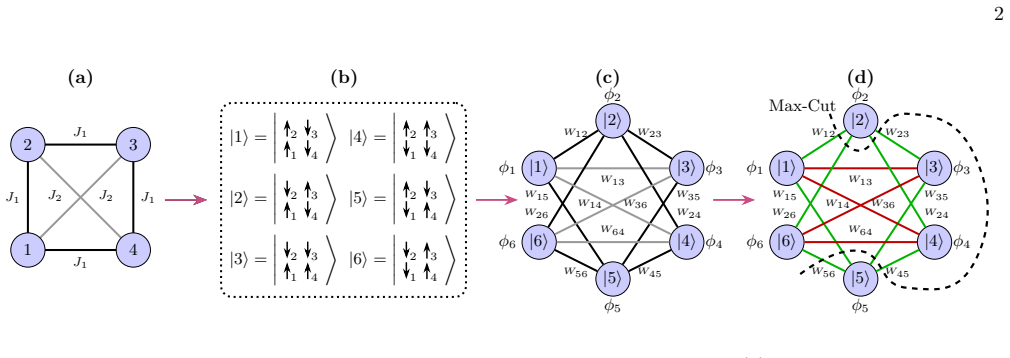
Representing Hilbert space as a weighted graph, the variational energy defines a weighted XY model that, for Z2 phases, reduces to a classical antiferromagnetic Ising model on that graph. For fixed amplitudes, reconstructing the signs of the ground state wavefunction thus reduces to a weighted Max-Cut instance. This establishes that ground state phase reconstruction for Heisenberg antiferromagnets is worst-case NP-hard and links the task to combinatorial optimization.
What carries the argument
The reduction of fixed-amplitude Z2 phase optimization to a weighted Max-Cut instance on the Hilbert-space graph, which carries the NP-hardness proof.
If this is right
- Sign reconstruction for these variational wavefunctions is NP-hard in the worst case.
- The phase optimization task is computationally equivalent to solving a weighted Max-Cut instance.
- Variational energy minimization with fixed amplitudes inherits the hardness of classical combinatorial problems.
- The Z2 phase structure alone is sufficient to produce the hardness result.
Where Pith is reading between the lines
- Heuristic Max-Cut solvers could be directly adapted as practical phase optimizers inside variational Monte Carlo codes.
- Similar graph reductions may apply to other frustrated spin Hamiltonians, suggesting a broader combinatorial barrier.
- The separation of amplitude and phase optimization isolates the combinatorial bottleneck; joint optimization of both may not remove the hardness.
Load-bearing premise
The variational energy can be exactly recast as a weighted XY model whose Z2 restriction is an antiferromagnetic Ising model on the Hilbert-space graph, with amplitudes fixed in advance.
What would settle it
Discovery of a polynomial-time algorithm that computes the optimal signs for any fixed-amplitude variational wavefunction of a Heisenberg antiferromagnet would falsify the claim.
Figures

read the original abstract
We study the computational complexity of learning the ground state phase structure of Heisenberg antiferromagnets. Representing Hilbert space as a weighted graph, the variational energy defines a weighted XY model that, for $\mathbb{Z}_2$ phases, reduces to a classical antiferromagnetic Ising model on that graph. For fixed amplitudes, reconstructing the signs of the ground state wavefunction thus reduces to a weighted Max-Cut instance. This establishes that ground state phase reconstruction for Heisenberg antiferromagnets is worst-case NP-hard and links the task to combinatorial optimization.
Editorial analysis
A structured set of objections, weighed in public.
Referee Report
Summary. The manuscript analyzes the computational complexity of optimizing the phase structure in variational wave functions for Heisenberg antiferromagnets. By representing the Hilbert space as a weighted graph, it shows that the variational energy minimization over Z_2 phases reduces exactly to a weighted Max-Cut problem on this graph, claiming this proves the worst-case NP-hardness of ground-state phase reconstruction.
Significance. The reduction chain from the variational energy to the XY model, then to the antiferromagnetic Ising model, and finally to Max-Cut is logically sound and parameter-free. If the NP-hardness claim can be rigorously established through an explicit reduction, this would be a significant contribution linking quantum many-body variational problems to combinatorial optimization, potentially guiding the development of approximation algorithms or heuristics for such tasks.
major comments (1)
- [Abstract] The assertion in the Abstract that the equivalence 'establishes that ground state phase reconstruction for Heisenberg antiferromagnets is worst-case NP-hard' is not justified. While the mapping to a weighted Max-Cut instance on the Hilbert-space graph is correct, the graph is highly structured (with edges and weights fixed by the physical lattice and amplitudes). Max-Cut on this restricted class of graphs is not known to be NP-hard, and the manuscript does not provide a Karp reduction from a canonical NP-complete problem to the phase optimization problem.
Simulated Author's Rebuttal
We thank the referee for the careful review and for recognizing the logical soundness of the reduction chain. We address the major comment below and will revise the manuscript to clarify the complexity claim.
read point-by-point responses
-
Referee: [Abstract] The assertion in the Abstract that the equivalence 'establishes that ground state phase reconstruction for Heisenberg antiferromagnets is worst-case NP-hard' is not justified. While the mapping to a weighted Max-Cut instance on the Hilbert-space graph is correct, the graph is highly structured (with edges and weights fixed by the physical lattice and amplitudes). Max-Cut on this restricted class of graphs is not known to be NP-hard, and the manuscript does not provide a Karp reduction from a canonical NP-complete problem to the phase optimization problem.
Authors: We agree with the referee that the current wording overstates the result. The manuscript demonstrates an exact equivalence between Z_2 phase optimization (for fixed amplitudes) and weighted Max-Cut on the Hilbert-space graph, but does not contain an explicit Karp reduction showing that this structured instance remains NP-hard. We will revise the abstract to state only that the problem is equivalent to a weighted Max-Cut instance on the graph induced by the physical system, thereby connecting it to combinatorial optimization without claiming unconditional worst-case NP-hardness. A brief discussion clarifying the distinction between general Max-Cut and the structured case will be added to the main text. revision: yes
Circularity Check
No circularity; derivation is a direct equivalence to Max-Cut without self-referential inputs or fitted predictions
full rationale
The paper's central step equates variational phase optimization (for fixed amplitudes) to weighted Max-Cut on the Hilbert-space graph induced by Heisenberg couplings, via the explicit rewriting of the energy as an antiferromagnetic Ising model. This reduction is constructed from the model definitions and graph representation rather than by redefining any quantity in terms of itself or by smuggling an ansatz through citation. No parameters are fitted and then relabeled as predictions, no uniqueness theorems are imported from prior self-work, and no self-citation chain bears the load of the equivalence. The subsequent claim that the task is NP-hard follows from the identification with Max-Cut (a known hard problem) rather than from any internal loop; while the restriction to structured graphs may weaken the hardness conclusion, that is a question of logical implication, not circularity. The derivation chain is therefore self-contained against its stated premises.
Axiom & Free-Parameter Ledger
axioms (2)
- domain assumption The variational wave function can be written with fixed real amplitudes and variable signs in a chosen basis.
- domain assumption The energy functional for fixed amplitudes reduces exactly to a weighted XY model on the graph whose vertices are basis states.
Forward citations
Cited by 1 Pith paper
-
Parallel Scan Recurrent Neural Quantum States for Scalable Variational Monte Carlo
PSR-NQS makes recurrent neural quantum states scalable for variational Monte Carlo by using parallel scan recurrence, reaching accurate results on 52x52 two-dimensional lattices.
Reference graph
Works this paper leans on
-
[1]
C. K. Majumdar and D. K. Ghosh, Journal of Mathe- matical Physics10, 1388 (1969)
work page 1969
-
[2]
C. K. Majumdar and D. K. Ghosh, Journal of Mathe- matical Physics10, 1399 (1969)
work page 1969
-
[3]
B. S. Shastry and B. Sutherland, Physica B+C108, 1069 (1981). 6
work page 1981
- [4]
- [5]
-
[6]
Variational wave functions for frustrated magnetic models
F. Becca, L. Capriotti, A. Parola, and S. Sorella, arXiv e-prints , arXiv:0905.4854 (2009), arXiv:0905.4854 [cond- mat.str-el]
work page internal anchor Pith review Pith/arXiv arXiv 2009
-
[7]
Solving the Quantum Many-Body Problem with Artificial Neural Networks
G. Carleo and M. Troyer, Science355, 602 (2017), arXiv:1606.02318 [cond-mat.dis-nn]
work page internal anchor Pith review Pith/arXiv arXiv 2017
-
[9]
M. Hibat-Allah, M. Ganahl, L. E. Hayward, R. G. Melko, and J. Carrasquilla, Physical Review Research2, 023358 (2020), arXiv:2002.02973 [cond-mat.dis-nn]
- [10]
-
[11]
Roth, arXiv e-prints , arXiv:2003.06228 (2020), arXiv:2003.06228 [physics.comp-ph]
C. Roth, arXiv e-prints , arXiv:2003.06228 (2020), arXiv:2003.06228 [physics.comp-ph]
- [12]
- [13]
-
[14]
C. Roth and A. H. MacDonald, arXiv e-prints , arXiv:2104.05085 (2021), arXiv:2104.05085 [quant-ph]
-
[15]
Solving frustrated quantum many-particle models with convolutional neural networks
X. Liang, W.-Y. Liu, P.-Z. Lin, G.-C. Guo, Y.-S. Zhang, and L. He, Phys. Rev. B98, 104426 (2018), arXiv:1807.09422 [cond-mat.str-el]
work page internal anchor Pith review Pith/arXiv arXiv 2018
-
[16]
M. A. Shamim, E. A. F. Reinhardt, T. A. Chowdhury, S. Gleyzer, and P. T. Araujo, Phys. Rev. B113, 045157 (2026)
work page 2026
-
[17]
F. Ferrari, F. Becca, and J. Carrasquilla, Physical Review B100, 125131 (2019)
work page 2019
-
[18]
Restricted-Boltzmann-Machine Learning for Solving Strongly Correlated Quantum Systems
Y. Nomura, A. S. Darmawan, Y. Yamaji, and M. Imada, Phys. Rev. B96, 205152 (2017), arXiv:1709.06475 [cond- mat.str-el]
work page internal anchor Pith review Pith/arXiv arXiv 2017
- [19]
-
[20]
L. Loris Viteritti, R. Rende, A. Parola, S. Goldt, and F. Becca, arXiv e-prints , arXiv:2311.16889 (2023), arXiv:2311.16889 [cond-mat.str-el]
- [21]
- [22]
-
[23]
D.-L. Deng, X. Li, and S. Das Sarma, Physical Review X 7, 021021 (2017)
work page 2017
- [24]
-
[25]
Cybenko, Mathematics of Control, Signals and Sys- tems2, 303 (1989)
G. Cybenko, Mathematics of Control, Signals and Sys- tems2, 303 (1989)
work page 1989
- [26]
-
[27]
F. Becca and S. Sorella,Quantum Monte Carlo Ap- proaches for Correlated Systems(Cambridge University Press, 2017)
work page 2017
-
[28]
A. Szab´ o and C. Castelnovo, Physical Review Research 2, 033075 (2020), arXiv:2002.04613 [cond-mat.str-el]
- [29]
-
[31]
T. Westerhout, N. Astrakhantsev, K. S. Tikhonov, M. I. Katsnelson, and A. A. Bagrov, Nature Commun.11, 1593 (2020), arXiv:1907.08186 [cond-mat.dis-nn]
-
[32]
J. Richter, N. B. Ivanov, and K. Retzlaff, EPL (Euro- physics Letters)25, 545 (1994), arXiv:cond-mat/9407041 [cond-mat]
work page internal anchor Pith review Pith/arXiv arXiv 1994
-
[34]
I. Schurov, A. Kravchenko, M. I. Katsnelson, A. A. Bagrov, and T. Westerhout, arXiv preprint arXiv:2508.09870 (2025)
-
[35]
M. A. Shamim, M. Rahman, M. Hibat-Allah, and P. T. Araujo, Supplementary material for: Graph–theoretic analysis of phase optimization complexity in variational wave functions for heisenberg antiferromagnets (2026), supplementary material
work page 2026
- [36]
-
[37]
R. Fabila-Monroy, D. Flores-Pe˜ naloza, C. Huemer, F. Hurtado, J. Urrutia, and D. R. Wood, Graphs and Combinatorics28, 365 (2012)
work page 2012
-
[38]
D. B. West,Introduction to Graph Theory, 2nd ed. (Pren- tice Hall, Upper Saddle River, NJ, 2001)
work page 2001
-
[39]
W. Karush,Minima of functions of several variables with inequalities as side conditions, Master’s thesis, Depart- ment of Mathematics, University of Chicago, Chicago, Illinois (1939)
work page 1939
-
[40]
H. W. Kuhn and A. W. Tucker, inProceedings of the Second Berkeley Symposium on Mathematical Statistics and Probability(University of California Press, 1951) pp. 481–492
work page 1951
- [41]
-
[42]
E. Lieb, T. Schultz, and D. Mattis, Annals of Physics16, 407 (1961)
work page 1961
- [43]
-
[44]
R. M. Karp, inComplexity of Computer Computations (Plenum Press, New York, 1972) pp. 85–103
work page 1972
-
[45]
F. O. Hadlock, SIAM Journal on Computing4, 221 (1975)
work page 1975
-
[46]
M. Gr¨ otschel and W. R. Pulleyblank, Operations Re- search Letters1, 23 (1981)
work page 1981
-
[47]
Computational complexity and fundamental limitations to fermionic quantum Monte Carlo simulations
M. Troyer and U.-J. Wiese, Phys. Rev. Lett.94, 170201 (2005), arXiv:cond-mat/0408370
work page internal anchor Pith review Pith/arXiv arXiv 2005
-
[49]
S. Boyd and L. Vandenberghe,Convex Optimization (Cambridge University Press, 2004)
work page 2004
-
[50]
M. Shamim, M. M. R. Raj, M. Hibat-Allah, N. Okada, and P. T. Araujo (2026), manuscript in preparation. SUPPLEMENTAL MATERIAL Graph–Theoretic Analysis of Phase Optimization Complexity in Variational Wave Functions for Heisenberg Antiferromagnets Mahmud Ashraf Shamim1, Md Moshiur Rahman Raj 2, Mohamed Hibat-Allah3,4 and Paulo T Araujo 1 1 Department of Phys...
work page 2026
-
[51]
The HGΓ(G)is bipartite
-
[52]
There exists a phase assignment satisfying the globalπ–edge condition (PEC) ϕσ−ϕτ≡π(mod 2π)for all(σ,τ)∈E. Proof.(1)⇒(2): If Γ(G) is bipartite, writeV=A∪Bwith all edges connectingAtoB. Define ϕσ= { 0, σ∈A, π, σ∈B. Every edge (σ,τ) connects opposite sublattices, soϕσ−ϕτ≡π(mod 2π); hence the PEC holds on every edge. (2)⇒(1): Assume there is a phase field ob...
-
[53]
Fazekas,Lecture Notes on Electron Correlation and Magnetism(WORLD SCIENTIFIC, 1999)
P. Fazekas,Lecture Notes on Electron Correlation and Magnetism(WORLD SCIENTIFIC, 1999)
work page 1999
-
[54]
Marshall, Proceedings of the Royal Society of London
W. Marshall, Proceedings of the Royal Society of London. Series A. Mathematical and Physical Sciences232, 48 (1955)
work page 1955
-
[55]
Rao,Field Theories in Condensed Matter Physics(CRC Press, 2019)
S. Rao,Field Theories in Condensed Matter Physics(CRC Press, 2019)
work page 2019
-
[56]
R. Fabila-Monroy, D. Flores-Pe˜ naloza, C. Huemer, F. Hurtado, J. Urrutia, and D. R. Wood, Graphs and Combinatorics 28, 365 (2012)
work page 2012
-
[57]
T. Westerhout, M. I. Katsnelson, and A. A. Bagrov, Commun. Phys.6, 275 (2023), arXiv:2207.10675 [cond-mat.dis-nn]
- [58]
-
[59]
M. X. Goemans and D. P. Williamson, Journal of the ACM (JACM)42, 1115 (1995)
work page 1995
-
[60]
S. Boyd and L. Vandenberghe,Convex Optimization(Cambridge University Press, 2004)
work page 2004
-
[61]
W. Karush,Minima of functions of several variables with inequalities as side conditions, Master’s thesis, Department of Mathematics, University of Chicago, Chicago, Illinois (1939)
work page 1939
-
[62]
H. W. Kuhn and A. W. Tucker, inProceedings of the Second Berkeley Symposium on Mathematical Statistics and Probability (University of California Press, 1951) pp. 481–492. 18
work page 1951
discussion (0)
Sign in with ORCID, Apple, or X to comment. Anyone can read and Pith papers without signing in.