Recognition: 1 theorem link
· Lean TheoremTriplet Feature Fusion for Equipment Anomaly Prediction : An Open-Source Methodology Using Small Foundation Models
Pith reviewed 2026-05-15 21:49 UTC · model grok-4.3
The pith
Triplet fusion of stats, time-series, and text embeddings predicts equipment anomalies with 0.1% false positive rate.
A machine-rendered reading of the paper's core claim, the machinery that carries it, and where it could break.
Core claim
The triplet feature fusion pipeline integrates statistical features (R^28), time-series embeddings (R^64 from LoRA-adapted TTM), and multilingual text embeddings (R^1024) into a concatenated vector processed by LightGBM to predict anomalies 30 to 90 days ahead, attaining 0.992 precision, 0.958 F1-score, 0.998 ROC-AUC, and reducing the false positive rate from 0.6% to 0.1% on a dataset of 64 HVAC units with 67,045 samples.
What carries the argument
The 1,116-dimensional triplet vector formed by concatenating sensor statistics, time-series model outputs, and multilingual text embeddings.
If this is right
- Supports fully local inference in under 2 milliseconds on CPU for edge deployment.
- Text embeddings align time-series patterns with fault archetypes without explicit categorical encoding.
- Enables multi-horizon forecasting at 30, 60, and 90 days using the same trained model.
- Relies entirely on open-source components with permissive licenses for easy adoption.
Where Pith is reading between the lines
- The multilingual embeddings could allow the method to transfer across languages and regions with similar equipment documentation.
- Similar fusion strategies might improve anomaly detection in other sensor-rich domains like manufacturing or transportation.
- Further gains could come from adapting the time-series model to specific industrial fault signatures rather than general time series.
Load-bearing premise
That adding the multilingual text embeddings from equipment master records supplies useful conditioning information that accounts for the large drop in false positive rate.
What would settle it
An experiment that removes the text embedding component from the triplet and retrains the classifier on the identical HVAC dataset to check if the false positive rate increases back toward the 0.6 percent baseline.
Figures



read the original abstract
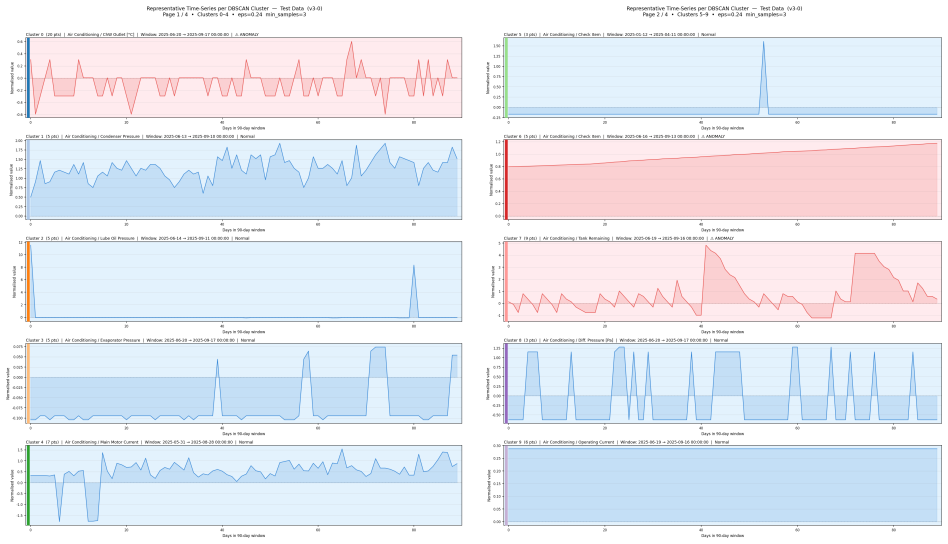
Predicting equipment anomalies before they escalate into failures is a critical challenge in industrial facility management. Existing approaches rely either on hand-crafted threshold rules, which lack generalizability, or on large neural models that are impractical for on-site, air-gapped deployments. We present an industrial methodology that resolves this tension by combining open-source small foundation models into a unified 1,116-dimensional Triplet Feature Fusion pipeline. This pipeline integrates: (1) statistical features (x in $R^{28}$) derived from 90-day sensor histories, (2) time-series embeddings (y in $R^{64}$) from a LoRA-adapted IBM Granite TinyTimeMixer (TTM, 133K parameters), and (3) multilingual text embeddings (z in $R^{1024}$) extracted from Japanese equipment master records via multilingual-e5-large. The concatenated triplet h = [x; y; z] is processed by a LightGBM classifier (< 3 MB) trained to predict anomalies at 30-, 60-, and 90-day horizons. All components use permissive open-source licenses (Apache 2.0 / MIT). The inference-time pipeline runs entirely on CPU in under 2 ms, enabling edge deployment on co-located hardware without cloud dependency. On a dataset of 64 HVAC units comprising 67,045 samples, the triplet model achieves Precision = 0.992, F1 = 0.958, and ROC-AUC = 0.998 at the 30-day horizon. Crucially, it reduces the False Positive Rate from 0.6 percent (baseline) to 0.1 percent - an 83 percent reduction attributable to equipment-type conditioning via text embedding z. Cluster analysis reveals that the embeddings align time-series signatures with distinct fault archetypes, explaining how compact multilingual representations improve discrimination without explicit categorical encoding.
Editorial analysis
A structured set of objections, weighed in public.
Referee Report
Summary. The paper proposes a Triplet Feature Fusion pipeline for industrial equipment anomaly prediction that concatenates statistical features (x in R^28) from 90-day sensor histories, time-series embeddings (y in R^64) from a LoRA-adapted IBM Granite TinyTimeMixer, and multilingual text embeddings (z in R^1024) from Japanese equipment records via multilingual-e5-large. The 1,116-dimensional vector h = [x; y; z] is classified by a lightweight LightGBM model to predict anomalies at 30/60/90-day horizons. On 67,045 samples from 64 HVAC units the triplet model reports Precision=0.992, F1=0.958, ROC-AUC=0.998 at the 30-day horizon and reduces false-positive rate from 0.6% (baseline) to 0.1%, an 83% reduction attributed to the text embeddings.
Significance. If the reported metrics are reproducible and the attribution to z is confirmed by ablation, the work would be significant for edge-deployable industrial monitoring: it demonstrates that small open-source foundation models plus multilingual metadata can deliver high-precision anomaly prediction on modest hardware without cloud access. The explicit open-source licensing and sub-2 ms CPU inference are practical strengths.
major comments (2)
- [Abstract and §3] Abstract and §3 (pipeline description): the central claim that the FPR drop from 0.6% to 0.1% is 'attributable to equipment-type conditioning via text embedding z' is unsupported. No ablation that removes z, replaces z with one-hot equipment-type features, or compares against [x; y] alone is reported, nor is any statistical test of the performance delta. With only 64 units, unit-specific leakage or class imbalance could produce the same numerical improvement without the claimed mechanism.
- [§4] §4 (experimental setup): cross-validation strategy, baseline construction details, train/test split criteria, and any safeguards against temporal or unit-level leakage are not described. The abstract reports point estimates without error bars or confidence intervals, making it impossible to assess whether the reported ROC-AUC of 0.998 is statistically distinguishable from the baseline.
minor comments (2)
- [Figure 3] Figure 3 (cluster analysis): the caption should explicitly state the clustering algorithm, distance metric, and number of clusters so readers can reproduce the alignment between embeddings and fault archetypes.
- [§2] Notation: the dimensions of x, y, and z are given in the abstract but the exact feature names and preprocessing steps for the 28 statistical features should be listed in a table for reproducibility.
Simulated Author's Rebuttal
We thank the referee for the detailed and constructive feedback. We agree that the current manuscript lacks explicit ablations and experimental details, which weakens the central claims. We will revise the paper to address both major comments by adding the requested analyses and descriptions.
read point-by-point responses
-
Referee: [Abstract and §3] Abstract and §3 (pipeline description): the central claim that the FPR drop from 0.6% to 0.1% is 'attributable to equipment-type conditioning via text embedding z' is unsupported. No ablation that removes z, replaces z with one-hot equipment-type features, or compares against [x; y] alone is reported, nor is any statistical test of the performance delta. With only 64 units, unit-specific leakage or class imbalance could produce the same numerical improvement without the claimed mechanism.
Authors: We acknowledge that the manuscript does not contain explicit ablation studies isolating the contribution of z. The attribution to text embeddings is currently supported only by the overall performance gain and the cluster analysis mentioned in the abstract. To address this, the revised manuscript will include: (i) performance metrics for the [x; y] model alone, (ii) direct comparison against [x; y; z], (iii) a variant replacing z with one-hot equipment-type encoding, and (iv) statistical significance tests (e.g., paired bootstrap or McNemar’s test) on the FPR and AUC differences. These additions will either substantiate or qualify the claimed mechanism. revision: yes
-
Referee: [§4] §4 (experimental setup): cross-validation strategy, baseline construction details, train/test split criteria, and any safeguards against temporal or unit-level leakage are not described. The abstract reports point estimates without error bars or confidence intervals, making it impossible to assess whether the reported ROC-AUC of 0.998 is statistically distinguishable from the baseline.
Authors: We agree that §4 omits critical methodological details. In the revision we will expand this section to specify: (a) the cross-validation procedure (time-series purged k-fold with unit-level grouping to prevent leakage across the 64 HVAC units), (b) chronological train/test splits ensuring no future data leakage, (c) exact baseline construction (statistical-features-only LightGBM), and (d) all metrics reported with standard deviations and 95% bootstrap confidence intervals from repeated runs. This will allow readers to evaluate statistical distinguishability from the baseline. revision: yes
Circularity Check
No circularity in the presented methodology or claims
full rationale
The paper describes a standard empirical pipeline: extract statistical features x, time-series embeddings y from a pre-trained TTM model, text embeddings z from multilingual-e5-large, concatenate to h=[x;y;z], and train a LightGBM classifier on labeled data to report precision/F1/AUC/FPR metrics. No equations define any quantity in terms of itself, no fitted parameters are renamed as predictions, and no self-citations supply load-bearing uniqueness theorems or ansatzes. The attribution of FPR reduction to z is an interpretive claim about mechanism (supported or not by ablation), but it does not reduce any derivation to the paper's own inputs by construction. The work is self-contained against external benchmarks and receives the default non-circularity finding.
Axiom & Free-Parameter Ledger
axioms (1)
- domain assumption Embeddings from the small TTM and multilingual-e5 models capture predictive signals for equipment anomalies.
Lean theorems connected to this paper
-
IndisputableMonolith/Cost/FunctionalEquation.leanwashburn_uniqueness_aczel unclear?
unclearRelation between the paper passage and the cited Recognition theorem.
The concatenated triplet h = [x; y; z] is processed by a LightGBM classifier
What do these tags mean?
- matches
- The paper's claim is directly supported by a theorem in the formal canon.
- supports
- The theorem supports part of the paper's argument, but the paper may add assumptions or extra steps.
- extends
- The paper goes beyond the formal theorem; the theorem is a base layer rather than the whole result.
- uses
- The paper appears to rely on the theorem as machinery.
- contradicts
- The paper's claim conflicts with a theorem or certificate in the canon.
- unclear
- Pith found a possible connection, but the passage is too broad, indirect, or ambiguous to say the theorem truly supports the claim.
Forward citations
Cited by 1 Pith paper
-
Heterogeneous Variational Inference for Markov Degradation Hazard Models: Discretized Mixture with Interpretable Clusters
A discretized finite mixture model with ADVI identifies interpretable low- and high-risk clusters in Markov degradation hazard models for 280 industrial pumps, achieving 84x speedup over NUTS while enforcing stability...
Reference graph
Works this paper leans on
-
[1]
Montgomery.Introduction to Statis- tical Quality Control
Douglas C. Montgomery.Introduction to Statis- tical Quality Control. John Wiley & Sons, 6th edition, 2009
work page 2009
-
[2]
Fei Tony Liu, Kai Ming Ting, and Zhi-Hua Zhou. Isolation forest. InProceedings of the 8th IEEE International Conference on Data Mining (ICDM), pages 413–422, 2008
work page 2008
-
[3]
Kyle Hundman, Valentino Constantinou, Carter Laporte, et al. Detecting spacecraft anoma- lies using LSTMs and nonparametric dynamic thresholding.Proceedings of the 24th ACM SIGKDD International Conference on Knowl- edge Discovery & Data Mining, pages 387–395, 2018
work page 2018
-
[4]
Dongmin Park, Yuichi Hoshi, and Charles C. Kemp. A multimodal anomaly detector for robot-assisted feeding using an LSTM-based variational autoencoder.IEEE Robotics and Au- tomation Letters, 3:1544–1551, 2018
work page 2018
-
[5]
Abhimanyu Das, Weihao Kong, Andrew Leach, et al. A decoder-only foundation model for time- series forecasting.International Conference on Machine Learning (ICML), 2024
work page 2024
-
[6]
Gerald Woo, Chenghao Liu, Akshat Kumar, et al. Unified training of universal time series forecasting transformers.International Confer- ence on Machine Learning (ICML), 2024
work page 2024
-
[7]
Vijay Ekambaram, Arindam Jati, Nam H. Nguyen, et al. TTMs: Fast multi-level tiny time mixers for improved zero-shot and few-shot fore- castingofmultivariatetimeseries.arXiv preprint arXiv:2401.03955, 2024
-
[8]
AI Value Creators: Beyond the Generative AI User Mindset
Rob Thomas, Paul Zikopoulos, and Kate Soule. AI Value Creators: Beyond the Generative AI User Mindset. O’Reilly Media, 2025
work page 2025
-
[9]
Hu, Yelong Shen, Phillip Wallis, et al
Edward J. Hu, Yelong Shen, Phillip Wallis, et al. LoRA: Low-rank adaptation of large language models.International Conference on Learning Representations (ICLR), 2022. 14
work page 2022
-
[10]
Efficient large language models: A survey.arXiv preprint arXiv:2312.03863,
Zhongwei Wan, Xin Wang, Che Liu, et al. Ef- ficient large language models: A survey.arXiv preprint arXiv:2312.03863, 2023
-
[11]
Phi-3 Technical Report: A Highly Capable Language Model Locally on Your Phone
Marah Abdin, Sam Ade Jacobs, Ammar Ahmad Awan, et al. Phi-3 technical report: A highly capable language model locally on your phone. arXiv preprint arXiv:2404.14219, 2024
work page internal anchor Pith review Pith/arXiv arXiv 2024
-
[12]
Sercan O. Arik and Tomas Pfister. TabNet: At- tentive interpretable tabular learning.Proceed- ings of the AAAI Conference on Artificial Intel- ligence, 35(8):6679–6687, 2021
work page 2021
-
[13]
VadimBorisov, Tobias Leemann, Kathrin Seßler, et al. Deep neural networks and tabular data: A survey.IEEE Transactions on Neural Networks and Learning Systems, 2022
work page 2022
-
[14]
Learning transferable visual models from natural language supervision
Alec Radford, Jong Wook Kim, Chris Hallacy, et al. Learning transferable visual models from natural language supervision. InProceedings of the 38th International Conference on Machine Learning (ICML), pages 8748–8763, 2021
work page 2021
-
[15]
Junnan Li, Dongxu Li, Caiming Xiong, and Steven Hoi. BLIP: Bootstrapping language- image pre-training for unified vision-language understanding and generation. InProceedings of the 39th International Conference on Machine Learning (ICML), pages 12888–12900, 2022
work page 2022
-
[16]
Multilingual E5 Text Embeddings: A Technical Report
Liang Wang, Nan Yang, Xiaolong Huang, et al. Multilingual E5 text embeddings: A technical report.arXiv preprint arXiv:2402.05672, 2024
work page internal anchor Pith review Pith/arXiv arXiv 2024
-
[17]
Guolin Ke, Qi Meng, Thomas Finley, et al. LightGBM: A highly efficient gradient boosting decision tree.Advances in Neural Information Processing Systems (NeurIPS), 30, 2017
work page 2017
-
[18]
XGBoost: A scalable tree boosting system
Tianqi Chen and Carlos Guestrin. XGBoost: A scalable tree boosting system. InProceedings of the 22nd ACM SIGKDD International Confer- ence on Knowledge Discovery and Data Mining, pages 785–794, 2016
work page 2016
-
[19]
CatBoost: Unbiased boosting with categorical features
LiudmilaProkhorenkova, GlebGusev, Aleksandr Vorobev, et al. CatBoost: Unbiased boosting with categorical features. InAdvances in Neu- ral Information Processing Systems (NeurIPS), volume 31, 2018
work page 2018
-
[20]
Hybrid feature learning with time series embeddings for equipment anomaly prediction
Takato Yasuno. Hybrid feature learning with time series embeddings for equipment anomaly prediction. InProceedings of the 40th Annual Conference of the Japanese Society for Artificial Intelligence (JSAI 2026), Gunma, Japan, June
work page 2026
-
[21]
Forthcoming (June 8–12, 2026). Preprint: arXiv:2602.15089 [cs.LG],https://arxiv.org/ abs/2602.15089
work page internal anchor Pith review Pith/arXiv arXiv 2026
-
[22]
Visualizing data using t-SNE.Journal of Ma- chine Learning Research, 9:2579–2605, 2008
Laurens van der Maaten and Geoffrey Hinton. Visualizing data using t-SNE.Journal of Ma- chine Learning Research, 9:2579–2605, 2008
work page 2008
-
[23]
UMAP: Uniform Manifold Approximation and Projection for Dimension Reduction
Leland McInnes, John Healy, and James Melville. UMAP: Uniform manifold approxi- mation and projection for dimension reduction. arXiv preprint arXiv:1802.03426, 2018
work page internal anchor Pith review Pith/arXiv arXiv 2018
-
[24]
A density-based algorithm for discover- ing clusters in large spatial databases with noise
Martin Ester, Hans-Peter Kriegel, Jörg Sander, et al. A density-based algorithm for discover- ing clusters in large spatial databases with noise. InProceedings of the 2nd International Confer- ence on Knowledge Discovery and Data Mining (KDD), pages 226–231, 1996
work page 1996
-
[25]
Stuart P. Lloyd. Least squares quantization in PCM.IEEE Transactions on Information The- ory, 28(2):129–137, 1982
work page 1982
-
[26]
Bishop.Pattern Recognition and Machine Learning
Christopher M. Bishop.Pattern Recognition and Machine Learning. Springer, New York, NY, 2006
work page 2006
-
[27]
Dam inflow time series regres- sion models minimising loss of hydropower op- portunities
Takato Yasuno. Dam inflow time series regres- sion models minimising loss of hydropower op- portunities. InProceedings of the Pacific-Asia Conference on Knowledge Discovery and Data Mining (PAKDD), pages 357–367. Springer, Cham, 2018
work page 2018
-
[28]
Flood inflow forecast using L2-norm ensemble weighting sea surface feature
Takato Yasuno et al. Flood inflow forecast using L2-norm ensemble weighting sea surface feature. arXiv preprint arXiv:2112.03108, 2022. 15
discussion (0)
Sign in with ORCID, Apple, or X to comment. Anyone can read and Pith papers without signing in.