Recognition: 2 theorem links
· Lean TheoremHeterogeneous architectures enable a 138x reduction in physical qubit requirements for fault-tolerant quantum computing under detailed accounting
Pith reviewed 2026-05-10 18:30 UTC · model grok-4.3
The pith
Heterogeneous quantum architectures reduce physical qubit requirements by up to 138 times
A machine-rendered reading of the paper's core claim, the machinery that carries it, and where it could break.
Core claim
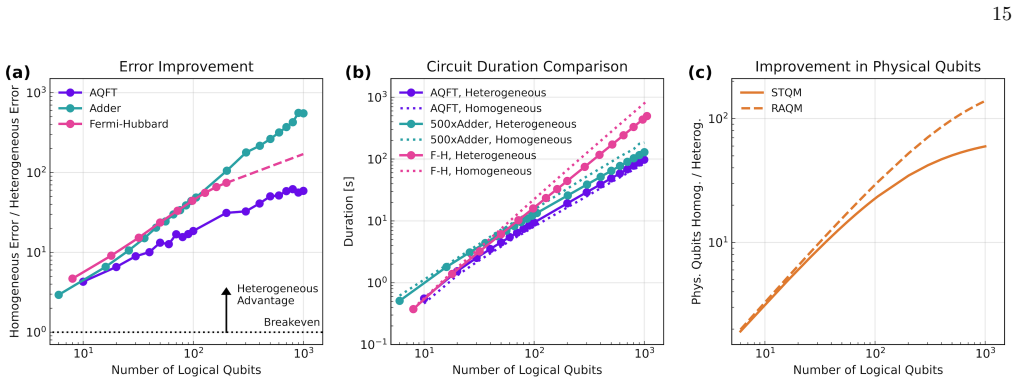
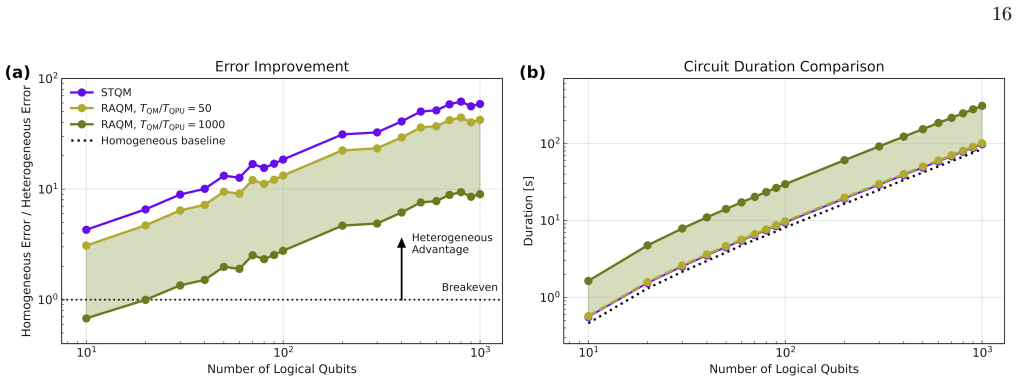
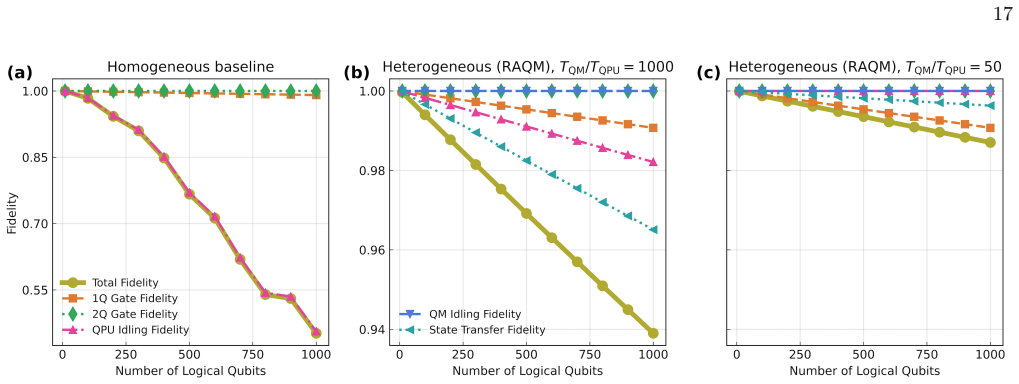
Presenting a complete heterogeneous quantum computing architecture incorporating task-specific hardware selection and QEC encoding, agnostic to code selection or physical qubit parameters, and including special-purpose processing modules with a full microarchitecture for fault-tolerant implementation of interfaces between quantum processing units and quantum memories, using a new fully featured compiler functioning across subsystems at the scale of 1,000 logical qubits to schedule and orchestrate algorithms, a detailed accounting of all operations reveals up to 551x reduction in algorithmic logical error and up to 138x reduction in physical-qubit overhead compared to a monolithic baseline.
What carries the argument
Heterogeneous architecture with task-specific hardware selection, QEC encoding, special-purpose processing modules, and microarchitecture for fault-tolerant interfaces between units and memories, orchestrated by a cross-subsystem compiler.
If this is right
- Factoring a 2048-bit RSA integer requires 381k physical qubits and 9.2 days with an experimentally demonstrated grid-coupling topology.
- Adding an algorithm-specific accelerator for the Adder subroutine reduces the runtime to 4.9 days at the cost of 439k qubits.
- With hypothetical long-range coupling and qLDPC codes for memory, the resource requirement drops to 190k qubits and under 10 days.
- The architecture is agnostic to the choice of quantum error correction code and physical qubit parameters.
- The tooling enables scheduling algorithms at the scale of 1,000 logical qubits across heterogeneous subsystems.
Where Pith is reading between the lines
- The modular design could encourage development of specialized quantum hardware components rather than uniform large-scale chips.
- Similar detailed accounting methods might reveal efficiencies in other quantum algorithms such as quantum simulation.
- Prioritizing research on long-range couplings could unlock the large savings from qLDPC memory codes.
- Quantum compiler development may shift toward optimizing for heterogeneous resources and interfaces from the outset.
Load-bearing premise
The modeled physical-qubit parameters, grid-coupling topology, and performance of special-purpose accelerators and qLDPC codes must match real hardware exactly.
What would settle it
Implementing the heterogeneous architecture on current quantum hardware for a small algorithm and measuring the actual reduction in physical qubits and error rates compared to a monolithic version.
Figures



read the original abstract
Quantum computer hardware is predicted to scale over hundreds of thousands of qubits coming online in the next decade. Despite significant theoretical and experimental QEC progress, quantum computer architecture has suffered a significant gap, with bottom-up physical-device-driven challenges largely disconnected from top-down QEC-code-driven considerations. In this work, we unify these two views, presenting a complete heterogeneous quantum computing architecture incorporating task-specific hardware selection and QEC encoding, and agnostic to code selection or physical qubit parameters. Our approach further enables special-purpose processing modules, and includes a full microarchitecture for fault-tolerant implementation of interfaces between quantum processing units and quantum memories. Using this architecture and a new fully featured compiler functioning across subsystems at the scale of $1,000$ logical qubits, we schedule and orchestrate a variety of algorithms down to hardware-specific instructions; a detailed accounting of all operations reveals up to 551x reduction in algorithmic logical error and up to 138x reduction in physical-qubit overhead compared to a monolithic baseline architecture. We then consider the factorization of 2048-bit RSA-integers; using an experimentally demonstrated grid-coupling topology, factoring RSA-2048 requires 381k physical qubits and 9.2 days, which can be reduced to 4.9 days via addition of an algorithm-specific accelerator for the Adder subroutine (requiring 439k qubits). Finally, assuming hypothetical long-range coupling, implementing quantum memory using qLDPC codes reduces the resources required for factoring to just 190k qubits and under 10 days. These results and the tooling we have built indicate that heterogeneous quantum-computer architectures can deliver significant, verifiable benefits on realistic hardware.
Editorial analysis
A structured set of objections, weighed in public.
Referee Report
Summary. The manuscript presents a heterogeneous quantum computing architecture incorporating task-specific hardware modules, QEC encodings, and a full microarchitecture for fault-tolerant interfaces between quantum processing units and memories. It introduces a new compiler that schedules algorithms at the scale of 1,000 logical qubits down to hardware-specific instructions. Using detailed operation accounting, the paper claims up to 551x reduction in algorithmic logical error and up to 138x reduction in physical-qubit overhead versus a monolithic baseline. Concrete estimates are given for 2048-bit RSA factorization: 381k physical qubits and 9.2 days using an experimentally demonstrated grid-coupling topology, reducible to 4.9 days with an Adder accelerator (439k qubits), and further to 190k qubits and under 10 days assuming hypothetical long-range coupling with qLDPC memory codes.
Significance. If the performance models hold, the work unifies physical-device and QEC perspectives in an architecture agnostic to code and qubit parameters, demonstrating how heterogeneity and special-purpose modules can substantially lower resources for fault-tolerant computation. A key strength is the fully featured compiler and complete operation accounting that produces concrete, falsifiable numbers for realistic algorithms like RSA-2048, rather than abstract bounds. This has direct relevance for scaling hardware to hundreds of thousands of qubits by quantifying benefits of task-specific accelerators and advanced memory codes.
major comments (2)
- The headline reductions of 551x in logical error and 138x in physical qubits are computed from fixed performance assumptions on the special-purpose Adder accelerator (latency and error-rate gains with no extra qubit/gate cost) and qLDPC memory density under long-range coupling. The RSA-2048 example shows these directly alter the overhead (381k to 190k qubits), so the central claim requires either explicit sensitivity analysis over these parameters or a clear statement that the numbers are illustrative only under the stated models.
- The detailed accounting is load-bearing for all quantitative claims, yet the manuscript provides no full methods description, data tables of operation counts, or error bars on the derived reduction factors. Without these, the 138x and 551x figures cannot be independently reproduced from the given text, undermining verification of the heterogeneous advantage over the monolithic baseline constructed with the same physical parameters.
minor comments (2)
- The abstract states the grid-coupling topology is 'experimentally demonstrated' but does not cite the specific experiment or quantify any interface overhead in the microarchitecture; add this reference and accounting detail for clarity.
- Clarify the exact monolithic baseline physical-qubit count used to arrive at the 'up to 138x' factor, as the RSA example gives absolute numbers but not the corresponding baseline for direct comparison.
Simulated Author's Rebuttal
We thank the referee for their careful review and for highlighting both the strengths of the work and areas for improvement. We address the major comments point by point below and will incorporate revisions to enhance the manuscript's clarity and reproducibility.
read point-by-point responses
-
Referee: The headline reductions of 551x in logical error and 138x in physical qubits are computed from fixed performance assumptions on the special-purpose Adder accelerator (latency and error-rate gains with no extra qubit/gate cost) and qLDPC memory density under long-range coupling. The RSA-2048 example shows these directly alter the overhead (381k to 190k qubits), so the central claim requires either explicit sensitivity analysis over these parameters or a clear statement that the numbers are illustrative only under the stated models.
Authors: The manuscript already qualifies the qLDPC results as assuming hypothetical long-range coupling and presents the Adder accelerator as an optional module with stated benefits. Nevertheless, we agree that the dependence on these assumptions should be made more explicit for the headline claims. In the revision we will add a dedicated sensitivity analysis subsection that varies the key parameters (accelerator latency/error-rate gains and qLDPC density) and recomputes the reduction factors and RSA-2048 resource estimates accordingly. We will also insert a clear statement that the reported 551x and 138x figures are illustrative under the stated performance models. These changes will directly address the concern while preserving the concrete examples. revision: yes
-
Referee: The detailed accounting is load-bearing for all quantitative claims, yet the manuscript provides no full methods description, data tables of operation counts, or error bars on the derived reduction factors. Without these, the 138x and 551x figures cannot be independently reproduced from the given text, undermining verification of the heterogeneous advantage over the monolithic baseline constructed with the same physical parameters.
Authors: We concur that the absence of a full methods description and supporting data tables limits independent verification. In the revised manuscript we will substantially expand the Methods section to document the compiler's scheduling algorithm, the precise operation-counting procedure, and all modeling assumptions used to derive logical-error and physical-qubit reductions. We will also add supplementary tables that list the operation counts (and derived quantities) for the RSA-2048 instance and other benchmarks under both the heterogeneous and monolithic architectures. Where the underlying physical parameters carry uncertainty, we will include error bars or ranges on the reported reduction factors. revision: yes
Circularity Check
Resource reductions obtained via direct scheduling comparison to monolithic baseline; no circular reduction to inputs
full rationale
The paper constructs a heterogeneous architecture model with task-specific modules and qLDPC memory, then uses a compiler to schedule algorithms (including RSA-2048) and performs a full operation accounting against an explicitly defined monolithic baseline that employs identical physical parameters and code family. The reported 138x qubit and 551x logical-error reductions are direct numerical outputs of this side-by-side accounting rather than quantities fitted, self-defined, or imported via self-citation. No equations in the provided text equate a claimed prediction to its own modeling inputs by construction, and no load-bearing self-citations or ansatzes are invoked to justify the architecture choices. The modeling assumptions (grid-coupling overhead, accelerator performance, qLDPC density) are treated as fixed inputs whose validity is external to the derivation chain itself.
Axiom & Free-Parameter Ledger
free parameters (2)
- physical qubit error rates and coupling strengths
- grid-coupling topology parameters
axioms (1)
- domain assumption Standard fault-tolerance thresholds and decoding assumptions for surface codes and qLDPC codes hold under the modeled noise.
Lean theorems connected to this paper
-
IndisputableMonolith/Foundation/RealityFromDistinction.leanreality_from_one_distinction unclearheterogeneous quantum computing architecture incorporating task-specific hardware selection and QEC encoding... Q-CHESS... detailed accounting of all operations reveals up to 551x reduction in algorithmic logical error and up to 138x reduction in physical-qubit overhead
Forward citations
Cited by 2 Pith papers
-
GreenPeas: Unlocking Adaptive Quantum Error Correction with Just-in-Time Decoding Hypergraphs
GreenPeas delivers a just-in-time GPU compiler for decoding hypergraphs that achieves >10x speedup on surface and bivariate bicycle codes, unlocking circuit-level decoding for adaptive quantum error correction.
-
Space-Time Tradeoffs of Pauli-Based Computation in Distributed qLDPC Architectures
Large qLDPC blocks in distributed quantum computing enable Pauli-based computation to run up to 10x faster than surface codes for optimization algorithms by using spare nodes to bypass serialization bottlenecks.
Reference graph
Works this paper leans on
-
[1]
The White House, National security memorandum on promoting united states leadership in quantum comput- ing while mitigating risks to vulnerable cryptographic systems, National Archives (2022)
2022
- [2]
-
[3]
H. Zhou, C. Zhao, M. Cain, D. Bluvstein, N. Maskara, C. Duckering, H.-Y. Hu, S.-T. Wang, A. Kubica, and M. D. Lukin, Nature646, 303 (2025)
2025
-
[4]
Acharyaet al.(Google Quantum AI and Collabora- tors), Nature638, 920 (2025)
R. Acharyaet al.(Google Quantum AI and Collabora- tors), Nature638, 920 (2025)
2025
-
[5]
Quantum Error-Corrected Computation of Molecular Energies
K. Yamamotoet al.(Quantinuum), Quantum Error- Corrected Computation of Molecular Energies (2025), arXiv:2505.09133 [quant-ph] version: 1
work page internal anchor Pith review Pith/arXiv arXiv 2025
-
[6]
Franke, J
D. Franke, J. Clarke, L. Vandersypen, and M. Veldhorst, Microprocessors and Microsystems67, 1 (2019)
2019
-
[7]
Hornibrook, J
J. Hornibrook, J. Colless, I. Conway Lamb, S. Pauka, H. Lu, A. Gossard, J. Watson, G. Gardner, S. Fallahi, M. Manfra, and D. Reilly, Physical Review Applied3, 024010 (2015)
2015
-
[8]
Krinner, S
S. Krinner, S. Storz, P. Kurpiers, P. Magnard, J. Hein- soo, R. Keller, J. L¨ utolf, C. Eichler, and A. Wallraff, EPJ Quantum Technology6, 2 (2019)
2019
-
[9]
S. Kawabata, Integration and Resource Estimation of Cryoelectronics for Superconducting Fault-Tolerant Quantum Computers (2026), arXiv:2601.03922 [quant- ph]
work page internal anchor Pith review Pith/arXiv arXiv 2026
-
[10]
Malinowski, D
M. Malinowski, D. Allcock, and C. Ballance, PRX Quantum4, 040313 (2023)
2023
-
[11]
Castelvecchi, Nature624, 238–238 (2023)
D. Castelvecchi, Nature624, 238–238 (2023)
2023
-
[12]
IBM, IBM Quantum System Two: the era of quantum utility is here, https://www.ibm.com/quantum/blog/q uantum-roadmap-2033 (2023), accessed: 2026-02-17
2033
-
[13]
IBM, IBM Quantum Roadmap, https://www.ibm.co m/downloads/documents/us-en/1443d5cda24021e4 (2025), accessed: 2026-02-17
2025
-
[14]
M. Field, A. Q. Chen, B. Scharmann, E. A. Sete, F. Oruc, K. Vu, V. Kosenko, J. Y. Mutus, S. Po- letto, and A. Bestwick, Physical Review Applied21, 10.1103/physrevapplied.21.054063 (2024)
-
[15]
pasqal.com/newsroom/pasqal-releases-2025-roadmap/ (2025), accessed: 2026-02-18
Pasqal, Pasqal Releases 2025 Roadmap Showcasing Upgradable Platform from Today’s Quantum Solutions to Tomorrow’s Fault-Tolerant Systems, https://www. pasqal.com/newsroom/pasqal-releases-2025-roadmap/ (2025), accessed: 2026-02-18
2025
-
[16]
IonQ, IonQ|Roadmap, https://www.ionq.com/roadm ap (2025), accessed: 2026-02-18
2025
-
[17]
Xanadu, Xanadu|Xanadu introduces Aurora: world’s first scalable, networked and modular quantum com- puter, https://www.xanadu.ai/press/xanadu-introduce s-aurora-worlds-first-scalable-networked-and-modular -quantum-computer (2025), accessed: 2026-02-18
2025
-
[18]
Caleffi, M
M. Caleffi, M. Amoretti, D. Ferrari, J. Illiano, A. Man- zalini, and A. S. Cacciapuoti, Computer Networks254, 110672 (2024)
2024
-
[19]
N. H. Nickerson, J. F. Fitzsimons, and S. C. Benjamin, Phys. Rev. X4, 041041 (2014)
2014
- [20]
-
[21]
H. Jacinto, E. Gouzien, and N. Sangouard, Physical Re- view Research8, 10.1103/v9ln-c4v2 (2026)
-
[22]
S. Singh, F. Gu, S. de Bone, E. Villase˜ nor, D. Elk- ouss, and J. Borregaard, npj Quantum Information12, 10.1038/s41534-025-01146-2 (2025)
-
[23]
Monroe, R
C. Monroe, R. Raussendorf, A. Ruthven, K. R. Brown, P. Maunz, L.-M. Duan, and J. Kim, Physical Review A 89, 022317 (2014)
2014
-
[24]
Magnard, S
P. Magnard, S. Storz, P. Kurpiers, J. Sch¨ ar, F. Marxer, J. L¨ utolf, T. Walter, J.-C. Besse, M. Gabureac, K. Reuer, A. Akin, B. Royer, A. Blais, and A. Wall- raff, Phys. Rev. Lett.125, 260502 (2020)
2020
-
[25]
K. Heya, T. Phung, M. Malekakhlagh, R. Steiner, M. Turchetti, W. Shanks, J. Mamin, W.-S. Lu, Y. P. Kandel, N. Sundaresan, and J. Orcutt, Phys. Rev. Lett. 135, 200801 (2025)
2025
-
[26]
Quantum, Nu Quantum, https://www.nu-quantum .com/, accessed: 2026-02-19
N. Quantum, Nu Quantum, https://www.nu-quantum .com/, accessed: 2026-02-19
2026
-
[27]
Aliro, Aliro - Quantum Powered Security, https://ww w.aliroquantum.com, accessed: 2026-02-19
2026
-
[28]
Qunnect, Enabling the Quantum Internet, https://qu nnect.inc/, accessed: 2026-02-19
2026
-
[29]
Gidney and M
C. Gidney and M. Ekera, Quantum5, 433 (2021)
2021
-
[30]
How to factor 2048 bit RSA integers with less than a million noisy qubits
C. Gidney, How to factor 2048 bit RSA integers with less than a million noisy qubits (2025), arXiv:2505.15917 [quant-ph]
work page internal anchor Pith review arXiv 2048
-
[31]
F. K. Marqversen, G. Baranes, M. Sirotin, and J. Bor- regaard, Fault-tolerant interfaces for modular quan- tum computing on diverse qubit platforms (2025), arXiv:2510.05221 [quant-ph]
work page internal anchor Pith review Pith/arXiv arXiv 2025
-
[32]
Strikis and L
A. Strikis and L. Berent, PRX Quantum4, 020321 (2023)
2023
-
[33]
Sutcliffe, B
E. Sutcliffe, B. Jonnadula, C. Le Gall, A. E. Moylett, and C. M. Westoby, in2025 IEEE International Confer- ence on Quantum Computing and Engineering (QCE), 26 Vol. 01 (2025) pp. 649–657
2025
-
[34]
P. Webster, L. Berent, O. Chandra, E. T. Hockings, N. Baspin, F. Thomsen, S. C. Smith, and L. Z. Cohen, The Pinnacle Architecture: Reducing the cost of break- ing RSA-2048 to 100 000 physical qubits using quantum LDPC codes (2026), arXiv:2602.11457 [quant-ph]
work page internal anchor Pith review Pith/arXiv arXiv 2048
- [35]
- [36]
-
[37]
T. J. Yoder, E. Schoute, P. Rall, E. Pritchett, J. M. Gambetta, A. W. Cross, M. Carroll, and M. E. Beverland, Tour de gross: A modular quan- tum computer based on bivariate bicycle codes (2025), arXiv:2506.03094 [quant-ph]
work page internal anchor Pith review arXiv 2025
-
[38]
Litinski, Quantum3, 128 (2019)
D. Litinski, Quantum3, 128 (2019)
2019
- [39]
-
[40]
C. Guinn, S. Stein, E. Tureci, G. Avis, C. Liu, S. Kras- tanov, A. A. Houck, and A. Li, Co-Designed Super- conducting Architecture for Lattice Surgery of Surface Codes with Quantum Interface Routing Card (2023), arXiv:2312.01246 [quant-ph]
-
[41]
A. Robertson, H. Gao, and Y. R. Sanders, A Re- source Allocating Compiler for Lattice Surgery (2025), arXiv:2506.04620 [quant-ph]
-
[42]
J. L. Hennessy, D. A. Patterson, and K. Asanovi´ c, Computer architecture: a quantitative approach, 5th ed. (Morgan Kaufmann/Elsevier, Waltham, MA, 2012)
2012
-
[43]
D. A. Patterson, J. L. Hennessy, and P. Alexan- der,Computer organization and design: the hard- ware/software interface, arm®edition ed. (Else- vier/Morgan Kaufmann, Amsterdam ; Boston, 2017)
2017
-
[44]
von Neumann, (J
J. von Neumann, (J. P. Eckert and J. Mauchly are seen by many to have made equal intellectual contri- butions but their names were controversially omitted [43].) ,First Draft of a Report on the EDV AC, Tech. Rep. (Moore School of Electrical Engineering, Univer- sity of Pennsylvania, 1945) contract No. W-670-ORD- 4926, U.S. Army Ordnance Department
1945
-
[45]
Zhang, Z.-Y
J. Zhang, Z.-Y. Chen, Y.-J. Wang, B.-H. Lu, H.-F. Zhang, J.-N. Li, P. Duan, Y.-C. Wu, and G.-P. Guo, npj Quantum Information11, 177 (2025)
2025
-
[46]
Pogorelov, F
I. Pogorelov, F. Butt, L. Postler, C. D. Marciniak, P. Schindler, M. M¨ uller, and T. Monz, Nature Physics 21, 298–303 (2025)
2025
-
[47]
Harper and S
R. Harper and S. T. Flammia, Physical Review Letters 122, 080504 (2019)
2019
-
[48]
Wanget al.(Quantinuum), Science Advances10, eado9024 (2024)
Y. Wanget al.(Quantinuum), Science Advances10, eado9024 (2024)
2024
-
[49]
P. S. Rodriguezet al.(QuEra), Nature645, 620 (2025)
2025
-
[50]
Magic state cultivation: growing T states as cheap as CNOT gates
C. Gidney, N. Shutty, and C. Jones, Magic state cultiva- tion: growing T states as cheap as CNOT gates (2024), arXiv:2409.17595 [quant-ph]
work page internal anchor Pith review arXiv 2024
-
[51]
Kobori, Y
T. Kobori, Y. Suzuki, Y. Ueno, T. Tanimoto, S. Todo, and Y. Tokunaga, in2025 IEEE International Sym- posium on High Performance Computer Architecture (HPCA)(2025) pp. 304–320
2025
-
[52]
AbuGhanem, Photonic quantum computers (2024), arXiv:2409.08229 [quant-ph]
M. AbuGhanem, Photonic quantum computers (2024), arXiv:2409.08229 [quant-ph]
-
[53]
X. Gu, A. F. Kockum, A. Miranowicz, Y.-x. Liu, and F. Nori, Physics Reports718-719, 1 (2017)
2017
-
[54]
Wang, C.-Y
P. Wang, C.-Y. Luan, M. Qiao, M. Um, J. Zhang, Y. Wang, X. Yuan, M. Gu, J. Zhang, and K. Kim, Na- ture Communications12, 233 (2021)
2021
- [55]
-
[56]
Q. Xu, J. P. Bonilla Ataides, C. A. Pattison, N. Raveen- dran, D. Bluvstein, J. Wurtz, B. Vasi´ c, M. D. Lukin, L. Jiang, and H. Zhou, Nature Physics20, 1084–1090 (2024)
2024
-
[57]
F. Wang, M. Ren, W. Sun, M. Guo, M. J. Sellars, R. L. Ahlefeldt, J. G. Bartholomew, J. Yao, S. Liu, and M. Zhong, PRX Quantum6, 010302 (2025)
2025
- [58]
-
[59]
Khodjasteh, J
K. Khodjasteh, J. Sastrawan, D. Hayes, T. J. Green, M. J. Biercuk, and L. Viola, Nature Communications 4, 2045 (2013)
2045
-
[60]
Ball, The Best Qubits for Quantum Computing Might Just Be Atoms (2024)
P. Ball, The Best Qubits for Quantum Computing Might Just Be Atoms (2024)
2024
-
[61]
Frackiewicz, Quantum Showdown: Superconducting vs Trapped Ion vs Photonic – Who Will Rule Quantum Computing? (2025)
M. Frackiewicz, Quantum Showdown: Superconducting vs Trapped Ion vs Photonic – Who Will Rule Quantum Computing? (2025)
2025
-
[62]
Defense Advanced Research Projects Agency, Program solicitation: Heterogeneous Architectures for Quantum (HARQ), https://sam.gov/opp/944007d554364a1aad 811469028a7e73/view (2025), accessed: 2026-02-20
2025
-
[63]
Bravyi, A
S. Bravyi, A. W. Cross, J. M. Gambetta, D. Maslov, P. Rall, and T. J. Yoder, Nature627, 778–782 (2024)
2024
-
[64]
Mariantoni, H
M. Mariantoni, H. Wang, T. Yamamoto, M. Neeley, R. C. Bialczak, Y. Chen, M. Lenander, E. Lucero, A. D. O’Connell, D. Sank, M. Weides, J. Wenner, Y. Yin, J. Zhao, A. N. Korotkov, A. N. Cleland, and J. M. Mar- tinis, Science334, 61 (2011)
2011
- [65]
-
[66]
Gouzien and N
E. Gouzien and N. Sangouard, Physical Review Letters 127, 140503 (2021)
2021
-
[67]
S. Stein, S. Sussman, T. Tomesh, C. Guinn, E. Tureci, S. F. Lin, W. Tang, J. Ang, S. Chakram, A. Li, M. Martonosi, F. T. Chong, A. A. Houck, I. L. Chuang, and M. A. DeMarco, Microarchitectures for hetero- geneous superconducting quantum computers (2023), arXiv:2305.03243 [quant-ph]
-
[68]
Andres-Martinez, T
P. Andres-Martinez, T. Forrer, D. Mills, J.-Y. Wu, L. Henaut, K. Yamamoto, M. Murao, and R. Duncan, Quantum Science and Technology9, 045021 (2024)
2024
-
[69]
Helios: A 98-qubit trapped-ion quantum computer,
A. Ransfordet al.(Quantinuum), Helios: A 98-qubit trapped-ion quantum computer (2025), arXiv:2511.05465 [quant-ph]
- [70]
- [71]
-
[72]
Rudolph, What is the logical gate speed of a pho- tonic quantum computer?, Quantum Frontiers (2023), accessed: 2024-05-22
T. Rudolph, What is the logical gate speed of a pho- tonic quantum computer?, Quantum Frontiers (2023), accessed: 2024-05-22
2023
-
[73]
Gidney and A
C. Gidney and A. G. Fowler, Quantum3, 135 (2019)
2019
-
[74]
S. A. Cuccaro, T. G. Draper, S. A. Kutin, and D. P. Moulton, A new quantum ripple-carry addition circuit (2004), arXiv:quant-ph/0410184 [quant-ph]
work page Pith review arXiv 2004
- [75]
-
[76]
J. Haah and M. B. Hastings, Quantum2, 71 (2018), arXiv:1709.02832 [quant-ph]
-
[77]
H. J. Kimble, Nature453, 1023 (2008)
2008
-
[78]
Kaiser, C
M. Kaiser, C. Glaser, L. Y. Ley, J. Grimmel, H. Hatter- mann, D. Bothner, D. Koelle, R. Kleiner, D. Petrosyan, A. G¨ unther, and J. Fort´ agh, Physical Review Research 4, 013207 (2022)
2022
-
[79]
Kumar, A
A. Kumar, A. Suleymanzade, M. Stone, L. Taneja, A. Anferov, D. I. Schuster, and J. Simon, Nature615, 614 (2023)
2023
-
[80]
Gottesman and I
D. Gottesman and I. L. Chuang, Nature402, 390 (1999)
1999
discussion (0)
Sign in with ORCID, Apple, or X to comment. Anyone can read and Pith papers without signing in.