Recognition: no theorem link
GCoT-Decoding: Unlocking Deep Reasoning Paths for Universal Question Answering
Pith reviewed 2026-05-10 17:53 UTC · model grok-4.3
The pith
A branching decoder generates and groups reasoning paths to handle any question without manual prompts.
A machine-rendered reading of the paper's core claim, the machinery that carries it, and where it could break.
Core claim
GCoT-decoding employs a two-stage branching method that combines Fibonacci sampling and heuristic error backtracking to produce candidate paths, splits each path into a reasoning span and an answer span for precise confidence scoring, and aggregates semantically similar paths to reach a consensus answer instead of using majority voting.
What carries the argument
Two-stage branching that pairs Fibonacci sampling with heuristic error backtracking, followed by span splitting for confidence and semantic similarity grouping for consensus.
If this is right
- Reasoning paths become available for open-ended questions that have no preset answer list.
- The method reduces dependence on manually written prompts for each new question type.
- Confidence scores become more accurate once reasoning content is isolated from the final answer.
- The same procedure applies across multiple QA datasets without task-specific retuning.
Where Pith is reading between the lines
- Semantic grouping may prove more stable than voting when different wording leads to the same meaning.
- The technique could be combined with other sampling strategies to further increase path diversity.
- If the grouping step works well on short answers, it may also help on longer multi-step reasoning problems.
- Wider adoption would make prompt-free reasoning a default option rather than an exception.
Load-bearing premise
The heuristic error backtracking and semantic similarity grouping can reliably separate correct reasoning paths from incorrect ones without adding new biases or requiring changes for each dataset.
What would settle it
A controlled test on a fresh free-form QA dataset where the method produces lower accuracy than plain decoding or where semantic grouping consistently merges incorrect paths would show the approach does not generalize as claimed.
Figures




read the original abstract
Chain-of-Thought reasoning can enhance large language models, but it requires manually designed prompts to guide the model. Recently proposed CoT-decoding enables the model to generate CoT-style reasoning paths without prompts, but it is only applicable to problems with fixed answer sets. To address this limitation, we propose a general decoding strategy GCoT-decoding that extends applicability to a broader range of question-answering tasks. GCoT-decoding employs a two-stage branching method combining Fibonacci sampling and heuristic error backtracking to generate candidate decoding paths. It then splits each path into a reasoning span and an answer span to accurately compute path confidence, and finally aggregates semantically similar paths to identify a consensus answer, replacing traditional majority voting. We conduct extensive experiments on six datasets covering both fixed and free QA tasks. Our method not only maintains strong performance on fixed QA but also achieves significant improvements on free QA, demonstrating its generality.
Editorial analysis
A structured set of objections, weighed in public.
Referee Report
Summary. The paper introduces GCoT-Decoding, a prompt-free decoding strategy extending CoT-decoding from fixed-answer to free-form QA tasks. It generates candidate paths via a two-stage branching process (Fibonacci sampling combined with heuristic error backtracking), splits paths into reasoning and answer spans for confidence scoring, and aggregates semantically similar paths to derive a consensus answer in place of majority voting. Experiments on six datasets are reported to show preserved performance on fixed QA while yielding significant gains on free QA, supporting claims of generality.
Significance. If the empirical gains hold under rigorous validation, the work would provide a generalizable decoding framework for open-ended reasoning in LLMs, removing reliance on manual prompts and addressing a core limitation of prior CoT-decoding methods. This could meaningfully broaden the scope of decoding-based approaches to universal question answering.
major comments (2)
- [§3] §3 (Method): The central claim that heuristic error backtracking plus semantic similarity grouping reliably isolates correct reasoning paths rests on unablated components; no experiments remove either the backtracking rule or the span-splitting/aggregation step to quantify their contribution to the free-QA gains.
- [§4] §4 (Experiments): The reported improvements on free QA lack accompanying ablation tables, statistical significance tests, or failure-mode analysis for cases where the heuristics misfire on open-ended text, leaving open the possibility that gains are artifacts of dataset-specific tuning or implicit biases in the similarity threshold.
minor comments (1)
- [Abstract] The abstract and method description would benefit from explicit pseudocode or a worked example illustrating the Fibonacci sampling depth, branching factors, and exact semantic similarity computation.
Simulated Author's Rebuttal
We thank the referee for the thoughtful and constructive feedback on our manuscript. We address each major comment below and commit to revisions that will strengthen the empirical validation of GCoT-Decoding.
read point-by-point responses
-
Referee: [§3] §3 (Method): The central claim that heuristic error backtracking plus semantic similarity grouping reliably isolates correct reasoning paths rests on unablated components; no experiments remove either the backtracking rule or the span-splitting/aggregation step to quantify their contribution to the free-QA gains.
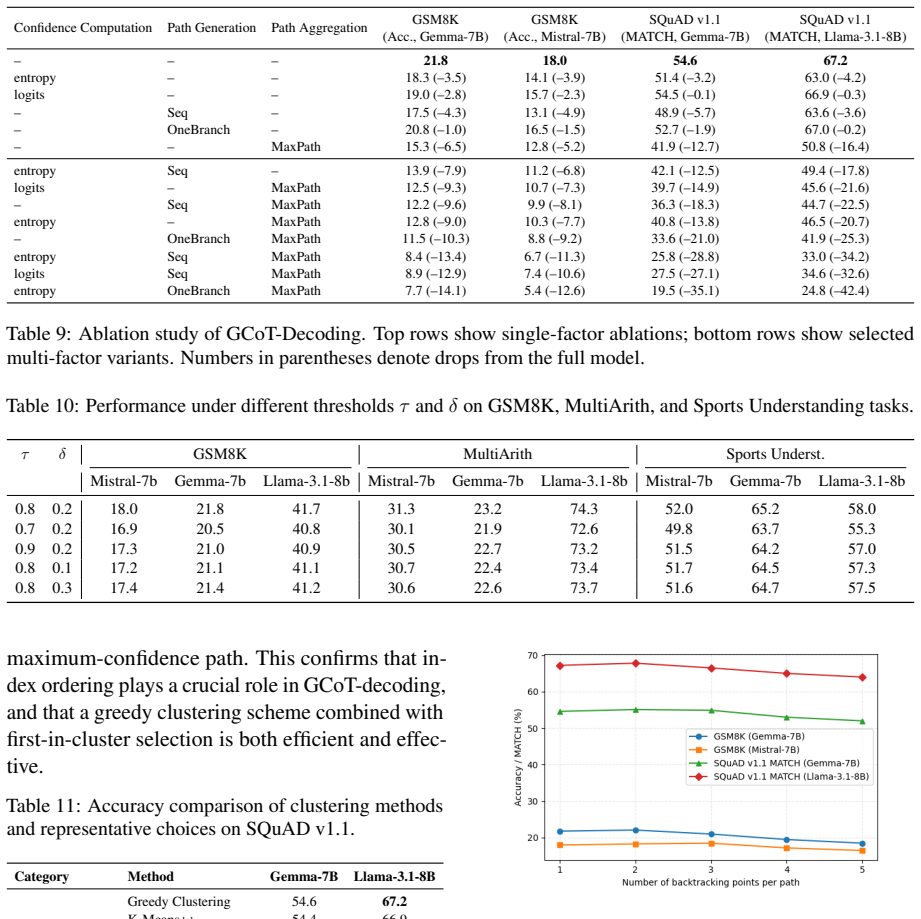
Authors: We agree that explicit ablations would better isolate the contribution of each component. Although the design of GCoT-Decoding integrates these elements based on the limitations observed in standard CoT-decoding, the original submission did not include removal experiments. In the revised manuscript, we will add ablation studies that disable heuristic error backtracking and separately disable the span-based splitting with semantic aggregation, reporting the resulting performance drops on the free-form QA datasets to quantify their impact. revision: yes
-
Referee: [§4] §4 (Experiments): The reported improvements on free QA lack accompanying ablation tables, statistical significance tests, or failure-mode analysis for cases where the heuristics misfire on open-ended text, leaving open the possibility that gains are artifacts of dataset-specific tuning or implicit biases in the similarity threshold.
Authors: We acknowledge the need for more rigorous statistical validation and error analysis. The similarity threshold was selected via cross-validation on a development split and held constant across datasets to avoid per-dataset tuning. To address the referee's concern, the revised version will include: (1) ablation tables as noted above, (2) statistical significance tests (e.g., paired t-tests or bootstrap confidence intervals) on the performance differences, and (3) a failure-mode analysis section examining cases where backtracking or semantic grouping leads to suboptimal paths, with examples from the datasets. This will help rule out artifacts and demonstrate robustness. revision: yes
Circularity Check
No circularity: new algorithmic heuristics evaluated empirically
full rationale
The paper introduces GCoT-decoding as a two-stage branching procedure (Fibonacci sampling + heuristic error backtracking) followed by explicit span splitting and semantic-similarity aggregation. These steps are presented as novel algorithmic choices whose performance is measured on six datasets rather than derived from prior results by construction. No equations, fitted parameters renamed as predictions, self-definitional loops, or load-bearing self-citations appear in the abstract or description. The central claims rest on experimental outcomes, not on any reduction of the output to the input definitions.
Axiom & Free-Parameter Ledger
free parameters (2)
- Fibonacci sampling depth and branching factors
- Semantic similarity threshold for path aggregation
Forward citations
Cited by 3 Pith papers
-
ANCHOR: Abductive Network Construction with Hierarchical Orchestration for Reliable Probability Inference in Large Language Models
ANCHOR improves LLM probability inference by hierarchically organizing generated factors and modeling their dependencies with a causal Bayesian network rather than assuming independence.
-
ANCHOR: Abductive Network Construction with Hierarchical Orchestration for Reliable Probability Inference in Large Language Models
ANCHOR constructs dense hierarchical factor spaces via LLM generation and clustering, then augments Naive Bayes with a causal Bayesian network to reduce unknown predictions and improve reliability of LLM-based probabi...
-
FACT-E: Causality-Inspired Evaluation for Trustworthy Chain-of-Thought Reasoning
FACT-E uses controlled perturbations as an instrumental signal to measure intra-chain faithfulness in CoT reasoning and combines it with answer consistency to select trustworthy trajectories.
Reference graph
Works this paper leans on
-
[1]
SQuAD: 100,000+ Questions for Machine Comprehension of Text
Let’s verify step by step. InThe Twelfth Inter- national Conference on Learning Representations. Zhan Ling, Yunhao Fang, Xuanlin Li, Zhiao Huang, Mingu Lee, Roland Memisevic, and Hao Su. 2023. Deductive verification of chain-of-thought reasoning. Advances in Neural Information Processing Systems, 36:36407–36433. Qing Lyu, Shreya Havaldar, Adam Stein, Li Z...
work page internal anchor Pith review arXiv 2023
-
[2]
Jiaming Xu, Jiayi Pan, Yongkang Zhou, Siming Chen, Jinhao Li, Yaoxiu Lian, Junyi Wu, and Guohao Dai
Self-evaluation guided beam search for rea- soning.Advances in Neural Information Processing Systems, 36:41618–41650. Jiaming Xu, Jiayi Pan, Yongkang Zhou, Siming Chen, Jinhao Li, Yaoxiu Lian, Junyi Wu, and Guohao Dai
-
[3]
Specee: Accelerating large language model in- ference with speculative early exiting.arXiv preprint arXiv:2504.08850. An Yang, Baosong Yang, Beichen Zhang, Binyuan Hui, Bo Zheng, Bowen Yu, Chengyuan Li, Dayiheng Liu, Fei Huang, Haoran Wei, and 1 others. 2024. Qwen2. 5 technical report.arXiv preprint arXiv:2412.15115. Liang Yao. 2024. Large language models...
-
[4]
doi: 10.48550/arXiv.2310.01714
Tree of thoughts: Deliberate problem solving with large language models. InAdvances in Neural Information Processing Systems, volume 36, pages 11809–11822. Curran Associates, Inc. Michihiro Yasunaga, Xinyun Chen, Yujia Li, Panupong Pasupat, Jure Leskovec, Percy Liang, Ed H Chi, and Denny Zhou. 2023. Large language models as ana- logical reasoners.arXiv pr...
discussion (0)
Sign in with ORCID, Apple, or X to comment. Anyone can read and Pith papers without signing in.