Recognition: unknown
Emergent structure in the binary black hole mass distribution and implications for population-based cosmology
Pith reviewed 2026-05-10 12:27 UTC · model grok-4.3
The pith
The binary black hole mass distribution shows emergent logarithmic hierarchy that biases Hubble constant measurements from gravitational waves.
A machine-rendered reading of the paper's core claim, the machinery that carries it, and where it could break.
Core claim
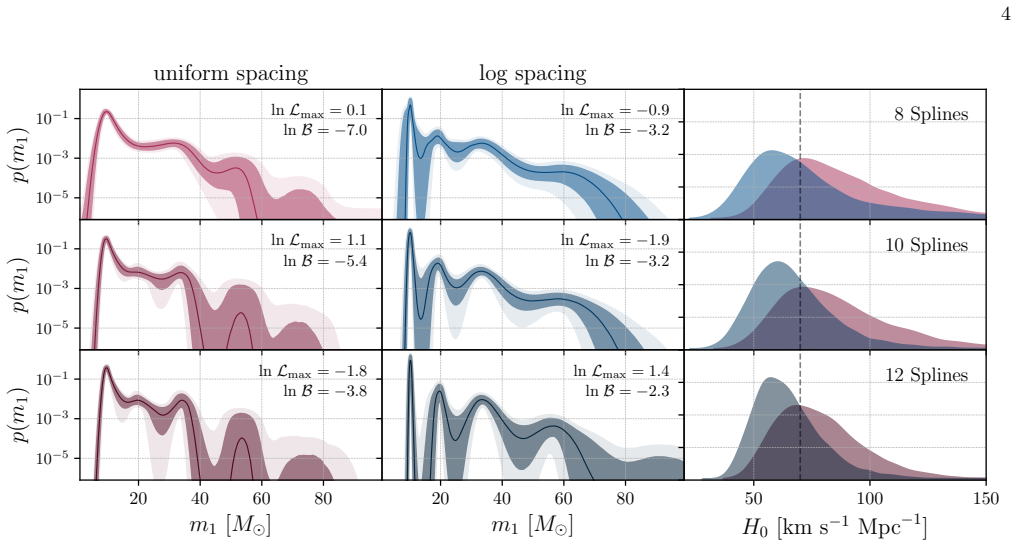
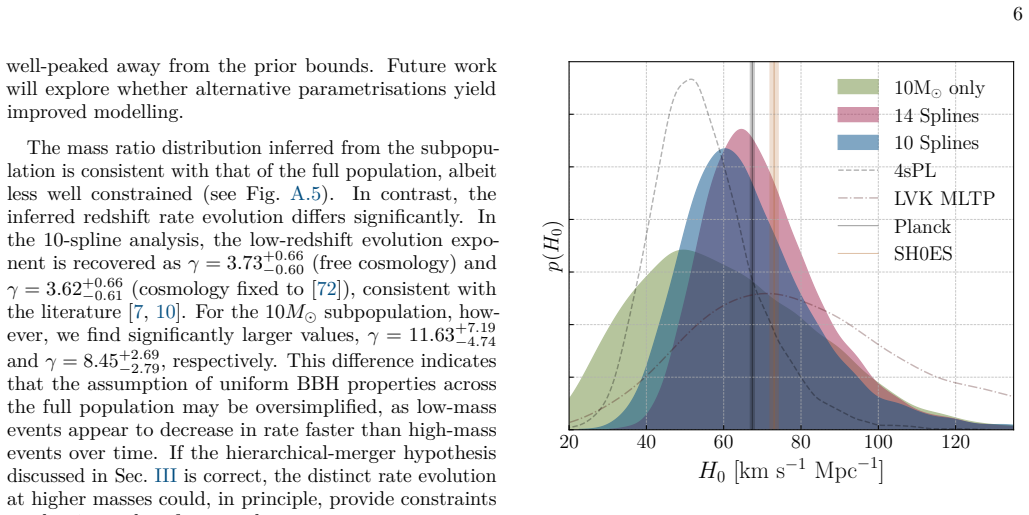
Using B-splines of increasing complexity on gravitational wave data, the reconstruction identifies several mass features that suggest a logarithmic hierarchy in the binary black hole population. The paper shows that these features, especially those at the distribution boundaries, introduce systematic shifts into population-based measurements of the Hubble constant, and it introduces an isolation approach for low-mass events that reduces such modeling systematics.
What carries the argument
B-spline reconstruction of the primary black hole mass distribution that identifies emergent structure by allowing increasing model complexity without a pre-chosen functional form.
If this is right
- Cosmological parameter estimation from gravitational wave populations must incorporate the identified boundary features to avoid bias in the Hubble constant.
- The logarithmic hierarchy provides a new observable for distinguishing between different black hole formation channels.
- Isolating the low-mass subpopulation yields a cleaner sample that reduces systematic uncertainties in population-based cosmology.
- Larger future catalogs will permit finer mapping of the hierarchy and its effects on other cosmological parameters.
Where Pith is reading between the lines
- Confirmation of the hierarchy could indicate that black hole formation involves discrete mass scales set by specific astrophysical processes.
- Smooth parametric models currently used for black hole populations may systematically misestimate cosmological quantities.
- Population simulations that embed log-spaced mass features could serve as a direct test of the reconstruction method's stability.
Load-bearing premise
The B-spline reconstruction with increasing complexity faithfully captures true population features without being dominated by selection effects, catalog incompleteness, or statistical fluctuations.
What would settle it
A substantially larger gravitational wave catalog analyzed with the same B-spline method that reveals no multiple mass features and no evidence of logarithmic spacing.
Figures


read the original abstract
Gravitational waves provide a powerful probe of both the astrophysical processes driving black hole mergers and the dynamics of the Universe, but these measurements rely on accurately inferring the unknown underlying population. We perform an agnostic reconstruction of the primary mass distribution using B-splines, characterising the emergence of structure with increasing model complexity. Using the latest gravitational-wave transient catalog, GWTC-4.0, we identify multiple mass features and find evidence suggesting a logarithmic hierarchy in the population. We show that this structure directly impacts measurements of the Hubble constant, primarily through features at the population boundaries. Finally, we introduce an approach that isolates a subpopulation of low-mass events to mitigate modelling systematics, providing a promising path toward robust population-based cosmology with future datasets.
Editorial analysis
A structured set of objections, weighed in public.
Referee Report
Summary. The paper performs an agnostic B-spline reconstruction of the primary black hole mass distribution from the GWTC-4.0 catalog. It reports the emergence of multiple mass features with increasing model complexity, including evidence for a logarithmic hierarchy, and demonstrates that boundary features in this distribution affect Hubble constant inference. It further proposes isolating a low-mass subpopulation to reduce modeling systematics for population-based cosmology.
Significance. If the identified hierarchy and boundary effects are shown to be intrinsic rather than artifacts, the work would strengthen the case for using GW population properties as cosmological probes and could inform astrophysical formation channels. The data-driven, prior-agnostic spline approach is a methodological strength that avoids strong parametric assumptions common in the field.
major comments (3)
- [Methods and Results] The central claim that increasing B-spline complexity reveals a genuine logarithmic hierarchy (rather than selection biases or Poisson fluctuations in the ~100 events) requires explicit validation; without injection-recovery tests on smooth power-law populations or posterior-predictive checks against p(det|m,z), the hierarchy and its H0 impact remain unverified.
- [Results and Discussion] The reported direct impact of boundary features on H0 measurements depends on the fitted spline parameters and their propagation through the redshifted-mass mapping; the manuscript must quantify this dependence (e.g., via marginalization over knot number/order or sensitivity to the low-mass cutoff) to support the cosmology implication.
- [Methods] The subpopulation-isolation method for mitigating systematics is introduced but lacks a concrete description of the selection criterion, its effect on the remaining sample size, and validation that it preserves cosmological information while removing boundary artifacts.
minor comments (2)
- [Methods] Clarify the precise criteria used for increasing model complexity and for declaring features 'emergent' (e.g., any information criterion or cross-validation metric).
- [Figures] Ensure all figures showing the reconstructed mass function include the full posterior uncertainty bands and the underlying GWTC-4.0 event masses for direct comparison.
Simulated Author's Rebuttal
We thank the referee for their constructive and detailed feedback, which has helped clarify several aspects of our work. We address each major comment point by point below. Revisions to the manuscript have been prepared to incorporate additional validations, quantifications, and methodological details as suggested.
read point-by-point responses
-
Referee: [Methods and Results] The central claim that increasing B-spline complexity reveals a genuine logarithmic hierarchy (rather than selection biases or Poisson fluctuations in the ~100 events) requires explicit validation; without injection-recovery tests on smooth power-law populations or posterior-predictive checks against p(det|m,z), the hierarchy and its H0 impact remain unverified.
Authors: We agree that explicit validation against artifacts is essential. In the revised manuscript we have added injection-recovery tests on mock catalogs drawn from smooth power-law mass distributions, injected through the GWTC-4.0 selection function p(det|m,z). These tests show that the logarithmic hierarchy does not appear when the underlying population is featureless, confirming it is not driven by Poisson fluctuations or selection biases alone. We have also included posterior-predictive checks comparing model predictions to the observed data. These additions directly support the robustness of the hierarchy and its reported effect on H0 inference. revision: yes
-
Referee: [Results and Discussion] The reported direct impact of boundary features on H0 measurements depends on the fitted spline parameters and their propagation through the redshifted-mass mapping; the manuscript must quantify this dependence (e.g., via marginalization over knot number/order or sensitivity to the low-mass cutoff) to support the cosmology implication.
Authors: We thank the referee for highlighting this dependence. The revised manuscript now quantifies it by marginalizing the H0 posterior over a range of knot numbers and spline orders. We additionally present sensitivity tests to shifts in the low-mass cutoff. These results demonstrate that the boundary features drive the H0 shift in a manner that is stable across reasonable variations in the spline hyperparameters and cutoff choice, thereby reinforcing the cosmological implications. revision: yes
-
Referee: [Methods] The subpopulation-isolation method for mitigating systematics is introduced but lacks a concrete description of the selection criterion, its effect on the remaining sample size, and validation that it preserves cosmological information while removing boundary artifacts.
Authors: We have substantially expanded the Methods section. The revised text now specifies the selection criterion as isolating events whose primary mass lies below the lowest-mass feature recovered by the B-spline model. This reduces the analyzed sample from the full GWTC-4.0 catalog to approximately 65 events. Validation is provided by direct comparison of the H0 posterior obtained from the isolated subpopulation versus the full sample; the constraints remain statistically consistent while the boundary-induced systematics are suppressed. revision: yes
Circularity Check
B-spline reconstruction of mass distribution and H0 sensitivity are data-driven without circular reduction to inputs
full rationale
The paper's core chain reconstructs the primary mass distribution via B-splines of increasing complexity directly from GWTC-4.0 events, identifies emergent features (including suggested logarithmic hierarchy) as outputs of that fit, and then demonstrates sensitivity of H0 inference to boundary features by feeding the fitted population model into the cosmological likelihood. This is a standard forward propagation of a data-driven model rather than any self-definitional loop, fitted parameter renamed as prediction, or load-bearing self-citation. The derivation remains self-contained against the catalog and selection function; no equation or step reduces the claimed structure or its cosmological implication to an input by construction.
Axiom & Free-Parameter Ledger
free parameters (1)
- B-spline order and knot number
axioms (1)
- domain assumption GWTC-4.0 catalog events accurately reflect the detectable population after accounting for selection biases and measurement uncertainties.
Forward citations
Cited by 1 Pith paper
-
Secondary-Mass Features improve Spectral-Siren $H_0$ Constraints
A new model emphasizing secondary mass features and pairing transitions improves spectral siren H0 constraints by ~30% using 142 GW events from GWTC-4.0.
Reference graph
Works this paper leans on
-
[1]
Observation of Gravitational Waves from a Binary Black Hole Merger
B. P. Abbottet al.(LIGO Scientific, Virgo), “Obser- vation of Gravitational Waves from a Binary Black Hole Merger,” Phys. Rev. Lett.116, 061102 (2016), arXiv:1602.03837 [gr-qc]
work page internal anchor Pith review arXiv 2016
-
[2]
Observed Gravitational-Wave Popula- tions,
T. A. Callister, “Observed Gravitational-Wave Popula- tions,” (2024), arXiv:2410.19145 [astro-ph.HE]
-
[3]
Cosmology with Gravitational Waves: A Review,
Simone Mastrogiovanni, Christos Karathanasis, Jonathan Gair, Gregory Ashton, Stefano Rinaldi, Hsiang-Yu Huang, and Gergely Dálya, “Cosmology with Gravitational Waves: A Review,” Annalen Phys. 536, 2200180 (2024)
2024
-
[4]
Black hole spectroscopy: from theory to experiment
Jahed Abediet al., “Black hole spectroscopy: from the- ory to experiment,” (2025), arXiv:2505.23895 [gr-qc]
work page internal anchor Pith review arXiv 2025
-
[5]
R. Abbottet al.(LIGO Scientific, Virgo), “Popula- tion Properties of Compact Objects from the Second LIGO-Virgo Gravitational-Wave Transient Catalog,” As- trophys. J. Lett. (2021), 10.3847/2041-8213/abe949, arXiv:2010.14533
-
[6]
R. Abbottet al.(KAGRA, VIRGO, LIGO Scientific), “Population of Merging Compact Binaries Inferred Using Gravitational Waves through GWTC-3,” Phys. Rev. X (2023), 10.1103/PhysRevX.13.011048, arXiv:2111.03634
-
[7]
GWTC-4.0: Population Properties of Merging Compact Binaries
A. G. Abacet al.(LIGO Scientific, VIRGO, KAGRA), “GWTC-4.0: Population Properties of Merging Compact Binaries,” (2025), arXiv:2508.18083 [astro-ph.HE]
work page internal anchor Pith review Pith/arXiv arXiv 2025
-
[8]
B. P. Abbottet al.(LIGO Scientific, Virgo, VIRGO), “A Gravitational-wave Measurement of the Hubble Con- stant Following the Second Observing Run of Ad- vanced LIGO and Virgo,” Astrophys. J.909, 218 (2021), arXiv:1908.06060 [astro-ph.CO]
-
[9]
R. Abbottet al.(LIGO Scientific, Virgo, KA- GRA), “Constraints on the Cosmic Expansion His- tory from GWTC–3,” Astrophys. J.949, 76 (2023), arXiv:2111.03604 [astro-ph.CO]
-
[10]
G., Abouelfettouh, I., Acernese, F., et al
A. G. Abacet al.(LIGO Scientific, VIRGO, KAGRA), “GWTC-4.0: Constraints on the Cosmic Expansion Rate and Modified Gravitational-wave Propagation,” (2025), arXiv:2509.04348 [astro-ph.CO]
-
[11]
Colm Talbot and Eric Thrane, “Measuring the binary black hole mass spectrum with an astrophysically moti- vated parameterization,” Astrophys. J.856, 173 (2018), arXiv:1801.02699 [astro-ph.HE]
-
[12]
Daniel Wysocki, Jacob Lange, and Richard O’Shaughnessy, “Reconstructing phenomenological dis- tributions of compact binaries via gravitational wave observations,” Phys. Rev. D100, 043012 (2019), arXiv:1805.06442 [gr-qc]
-
[13]
Vasco Gennari, Simone Mastrogiovanni, Nicola Tamanini, Sylvain Marsat, and Grégoire Pierra, “Search- ing for additional structure and redshift evolution in the observed binary black hole population with a parametric time-dependent mass distribution,” Phys. Rev. D111, 123046 (2025), arXiv:2502.20445 [gr-qc]
-
[14]
Amanda M. Farah, Bruce Edelman, Michael Zevin, Maya Fishbach, Jose María Ezquiaga, Ben Farr, and Daniel E. Holz, “Things That Might Go Bump in the Night: As- sessing Structure in the Binary Black Hole Mass Spec- trum,” Astrophys. J.955, 107 (2023), arXiv:2301.00834 [astro-ph.HE]
-
[15]
VAMANA: modeling binary black hole population with minimal assumptions,
Vaibhav Tiwari, “VAMANA: modeling binary black hole population with minimal assumptions,” Class. Quant. Grav.38, 155007 (2021), arXiv:2006.15047 [astro- ph.HE]
-
[16]
Stefano Rinaldi and Walter Del Pozzo, “(H)DPGMM: a hierarchy of Dirichlet process Gaussian mixture mod- els for the inference of the black hole mass function,” Mon. Not. Roy. Astron. Soc.509, 5454–5466 (2021), arXiv:2109.05960 [astro-ph.IM]
-
[17]
Jam Sadiq, Thomas Dent, and Daniel Wysocki, “Flex- ible and fast estimation of binary merger population distributions with an adaptive kernel density estimator,” Phys. Rev. D105, 123014 (2022), arXiv:2112.12659 [gr- qc]
-
[18]
Cover Your Basis: Comprehensive Data-driven Characteriza- tion of the Binary Black Hole Population,
Bruce Edelman, Ben Farr, and Zoheyr Doctor, “Cover Your Basis: Comprehensive Data-driven Characteriza- tion of the Binary Black Hole Population,” Astrophys. J.946, 16 (2023), arXiv:2210.12834 [astro-ph.HE]
-
[19]
Parameter-Free Tour of the Binary Black Hole Population,
Thomas A. Callister and Will M. Farr, “Parameter-Free Tour of the Binary Black Hole Population,” Phys. Rev. X14, 021005 (2024), arXiv:2302.07289 [astro-ph.HE]
-
[20]
Anarya Ray, Ignacio Magaña Hernandez, Katelyn Breivik, and Jolien Creighton, “Searching for bi- nary black hole sub-populations in gravitational wave data using binned Gaussian processes,” (2024), arXiv:2404.03166 [astro-ph.HE]
-
[21]
Jack Heinzel, Matthew Mould, Sofía Álvarez-López, and Salvatore Vitale, “PixelPop: High Resolution Nonparam- eteric Inference of Gravitational-Wave Populations in Multiple Dimensions,” (2024), arXiv:2406.16813 [astro- ph.HE]
-
[22]
Seeking spinning subpopulations of black hole binaries via iterative density estimation,
Jam Sadiq, Thomas Dent, and Ana Lorenzo-Medina, “Seeking spinning subpopulations of black hole binaries via iterative density estimation,” Phys. Rev. D112, 123054 (2025), arXiv:2506.02250 [astro-ph.HE]
-
[23]
Measurement prospects for the pair-instability mass cutoff with gravitational waves
Matthew Mould, Jack Heinzel, Sofia Alvarez-Lopez, Cailin Plunkett, Noah E. Wolfe, and Salvatore Vitale, “Measurement prospects for the pair-instability mass cut- off with gravitational waves,” (2026), arXiv:2602.11282 [astro-ph.HE]
work page internal anchor Pith review Pith/arXiv arXiv 2026
-
[24]
2025, arXiv e-prints, arXiv:2510.25579, doi: 10.48550/arXiv.2510.25579
Vaibhav Tiwari, “Population of Binary Black Holes In- ferred from One Hundred and Fifty Gravitational Wave Signals,” (2025), arXiv:2510.25579 [astro-ph.HE]
-
[25]
Matteo Tagliazucchi, Michele Moresco, Nicola Borghi, and Chiara Ciapetti, “Mind the peak: improving cosmo- logical constraints from GWTC-4.0 spectral sirens using semiparametric mass models,” (2026), arXiv:2601.03347 [astro-ph.CO]
work page internal anchor Pith review Pith/arXiv arXiv 2026
-
[26]
Spectral sirens cosmology from binary black holes populations with sharper mass features
Tom Bertheas, Vasco Gennari, Danièle Steer, and Nicola Tamanini, “Spectral sirens cosmology from binary black holes populations with sharper mass features,” (2026), arXiv:2603.06792 [gr-qc]
-
[27]
Ignacio Magaña Hernandez and Antonella Palmese, “A new bump in the night: evidence of a new fea- ture in the binary black hole mass distribution at 70 M⊙ from gravitational-wave observations,” (2024), arXiv:2407.02460 [astro-ph.HE]
-
[28]
Heavy Black-Holes Also Matter in Standard Siren Cosmology
Grégoire Pierra and Alexander Papadopoulos, “Heavy Black-Holes Also Matter in Standard Siren Cosmology,” (2026), arXiv:2601.03257 [astro-ph.CO]
-
[29]
Predictions of a simple parametric model 13 of hierarchical black hole mergers,
Parthapratim Mahapatra, Debatri Chattopadhyay, Anu- radha Gupta, Marc Favata, B. S. Sathyaprakash, and K. G. Arun, “Predictions of a simple parametric model 13 of hierarchical black hole mergers,” Phys. Rev. D111, 023013 (2025), arXiv:2209.05766 [astro-ph.HE]
-
[30]
Jacob Golomb, Maximiliano Isi, and Will M. Farr, “Physical Models for the Astrophysical Population of Black Holes: Application to the Bump in the Mass Distribution of Gravitational-wave Sources,” Astrophys. J.976, 121 (2024), arXiv:2312.03973 [astro-ph.HE]
-
[31]
Maria Paola Vaccaro, Michela Mapelli, Carole Périgois, Dario Barone, Maria Celeste Artale, Marco Dall’Amico, Giuliano Iorio, and Stefano Torniamenti, “Impact of gas hardening on the population properties of hierarchi- cal black hole mergers in active galactic nucleus disks,” Astron. Astrophys.685, A51 (2024), arXiv:2311.18548 [astro-ph.HE]
-
[32]
Storm Colloms, Christopher P. L. Berry, John Veitch, and Michael Zevin, “Exploring the Evolution of Gravitational-wave Emitters with Efficient Emulation: Constraining the Origins of Binary Black Holes Us- ing Normalizing Flows,” Astrophys. J.988, 189 (2025), arXiv:2503.03819 [astro-ph.HE]
-
[33]
Calibrating spectral siren cosmology with synthetic catalogs of binary black hole mergers,
Arianna Scarpa, Simone Mastrogiovanni, Filippo San- toliquido, and Manuel Arca-Sedda, “Calibrating spectral siren cosmology with synthetic catalogs of binary black hole mergers,” (2026), arXiv:2603.15332 [astro-ph.CO]
-
[34]
Dynamics of binary black holes in low-mass young star clusters,
Sara Rastello, Michela Mapelli, Ugo N. di Carlo, Giu- liano Iorio, Alessandro Ballone, Nicola Giacobbo, Fil- ippo Santoliquido, and Stefano Torniamenti, “Dynamics of binary black holes in low-mass young star clusters,” Mon. Not. Roy. Astron. Soc.507, 3612–3625 (2021), arXiv:2105.01669 [astro-ph.GA]
-
[35]
Filippo Santoliquido, Michela Mapelli, Giuliano Iorio, Guglielmo Costa, Simon C. O. Glover, Tilman Hartwig, Ralf S. Klessen, and Lorenzo Merli, “Binary black hole mergers from population III stars: uncertainties from star formation and binary star properties,” Mon. Not. Roy. Astron. Soc.524, 307–324 (2023), [Erra- tum: Mon.Not.Roy.Astron.Soc. 528, 954–962...
-
[36]
Cecilia Sgalletta, Michela Mapelli, Lumen Boco, Filippo Santoliquido, M. Celeste Artale, Giuliano Iorio, Andrea Lapi, and Mario Spera, “The more accurately we model the metal-dependent star formation rate, the larger the predicted excess of binary black hole mergers,” (2024), arXiv:2410.21401 [astro-ph.HE]
-
[37]
Stefano Rinaldi, Yajie Liang, Gabriele Demasi, Michela Mapelli, and Walter Del Pozzo, “Exploration of fea- tures in the black hole mass spectrum inspired by non- parametric analyses of gravitational wave observations,” Astron. Astrophys.702, A52 (2025), arXiv:2506.05929 [astro-ph.HE]
-
[38]
Trust the process: mapping data-driven recon- structionstoinformedmodelsusingstochasticprocesses,
Stefano Rinaldi, Alexandre Toubiana, and Jonathan R. Gair, “Trust the process: mapping data-driven recon- structionstoinformedmodelsusingstochasticprocesses,” JCAP12, 031 (2025), arXiv:2506.05153 [gr-qc]
-
[39]
Variance of gravitational-wave populations,
Alessia Corelli, Davide Gerosa, Matthew Mould, and Cecilia Maria Fabbri, “Variance of gravitational-wave populations,” (2026), arXiv:2603.00239 [astro-ph.HE]
-
[40]
Bruce Edelman, Zoheyr Doctor, Jaxen Godfrey, and Ben Farr, “Ain’t No Mountain High Enough: Semi- parametric Modeling of LIGO–Virgo’s Binary Black Hole Mass Distribution,” Astrophys. J.924, 101 (2022), arXiv:2109.06137 [astro-ph.HE]
-
[41]
Hubble without the Hubble: Cosmology using advanced gravitational-wave detectors alone,
Stephen R. Taylor, Jonathan R. Gair, and Ilya Mandel, “Hubble without the Hubble: Cosmology using advanced gravitational-wave detectors alone,” Phys. Rev. D85, 023535 (2012), arXiv:1108.5161 [gr-qc]
-
[42]
Spectral Sirens: Cosmology from the Full Mass Distribution of Compact Binaries,
Jose María Ezquiaga and Daniel E. Holz, “Spectral Sirens: Cosmology from the Full Mass Distribution of Compact Binaries,” Phys. Rev. Lett.129, 061102 (2022), arXiv:2202.08240 [astro-ph.CO]
-
[43]
Utkarsh Mali and Reed Essick, “Striking a Chord with Spectral Sirens: Multiple Features in the Compact Bi- nary Population Correlate with H0,” Astrophys. J.980, 85 (2025), arXiv:2410.07416 [astro-ph.HE]
-
[44]
J. Aasiet al.(LIGO Scientific), “Advanced LIGO,” Class. Quant. Grav.32, 074001 (2015), arXiv:1411.4547 [gr-qc]
work page internal anchor Pith review arXiv 2015
-
[45]
Advanced Virgo: a 2nd generation interferometric gravitational wave detector
F. Acerneseet al.(VIRGO), “Advanced Virgo: a second- generation interferometric gravitational wave detector,” Class. Quant. Grav.32, 024001 (2015), arXiv:1408.3978 [gr-qc]
work page internal anchor Pith review arXiv 2015
-
[46]
T. Akutsuet al.(KAGRA), “Overview of KAGRA: De- tector design and construction history,” PTEP2021, 05A101 (2021), arXiv:2005.05574 [physics.ins-det]
-
[47]
B. P. Abbottet al.(KAGRA, LIGO Scientific, Virgo), “Prospectsforobservingandlocalizinggravitational-wave transients with Advanced LIGO, Advanced Virgo and KAGRA,”LivingRev.Rel.19,1(2016),arXiv:1304.0670 [gr-qc]
-
[48]
A. G. Abacet al.(LIGO Scientific, VIRGO, KAGRA), “GWTC-4.0: UpdatingtheGravitational-WaveTransient Catalog with Observations from the First Part of the Fourth LIGO-Virgo-KAGRA Observing Run,” (2025), arXiv:2508.18082 [gr-qc]
work page internal anchor Pith review arXiv 2025
-
[49]
Abbottet al.(LIGO Scientific and Virgo Collaboration), Phys
R.Abbottet al.(LIGOScientific, Virgo),“GW190521: A Binary Black Hole Merger with a Total Mass of150M⊙,” Phys. Rev. Lett.125, 101102 (2020), arXiv:2009.01075 [gr-qc]
-
[50]
Abbottet al.(LIGO Scientific and Virgo Collaboration), Astrophys
R. Abbottet al.(LIGO Scientific, Virgo), “Properties and Astrophysical Implications of the 150 M⊙ Binary Black Hole Merger GW190521,” Astrophys. J. Lett.900, L13 (2020), arXiv:2009.01190 [astro-ph.HE]
-
[51]
GW231123: A Binary Black Hole Merger with Total Mass 190–265M ⊙,
A. G. Abacet al.(LIGO Scientific, VIRGO, KAGRA), “GW231123: A Binary Black Hole Merger with Total Mass 190–265 M⊙,” Astrophys. J. Lett.993, L25 (2025), arXiv:2507.08219 [astro-ph.HE]
-
[52]
Abbottet al.(LIGO Scientific and Virgo Collaboration), Phys
R. Abbottet al.(LIGO Scientific, Virgo), “GW190412: Observation of a Binary-Black-Hole Coalescence with Asymmetric Masses,” Phys. Rev. D102, 043015 (2020), arXiv:2004.08342 [astro-ph.HE]
-
[53]
Digging the population of compact binary mergers out of the noise,
Sebastian M. Gaebel, John Veitch, Thomas Dent, and Will M. Farr, “Digging the population of compact binary mergers out of the noise,” Mon. Not. Roy. Astron. Soc. 484, 4008–4023 (2019), arXiv:1809.03815 [astro-ph.IM]
-
[54]
Extracting distribution parameters from multiple uncertain observations with selection biases
Ilya Mandel, Will M. Farr, and Jonathan R. Gair, “Extracting distribution parameters from multiple uncer- tain observations with selection biases,” Mon. Not. Roy. Astron. Soc.486, 1086–1093 (2019), arXiv:1809.02063 [physics.data-an]
work page Pith review arXiv 2019
-
[55]
Inferring the properties of a population of compact binaries in presence of selection effects
Salvatore Vitale, Davide Gerosa, Will M. Farr, and Stephen R. Taylor, “Inferring the properties of a population of compact binaries in presence of selec- tion effects,” (2020), 10.1007/978-981-15-4702-7-45-1, arXiv:2007.05579 [astro-ph.IM]
work page internal anchor Pith review Pith/arXiv arXiv doi:10.1007/978-981-15-4702-7-45-1 2020
-
[56]
Simone Mastrogiovanni, Konstantin Leyde, Christos Karathanasis, Eric Chassande-Mottin, Daniele Ann Steer, Jonathan Gair, Archisman Ghosh, Rachel Gray, Suvodip Mukherjee, and Stefano Rinaldi, “Cosmology in the dark: How compact binaries formation impact the 14 gravitational-waves cosmological measurements,” PoS EPS-HEP2021, 098 (2022), arXiv:2205.05421 [gr-qc]
-
[57]
Simone Mastrogiovanni, Danny Laghi, Rachel Gray, Giada Caneva Santoro, Archisman Ghosh, Christos Karathanasis, Konstantin Leyde, Daniele A. Steer, StephanePerries, andGregoirePierra,“Jointpopulation and cosmological properties inference with gravitational waves standard sirens and galaxy surveys,” Phys. Rev. D108, 042002 (2023), arXiv:2305.10488 [astro-ph.CO]
-
[58]
Simone Mastrogiovanni, Grégoire Pierra, Stéphane Per- riès, Danny Laghi, Giada Caneva Santoro, Archisman Ghosh, Rachel Gray, Christos Karathanasis, and Kon- stantin Leyde, “ICAROGW: A python package for in- ference of astrophysical population properties of noisy, heterogeneous, and incomplete observations,” Astron. Astrophys.682, A167 (2024), arXiv:2305.1...
-
[59]
, archivePrefix = "arXiv", eprint =
Piero Madau and Mark Dickinson, “Cosmic Star Forma- tion History,” Ann. Rev. Astron. Astrophys.52, 415–486 (2014), arXiv:1403.0007 [astro-ph.CO]
work page internal anchor Pith review Pith/arXiv arXiv 2014
-
[60]
Hui Tong, Maya Fishbach, and Eric Thrane, “Spin- ning Spectral Sirens: Robust Cosmological Measure- ment Using Mass–Spin Correlations in the Binary Black Hole Population,” Astrophys. J.985, 220 (2025), arXiv:2502.10780 [astro-ph.CO]
-
[61]
Shanika Galaudageet al., “Building Better Spin Models for Merging Binary Black Holes: Evidence for Nonspin- ning and Rapidly Spinning Nearly Aligned Subpopu- lations,” Astrophys. J. Lett.921, L15 (2021), [Erra- tum: Astrophys.J.Lett. 936, L18 (2022), Erratum: As- trophys.J. 936, L18 (2022)], arXiv:2109.02424 [gr-qc]
-
[62]
Who Ordered That? Unequal-mass Binary Black Hole Mergers Have Larger Effective Spins,
Thomas A. Callister, Carl-Johan Haster, Ken K. Y. Ng, Salvatore Vitale, and Will M. Farr, “Who Ordered That? Unequal-mass Binary Black Hole Mergers Have Larger Effective Spins,” Astrophys. J. Lett.922, L5 (2021), arXiv:2106.00521 [astro-ph.HE]
-
[63]
The Binary Black Hole Spin Distribution Likely Broadens with Redshift,
Sylvia Biscoveanu, Thomas A. Callister, Carl-Johan Haster, Ken K. Y. Ng, Salvatore Vitale, and Will M. Farr, “The Binary Black Hole Spin Distribution Likely Broadens with Redshift,” Astrophys. J. Lett.932, L19 (2022), arXiv:2204.01578 [astro-ph.HE]
-
[64]
2024b, arXiv e-prints, arXiv:2406.01679, doi: 10.48550/arXiv.2406.01679
Grégoire Pierra, Simone Mastrogiovanni, and Stéphane Perriès, “The spin magnitude of stellar-mass binary black holes evolves with the mass: evidence from gravitational wave data,” (2024), arXiv:2406.01679 [gr-qc]
-
[65]
Emanuele Berti, Francesco Crescimbeni, Gabriele Fran- ciolini, Simone Mastrogiovanni, Paolo Pani, and Gré- goire Pierra, “Inferring black hole formation channels in GWTC-4.0 via parametric mass-spin correlations de- rived from first principles,” Phys. Rev. D113, 043048 (2026), arXiv:2512.03152 [gr-qc]
-
[66]
nessai: Nested sampling with artificial intelligence,
Michael J. Williams, “nessai: Nested sampling with artificial intelligence,” (2021)
2021
-
[67]
Nested sampling with normalizing flows for gravitational-wave inference,
Michael J. Williams, John Veitch, and Chris Mes- senger, “Nested sampling with normalizing flows for gravitational-wave inference,” Phys. Rev. D103, 103006 (2021), arXiv:2102.11056 [gr-qc]
-
[68]
and Veitch, John and Messenger, Chris
Michael J. Williams, John Veitch, and Chris Mes- senger, “Importance nested sampling with normalis- ing flows,” Mach. Learn. Sci. Tech.4, 035011 (2023), arXiv:2302.08526 [astro-ph.IM]
-
[69]
Gwtc-4.0 cumulative search sensitivity estimates,
LIGO Scientific Collaboration, Virgo Collaboration, and KAGRA Collaboration, “Gwtc-4.0 cumulative search sensitivity estimates,”https://zenodo.org/records/ 16740128(2025)
2025
-
[70]
Reed Essicket al., “Compact Binary Coalescence Sensi- tivity Estimates with Injection Campaigns during the LIGO-Virgo-KAGRA Collaborations’ Fourth Observing Run,” (2025), arXiv:2508.10638 [gr-qc]
-
[71]
Accuracy Requirements for Empirically- Measured Selection Functions,
Will M. Farr, “Accuracy Requirements for Empirically- Measured Selection Functions,” Research Notes of the AAS3, 66 (2019), arXiv:1904.10879 [astro-ph.IM]
-
[72]
Planck 2015 results. XIII. Cosmological parameters
P. A. R. Adeet al.(Planck), “Planck 2015 results. XIII. Cosmological parameters,” Astron. Astrophys.594, A13 (2016), arXiv:1502.01589 [astro-ph.CO]
work page Pith review arXiv 2015
-
[73]
Alexandre Toubiana, Michael L. Katz, and Jonathan R. Gair, “Is there an excess of black holes around 20 M⊙? Optimizing the complexity of population models with the use of reversible jump MCMC.” Mon. Not. Roy. Astron. Soc.524, 5844–5853 (2023), arXiv:2305.08909 [gr-qc]
-
[74]
Tom Bertheas, Vasco Gennari, and Nicola Tamanini, “Towards a few percent measurement of the Hubble con- stant with the current network of gravitational wave detectors without using electromagnetic information,” (2025), arXiv:2508.19331 [gr-qc]
-
[75]
Examining the Gap in the Chirp Mass Distribution of Binary Black Holes,
Vaibhav Tiwari, “Examining the Gap in the Chirp Mass Distribution of Binary Black Holes,” Astrophys. J.995, 177 (2025), arXiv:2507.15697 [astro-ph.HE]
-
[76]
2026, arXiv e-prints, arXiv:2604.01420, doi: 10.48550/arXiv.2604.01420
Isaac Legred, Jacob Golomb, and Katerina Chatziioan- nou, “Low-mass failed supernovae and the10M⊙ peak in the merging black hole mass distribution,” (2026), arXiv:2604.01420 [astro-ph.HE]
-
[77]
Matthew Mould, Noah E. Wolfe, and Salvatore Vi- tale, “Rapid inference and comparison of gravitational- wave population models with neural variational posteri- ors,” Phys. Rev. D111, 123049 (2025), arXiv:2504.07197 [astro-ph.IM]
-
[78]
Michela Mapelliet al., “Hierarchical black hole mergers in young, globular and nuclear star clusters: the effect of metallicity, spin and cluster properties,” Mon. Not. Roy. Astron. Soc.505, 339–358 (2021), arXiv:2103.05016 [astro-ph.HE]
-
[79]
Hierarchical merg- ers of stellar-mass black holes and their gravitational- wave signatures,
Davide Gerosa and Maya Fishbach, “Hierarchical merg- ers of stellar-mass black holes and their gravitational- wave signatures,” Nature Astron.5, 749–760 (2021), arXiv:2105.03439 [astro-ph.HE]
-
[80]
Are LIGO’s Black Holes Made From Smaller Black Holes?
Maya Fishbach, Daniel E. Holz, and Ben Farr, “Are LIGO’s Black Holes Made From Smaller Black Holes?” Astrophys. J. Lett.840, L24 (2017), arXiv:1703.06869 [astro-ph.HE]
discussion (0)
Sign in with ORCID, Apple, or X to comment. Anyone can read and Pith papers without signing in.