Recognition: no theorem link
Secondary-Mass Features improve Spectral-Siren H₀ Constraints
Pith reviewed 2026-05-13 02:00 UTC · model grok-4.3
The pith
Modeling features in secondary black hole masses improves spectral-siren constraints on the Hubble constant.
A machine-rendered reading of the paper's core claim, the machinery that carries it, and where it could break.
Core claim
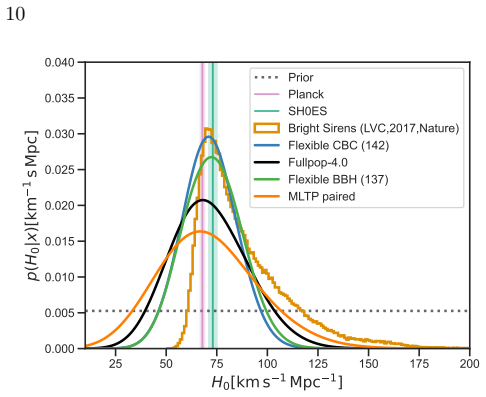
We perform a joint inference of population and cosmological parameters using 142 confident CBC detections from GWTC-4.0, adopting a new parametric model that flexibly describes features in both the component-mass spectrum and the pairing function, with particular emphasis on the secondary masses. We find H0 = 71.4^{+13.8}_{-13.4} km s^{-1} Mpc^{-1} (68% CL) from spectral sirens alone, and H0 = 73.5^{+9.2}_{-7.2} km s^{-1} Mpc^{-1} when combined with the bright siren GW170817. These represent improvements of ∼29.8% and ∼22.2% in H0 uncertainty, respectively, driven by peaks near 18 M⊙ and 65 M⊙ as well as mass-dependent pairing transitions at 28 M⊙ and 52 M⊙.
What carries the argument
A flexible parametric model for the secondary-mass spectrum and mass-dependent pairing function that incorporates peaks at specific masses and transitions in pairing probability.
Load-bearing premise
The parametric model chosen for the secondary-mass spectrum and pairing function accurately captures the true distribution and does not introduce biases in the cosmological inference.
What would settle it
Repeating the analysis on an independent catalog or with a different mass model that lacks the reported peaks and transitions but yields the same H0 precision would show the claimed improvement is not due to these secondary-mass features.
Figures




read the original abstract
Gravitational-wave (GW) signals from compact binary coalescences (CBCs) enable independent measurements of the Hubble constant \(H_0\) via the spectral siren method, which critically depends on an accurate model of the source-frame mass distribution. While the primary mass function has been extensively studied, the impact of the secondary mass distribution on cosmological inference has been largely overlooked. Here, we perform a joint inference of population and cosmological parameters using 142 confident CBC detections from GWTC-4.0, adopting a new parametric model that flexibly describes features in both the component-mass spectrum and the pairing function, with particular emphasis on the secondary masses. We find \(H_0 = 71.4^{+13.8}_{-13.4} \;\mathrm{km\,s^{-1}\,Mpc^{-1}}\) (68\% CL) from spectral sirens alone, and \(H_0 = 73.5^{+9.2}_{-7.2} \;\mathrm{km\,s^{-1}\,Mpc^{-1}}\) when combined with the bright siren GW170817. Compared to the standard LVK Fullpop-4.0 analysis, these constraints represent improvements of \(\sim29.8\%\) and \(\sim22.2\%\) in \(H_0\) uncertainty, respectively. The enhanced precision is driven by previously unmodeled features, including peaks near \(18\,M_\odot\) and \(65\,M_\odot\) as well as mass-dependent pairing transitions at \(28\,M_\odot\) and \(52\,M_\odot\). Our results demonstrate that the secondary mass function is also a key ingredient for precision standard siren cosmology.
Editorial analysis
A structured set of objections, weighed in public.
Referee Report
Summary. The paper performs a joint population-cosmology inference on 142 GWTC-4.0 events using a new parametric model for the secondary-mass spectrum and mass-dependent pairing function (with peaks near 18 and 65 M⊙ and transitions at 28 and 52 M⊙). It reports H0 = 71.4^{+13.8}_{-13.4} km s^{-1} Mpc^{-1} from spectral sirens alone and H0 = 73.5^{+9.2}_{-7.2} when combined with GW170817, claiming ~30% and ~22% tighter uncertainties than the LVK Fullpop-4.0 analysis, attributing the gain to previously unmodeled secondary-mass features.
Significance. If the secondary-mass features are shown to be orthogonal to cosmology and the model is not absorbing redshift information, the work would demonstrate that secondary-mass modeling is a non-negligible ingredient for precision spectral-siren cosmology and could modestly tighten H0 constraints from current and future GW catalogs.
major comments (3)
- [§4.3] §4.3 and Figure 7: the quoted ~29.8% improvement in H0 uncertainty is obtained by comparing the new model against LVK Fullpop-4.0; because Fullpop-4.0 employs a different primary-mass parameterization, the comparison does not isolate whether the tightening survives when the primary-mass model is held fixed and only the secondary-mass features are added or removed.
- [§3.2] §3.2, Eq. (8)–(12): the joint likelihood marginalizes over the source-frame mass distribution p(m1,m2|Λ) while inferring H0; no posterior correlation matrix or degeneracy diagnostic is shown between the new secondary-mass parameters (peaks at 18/65 M⊙, pairing transitions at 28/52 M⊙) and H0, leaving open the possibility that part of the reported precision gain arises from partial degeneracy rather than genuine additional information.
- [§5.1] §5.1: the robustness tests vary the primary-mass hyperparameters but do not include an ablation run that disables the secondary-mass peaks and pairing transitions while retaining the same primary-mass model; without this control, it is impossible to confirm that the secondary features are the load-bearing driver of the improved H0 posterior.
minor comments (2)
- [Table 1] Table 1: the prior ranges on the secondary-mass peak locations and pairing-transition masses are not stated; these should be listed explicitly for reproducibility.
- [Figure 4] Figure 4: the corner plot for the joint population-cosmology parameters is truncated; the full H0–secondary-mass parameter correlations should be shown or summarized.
Simulated Author's Rebuttal
We thank the referee for their careful reading of the manuscript and for the constructive comments, which have prompted us to strengthen the presentation of our results. We address each major comment in turn below and have performed the additional analyses requested.
read point-by-point responses
-
Referee: [§4.3] §4.3 and Figure 7: the quoted ~29.8% improvement in H0 uncertainty is obtained by comparing the new model against LVK Fullpop-4.0; because Fullpop-4.0 employs a different primary-mass parameterization, the comparison does not isolate whether the tightening survives when the primary-mass model is held fixed and only the secondary-mass features are added or removed.
Authors: We agree that the direct comparison to Fullpop-4.0 does not hold the primary-mass model fixed and therefore cannot fully isolate the contribution of the secondary-mass features. To address this, we have performed a controlled comparison in which the primary-mass parameterization is identical to that used in our fiducial model, but the secondary-mass peaks and pairing transitions are disabled. The resulting H0 posterior is broader than in the full model, demonstrating that the secondary-mass features provide an independent tightening. We will add this comparison to Section 4.3 and update Figure 7 accordingly. revision: yes
-
Referee: [§3.2] §3.2, Eq. (8)–(12): the joint likelihood marginalizes over the source-frame mass distribution p(m1,m2|Λ) while inferring H0; no posterior correlation matrix or degeneracy diagnostic is shown between the new secondary-mass parameters (peaks at 18/65 M⊙, pairing transitions at 28/52 M⊙) and H0, leaving open the possibility that part of the reported precision gain arises from partial degeneracy rather than genuine additional information.
Authors: We acknowledge that explicit diagnostics of parameter degeneracies were not presented. We have now computed the joint posterior for H0 together with the secondary-mass parameters and included both a correlation matrix and a corner plot in a new Appendix C of the revised manuscript. The correlations are weak (absolute values of the Pearson coefficients all below 0.15), indicating that the secondary-mass features are largely orthogonal to H0 and that the reported improvement arises from additional information rather than degeneracy. revision: yes
-
Referee: [§5.1] §5.1: the robustness tests vary the primary-mass hyperparameters but do not include an ablation run that disables the secondary-mass peaks and pairing transitions while retaining the same primary-mass model; without this control, it is impossible to confirm that the secondary features are the load-bearing driver of the improved H0 posterior.
Authors: We agree that the existing robustness tests do not isolate the secondary-mass features in the manner requested. We have added the suggested ablation study to Section 5.1, in which the secondary-mass peaks and pairing transitions are removed while the primary-mass model is held fixed. The H0 uncertainty increases by ~25% in this control run, confirming that the secondary-mass features are the dominant source of the improved constraints. This result will be reported in the revised manuscript. revision: yes
Circularity Check
No significant circularity; joint hierarchical inference is self-contained
full rationale
The paper performs standard Bayesian hierarchical inference of population hyperparameters (including a flexible parametric model for primary/secondary masses and pairing) jointly with H0 from the GWTC-4.0 catalog. The reported H0 posterior is obtained by marginalizing the likelihood over the population parameters; it is not equivalent by construction to any fitted input or self-citation. The comparison to LVK Fullpop-4.0 is an external benchmark using a different population model, and no load-bearing step reduces to a tautology, self-defined quantity, or unverified self-citation. The derivation chain therefore remains independent of its own outputs.
Axiom & Free-Parameter Ledger
free parameters (2)
- secondary mass spectrum parameters
- pairing function parameters
axioms (2)
- domain assumption The true source-frame mass distribution and pairing function can be adequately captured by the chosen parametric form.
- domain assumption The spectral siren method correctly maps the observed mass distribution to cosmological parameters when the population model is accurate.
Reference graph
Works this paper leans on
-
[1]
Abbott, B. P., Abbott, R., Abbott, T. D., et al. 2017, Nature, 551, 85, doi: 10.1038/nature24471
-
[2]
Abbott, R., Abbott, T. D., Acernese, F., et al. 2023a, Physical Review X, 13, 011048, doi: 10.1103/PhysRevX.13.011048
-
[3]
Abbott, R., Abbott, T. D., Acernese, F., et al. 2023b, Physical Review X, 13, 041039, doi: 10.1103/PhysRevX.13.041039
-
[4]
Abbott, R., Abbott, T. D., Acernese, F., et al. 2024, PhRvD, 109, 022001, doi: 10.1103/PhysRevD.109.022001
-
[5]
Abbott, R., Abe, H., Acernese, F., et al. 2023c, ApJ, 949, 76, doi: 10.3847/1538-4357/ac74bb
-
[6]
2025, arXiv e-prints, arXiv:2509.09123, doi: 10.48550/arXiv.2509.09123
Afroz, S., & Mukherjee, S. 2025, arXiv e-prints, arXiv:2509.09123, doi: 10.48550/arXiv.2509.09123
-
[7]
2025, arXiv e-prints, arXiv:2506.20731, doi: 10.48550/arXiv.2506.20731
Alvarez-Lopez, S., Heinzel, J., Mould, M., & Vitale, S. 2025, arXiv e-prints, arXiv:2506.20731, doi: 10.48550/arXiv.2506.20731
-
[8]
2019, MNRAS, 486, 5008, doi: 10.1093/mnras/stz1149
Antonini, F., Gieles, M., & Gualandris, A. 2019, MNRAS, 486, 5008, doi: 10.1093/mnras/stz1149
-
[9]
Gravitational-wave constraints on the pair-instability mass gap and nuclear burning in massive stars
Antonini, F., Romero-Shaw, I., Callister, T., et al. 2025a, arXiv e-prints, arXiv:2509.04637, doi: 10.48550/arXiv.2509.04637
work page internal anchor Pith review Pith/arXiv arXiv doi:10.48550/arxiv.2509.04637
-
[10]
Antonini, F., Romero-Shaw, I. M., & Callister, T. 2025b, PhRvL, 134, 011401, doi: 10.1103/PhysRevLett.134.011401 Arca Sedda, M., Paiella, L., Ugolini, C., et al. 2026, arXiv e-prints, arXiv:2603.20430, doi: 10.48550/arXiv.2603.20430
- [11]
-
[12]
Banagiri, S., Thrane, E., & Lasky, P. D. 2025, arXiv e-prints, arXiv:2509.15646, doi: 10.48550/arXiv.2509.15646
-
[13]
2026, PhRvD, 113, 043048, doi: 10.1103/3mb7-vnft
Berti, E., Crescimbeni, F., Franciolini, G., et al. 2026, PhRvD, 113, 043048, doi: 10.1103/3mb7-vnft
-
[14]
Biscoveanu, S., Callister, T. A., Haster, C.-J., et al. 2022, ApJL, 932, L19, doi: 10.3847/2041-8213/ac71a8
-
[15]
Buchner, J. 2016, PyMultiNest: Python interface for MultiNest,, Astrophysics Source Code Library, record ascl:1606.005 http://ascl.net/1606.005
work page 2016
-
[16]
The Astrophysical Journal Letters , author =
Callister, T., Fishbach, M., Holz, D. E., & Farr, W. M. 2020, ApJL, 896, L32, doi: 10.3847/2041-8213/ab9743
-
[17]
Callister, T. A. 2024, arXiv e-prints, arXiv:2410.19145, doi: 10.48550/arXiv.2410.19145
-
[18]
Callister, T. A., & Farr, W. M. 2024, Physical Review X, 14, 021005, doi: 10.1103/PhysRevX.14.021005
-
[19]
Farr, W. M. 2021, ApJL, 922, L5, doi: 10.3847/2041-8213/ac2ccc
-
[20]
Copeland, E. J., Sami, M., & Tsujikawa, S. 2006, International Journal of Modern Physics D, 15, 1753, doi: 10.1142/S021827180600942X
-
[21]
Cousins, B., Schumacher, K., Chung, A. K.-W., et al. 2026, PhRvL, 136, 101003, doi: 10.1103/4lzh-bm7y de Mink, S. E., & Mandel, I. 2016, MNRAS, 460, 3545, doi: 10.1093/mnras/stw1219 Di Valentino, E., & Brout Dillon. 2024, The Hubble Constant Tension, doi: 10.1007/978-981-99-0177-7 Di Valentino, E., Said, J. L., Riess, A., et al. 2025, Physics of the Dark ...
-
[22]
2022, ApJ, 924, 101, doi: 10.3847/1538-4357/ac3667
Edelman, B., Doctor, Z., Godfrey, J., & Farr, B. 2022, ApJ, 924, 101, doi: 10.3847/1538-4357/ac3667
-
[23]
2023, ApJ, 946, 16, doi: 10.3847/1538-4357/acb5ed
Edelman, B., Farr, B., & Doctor, Z. 2023, ApJ, 946, 16, doi: 10.3847/1538-4357/acb5ed
-
[24]
Essick, R., Coughlin, M. W., Zevin, M., et al. 2025, PhRvD, 112, 102001, doi: 10.1103/44x3-hv3y
-
[25]
Spectral Sirens: Cosmology from the Full Mass Distribution of Compact Binaries
Ezquiaga, J. M., & Holz, D. E. 2022, PhRvL, 129, 061102, doi: 10.1103/PhysRevLett.129.061102
-
[26]
and Fishbach, Maya and Essick, Reed and Holz, Daniel E
Galaudage, S. 2022, ApJ, 931, 108, doi: 10.3847/1538-4357/ac5f03
-
[27]
Farah, A. M., Callister, T. A., Ezquiaga, J. M., Zevin, M., & Holz, D. E. 2025, ApJ, 978, 153, doi: 10.3847/1538-4357/ad9253
-
[28]
Farah, A. M., Edelman, B., Zevin, M., et al. 2023, ApJ, 955, 107, doi: 10.3847/1538-4357/aced02
-
[29]
Farah, A. M., Vijaykumar, A., & Fishbach, M. 2026, arXiv e-prints, arXiv:2601.03456, doi: 10.48550/arXiv.2601.03456
work page internal anchor Pith review Pith/arXiv arXiv doi:10.48550/arxiv.2601.03456 2026
-
[30]
M., Fishbach, M., Ye, J., & Holz, D
Farr, W. M., Fishbach, M., Ye, J., & Holz, D. E. 2019, ApJL, 883, L42, doi: 10.3847/2041-8213/ab4284
-
[31]
M., Sravan, N., Cantrell, A., et al
Farr, W. M., Sravan, N., Cantrell, A., et al. 2011, ApJ, 741, 103, doi: 10.1088/0004-637X/741/2/103
-
[32]
Ferraiuolo, S., Mastrogiovanni, S., Escoffier, S., & Kajfasz, E. 2025, A&A, 701, A36, doi: 10.1051/0004-6361/202555124
-
[33]
Fishbach, M., Essick, R., & Holz, D. E. 2020, ApJL, 899, L8, doi: 10.3847/2041-8213/aba7b6
-
[34]
2025, A&A, 694, A186, doi: 10.1051/0004-6361/202451654
Galaudage, S., & Lamberts, A. 2025, A&A, 694, A186, doi: 10.1051/0004-6361/202451654
-
[35]
Gennari, V., Bertheas, T., & Tamanini, N. 2026, arXiv e-prints, arXiv:2604.14290, doi: 10.48550/arXiv.2604.14290 14
work page internal anchor Pith review Pith/arXiv arXiv doi:10.48550/arxiv.2604.14290 2026
-
[36]
2025, PhRvD, 111, 123046, doi: 10.1103/ftw9-7xd5
Gennari, V., Mastrogiovanni, S., Tamanini, N., Marsat, S., & Pierra, G. 2025, PhRvD, 111, 123046, doi: 10.1103/ftw9-7xd5
-
[37]
Second-Generation Mass Peak in the Gravitational-Wave Population as a Probe of Globular Clusters
Ginat, Y. B., Antonini, F., Flanagan, B., & Gieles, M. 2026, arXiv e-prints, arXiv:2604.07456, doi: 10.48550/arXiv.2604.07456
work page internal anchor Pith review Pith/arXiv arXiv doi:10.48550/arxiv.2604.07456 2026
-
[38]
2023, arXiv e-prints, arXiv:2304.01288, doi: 10.48550/arXiv.2304.01288
Godfrey, J., Edelman, B., & Farr, B. 2023, arXiv e-prints, arXiv:2304.01288, doi: 10.48550/arXiv.2304.01288
-
[39]
2024, ApJ, 975, 54, doi: 10.3847/1538-4357/ad758a
Guo, W.-H., Li, Y.-J., Wang, Y.-Z., et al. 2024, ApJ, 975, 54, doi: 10.3847/1538-4357/ad758a
-
[40]
2025a, PhRvD, 111, 063043, doi: 10.1103/PhysRevD.111.063043
Heinzel, J., Mould, M., ´Alvarez-L´ opez, S., & Vitale, S. 2025a, PhRvD, 111, 063043, doi: 10.1103/PhysRevD.111.063043
-
[41]
Heinzel, J., Mould, M., & Vitale, S. 2025b, PhRvD, 111, L061305, doi: 10.1103/PhysRevD.111.L061305
-
[42]
2024, PhRvD, 109, 103006, doi: 10.1103/PhysRevD.109.103006
Heinzel, J., Vitale, S., & Biscoveanu, S. 2024, PhRvD, 109, 103006, doi: 10.1103/PhysRevD.109.103006
-
[43]
2026, ApJ, 996, 71, doi: 10.3847/1538-4357/ae1574 Kishore Roy, S., van Son, L
Hussain, A., Isi, M., & Zimmerman, A. 2026, ApJ, 996, 71, doi: 10.3847/1538-4357/ae1574 Kishore Roy, S., van Son, L. A. C., & Farr, W. M. 2025, Classical and Quantum Gravity, 42, 225008, doi: 10.1088/1361-6382/ae1921
-
[44]
2026, arXiv e-prints, arXiv:2604.01420, doi: 10.48550/arXiv.2604.01420
Legred, I., Golomb, J., & Chatziioannou, K. 2026, arXiv e-prints, arXiv:2604.01420, doi: 10.48550/arXiv.2604.01420
-
[45]
2025, ApJ, 986, 61, doi: 10.3847/1538-4357/adda46
Li, G.-P., & Fan, X.-L. 2025, ApJ, 986, 61, doi: 10.3847/1538-4357/adda46
-
[46]
2013, Frontiers of Physics, 8, 828, doi: 10.1007/s11467-013-0300-5
Li, M., Li, X.-D., Wang, S., & Wang, Y. 2013, Frontiers of Physics, 8, 828, doi: 10.1007/s11467-013-0300-5
-
[47]
2024a, ApJ, 977, 67, doi: 10.3847/1538-4357/ad83b5
Li, Y.-J., Tang, S.-P., Gao, S.-J., Wu, D.-C., & Wang, Y.-Z. 2024a, ApJ, 977, 67, doi: 10.3847/1538-4357/ad83b5
-
[48]
2024b, ApJ, 976, 153, doi: 10.3847/1538-4357/ad888b
Li, Y.-J., Tang, S.-P., Wang, Y.-Z., & Fan, Y.-Z. 2024b, ApJ, 976, 153, doi: 10.3847/1538-4357/ad888b
-
[49]
2021a, ApJ, 923, 97, doi: 10.3847/1538-4357/ac34f0
Li, Y.-J., Tang, S.-P., Wang, Y.-Z., et al. 2021a, ApJ, 923, 97, doi: 10.3847/1538-4357/ac34f0
-
[50]
2021b, ApJ, 917, 33, doi: 10.3847/1538-4357/ac0971
Li, Y.-J., Wang, Y.-Z., Han, M.-Z., et al. 2021b, ApJ, 917, 33, doi: 10.3847/1538-4357/ac0971
-
[51]
2025a, ApJ, 987, 65, doi: 10.3847/1538-4357/add535
Li, Y.-J., Wang, Y.-Z., Tang, S.-P., Chen, T., & Fan, Y.-Z. 2025a, ApJ, 987, 65, doi: 10.3847/1538-4357/add535
-
[52]
2024c, PhRvL, 133, 051401, doi: 10.1103/PhysRevLett.133.051401
Li, Y.-J., Wang, Y.-Z., Tang, S.-P., & Fan, Y.-Z. 2024c, PhRvL, 133, 051401, doi: 10.1103/PhysRevLett.133.051401
-
[53]
2025b, arXiv e-prints, arXiv:2509.23897, doi: 10.48550/arXiv.2509.23897
Li, Y.-J., Wang, Y.-Z., Tang, S.-P., & Fan, Y.-Z. 2025b, arXiv e-prints, arXiv:2509.23897, doi: 10.48550/arXiv.2509.23897
-
[54]
2022, ApJL, 933, L14, doi: 10.3847/2041-8213/ac78dd Maga˜ na Hernandez, I., & Palmese, A
Li, Y.-J., Wang, Y.-Z., Tang, S.-P., et al. 2022, ApJL, 933, L14, doi: 10.3847/2041-8213/ac78dd Maga˜ na Hernandez, I., & Palmese, A. 2025a, arXiv e-prints, arXiv:2508.19208, doi: 10.48550/arXiv.2508.19208 Maga˜ na Hernandez, I., & Palmese, A. 2025b, arXiv e-prints, arXiv:2509.03607, doi: 10.48550/arXiv.2509.03607
-
[55]
Marchant, P., Langer, N., Podsiadlowski, P., Tauris, T. M., & Moriya, T. J. 2016, A&A, 588, A50, doi: 10.1051/0004-6361/201628133
-
[56]
Mastrogiovanni, S., Leyde, K., Karathanasis, C., et al. 2021, PhRvD, 104, 062009, doi: 10.1103/PhysRevD.104.062009
-
[57]
and Perries, Stephane and Pierra, Gregoire
Mastrogiovanni, S., Laghi, D., Gray, R., et al. 2023, PhRvD, 108, 042002, doi: 10.1103/PhysRevD.108.042002
-
[58]
2022, Living Reviews in Relativity, 25, 6, doi: 10.1007/s41114-022-00040-z
Moresco, M., Amati, L., Amendola, L., et al. 2022, Living Reviews in Relativity, 25, 6, doi: 10.1007/s41114-022-00040-z
-
[59]
2024, arXiv e-prints, arXiv:2405.17161, doi: 10.48550/arXiv.2405.17161
Pierra, G. 2024, arXiv e-prints, arXiv:2405.17161, doi: 10.48550/arXiv.2405.17161
-
[60]
2025, arXiv e-prints, arXiv:2511.11795, doi: 10.48550/arXiv.2511.11795
Pierra, G., Colombo, A., & Mastrogiovanni, S. 2025, arXiv e-prints, arXiv:2511.11795, doi: 10.48550/arXiv.2511.11795
-
[61]
The spin magnitude of stellar-mass black holes evolves with the mass
Pierra, G., Mastrogiovanni, S., & Perri` es, S. 2024a, A&A, 692, A80, doi: 10.1051/0004-6361/202452545
-
[62]
2024b, arXiv e-prints, arXiv:2406.01679, doi: 10.48550/arXiv.2406.01679
Pierra, G., Mastrogiovanni, S., & Perri` es, S. 2024b, arXiv e-prints, arXiv:2406.01679, doi: 10.48550/arXiv.2406.01679
-
[63]
Pierra, G., Mastrogiovanni, S., Perri` es, S., & Mapelli, M. 2024c, PhRvD, 109, 083504, doi: 10.1103/PhysRevD.109.083504
-
[64]
Heavy Black-Holes Also Matter in Standard Siren Cosmology
Pierra, G., & Papadopoulos, A. 2026, arXiv e-prints, arXiv:2601.03257, doi: 10.48550/arXiv.2601.03257 Planck Collaboration, Aghanim, N., Akrami, Y., et al. 2020, A&A, 641, A6, doi: 10.1051/0004-6361/201833910
-
[65]
Signatures of a subpopulation of hierarchical mergers in the GWTC-4 gravitational-wave dataset
Plunkett, C., Callister, T., Zevin, M., & Vitale, S. 2026, arXiv e-prints, arXiv:2601.07908, doi: 10.48550/arXiv.2601.07908
work page internal anchor Pith review Pith/arXiv arXiv doi:10.48550/arxiv.2601.07908 2026
-
[66]
2023, ApJ, 957, 37, doi: 10.3847/1538-4357/acf452
Kapadia, S. 2023, ApJ, 957, 37, doi: 10.3847/1538-4357/acf452
-
[67]
2026, ApJL, 998, L20, doi: 10.3847/2041-8213/ae374d
Ray, A., & Kalogera, V. 2026, ApJL, 998, L20, doi: 10.3847/2041-8213/ae374d
-
[68]
2026, arXiv e-prints, arXiv:2603.17987, doi: 10.48550/arXiv.2603.17987
Ray, A., Mukherjee, S., Zevin, M., & Kalogera, V. 2026, arXiv e-prints, arXiv:2603.17987, doi: 10.48550/arXiv.2603.17987
-
[69]
Riess, A. G., Yuan, W., Macri, L. M., et al. 2022, ApJL, 934, L7, doi: 10.3847/2041-8213/ac5c5b
-
[70]
2022, MNRAS, 509, 5454, doi: 10.1093/mnras/stab3224
Rinaldi, S., & Del Pozzo, W. 2022, MNRAS, 509, 5454, doi: 10.1093/mnras/stab3224
-
[71]
2025, A&A, 702, A52, doi: 10.1051/0004-6361/202555870
Pozzo, W. 2025, A&A, 702, A52, doi: 10.1051/0004-6361/202555870
-
[72]
L., Chatterjee, S., & Rasio, F
Rodriguez, C. L., Chatterjee, S., & Rasio, F. A. 2016, PhRvD, 93, 084029, doi: 10.1103/PhysRevD.93.084029 15
-
[73]
2024, ApJ, 960, 65, doi: 10.3847/1538-4357/ad0ce6
Sadiq, J., Dent, T., & Gieles, M. 2024, ApJ, 960, 65, doi: 10.3847/1538-4357/ad0ce6
-
[74]
2022, PhRvD, 105, 123014, doi: 10.1103/PhysRevD.105.123014
Sadiq, J., Dent, T., & Wysocki, D. 2022, PhRvD, 105, 123014, doi: 10.1103/PhysRevD.105.123014
-
[75]
Schutz, B. F. 1986, Nature, 323, 310, doi: 10.1038/323310a0
-
[76]
Tagliazucchi, M., Moresco, M., Borghi, N., & Ciapetti, C. 2026, arXiv e-prints, arXiv:2601.03347, doi: 10.48550/arXiv.2601.03347
work page internal anchor Pith review Pith/arXiv arXiv doi:10.48550/arxiv.2601.03347 2026
-
[77]
GWTC-4.0: Population Properties of Merging Compact Binaries
Taylor, S. R., Gair, J. R., & Mandel, I. 2012, PhRvD, 85, 023535, doi: 10.1103/PhysRevD.85.023535 The LIGO Scientific Collaboration, the Virgo Collaboration, the KAGRA Collaboration, et al. 2025a, arXiv e-prints, arXiv:2508.18083, doi: 10.48550/arXiv.2508.18083 The LIGO Scientific Collaboration, the Virgo Collaboration, the KAGRA Collaboration, Abac, A. G...
work page internal anchor Pith review Pith/arXiv arXiv doi:10.1103/physrevd.85.023535 2012
-
[78]
2021, Classical and Quantum Gravity, 38, 155007, doi: 10.1088/1361-6382/ac0b54
Tiwari, V. 2021, Classical and Quantum Gravity, 38, 155007, doi: 10.1088/1361-6382/ac0b54
-
[79]
2022, ApJ, 928, 155, doi: 10.3847/1538-4357/ac589a
Tiwari, V. 2022, ApJ, 928, 155, doi: 10.3847/1538-4357/ac589a
-
[80]
2024, MNRAS, 527, 298, doi: 10.1093/mnras/stad3155
Tiwari, V. 2024, MNRAS, 527, 298, doi: 10.1093/mnras/stad3155
discussion (0)
Sign in with ORCID, Apple, or X to comment. Anyone can read and Pith papers without signing in.