Recognition: no theorem link
CaST-POI: Candidate-Conditioned Spatiotemporal Modeling for Next POI Recommendation
Pith reviewed 2026-05-16 05:53 UTC · model grok-4.3
The pith
Next POI recommendation improves when each candidate location conditions how past visits are read.
A machine-rendered reading of the paper's core claim, the machinery that carries it, and where it could break.
Core claim
CaST-POI shows that replacing the candidate-agnostic paradigm with a candidate-conditioned sequence reader produces better next-POI predictions. The reader treats each candidate POI as a query that attends over historical visits, while candidate-relative temporal and spatial biases capture fine-grained relationships between past locations and the candidate under consideration.
What carries the argument
candidate-conditioned sequence reader that uses the candidate POI as query to attend over user history, augmented by candidate-relative temporal and spatial bias terms
If this is right
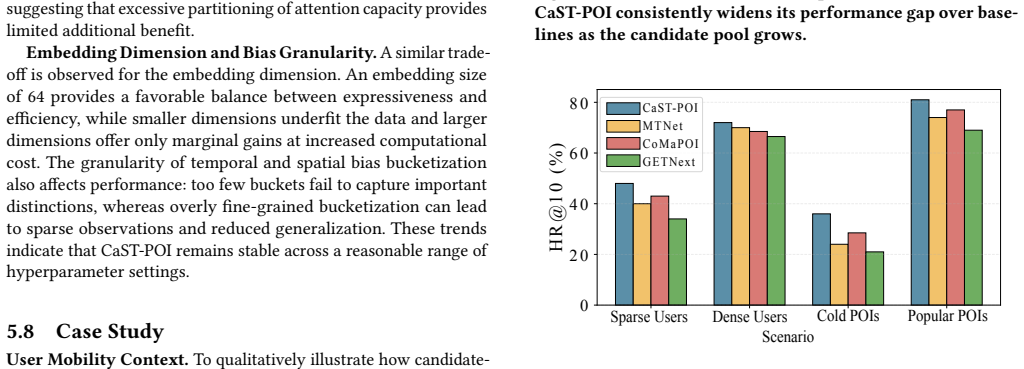
- Consistent outperformance of state-of-the-art POI recommenders on standard metrics across three datasets
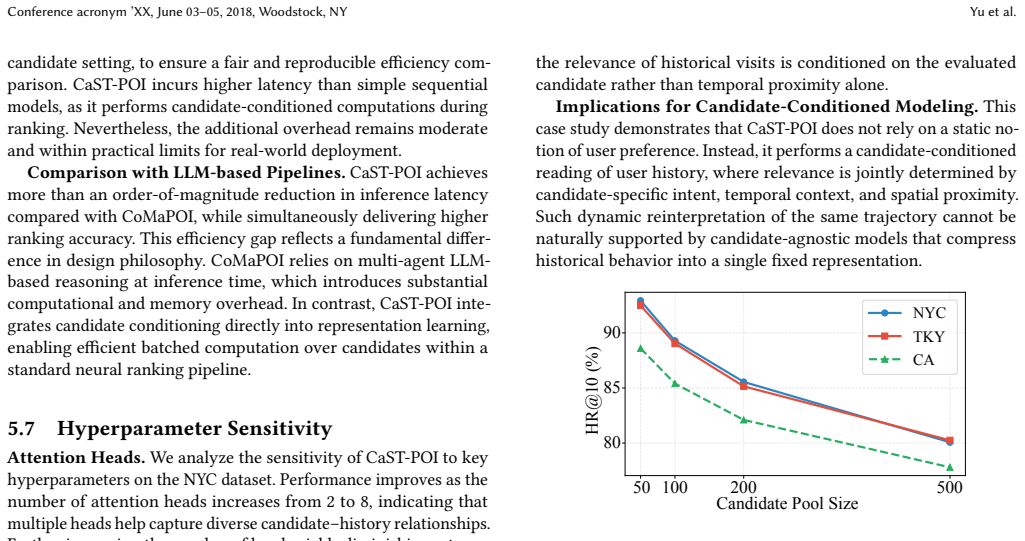
- Particularly strong gains when the number of candidate POIs is large
- More precise modeling of spatiotemporal dependencies tied to each possible next location
- A shift from fixed user embeddings to dynamic, candidate-specific reading of trajectories
Where Pith is reading between the lines
- The conditioning idea could transfer to other sequential recommendation settings where the target item changes which history matters
- Large-scale systems might reduce reliance on a single user vector by adopting per-candidate attention
- Deployment in location services could test whether the modeled candidate dependence matches actual user behavior patterns
Load-bearing premise
The relevance of historical visits truly varies with the specific candidate POI being scored, and conditioning attention plus relative biases on that candidate captures the variation better than any single shared user representation.
What would settle it
A controlled ablation that removes the candidate-conditioned attention and relative biases, then checks whether accuracy on the same three datasets falls back to the level of prior non-conditioned models.
Figures


read the original abstract
Next Point-of-Interest (POI) recommendation plays a crucial role in location-based services by predicting users' future mobility patterns. Existing methods typically compute a single user representation from historical trajectories and use it to score all candidate POIs uniformly. However, this candidate-agnostic paradigm overlooks that the relevance of historical visits inherently depends on which candidate is being evaluated. In this paper, we propose CaST-POI, a candidate-conditioned spatiotemporal model for next POI recommendation. Our key insight is that the same user history should be interpreted differently when evaluating different candidate POIs. CaST-POI employs a candidate-conditioned sequence reader that uses candidates as queries to dynamically attend to user history. In addition, we introduce candidate-relative temporal and spatial biases to capture fine-grained mobility patterns based on the relationships between historical visits and each candidate POI. Extensive experiments on three benchmark datasets demonstrate that CaST-POI consistently outperforms state-of-the-art methods, yielding substantial improvements across multiple evaluation metrics, with particularly strong advantages under large candidate pools. Code is available at https://github.com/YuZhenyuLindy/CaST-POI.git.
Editorial analysis
A structured set of objections, weighed in public.
Referee Report
Summary. The manuscript proposes CaST-POI, a candidate-conditioned spatiotemporal model for next POI recommendation. It argues that existing methods compute a single user representation from history and score all candidates uniformly, overlooking that history relevance depends on the evaluated candidate. The model uses the candidate as query in attention over history and adds candidate-relative temporal/spatial biases. Experiments on three benchmarks report consistent outperformance over SOTA methods, with larger gains under big candidate pools; code is released.
Significance. If the gains are shown to arise specifically from candidate conditioning rather than capacity or bias terms, the work would advance POI recommendation by replacing uniform user representations with context-dependent history interpretation. Code release supports reproducibility. The core intuition is plausible and the benchmark results are positive, but significance remains conditional on isolating the proposed mechanism.
major comments (1)
- [Experiments] Experiments section: the central claim that candidate-conditioned attention plus relative biases better captures history relevance than candidate-agnostic models is load-bearing, yet no ablation holds parameter count and overall architecture fixed while removing per-candidate conditioning. Reported gains on the three benchmarks could therefore stem from increased per-candidate computation or the bias terms alone, leaving the weakest assumption untested.
minor comments (1)
- The experimental setup should explicitly state the data splits, negative sampling strategy, and exact metrics (e.g., HR@K, NDCG@K) used for the three benchmarks to enable direct reproduction.
Simulated Author's Rebuttal
We thank the referee for the constructive feedback. The concern about isolating the contribution of candidate-conditioned attention is valid, and we address it directly below.
read point-by-point responses
-
Referee: [Experiments] Experiments section: the central claim that candidate-conditioned attention plus relative biases better captures history relevance than candidate-agnostic models is load-bearing, yet no ablation holds parameter count and overall architecture fixed while removing per-candidate conditioning. Reported gains on the three benchmarks could therefore stem from increased per-candidate computation or the bias terms alone, leaving the weakest assumption untested.
Authors: We agree that the current ablations do not fully isolate candidate conditioning while holding parameter count fixed. In the revision we will add a controlled ablation that replaces the candidate-as-query attention with a candidate-agnostic alternative (e.g., mean-pooled history representation) while matching total parameters through modest adjustments to embedding or feed-forward dimensions. This will quantify the incremental benefit attributable to per-candidate history interpretation versus the bias terms alone. revision: yes
Circularity Check
No circularity: empirical modeling evaluated on external benchmarks
full rationale
The paper introduces a candidate-conditioned attention mechanism and relative spatiotemporal biases as a modeling change for next-POI recommendation. All performance claims rest on standard benchmark evaluations rather than any derivation that reduces outputs to inputs by construction. No equations equate predictions to fitted parameters, no self-citation chains justify uniqueness, and no ansatz is smuggled in. The central hypothesis (history relevance depends on the candidate) is tested via architecture comparison, not presupposed by definition.
Axiom & Free-Parameter Ledger
axioms (2)
- domain assumption Attention mechanisms can effectively use a candidate as a query to re-weight historical user visits
- domain assumption Candidate-relative temporal and spatial biases capture fine-grained mobility patterns
Forward citations
Cited by 1 Pith paper
-
TriAlignGR: Triangular Multitask Alignment with Multimodal Deep Interest Mining for Generative Recommendation
TriAlignGR integrates visual content and latent user interests into Semantic IDs via cross-modal alignment, CoT-based interest mining, and triangular multitask training to address content degradation and semantic opac...
Reference graph
Works this paper leans on
-
[1]
Jiawei Cao, Xin Zhou, Yanyan Shen, Xiang Ao, and Lei Wang. 2022. Contrastive Cross-domain Recommendation in Matching. InProceedings of the 28th ACM SIGKDD Conference on Knowledge Discovery and Data Mining. ACM, 2951–2960
work page 2022
-
[2]
Xinyu Chen, Yinan Zhang, Jiahui Wu, and Yabin Chen. 2024. Candidate-Aware Learning for Click-Through Rate Prediction. InProceedings of the ACM Web Conference (WWW). ACM, 2845–2854
work page 2024
-
[3]
Paul Covington, Jay Adams, and Emre Sargin. 2016. Deep Neural Networks for YouTube Recommendations. InProceedings of the 10th ACM Conference on Recommender Systems (RecSys). ACM, 191–198
work page 2016
-
[4]
Qiang Cui, Chenrui Zhang, Yafeng Zhang, Jinpeng Wang, and Mingchen Cai. 2021. ST-PIL: Spatial-Temporal Periodic Interest Learning for Next Point-of-Interest Recommendation. (2021), 2960–2964
work page 2021
-
[5]
Yizhou Dang, Enneng Yang, Guibing Guo, Linying Jiang, Xingwei Wang, Xiaoxiao Xu, Qinghui Sun, and Hong Liu. 2023. Uniform sequence better: Time interval aware data augmentation for sequential recommendation. InProceedings of the AAAI conference on artificial intelligence, Vol. 37. 4225–4232
work page 2023
-
[6]
Jie Feng, Yong Li, Chao Zhang, Funing Sun, Fanchao Meng, Ang Guo, and Depeng Jin. 2018. DeepMove: Predicting Human Mobility with Attentional Recurrent Networks. (2018), 1459–1468
work page 2018
-
[7]
Jiayan Guo, Peiyan Zhang, Chaozhuo Li, Xing Xie, Yan Zhang, and Sunghun Kim
-
[8]
InProceedings of the AAAI Conference on Artificial Intelligence, Vol
TiCoSeRec: Augmenting Data to Uniform Sequences by Time Intervals for Effective Recommendation. InProceedings of the AAAI Conference on Artificial Intelligence, Vol. 37. 4341–4349
-
[9]
Balázs Hidasi, Alexandros Karatzoglou, Linas Baltrunas, and Domonkos Tikk
-
[10]
In Proceedings of the 4th International Conference on Learning Representations (ICLR)
Session-based Recommendations with Recurrent Neural Networks. In Proceedings of the 4th International Conference on Learning Representations (ICLR)
-
[11]
Tianhao Huang, Xuan Pan, Xiangrui Cai, Ying Zhang, and Xiaojie Yuan. 2024. Learning time slot preferences via mobility tree for next poi recommendation. In Proceedings of the AAAI Conference on Artificial Intelligence, Vol. 38. 8535–8543
work page 2024
-
[12]
Wang-Cheng Kang and Julian McAuley. 2018. Self-attentive sequential recom- mendation. In2018 IEEE international conference on data mining (ICDM). IEEE, 197–206
work page 2018
-
[13]
Peibo Li, Maarten de Rijke, Hao Xue, Shuang Ao, Yang Song, and Flora D Salim
-
[14]
Large language models for next point-of-interest recommendation. In Proceedings of the 47th International ACM SIGIR Conference on Research and Development in Information Retrieval. 1463–1472
-
[15]
Zihao Li, Aixin Sun, and Chenliang Li. 2023. Diffurec: A diffusion model for sequential recommendation.ACM Transactions on Information Systems42, 3 (2023), 1–28
work page 2023
-
[16]
Nicholas Lim, Bryan Hooi, See-Kiong Ng, Xueou Wang, Yong Liang Gao, Yuncheng Wu, and Jiabao Ma. 2020. STP-UDGAT: Spatial-Temporal-Preference User Dimensional Graph Attention Network for Next POI Recommendation. In Proceedings of the 29th ACM International Conference on Information and Knowl- edge Management (CIKM). ACM, 845–854
work page 2020
-
[17]
Qiang Liu, Shu Wu, Liang Wang, and Tieniu Tan. 2016. Predicting the Next Location: A Recurrent Model with Spatial and Temporal Contexts. InProceedings of the AAAI Conference on Artificial Intelligence, Vol. 30. 194–200
work page 2016
-
[18]
Wei Liu, Peng Zhao, and Qingyao Wu. 2024. Pre-Ranking with Late-Stage Candidate Features for Large-Scale Recommendation. InProceedings of the ACM SIGKDD Conference on Knowledge Discovery and Data Mining. ACM, 4612–4621
work page 2024
-
[19]
Yingtao Luo, Qiang Liu, and Zhaocheng Liu. 2021. STAN: Spatio-Temporal Attention Network for Next Location Recommendation. InProceedings of The Web Conference (WWW). ACM, 2177–2185
work page 2021
-
[20]
Ruihong Qiu, Zi Huang, Hongzhi Yin, and Zijian Wang. 2022. Contrastive learning for representation degeneration problem in sequential recommendation. InProceedings of the fifteenth ACM international conference on web search and data mining. 813–823
work page 2022
-
[21]
Xuan Rao, Lisi Chen, Yong Liu, Shuo Shang, Bin Yao, and Peng Han. 2022. Graph- flashback network for next location recommendation. InProceedings of the 28th ACM SIGKDD conference on knowledge discovery and data mining. 1463–1471
work page 2022
-
[22]
Patricia Sánchez, Luca Belcastro, Ludovico Ferraro, Fabrizio Marozzo, and Domenico Talia. 2022. POI Recommendation Techniques and Trends: A Survey. Information Processing & Management59, 5 (2022), 103034
work page 2022
-
[23]
Peter Shaw, Jakob Uszkoreit, and Ashish Vaswani. 2018. Self-Attention with Relative Position Representations. InProceedings of the 2018 Conference of the North American Chapter of the Association for Computational Linguistics: Human Language Technologies (NAACL-HLT). ACL, 464–468
work page 2018
-
[24]
Fei Sun, Jun Liu, Jian Wu, Changhua Pei, Xiao Lin, Wenwu Ou, and Peng Jiang
-
[25]
InProceedings of the 28th ACM international conference on information and knowledge management
BERT4Rec: Sequential recommendation with bidirectional encoder rep- resentations from transformer. InProceedings of the 28th ACM international conference on information and knowledge management. 1441–1450
-
[26]
Hongjin Tao, Jun Zeng, Ziwei Wang, Min Gao, and Junhao Wen. 2023. Next POI recommendation based on spatial and temporal disentanglement representation. In2023 IEEE International Conference on Web Services (ICWS). IEEE, 84–90
work page 2023
-
[27]
Gomez, Łukasz Kaiser, and Illia Polosukhin
Ashish Vaswani, Noam Shazeer, Niki Parmar, Jakob Uszkoreit, Llion Jones, Aidan N. Gomez, Łukasz Kaiser, and Illia Polosukhin. 2017. Attention is All You Need. InAdvances in Neural Information Processing Systems (NeurIPS), Vol. 30. 5998–6008
work page 2017
-
[28]
Dingqi Yang, Daqing Zhang, Vincent W. Zheng, and Zhiyong Yu. 2015. Modeling User Activity Preference by Leveraging User Spatial Temporal Characteristics in LBSNs.IEEE Transactions on Systems, Man, and Cybernetics: Systems45, 1 (2015), 129–142
work page 2015
-
[29]
Song Yang, Jiamou Liu, and Kaiqi Zhao. 2022. GETNext: Trajectory flow map enhanced transformer for next POI recommendation. InProceedings of the 45th International ACM SIGIR Conference on research and development in information retrieval. 1144–1153
work page 2022
-
[30]
Yuxuan Yang, Siyuan Zhou, He Weng, Dongjing Wang, Xin Zhang, Dongjin Yu, and Shuiguang Deng. 2024. Siamese learning based on graph differential equation for Next-POI recommendation.Applied Soft Computing150 (2024), 111086
work page 2024
-
[31]
Yaowen Ye, Lianghao Xia, and Chao Huang. 2023. Graph masked autoencoder for sequential recommendation. InProceedings of the 46th international ACM SIGIR conference on research and development in information retrieval. 321–330
work page 2023
-
[32]
Quan Yuan, Gao Cong, Zongyang Ma, Aixin Sun, and Nadia Magnenat-Thalmann
-
[33]
Time-Aware Point-of-Interest Recommendation. InProceedings of the 36th International ACM SIGIR Conference on Research and Development in Information Retrieval. ACM, 363–372
-
[34]
Pengpeng Zhao, Haifeng Zhu, Yanchi Liu, Jiajie Xu, Zhixu Li, Fuzhen Zhuang, Victor S. Sheng, and Xiaofang Zhou. 2022. Where to Go Next: A Spatio-Temporal Gated Network for Next POI Recommendation.IEEE Transactions on Knowledge and Data Engineering34, 5 (2022), 2512–2524
work page 2022
-
[35]
Lin Zhong, Lingzhi Wang, Xu Yang, and Qing Liao. 2025. Comapoi: A collabo- rative multi-agent framework for next poi prediction bridging the gap between trajectory and language. InProceedings of the 48th International ACM SIGIR Conference on Research and Development in Information Retrieval. 1768–1778. Conference acronym ’XX, June 03–05, 2018, Woodstock, ...
work page 2025
discussion (0)
Sign in with ORCID, Apple, or X to comment. Anyone can read and Pith papers without signing in.