Locally anti-blocking g-polytopes for flow polytopes
Pith reviewed 2026-06-29 17:08 UTC · model grok-4.3
The pith
Amply framed DAGs with locally anti-blocking g-polytopes have DKK-induced triangulations that are pulling triangulations.
A machine-rendered reading of the paper's core claim, the machinery that carries it, and where it could break.
Core claim
Given an acyclic directed graph that admits an ample framing, the flow polytope is Gorenstein and projects linearly onto a reflexive g-polytope. When the g-polytope is locally anti-blocking, the DAGs receive a combinatorial characterization, the minimal faces containing any fixed pair of vertices are described, the induced unimodular triangulation is proven to be a pulling triangulation, and the pulling orders that recover the DKK triangulation are characterized. Coherence diagrams supply the combinatorial model that establishes these facts, with indications toward extensions for g-polytopes of gentle Nakayama algebras.
What carries the argument
coherence diagrams as a combinatorial model of coherence for amply framed DAGs with locally anti-blocking g-polytopes
If this is right
- Amply framed DAGs that have locally anti-blocking g-polytopes receive a combinatorial characterization.
- The minimal faces of the g-polytope containing a fixed pair of vertices are characterized.
- The unimodular triangulation of the g-polytope induced by the DKK triangulation of the flow polytope is a pulling triangulation.
- The pulling orders that yield the DKK triangulation are characterized.
- The results point toward possible extensions to g-polytopes for gentle Nakayama algebras.
Where Pith is reading between the lines
- The characterizations may permit direct formulas for the Ehrhart series or h-vectors of these g-polytopes.
- Coherence diagrams could be generalized to analyze projections and triangulations for other reflexive polytopes arising from algebraic structures.
- The connection between flow polytopes and locally anti-blocking g-polytopes may clarify when such projections preserve unimodular triangulations.
Load-bearing premise
The DAG admits an ample framing so that the flow polytope linearly projects onto a reflexive g-polytope.
What would settle it
An explicit amply framed DAG whose g-polytope is locally anti-blocking but whose induced triangulation from the flow polytope fails to be a pulling triangulation would falsify the central claim.
Figures
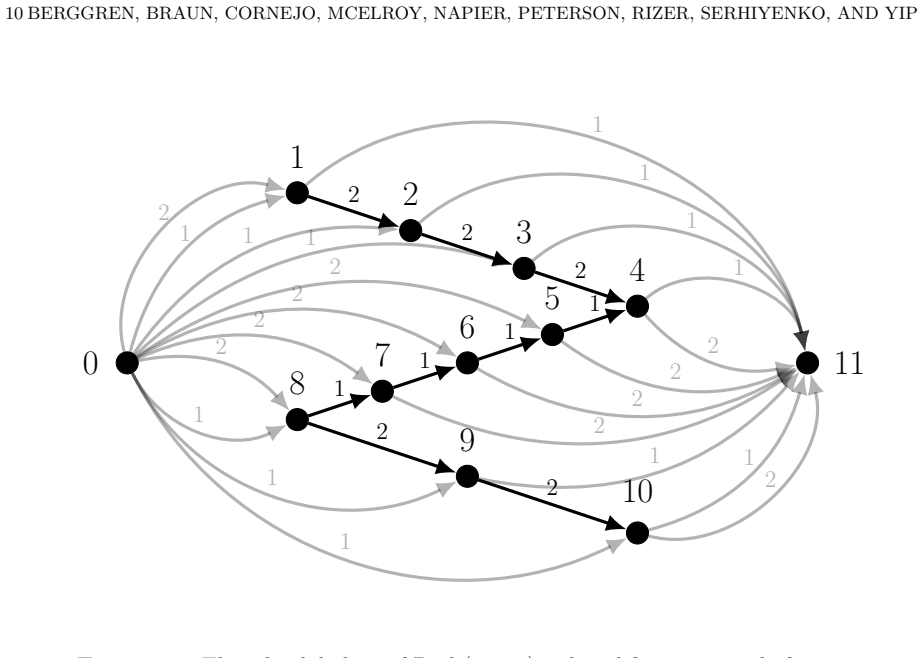

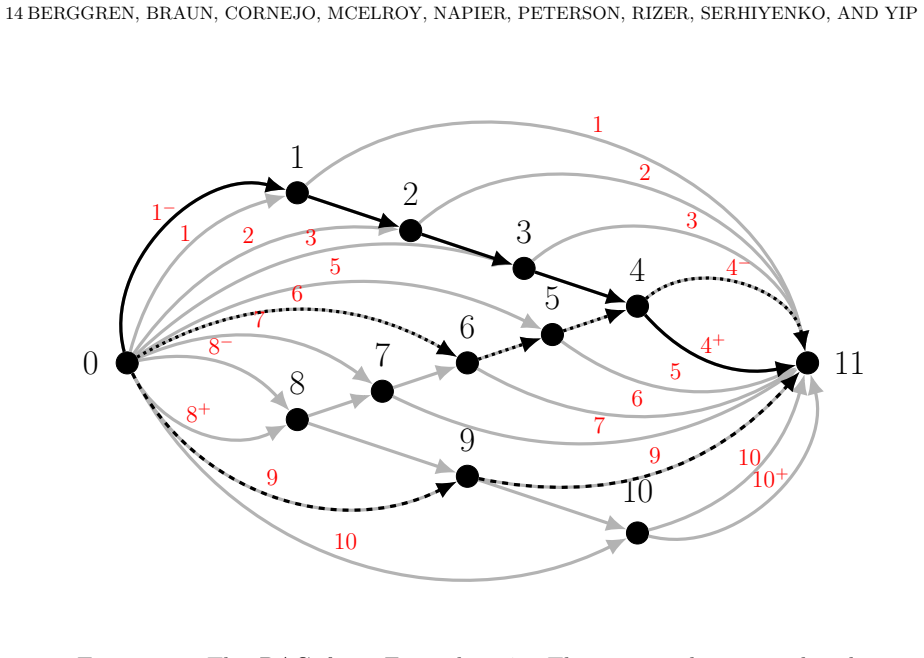
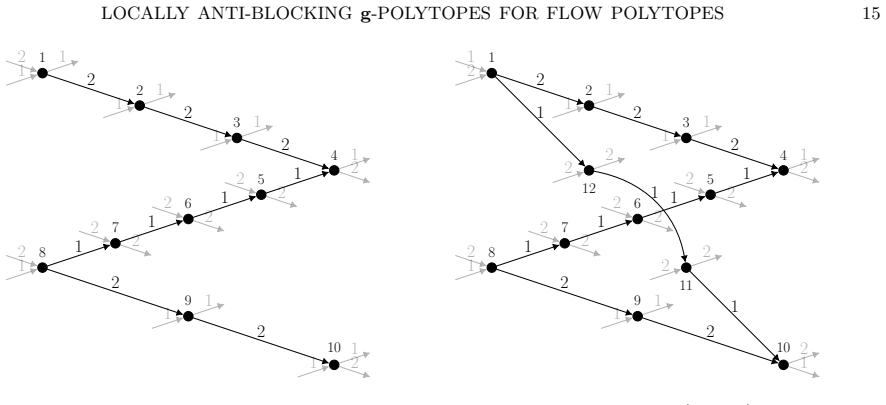
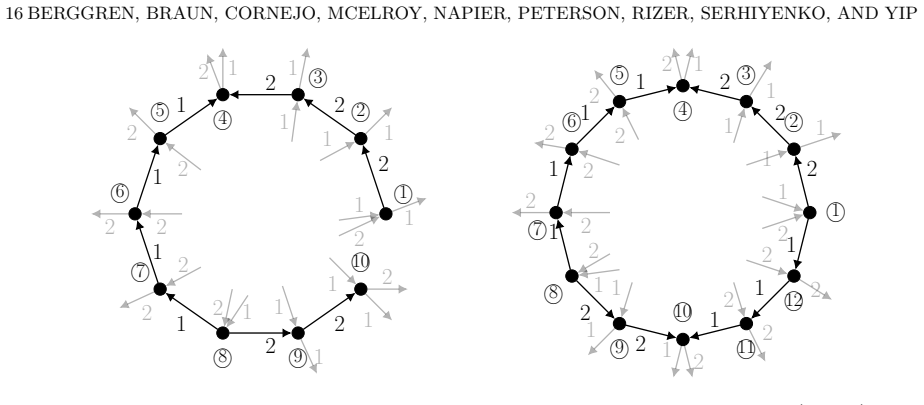

read the original abstract
Given an acyclic directed graph (DAG), the space of strength one flows is a lattice polytope called the flow polytope of the DAG. If the DAG admits an ample framing, then the flow polytope is Gorenstein and it linearly projects onto a reflexive polytope called the $\mathbf{g}$-polytope. We provide a combinatorial characterization of amply framed DAGs that have a locally anti-blocking $\mathbf{g}$-polytope, and we characterize the minimal faces of the $\mathbf{g}$-polytope containing a fixed pair of vertices. We prove in this case that the unimodular triangulation of the $\mathbf{g}$-polytope induced by the DKK triangulation of the flow polytope is a pulling triangulation, and we characterize the pulling orders that yield the DKK triangulation. To prove our results, we introduce and study coherence diagrams, a combinatorial model of coherence for amply framed DAGs with locally anti-blocking $\mathbf{g}$-polytopes. We conclude by indicating possible extensions of these results to the setting of $\mathbf{g}$-polytopes for gentle Nakayama algebras.
Editorial analysis
A structured set of objections, weighed in public.
Referee Report
Summary. The paper studies flow polytopes of acyclic directed graphs (DAGs). When the DAG admits an ample framing, the flow polytope is Gorenstein and linearly projects onto a reflexive g-polytope. The central claims are: (i) a combinatorial characterization of amply framed DAGs whose g-polytopes are locally anti-blocking; (ii) a characterization of the minimal faces of the g-polytope containing any fixed pair of vertices; (iii) a proof that the unimodular triangulation of the g-polytope induced by the DKK triangulation of the flow polytope is a pulling triangulation, together with an explicit characterization of the pulling orders that recover the DKK triangulation. The proofs rely on a new combinatorial model called coherence diagrams. The paper concludes with remarks on possible extensions to g-polytopes arising from gentle Nakayama algebras.
Significance. If the characterizations and the pulling-triangulation statement hold, the work supplies concrete combinatorial tools (coherence diagrams and explicit pulling orders) for studying reflexive g-polytopes that arise as projections of flow polytopes. These tools connect polyhedral combinatorics with the theory of DKK triangulations and may facilitate further links to the representation theory of gentle algebras. The explicit, checkable nature of the characterizations is a strength.
minor comments (3)
- [§1] §1 (Introduction): the definition of an 'ample framing' is referenced to prior work but the precise numerical conditions used in the present paper (e.g., the inequalities that guarantee the projection is reflexive) are not restated; a short self-contained paragraph would improve readability.
- [§3] The notation for coherence diagrams (introduced in §3) is compact; adding a small table that lists the allowed local configurations and their corresponding flow values would make the subsequent proofs easier to follow.
- [Theorem 5.3] Theorem 5.3 (pulling orders): the statement lists four families of orders; it would be helpful to include a one-sentence remark on whether these families are exhaustive or whether additional orders exist outside the DKK case.
Simulated Author's Rebuttal
We thank the referee for the positive assessment of our work on locally anti-blocking g-polytopes arising from amply framed DAG flow polytopes, including the combinatorial tools via coherence diagrams and the links to DKK triangulations and gentle Nakayama algebras. The report recommends minor revision but lists no specific major comments under that heading. Accordingly, we have no individual points to address point-by-point at this stage.
Circularity Check
No significant circularity
full rationale
The paper's derivation begins from the standard setup that an ample framing makes the flow polytope Gorenstein with a linear projection to a reflexive g-polytope; all subsequent claims are combinatorial characterizations of amply framed DAGs admitting locally anti-blocking g-polytopes, minimal faces, and the induced DKK triangulation being a pulling triangulation. These rest on the newly introduced coherence diagrams as an independent combinatorial model rather than on any self-definitional reduction, fitted inputs renamed as predictions, or load-bearing self-citations. The central results are proved directly from the coherence diagrams and do not reduce by the paper's own equations to their inputs.
Axiom & Free-Parameter Ledger
Forward citations
Cited by 1 Pith paper
-
Order polytopes of generalized snake posets are $h^*$-real-rooted
Proves the conjecture that Ehrhart h*-polynomials of order polytopes of generalized snake posets are real-rooted by connecting them to non-nesting rook polynomials.
Reference graph
Works this paper leans on
-
[1]
Morales, GaYee Park, and Hugh Thomas
Antoine Abram, Jose Bastidas, Benjamin Dequˆ ene, Alejandro H. Morales, GaYee Park, and Hugh Thomas. Flows on graphs with cycles, locally gentle algebras, and the mutoperhedron, 2026. https://arxiv.org/abs/2601.08150
-
[2]
Math., 150(3):415–452, 2014
Takahide Adachi, Osamu Iyama, and Idun Reiten.τ-tilting theory.Compos. Math., 150(3):415–452, 2014
2014
-
[3]
Fans and poly- topes in tilting theory I: Foundations
Toshitaka Aoki, Akihiro Higashitani, Osamu Iyama, Ryoichi Kase, and Yuya Mizuno. Fans and poly- topes in tilting theory I: Foundations. https://arxiv.org/abs/2203.15213
-
[4]
Geometric inequalities for anti-blocking bodies.Commun
Shiri Artstein-Avidan, Shay Sadovsky, and Raman Sanyal. Geometric inequalities for anti-blocking bodies.Commun. Contemp. Math., 25(3):Paper No. 2150113, 30, 2023
2023
-
[5]
Ehrhart polynomials, simplicial polytopes, magic squares and a conjecture of Stanley.Journal fur die Reine und Angewandte Mathematik, 2005, 01 2004
Christos Athanasiadis. Ehrhart polynomials, simplicial polytopes, magic squares and a conjecture of Stanley.Journal fur die Reine und Angewandte Mathematik, 2005, 01 2004. 34 BERGGREN, BRAUN, CORNEJO, MCELROY, NAPIER, PETERSON, RIZER, SERHIYENKO, AND YIP
2005
-
[6]
Kostant partitions functions and flow polytopes.Transform
Welleda Baldoni and Mich‘ele Vergne. Kostant partitions functions and flow polytopes.Transform. Groups, 13(3-4):447–469, 2008
2008
-
[7]
Victor V. Batyrev. Dual polyhedra and mirror symmetry for Calabi-Yau hypersurfaces in toric varieties. J. Algebraic Geom., 3(3):493–535, 1994
1994
-
[8]
McAllister
Matthias Beck, Pallavi Jayawant, and Tyrrell B. McAllister. Lattice-point generating functions for free sums of convex sets.J. Combin. Theory Ser. A, 120(6):1246–1262, 2013
2013
-
[9]
Undergraduate Texts in Math- ematics
Matthias Beck and Sinai Robins.Computing the Continuous Discretely. Undergraduate Texts in Math- ematics. Springer, second edition, 2007
2007
-
[10]
Triangulations of flow polytopes, ample framings, and gentle algebras.Selecta Math
Matias von Bell, Benjamin Braun, Kaitlin Bruegge, Derek Hanely, Zachery Peterson, Khrystyna Ser- hiyenko, and Martha Yip. Triangulations of flow polytopes, ample framings, and gentle algebras.Selecta Math. (N.S.), 30(3):Paper No. 55, 34, 2024
2024
-
[11]
Vindas-Mel´ endez, and Martha Yip
Matias von Bell, Benjamin Braun, Derek Hanely, Khrystyna Serhiyenko, Julianne Vega, Andr´ es R. Vindas-Mel´ endez, and Martha Yip. Triangulations, order polytopes, and generalized snake posets.S´ em. Lothar. Combin., 86B:Art. 5, 12, 2022
2022
-
[12]
Framing Lattices and Flow Polytopes
Matias von Bell and Cesar Ceballos. Framing lattices and flow polytopes, 2026. https://arxiv.org/abs/2512.20575
work page internal anchor Pith review Pith/arXiv arXiv 2026
-
[13]
Gonz´ alez D’Le´ on, Francisco A
Matias von Bell, Rafael S. Gonz´ alez D’Le´ on, Francisco A. Mayorga Cetina, and Martha Yip. A unifying framework for theν-Tamari lattice and principal order ideals in Young’s lattice.Combinatorica, pages 1–26, 2023
2023
-
[14]
Gonz´ alez D’Le´ on, Christopher R
Carolina Benedetti, Rafael S. Gonz´ alez D’Le´ on, Christopher R. H. Hanusa, Pamela E. Harris, Apoorva Khare, Alejandro H. Morales, and Martha Yip. A combinatorial model for computing volumes of flow polytopes.Trans. Amer. Math. Soc., 372(5):3369–3404, 2019
2019
-
[15]
Flows on gentle algebras, 2025
Jonah Berggren. Flows on gentle algebras, 2025. https://arxiv.org/abs/2507.12688
-
[16]
Framing Triangulations and Framing Posets of Planar DAGs with Nontrivial Netflow Vectors
Jonah Berggren. Framing triangulations and framing posets of planar DAGs with nontrivial netflow vectors, 2026. https://arxiv.org/abs/2507.12684
work page internal anchor Pith review Pith/arXiv arXiv 2026
-
[17]
Framing Triangulations for Arbitrary Integer Flow Polytopes
Jonah Berggren. Framing triangulations for arbitrary integer flow polytopes, 2026. https://arxiv.org/abs/2605.24328
work page internal anchor Pith review Pith/arXiv arXiv 2026
-
[18]
On the common generalization of gentle algebras and framed directed acyclic graphs,
Jonah Berggren. On the common generalization of gentle algebras and framed directed acyclic graphs,
-
[19]
https://arxiv.org/abs/2605.24327
work page internal anchor Pith review Pith/arXiv arXiv
-
[20]
Wilting theory of flow polytopes.S´ em
Jonah Berggren and Khrystyna Serhiyenko. Wilting theory of flow polytopes.S´ em. Lothar. Combin., 91B:Art. 21, 12, 2024
2024
-
[21]
Flow polytopes for extensions of bipartite graphs, 2025
Benjamin Braun, Kaitlin Bruegge, Robert Davis, and Derek Hanely. Flow polytopes for extensions of bipartite graphs, 2025. https://arxiv.org/abs/2509.26445
-
[22]
Equatorial flow triangulations of Gorenstein flow polytopes.Elec- tron
Benjamin Braun and Alvaro Cornejo. Equatorial flow triangulations of Gorenstein flow polytopes.Elec- tron. J. Combin., 32(4):Paper No. 4.22, 34, 2025
2025
-
[23]
Detecting the integer decomposition property and Ehrhart unimodality in reflexive simplices.Adv
Benjamin Braun, Robert Davis, and Liam Solus. Detecting the integer decomposition property and Ehrhart unimodality in reflexive simplices.Adv. in Appl. Math., 100:122–142, 2018
2018
-
[24]
Volume inequalities for flow polytopes of full directed acyclic graphs.Comb
Benjamin Braun and James Ford McElroy. Volume inequalities for flow polytopes of full directed acyclic graphs.Comb. Theory, 5(2):Paper No. 14, 39, 2025
2025
-
[25]
h-vectors of Gorenstein polytopes.J
Winfried Bruns and Tim R¨ omer. h-vectors of Gorenstein polytopes.J. Comb. Theory, Ser. A, 114:65–76, 2007
2007
-
[26]
Geometry of Tamari lattices in typesAandB
Cesar Ceballos, Arnau Padrol, and Camilo Sarmiento. Geometry of Tamari lattices in typesAandB. Trans. Amer. Math. Soc., 371(4):2575–2622, 2019
2019
-
[27]
Chan, David P
Clara S. Chan, David P. Robbins, and David S. Yuen. On the volume of a certain polytope.Experiment. Math., 9(1):91–99, 2000
2000
-
[28]
Fr´ ed´ eric Chapoton and Driss Essouabri.q-Ehrhart polynomials of Gorenstein polytopes, Bernoulli um- bra and related Dirichlet series.Mosc. J. Comb. Number Theory, 5(4):13–38, 2015
2015
-
[29]
David A. Cox. Mirror symmetry and polar duality of polytopes.Symmetry, 7(3):1633–1645, 2015
2015
-
[30]
Danilov, Alexander V
Vladimir I. Danilov, Alexander V. Karzanov, and Gleb A. Koshevoy. Coherent fans in the space of flows in framed graphs. In24th International Conference on Formal Power Series and Algebraic Combina- torics (FPSAC 2012), Discrete Math. Theor. Comput. Sci. Proc., AR, pages 481–490. Assoc. Discrete Math. Theor. Comput. Sci., Nancy, 2012
2012
-
[31]
On the equations and classification of toric quiver varieties.Proc
M´ aty´ as Domokos and D´ aniel Jo´ o. On the equations and classification of toric quiver varieties.Proc. Roy. Soc. Edinburgh Sect. A, 146(2):265–295, 2016. LOCALLY ANTI-BLOCKINGg-POLYTOPES FOR FLOW POLYTOPES 35
2016
-
[32]
Dugan, Maura Hegarty, Alejandro H
William T. Dugan, Maura Hegarty, Alejandro H. Morales, and Annie Raymond. Generalized Pitman- Stanley polytope: vertices and faces.Discrete Comput. Geom., 74(2):492–543, 2025
2025
-
[33]
Dugan, Maura Hegarty, Alejandro H
William T. Dugan, Maura Hegarty, Alejandro H. Morales, and Annie Raymond. Volume and lattice points of generalized Pitman-Stanley flow polytopes.S´ em. Lothar. Combin., 93B:Art. 94, 12, 2025
2025
-
[34]
D. R. Fulkerson. Blocking and anti-blocking pairs of polyhedra.Math. Programming, 1:168–194, 1971
1971
-
[35]
D. R. Fulkerson. Anti-blocking polyhedra.J. Combinatorial Theory Ser. B, 12:50–71, 1972
1972
-
[36]
Gonz´ alez D’Le´ on, Christopher R
Rafael S. Gonz´ alez D’Le´ on, Christopher R. H. Hanusa, Alejandro H. Morales, and Martha Yip. Column- convex matrices,G-cyclic orders, and flow polytopes.Discrete Comput. Geom., 70(4):1593–1631, 2023
2023
-
[37]
Gonz´ alez D’Le´ on, Alejandro H
Rafael S. Gonz´ alez D’Le´ on, Alejandro H. Morales, Eva Philippe, Daniel Tamayo Jim´ enez, and Martha Yip. Realizing the s-permutahedron via flow polytopes.Trans. Amer. Math. Soc., 378(11):7625–7666, 2025
2025
-
[38]
Rafael S. Gonz´ alez D’Le´ on, Christopher R. H. Hanusa, and Martha Yip. Permutation flows I: Triangu- lations of flow polytopes (research announcement). http://arxiv.org/abs/2512.04078
-
[39]
Piechnik, and Francisco Santos
Christian Haase, Andreas Paffenholz, Lindsay C. Piechnik, and Francisco Santos. Existence of unimod- ular triangulations—positive results.Mem. Amer. Math. Soc., 270(1321):v+83, 2021
2021
-
[40]
Martin Henk, J¨ urgen Richter-Gebert, and G¨ unter M. Ziegler. Basic properties of convex polytopes. In Handbook of discrete and computational geometry, CRC Press Ser. Discrete Math. Appl., pages 243–270. CRC, Boca Raton, FL, 1997
1997
-
[41]
Roots of Ehrhart polynomials of Gorenstein Fano polytopes.Proc
Takayuki Hibi, Akihiro Higashitani, and Hidefumi Ohsugi. Roots of Ehrhart polynomials of Gorenstein Fano polytopes.Proc. Amer. Math. Soc., 139(10):3727–3734, 2011
2011
-
[42]
Gorenstein graphic matroids.Israel J
Takayuki Hibi, Micha l Laso´ n, Kazunori Matsuda, Mateusz Micha lek, and Martin Vodiˇ cka. Gorenstein graphic matroids.Israel J. Math., 243(1):1–26, 2021
2021
-
[43]
Gorenstein properties and integer decomposition properties of lecture hall polytopes.Mosc
Takayuki Hibi, McCabe Olsen, and Akiyoshi Tsuchiya. Gorenstein properties and integer decomposition properties of lecture hall polytopes.Mosc. Math. J., 18(4):667–679, 2018
2018
-
[44]
Facets and volume of Gorenstein Fano polytopes.Math
Takayuki Hibi and Akiyoshi Tsuchiya. Facets and volume of Gorenstein Fano polytopes.Math. Nachr., 290(16):2619–2628, 2017
2017
-
[45]
The depth of a reflexive polytope.Arch
Takayuki Hibi and Akiyoshi Tsuchiya. The depth of a reflexive polytope.Arch. Math. (Basel), 113(3):265–272, 2019
2019
-
[46]
Reflexive polytopes arising from partially ordered sets and perfect graphs.J
Takayuki Hibi and Akiyoshi Tsuchiya. Reflexive polytopes arising from partially ordered sets and perfect graphs.J. Algebraic Combin., 49(1):69–81, 2019
2019
-
[47]
Gorenstein polytopes with trinomialh ∗- polynomials.Beitr
Akihiro Higashitani, Benjamin Nill, and Akiyoshi Tsuchiya. Gorenstein polytopes with trinomialh ∗- polynomials.Beitr. Algebra Geom., 62(3):667–685, 2021
2021
-
[48]
Quivers, cones and polytopes.Linear Algebra and its Applications, 365:215–237, 2003
Lutz Hille. Quivers, cones and polytopes.Linear Algebra and its Applications, 365:215–237, 2003. Special Issue on Linear Algebra Methods in Representation Theory
2003
-
[49]
Counting integer points of flow polytopes.Dis- crete Comput
Kabir Kapoor, Karola M´ esz´ aros, and Linus Setiabrata. Counting integer points of flow polytopes.Dis- crete Comput. Geom., 66(2):723–736, 2021
2021
-
[50]
Unconditional reflexive polytopes.Discrete Comput
Florian Kohl, McCabe Olsen, and Raman Sanyal. Unconditional reflexive polytopes.Discrete Comput. Geom., 64(2):427–452, 2020
2020
-
[51]
Gorenstein matroids.Int
Micha l Laso´ n and Mateusz Micha l ek. Gorenstein matroids.Int. Math. Res. Not. IMRN, (18):15687– 15728, 2023
2023
-
[52]
Carl W. Lee. Subdivisions and triangulations of polytopes. InHandbook of discrete and computational geometry, CRC Press Ser. Discrete Math. Appl., pages 271–290. CRC, Boca Raton, FL, 1997
1997
-
[53]
B. V. Lidski˘i. The Kostant function of the system of rootsA n.Funktsional. Anal. i Prilozhen., 18(1):76– 77, 1984
1984
-
[54]
Liu, Karola M´ esz´ aros, and Avery St
Ricky I. Liu, Karola M´ esz´ aros, and Avery St. Dizier. Gelfand-Tsetlin polytopes: a story of flow and order polytopes.SIAM J. Discrete Math., 33(4):2394–2415, 2019
2019
-
[55]
Morales, and Karola M´ esz´ aros
Ricky Ini Liu, Alejandro H. Morales, and Karola M´ esz´ aros. Flow polytopes and the space of diagonal harmonics.Canad. J. Math., 71(6):1495–1521, 2019
2019
-
[56]
On smooth Gorenstein polytopes.Tohoku Math
Benjamin Lorenz and Benjamin Nill. On smooth Gorenstein polytopes.Tohoku Math. J. (2), 67(4):513– 530, 2015
2015
-
[57]
McMullen
P. McMullen. Constructions for projectively unique polytopes.Discrete Math., 14(4):347–358, 1976
1976
-
[58]
Karola M´ esz´ aros and Alejandro H. Morales. Volumes and Ehrhart polynomials of flow polytopes.Math. Z., 293(3-4):1369–1401, 2019. 36 BERGGREN, BRAUN, CORNEJO, MCELROY, NAPIER, PETERSON, RIZER, SERHIYENKO, AND YIP
2019
-
[59]
Morales, and Jessica Striker
Karola M´ esz´ aros, Alejandro H. Morales, and Jessica Striker. On flow polytopes, order polytopes, and certain faces of the alternating sign matrix polytope.Discrete Comput. Geom., 62(1):128–163, 2019
2019
-
[60]
Morales and William Shi
Alejandro H. Morales and William Shi. Refinements and symmetries of the Morris identity for volumes of flow polytopes.C. R. Math. Acad. Sci. Paris, 359:823–851, 2021
2021
-
[61]
Volume and lattice points of reflexive simplices.Discrete Comput
Benjamin Nill. Volume and lattice points of reflexive simplices.Discrete Comput. Geom., 37(2):301–320, 2007
2007
-
[62]
Gorenstein polytopes and their stringyE-functions.Math
Benjamin Nill and Jan Schepers. Gorenstein polytopes and their stringyE-functions.Math. Ann., 355(2):457–480, 2013
2013
-
[63]
Gorenstein cut polytopes.European J
Hidefumi Ohsugi. Gorenstein cut polytopes.European J. Combin., 38:122–129, 2014
2014
-
[64]
Convex polytopes all of whose reverse lexicographic initial ideals are squarefree.Proc
Hidefumi Ohsugi and Takayuki Hibi. Convex polytopes all of whose reverse lexicographic initial ideals are squarefree.Proc. Amer. Math. Soc., 129(9):2541–2546, 2001
2001
-
[65]
Special simplices and Gorenstein toric rings.J
Hidefumi Ohsugi and Takayuki Hibi. Special simplices and Gorenstein toric rings.J. Combin. Theory Ser. A, 113(4):718–725, 2006
2006
-
[66]
Theh ∗-polynomials of locally anti-blocking lattice polytopes and theirγ-positivity.Discrete Comput
Hidefumi Ohsugi and Akiyoshi Tsuchiya. Theh ∗-polynomials of locally anti-blocking lattice polytopes and theirγ-positivity.Discrete Comput. Geom., 66(2):701–722, 2021
2021
-
[67]
M. A. Perles and G. C. Shephard. Facets and nonfacets of convex polytopes.Acta Math., 119:113–145, 1967
1967
-
[68]
Kyle Petersen, Pavlo Pylyavskyy, and David E
T. Kyle Petersen, Pavlo Pylyavskyy, and David E. Speyer. A non-crossing standard monomial theory. J. Algebra, 324(5):951–969, 2010
2010
-
[69]
Harmonics and graded Ehrhart theory, 2024
Victor Reiner and Brendon Rhoades. Harmonics and graded Ehrhart theory, 2024. https://arxiv.org/abs/2407.06511
-
[70]
Root, flow and order polytopes with connections to toric geometry.Forum Math
Konstanze Rietsch and Lauren Kiyomi Williams. Root, flow and order polytopes with connections to toric geometry.Forum Math. Sigma, 13:Paper No. e194, 35, 2025
2025
-
[71]
Richard P. Stanley. Hilbert functions of graded algebras.Advances in Math., 28(1):57–83, 1978
1978
-
[72]
Stanley and Jim Pitman
Richard P. Stanley and Jim Pitman. A polytope related to empirical distributions, plane trees, parking functions, and the associahedron.Discrete Comput. Geom., 27(4):603–634, 2002
2002
-
[73]
Compressed polytopes and statistical disclosure limitation.Tohoku Math
Seth Sullivant. Compressed polytopes and statistical disclosure limitation.Tohoku Math. J. (2), 58(3):433–445, 2006
2006
-
[74]
Gorenstein simplices and the associated finite abelian groups.European J
Akiyoshi Tsuchiya. Gorenstein simplices and the associated finite abelian groups.European J. Combin., 67:145–157, 2018
2018
-
[75]
Classification and counting of Gorenstein simplices with $h^*$-polynomial $1+t^k+\cdots+t^{(v-1)k}$
Akiyoshi Tsuchiya. Classification and counting of Gorenstein simplices withh ∗-polynomial 1+t k +· · ·+ t(v−1)k, 2026. https://arxiv.org/abs/2605.11820
work page internal anchor Pith review Pith/arXiv arXiv 2026
-
[76]
Gorenstein Simplices and Even Binary Self-Complementary Codes
Akiyoshi Tsuchiya. Gorenstein simplices and even binary self-complementary codes, 2026. https://arxiv.org/abs/2604.15005. LOCALLY ANTI-BLOCKINGg-POLYTOPES FOR FLOW POLYTOPES 37 Department of Mathematics, University of Kentucky Email address:jrberggren@uky.edu URL:https://sites.google.com/view/jonahberggrenmath/ Department of Mathematics, University of Ken...
work page internal anchor Pith review Pith/arXiv arXiv 2026
discussion (0)
Sign in with ORCID, Apple, or X to comment. Anyone can read and Pith papers without signing in.