Personality Anchoring for Social Simulation: Linking Personality, Social Behavior, and Interaction Success with LLM Agents
Pith reviewed 2026-06-27 21:09 UTC · model grok-4.3
The pith
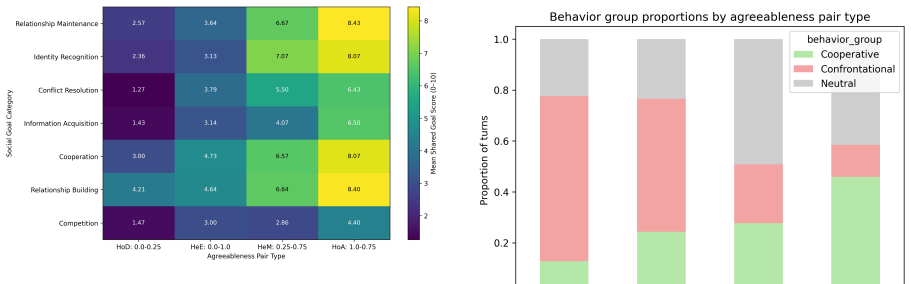
Agreeable personality pairs among LLM agents reach shared goals ten times more often than disagreeable pairs.
A machine-rendered reading of the paper's core claim, the machinery that carries it, and where it could break.
Core claim
Using personality anchoring with movie characters and public figures, the study finds a monotonic relationship between dyadic Agreeableness composition and shared goal achievement in 1,010 simulated conversations, where homogeneous-agreeable pairs succeed at 62% versus 6% for homogeneous-disagreeable pairs. Behavioral mediation analysis indicates that Agreeableness influences outcomes partly through selection of cooperative strategies but continues to predict success even within the same strategy.
What carries the argument
Personality anchoring, the assignment of personality traits drawn from well-known movie characters and public figures to LLM agents to produce psychologically grounded conversational behaviors.
If this is right
- Agreeableness shapes goal achievement partially through cooperative strategy selection.
- Personality effects on outcomes persist even when controlling for the dominant strategy used.
- Results show high consistency across repeated simulations with ICC of 0.89.
- Personality expression remains stable across diverse scenarios.
- Personality anchoring serves as a viable method for operationalizing personality in multi-LLM simulations.
Where Pith is reading between the lines
- Simulations like this could be extended to test how personality affects outcomes in larger groups or different task types.
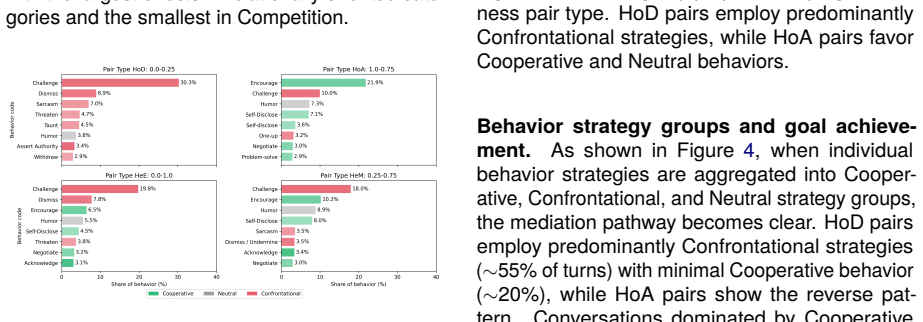
- If the anchoring proves valid against human data, it opens scalable experiments on personality interventions without recruiting participants.
- The partial mediation suggests unmeasured conversational elements, such as tone or persistence, also carry personality effects.
- Future work could anchor other Big Five traits to explore their joint effects on social success.
Load-bearing premise
Assigning personality traits from movie characters and public figures to LLM agents produces conversational behaviors that reflect the causal influence of those traits on social interaction outcomes in humans.
What would settle it
If repeated simulations with anchored agents show no difference in goal success rates between agreeable and disagreeable pairs, or if human observers cannot match the agents' behaviors to the anchored personality profiles.
Figures


read the original abstract
Social interactions are shaped by the interplay of dispositional traits and situational context, yet systematically investigating how personality configurations between individuals jointly influence social behavior across diverse social contexts remains methodologically challenging. We address this gap by introducing a simulation pipeline adapted from the CHARISMA framework, which employs well-known movie characters and public figures as psychologically grounded agents for multi-LLM social simulation using a method we term personality anchoring. We present a large-scale empirical study examining how dyadic Agreeableness composition influences social interaction outcomes across 1,010 simulated conversations. Our results reveal a monotonic relationship between dyadic Agreeableness composition and shared goal achievement, with Homogeneous-Agreeable pairs achieving success 10 times the rate of Homogeneous-Disagreeable pairs (62% vs. 6%). Behavioral mediation analysis reveals that Agreeableness shapes goal achievement partially through cooperative strategy selection, though it continues to predict outcomes within the same dominant strategy, indicating pathways beyond observable conversational behavior. Robustness analyses confirm high consistency of results across repeated simulations (ICC = 0.89) and stable personality expression across diverse scenarios, validating personality anchoring as a viable operationalization strategy.
Editorial analysis
A structured set of objections, weighed in public.
Referee Report
Summary. The manuscript introduces a simulation pipeline adapted from the CHARISMA framework that uses 'personality anchoring'—assigning Big-Five traits via well-known movie characters and public figures—to create LLM agents. It reports results from 1,010 simulated dyadic conversations examining how Agreeableness composition affects shared goal achievement, finding a monotonic relationship with homogeneous-agreeable pairs succeeding at 62% versus 6% for homogeneous-disagreeable pairs, partial mediation via cooperative strategy selection, and high internal consistency (ICC=0.89). The work positions personality anchoring as a viable method for studying personality effects in social interactions.
Significance. If the anchoring method produces conversational behaviors that validly track the causal effects of human personality traits, the large-scale simulation approach could provide a scalable, controllable platform for testing personality-configuration hypotheses that are difficult to study in human subjects. The reported monotonic pattern, within-strategy mediation, and robustness metrics would then constitute a concrete empirical contribution to understanding Agreeableness in goal-directed interactions.
major comments (3)
- [Abstract / Methods (personality anchoring)] Abstract and Methods (personality anchoring description): The central claim that the observed monotonic relationship between dyadic Agreeableness and goal achievement reflects human personality mechanisms rests on the untested assumption that LLM agents anchored to named characters exhibit conversational statistics and outcome distributions comparable to human dyads measured on the same Big-Five dimensions and tasks. No section provides such a comparison or external validation; the reported ICC=0.89 and strategy-mediation analyses are internal consistency checks only.
- [Results (mediation and robustness)] Results (mediation and robustness analyses): The behavioral mediation finding and ICC=0.89 are computed entirely within the LLM simulation runs. These metrics do not test whether the 62% vs. 6% success differential is driven by training-data stereotypes attached to the character anchors rather than a general personality mechanism; without this test the causal pathway claim is not load-bearing.
- [Abstract] Abstract: Concrete percentages, monotonic pattern, and mediation results are reported without accompanying details on conversation structure, exact goal-measurement criteria, statistical tests for monotonicity, controls for LLM stochasticity, or how personality stability was quantified across scenarios. These omissions prevent evaluation of the soundness of the headline result.
minor comments (1)
- [Abstract] The abstract could more explicitly state the number of simulation repetitions per dyad and the precise operational definition of 'shared goal achievement' to improve reproducibility.
Simulated Author's Rebuttal
We thank the referee for the constructive feedback on our manuscript. We address each major comment below, acknowledging limitations where the current work does not provide external validation and proposing targeted revisions to improve clarity and framing. The study focuses on demonstrating consistent patterns within LLM-based simulations using personality anchoring, rather than claiming direct equivalence to human mechanisms.
read point-by-point responses
-
Referee: [Abstract / Methods (personality anchoring)] The central claim that the observed monotonic relationship between dyadic Agreeableness and goal achievement reflects human personality mechanisms rests on the untested assumption that LLM agents anchored to named characters exhibit conversational statistics and outcome distributions comparable to human dyads measured on the same Big-Five dimensions and tasks. No section provides such a comparison or external validation; the reported ICC=0.89 and strategy-mediation analyses are internal consistency checks only.
Authors: We agree that the manuscript does not include a direct empirical comparison between the anchored LLM agents and human dyads on equivalent tasks. The work presents personality anchoring as a scalable simulation method adapted from CHARISMA, with results demonstrating internal consistency and a monotonic pattern within the simulated environment. We will revise the abstract, methods, and discussion sections to explicitly frame the findings as patterns observed in LLM agents rather than validated proxies for human personality effects, and to note the need for future human validation studies. This revision will remove any implication of direct causal equivalence. revision: yes
-
Referee: [Results (mediation and robustness)] The behavioral mediation finding and ICC=0.89 are computed entirely within the LLM simulation runs. These metrics do not test whether the 62% vs. 6% success differential is driven by training-data stereotypes attached to the character anchors rather than a general personality mechanism; without this test the causal pathway claim is not load-bearing.
Authors: This is a valid concern. The mediation analysis and ICC are internal to the simulation runs and do not isolate stereotype effects from the specific character anchors. We will revise the results and discussion to acknowledge this as a potential alternative explanation and to emphasize that the diverse set of anchors (movie characters and public figures) was chosen to reduce idiosyncratic effects. We cannot add a new control experiment in this revision but will tone down causal language to reflect that the pathway is demonstrated within the anchored agents. revision: partial
-
Referee: [Abstract] Concrete percentages, monotonic pattern, and mediation results are reported without accompanying details on conversation structure, exact goal-measurement criteria, statistical tests for monotonicity, controls for LLM stochasticity, or how personality stability was quantified across scenarios. These omissions prevent evaluation of the soundness of the headline result.
Authors: The abstract summarizes headline results concisely, with full details on conversation structure, goal criteria, statistical methods, stochasticity controls (via repeated runs), and personality stability provided in the Methods and Results sections of the manuscript. We will revise the abstract to incorporate brief additional context on these elements (e.g., mention of repeated simulations for ICC and goal achievement criteria) to enhance standalone evaluability without exceeding length constraints. revision: yes
- No direct external validation data comparing anchored LLM agent behaviors to human dyads on the same tasks is available in the current study or feasible to add without new data collection.
Circularity Check
No circularity: results emerge from independent simulation runs
full rationale
The paper defines personality anchoring as an operational method (assigning Big-Five traits via named movie characters/public figures to LLM agents), then runs 1,010 fresh multi-agent conversations and reports observed success rates and mediation statistics. No equation, parameter fit, or self-citation reduces the headline monotonic relationship (62 % vs 6 % success) to an algebraic identity or to the input labels themselves. The ICC and strategy-mediation checks are post-hoc consistency diagnostics on the generated data, not definitional tautologies. External-validity concerns about whether LLM stereotypes track human trait effects are separate from circularity.
Axiom & Free-Parameter Ledger
axioms (1)
- domain assumption LLM agents can be assigned stable personality traits via anchoring to character descriptions that influence their conversational behavior in predictable ways matching human personality effects.
Reference graph
Works this paper leans on
-
[1]
Introduction Understanding how dispositional traits and situa- tional context jointly shape social interaction out- comes is central to social psychology. Attribution theory provides a foundational framework for this inquiry, explaining how individuals infer the causes of behavior by distinguishing between dispositional and situational factors (Heider, 20...
work page internal anchor Pith review Pith/arXiv arXiv 2013
-
[2]
We introduce a personality-driven simulation methodology that integrates personality through character-based anchoring, a structured taxon- omy of human goals, and behavior strategies in conversational interaction, enabling systematic analysis of how dispositional traits and situa- tional factors jointly shape social behavior in simulated interactions
-
[3]
We conduct a large-scale empirical analysis of how dyadic Agreeableness composition shapes social behavior across seven social goal cate- gories, two difficulty levels, and multiple interac- tion models
-
[4]
We provide a behavioral mediation analysis ex- amining whether and how conversational strate- gies mediate the relationship between personal- ity composition and interaction outcomes, distin- guishing between direct and indirect pathways of personality influence
-
[5]
We evaluate robustness along two dimensions: (i)result consistency across repeated simula- tions and(ii)personality expression stability across diverse scenarios, assessing the reliabil- ityofcharacter-basedanchoringasapersonality operationalization strategy. The code, dataset, full list of behavior strategies and characters, and behavioral analysis scrip...
-
[6]
Related Work 2.1. LLM-Based Social Simulation LLM-powered social simulation has scaled rapidly since the introduction of Generative Agents (Park et al., 2023), which demonstrated that 25 LLM agents could sustain coherent social behavior, in- cluding relationship formation and activity coordi- nation, over multiple simulated days using mem- ory, reflection...
2023
-
[7]
simulates up to one million agents on so- cialmediaplatforms,replicatinginformationspread- ing and group polarization dynamics. AgentSoci- ety (Piao et al., 2025) integrates Maslow’s hierar- chy of needs and the Theory of Planned Behav- ior into 10,000+ agents, successfully reproducing real-world social experiments including polariza- tion dynamics and un...
2025
-
[8]
youarehighlyagreeable
tests 25 models across 2M+ responses and finds that even 400B+ parameter models show sub- stantial measurement instability under question re- ordering. Most studies use explicit trait prompting (e.g.,“youarehighlyagreeable”)(Jiangetal.,2024; Serapio-García et al., 2025; Sorokovikova et al., 2024), which frames personality as an instruction rather than a n...
2024
-
[9]
develops narrative backstory conditioning that reproduces population-level cooperative be- haviors in social dilemmas without explicit trait la- bels. Our work follows this character-based line, leveraging LLMs’ embedded knowledge of well- known movie characters and public figures’ behav- ioral tendencies rather than explicit trait descriptors. When perso...
-
[10]
find that Big Five profiles influence negotia- tion outcomes and strategy use. NetworkGames (Qiu,2025)assignsMBTItypestoagentsiniterated Prisoner’s Dilemma on network topologies, show- ing that macro-level cooperation depends on both dyadic personality pairings and network structure. Zeng et al. (Zeng et al., 2025) model dynamic per- sonality evolution ac...
2025
-
[11]
Our work extends this body of research in three ways
report across 1,500 multi-issue negotiation simulations that agreeableness is the most impor- tant personality trait for negotiation outcomes. Our work extends this body of research in three ways. First, we examine the agreeableness effects across diverse social goal categories rather than in a single task domain. Second, we operational- ize personality t...
-
[12]
Methodology We introduce a simulation pipeline adapted from the CHARISMA framework (Sadiri Javadi et al.,
-
[13]
for a large-scale empirical study of how dis- positional traits and situational factors jointly shape social behavior in social interactions. As shown in Figure 1, the simulation pipeline consists of five stages:(1)socialscenariosetup,(2)characterpair- ing curation,(3)scenario generation and curation, (4)interaction generation with behavior strategy, and(...
2001
-
[14]
It can also selectNoneif no code fits the response
Behaviorstrategyselection: theagentselects a communicative intent label (e.g.,Propose, Challenge,Encourage) from a coding scheme organized into category-specific and universal codes (See Appendix A.2 for the full list). It can also selectNoneif no code fits the response
-
[15]
Personality reasoning: the agent reasons about how its personality traits should influence the response
-
[16]
Response generation: guided by the selected code and personality reasoning, the agent pro- duces a natural-language utterance
-
[17]
Trait score reporting: the agent reports numer- ical BFI scores reflecting trait levels expressed in the current turn. Individual behavior strategies are aggregated into three higher-orderbehavior strategy groups: Cooperative(e.g., Encourage, Express Gratitude, Build Consensus),Confrontational(e.g., Chal- lenge, Dismiss, Taunt, Threaten), andNeutral(e.g.,...
-
[18]
Table 2 summarizes the experimental design
Experiments and Results We conduct four experiments across 1,010 con- versations to examine how dyadic Agreeableness composition shapes social interaction outcomes, the behavior strategies underlying this relationship, andtherobustnessofbothresults(i.e., sharedgoal achievement) and personality expression. Table 2 summarizes the experimental design. Resear...
-
[19]
Personality→GA 400 Direct effects
-
[20]
Personality→BS→GA 400 Mediation
-
[21]
Result Consistency 250 Robustness
-
[22]
strong success
Personality Expression 360 Trait stability Table 2: Overview of the experimental design, in- cluding the number of conversations and the ana- lytical focus for each RQ. GA = Goal Achievement; BS = Behavior Strategy. Experiments 1 and 2 are conducted on the same conversation dataset. Shared Configuration.All experiments build on the curated scenario databa...
2016
-
[23]
Conclusion In this paper, we present a large-scale empiri- cal study of how dyadic personality composition shapes social interaction outcomes in LLM-based simulations, using a simulation pipeline adapted from the CHARISMA framework. By leveraging LLMs’ embedded knowledge of well-known movie characters and public figures, we operationalize personality as a...
-
[24]
1.OurstudyfocusesexclusivelyonAgreeableness as the focal personality dimension
Limitations Several limitations should be acknowledged when interpreting our findings. 1.OurstudyfocusesexclusivelyonAgreeableness as the focal personality dimension. While Agree- ableness has the strongest theoretical connection to interpersonal conflict and cooperation, social interaction outcomes are likely shaped by the inter- play of multiple Big Fiv...
-
[25]
Ethical Consideration Our work raises several ethical considerations that warrant discussion. 1.Simulating personality-driven social interac- tions using LLM agents carries the risk of reinforc- ing stereotypical associations between personality traits and behavioral outcomes. Our finding that low-Agreeableness agents consistently underper- form in shared...
-
[26]
McGraw-Hill New York
Bibliographical References Elliot Aronson, J Merrill Carlsmith, Phoebe C Ellsworth,andMartiHopeGonzales.1990.Meth- ods of research in social psychology, volume 2. McGraw-Hill New York. Hongzhan Chen, Hehong Chen, Ming Yan, Wen- shen Xu, Gao Xing, Weizhou Shen, Xiaojun Quan, Chenliang Li, Ji Zhang, and Fei Huang
1990
-
[27]
SocialBench: Sociality evaluation of role- playing conversational agents. InFindings of the Association for Computational Linguistics: ACL 2024, pages 2108–2126, Bangkok, Thailand. As- sociation for Computational Linguistics. Ada S. Chulef, Stephen J. Read, and David A. Walsh. 2001. A hierarchical taxonomy of human goals.Motivation and Emotion, 25(3):191–...
-
[28]
G-Eval: NLG Evaluation using GPT-4 with Better Human Alignment
Agreeableness as a moderator of interper- sonal conflict.Journal of Personality, 69(2):323– 362. Hang Jiang, Xiajie Zhang, Xubo Cao, Cynthia Breazeal, Deb Roy, and Jad Kabbara. 2024. Per- sonallm: Investigating the ability of large lan- guage models to express personality traits. In Findings of the association for computational lin- guistics: NAACL 2024, ...
work page internal anchor Pith review Pith/arXiv arXiv 2024
-
[29]
NetworkGames: Simulating Cooperation in Network Games with Personality-driven LLM Agents
Agentsociety: Large-scale simulation of llm-driven generative agents advances under- standing of human behaviors and society. Xuan Qiu. 2025. NetworkGames: Simulating coop- eration in network games with personality-driven LLM agents.arXiv preprint arXiv:2511.21783. Vahid Sadiri Javadi, Fryderyk Róg, Aksa Aksa, Jo- hanne Trippas, Svitlana Vakulenko, and Lu...
work page internal anchor Pith review Pith/arXiv arXiv 2025
-
[30]
Canyouexplainwhythisformulaworksinprac- tice?
Dynamic personality in LLM agents: A framework for evolutionary modeling and behav- ioral analysis in the prisoner’s dilemma. InFind- ings of ACL 2025, pages 23087–23100. Wenyuan Zhang, Tong Liu, Muyun Song, Xuan Li, and Ting Liu. 2025. SOTOPIA-ω: Dynamic strategy injection learning and social instruction following evaluation for social agents.Proceed- in...
2025
discussion (0)
Sign in with ORCID, Apple, or X to comment. Anyone can read and Pith papers without signing in.