Sovereign Execution Broker: Enforcing Certificate-Bound Authority in Agentic Control Planes
Pith reviewed 2026-06-26 16:51 UTC · model grok-4.3
The pith
The Sovereign Execution Broker converts certified agent proposals into short-lived, revocable, auditable execution capabilities by minting scoped identities after verification.
A machine-rendered reading of the paper's core claim, the machinery that carries it, and where it could break.
Core claim
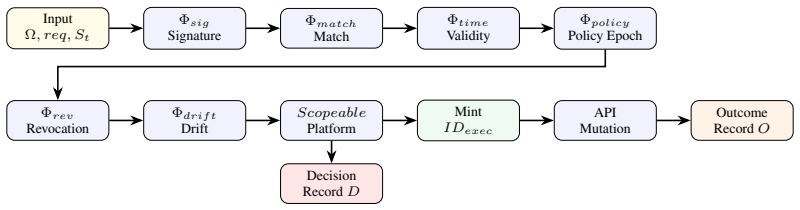
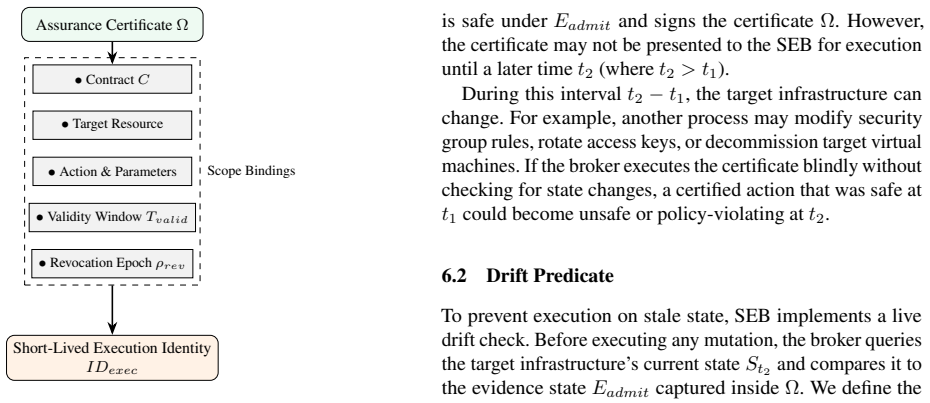
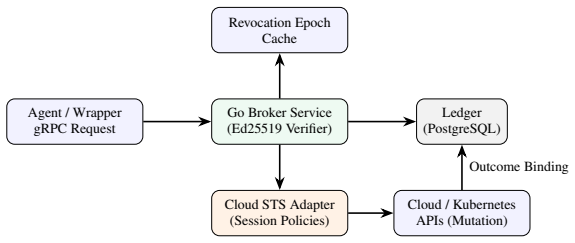
SEB consumes certificates issued by the Sovereign Assurance Boundary (SAB), verifies that the requested mutation matches the certified execution contract, checks validity windows, policy epochs, revocation epochs, and live-state drift, mints scoped execution identity, invokes infrastructure APIs, and records signed decision and outcome records. By separating proposal, admission, and execution, SEB turns certified authority into a short-lived, revocable, auditable runtime capability, provided that production mutation APIs reject non-broker identities.
What carries the argument
The Sovereign Execution Broker (SEB), the runtime enforcement boundary that verifies certificates against execution contracts and mints scoped identities for API invocation.
If this is right
- Separation of proposal, admission, and execution phases allows independent revocation and audit trails for each agent action.
- Scoped identities limit the duration and scope of any granted mutation authority.
- Replay-verification predicates and drift checks enable post-execution detection of policy violations or state changes.
- Bypass-prevention patterns require that all production APIs are locked to the broker identity.
- The model defines explicit failure behavior under revocation, drift, or certificate expiry.
Where Pith is reading between the lines
- The same boundary pattern could apply to any control plane where non-deterministic processes must affect deterministic infrastructure without holding long-lived credentials.
- Adoption would require corresponding changes in how API gateways and cloud providers expose identity restrictions.
- Measuring revocation propagation latency across multi-region clusters would provide a direct test of the auditable capability claim.
- The approach aligns with zero-trust principles by making every mutation require fresh certificate validation at execution time.
Load-bearing premise
Production mutation APIs must be configured to reject every identity except the scoped execution identity minted by SEB.
What would settle it
Demonstration that an infrastructure API accepts and executes a mutation from any identity other than the current SEB-minted scoped identity, or that a revoked certificate still permits successful mutation.
Figures


read the original abstract
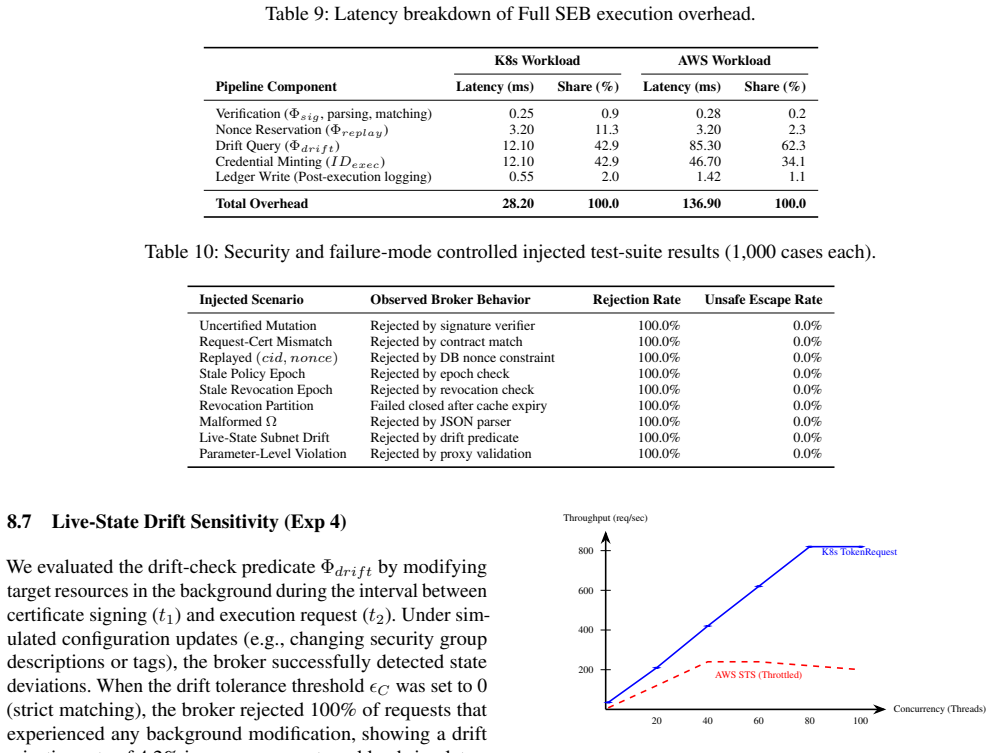
Autonomous agents are increasingly connected to cloud, deployment, and data-control workflows, but production mutation authority should not reside inside non-deterministic reasoning processes. Existing access-control mechanisms authorize identities, while assurance layers certify proposed actions; neither alone provides a mandatory enforcement point for certified authority at the moment of mutation. This paper introduces the Sovereign Execution Broker (SEB), a runtime enforcement boundary for certificate-bound agentic infrastructure. SEB consumes certificates issued by the Sovereign Assurance Boundary (SAB), verifies that the requested mutation matches the certified execution contract, checks validity windows, policy epochs, revocation epochs, and live-state drift, mints scoped execution identity, invokes infrastructure APIs, and records signed decision and outcome records. By separating proposal, admission, and execution, SEB turns certified authority into a short-lived, revocable, auditable runtime capability, provided that production mutation APIs reject non-broker identities. We present the SEB execution model, certificate and replay-verification predicates, scoped identity semantics, bypass-prevention deployment patterns, failure behavior, and a concrete prototype implementation. We evaluate the prototype on AWS and Kubernetes clusters, measuring latency overheads, revocation propagation, drift detection, and security under fault injection.
Editorial analysis
A structured set of objections, weighed in public.
Referee Report
Summary. The paper introduces the Sovereign Execution Broker (SEB) as a runtime enforcement boundary for certificate-bound agentic infrastructure. SEB consumes certificates from the Sovereign Assurance Boundary (SAB), verifies that requested mutations match certified execution contracts, checks validity windows, policy epochs, revocation epochs, and live-state drift, mints scoped execution identities, invokes infrastructure APIs, and records signed decision and outcome records. By separating proposal, admission, and execution, SEB is claimed to convert certified authority into short-lived, revocable, auditable runtime capabilities, provided that production mutation APIs reject non-broker identities. The manuscript presents the execution model, certificate and replay-verification predicates, scoped identity semantics, bypass-prevention deployment patterns, failure behavior, a prototype implementation, and an evaluation on AWS and Kubernetes clusters measuring latency overheads, revocation propagation, drift detection, and security under fault injection.
Significance. If the enforcement model holds under the stated prerequisite, SEB would address a meaningful gap between existing identity-based access control and assurance layers by inserting a mandatory, auditable execution boundary for non-deterministic agent workflows in cloud and deployment settings. The provision of a concrete prototype with empirical measurements on real platforms (AWS, Kubernetes) and fault-injection testing is a positive aspect that grounds the claims in observable behavior rather than purely abstract design.
major comments (2)
- [Abstract] Abstract: The central security claim—that SEB provides short-lived, revocable, auditable runtime capabilities—explicitly rests on the external prerequisite that 'production mutation APIs reject non-broker identities.' The manuscript supplies deployment patterns and bypass-prevention guidance but no intrinsic mechanism, invariant, or verification procedure that would guarantee or detect violations of this rejection property under API updates, configuration drift, or multi-tenant operation. Because SEB itself performs no enforcement on the mutation surfaces, the verification predicates, revocation checks, and replay protection become irrelevant if the prerequisite fails.
- [Evaluation section] Evaluation (prototype on AWS and Kubernetes): The reported security results under fault injection and the measurements of revocation propagation and drift detection are conditioned on the same external configuration assumption. Without additional experiments or analysis showing behavior when non-broker identities can reach the mutation APIs, the evaluation does not establish that the runtime capability guarantee survives realistic deployment deviations.
minor comments (1)
- [Abstract / Introduction] The abstract and introduction use several compound terms (e.g., 'certificate-bound authority,' 'scoped execution identity') without an early glossary or reference to their formal definitions later in the model section; this reduces readability for readers outside the immediate sub-area.
Simulated Author's Rebuttal
We thank the referee for the constructive comments on the dependency of SEB's security claims on the stated deployment prerequisite. We address each major comment below and will incorporate clarifications to make the assumptions and scope more explicit.
read point-by-point responses
-
Referee: [Abstract] Abstract: The central security claim—that SEB provides short-lived, revocable, auditable runtime capabilities—explicitly rests on the external prerequisite that 'production mutation APIs reject non-broker identities.' The manuscript supplies deployment patterns and bypass-prevention guidance but no intrinsic mechanism, invariant, or verification procedure that would guarantee or detect violations of this rejection property under API updates, configuration drift, or multi-tenant operation. Because SEB itself performs no enforcement on the mutation surfaces, the verification predicates, revocation checks, and replay protection become irrelevant if the prerequisite fails.
Authors: We agree that the security model is conditional on production mutation APIs rejecting non-broker identities, as explicitly noted in the abstract and deployment sections. SEB is positioned as an execution-time enforcement boundary that relies on this external configuration, analogous to how many control-plane systems depend on correct API server policies. The manuscript already describes bypass-prevention patterns, but we acknowledge the lack of an intrinsic detection mechanism inside SEB for configuration violations. We will revise the abstract, threat model, and discussion sections to more prominently state the assumption, its implications, and guidance for verifying the prerequisite in multi-tenant settings. revision: partial
-
Referee: [Evaluation section] Evaluation (prototype on AWS and Kubernetes): The reported security results under fault injection and the measurements of revocation propagation and drift detection are conditioned on the same external configuration assumption. Without additional experiments or analysis showing behavior when non-broker identities can reach the mutation APIs, the evaluation does not establish that the runtime capability guarantee survives realistic deployment deviations.
Authors: The evaluation measures SEB behavior (latency, revocation, drift detection, and fault injection) under the prerequisite that mutation APIs accept only broker identities. We concur that the results do not include cases where the prerequisite is violated, as such scenarios lie outside the defined model. We will add explicit analysis in the evaluation discussion noting that the reported metrics assume correct deployment and that violation of the prerequisite would render the broker ineffective. No new experiments simulating direct API access by non-broker identities will be added, as they would require altering the underlying infrastructure APIs. revision: partial
Circularity Check
No circularity; design is a new component with explicitly external prerequisite
full rationale
The paper presents SEB as a novel runtime enforcement boundary that consumes certificates from SAB, performs verification, mints identities, and invokes APIs, with the core guarantee stated as conditional on an external configuration prerequisite (production mutation APIs rejecting non-broker identities). No equations, fitted parameters, predictions, or derivation chain appear in the provided text. No self-citations are invoked to justify uniqueness or load-bearing premises, and the architecture is evaluated via prototype measurements rather than reduced to prior results by construction. The design is therefore self-contained as an engineering proposal.
Axiom & Free-Parameter Ledger
axioms (2)
- domain assumption Cryptographic certificates can be issued, verified, and revoked reliably by the Sovereign Assurance Boundary.
- domain assumption Production mutation APIs can be configured to accept only identities minted by SEB.
invented entities (1)
-
Sovereign Execution Broker (SEB)
no independent evidence
Forward citations
Cited by 1 Pith paper
-
Governing Actions, Not Agents: Institutional Attestation as a Governance Model for Autonomous AI Systems
The paper formalizes a computational governance model where AI agents retain planning autonomy but require cryptographically bound, independently attested preconditions for executing high-risk actions, supported by ta...
Reference graph
Works this paper leans on
-
[1]
Sovereign assurance boundary: Certificate-bound admission for agentic infrastructure
Jun He and Deying Yu. Sovereign assurance boundary: Certificate-bound admission for agentic infrastructure. arXiv preprint arXiv:2606.11632, 2026
Pith/arXiv arXiv 2026
-
[2]
Anderson
James P. Anderson. Computer security technology plan- ning study. Technical report, Electronic Systems Divi- sion, Air Force Systems Command, 1972
1972
-
[3]
Schneider
Fred B. Schneider. Enforceable security policies. ACM Transactions on Information and System Security, 3(1):30–50, 2000
2000
-
[4]
Zero trust architecture
Scott Rose, Oliver Borchert, Stu Mitchell, and Sean Con- nelly. Zero trust architecture. Technical Report Special Publication 800-207, National Institute of Standards and Technology (NIST), 2020
2020
-
[5]
IAM Roles Anywhere
Amazon Web Services. IAM Roles Anywhere. AWS documentation, 2026. Accessed 2026-06-05
2026
-
[6]
SPIFFE standards
SPIFFE Project. SPIFFE standards. SPIFFE documen- tation, 2026. Accessed 2026-06-05
2026
-
[7]
SPIRE: The SPIFFE runtime environ- ment
SPIRE Project. SPIRE: The SPIFFE runtime environ- ment. SPIRE documentation, 2026. Accessed 2026-06- 05
2026
-
[8]
AWS Identity and Access Man- agement (IAM) user guide
Amazon Web Services. AWS Identity and Access Man- agement (IAM) user guide. AWS documentation, 2026. Accessed 2026-06-05
2026
-
[9]
Session policies for AWS STS
Amazon Web Services. Session policies for AWS STS. AWS documentation, 2026. Accessed 2026-06-05
2026
-
[10]
Policy language
Open Policy Agent. Policy language. Open Policy Agent documentation, 2026. Accessed 2026-06-05
2026
-
[11]
Gatekeeper: Policy controller for Kubernetes
Open Policy Agent Gatekeeper Project. Gatekeeper: Policy controller for Kubernetes. Gatekeeper documen- tation, 2026. Accessed 2026-06-05
2026
-
[12]
Kyverno documentation
Kyverno Project. Kyverno documentation. Kyverno documentation, 2026. Accessed 2026-06-05
2026
-
[13]
Cedar policy language
Cedar Policy Language Project. Cedar policy language. Cedar documentation, 2026. Accessed 2026-06-05
2026
-
[14]
Using simplicity to control complexity.IEEE Software, 18(4):20–28, 2001
Lui Sha. Using simplicity to control complexity.IEEE Software, 18(4):20–28, 2001
2001
-
[15]
Shield synthesis: Runtime enforcement for reactive systems
Roderick Bloem, Bettina Könighofer, Robert Könighofer, and Chao Wang. Shield synthesis: Runtime enforcement for reactive systems. InPro- ceedings of the International Conference on Tools and Algorithms for the Construction and Analysis of Systems (TACAS), pages 533–548, 2015
2015
-
[16]
Safe reinforcement learning via shielding
Mohammed Alshiekh, Roderick Bloem, Rüdiger Ehlers, Bettina Könighofer, Scott Niekum, and Ufuk Topcu. Safe reinforcement learning via shielding. InProceed- ings of the AAAI Conference on Artificial Intelligence, pages 2669–2678, 2018
2018
-
[17]
in-toto: Providing farm-to-table guarantees for bits and bytes
Santiago Torres-Arias, Hammad Afzali, Tris- hank Karthik Kuppusamy, Reza Curtmola, and Justin Cappos. in-toto: Providing farm-to-table guarantees for bits and bytes. InProceedings of the USENIX Security Symposium, 2019
2019
-
[18]
SLSA: Supply-chain levels for software artifacts
SLSA Project. SLSA: Supply-chain levels for software artifacts. SLSA documentation, 2026. Accessed 2026- 06-05
2026
-
[19]
The part-time parliament.ACM Trans- actions on Computer Systems (TOCS), 16(2):133–169, 1998
Leslie Lamport. The part-time parliament.ACM Trans- actions on Computer Systems (TOCS), 16(2):133–169, 1998
1998
-
[20]
In search of an understandable consensus algorithm
Diego Ongaro and John Ousterhout. In search of an understandable consensus algorithm. InProceedings of the USENIX Annual Technical Conference (ATC), pages 305–320, 2014. 19
2014
discussion (0)
Sign in with ORCID, Apple, or X to comment. Anyone can read and Pith papers without signing in.